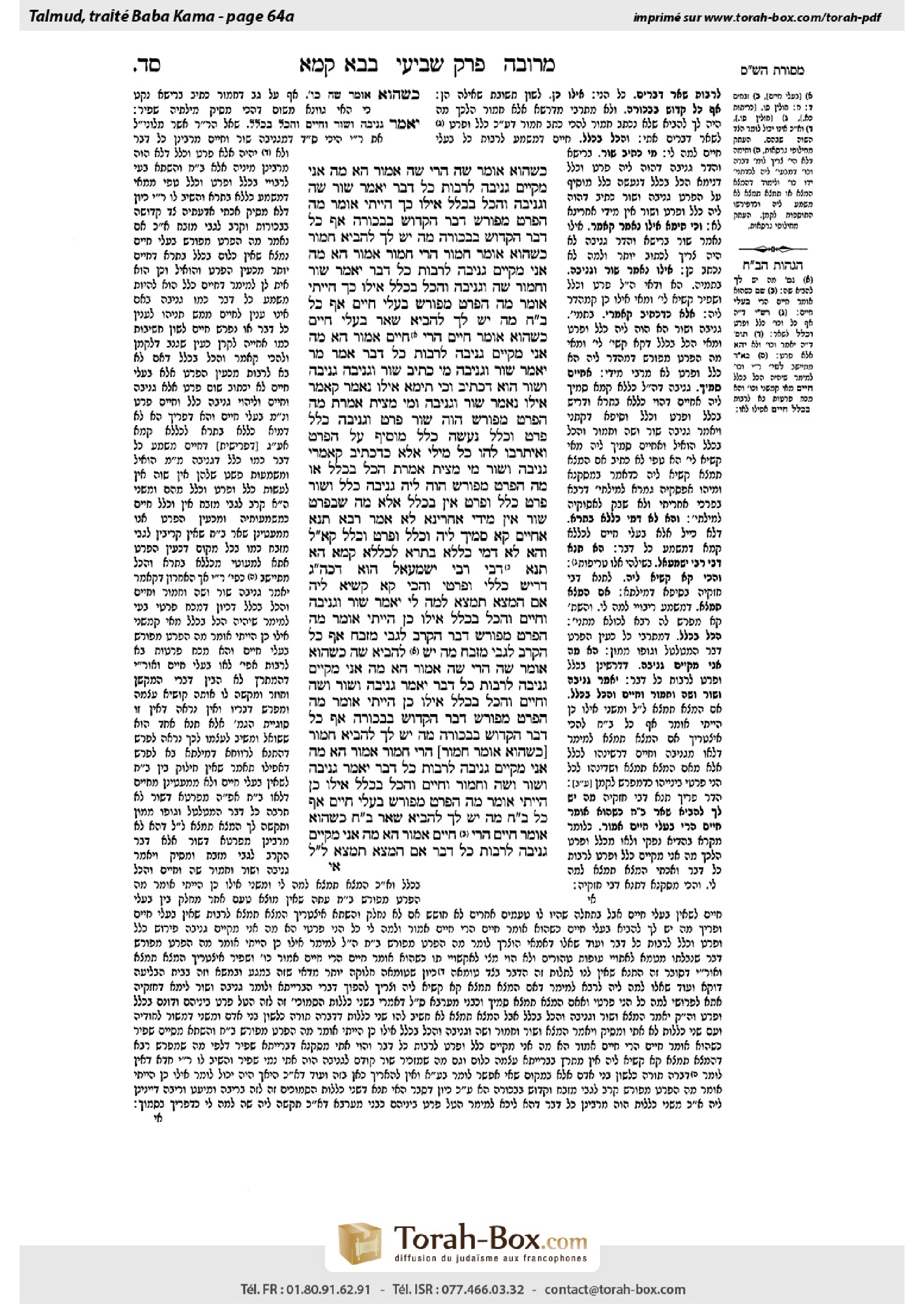
Bava Kamma 64a: Talmud study for Daf Yomi
Study the Talmud for Daf Yomi with scanned pages, Hebrew text, English translations from Sefaria and AI-generated French translations.
Passage selection and English or AI-generated French translation are available where the scan has annotations. Daf Study is independent of Torah-Box and Sefaria.
Browse Bava Kamma · בבא קמא · All tractatesBava Kamma 64a text and translations
This page of Bava Kamma includes the Aramaic text, an English translation and an AI-generated French translation, alongside the scan above.
בבא קמא ס״ד א · Aramaic and Hebrew text
כְּשֶׁהוּא אוֹמֵר ״שֶׂה״ – הֲרֵי שֶׂה אָמוּר, הָא מָה אֲנִי מְקַיֵּים ״גְּנֵיבָה״? לְרַבּוֹת כָּל דָּבָר.
יֵאָמֵר ״שׁוֹר״, ״שֶׂה״ וּ״גְנֵיבָה״, וְהַכֹּל בַּכְּלָל! אִילּוּ כָּךְ, הָיִיתִי אוֹמֵר: מָה הַפְּרָט מְפוֹרָשׁ – דָּבָר הַקָּדוֹשׁ בִּבְכוֹרָה, אַף כֹּל דָּבָר הַקָּדוֹשׁ בִּבְכוֹרָה.
מָה יֵשׁ לְךָ לְהָבִיא – חֲמוֹר, כְּשֶׁהוּא אוֹמֵר ״חֲמוֹר״ – הֲרֵי חֲמוֹר אָמוּר, הָא מָה אֲנִי מְקַיֵּים ״גְּנֵיבָה״? לְרַבּוֹת כׇּל דָּבָר.
יֵאָמֵר ״שׁוֹר״ וַ״חֲמוֹר״ ״שֶׂה״ וּ״גְנֵיבָה״ – וְהַכֹּל בַּכְּלָל! אִילּוּ כָּךְ, הָיִיתִי אוֹמֵר: מָה הַפְּרָט מְפוֹרָשׁ – בַּעֲלֵי חַיִּים, אַף כֹּל בַּעֲלֵי חַיִּים.
מָה יֵשׁ לְךָ לְהָבִיא – שְׁאָר בַּעֲלֵי חַיִּים, כְּשֶׁהוּא אוֹמֵר ״חַיִּים״ – הֲרֵי חַיִּים אָמוּר, הָא מָה אֲנִי מְקַיֵּים ״גְּנֵיבָה״? לְרַבּוֹת כׇּל דָּבָר.
אָמַר מָר: יֵאָמֵר ״שׁוֹר״ וּ״גְנֵיבָה״. מִי כְּתִיב ״שׁוֹר״ וּ״גְנֵיבָה״? ״גְּנֵיבָה״ וָ״שׁוֹר״ הוּא דִּכְתִיב!
וְכִי תֵּימָא ״אִילּוּ נֶאֱמַר״ קָאָמַר – אִילּוּ נֶאֱמַר ״שׁוֹר״ וּ״גְנֵיבָה״; וּמִי מָצֵית אָמְרַתְּ ״מָה הַפְּרָט מְפוֹרָשׁ״?! הָוֵה ״שׁוֹר״ פְּרָט וּ״גְנֵיבָה״ כְּלָל; פְּרָט וּכְלָל – נַעֲשָׂה כְּלָל מוֹסִיף עַל הַפְּרָט, וְאִיתְרַבּוּ לְהוּ כֹּל מִילֵּי!
אֶלָּא כְּדִכְתִיב קָאָמְרִי – ״גְּנֵיבָה״ וְ״שׁוֹר״. מִי מָצֵית אָמְרַתְּ ״הַכֹּל בַּכְּלָל״, אוֹ ״מָה הַפְּרָט מְפוֹרָשׁ״? הָוֵה לֵיהּ ״גְּנֵיבָה״ כְּלָל וְ״שׁוֹר״ פְּרָט; כְּלָל וּפְרָט – אֵין בַּכְּלָל אֶלָּא מַה שֶּׁבַּפְּרָט; שׁוֹר אִין, מִידֵּי אַחֲרִינָא לָא!
אָמַר רָבָא: תַּנָּא אַ״חַיִּים״ קָא סָמֵיךְ לֵיהּ, וּכְלָל וּפְרָט וּכְלָל קָאָמַר לֵיהּ.
וְהָא לָא דָּמֵי כְּלָלָא בָּתְרָא לִכְלָלָא קַמָּא! הָא תַּנָּא – דְּבֵי רַבִּי יִשְׁמָעֵאל הוּא, דִּכְהַאי גַּוְונָא דָּרֵישׁ כְּלָלֵי וּפְרָטֵי.
וְהָכִי קָא קַשְׁיָא לֵיהּ: ״אִם הִמָּצֵא תִמָּצֵא״ לְמָה לִי? יֵאָמֵר ״שׁוֹר״ וּ״גְנֵיבָה״ וְ״חַיִּים״ – וְהַכֹּל בַּכְּלָל!
אִילּוּ כֵּן, הָיִיתִי אוֹמֵר: מָה הַפְּרָט מְפוֹרָשׁ – דָּבָר הַקָּרֵב לְגַבֵּי מִזְבֵּחַ, אַף כֹּל הַקָּרֵב לְגַבֵּי מִזְבֵּחַ. מָה יֵשׁ לְהָבִיא – ״שֶׂה״, כְּשֶׁהוּא אוֹמֵר ״שֶׂה״ – הֲרֵי שֶׂה אָמוּר, הָא מָה אֲנִי מְקַיֵּים ״גְּנֵיבָה״? לְרַבּוֹת כׇּל דָּבָר.
יֵאָמֵר ״גְּנֵיבָה״ וְ״שׁוֹר״ וָ״שֶׂה״ וְחַיִּים״ – וְהַכֹּל בַּכְּלָל! אִילּוּ כֵּן, הָיִיתִי אוֹמֵר: מָה הַפְּרָט מְפוֹרָשׁ – דָּבָר הַקָּדוֹשׁ בִּבְכוֹרָה, אַף כֹּל דָּבָר הַקָּדוֹשׁ בִּבְכוֹרָה.
מָה יֵשׁ לְךָ לְהָבִיא – חֲמוֹר, [כְּשֶׁהוּא אוֹמֵר ״חֲמוֹר״] הֲרֵי חֲמוֹר אָמוּר, הָא מָה אֲנִי מְקַיֵּים ״גְּנֵיבָה״? לְרַבּוֹת כׇּל דָּבָר.
יֵאָמֵר ״גְּנֵיבָה״, וְ״שׁוֹר״, וָ״שֶׂה״, וַ״חֲמוֹר״, וְ״חַיִּים״ – וְהַכֹּל בַּכְּלָל! אִילּוּ כֵּן, הָיִיתִי אוֹמֵר: מָה הַפְּרָט מְפוֹרָשׁ – בַּעֲלֵי חַיִּים, אַף כֹּל בַּעֲלֵי חַיִּים.
מָה יֵשׁ לְךָ לְהָבִיא – שְׁאָר בַּעֲלֵי חַיִּים; כְּשֶׁהוּא אוֹמֵר ״חַיִּים״ – הֲרֵי חַיִּים אָמוּר, הָא מָה אֲנִי מְקַיֵּים ״גְּנֵיבָה״? לְרַבּוֹת כׇּל דָּבָר; ״אִם הִמָּצֵא תִמָּצֵא״ לְמָה לִי?
Bava Kamma 64a · English translation
When the verse states “sheep,” a sheep is thereby stated explicitly. Therefore, the detail of “ox” cannot be written to include specifically items that can be sacrificed on the altar, e.g., a sheep. How then do I realize the meaning of the word “theft,” i.e., what is the category of items derived from the detail and generalization? It must be that it serves to include all types of items in the requirement of double payment.
The baraita continues to analyze the verse: Let the verse state only “ox,” “sheep,” and “theft,” and in that manner everything would be included. Why is it necessary to write “donkey”? Had the verse been written in this manner, without “donkey,” I would have said: Just as the items mentioned in the detail, “ox” and “sheep,” are clearly defined as items that are subject to being sacred with the sanctity of the firstborn, so too any item that is subject to being sacred with the sanctity of the firstborn is subject to double payment, but not other items.
What is there for you to include in this category? A donkey. When the verse says “donkey,” a donkey is thereby stated explicitly. Therefore, the details of “ox” and “sheep” cannot be written to include specifically items that are subject to being sacred with the sanctity of the firstborn, e.g., a donkey. How then do I realize the meaning of the word “theft,” i.e., what is the category of items derived from the detail and generalization? It must be that it serves to include all types of items in the requirement of double payment.
The baraita continues to analyze the verse: Let the verse state only “ox,” and “donkey,” and “sheep,” and “theft,” and in that manner all items would be included. Why is it necessary to write the word “alive”? Had the verse been written in this manner, I would say: Just as the items mentioned in the detail, “ox,” “sheep,” and “donkey,” are clearly defined as items that are animals, so too all animals are subject to double payment, but not inanimate objects.
What is there for you to include in this category that is not already listed? Animals other than oxen, sheep, and donkeys. When the verse states the term “alive,” animals are thereby stated explicitly. Therefore, the details of “ox,” “sheep,” and “donkey” cannot be written to include animals. How then do I realize the meaning of “theft,” i.e., what is the category of items derived from the detail and generalization? It must be that it serves to include all types of items in the requirement of double payment. This is the end of the baraita.
There are several puzzling elements of the halakhic exposition of the verse in this baraita. The Gemara now seeks to explain it in detail. The Master said in the baraita above: Let the verse state only “ox” and “theft.” The Gemara objects: Are “ox” and “theft” written in the verse in this order, as a generalization and a detail? No, it is “theft” and then “ox” that is written. Consequently, the verse contains a generalization and a detail, in which case the generalization is understood to refer only to that which is specified in the detail.
And if you would say that the baraita is saying that this would be the case had the verse stated the words in this manner, i.e.: Had the verse stated “ox” and then “theft,” all items would have been included; how can you then proceed to say: Just as the item mentioned in the detail, “ox,” is clearly defined as an item that can be sacrificed on the altar, so too everything that can be sacrificed on the altar is subject to double payment? “Ox” is a detail and “theft” is a generalization, and according to the rules of hermeneutics, in such a case the generalization adds to the detail, and all items are included, not just items that resemble the detailed item.
Rather, the baraita must be saying that the verse should be analyzed as it is actually written: First “theft” and then “ox.” Accordingly, how can you then proceed to say that all items would be included, or: Just as the item mentioned in the detail is clearly defined as an item that can be sacrificed on the altar, as the baraita states? This analysis is applicable only when there is a generalization, and a detail, and a generalization. In this verse “theft” is a generalization and “ox” is a detail. The rules of hermeneutics state that when there is only a generalization and a detail, there is nothing included in the generalization other than what is listed in the detail. In this case, one would necessarily conclude that if one steals an ox, yes, he is liable to pay the double payment for stealing it, but if one steals anything else, no, there is no double payment.
Rava stated an explanation of the baraita: When the tanna suggested: Let the verse say “ox” and “theft,” and similar suggestions, he was relying on the word “alive” at the end of the phrase. He considered this word an additional generalization after the detailed items, and therefore he was saying that the phrase is to be treated as a generalization, and a detail, and a generalization. Consequently, it should have been sufficient for the verse to state merely “theft,” followed by “ox,” followed by “alive.” Why does the Torah specify further items?
The Gemara questions this explanation: But the latter generalization is not similar to the first generalization. The first generalization, “theft,” is so general that it includes all items, whereas the latter generalization, “alive,” includes only animals. Consequently, the rule of a generalization, and a detail, and a generalization should not apply. The Gemara responds: This tanna, the author of this baraita, is of the school of Rabbi Yishmael, who expounds generalizations and details in a case like this. Even if the first generalization and the latter generalization are dissimilar, he interprets the verse as a generalization, and a detail, and a generalization.
Rava continues his explanation of the baraita: And this is what the tanna found difficult at the end of the baraita: Why do I need the beginning of the verse to state: “If the theft shall be found [himmatze timmatze],” with the verb repeated? Rava now explains the entire baraita, from the beginning: Let the verse say “ox” and “theft” and “alive,” and all items would be included, in accordance with the rules of a generalization, and a detail, and a generalization. Why did the verse include other details?
The baraita answers this by saying: Had the verse been written in this manner, I would have said: Just as the item mentioned in the detail, “ox,” is clearly defined as an item that is sacrificed on the altar, so too everything that is sacrificed on the altar is subject to double payment, but not other items. What else is there for you to include in this category? A sheep. When the verse states “sheep,” a sheep is thereby stated explicitly. Therefore, the detail of “ox” cannot be written to include specifically items that can be sacrificed on the altar, e.g., a sheep. How then do I realize the meaning of the word “theft,” i.e., what is the category of items derived from the detail and generalization? It must be that it serves to include all types of items in the requirement of double payment.
The baraita continues: Let the verse say only “theft,” and “ox” and “sheep” and “alive,” and all items would be included. Why is it necessary to write “donkey”? The baraita answers: Had the verse been written in this manner, without “donkey,” I would have said: Just as the items mentioned in the detail, “ox” and “sheep,” are clearly defined as items that are subject to being sacred with the sanctity of the firstborn, so too any item that is subject to being sacred with the sanctity of the firstborn is subject to double payment, but not other items.
What is there for you to include in this category? A donkey. When the verse says “donkey,” a donkey is thereby stated explicitly. Therefore, the details of “ox” and “sheep” cannot be written to include specifically items that are subject to being sacred with the sanctity of the firstborn, e.g., a donkey. How then do I realize the meaning of the word “theft,” i.e., what is the category of items derived from the detail and generalization? It must be that it serves to include all types of items in the requirement of double payment.
The baraita then asks: Let the verse say only “theft,” and “ox,” and “sheep,” and “donkey” and “alive,” and in that manner all items would be included. The baraita answers: Had the verse been written in this manner, I would say: Just as the items mentioned in the detail, “ox,” “sheep,” and “donkey,” are clearly defined as items that are animals, so too all animals are subject to double payment, but not inanimate objects.
What is there for you to include in this category that is not already listed? Animals other than oxen, sheep, and donkeys. When the verse states “alive,” animals are thereby stated explicitly. Therefore, the details of “ox,” “sheep,” and “donkey” cannot be written to include animals. How then do I realize the meaning of “theft,” i.e., what is the category of items derived from the detail and generalization? It must be that it serves to include all types of items in the requirement of double payment. If so, why do I need the phrase “if the theft shall be found [himmatze timmatze]”? This is the conclusion of the baraita as explained by Rava.
Bava Kamma 64a · Traduction française (IA)
Lorsque la versette mentionne « brebis », une brebis est ainsi explicitement mentionnée. Par conséquent, le détail de « bœuf » ne peut pas être utilisé pour inclure spécifiquement des objets pouvant être sacrifiés sur l'autel, par exemple une brebis. Comment alors saisir le sens du mot « vol », c'est-à-dire quelle est la catégorie d'objets dérivée du détail et de la généralisation ? Il doit être que cela sert à inclure tous les types d'objets dans la condition de paiement double.
La baraïta continue d'analyser la versette : que la versette mentionne uniquement « bœuf », « brebis » et « vol », et ainsi tout serait inclus. Pourquoi est-il nécessaire d'écrire « âne » ? Si la versette avait été écrite ainsi, sans « âne », je dirais : Tout comme les objets mentionnés dans le détail, « bœuf » et « brebis », sont clairement définis comme des objets soumis à la sanctité du premier-né, de même tout objet soumis à la sanctité du premier-né est soumis au paiement double, mais pas d'autres objets.
Qu'y a-t-il pour vous à inclure dans cette catégorie ? Un âne. Lorsque la versette dit « âne », un âne est ainsi explicitement mentionné. Par conséquent, les détails de « bœuf » et « brebis » ne peuvent pas être utilisés pour inclure spécifiquement des objets soumis à la sanctité du premier-né, par exemple un âne. Comment alors saisir le sens du mot « vol », c'est-à-dire quelle est la catégorie d'objets dérivée du détail et de la généralisation ? Il doit être que cela sert à inclure tous les types d'objets dans la condition de paiement double.
La baraïta continue d'analyser la versette : que la versette mentionne uniquement « bœuf », « âne », « brebis » et « vol », et ainsi tous les objets seraient inclus. Pourquoi est-il nécessaire d'écrire le mot « vivant » ? Si la versette avait été écrite ainsi, je dirais : Tout comme les objets mentionnés dans le détail, « bœuf », « brebis » et « âne », sont clairement définis comme des animaux, de même tous les animaux sont soumis au paiement double, mais pas les objets inanimés.
Qu'y a-t-il pour vous à inclure dans cette catégorie qui n'est pas déjà mentionné ? Des animaux autres que les bœufs, les brebis et les ânes. Lorsque la versette mentionne le terme « vivant », les animaux sont ainsi explicitement mentionnés. Par conséquent, les détails de « bœuf », « brebis » et « âne » ne peuvent pas être écrits pour inclure les animaux. Comment alors saisir le sens de « vol », c'est-à-dire quelle est la catégorie d'objets dérivée du détail et de la généralisation ? Il doit être que cela sert à inclure tous les types d'objets dans la condition de paiement double. C'est la fin de la baraïta.
Il y a plusieurs éléments troublants dans l'exposition halachique de la versette dans cette baraïta. La Guemara cherche maintenant à l'expliquer en détail. Le Maître a dit dans la baraïta ci-dessus : que la versette mentionne uniquement « bœuf » et « vol ». La Guemara s'oppose à cela : Les mots « bœuf » et « vol » sont-ils écrits dans la versette dans cet ordre, comme une généralisation et un détail ? Non, c'est « vol » puis « bœuf » qui est écrit. Par conséquent, la versette contient une généralisation et un détail, dans ce cas la généralisation est interprétée comme se référant uniquement à ce qui est spécifié dans le détail.
Et si vous dites que la baraïta dit que cela serait le cas si la versette avait mentionné les mots dans cet ordre, c'est-à-dire : si la versette avait dit « bœuf » puis « vol », tous les objets seraient inclus ; comment pouvez-vous alors dire : Tout comme l'objet mentionné dans le détail, « bœuf », est clairement défini comme un objet pouvant être sacrifié sur l'autel, de même tout objet pouvant être sacrifié sur l'autel est soumis au paiement double ? « Bœuf » est un détail et « vol » est une généralisation, et selon les règles d'herméneutique, dans ce cas la généralisation ajoute au détail, et tous les objets sont inclus, pas seulement ceux ressemblant à l'objet détaillé.
Plutôt, la baraïta doit être interprétée comme suit : la versette est analysée telle qu'elle est réellement écrite : d'abord « vol » puis « bœuf ». Ainsi, comment pouvez-vous alors dire que tous les objets seraient inclus, ou : Tout comme l'objet mentionné dans le détail est clairement défini comme un objet pouvant être sacrifié sur l'autel, comme le dit la baraïta ? Cette analyse s'applique uniquement lorsqu'il y a une généralisation, un détail et une généralisation. Dans cette versette « vol » est une généralisation et « bœuf » est un détail. Les règles d'herméneutique stipulent que lorsqu'il n'y a qu'une généralisation et un détail, il n'y a rien inclus dans la généralisation autre que ce qui est listé dans le détail. Dans ce cas, on conclurait nécessairement que si l'on vole un bœuf, oui, il est tenu responsable du paiement double pour avoir volé, mais si l'on vole quelque chose d'autre, non, il n'y a pas de paiement double.
Rava a donné une explication de la baraïta : Lorsque le tanna a suggéré que la versette dise « bœuf » et « vol », et des suggestions similaires, il s'appuyait sur le mot « vivant » à la fin de la phrase. Il considérait ce mot comme une généralisation supplémentaire après les objets détaillés, et par conséquent il disait que la phrase doit être traitée comme une généralisation, un détail et une généralisation. Ainsi, il aurait suffi à la versette de mentionner uniquement « vol », suivi de « bœuf », suivi de « vivant ». Pourquoi la Torah précise-t-elle davantage d'objets ?
La Guemara question cette explication : Mais cette dernière généralisation n'est pas semblable à la première généralisation. La première généralisation, « vol », est si générale qu'elle inclut tous les objets, tandis que la dernière généralisation, « vivant », inclut uniquement les animaux. Par conséquent, la règle d'une généralisation, un détail et une généralisation ne devrait pas s'appliquer. La Guemara répond : Ce tanna, l'auteur de cette baraïta, est de la maison de Rabbi Yishmael, qui explique les généralisations et les détails dans un cas comme celui-ci. Même si les deux généralisations sont différentes, il interprète la versette comme une généralisation, un détail et une généralisation.
Rava continue son explication de la baraïta : Et c'est ce que le tanna trouvait difficile à la fin de la baraïta : pourquoi avoir besoin du début de la versette pour dire : « Si le vol sera trouvé [himmatze timmatze] », avec le verbe répété ? Rava explique maintenant toute la baraïta, du début : que la versette dise « bœuf » et « vol » et « vivant », et tous les objets seraient inclus, conformément aux règles d'une généralisation, d'un détail et d'une généralisation. Pourquoi la versette a-t-elle inclus d'autres détails ?
La baraïta répond à cela en disant : si la versette avait été écrite ainsi, j'aurais dit : tout comme l'objet mentionné dans le détail, « bœuf », est clairement défini comme un objet sacrifié sur l'autel, ainsi tout objet sacrifié sur l'autel est soumis à la double réparation, mais pas d'autres objets. Quel autre objet dois-je inclure dans cette catégorie ? Un mouton. Lorsque la versette dit « mouton », un mouton est ainsi explicitement mentionné. Par conséquent, le détail de « bœuf » ne peut pas être écrit pour inclure spécifiquement des objets sacrifiés sur l'autel, par exemple un mouton. Comment alors sais-je le sens du mot « vol », c'est-à-dire quelle est la catégorie d'objets dérivée du détail et de la généralisation ? Il doit être que cela sert à inclure tous les types d'objets dans la réparation double.
La baraïta continue : que la versette dise seulement « vol », et « bœuf » et « mouton » et « vivant », et tous les objets seraient inclus. Pourquoi est-il nécessaire d'écrire « âne » ? La baraïta répond : si la versette avait été écrite ainsi, sans « âne », j'aurais dit : tout comme les objets mentionnés dans le détail, « bœuf » et « mouton », sont clairement définis comme des objets soumis à la sanctité du premier-né, ainsi tout objet soumis à la sanctité du premier-né est soumis à la double réparation, mais pas d'autres objets.
Quel objet dois-je inclure dans cette catégorie ? Un âne. Lorsque la versette dit « âne », un âne est ainsi explicitement mentionné. Par conséquent, les détails de « bœuf » et « mouton » ne peuvent pas être écrits pour inclure spécifiquement des objets soumis à la sanctité du premier-né, par exemple un âne. Comment alors sais-je le sens du mot « vol », c'est-à-dire quelle est la catégorie d'objets dérivée du détail et de la généralisation ? Il doit être que cela sert à inclure tous les types d'objets dans la réparation double.
La baraïta demande alors : que la versette dise seulement « vol », et « bœuf », et « mouton », et « âne » et « vivant », et ainsi tous les objets seraient inclus. La baraïta répond : si la versette avait été écrite ainsi, j'aurais dit : tout comme les objets mentionnés dans le détail, « bœuf », « mouton » et « âne », sont clairement définis comme des animaux, ainsi tous les animaux sont soumis à la double réparation, mais pas les objets inanimés.
Quel objet dois-je inclure dans cette catégorie qui n'est pas déjà listé ? Des animaux autres que les bœufs, les moutons et les ânes. Lorsque la versette dit « vivant », les animaux sont ainsi explicitement mentionnés. Par conséquent, les détails de « bœuf », « mouton » et « âne » ne peuvent pas être écrits pour inclure les animaux. Comment alors sais-je le sens de « vol », c'est-à-dire quelle est la catégorie d'objets dérivée du détail et de la généralisation ? Il doit être que cela sert à inclure tous les types d'objets dans la réparation double. Si c'est ainsi, pourquoi ai-je besoin de la phrase « si le vol sera trouvé [himmatze timmatze] » ? C'est la conclusion de la baraïta, comme expliqué par Rava.
Traduction française générée par IA à partir de l’édition anglaise de Sefaria. Vérifie toujours un passage avec le texte source.
Text from Sefaria: William Davidson Edition - Vocalized Aramaic (CC BY NC); William Davidson Edition - English (CC BY NC).