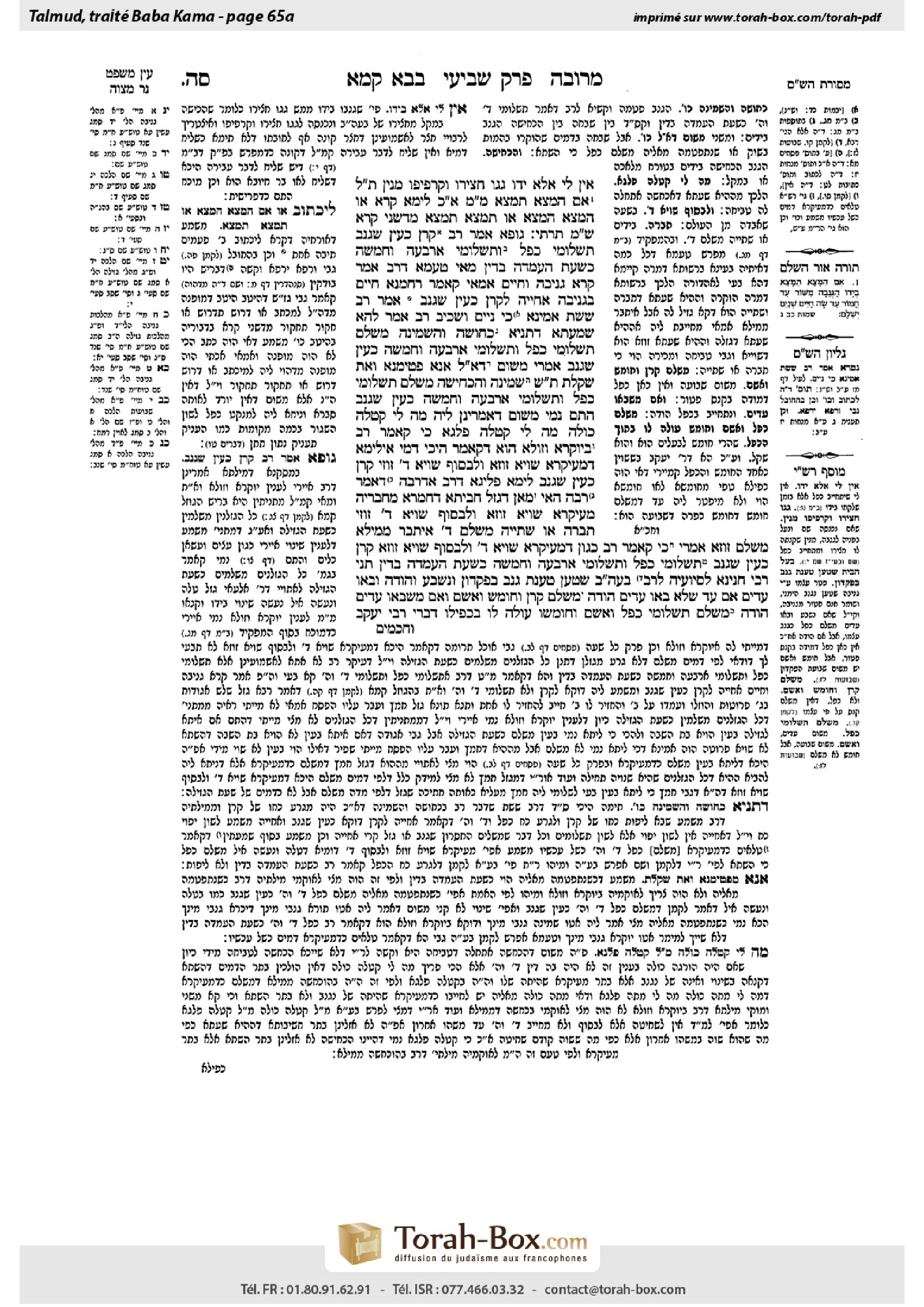
Bava Kamma 65a: Talmud study for Daf Yomi
Study the Talmud for Daf Yomi with scanned pages, Hebrew text, English translations from Sefaria and AI-generated French translations.
Passage selection and English or AI-generated French translation are available where the scan has annotations. Daf Study is independent of Torah-Box and Sefaria.
Browse Bava Kamma · בבא קמא · All tractatesBava Kamma 65a text and translations
This page of Bava Kamma includes the Aramaic text, an English translation and an AI-generated French translation, alongside the scan above.
בבא קמא ס״ה א · Aramaic and Hebrew text
אֵין לִי אֶלָּא יָדוֹ, גַּגּוֹ חֲצֵירוֹ וְקַרְפֵּיפוֹ מִנַּיִן? תַּלְמוּד לוֹמַר: ״אִם הִמָּצֵא תִמָּצֵא״ מִכׇּל מָקוֹם!
אִם כֵּן, לֵימָא קְרָא אוֹ ״הִמָּצֵא הִמָּצֵא״ אוֹ ״תִּמָּצֵא תִמָּצֵא״; מִדְּשַׁנִּי קְרָא, שְׁמַע מִינַּהּ תַּרְתֵּי.
גּוּפָא – אָמַר רַב: קֶרֶן – כְּעֵין שֶׁגָּנַב. תַּשְׁלוּמֵי כֶפֶל וְתַשְׁלוּמֵי אַרְבָּעָה וַחֲמִשָּׁה – כִּשְׁעַת הַעֲמָדָה בַּדִּין.
מַאי טַעְמָא דְּרַב? אָמַר קְרָא: ״גְּנֵיבָה״ וְ״חַיִּים״. אַמַּאי קָאָמַר רַחֲמָנָא ״חַיִּים״ בִּגְנֵיבָה? אַחֲיַיהּ לְקֶרֶן כְּעֵין שֶׁגָּנַב.
אָמַר רַב שֵׁשֶׁת: אָמֵינָא, כִּי נָיֵים וְשָׁכֵיב רַב אָמַר לְהָא שְׁמַעְתָּא. דְּתַנְיָא: כְּחוּשָׁה וְהִשְׁמִינָהּ – מְשַׁלֵּם תַּשְׁלוּמֵי כֶפֶל וְתַשְׁלוּמֵי אַרְבָּעָה וַחֲמִשָּׁה כְּעֵין שֶׁגָּנַב.
אָמְרִי, מִשּׁוּם דַּאֲמַר לֵיהּ: ״אֲנָא פַּטֵּימְנָא וְאַתְּ שָׁקְלַתְּ?!״
תָּא שְׁמַע: שְׁמֵינָה וְהִכְחִישָׁהּ – מְשַׁלֵּם תַּשְׁלוּמֵי כֶפֶל וְתַשְׁלוּמֵי אַרְבָּעָה וַחֲמִשָּׁה כְּעֵין שֶׁגָּנַב!
הָתָם נָמֵי – מִשּׁוּם דְּאָמְרִינַן לֵיהּ: מָה לִי קַטְלַהּ כּוּלַּהּ, מָה לִי קַטְלַהּ פַּלְגָא. כִּי קָאָמַר רַב – בְּיוּקְרָא וְזוּלָא הוּא דְּקָאָמַר.
הֵיכִי דָמֵי? אִילֵּימָא דְּמֵעִיקָּרָא שָׁוְיָא זוּזָא, וּלְבַסּוֹף שָׁוְיָא אַרְבְּעָה זוּזֵי – קֶרֶן כְּעֵין שֶׁגָּנַב; לֵימָא פְּלִיגָא דְּרַב אַדְּרַבָּה? דְּאָמַר רַבָּה: הַאי מַאן דִּגְזַל חָבִיתָא דְחַמְרָא מֵחַבְרֵיהּ, מֵעִיקָּרָא שָׁוְיָא זוּזָא וּלְבַסּוֹף שָׁוְיָא אַרְבְּעָה זוּזֵי, תַּבְרַהּ אוֹ שַׁתְיַיהּ – מְשַׁלֵּם אַרְבְּעָ[ה]. אִיתְּבַר מִמֵּילָא – מְשַׁלֵּם זוּזָא.
אָמְרִי: כִּי קָאָמַר רַב – כְּגוֹן דְּמֵעִיקָּרָא שָׁוְיָא אַרְבְּעָ[ה] וּלְבַסּוֹף שָׁוְיָא זוּזָא; קֶרֶן – כְּעֵין שֶׁגָּנַב, תַּשְׁלוּמֵי כֶפֶל וְתַשְׁלוּמֵי אַרְבָּעָה וַחֲמִשָּׁה – כִּשְׁעַת הַעֲמָדָה בַּדִּין.
תָּנֵי רַבִּי חֲנִינָא לְסַיּוֹעֵיהּ לְרַב: בַּעַל הַבַּיִת שֶׁטָּעַן טַעֲנַת גַּנָּב בְּפִקָּדוֹן, וְנִשְׁבַּע, וְהוֹדָה, וּבָאוּ עֵדִים – אִם עַד שֶׁלֹּא בָּאוּ עֵדִים הוֹדָה, מְשַׁלֵּם קֶרֶן וָחוֹמֶשׁ וְאָשָׁם; וְאִם מִשֶּׁבָּאוּ עֵדִים הוֹדָה – מְשַׁלֵּם תַּשְׁלוּמֵי כֶפֶל וְאָשָׁם, וְחוּמְשׁוֹ עוֹלֶה לוֹ בִּכְפֵילוֹ; דִּבְרֵי רַבִּי יַעֲקֹב.
Bava Kamma 65a · English translation
I have derived only a case where the stolen item is found in his hand [yado]. From where do I derive that the same halakha applies if it is found on his roof, in his yard, or in his enclosure [vekarpeifo]? The verse states the repetitive phrase “if the theft shall be found [himmatze timmatze],” to indicate that the same halakha applies in any case, i.e., in any location that the stolen item is found.
The Gemara answers: If so, if this is all the phrase is coming to teach, let the verse state the identical word twice: Himmatze himmatze, or: Timmatze timmatze. From the fact that the verse varied its wording, one may conclude two halakhot from it: That one is liable to pay double payment regardless of where the stolen item was found, and that a thief pays double payment even if he did not take an oath.
§ The Gemara returns to the matter itself. Rav says: When a thief makes his payments, the principal is paid according to the value as of the time when he stole it, whereas the double payment and the fourfold or fivefold payment are calculated according to the value at the time of standing trial.
The Gemara asks: What is the reason, i.e., the source, for this ruling of Rav? The Gemara answers: The verse states: “If the theft shall be found in his possession alive, whether it is an ox, or a donkey, or a sheep, he shall pay double” (Exodus 22:3). Why is the Merciful One saying “alive [ḥayyim]” in the context of this theft? This juxtaposition serves to teach: When making payment, revive [aḥayah] the principal to the value it had as of the time when he stole it.
Rav Sheshet said: I say that when Rav was sleepy and lying down to rest, he said this halakha. Rav Sheshet meant that this is a careless ruling, as it is contrary to a baraita. As it is taught in a baraita: If the animal was stolen when it was lean and the thief fattened it, he pays the double payment and the fourfold or fivefold payment according to the value of the animal as of the time when he stole it. This shows that the double payment and the fourfold and fivefold payment are applied in accordance with the value of the item at the time of the theft, not its value at the time of trial, as claimed by Rav.
The Sages say in response: This baraita is not a refutation of Rav’s opinion, because the thief could say to the owner of the animal: I fattened the animal myself, and will you take for yourself the added value from its fattening? In this particular case, Rav would agree that all payments are in accordance with the value of the item at the time of the theft.
The Gemara asks further: Come and hear another baraita that apparently contradicts Rav’s ruling. If the animal was stolen when it was fat and the thief caused it to become lean, he pays the double payment and the fourfold or fivefold payment according to the value of the animal as of the time when he stole it. The double and fourfold and fivefold payments are not paid in accordance with the value at the time of the trial, as claimed by Rav.
The Gemara answers: There too, there is a reason for this exception, because we say of the thief: What is it to me if he killed the animal entirely, and what is it to me if he killed it partially? By causing the animal to become lean, the thief is considered to have started to put it to death. Consequently, when he ultimately kills the animal, he pays the fourfold or fivefold payment according to its value when he first began to weaken it, i.e., at the time of the theft. When Rav says his ruling, he is saying it only with regard to cases of appreciation in value and depreciation in value, not to changes in the animal’s physical state.
What are the circumstances of the case referred to by Rav? If we say that initially the stolen item was worth one dinar and in the end it was worth four dinars, and Rav teaches that the thief pays the principal according to the value of the animal as of the time when he stole it, which is one dinar, shall we say that Rav disagrees with this ruling of Rabba? As Rabba says: With regard to this one who robbed another of a barrel of wine, if it was initially worth one dinar and ultimately it was worth four dinars, and after its appreciation the robber broke the barrel or drank the wine, he pays four dinars. If the barrel broke by itself, he pays one dinar. Rabba holds that even the principal is paid according to the time when he broke the barrel.
The Sages say in response that Rav agrees with Rabba with regard to the above case. When Rav says his halakha he is referring to a case where, for example, the item was initially worth four dinars and ultimately was worth one dinar. In this situation, Rav maintains that the thief does not profit from the decrease in the value of the principal. Rather, he pays the principal according to its value as of the time when he stole it, and the double payment and the fourfold or fivefold payment are paid according to the value at the time of standing trial.
Rabbi Ḥanina teaches a baraita in support of Rav: In the case of a homeowner acting as a bailee, who falsely stated the claim that a thief stole the deposit, and subsequently took an oath as to the truth of his claim, and then admitted that he was lying and that he in fact took the item himself, and at some point witnesses came and testified that the bailee himself had the item, if he admitted his guilt before the witnesses came and testified, he pays the principal and an additional one-fifth, and he must also bring a guilt-offering. But if he admitted his guilt after witnesses came and testified, he pays the double payment and brings a guilt-offering, and his additional one-fifth is covered by his double payment that he pays; this is the statement of Rabbi Ya’akov.
Bava Kamma 65a · Traduction française (IA)
J'ai tiré une seule cas où l'objet volé est trouvé dans sa main [yado]. D'où tire-t-on que la même halakha s'applique si l'objet est trouvé sur son toit, dans son jardin ou dans son enclos [vekarpeifo]? La Sainte Écriture répète la phrase « si le vol est trouvé [himmatze timmatze] », pour indiquer que la même halakha s'applique dans tous les cas, c'est-à-dire dans n'importe quel lieu où l'objet volé est trouvé.
Le Guemara répond : Si c'est tout ce que la phrase vient enseigner, pourquoi ne pas répéter le même mot deux fois : Himmatze himmatze, ou Timmatze timmatze. D'après le fait que la Sainte Écriture a varié son expression, on peut conclure deux halakhot à partir de cela : que l'on est tenu de payer double indépendamment de l'endroit où l'objet volé a été trouvé, et que le voleur paie double même s'il n'a pas prêté serment.
§ Le Guemara reprend la question. Rav dit : Lorsque le voleur fait son paiement, le principal est payé selon la valeur à l'époque où il a commis le vol, tandis que le paiement double et le paiement quatre fois ou cinq fois sont calculés selon la valeur à l'époque du procès.
Le Guemara pose la question : Quel est le motif, c'est-à-dire la source, de cette décision de Rav ? Le Guemara répond : La Sainte Écriture dit : « Si le vol est trouvé en sa possession vivant, qu'il s'agisse d'un bœuf, d'un âne ou d'une brebis, il paiera double » (Exode 22:3). Pourquoi le Miséricordieux dit-il « vivant [ḥayyim] » dans le contexte de ce vol ? Cette juxtaposition sert à enseigner : Lors du paiement, réveille [aḥayah] le principal à la valeur qu'il avait à l'époque où il a commis le vol.
Rav Sheshet dit : Je dis que lorsque Rav était endormi et allongé pour dormir, il a dit cette halakha. Rav Sheshet voulait dire que cette décision est une décision négligente, car elle est contraire à une baraïta. Comme il est enseigné dans une baraïta : Si l'animal a été volé lorsqu'il était maigre et que le voleur l'a fait grossir, il paie le double et le quatre fois ou cinq fois selon la valeur de l'animal à l'époque où il l'a volé. Cela montre que le double et le quatre fois ou cinq fois sont appliqués selon la valeur de l'objet au moment du vol, pas selon sa valeur au moment du procès, comme le prétend Rav.
Les Sages répondent : Cette baraïta n'est pas une réfutation de l'opinion de Rav, car le voleur pourrait dire à l'propriétaire de l'animal : J'ai fait grossir l'animal moi-même, et veux-tu prendre pour toi la valeur ajoutée de sa grossesse ? Dans ce cas particulier, Rav serait d'accord pour que tous les paiements soient effectués selon la valeur de l'objet au moment du vol.
Le Guemara pose une autre question : Viens écouter une autre baraïta qui semble contredire la décision de Rav. Si l'animal a été volé lorsqu'il était gras et que le voleur l'a fait maigrir, il paie le double et le quatre fois ou le cinq fois selon la valeur de l'animal à l'époque où il l'a volé. Le double, le quatre fois et le cinq fois ne sont pas payés selon la valeur au moment du procès, comme le prétend Rav.
Le Guemara répond : Il en est de même dans ce cas, car on dit du voleur : Qu'est-ce que cela me fait si l'animal a été entièrement tué, et qu'est-ce que cela me fait si l'animal a été partiellement tué ? En causant la maigreur de l'animal, le voleur est considéré comme ayant commencé à le tuer. Ainsi, lorsqu'il finit par le tuer, il paie le quatre fois ou le cinq fois selon la valeur de l'animal au moment où il a commencé à le faiblir, c'est-à-dire à l'époque du vol. Lorsque Rav dit sa décision, il la dit uniquement concernant les changements de valeur et non les changements dans l'état physique de l'animal.
Quelles sont les circonstances du cas mentionné par Rav ? Si nous disons que l'objet volé était initialement d'un dinar et finalement de quatre dinars, et que Rav enseigne que le voleur paie le principal selon la valeur de l'animal à l'époque du vol, qui est un dinar, devons-nous dire que Rav est d'accord avec cette décision de Rabba ? Comme Rabba dit : Concernant celui qui a volé une barrique de vin, si elle était initialement d'un dinar et finalement de quatre dinars, et après son appréciation le voleur a brisé la barrique ou a bu le vin, il paie quatre dinars. Si la barrique s'est brisée toute seule, il paie un dinar. Rabba considère que même le principal est payé selon l'époque où il a brisé la barrique.
Les Sages répondent que Rav est d'accord avec Rabba concernant le cas mentionné ci-dessus. Lorsque Rav dit sa halakha, il fait référence à un cas où, par exemple, l'objet était initialement d'un dinar et finalement d'un dinar. Dans ce cas, Rav maintient que le voleur ne profite pas de la baisse de valeur du principal. Il paie le principal selon sa valeur à l'époque du vol, et le double et le quatre fois ou cinq fois selon la valeur au moment du procès.
Rabbi Ḥanina enseigne une baraïta en soutien de Rav : Dans le cas d'un propriétaire agissant comme dépositaire, qui a faux-ment affirmé que le vol avait eu lieu et a ensuite prêté serment sur la véracité de son affirmation, puis a avoué qu'il mentait et qu'il avait en réalité pris l'objet, et à un moment donné des témoins sont venus témoigner que le dépositaire lui-même avait l'objet, si il a avoué sa faute avant que les témoins ne témoignent, il paie le principal et un cinquième supplémentaire, et il doit aussi apporter un sacrifice de culpabilité. Mais si il a avoué sa faute après que les témoins aient témoigné, il paie double et apporte un sacrifice de culpabilité, et son cinquième supplémentaire est couvert par le double qu'il paie ; c'est l'opinion de Rabbi Ya'akov.
Traduction française générée par IA à partir de l’édition anglaise de Sefaria. Vérifie toujours un passage avec le texte source.
Text from Sefaria: William Davidson Edition - Vocalized Aramaic (CC BY NC); William Davidson Edition - English (CC BY NC).