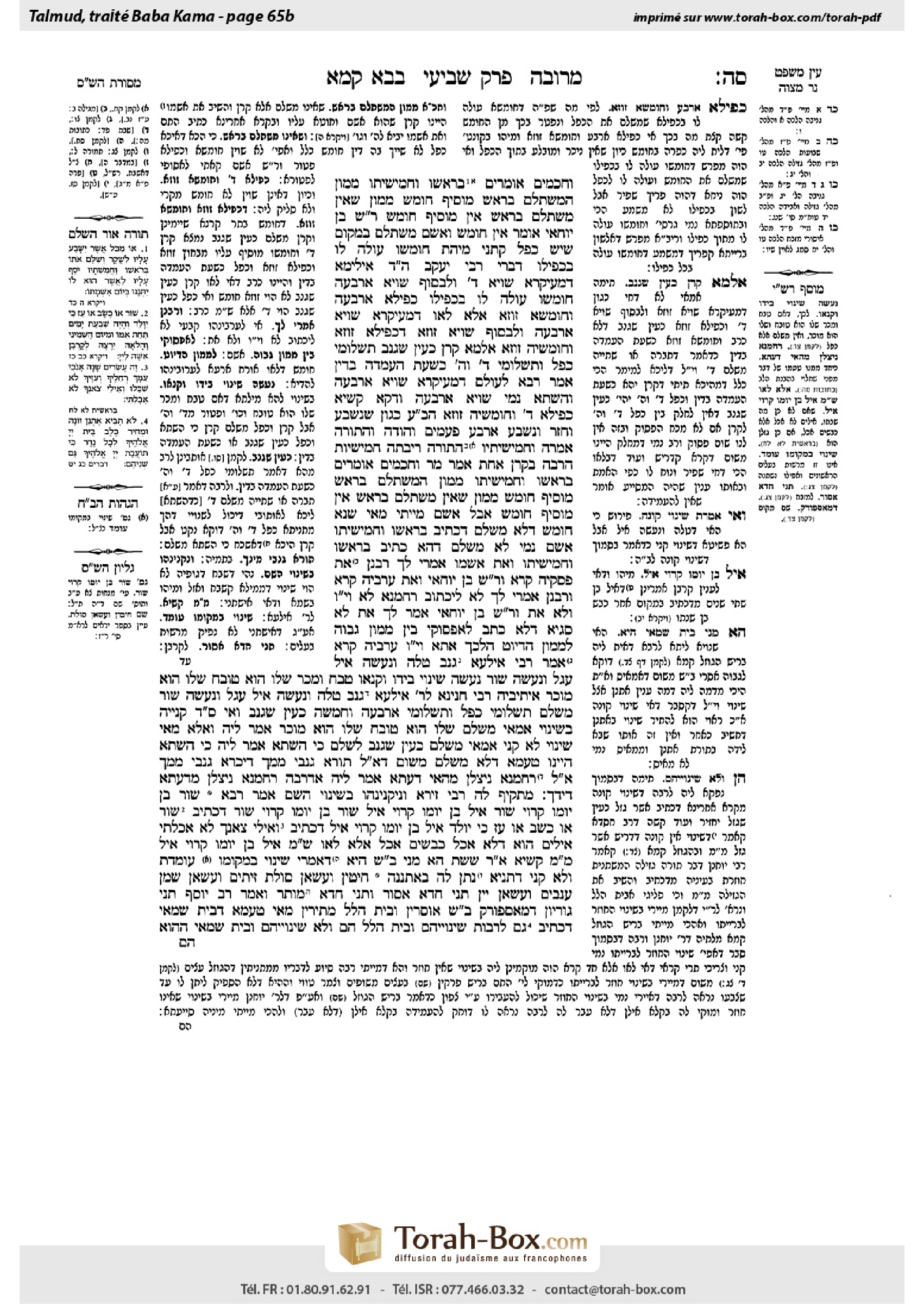
Bava Kamma 65b: Talmud study for Daf Yomi
Study the Talmud for Daf Yomi with scanned pages, Hebrew text, English translations from Sefaria and AI-generated French translations.
Passage selection and English or AI-generated French translation are available where the scan has annotations. Daf Study is independent of Torah-Box and Sefaria.
Browse Bava Kamma · בבא קמא · All tractatesBava Kamma 65b text and translations
This page of Bava Kamma includes the Aramaic text, an English translation and an AI-generated French translation, alongside the scan above.
בבא קמא ס״ה ב · Aramaic and Hebrew text
וַחֲכָמִים אוֹמְרִים: ״בְּרֹאשׁוֹ וַחֲמִשִׁתָיו״; מָמוֹן הַמִּשְׁתַּלֵּם בְּרֹאשׁ – מוֹסִיף חוֹמֶשׁ, מָמוֹן שֶׁאֵין מִשְׁתַּלֵּם בְּרֹאשׁ – אֵין מוֹסִיף חוֹמֶשׁ. רַבִּי שִׁמְעוֹן בֶּן יוֹחַאי אוֹמֵר: אֵין חוֹמֶשׁ וְאָשָׁם מִשְׁתַּלֵּם בְּמָקוֹם שֶׁיֵּשׁ כֶּפֶל.
קָתָנֵי מִיהַת: חוּמְשׁוֹ עוֹלֶה לוֹ בִּכְפֵילוֹ, דִּבְרֵי רַבִּי יַעֲקֹב. הֵיכִי דָמֵי? אִילֵּימָא דְּמֵעִיקָּרָא שָׁוְיָא אַרְבְּעָה וּלְבַסּוֹף שָׁוְיָא אַרְבְּעָה, חוּמְשׁוֹ עוֹלֶה לוֹ בִּכְפֵילוֹ?!
כְּפֵילָא אַרְבְּעָה, וְחוּמְשָׁא זוּזָא! אֶלָּא לָאו דְּמֵעִיקָּרָא שָׁוְיָא אַרְבְּעָה, וּלְבַסּוֹף שָׁוְיָא זוּזָא, דִּכְפֵילָא זוּזָא וְחוּמְשֵׁיהּ זוּזָא?
אַלְמָא קֶרֶן כְּעֵין שֶׁגָּנַב, תַּשְׁלוּמֵי כֶפֶל וְתַשְׁלוּמֵי אַרְבָּעָה וַחֲמִשָּׁה כִּשְׁעַת הַעֲמָדָה בַּדִּין!
אָמַר רָבָא: לְעוֹלָם דְּמֵעִיקָּרָא שָׁוְיָא אַרְבְּעָה וְהַשְׁתָּא נָמֵי שָׁוְיָא אַרְבְּעָה, וּדְקָא קַשְׁיָא: כְּפֵילָא אַרְבְּעָה וְחוּמְשֵׁיהּ זוּזָא, הָכָא בְּמַאי עָסְקִינַן – כְּגוֹן שֶׁנִּשְׁבַּע וְחָזַר וְנִשְׁבַּע אַרְבַּע פְּעָמִים, וְהוֹדָה; וְהַתּוֹרָה אָמְרָה ״וַחֲמִשִׁתָיו״ –
הַתּוֹרָה רִיבְּתָה חֲמִישִׁיּוֹת הַרְבֵּה בְּקֶרֶן אַחַת.
אָמַר מָר, וַחֲכָמִים אוֹמְרִים: ״בְּרֹאשׁוֹ וַחֲמִשִׁתָיו״ – מָמוֹן הַמִּשְׁתַּלֵּם בְּרֹאשׁ מוֹסִיף חוֹמֶשׁ, מָמוֹן שֶׁאֵין מִשְׁתַּלֵּם בְּרֹאשׁ אֵין מוֹסִיף חוֹמֶשׁ. אֲבָל אָשָׁם – מַיְיתֵי,
מַאי שְׁנָא חוֹמֶשׁ דְּלָא מְשַׁלֵּם – דִּכְתִיב: ״בְּרֹאשׁוֹ וַחֲמִשִׁתָיו״, אָשָׁם נָמֵי לָא מְשַׁלֵּם – דְּהָא כְּתִיב: ״בְּרֹאשׁוֹ וַחֲמִשִׁתָיו״, ״וְאֶת אֲשָׁמוֹ״!
אָמְרִי לָךְ רַבָּנַן: ״אֶת״ פַּסְקֵיהּ קְרָא.
וְרַבִּי שִׁמְעוֹן בֶּן יוֹחַאי – ״וְאֶת״ עָרְבֵיהּ קְרָא. וְרַבָּנַן אָמְרִי לָךְ: לָא לִיכְתּוֹב רַחֲמָנָא לָא וָיו וְלֹא ״אֶת״.
וְרַבִּי שִׁמְעוֹן בֶּן יוֹחַאי אָמַר לָךְ: ״אֶת״ לָא סַגִּיא דְּלָא כְּתַב – לְאַפְסוֹקֵי בֵּין מָמוֹן גָּבוֹהַּ לְמָמוֹן הֶדְיוֹט; הִלְכָּךְ אֲתָא וָיו עָרְבֵיהּ קְרָא.
אָמַר רַבִּי אִילְעָא: גָּנַב טָלֶה וְנַעֲשָׂה אַיִל, עֵגֶל וְנַעֲשָׂה שׁוֹר – נַעֲשָׂה שִׁינּוּי בְּיָדוֹ, וּקְנָאוֹ. טָבַח וּמָכַר – שֶׁלּוֹ הוּא טוֹבֵחַ, שֶׁלּוֹ הוּא מוֹכֵר.
אֵיתִיבֵיהּ רַבִּי חֲנִינָא לְרַבִּי אִילְעָא: גָּנַב טָלֶה וְנַעֲשָׂה אַיִל, עֵגֶל וְנַעֲשָׂה שׁוֹר – מְשַׁלֵּם תַּשְׁלוּמֵי כֶפֶל וְתַשְׁלוּמֵי אַרְבָּעָה וַחֲמִשָּׁה, כְּעֵין שֶׁגָּנַב. וְאִי סָלְקָא דַעְתָּךְ קַנְיֵיהּ בְּשִׁינּוּי, אַמַּאי מְשַׁלֵּם? שֶׁלּוֹ הוּא טוֹבֵחַ, שֶׁלּוֹ הוּא מוֹכֵר!
אֲמַר לֵיהּ: וְאֶלָּא מַאי, שִׁינּוּי לָא קָנֵי? אַמַּאי מְשַׁלֵּם כְּעֵין שֶׁגָּנַב? לְשַׁלֵּם כִּי הַשְׁתָּא!
אֲמַר לֵיהּ: כִּי הַשְׁתָּא הַיְינוּ טַעְמָא דְּלָא מְשַׁלֵּם – מִשּׁוּם דַּאֲמַר לֵיהּ: ״תּוֹרָא גְּנַבִי מִמָּךְ?״ ״דִּיכְרָא גְּנַבִי מִמְּךָ?״ אֲמַר לֵיהּ: רַחֲמָנָא נַיצְּלַן מֵהַאי דַּעְתָּא! אֲמַר לֵיהּ: אַדְּרַבָּה, רַחֲמָנָא נַיצְּלַן מִדַּעְתָּא דִּידָךְ!
מַתְקֵיף לַהּ רַבִּי זֵירָא: וְנִיקְנִינְהוּ בְּשִׁינּוּי הַשֵּׁם!
אָמַר רָבָא: שׁוֹר בֶּן יוֹמוֹ קָרוּי ״שׁוֹר״, אַיִל בֶּן יוֹמוֹ קָרוּי ״אַיִל״. שׁוֹר בֶּן יוֹמוֹ קָרוּי ״שׁוֹר״ – דִּכְתִיב: ״שׁוֹר אוֹ כֶשֶׂב אוֹ עֵז כִּי יִוָּלֵד״.
אַיִל בֶּן יוֹמוֹ קָרוּי ״אַיִל״ – דִּכְתִיב: ״וְאֵילֵי צֹאנְךָ לֹא אָכָלְתִּי״ – אֵילִים הוּא דְּלָא אֲכַל, כְּבָשִׂים אֲכַל?! אֶלָּא לָאו שְׁמַע מִינַּהּ אַיִל בֶּן יוֹמוֹ ״קָרוּי״ אַיִל?
מִכׇּל מָקוֹם קַשְׁיָא! אָמַר רַב שֵׁשֶׁת: הָא מַנִּי – בֵּית שַׁמַּאי הִיא, דְּאָמְרִי: שִׁינּוּי בִּמְקוֹמוֹ עוֹמֵד(ת), וְלָא קָנֵי.
דְּתַנְיָא: נָתַן לָהּ בְּאֶתְנַנָּהּ חִיטִּין וַעֲשָׂאָן סוֹלֶת, זֵיתִים וַעֲשָׂאָן שֶׁמֶן, עֲנָבִים וַעֲשָׂאָן יַיִן; תָּנֵי חֲדָא אָסוּר, וְתָנֵי חֲדָא מוּתָּר. וְאָמַר רַב יוֹסֵף, תָּנֵי גּוּרְיוֹן דְּמֵאַסְפּוֹרַק: בֵּית שַׁמַּאי אוֹסְרִין, וּבֵית הִלֵּל מַתִּירִין.
מַאי טַעְמָא דְּבֵית שַׁמַּאי? דִּכְתִיב: ״גַּם״ – לְרַבּוֹת שִׁינּוּיֵיהֶם. וּבֵית הִלֵּל – ״הֵם״ וְלֹא שִׁינּוּיֵיהֶם.
וּבֵית שַׁמַּאי – הָהוּא
Bava Kamma 65b · English translation
And the Rabbis say: It is written concerning a bailee who falsely claims innocence with regard to a deposit entrusted to him: “He shall restore it according to its principal, and shall add its fifth part to it” (Leviticus 5:24). This verse teaches that with regard to monetary restitution that is paid precisely according to the principal, one adds one-fifth, but for monetary restitution that is not paid precisely according to the principal, as is the case here, where the bailee pays double the principal value, one does not add one-fifth. Rabbi Shimon ben Yoḥai says: Neither the additional one-fifth nor the guilt-offering is paid in a case where there is double payment. This concludes the baraita.
Rabbi Ḥanina explains: In any event, the baraita teaches: His payment of the additional one-fifth is covered by his double payment; this is the statement of Rabbi Ya’akov. What are the circumstances of this case? If we say that the stolen item was initially worth four dinars and ultimately, at the time of trial, was still worth four dinars, how could he say: His payment of the additional one-fifth is covered by his double payment?
This statement is inaccurate in this case, as the double payment, i.e., the penalty included in the double payment, is four dinars, and the additional one-fifth is one dinar. When the Torah states “fifth” it means one-fifth of the total payment of the one-fifth and the principal together, i.e., one-quarter of the principal. For the additional one-fifth to be covered by the double payment, the two must be exactly equal, which is not the case here. Rather, is it not referring to a situation where initially it was worth four dinars and at the end it was worth one dinar, as the penalty component of the double payment is one dinar and the additional one-fifth is also one dinar?
Apparently, the principal, as well as the additional one-fifth, is paid according to the value as of the time when he stole, whereas the double payment and the fourfold or fivefold payment is according to the value at the time of standing trial, as claimed by Rav.
The Gemara refutes this analysis. Rava said: Actually, the baraita could be referring to a case in which initially it was worth four dinars and now, at the time of trial, it is also worth four dinars. And as for what is difficult with this case, namely that the double payment is four dinars and the additional one-fifth is one dinar, this problem can be resolved as follows: With what are we dealing here? It is a case where the bailee took an oath that the deposit was stolen from him, and he again took the same oath, and so on four times, and after each oath he admitted afterward that he had lied. And the Torah said: “And shall add its fifth part [ḥamishitav] to it” (Leviticus 5:24).
Rava continues: The term ḥamishitav is in the plural, which indicates that the Torah included the possibility of many payments of an additional one-fifth for a single principal. In other words, each time the bailee takes a false oath he becomes obligated to pay an additional one-fifth, despite the fact that each oath concerns the same item. Since he did so four times, and the one-fifth is actually one-quarter of the principal, the total amount of payments of the additional one-fifth is equal to the principal, which is the same as the penalty component of the double payment.
§ The Master said in the baraita: And the Sages say: “He shall restore it according to its principal, and shall add its fifth part to it” (Leviticus 5:24). This verse teaches that for monetary restitution that is paid precisely according to the principal, one adds one-fifth. But for monetary restitution that is not paid precisely according to the principal, one does not add one-fifth. The Gemara infers: He does not add one-fifth, but he is obligated to bring a guilt-offering.
The Gemara asks: What is different about the additional one-fifth in that case, that he does not have to pay it? As it is written: “He shall restore it according to its principal, and shall add its fifth part to it.” This indicates that the additional one-fifth is linked to the payment of the precise amount of the principal amount. If so, with regard to the guilt offering as well, he should not have to pay, i.e., bring it, as it is written: “He shall restore it according to its principal, and shall add its fifth part to it…and his guilt-offering [ve’et ashamo] he shall bring to the Lord” (Leviticus 5:24–25). The verse links the guilt-offering to the payment of the precise amount of the principal, just like it does the additional one-fifth.
The Gemara answers: The Sages would say to you in response: The superfluous word “et” in the phrase “and his guilt offering [ve’et ashamo]” divides the verse. Therefore, only the additional one-fifth payment, but not the guilt-offering, is linked to the payment of the precise amount of the principal.
The Gemara asks: And Rabbi Shimon ben Yoḥai, who maintains that this bailee is exempt from a guilt-offering as well, how would he respond to the Sages’ argument concerning “et”? He would point out that the term in question is actually “ve’et,” consisting of the word et preceded by the letter vav, meaning “and.” The conjunction joins the clauses of the verse. Therefore, both the additional one-fifth payment and the guilt-offering are linked to the payment of the precise amount of the principal. And the Rabbis would respond to Rabbi Shimon ben Yoḥai’s claim and say to you: If the Torah had intended that the two issues should be joined together, let the Merciful One write neither the vav nor “et.”
And Rabbi Shimon ben Yoḥai could have said to you in response to this argument: It is not possible for the verse to have not written “et,” as this term is necessary to separate between property belonging to the Most High, i.e., the guilt-offering, and non-sacred property, i.e., that of a Jew. Therefore, as the verse had to use “et” to indicate this difference, the vav comes and joins the clauses of the verse.
§ The Gemara discusses other cases in which an object undergoes a change after it has been stolen. Rabbi Ile’a says: If one stole a lamb and it subsequently became a ram, or if he stole a calf and it subsequently became a bull, the stolen item has undergone a change while in the thief’s possession, and he has therefore acquired it as his own property. Consequently, his obligation of restitution consists of monetary payment rather than giving back the stolen item itself. If he subsequently slaughtered or sold the animal, it is in effect his own animal that he slaughters, or it is his own animal that he sells, and he is not obligated in the fourfold or fivefold payment.
Rabbi Ḥanina raised an objection to Rabbi Ile’a from a baraita: If one stole a lamb and it subsequently became a ram, or if he stole a calf and it subsequently became a bull, he pays the double payment and the fourfold or fivefold payment according to the animal’s value as of the time when he stole it. And if it enters your mind that in a case of this kind the thief has acquired the animal as his own property by virtue of the physical change the animal underwent when it matured, why does he pay the fourfold or fivefold payment? After all, it is his own animal that he slaughters, or it is his own animal that he sells.
Rabbi Ile’a said to him: Rather, what would you conclude from the baraita? That this physical change in the stolen animal does not serve to acquire it for the thief and render it his property? If so, why should he pay according to the animal’s value as of the time when he stole it? Let him pay according to the animal’s value now, i.e., at the time of the slaughter or sale.
Rabbi Ḥanina said to him: This is the reason that he does not pay in accordance with the animal’s value now: It is because the thief can say to the animal’s owner: Did I steal a bull from you, or: Did I steal a ram from you? No; I stole only a calf or a lamb, and therefore I will pay you the value of the animal when I stole it. Rabbi Ile’a said to Rabbi Ḥanina: May the Merciful One save us from this opinion of yours! Rabbi Ḥanina said back to him: On the contrary, may the Merciful One save us from your opinion!
Rabbi Zeira objects to this: But even if an animal’s natural growth is not considered a physical change, let the thief acquire it through its change in name, i.e., its change of classification, as the animal was originally called a calf or a lamb and now it is considered a bull or ram.
Rava says: There is in fact no change in name here, as even a day-old bull is called a bull, and even a day-old ram is called a ram. A day-old bull is called a bull, as it is written: “When a bull, or a sheep, or a goat is born” (Leviticus 22:27).
A day-old ram is called a ram, as can be derived from Jacob’s statement to Laban, as it is written: “And the rams of your flock I have not eaten” (Genesis 31:38). Now, did Jacob mean that he did not eat any of Laban’s rams, but younger lambs he did eat? This is certainly not the meaning of this verse, as this would mean he was a thief. Rather, must one not conclude from this verse that a day-old ram is called a ram?
In any case, the baraita cited earlier by Rabbi Ḥanina is difficult for the opinion of Rabbi Ile’a, as it states that the thief must pay the fourfold or fivefold payment despite the fact that the slaughter or sale of the animal took place after it matured from a calf to a bull or from a lamb to a ram. To resolve the difficulty, Rav Sheshet said: In accordance with whose opinion is this baraita? It is in accordance with the opinion of Beit Shammai, who say: An item, even if it has undergone a physical change, remains in its place, i.e., a stolen item remains in the possession of its owner, and a thief does not acquire it even if it undergoes a change.
As it is taught in a baraita: If one gave wheat to a prostitute for her payment, i.e., the hire of her services, and she made the wheat into flour; or if he gave her olives and she made them into oil; or if he gave her grapes and she made them into wine, it is taught in one baraita that it is prohibited to bring these products as an offering in the Temple, in accordance with the verse: “You shall not bring the hire of a harlot…into the house of the Lord your God for any vow” (Deuteronomy 23:19). And it is taught in one baraita that these products are permitted, as the physical change renders them into new items. And Rav Yosef says that Guryon of Asporak teaches in a baraita: Beit Shammai prohibit these products and Beit Hillel permit them. If so, these two baraitot reflect a dispute between Beit Shammai and Beit Hillel.
The Gemara clarifies the source of these two opinions. What is the reason of Beit Shammai for prohibiting these products? As it is written: “You shall not bring the hire of a harlot, or the price of a dog, into the house of the Lord your God for any vow; for even both of these are an abomination to the Lord your God” (Deuteronomy 23:19). The apparently superfluous word “even” serves to include their changed status. And Beit Hillel, who permit these items after they have undergone a physical change, maintain that the term “these” in the phrase “both of these” teaches that this prohibition applies only to the original items, but not to their changed form.
And Beit Shammai would reply: That term,
Bava Kamma 65b · Traduction française (IA)
Et les Rabbins disent : Il est écrit concernant un dépositaire qui prétend faussement être innocent concernant un dépôt confié à lui : « Il le restituera selon son principal et ajoutera sa cinquième partie à cela » (Lévitique 5:24). Cette versette enseigne que concernant la restitution monétaire qui est payée exactement selon le principal, on ajoute une cinquième partie, mais concernant la restitution monétaire qui n'est pas payée exactement selon le principal, comme c'est le cas ici, où le dépositaire paie double la valeur principale, on ne rajoute pas une cinquième partie. Rabbi Šimon ben Yoḥai dit : Ni la cinquième partie supplémentaire ni l'offrande expiatoire ne sont payées dans le cas où il y a paiement double. Cela conclut la baraïta.
Rabbi Ḥanina explique : En tout cas, la baraïta enseigne : Son paiement de la cinquième partie supplémentaire est couvert par son paiement double ; c'est la déclaration de Rabbi Ya'akov. Quelles sont les circonstances de ce cas ? Si nous disons que l'objet volé valait initialement quatre dinars et finalement, au moment du procès, valait encore quatre dinars, comment pourrait-il dire : Son paiement de la cinquième partie supplémentaire est couvert par son paiement double ?
Cette déclaration est inexacte dans ce cas, car le paiement double, c'est-à-dire la sanction incluse dans le paiement double, est de quatre dinars, et la cinquième partie supplémentaire est d'un dinar. Lorsque la Torah dit « cinquième », cela signifie une cinquième partie du montant total du paiement de la cinquième partie et du principal ensemble, c'est-à-dire un quart du principal. Pour que la cinquième partie supplémentaire soit couverte par le paiement double, les deux doivent être exactement égaux, ce qui n'est pas le cas ici. Plutôt, ne s'agit-il pas d'une situation où initialement il valait quatre dinars et à la fin il valait un dinar, comme la composante pénale du paiement double est un dinar et la cinquième partie supplémentaire est aussi un dinar ?
Apparemment, le principal ainsi que la cinquième partie supplémentaire sont payés selon la valeur à l'époque où il a volé, tandis que le paiement double et le paiement quatre fois ou cinq fois est selon la valeur au moment du procès, comme le soutient Rav.
La Guemara réfute cette analyse. Rava dit : En réalité, la baraïta pourrait faire référence à un cas où initialement il valait quatre dinars et maintenant, au moment du procès, il vaut aussi quatre dinars. Et concernant ce qui est difficile dans ce cas, à savoir que le paiement double est de quatre dinars et la cinquième partie supplémentaire est d'un dinar, ce problème peut être résolu ainsi : De quoi sommes-nous en train de parler ? C'est un cas où le dépositaire a pris un serment que le dépôt lui avait été volé, et il a à nouveau pris le même serment, et ainsi de suite quatre fois, et après chaque serment il a admis ensuite qu'il avait menti. Et la Torah dit : « Et il ajoutera sa cinquième partie [ḥamishitav] à cela » (Lévitique 5:24).
Rava continue : Le terme ḥamishitav est au pluriel, ce qui indique que la Torah inclut la possibilité de plusieurs paiements de la cinquième partie supplémentaire pour un seul principal. En d'autres termes, chaque fois que le dépositaire prend un faux serment, il est tenu de payer une cinquième partie supplémentaire, malgré le fait que chaque serment concerne le même objet. Puisqu'il a fait cela quatre fois, et que la cinquième partie est en réalité un quart du principal, le montant total des paiements de la cinquième partie supplémentaire est égal au principal, ce qui est le même que la composante pénale du paiement double.
§ Le Maître dit dans la baraïta : Et les Sages disent : « Il le restituera selon son principal, et ajoutera sa cinquième partie à cela » (Lévitique 5:24). Cette versette enseigne que concernant la restitution monétaire qui est payée exactement selon le principal, on ajoute une cinquième partie. Mais concernant la restitution monétaire qui n'est pas payée exactement selon le principal, on ne rajoute pas une cinquième partie. La Guemara infère : Il ne rajoute pas une cinquième partie, mais il est tenu de présenter une offrande expiatoire.
La Guemara pose la question : Qu'est-ce qui diffère concernant la cinquième partie supplémentaire dans ce cas, pour qu'il ne doive pas la payer ? Comme il est écrit : « Il le restituera selon son principal, et ajoutera sa cinquième partie à cela » (Lévitique 5:24). Cela indique que la cinquième partie supplémentaire est liée au paiement de la somme exacte du principal. Si c'est ainsi, concernant l'offrande expiatoire également, il ne devrait pas avoir à la présenter, c'est-à-dire la présenter à l'Éternel, comme il est écrit : « Il le restituera selon son principal, et ajoutera sa cinquième partie à cela et son offrande expiatoire [ve’et ashamo] il la présentera à l'Éternel » (Lévitique 5:24–25). La versette lie l'offrande expiatoire au paiement de la somme exacte du principal, tout comme elle le fait pour la cinquième partie supplémentaire.
La Guemara répond : Les Sages diraient à vous en réponse : Le mot superflu « et » dans la phrase « et son offrande expiatoire [ve’et ashamo] » divise la versette. Ainsi, seule la cinquième partie supplémentaire est liée au paiement de la somme exacte du principal, mais pas l'offrande expiatoire.
La Guemara pose la question : Et Rabbi Šimon ben Yoḥai, qui maintient que ce dépositaire est exempt de l'offrande expiatoire également, comment répondrait-il à l'argument des Sages concernant « et » ? Il soulignerait que le terme en question est en réalité « ve’et », composé du mot « et » précédé de la lettre vav, signifiant « et ». La conjonction relie les clauses de la versette. Ainsi, à la fois le paiement de la cinquième partie supplémentaire et l'offrande expiatoire sont liés au paiement de la somme exacte du principal. Et les Rabbins répondraient à la déclaration de Rabbi Šimon ben Yoḥai et diraient à vous : Si la Torah avait voulu que les deux questions soient jointes ensemble, que l'Éternel Miséricordieux n'ait pas écrit ni la vav ni « et ».
Et Rabbi Šimon ben Yoḥai pourrait avoir dit à vous en réponse à cet argument : Il n'est pas possible que la versette n'ait pas écrit « et », car ce terme est nécessaire pour distinguer entre la propriété du Très Haut, c'est-à-dire l'offrande expiatoire, et la propriété non sacrée, c'est-à-dire celle d'un Juif. Ainsi, comme la versette avait dû utiliser « et » pour indiquer cette différence, la vav vient et relie les clauses de la versette.
§ La Guemara discute d'autres cas où un objet subit un changement après avoir été volé. Le maître Ile’a dit : Si l'on vole un agneau et qu'il devient ensuite un bélier, ou si l'on vole un veau et qu'il devient ensuite un taureau, l'objet volé a subi un changement pendant qu'il était en possession du voleur, et il a donc acquis l'animal comme sien. Par conséquent, son obligation de restitution consiste à payer une somme d'argent plutôt que de rendre l'objet volé lui-même. Si ensuite il abat ou vend l'animal, c'est en effet son propre animal qu'il abat ou vend, et il n'est pas tenu de payer le quadruple ou le quintuple.
Le maître Ḥanina a soulevé une objection contre le maître Ile’a, à partir d'une baraïta : Si l'on vole un agneau et qu'il devient ensuite un bélier, ou si l'on vole un veau et qu'il devient ensuite un taureau, il paie le double et le quadruple ou le quintuple selon la valeur de l'animal au moment où il l'a volé. Et si vous pensez que dans un cas de ce genre le voleur a acquis l'animal comme sien grâce au changement physique qu'il a subi lorsqu'il a mûri, pourquoi paie-t-il le quadruple ou le quintuple ? Après tout, c'est son propre animal qu'il abat ou vend.
Le maître Ile’a répondit à lui : Plutôt, que concluez-vous de la baraïta ? Que ce changement physique de l'animal volé ne sert pas à l'acquérir pour le voleur et à le rendre sien ? Si c'est ainsi, pourquoi paie-t-il selon la valeur de l'animal au moment où il l'a volé ? Que lui paie selon la valeur actuelle de l'animal, c'est-à-dire au moment de l'abattage ou de la vente.
Le maître Ḥanina répondit à lui : C'est pour cette raison qu'il ne paie pas selon la valeur actuelle de l'animal : C'est parce que le voleur peut dire à l'propriétaire de l'animal : Ai-je volé un taureau de vous, ou : Ai-je volé un bélier de vous ? Non ; j'ai volé seulement un veau ou un agneau, et par conséquent je paierai la valeur de l'animal au moment où j'ai volé. Le maître Ile’a répondit au maître Ḥanina : Que l'Éternel nous sauve de cette opinion à vous ! Le maître Ḥanina répondit à lui : Au contraire, que l'Éternel nous sauve de votre opinion !
Le maître Zéira s'oppose à cela : Mais même si le développement naturel de l'animal n'est pas considéré comme un changement physique, que le voleur acquière l'animal grâce à son changement de nom, c'est-à-dire de classification, puisque l'animal était d'abord appelé un veau ou un agneau et qu'il est maintenant considéré comme un taureau ou un bélier.
Rava dit : Il n'y a en effet pas de changement de nom ici, car même un taureau de un jour est appelé un taureau, et même un bélier de un jour est appelé un bélier. Un taureau de un jour est appelé un taureau, car il est écrit : « Quand un taureau, ou un agneau, ou un bouc est né » (Lévitique 22:27).
Un agneau de un jour est appelé un agneau, comme on peut en déduire de la déclaration de Jacob à Laban, car il est écrit : « Et les agneaux de ton troupeau, je n'ai pas mangés » (Gen 31:38). Maintenant, Jacob voulait-il dire qu'il n'avait pas mangé aucun des agneaux de Laban, mais qu'il avait mangé les jeunes brebis ? Cela ne peut pas être la signification de cette versette, car cela signifierait qu'il était un voleur. Plutôt, ne doit-on pas conclure de cette versette que l'agneau de un jour est appelé un agneau ?
En tout cas, la baraïta citée plus tôt par Rabbi Ḥanina pose un problème pour l'opinion de Rabbi Ile’a, car elle stipule que le voleur doit payer quatre fois ou cinq fois, même si la mise à mort ou la vente de l'animal s'est produite après qu'il ait atteint l'âge adulte, passant d'une veau à un taureau ou d'un agneau à un mouton. Pour résoudre cette difficulté, Rav Sheshet dit : Selon quel avis est cette baraïta ? Selon l'avis de Beit Shammai, qui disent : Un objet, même s'il a subi un changement physique, reste dans son état initial, c'est-à-dire un objet volé reste dans la possession de son propriétaire, et le voleur ne l'acquiert pas même s'il subit un changement.
Comme il est enseigné dans une baraïta : Si l'on donne du blé à une prostituée en échange de ses services, et qu'elle le transforme en farine ; ou si l'on lui donne des olives et qu'elle les transforme en huile ; ou si l'on lui donne des raisins et qu'elle les transforme en vin, il est enseigné dans une baraïta que ces produits sont interdits d'être offerts dans le Temple, conformément à la versette : « Tu ne porteras pas la rétribution d'une prostituée… dans la maison du Seigneur ton Dieu pour tout vœu » (Dt 23:19). Et il est enseigné dans une autre baraïta que ces produits sont permis, car le changement physique les transforme en nouveaux objets. Et Rav Yosef dit que Guryon d'Asporak enseigne dans une baraïta : Beit Shammai interdisent ces produits et Beit Hillel les permettent. Si c'est ainsi, ces deux baraitot reflètent un débat entre Beit Shammai et Beit Hillel.
La Guemara clarifie la source de ces deux opinions. Quel est le raisonnement de Beit Shammai pour interdire ces produits ? Comme il est écrit : « Tu ne porteras pas la rétribution d'une prostituée, ou le prix d'un chien, dans la maison du Seigneur ton Dieu pour tout vœu ; car même ces deux-ci sont un abomination au Seigneur ton Dieu » (Dt 23:19). Le mot apparemment superflu « même » sert à inclure leur statut modifié. Et Beit Hillel, qui permettent ces objets après qu'ils aient subi un changement physique, maintiennent que le terme « ces deux-ci » dans la phrase « ces deux-ci » enseigne que cette interdiction s'applique uniquement aux objets originaux, mais pas à leur forme modifiée.
Et Beit Shammai répondrait : Ce terme,
Traduction française générée par IA à partir de l’édition anglaise de Sefaria. Vérifie toujours un passage avec le texte source.
Text from Sefaria: William Davidson Edition - Vocalized Aramaic (CC BY NC); William Davidson Edition - English (CC BY NC).