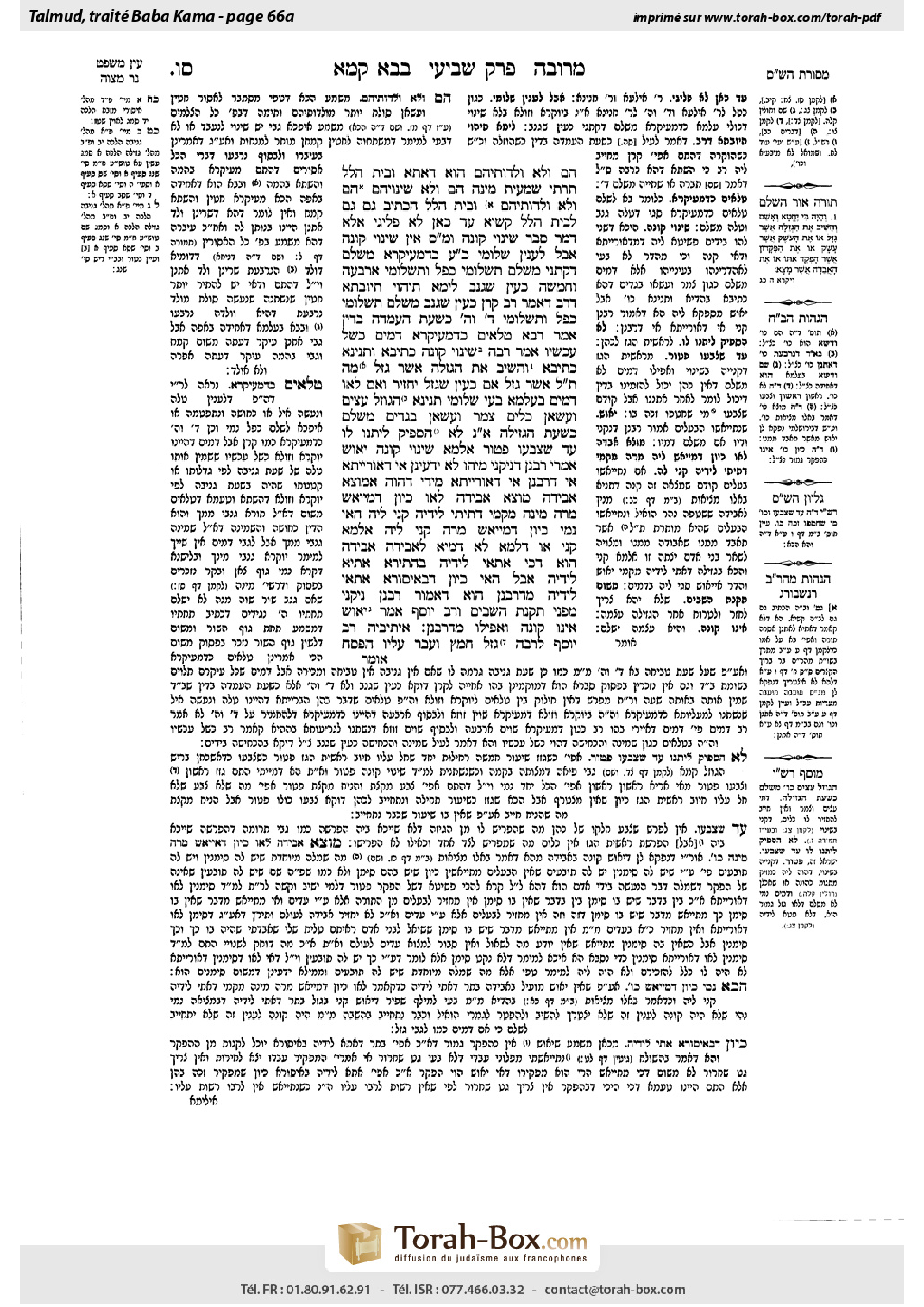
Bava Kamma 66a: Talmud study for Daf Yomi
Study the Talmud for Daf Yomi with scanned pages, Hebrew text, English translations from Sefaria and AI-generated French translations.
Passage selection and English or AI-generated French translation are available where the scan has annotations. Daf Study is independent of Torah-Box and Sefaria.
Browse Bava Kamma · בבא קמא · All tractatesBava Kamma 66a text and translations
This page of Bava Kamma includes the Aramaic text, an English translation and an AI-generated French translation, alongside the scan above.
בבא קמא ס״ו א · Aramaic and Hebrew text
״הֵם״ וְלֹא וַלְדוֹתֵיהֶם הוּא דַּאֲתָא. וּבֵית הִלֵּל – תַּרְתֵּי שְׁמַעִית מִינַּהּ: ״הֵם״ וְלֹא שִׁינּוּיֵהֶם, ״הֵם״ וְלֹא וַלְדוֹתֵיהֶם. וּבֵית הִלֵּל, הָכְתִיב ״גַּם״! ״גַּם״ לְבֵית הִלֵּל קַשְׁיָא.
עַד כָּאן לָא פְּלִיגִי, אֶלָּא דְּמָר סָבַר: שִׁינּוּי קוֹנֶה, וּמַר סָבַר: אֵין שִׁינּוּי קוֹנֶה; אֲבָל לְעִנְיַן שַׁלּוֹמֵי – כּוּלֵּי עָלְמָא כִּדְמֵעִיקָּרָא מְשַׁלֵּם, דְּקָתָנֵי: מְשַׁלֵּם תַּשְׁלוּמֵי כֶפֶל וְתַשְׁלוּמֵי אַרְבָּעָה וַחֲמִשָּׁה כְּעֵין שֶׁגָּנַב.
לֵימָא תֶּיהְוֵי תְּיוּבְתָּא דְּרַב, דְּאָמַר רַב: קֶרֶן – כְּעֵין שֶׁגָּנַב מְשַׁלֵּם, תַּשְׁלוּמֵי כֶפֶל וְתַשְׁלוּמֵי אַרְבָּעָה וַחֲמִשָּׁה – כִּשְׁעַת הַעֲמָדָה בַּדִּין? אָמַר רָבָא: טְלָאִים – כִּדְמֵעִיקָּרָא, דָּמִים – כְּשֶׁל עַכְשָׁיו.
אָמַר רַבָּה: שִׁינּוּי קוֹנֶה – כְּתִיבָא וּתְנֵינָא. כְּתִיבָא – ״וְהֵשִׁיב אֶת הַגְּזֵלָה אֲשֶׁר גָּזָל״, מָה תַּלְמוּד לוֹמַר ״אֲשֶׁר גָּזָל״? אִם כְּעֵין שֶׁגָּזַל – יַחֲזִיר, וְאִם לָאו – דָּמִים בְּעָלְמָא בָּעֵי שַׁלּוֹמֵי.
תְּנֵינָא – הַגּוֹזֵל עֵצִים וַעֲשָׂאָן כֵּלִים, צֶמֶר וַעֲשָׂאָן בְּגָדִים – מְשַׁלֵּם כִּשְׁעַת הַגְּזֵילָה.
אִי נָמֵי – לֹא הִסְפִּיק לִיתְּנוֹ לוֹ עַד שֶׁצְּבָעוֹ, פָּטוּר. אַלְמָא שִׁינּוּי קוֹנֶה.
יֵאוּשׁ – אָמְרִי רַבָּנַן דְּנִיקְנֵי, מִיהוּ לָא יָדְעִינַן אִי דְּאוֹרָיְיתָא אִי דְּרַבָּנַן.
אִי דְּאוֹרָיְיתָא – מִידֵּי דַּהֲוָה אַמּוֹצֵא אֲבֵידָה; מוֹצֵא אֲבֵידָה לָאו כֵּיוָן דְּמִיָּיאַשׁ מָרַהּ מִינַּהּ מִקַּמֵּי דְּתֵיתֵי לִידֵיהּ, קָנֵי לֵיהּ? הַאי נָמֵי, כֵּיוָן דִּמְיָיאֵשׁ מָרַהּ, קָנֵי לֵיהּ. אַלְמָא קָנֵי.
אוֹ דִלְמָא לָא דָּמְיָא לַאֲבֵידָה, אֲבֵידָה הוּא דְּכִי אֲתַאי לִידֵיהּ – בְּהֶתֵּירָא אֲתַאי לִידֵיהּ; אֲבָל הַאי, כֵּיוָן דִּבְאִיסּוּרָא אֲתַאי לִידֵיהּ – מִדְּרַבָּנַן הוּא;
דַּאֲמוּר רַבָּנַן נִיקְנֵי, מִפְּנֵי תַּקָּנַת הַשָּׁבִים.
וְרַב יוֹסֵף אָמַר: יֵאוּשׁ אֵינוֹ קוֹנֶה, וַאֲפִילּוּ מִדְּרַבָּנַן.
אֵיתִיבֵיהּ רַב יוֹסֵף לְרַבָּה: גָּזַל חָמֵץ וְעָבַר עָלָיו הַפֶּסַח,
Bava Kamma 66a · English translation
“these,” comes to teach that this halakha applies only to the animals given as payment to the prostitute but not to their offspring. The Gemara asks: And from where do Beit Hillel derive this halakha? They would say that one should conclude two conclusions from this term: “These” items are disqualified, but not when they are in their changed form, and “these” are disqualified, but not their offspring. The Gemara asks: And according to the opinion of Beit Hillel, isn’t it written “even”? Since Beit Hillel reject the halakha that Beit Shammai derive from this term, what do they learn from it? The Gemara states: Indeed, the word “even” is difficult according to the opinion of Beit Hillel.
In any event, they disagree only with regard to this particular issue: One Sage, Beit Hillel, holds that a physical change in a stolen item causes the thief to acquire it, and one Sage, Beit Shammai, holds that a physical change in a stolen item does not cause the thief to acquire it. But with regard to the payment of the thief, everyone agrees that he pays according to the initial value of the item, at the time of the theft, as it teaches in the baraita cited above: He pays the double payment and the fourfold or fivefold payment according to the animal’s value as of the time when he stole it.
The Gemara suggests: Shall we say that this baraita constitutes a conclusive refutation of the opinion of Rav? As Rav says: When a thief makes his payments, he pays the principal according to the value as of the time when he stole it, whereas the double payment and the fourfold or fivefold payment are calculated according to the value at the time of standing trial. Rava said in resolution of this difficulty: If one stole lambs that subsequently became rams or were fattened, he pays the double payment and the fourfold or fivefold payment according to the initial state of the animal, as claimed by both Beit Shammai and Beit Hillel. If there was a change in the animal’s value due to fluctuation of the monetary value of animals, he pays according to the animal’s worth now, at the time of standing trial.
§ Rabba said: The principle that a change in a stolen item causes the thief to acquire it is written in the Torah, and we learned it in a mishna as well. It is written in the Torah: “Then it shall be, if he has sinned, and is guilty, that he shall restore the item that he robbed” (Leviticus 5:23). What is the meaning when the verse states the seemingly superfluous phrase “that he robbed”? This serves to teach that if the item is the same as it was when he stole it, he must return the stolen item itself. But if it is not the same as it was then, he is required to pay only money, while the stolen item remains his to keep.
We learned this halakha in a mishna as well, as it is taught (93b): In the case of one who robs another of wood and fashions it into vessels, or one who robs another of wool and fashions it into garments, he pays the robbery victim according to the value of the goods at the time of the robbery, and keeps the altered materials for himself.
Alternatively, another mishna can serve as the source for this principle (Ḥullin 135a): If one did not manage to give the first of the sheared wool of his sheep to a priest until after he dyed it (see Deuteronomy 18:4), he is exempt from giving it to the priest. This mishna indicates that an item that has undergone a change is no longer considered the same item as it had been. Apparently, a physical change in a stolen item causes the thief to acquire it.
§ Rabba continues to discuss the ways in which a thief acquires ownership of a stolen item: With regard to the owner’s despair over ever recovering the stolen item, the Sages say that this too causes the thief to acquire the stolen item. However, we do not know if this halakha applies by Torah law or by rabbinic law.
Rabba elaborates on the two possibilities he has just mentioned: If it applies by Torah law, this is just as it is with regard to one who finds a lost item. Is it not the case with regard to one who finds a lost item that once the owner of the item despairs of recovering it, before the item came into the finder’s possession, the finder acquires it and may keep it for himself? The same principle applies to this thief as well: Once the owner of the item despairs of recovering it, the thief acquires it for himself and need no longer return it. Apparently, then, the despair of the owner causes the thief to acquire the stolen item.
Or perhaps the case of a stolen item is not comparable to the case of a lost item, as it is only with regard to a lost item that the owner’s despair enables the finder to acquire the item, because the item came into his possession in a permitted manner. But in this case of the thief, since the item came into his possession in a prohibited manner, this case cannot be derived from the halakha of a lost item. If so, the ruling that despair effects acquisition in a case of theft applies not by Torah law but by rabbinic law.
Why would this halakha have been instituted by rabbinic law? As, the Sages said that a thief should acquire the stolen item in this manner, due to an ordinance instituted for the penitent. To encourage thieves to repent and repay their victims, the Sages instituted that they need not return the stolen item after the owner despairs of recovering it. Rather, they can reimburse the owner for the monetary value of the item.
And Rav Yosef says: Despair on the part of the owner over the possibility of recovering his item does not cause the thief to acquire that item at all, and this is the halakha even by rabbinic law.
Rav Yosef raised an objection to Rabba from a mishna (96b): If one robbed another of leavened bread and Passover elapsed in the meantime, so that deriving benefit from it is prohibited,
Bava Kamma 66a · Traduction française (IA)
«Ces», vient enseigner que cette halakha s'applique uniquement aux animaux donnés en paiement à la prostituée, mais pas à leurs descendants. La Guemara demande : Et d'où Beit Hillel dérivent-ils cette halakha ? Ils diraient qu'on doit conclure deux conclusions à partir de ce terme : « Ces » objets sont disqualifiés, mais pas lorsqu'ils sont dans leur forme modifiée, et « ces » sont disqualifiés, mais pas leurs descendants. La Guemara demande : Et selon l'opinion de Beit Hillel, n'est-il pas écrit « même » ? Puisque Beit Hillel rejettent la halakha que Beit Shammai dérive de ce terme, qu'apprennent-ils alors de ce terme ? La Guemara affirme : En effet, le mot « même » est difficile selon l'opinion de Beit Hillel.
En tout cas, ils ne s'entendent que sur ce point particulier : un Sage, Beit Hillel, considère qu'un changement physique dans un objet volé permet au voleur d'en acquérir la propriété, et un autre Sage, Beit Shammai, considère que ce changement physique ne permet pas au voleur d'en acquérir la propriété. Mais concernant le paiement du voleur, tout le monde s'accorde à ce qu'il paie selon la valeur initiale de l'objet, au moment du vol, comme il est enseigné dans la baraïta citée ci-dessus : Il paie le double paiement et le quadruple ou quintuple paiement selon la valeur de l'animal au moment où il l'a volé.
La Guemara suggère : Devons-nous dire que cette baraïta constitue une réfutation définitive de l'opinion de Rav ? Comme Rav dit : Lorsque le voleur fait son paiement, il paie le principal selon la valeur au moment où il a volé, tandis que le double paiement et le quadruple ou quintuple paiement sont calculés selon la valeur au moment de l'audience. Rava a résolu cette difficulté en disant : Si l'on a volé des agneaux qui sont ensuite devenus des béliers ou qui ont été épaissis, il paie le double paiement et le quadruple ou quintuple paiement selon l'état initial de l'animal, comme le prétendent à la fois Beit Shammai et Beit Hillel. Si la valeur de l'animal a changé en raison de la fluctuation de la valeur monétaire des animaux, il paie selon la valeur actuelle de l'animal, au moment de l'audience.
§ Rabba dit : Le principe selon lequel un changement dans un objet volé permet au voleur d'en acquérir la propriété est écrit dans la Torah, et nous l'avons appris dans une mitsva également. Il est écrit dans la Torah : « Alors il arrivera, s'il a péché et est coupable, qu'il rendra l'objet qu'il a volé » (Lévitique 5:23). Quelle est la signification lorsque la versette mentionne la phrase apparemment superflue « qu'il a volé » ? Cela sert à enseigner que si l'objet est le même qu'à l'époque du vol, il doit rendre l'objet volé lui-même. Mais si ce n'est pas le même qu'à l'époque, il doit payer seulement en argent, tandis que l'objet volé reste à lui.
Nous avons appris cette halakha dans une mitsva également, comme il est enseigné (93b) : Dans le cas d'une personne qui vole du bois à un autre et le transforme en récipients, ou qui vole de la laine à un autre et la transforme en vêtements, il paie la victime du vol selon la valeur des biens au moment du vol, et garde les matériaux modifiés pour lui-même.
Alternativement, une autre mitsva peut servir de source pour ce principe (Ḥullin 135a) : Si l'on n'a pas réussi à donner la première laine de son mouton à un prêtre jusqu'après qu'elle ait été teintée (voir Deutéronome 18:4), il est exempt de la donner au prêtre. Cette mitsva indique que lorsqu'un objet a subi un changement, il n'est plus considéré comme le même objet qu'avant. Apparemment, un changement physique dans un objet volé permet au voleur d'en acquérir la propriété.
§ Rabba continue à discuter des manières dont un voleur acquiert la propriété d'un objet volé : En ce qui concerne la déception du propriétaire quant à la possibilité de récupérer l'objet volé, les Sages disent que cela aussi permet au voleur d'en acquérir la propriété. Cependant, nous ne savons pas si cette halakha s'applique selon la loi divine ou selon la loi rabbinique.
Rabba développe les deux possibilités qu'il a mentionnées précédemment : Si elle s'applique selon la loi divine, c'est tout à fait comme dans le cas d'une personne qui trouve un objet perdu. N'est-ce pas le cas avec une personne qui trouve un objet perdu que, lorsqu'un propriétaire désespère de récupérer son objet avant que l'objet ne soit entré en possession du trouver, le trouver acquiert l'objet et peut le garder pour lui-même ? Le même principe s'applique à ce voleur également : une fois que le propriétaire de l'objet désespère de le récupérer, le voleur acquiert l'objet pour lui-même et n'a plus besoin de le rendre. Apparemment, alors, la déception du propriétaire cause au voleur d'en acquérir la propriété.
Ou peut-être le cas d'un objet volé n'est pas comparable au cas d'un objet perdu, car c'est seulement concernant un objet perdu que la déception du propriétaire permet au trouver d'en acquérir la propriété, car l'objet est entré en possession du trouver de manière permise. Mais dans ce cas de voleur, puisque l'objet est entré en possession du voleur de manière interdite, ce cas ne peut pas être dérivé de la halakha d'un objet perdu. Si c'est ainsi, la décision selon laquelle la déception a un effet d'acquisition dans le cas de vol s'applique non pas selon la loi divine mais selon la loi rabbinique.
Pourquoi cette halakha a-t-elle été instituée selon la loi rabbinique ? Car les Sages dirent que le voleur devrait acquérir l'objet volé ainsi, en raison d'un ordonnance instituée pour le repentant. Pour encourager les voleurs à se repentir et à réparer leurs victimes, les Sages instituèrent que, après que le propriétaire ait désespéré de récupérer son objet, le voleur n'ait plus besoin de le rendre. Au contraire, il peut indemner le propriétaire de la valeur monétaire de l'objet.
Et Rav Yosef dit : La déception du propriétaire quant à la possibilité de récupérer son objet ne cause pas au voleur d'en acquérir la propriété du tout, et c'est la halakha même selon la loi rabbinique.
Rav Yosef a soulevé une objection contre Rabba à partir d'une mitsna (96b) : Si l'on a volé du pain levé et que le Pessah est passé en même temps, de sorte que tirer un bénéfice de cela est interdit,
Traduction française générée par IA à partir de l’édition anglaise de Sefaria. Vérifie toujours un passage avec le texte source.
Text from Sefaria: William Davidson Edition - Vocalized Aramaic (CC BY NC); William Davidson Edition - English (CC BY NC).