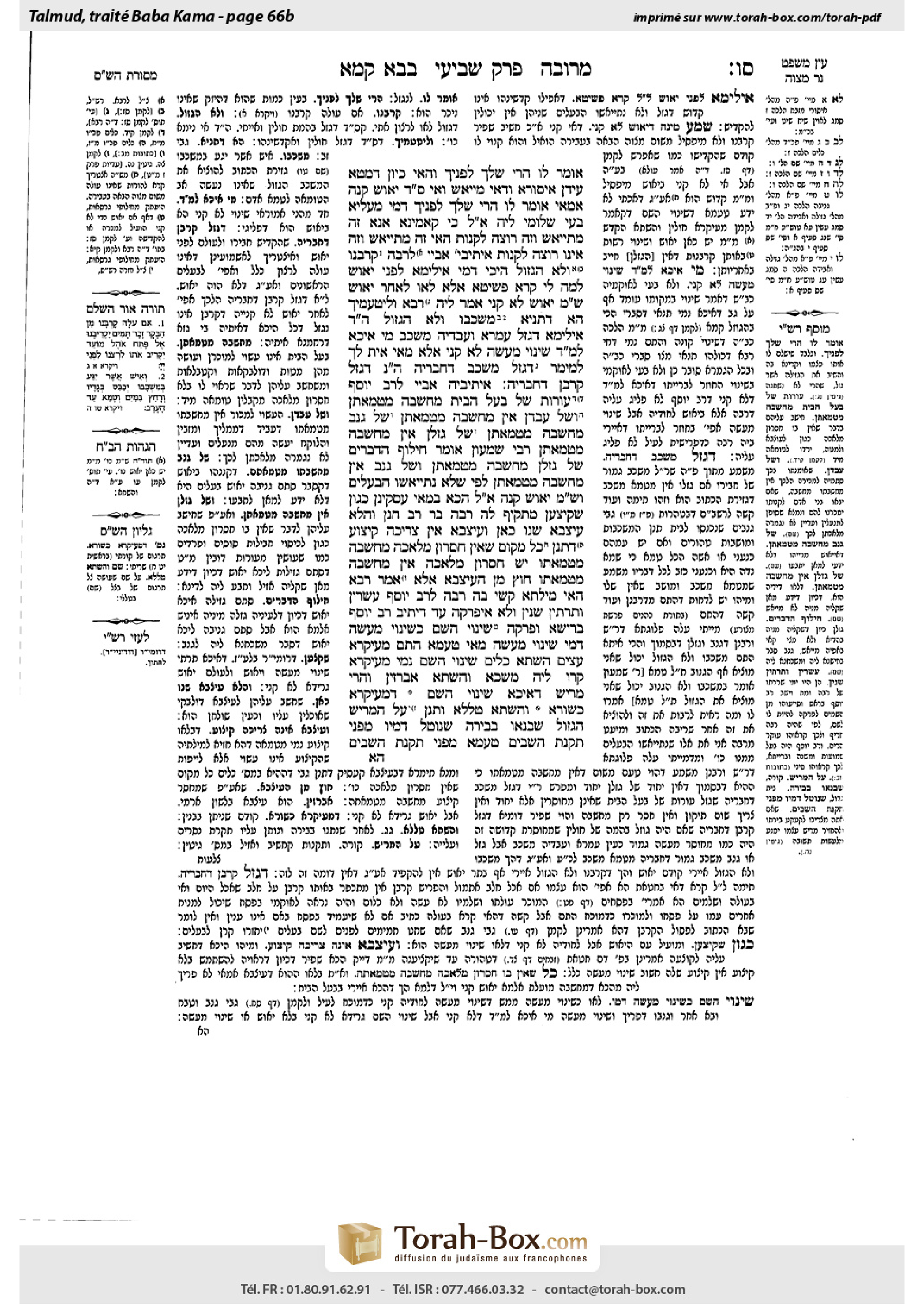
Bava Kamma 66b: Talmud study for Daf Yomi
Study the Talmud for Daf Yomi with scanned pages, Hebrew text, English translations from Sefaria and AI-generated French translations.
Passage selection and English or AI-generated French translation are available where the scan has annotations. Daf Study is independent of Torah-Box and Sefaria.
Browse Bava Kamma · בבא קמא · All tractatesBava Kamma 66b text and translations
This page of Bava Kamma includes the Aramaic text, an English translation and an AI-generated French translation, alongside the scan above.
בבא קמא ס״ו ב · Aramaic and Hebrew text
אוֹמֵר לוֹ: ״הֲרֵי שֶׁלְּךָ לְפָנֶיךָ״. וְהַאי, כֵּיוָן דִּמְטָא עִידָּן אִיסּוּרָא – וַדַּאי מִיָּיאַשׁ; וְאִי סָלְקָא דַעְתָּךְ יֵאוּשׁ קוֹנֶה, אַמַּאי אוֹמֵר לוֹ: ״הֲרֵי שֶׁלְּךָ לְפָנֶיךָ״? דְּמֵי מְעַלְּיָא בָּעֵי שַׁלּוֹמֵי לֵיהּ!
אֲמַר לֵיהּ: כִּי קָאָמֵינָא אֲנָא – זֶה מִתְיָיאֵשׁ וְזֶה רוֹצֶה לִקְנוֹת; הַאי – זֶה מִתְיָיאֵשׁ וְזֶה אֵינוֹ רוֹצֶה לִקְנוֹת.
אֵיתִיבֵיהּ אַבָּיֵי לְרַבָּה: ״קׇרְבָּנוֹ״ – וְלֹא הַגָּזוּל. הֵיכִי דָמֵי? אִילֵּימָא לִפְנֵי יֵאוּשׁ, לְמָה לִי קְרָא? פְּשִׁיטָא!
אֶלָּא לָאו לְאַחַר יֵאוּשׁ? שְׁמַע מִינַּהּ יֵאוּשׁ לָא קָנֵי!
אֲמַר לֵיהּ רָבָא: וְלִיטַעְמָיךְ, הָא דְּתַנְיָא: ״מִשְׁכָּבוֹ״ – וְלֹא הַגָּזוּל,
הֵיכִי דָמֵי? אִילֵּימָא דִּגְזַל עַמְרָא וְעַבְדֵיהּ מִשְׁכָּב, מִי אִיכָּא לְמַאן דְּאָמַר שִׁינּוּי מַעֲשֶׂה לָא קָנֵי? אֶלָּא מַאי אִית לָךְ לְמֵימַר – דִּגְזַל מִשְׁכָּב דְּחַבְרֵיהּ; הָכִי נָמֵי – דִּגְזַל קׇרְבָּן דְּחַבְרֵיהּ.
אֵיתִיבֵיהּ אַבָּיֵי לְרַב יוֹסֵף: עוֹרוֹת שֶׁל בַּעַל הַבַּיִת – מַחְשָׁבָה מְטַמְּאָתָן.
וְשֶׁל עַבְּדָן – אֵין מַחְשָׁבָה מְטַמְּאָתָן.
שֶׁל גַּנָּב – מַחְשָׁבָה מְטַמְּאָתָן, שֶׁל גַּזְלָן – אֵין מַחְשָׁבָה מְטַמְּאָתָן.
רַבִּי שִׁמְעוֹן אוֹמֵר: חִילּוּף הַדְּבָרִים – שֶׁל גַּזְלָן מַחְשָׁבָה מְטַמְּאָתָן, וְשֶׁל גַּנָּב אֵין מַחְשָׁבָה מְטַמְּאָתָן; לְפִי שֶׁלֹּא נִתְיָיאֲשׁוּ הַבְּעָלִים.
וּשְׁמַע מִינַּהּ, יֵאוּשׁ קֹנֶה! אֲמַר לֵיהּ: הָכָא בְּמַאי עָסְקִינַן – כְּגוֹן שֶׁקִּיצְּעָן.
מַתְקֵיף לַהּ רַבָּה בַּר רַב חָנָן: וַהֲלֹא עִיצְבָּא שָׁנוּ כָּאן, וְעִיצְבָּא אֵין צְרִיכָה קִיצּוּעַ!
דִּתְנַן: כׇּל מָקוֹם שֶׁאֵין חֶסְרוֹן מְלָאכָה – מַחְשָׁבָה מְטַמְּאָתוֹ, יֵשׁ חֶסְרוֹן מְלָאכָה – אֵין מַחְשָׁבָה מְטַמְּאָתוֹ; חוּץ מִן הָעֵיצְבָא.
אֶלָּא אָמַר רָבָא: הַאי מִילְּתָא קְשִׁי בַּהּ רַבָּה לְרַב יוֹסֵף עֶשְׂרִין וְתַרְתֵּין שְׁנִין, וְלָא אִיפַּרְקָה עַד דְּיָתֵיב רַב יוֹסֵף בְּרֵישָׁא, וּפָרְקַהּ: שִׁינּוּי הַשֵּׁם – כְּשִׁינּוּי מַעֲשֶׂה דָּמֵי.
שִׁינּוּי מַעֲשֶׂה מַאי טַעְמָא – הָתָם מֵעִיקָּרָא עֵצִים, הַשְׁתָּא כֵּלִים; שִׁינּוּי הַשֵּׁם נָמֵי – מֵעִיקָּרָא קָרוּ לֵיהּ ״מַשְׁכָּא״, וְהַשְׁתָּא ״אַבַּרְזִין״.
וַהֲרֵי מָרִישׁ – דְּאִיכָּא שִׁינּוּי הַשֵּׁם, דְּמֵעִיקָּרָא ״כְּשׁוּרָא״ וְהַשְׁתָּא ״טְלָלָא״; וּתְנַן: עַל הַמָּרִישׁ הַגָּזוּל שֶׁבְּנָאוֹ בְּבִירָה שֶׁנּוֹטֵל דָּמָיו, מִפְּנֵי תַּקָּנַת הַשָּׁבִים.
טַעְמָא מִפְּנֵי תַּקָּנַת הַשָּׁבִים,
Bava Kamma 66b · English translation
the robber may nonetheless return the worthless bread to the owner and say to him: That which is yours is before you, and no compensation is required. Rav Yosef states his objection: But in this case, once the time of the prohibition of leavened bread arrives, the owner certainly despairs of recovering his now-worthless bread. And if it enters your mind to say that the owner’s despair causes the robber to acquire the stolen item, why can he say to him: That which is yours is before you? He should be required to pay the owner full-fledged money rather than return the worthless food, as the bread now belongs to the robber.
Rava said to him in response: When I say that the thief acquires the stolen item upon the owner’s despair of recovery it is when this owner despairs, and that thief wants to acquire the item. In this case, this one despairs but that one does not wish to acquire the worthless bread.
Abaye raised an objection to Rabba from a baraita. The verse: “If his offering is a burnt-offering of the herd” (Leviticus 1:3), indicates that one’s offering must be “his offering,” but not an animal stolen from another. What are the circumstances of the case referred to by the baraita? If we say it is dealing with a stolen animal that the robber consecrates and sacrificed before the owner’s despair of recovery, why do I need a verse to teach this? It is obvious that this is disqualified, as one cannot even consecrate an animal that does not belong to him.
Rather, is it not referring to one who seeks to consecrate and sacrifice a stolen animal after the owner’s despair? And yet the baraita teaches that the animal cannot be consecrated by the thief. Conclude from the baraita that the owner’s despair of recovering a stolen item does not cause the thief to acquire it, as if it belonged to him he would be able to consecrate and sacrifice it.
Rava said to Abaye in refutation of this proof: And according to your reasoning, consider that which is taught in a baraita: It is written with regard to a zav, a man who experiences a gonorrhea-like discharge: “And whoever touches his bedding shall wash his clothes and bathe himself in water and be impure until the evening” (Leviticus 15:5). This indicates that bedding on which a zav lies can become ritually impure and impart impurity only if it is “his bedding,” but not if it is stolen bedding.
What are the circumstances of the case discussed in the baraita? If we say that he robbed another of wool and made it into bedding, is there anyone who says that a physical change that results from an action performed to a stolen item does not cause the thief to acquire it? Rather, what have you to say? The baraita must be speaking of a case in which the zav robbed another of bedding. So too, the previous baraita is dealing with one who robbed another of an offering, already consecrated. The reason this animal does not atone for the thief is that a consecrated animal cannot be stolen and become the thief’s property, as it belongs to the Temple treasury wherever it is located.
Abaye raised an objection to Rav Yosef from a mishna (Kelim 26:8): With regard to hides belonging to a homeowner, one’s thought renders them susceptible to contracting ritual impurity. Hides and leather are susceptible to contracting impurity only if they are in a finished state. If a private individual uses a piece of hide or leather for a certain purpose, e.g., as a cot or a table top, and decides that this will be its fixed purpose, it is considered a finished product and is susceptible to contracting impurity.
But with regard to hides belonging to a leatherworker, thought does not render them susceptible to ritual impurity. Since this individual sells leather to others, when he uses a piece of leather for a household purpose and decides that this will be its fixed purpose, this is not considered a finished state, as he is likely to change his mind and sell the leather to one who will process it further and put it to a different use.
The mishna continues: If the hides are those of a thief, who has stolen them from another, the thief’s thought renders them susceptible to ritual impurity. If they are those of a robber his thought does not render them susceptible to ritual impurity, because he is not considered the owner of the hide. The difference is that unlike the case of a thief, who steals items stealthily, the identity of a robber, who takes the item openly, is known to the owner, and the owner harbors hope of finding the robber and getting the item back. Consequently, he does not despair of recovering his property.
Rabbi Shimon says that the matters are reversed: In the case of a robber, the robber’s thought renders them susceptible to ritual impurity. If the hides are those of a thief, thought does not render them susceptible to ritual impurity, because the owners have not despaired of recovering them and the thief has not acquired the hide. Rabbi Shimon’s reasoning is that a robber, who seizes items brazenly, is a more difficult criminal to apprehend and bring to justice than a thief.
And although the two tanna’im of the mishna disagree as to which situation involves an owner’s despair of recovery, whether robbery or theft, in any event one can conclude from this mishna that the despair of the owner causes the thief or robber to acquire the item, as otherwise the perpetrator’s thoughts about the hide would have no effect on its status with regard to ritual impurity. Rav Yosef said to Abaye in response: With what are we dealing here in this mishna? It is a case where the thief or robber trimmed the leather by cutting it. Although trimming a piece of leather is not a sufficient change to constitute an act of acquisition by itself, it is effective in conjunction with the owner’s despair.
Rabba bar Rav Ḥanan objects to this answer: But is it not the case that they taught this mishna here with regard to a leather table top [itzba]? And a leather table top does not require trimming, either due to the fact that its edges are not seen or because it is merely ornamental. Since it does not require trimming, this action should not be considered an act of acquisition at all.
As we learned in the previous mishna (Kelim 26:7): Wherever there is no work lacking for an item to be considered finished, one’s thought renders it susceptible to ritual impurity; when there is still some work lacking for the item to be considered finished, thought does not render it susceptible to ritual impurity, except for the case of a leather table top. Although further work is required to smooth out the edges, one’s thought can render it susceptible to impurity because people do not care if this leather table top has uneven edges. It is with regard to this case of a table top that the mishna distinguishes between a homeowner and a leatherworker. Therefore, Rav Yosef’s explanation is rejected.
The Gemara suggests a different answer. Rather, Rava said that this matter was a difficulty posed by Rabba to Rav Yosef for twenty-two years, and it was not resolved until Rav Yosef sat as the head of the yeshiva and resolved it in the following manner: A change in name of an item, representing a change in status, is similar to a physical change brought about by an action.
What is the reason that a physical change through an action causes the thief to acquire the item? It is because there the stolen items were initially just wood, and now they are vessels. The same can be said for a change in name as well: Initially they called it a hide, and now they call it a table top [abrazin].
The Gemara asks a question with regard to changes in name: But what about the case of a beam, where there is a change in name, as initially, when it was stolen, it was called a beam, and now, after it has been placed in a building, it is called a joist [telala], and yet we learned in a mishna (Gittin 55a): With regard to a stolen beam that a robber had built into a large building, the court ruled that the owner should receive its value in money rather than demand that the robber demolish the house to return the beam itself, because of an ordinance instituted for the penitent, i.e., to encourage robbers to admit their crime and reimburse the owner of the stolen item.
This mishna indicates that the only reason the robber does not have to return the beam itself is because of this ordinance instituted for the penitent.
Bava Kamma 66b · Traduction française (IA)
le voleur peut néanmoins rendre le pain inutile à l'owner et dire à celui-ci : Ce qui est à toi est devant toi, et aucune compensation n'est exigée. Rav Yosef énonce son objection : Mais dans ce cas, une fois que vient le temps de l'interdiction du pain levé, l'owner est certainement désespéré de récupérer son pain désormais inutile. Et si cela t'entre en tête de dire que le désespoir de l'owner cause au voleur d'acquérir l'objet volé, pourquoi peut-il dire à l'owner : Ce qui est à toi est devant toi ? Il devrait être tenu de payer à l'owner l'argent complet plutôt que de rendre le pain inutile, car le pain appartient désormais au voleur.
Rava répondit à lui en disant : Lorsque je dis que le voleur acquiert l'objet volé en raison du désespoir de l'owner, c'est lorsque cet owner désespère et que ce voleur veut acquérir l'objet. Dans ce cas, ce dernier désespère mais celui-ci ne veut pas acquérir le pain inutile.
Abaye émit une objection contre Rabba à partir d'une baraïta. La parole : « Si son offrande est un holocauste du bétail » (Lévitique 1:3), indique que l'offrande doit être « son offrande », mais pas un animal volé à un autre. Quelles sont les circonstances du cas mentionné par la baraïta ? Si nous disons qu'il s'agit d'un animal volé que le voleur consacre et sacrifie avant que l'owner ne désespère de le récupérer, pourquoi ai-je besoin d'une parole pour enseigner cela ? Cela est évident que cela est disqualifié, car on ne peut même pas consacrer un animal qui n'appartient pas à soi.
Plutôt, n'est-ce pas en référence à celui qui cherche à consacrer et à sacrifier un animal volé après le désespoir de l'owner ? Et pourtant, la baraïta enseigne que l'animal ne peut être consacré par le voleur. Concluez de la baraïta que le désespoir de l'owner de récupérer un objet volé ne cause pas au voleur d'acquérir cet objet, car s'il appartenait à lui, il aurait pu le consacrer et le sacrifier.
Rava répondit à Abaye en réfutant cette preuve : Et selon votre raisonnement, considérez ce qui est enseigné dans une baraïta : Il est écrit concernant un zav, un homme qui a une décharge similaire à la gonorée : « Et celui qui touche son lit doit laver ses vêtements et se laver avec de l'eau et être impur jusqu'au soir » (Lévitique 15:5). Cela indique que le lit sur lequel un zav se repose peut devenir impur et transmettre l'impureté uniquement si c'est « son lit », mais pas si c'est un lit volé.
Quelles sont les circonstances du cas discuté dans la baraïta ? Si nous disons qu'il a volé du laine à un autre et l'a transformé en lit, y a-t-il quelqu'un qui dise qu'un changement physique résultant d'une action effectuée sur un objet volé ne cause pas au voleur d'acquérir cet objet ? Plutôt, que dites-vous ? La baraïta doit parler d'un cas où le zav a volé un lit à un autre. De même, la baraïta précédente traite d'une personne qui a volé un offrande déjà consacrée. La raison pour laquelle cet animal ne remplit pas la fonction de l'individu voleur est que un animal consacré ne peut être volé et devenir la propriété du voleur, car il appartient au trésor du Temple où qu'il se trouve.
Abaye émit une objection contre Rav Yosef à partir d'une mishna (Kelim 26:8) : Concernant les peaux appartenant à un propriétaire, la pensée rend ces peaux sujets à l'impureté rituelle. Les peaux et le cuir sont sujets à l'impureté rituelle uniquement si elles sont en état fini. Si un individu privé utilise une pièce de cuir ou de peau à un certain usage, par exemple, comme un lit ou une surface de table, et décide que cela sera son usage fixe, il est considéré comme un produit fini et est sujet à l'impureté rituelle.
Mais concernant les peaux appartenant à un tannait, la pensée ne rend pas ces peaux sujets à l'impureté rituelle. Puisque cette personne vend du cuir à d'autres, lorsqu'il utilise une pièce de cuir à un usage domestique et décide que cela sera son usage fixe, cela n'est pas considéré comme un état fini, car il est probable qu'il change d'avis et vende le cuir à quelqu'un qui le traitera davantage et l'utilisera à un autre usage.
La mishna continue : Si les peaux sont celles d'un voleur, qui a volé ces peaux à un autre, la pensée du voleur rend ces peaux sujettes à l'impureté rituelle. Si elles sont celles d'un voleur, sa pensée ne rend pas ces peaux sujettes à l'impureté rituelle, car il n'est pas considéré comme le propriétaire des peaux. La différence est que contrairement au cas d'un voleur, qui vole des objets discrètement, l'identité d'un voleur, qui prend l'objet ouvertement, est connue par le propriétaire, et le propriétaire espère trouver le voleur et récupérer l'objet. Par conséquent, il ne désespère pas de récupérer son bien.
Rabbi Shimon dit que les choses sont inversées : dans le cas d'un voleur, la pensée du voleur rend les peaux sujettes à l'impureté rituelle. Si les peaux sont celles d'un voleur, la pensée ne rend pas ces peaux sujettes à l'impureté rituelle, car les propriétaires n'ont pas désespéré de récupérer leurs biens et le voleur n'a pas acquis la peau. La raison de Rabbi Shimon est que le voleur, qui s'empare des objets de manière audacieuse, est un criminel plus difficile à arrêter et à juger que le voleur.
Et bien que les deux tannaïm de la mishna diffèrent sur la situation où l'owner désespère de récupérer son bien, que ce soit un vol ou un vol, en tout cas on peut conclure de cette mishna que le désespoir de l'owner cause au voleur ou au voleur d'acquérir l'objet, car autrement les pensées du voleur ou du voleur sur la peau n'auraient pas d'effet sur son statut en matière d'impureté rituelle. Rav Yosef répondit à Abaye en disant : Avec quoi sommes-nous en train de travailler ici dans cette mishna ? C'est un cas où le voleur ou le voleur a taillé le cuir en le coupant. Bien que tailler une pièce de cuir ne soit pas un changement suffisant pour constituer une acquisition par lui-même, il est efficace en conjonction avec le désespoir de l'owner.
Rabba bar Rav Ḥanan s'objecte à cette réponse : Mais n'est-ce pas le cas que cette mitsna a été enseignée ici concernant une table en cuir [itzba] ? Et une table en cuir ne nécessite pas de rabotage, soit parce que ses bords ne sont pas visibles, soit parce qu'il s'agit simplement d'une décoration. Puisque cela ne nécessite pas de rabotage, cette action ne devrait pas être considérée comme un acte d'acquisition du tout.
Comme nous l'avons appris dans la mitsna précédente (Kelim 26:7) : Partout où il n'y a pas de travail manquant pour que l'objet soit considéré comme achevé, la pensée de la personne le rend susceptible de souillure rituelle ; lorsque quelque travail manque encore pour que l'objet soit considéré comme achevé, la pensée ne le rend pas susceptible de souillure rituelle, sauf dans le cas d'une table en cuir. Bien que quelque travail supplémentaire soit nécessaire pour affiner les bords, la pensée peut rendre cet objet susceptible de souillure rituelle car les gens n'ont pas d'importance à ce que les bords de cette table en cuir soient irréguliers. C'est concernant ce cas de table en cuir que la mitsna distingue entre un propriétaire et un artisan en cuir. Par conséquent, l'explication de Rav Yosef est rejetée.
Le Guemara suggère une autre réponse. Plutôt, Rava a dit que cette question était une difficulté posée par Rabba à Rav Yosef pendant vingt-deux ans, et elle n'a pas été résolue jusqu'à ce que Rav Yosef devienne le chef de l'yeshiva et la résolve ainsi : Un changement de nom d'un objet, représentant un changement de statut, est semblable à un changement physique provoqué par une action.
Quelle est la raison pour laquelle un changement physique par une action permet au voleur d'acquérir l'objet ? C'est parce que les objets volés étaient initialement simplement du bois, et maintenant ils sont des ustensiles. De même, cela peut être dit concernant un changement de nom : initialement, on les appelait une peau, et maintenant on les appelle une table en cuir [abrazin].
Le Guemara pose une question concernant les changements de nom : Mais que devient le cas d'une poutre, où il y a un changement de nom, car initialement, lorsqu'elle était volée, on l'appelait une poutre, et maintenant, après qu'elle ait été placée dans un bâtiment, on l'appelait un montant [telala], et pourtant nous avons appris dans une mitsva (Gittin 55a) : Concernant une poutre volée que le voleur a construite dans un grand bâtiment, la cour a décidé que le propriétaire devrait recevoir sa valeur en argent plutôt que demander au voleur de démolir la maison pour récupérer la poutre elle-même, en raison d'une ordonnance instituée pour le repentant, c'est-à-dire pour encourager les voleurs à avouer leur crime et à indemniser le propriétaire de l'objet volé.
Cette mitsva indique que la seule raison pour laquelle le voleur n'a pas à rendre la poutre elle-même est en raison de cette ordonnance instituée pour le repentant.
Traduction française générée par IA à partir de l’édition anglaise de Sefaria. Vérifie toujours un passage avec le texte source.
Text from Sefaria: William Davidson Edition - Vocalized Aramaic (CC BY NC); William Davidson Edition - English (CC BY NC).