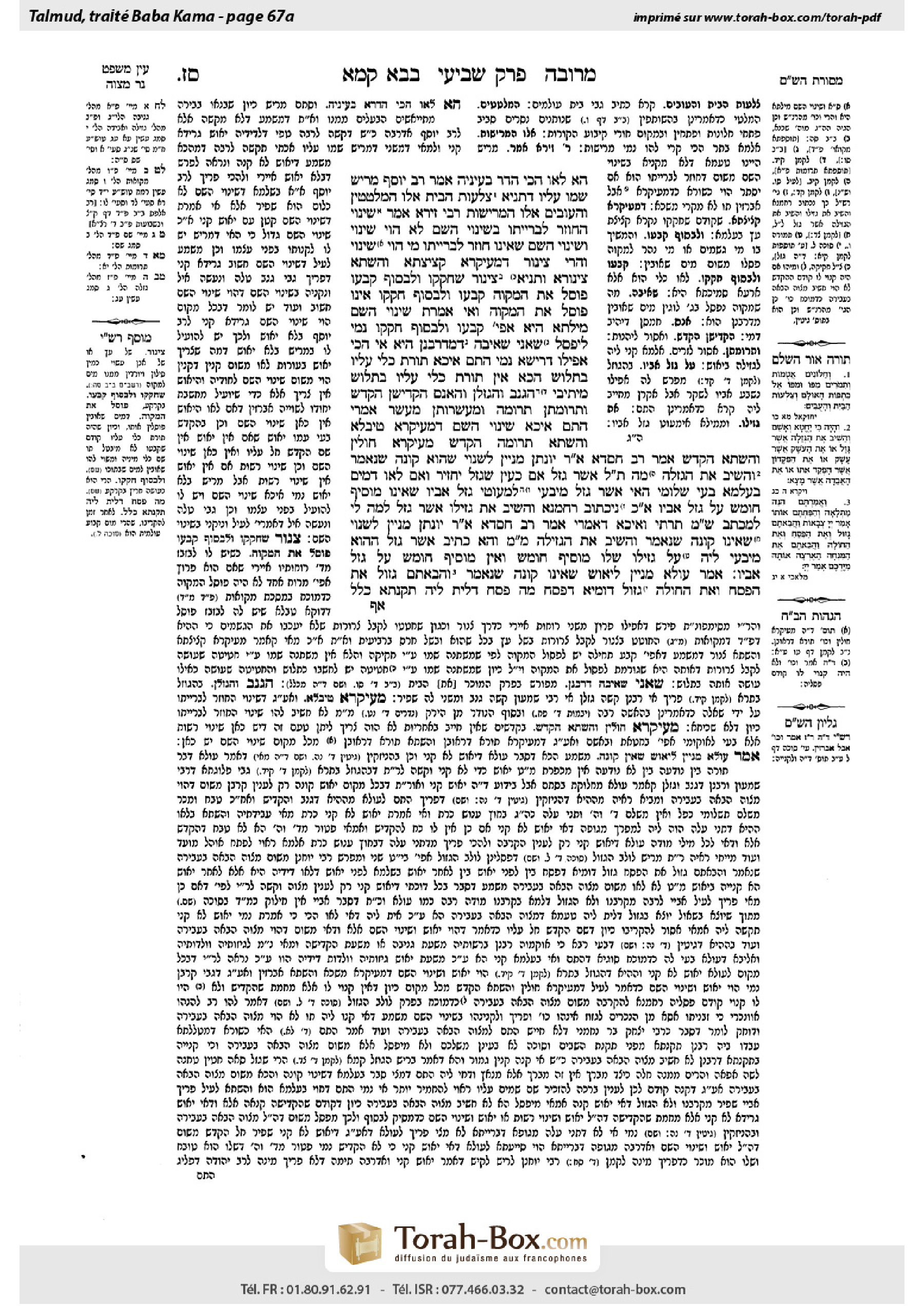
Bava Kamma 67a: Talmud study for Daf Yomi
Study the Talmud for Daf Yomi with scanned pages, Hebrew text, English translations from Sefaria and AI-generated French translations.
Passage selection and English or AI-generated French translation are available where the scan has annotations. Daf Study is independent of Torah-Box and Sefaria.
Browse Bava Kamma · בבא קמא · All tractatesBava Kamma 67a text and translations
This page of Bava Kamma includes the Aramaic text, an English translation and an AI-generated French translation, alongside the scan above.
בבא קמא ס״ז א · Aramaic and Hebrew text
הָא לָאו הָכִי – הָדַר בְּעֵינֵיהּ! אָמַר רַב יוֹסֵף: מָרִישׁ – שְׁמוֹ עָלָיו, דְּתַנְיָא: ״צַלְעוֹת הַבַּיִת״ – אֵלּוּ הַמַּלְטְטִין, ״וְהָעֻבִּים״ – אֵלּוּ הַמְּרִישׁוֹת.
רַבִּי זֵירָא אָמַר: שִׁינּוּי הַחוֹזֵר לִבְרִיָּיתוֹ – בְּשִׁינּוּי הַשֵּׁם – לָא הָוֵי שִׁינּוּי.
וְשִׁינּוּי הַשֵּׁם שֶׁאֵינוֹ חוֹזֵר לִבְרִיָּיתוֹ, מִי הָוֵי שִׁינּוּי? וַהֲרֵי צִינּוֹר – דְּמֵעִיקָּרָא ״קְצִיצְתָּא״ וְהַשְׁתָּא ״צִינּוֹרָא״, וְתַנְיָא: צִינּוֹר שֶׁחֲקָקוֹ וּלְבַסּוֹף קְבָעוֹ – פּוֹסֵל אֶת הַמִּקְוֶה.
קְבָעוֹ וּלְבַסּוֹף חֲקָקוֹ – אֵינוֹ פּוֹסֵל אֶת הַמִּקְוֶה.
וְאִי אָמְרַתְּ שִׁינּוּי הַשֵּׁם מִילְּתָא הִיא, אֲפִילּוּ קְבָעוֹ וּלְבַסּוֹף חֲקָקוֹ נָמֵי לִיפְסֹל!
שָׁאנֵי שְׁאִיבָה, דְּמִדְּרַבָּנַן הִיא. אִי הָכִי, אֲפִילּוּ דְּרֵישָׁא נָמֵי! הָתָם אִיכָּא תּוֹרַת כְּלִי עָלָיו בְּתָלוּשׁ, הָכָא אֵין תּוֹרַת כְּלִי עָלָיו בְּתָלוּשׁ.
מֵיתִיבִי: הַגַּנָּב וְהַגַּזְלָן וְהָאַנָּס – הֶקְדֵּישָׁן הֶקְדֵּשׁ, וּתְרוּמָתָן תְּרוּמָה, וּמַעְשְׂרוֹתָן מַעֲשֵׂר.
אָמְרִי: הָתָם אִיכָּא שִׁינּוּי הַשֵּׁם – דְּמֵעִיקָּרָא ״טִיבְלָא״ וְהַשְׁתָּא ״תְּרוּמָה״, הֶקְדֵּשׁ מֵעִיקָּרָא ״חוּלִּין״ וְהַשְׁתָּא ״הֶקְדֵּשׁ״.
אָמַר רַב חִסְדָּא אָמַר רַבִּי יוֹנָתָן: מִנַּיִין לְשִׁנּוּי שֶׁהוּא קוֹנֶה? שֶׁנֶּאֱמַר: ״וְהֵשִׁיב אֶת הַגְּזֵלָה״ – מָה תַּלְמוּד לוֹמַר ״אֲשֶׁר גָּזָל״? אִם כְּעֵין שֶׁגָּזַל – יַחֲזִיר, וְאִם לָאו – דָּמִים בְּעָלְמָא בָּעֵי שַׁלּוֹמֵי.
הַאי ״אֲשֶׁר גָּזָל״ מִיבְּעֵי לְמַעוֹטֵי גֶּזֶל אָבִיו, שֶׁאֵינוֹ מוֹסִיף חוֹמֶשׁ עַל גֶּזֶל אָבִיו!
אִם כֵּן, נִיכְתּוֹב רַחֲמָנָא ״וְהֵשִׁיב אֶת גְּזֵילוֹ״, ״אֲשֶׁר גָּזָל״ לְמָה לִי לְמִכְתַּב? שְׁמַע מִינַּהּ תַּרְתֵּי.
וְאִיכָּא דְּאָמְרִי, אָמַר רַב חִסְדָּא אָמַר רַבִּי יוֹנָתָן: מִנַּיִין לְשִׁנּוּי שֶׁאֵינוֹ קוֹנֶה – שֶׁנֶּאֱמַר: ״וְהֵשִׁיב אֶת הַגְּזֵילָה״ – מִכׇּל מָקוֹם. וְהָא כְּתִיב: ״אֲשֶׁר גָּזָל״! הָהוּא מִיבְּעֵי לֵיהּ – עַל גְּזֵילוֹ שֶׁלּוֹ מוֹסִיף חוֹמֶשׁ, וְאֵין מוֹסִיף חוֹמֶשׁ עַל גֶּזֶל אָבִיו.
אָמַר עוּלָּא: מִנַּיִין לְיֵאוּשׁ שֶׁאֵינוֹ קוֹנֶה? שֶׁנֶּאֱמַר: ״וַהֲבֵאתֶם גָּזוּל אֶת הַפִּסֵּחַ וְאֶת הַחוֹלֶה״ – גָּזוּל דּוּמְיָא דְּפִסֵּחַ, מָה פִּסֵּחַ דְּלֵית לֵיהּ תַּקַּנְתָּא כְּלָל,
Bava Kamma 67a · English translation
One can infer: But if were not for this decree, the beam would have to be returned to the owner as is, notwithstanding its change in name. Rav Yosef said: This is not a genuine change in name, as a beam retains its name even after it is inserted into a building. As it is taught in a baraita with regard to two obscure terms: The verse states: “And there were narrow windows and palm trees on the one side and on the other side, on the sides of the porch; there were also the tzalot of the house, and the ubbim” (Ezekiel 41:26). “Tzalot of the house”; these are the casings [hamaltetin]. “And the ubbim”; these are the beams [hamerishot]. This shows that a beam can retain its name even after it has been built into a house.
Rabbi Zeira said a different answer: With regard to a change in name, a change in which the item can revert to its original state is not considered enough of a change for the thief to acquire the stolen item. Since the joist can be removed and revert to being called a beam, it is not considered a true change of name.
The Gemara asks: And is a change in name in which the item does not revert to its original state really considered a change? But there is the case of a water duct, where it was initially called a log [ketzitzta] and now it is called a duct, and it is taught in a baraita: A duct that one hollowed out and afterward attached to the ground or to a building invalidates a ritual bath through the water it channels to the bath. The water in a ritual bath must be gathered directly from rain or a stream, not drawn with vessels. If one hollowed out a log and used it to channel water into the bath, this is considered drawn water, as he used a vessel.
By contrast, if one attached it first and afterward hollowed it out, it does not invalidate the ritual bath. Before the log was hollowed out, it was already attached to and considered part of the ground, and therefore the act of hollowing it out does not turn it into a vessel.
The Gemara states its question: And if you say that a change in name is considered a matter of significance, i.e., it is considered a real change in the item, then even if one attached the log first and afterward hollowed it out, the ritual bath should also be invalid. Since hollowing out the log leads to a change in name, it should be considered a new vessel at that point.
The Gemara answers: The halakha that drawn water may not be used for a ritual bath is different, as it applies by rabbinic law, and consequently the Sages were lenient in this case. The Gemara asks: If so, then even in the first clause, where the log was hollowed out before being attached, it should be permitted as well. The Gemara answers: There is a difference between the two cases. There, in the first clause, the log had the status of a vessel while it was still detached. Here, in the second case, it did not have the status of a vessel while it was detached, but only after it became attached to the ground, and therefore the Sages were lenient.
The Gemara raises an objection against Rav Yosef’s opinion that the owner’s despair that he will recover his stolen items does not effect acquisition for the thief, from a baraita: With regard to a thief, a robber, and one who forces people to sell him items against their will, their consecration of the items they obtained in these manners is a valid consecration; and the teruma that they separate from the produce they obtained in these manners is valid teruma; and the tithes that they separate from those foods are valid tithes. Consecrations, terumot, and tithes must be performed by the owner of the item in question. Since there was no physical change in these items, this shows that the thief is considered the new owner merely by virtue of the owner’s despair of recovery.
The Sages say, in answer to this question: There, in those cases involving consecrations, terumot, and tithes, there is a change in name of the stolen item, as initially the stolen food was called untithed produce, i.e., produce from which teruma and tithes have not been separated, and now it is called teruma or tithe. With regard to consecration, it was initially called non-sacred property, and now it is called consecrated property.
Rav Ḥisda says that Rabbi Yonatan says: From where is it derived that a change in a stolen item causes the thief to acquire it? As it is stated: “And he shall return the stolen item that he took by robbery” (Leviticus 5:23). What is the meaning when the verse states the seemingly superfluous phrase “that he took by robbery”? It teaches that only if the item is in the same state as when he took it by robbery it he must return it. But if not, he is required to pay only money; the stolen item remains his to keep.
The Gemara asks with regard to this derivation: But this phrase: “That he took by robbery,” is required to exclude the case of an item stolen by one’s father, i.e., that when a son returns an item or money that his father had stolen, he does not add one-fifth to the principal amount of that which his father stole. The passage in question addresses one who stole and took a false oath. This individual is obligated to add one-fifth to the amount he stole (see Leviticus 5:21–24). The apparently redundant phrase “that he took by robbery,” teaches that the requirement to add one-fifth applies only to the sinner himself, not to his heirs (see 104b).
The Gemara answers: If so, if the verse teaches only that halakha, let the Merciful One write merely: And he shall return his stolen item, as from that phrase alone it could be derived that an heir does not have to add one-fifth. Why do I need the Torah to write the expression “that he took by robbery”? One may therefore conclude two conclusions from this verse: A son need not add one-fifth, and a change in a stolen item effects acquisition for the thief.
And there are those who say a different version of the above statement: Rav Ḥisda says that Rabbi Yonatan says: From where is it derived that a change in a stolen item does not cause the thief to acquire it? As it is stated: “And he shall return the stolen item that he took by robbery” (Leviticus 5:23), from which it may be inferred that he must return it in any case, even if it has undergone a change. The Gemara asks: But it is written “that he took by robbery,” which indicates that, on the contrary, the item need be returned only if it is in a similar state to when it was stolen. The Gemara answers: That phrase is required to teach another halakha: One adds one-fifth upon returning his own stolen item concerning which he had taken a false oath, but he does not add one-fifth upon returning something stolen by his father.
Ulla says: From where is it derived that the owner’s despair of recovering his stolen item does not cause the thief to acquire it? As it is stated in the criticism of the Jewish people for bringing inferior animals as offerings: “And you have brought that which is stolen, and the lame, and the sick” (Malachi 1:13). From the juxtaposition of these cases it may be derived that a stolen animal is similar to a lame animal: Just as a lame animal has no rectification at all with regard to its disqualification as an offering,
Bava Kamma 67a · Traduction française (IA)
On peut en déduire : Mais si ce décret n'existait pas, la poutre devrait être rendue à l'propriétaire telle quelle, malgré le changement de nom. Rav Yosef a dit : Ce n'est pas un changement de nom réel, car une poutre conserve son nom même après avoir été insérée dans un bâtiment. Comme il est enseigné dans une baraïta concernant deux termes obscurs : La parabole dit : « Et il y avait des fenêtres étroites et des palmiers d'un côté et de l'autre, sur les côtés du porche ; il y avait aussi les tzalot de la maison, et les ubbim » (Ezéchiel 41:26). « Tzalot de la maison » : ce sont les casemates [hamaltetin]. « Et les ubbim » : ce sont les poutres [hamerishot]. Cela montre que la poutre peut conserver son nom même après avoir été construite dans une maison.
Rabbi Zeira a dit une réponse différente : Concernant un changement de nom, un changement par lequel l'objet peut revenir à son état originel n'est pas considéré comme suffisant pour que le voleur acquière l'objet volé. Puisque la poutre peut être retirée et revenir à son état initial, elle n'est pas considérée comme un changement de nom réel.
Le Guemara pose une question : Et un changement de nom par lequel l'objet ne peut pas revenir à son état originel est-il vraiment considéré comme un changement ? Mais il y a le cas d'un conduit d'eau, où il était initialement appelé un tronc [ketzitzta] et maintenant il est appelé un conduit, et il est enseigné dans une baraïta : Un conduit que l'on a creusé et ensuite attaché au sol ou à un bâtiment invalidate un bain rituel par l'eau qu'il dirige vers le bain. L'eau d'un bain rituel doit être recueillie directement de la pluie ou d'un cours d'eau, pas tirée avec des récipients. Si l'on a creusé un tronc et l'a utilisé pour diriger l'eau vers le bain, cela est considéré comme de l'eau tirée, car l'on a utilisé un récipient.
Par contraste, si l'on a attaché le tronc d'abord et ensuite creusé, cela ne rend pas le bain rituel invalide. Avant que le tronc ne soit creusé, il était déjà attaché au sol et considéré comme faisant partie du sol, et donc l'acte de le creuser ne le transforme pas en un récipient.
Le Guemara énonce sa question : Et si vous dites qu'un changement de nom est considéré comme une affaire importante, c'est-à-dire qu'il est considéré comme un changement réel de l'objet, alors même si l'on a attaché le tronc d'abord et ensuite le creusé, le bain rituel devrait être également invalide. Puisque le creusement du tronc entraîne un changement de nom, il devrait être considéré comme un nouveau récipient à ce moment-là.
Le Guemara répond : La halakha selon laquelle l'eau tirée ne peut pas être utilisée pour un bain rituel est différente, car elle s'applique selon la loi rabbinique, et par conséquent les Sages ont été cléments dans ce cas. Le Guemara pose une question : Si tel est le cas, alors même dans le premier cas, où le tronc a été creusé avant d'être attaché, il devrait être permis également. Le Guemara répond : Il y a une différence entre les deux cas. Là-bas, dans le premier cas, le tronc avait le statut de récipient alors qu'il était encore détaché. Ici, dans le second cas, il n'avait pas le statut de récipient alors qu'il était détaché, mais seulement après qu'il fut attaché au sol, et par conséquent les Sages ont été cléments.
Le Guemara soulève une objection contre l'opinion de Rav Yosef selon laquelle l'espoir de l'owner de récupérer ses objets volés n'effet l'acquisition pour le voleur, à partir d'une baraïta : Concernant un voleur, un voleur, et celui qui force les gens à vendre des objets contre leur volonté, leur consécration des objets qu'ils ont obtenus de cette manière est une consécration valide ; et la terouma qu'ils séparent des produits qu'ils ont obtenus de cette manière est une terouma valide ; et les dîmes qu'ils séparent de ces aliments sont des dîmes valides. Les consécration, les terouma et les dîmes doivent être effectuées par l'owner de l'objet en question. Puisque ces objets n'ont pas subi un changement physique, cela montre que le voleur est considéré comme le nouveau propriétaire uniquement par l'espoir de l'owner de récupérer ses objets volés.
Les Sages répondent à cette question : Là-bas, dans ces cas concernant les consécration, les terouma et les dîmes, il y a un changement de nom de l'objet volé, car initialement le produit volé était appelé produit non titulaire, c'est-à-dire produit dont les terouma et les dîmes n'ont pas été séparés, et maintenant il est appelé terouma ou dîme. Concernant la consécration, il était initialement appelé propriété non sacrée, et maintenant il est appelé propriété consacrée.
Rav Ḥisda dit que Rabbi Yonatan dit : D'où est tiré que le changement d'un objet volé cause l'acquisition du voleur ? Comme il est dit : « Et il devra rendre l'objet volé qu'il a pris par vol » (Lévitique 5:23). Quelle est la signification lorsque la phrase mentionne la phrase superflue « qu'il a pris par vol » ? Elle enseigne que seul si l'objet est dans l'état où il l'a pris par vol, il doit le rendre. Mais si ce n'est pas le cas, il est tenu de payer seulement de l'argent ; l'objet volé reste à lui pour le garder.
Le Guemara pose une question concernant cette dérivation : Mais cette phrase : « Qu'il a pris par vol », est nécessaire pour exclure le cas d'un objet volé par le père, c'est-à-dire que lorsque le fils rend un objet ou de l'argent que son père a volé, il ne doit pas ajouter un cinquième au montant principal de ce que son père a volé. Le passage en question concerne celui qui a volé et a pris un faux serment. Cette personne est tenue d'ajouter un cinquième au montant qu'il a volé (voir Lévitique 5:21–24). La phrase apparemment superflue « qu'il a pris par vol » enseigne que la nécessité d'ajouter un cinquième s'applique uniquement à l'individu lui-même, pas à ses héritiers (voir 104b).
Le Guemara répond : Si tel est le cas, si la Torah enseigne seulement la halakha, laissez le Miséricordieux écrire simplement : Et il devra rendre son objet volé, car à partir de cette phrase seule on pourrait déduire que l'héritier n'a pas besoin d'ajouter un cinquième. Pourquoi ai-je besoin de la Torah pour écrire l'expression « qu'il a pris par vol » ? On peut donc en déduire deux conclusions de cette phrase : le fils n'a pas besoin d'ajouter un cinquième, et un changement dans un objet volé constitue une acquisition pour le voleur.
Et il y a ceux qui disent une autre version de l'affirmation ci-dessus : Rav Ḥisda dit que Rabbi Yonatan dit : D'où est tiré le fait qu'un changement dans un objet volé ne permet pas au voleur d'en acquérir la propriété ? Comme il est dit : « Et il rendra l'objet volé qu'il a pris par vol » (Lévitique 5:23), d'où on peut déduire qu'il doit le rendre en tout cas, même s'il a subi un changement. La Guemara demande : Mais il est écrit « que tu as pris par vol », ce qui indique que, tout le contraire, l'objet doit être rendu uniquement s'il est dans un état similaire à celui où il a été volé. La Guemara répond : Cette expression est nécessaire pour enseigner une autre halakha : On ajoute un cinquième lors de la restitution de son propre objet volé concernant lequel il a pris un faux serment, mais on ne l'ajoute pas lors de la restitution d'un objet volé par son père.
Ulla dit : D'où est tiré le fait que l'abandon de la propriété par le propriétaire ne permet pas au voleur d'en acquérir la propriété ? Comme il est dit dans la critique du peuple d'Israël pour avoir apporté des animaux inférieurs comme offrandes : « Et vous avez apporté ce qui est volé, et les bovins boiteux, et les malades » (Mal 1:13). De la juxtaposition de ces cas on peut déduire que l'animal volé est semblable à l'animal boiteux : Tout comme l'animal boiteux n'a aucune réparation concernant son inaptitude à être offrande,
Traduction française générée par IA à partir de l’édition anglaise de Sefaria. Vérifie toujours un passage avec le texte source.
Text from Sefaria: William Davidson Edition - Vocalized Aramaic (CC BY NC); William Davidson Edition - English (CC BY NC).