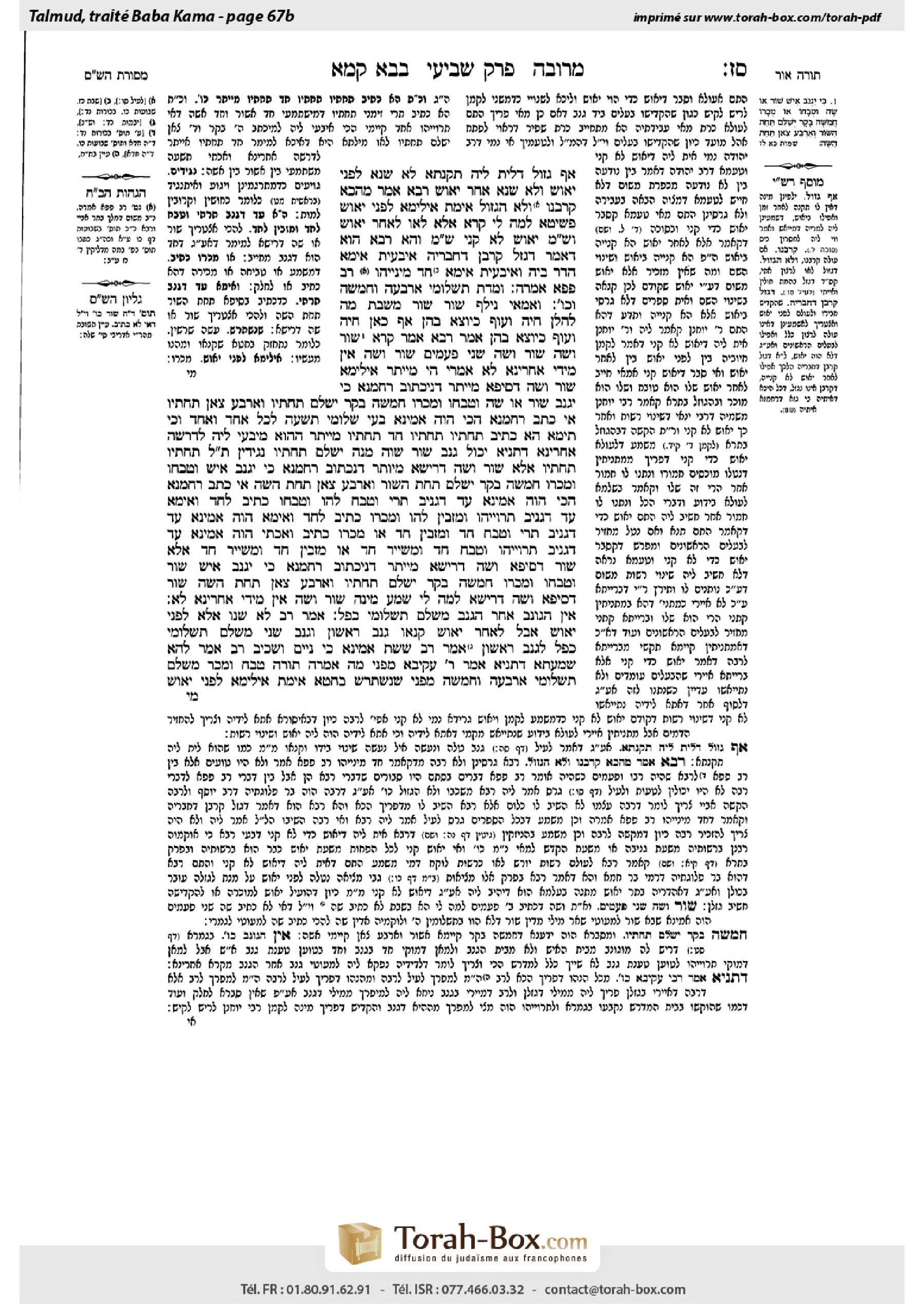
Bava Kamma 67b: Talmud study for Daf Yomi
Study the Talmud for Daf Yomi with scanned pages, Hebrew text, English translations from Sefaria and AI-generated French translations.
Passage selection and English or AI-generated French translation are available where the scan has annotations. Daf Study is independent of Torah-Box and Sefaria.
Browse Bava Kamma · בבא קמא · All tractatesBava Kamma 67b text and translations
This page of Bava Kamma includes the Aramaic text, an English translation and an AI-generated French translation, alongside the scan above.
בבא קמא ס״ז ב · Aramaic and Hebrew text
אַף גָּזוּל דְּלֵית לֵיהּ תַּקַּנְתָּא; לָא שְׁנָא לִפְנֵי יֵאוּשׁ, וְלָא שְׁנָא אַחַר יֵאוּשׁ.
רָבָא אָמַר מֵהָכָא: ״קׇרְבָּנוֹ״ – וְלֹא הַגָּזוּל. אֵימַת? אִילֵּימָא לִפְנֵי יֵאוּשׁ – פְּשִׁיטָא, לְמָה לִי קְרָא?
אֶלָּא לָאו לְאַחַר יֵאוּשׁ – וּשְׁמַע מִינַּהּ יֵאוּשׁ לָא קָנֵי? שְׁמַע מִינַּהּ.
וְהָא רָבָא הוּא דְּאָמַר דִּגְזַל קׇרְבָּן דְּחַבְרֵיהּ! אִיבָּעֵית אֵימָא: הֲדַר בֵּיהּ, וְאִיבָּעֵית אֵימָא: חַד מִינַּיְיהוּ רַב פָּפָּא אַמְרַהּ.
וּמִדַּת תַּשְׁלוּמֵי אַרְבָּעָה וַחֲמִשָּׁה וְכוּ׳.
וְאַמַּאי? נֵילַף ״שׁוֹר״–״שׁוֹר״ מִשַּׁבָּת – מָה לְהַלָּן חַיָּה וְעוֹף כַּיּוֹצֵא בָּהֶן, אַף כָּאן חַיָּה וָעוֹף כַּיּוֹצֵא בָּהֶן!
אָמַר רָבָא, אָמַר קְרָא: ״שׁוֹר וָשֶׂה״ ״שׁוֹר וָשֶׂה״ שְׁנֵי פְּעָמִים – שׁוֹר וָשֶׂה אִין, מִידֵּי אַחֲרִינָא לָא.
אָמְרִי: הֵי מְיַיתַּר? אִילֵימָא ״שׁוֹר וָשֶׂה״ דְּסֵיפָא מְיַיתַּר, דְּנִיכְתּוֹב רַחֲמָנָא: ״כִּי יִגְנֹב שׁוֹר אוֹ שֶׂה וּטְבָחוֹ וּמְכָרוֹ, חֲמִשָּׁה בָקָר יְשַׁלֵּם תַּחְתָּיו וְאַרְבַּע צֹאן תַּחְתָּיו״; אִי כְּתַב רַחֲמָנָא הָכִי, הֲוָה אָמֵינָא בָּעֵי שַׁלּוֹמֵי תִּשְׁעָה לְכׇל אֶחָד וְאֶחָד!
וְכִי תֵּימָא הָא כְּתִיב ״תַּחְתָּיו״ ״תַּחְתָּיו״ – חַד ״תַּחְתָּיו״ מְיַיתַּר;
הַהוּא מִיבְּעֵי לֵיהּ לִדְרָשָׁה אַחֲרִינָא – דְּתַנְיָא: יָכוֹל גָּנַב שׁוֹר שָׁוֶה מָנֶה, יְשַׁלֵּם תַּחְתָּיו [חֲמִשָּׁה] נְגִידִין? תַּלְמוּד לוֹמַר: ״תַּחְתָּיו״ ״תַּחְתָּיו״.
אֶלָּא ״שׁוֹר וָשֶׂה״ דְּרֵישָׁא מְיַיתַּר – דְּנִכְתּוֹב רַחֲמָנָא: ״כִּי יִגְנֹב אִישׁ וּטְבָחוֹ וּמְכָרוֹ, חֲמִשָּׁה בָקָר יְשַׁלֵּם תַּחַת הַשּׁוֹר, וְאַרְבַּע צֹאן תַּחַת הַשֶּׂה״.
אִי כְּתַב רַחֲמָנָא הָכִי, הֲוָה אָמֵינָא: עַד דְּגָנֵיב תְּרֵי וְטָבַח לְהוּ! ״וּטְבָחוֹ״ כְּתִיב – לְחַד.
וְאֵימָא: עַד דְּגָנֵיב תַּרְוַיְיהוּ וּמְזַבֵּין לְהוּ! ״וּמְכָרוֹ״ כְּתִיב – לְחַד.
וְאֵימָא: הָוֵה אָמֵינָא עַד דְּגָנֵיב תְּרֵי, וְטָבַח חַד וּמְזַבֵּין חַד! ״אוֹ מְכָרוֹ״ כְּתִיב.
וְאַכַּתִּי הֲוָה אָמֵינָא עַד דְּגָנֵיב תַּרְוַיְיהוּ וְטָבַח חַד וּמְשַׁיַּיר חַד, אוֹ מְזַבֵּין חַד וּמְשַׁיַּיר חַד!
אֶלָּא: ״שׁוֹר״ דְּסֵיפָא וְ״שֶׂה״ דְּרֵישָׁא מְיַיתַּר, דְּנִיכְתּוֹב רַחֲמָנָא: ״כִּי יִגְנֹב אִישׁ שׁוֹר וּטְבָחוֹ וּמְכָרוֹ, חֲמִשָּׁה בָקָר יְשַׁלֵּם תַּחְתָּיו, וְאַרְבַּע צֹאן תַּחַת הַשֶּׂה״; ״שׁוֹר״ דְּסֵיפָא וְ״שֶׂה״ דְּרֵישָׁא לְמָה לִי? שְׁמַע מִינַּהּ: שׁוֹר וָשֶׂה אִין, מִידֵּי אַחֲרִינָא לָא.
אֵין הַגּוֹנֵב אַחַר הַגַּנָּב מְשַׁלֵּם תַּשְׁלוּמֵי כֶפֶל. אָמַר רַב: לֹא שָׁנוּ אֶלָּא לִפְנֵי יֵאוּשׁ, אֲבָל לְאַחַר יֵאוּשׁ – קְנָאוֹ גַּנָּב רִאשׁוֹן, וְגַנָּב שֵׁנִי מְשַׁלֵּם תַּשְׁלוּמֵי כֶפֶל לְגַנָּב רִאשׁוֹן.
אָמַר רַב שֵׁשֶׁת: אָמֵינָא כִּי נָיֵים וְשָׁכֵיב רַב אָמַר לְהָא שְׁמַעְתָּא. דְּתַנְיָא, אָמַר רַבִּי עֲקִיבָא: מִפְּנֵי מָה אָמְרָה תּוֹרָה טָבַח וּמָכַר מְשַׁלֵּם תַּשְׁלוּמֵי אַרְבָּעָה וַחֲמִשָּׁה? מִפְּנֵי שֶׁנִּשְׁתָּרֵשׁ בַּחֵטְא. אֵימַת? אִילֵּימָא לִפְנֵי יֵאוּשׁ,
Bava Kamma 67b · English translation
so too a stolen animal has no rectification for its disqualification. There is no difference whether one is dealing with a stolen animal before the owner’s despair of recovering it, and there is no difference if it is after the owner’s despair. In either case, it is disqualified. This shows that the owner’s despair does not effect acquisition for the thief.
Rava said: This halakha may be derived from here, a baraita: The verse: “If his offering is a burnt-offering of the herd” (Leviticus 1:3), indicates that one’s offering must be “his offering,” but not an animal stolen from another. When, i.e., in which circumstances, is it necessary to teach this halakha? If we say it is dealing with a stolen animal that the robber consecrated and sacrificed before the owner’s despair of recovery, why do I need a verse to teach this? It is obvious that it is disqualified, as one cannot even consecrate an animal that does not belong to him.
Rather, is it not referring to one who seeks to consecrate and sacrifice a stolen animal after the owner’s despair? And yet the baraita teaches that the animal cannot be consecrated by the thief. Conclude from the baraita that the owner’s despair of recovering a stolen item does not cause the thief to acquire it, as if it belonged to him he would be able to consecrate and sacrifice it. The Gemara affirms: Conclude from the baraita that it is so.
The Gemara asks: But Rava was the one who said that this proof can be refuted, as the baraita can be interpreted as dealing with one who robbed another of an offering that was already consecrated. Rava apparently contradicts himself. The Gemara answers: If you wish, say that Rava retracted one of these two statements. And if you wish, say instead that Rav Pappa, not Rava, said one of these two statements.
§ The Gemara returns to the mishna, which teaches: But the principle of fourfold or fivefold payment applies only to the theft of an ox or a sheep, as it is stated: “If a man steal an ox or a sheep, and slaughter it or sell it, he shall pay five oxen for an ox and four sheep for a sheep” (Exodus 21:37).
The Gemara asks: But why is the fourfold and fivefold payment limited to oxen and sheep? Let us derive otherwise by a verbal analogy of the term “ox” in this verse and “ox” from a passage dealing with Shabbat, where it is stated: “And the seventh day is Sabbath to the Lord your God, you shall not perform any labor, you, your son, and your daughter, and your slave, and your maidservant, and your ox, and your donkey, and all your animals, and the gentile that is within your gates” (Deuteronomy 5:13). Just as there, with regard to Shabbat, the halakha stated with regard to an ox is not limited to oxen, as undomesticated animals and fowl are similar to oxen in that they too are included in this prohibition, as the verse states: “Nor any of your animals,” so too here, in the case of theft, one can say that undomesticated animals and fowl are similar to oxen in that the fourfold or fivefold payment is incurred for their theft.
Rava said: The verse dealing with theft states “ox” and “sheep,” “ox” and “sheep” twice. This repetition indicates that for an ox and a sheep, yes, there is a fourfold or fivefold payment, and for other items, no, there is no fourfold or fivefold payment.
The Gemara says, with regard to Rava’s assertion that one of the instances of “ox” and “sheep” is superfluous: Which instance of the word “ox” or “sheep” is the superfluous one? If we say that the instance of “ox” and “sheep” at the end of the verse is superfluous, due to the following consideration: Let the Merciful One write: If one steal an ox or a sheep, and slaughter it or sell it, he shall pay five oxen for it and four sheep for it, without repeating the words “ox” and “sheep,” this is not possible. If the Merciful One had written the verse like this, I would say that the thief is required to pay nine animals, five oxen and four sheep, for each and every animal stolen.
And if you would say that this interpretation is not possible, as the suggestion is that the verse would have written: For it, for it, twice, whereas if a payment of nine animals were required for each stolen animal the verse would have written: For it, only once; then one mention of: For it, is superfluous, to teach us that it is five for an ox and four for a sheep.
The Gemara rejects this: That repetition of: For it, is required for another interpretation, and cannot teach that it is five for an ox and four for a sheep. As it is taught in a baraita: One might have thought that if one stole an expensive ox worth one hundred dinars he may pay for it with lean, inferior animals [negidin]. To counter this, the verse states: “For the ox” and “for the sheep,” which indicates that the oxen and sheep used for payment must be similar to the stolen animal in quality. Since one might have erred and understood that the thief is required to pay nine animals, five oxen and four sheep, for each and every animal stolen, that suggested version of the verse is not a possibility. The words “ox” and “sheep” at the end of the verse could not have been omitted, so they are not superfluous.
The Gemara suggests: Rather, the words “ox” and “sheep” in the first part of the verse are superfluous, due to the following consideration: Let the Merciful One write: If a man steal, and slaughter it or sell it, he shall pay five oxen for the ox, and four sheep for the sheep, without mentioning “ox” or “sheep” at the beginning of the verse.
The Gemara objects: It is not possible for the verse to have been written this way, as if the Merciful One had written it in this manner I would say: A thief is not required to pay the fourfold or fivefold payment unless he steals two animals, an ox and a sheep, and slaughters them both. The Gemara responds: One could not interpret the verse in this manner, as it is written: “And slaughter it.” The singular pronoun “it” is referring to the slaughter of only one animal.
The Gemara asks: But one could say that a thief is not required to pay the fourfold or fivefold payment unless he steals both of these animals, an ox and a sheep, and sells them both. The Gemara rejects this suggestion in a similar manner: This interpretation is also not possible, as it is written: “Or sell it,” which is referring to the sale of only one animal.
The Gemara further asks: But one could say a different interpretation: I would say that a thief is not required to pay the fourfold or fivefold payment unless he steals two animals, an ox and a sheep, and slaughters one of them and sells the other one. The Gemara rejects this suggestion as well: This interpretation is impossible, as it is written: “And slaughter it or sell it.” The term “or” indicates that only one of these two actions results in paying the penalty.
The Gemara asks: But still, had the verse been worded without mentioning an ox or sheep at the start, I would say: A thief does not pay the fourfold or fivefold payment unless he steals two animals, an ox and a sheep, and slaughters one of them and leaves the other one, or sells one and leaves the other one. It is therefore impossible to omit the words “ox” and “sheep” in the beginning of the verse, which means that these words are not superfluous.
The Gemara gives its final explanation of Rava’s statement: Rather, “ox” at the end of the verse and “sheep” in the first part of the verse are superfluous, due to the following consideration: Let the Merciful One write: If a man steal an ox and slaughter it or sell it, he shall pay five oxen for it, and four sheep for a sheep. Why do I need the word “ox” at the end of the verse and the word “sheep” in the first part of the verse? Conclude from these apparently superfluous words that for an ox and a sheep, yes, a thief is obligated to pay the fourfold or fivefold payment, but for stealing other items, no, he is not.
§ The mishna teaches: One who steals an item after a thief has already stolen it, i.e., one who steals a stolen item, does not pay the double payment to the thief or to the prior owner. Rather, he pays the principal amount alone. Rav says: They taught this halakha only in a case where the second thief stole from the first thief before the owner’s despair of recovering his item. But if the second thief stole it after the owner’s despair, the first thief had acquired the stolen item for himself as a result of the owner’s despair, and the second thief pays the double payment to the first thief, who at the time of the second theft was its legal owner.
Rav Sheshet said: I say that when Rav was sleepy and lying down to rest he said this halakha, i.e., he did not give it enough thought. This ruling is incorrect, as it is taught in a baraita that Rabbi Akiva said: For what reason did the Torah say that if a thief slaughtered or sold a stolen ox or sheep he pays the fourfold or fivefold payment? It is because by selling or slaughtering the animal the thief becomes more deeply entrenched in sin. Rav Sheshet analyzes Rabbi Akiva’s statement: When did this sale of the stolen animal take place? If we say it occurred before the owner’s despair of recovering his property,
Bava Kamma 67b · Traduction française (IA)
Un animal volé n’a pas de réparation pour son inaptitude. Il n’y a pas de différence entre un animal volé avant que l’propriétaire ne perde espoir de le récupérer et après que l’propriétaire ait perdu espoir. Dans les deux cas, il est inapte. Cela montre que la perte d’espoir de l’propriétaire n’effetue pas l’acquisition pour le voleur.
Rava a dit : Cette halakha peut être dérivée d’ici, une baraïta : La parole : « Si son offrande est un holocauste du bétail » (Lévitique 1:3), indique que l’offrande doit être « son offrande », mais pas un animal volé à un autre. Dans quelles circonstances est-il nécessaire d’enseigner cette halakha ? Si nous disons qu’il s’agit d’un animal volé que le voleur a consacré et sacrifié avant que l’propriétaire ne perde espoir de le récupérer, pourquoi ai-je besoin d’une parole pour enseigner cela ? C’est évident qu’il est inapte, car on ne peut même pas consacrer un animal qui n’appartient pas à soi.
Plutôt, n’est-ce pas plutôt en ce sens : celui qui cherche à consacrer et à sacrifier un animal volé après que l’propriétaire ait perdu espoir ? Et pourtant, la baraïta enseigne que l’animal ne peut être consacré par le voleur. Concluez de la baraïta que la perte d’espoir de l’propriétaire de récupérer un objet volé ne cause pas l’acquisition pour le voleur, comme s’il appartenait à lui, il pourrait consacrer et sacrifier l’animal. La Guemara confirme : Concluez de la baraïta que c’est ainsi.
La Guemara pose la question : Mais c’est Rava qui a dit que cette preuve peut être réfutée, car la baraïta peut être interprétée comme concernant celui qui a volé une offrande déjà consacrée. Rava semble se contredire. La Guemara répond : Si vous le souhaitez, dites que Rava a rétracté l’une de ces deux déclarations. Et si vous le souhaitez, dites plutôt que c’est Rav Pappa, pas Rava, qui a dit l’une de ces deux déclarations.
§ La Guemara revient à la mitsna, qui enseigne : Mais le principe de paiement quatre fois ou cinq fois s’applique uniquement au vol d’un bœuf ou d’une brebis, comme il est dit : « Si un homme vole un bœuf ou une brebis, et le tue ou le vend, il devra payer cinq bœufs pour un bœuf et quatre brebis pour une brebis » (Exode 21:37).
La Guemara pose la question : Mais pourquoi le paiement quatre fois et cinq fois est-il limité aux bœufs et aux brebis ? Faisons-en une déduction par analogie verbale du terme « bœuf » dans cette parole et « bœuf » d’un passage concernant le Shabbat, où il est dit : « Et le septième jour est le repos du Seigneur votre Dieu, vous ne ferez aucun travail, vous, votre fils, et votre fille, et votre serviteur, et votre servante, et votre bœuf, et votre âne, et tous vos animaux, et l’étranger qui est dans vos villes » (Deutéronome 5:13). Tout comme là, concernant le Shabbat, la halakha concernant le bœuf n’est pas limitée aux bœufs, car les animaux sauvages et les oiseaux sont semblables aux bœufs dans le sens où ils sont inclus dans cette interdiction, comme la parole dit : « Ni aucun de vos animaux », ainsi aussi ici, dans le cas du vol, on peut dire que les animaux sauvages et les oiseaux sont semblables aux bœufs dans le sens où le paiement quatre fois ou cinq fois s’applique à leur vol.
Rava a dit : La parole concernant le vol dit « bœuf » et « brebis », « bœuf » et « brebis » deux fois. Cette répétition indique que pour un bœuf et une brebis, oui, il y a un paiement quatre fois ou cinq fois, et pour d’autres objets, non, il n’y a pas de paiement quatre fois ou cinq fois.
La Guemara dit, concernant l’affirmation de Rava que l’une des occurrences de « bœuf » et « brebis » est superflue : Quelle occurrence de « bœuf » ou « brebis » est superflue ? Si nous disons que l’occurrence de « bœuf » et « brebis » à la fin de la parole est superflue, en raison de la considération suivante : Que le Miséricordieux écrive : Si l’on vole un bœuf ou une brebis, et qu’on le tue ou qu’on le vend, il devra payer cinq bœufs pour cela et quatre brebis pour cela, sans répéter les mots « bœuf » et « brebis », cela n’est pas possible. Si le Miséricordieux avait écrit la parole ainsi, je dirais que le voleur doit payer neuf animaux, cinq bœufs et quatre brebis, pour chaque animal volé.
Et si vous dites que cette interprétation n’est pas possible, car la suggestion est que la parole aurait écrit : Pour cela, pour cela, deux fois, alors que si un paiement de neuf animaux était requis pour chaque animal volé, la parole aurait écrit : Pour cela, seulement une fois ; alors une mention de : Pour cela, est superflue, pour enseigner que c’est cinq pour un bœuf et quatre pour une brebis.
La Guemara rejette cela : Cette répétition de « Pour cela » est requise pour une autre interprétation, et ne peut enseigner que c’est cinq pour un bœuf et quatre pour une brebis. Comme il est enseigné dans une baraïta : On pourrait penser que si l’on a volé un bœuf cher valant cent dinars, on peut payer pour cela avec des animaux maigres, inférieurs [negidin]. Pour contrecarrer cela, la parole dit : « Pour le bœuf » et « pour la brebis », ce qui indique que les bœufs et les brebis utilisés pour le paiement doivent être semblables à l’animal volé en qualité. Puisque l’on pourrait s’être trompé et comprendre que le voleur doit payer neuf animaux, cinq bœufs et quatre brebis, pour chaque animal volé, cette version de la parole n’est pas possible. Les mots « bœuf » et « brebis » à la fin de la parole ne pouvaient pas avoir été omis, donc ils ne sont pas superflus.
La Guemara suggère : Plutôt, les mots « bœuf » et « brebis » dans la première partie de la parole sont superflus, en raison de la considération suivante : Que le Miséricordieux écrive : Si un homme vole, et le tue ou le vend, il devra payer cinq bœufs pour le bœuf, et quatre brebis pour la brebis, sans mentionner « bœuf » ou « brebis » au début de la parole.
La Guemara s’oppose à cela : Il n’est pas possible que la parole ait été écrite ainsi, car si le Miséricordieux avait écrit ainsi, je dirais : Un voleur n’est pas tenu de payer le paiement quatre fois ou cinq fois à moins qu’il ne vole deux animaux, un bœuf et une brebis, et qu’il les tue tous les deux. La Guemara répond : On ne pourrait pas interpréter la parole ainsi, car il est dit : « Et le tue ». Le pronom singulier « il » fait référence à la tuerie d’un seul animal.
La Guemara pose la question : Mais on pourrait dire qu’un voleur n’est pas tenu de payer la réparation quadruple ou quintuple à moins qu’il ne vole à la fois ces deux animaux, un bœuf et une brebis, et ne les vende tous les deux. La Guemara rejette cette interprétation de la même manière : cette interprétation n’est pas possible, car il est écrit : « Ou le vende », ce qui fait référence à la vente d’un seul animal seulement.
La Guemara pose ensuite une autre question : Mais on pourrait dire une autre interprétation : je dirais qu’un voleur n’est pas tenu de payer la réparation quadruple ou quintuple à moins qu’il ne vole deux animaux, un bœuf et une brebis, et qu’il tue l’un d’eux et vend l’autre. La Guemara rejette également cette interprétation : cette interprétation n’est pas possible, car il est écrit : « Et le tue ou le vende ». Le mot « ou » indique que seul l’une de ces deux actions entraîne la sanction.
La Guemara pose la question : Mais encore, si la parole avait été formulée sans mentionner un bœuf ou une brebis au début, je dirais : un voleur ne paie la réparation quadruple ou quintuple à moins qu’il ne vole deux animaux, un bœuf et une brebis, et qu’il tue l’un d’eux et laisse l’autre, ou qu’il vende l’un et laisse l’autre. Il est donc impossible d’omettre les mots « bœuf » et « brebis » au début de la parole, ce qui signifie que ces mots ne sont pas superflus.
La Guemara donne son explication finale de l’affirmation de Rava : plutôt, « bœuf » à la fin de la phrase et « brebis » dans la première partie de la phrase sont superflus, en raison de la considération suivante : que l’Éternel écrive : si un homme vole un bœuf et le tue ou le vende, il paiera cinq bœufs pour cela, et quatre brebis pour une brebis. Pourquoi ai-je besoin du mot « bœuf » à la fin de la phrase et du mot « brebis » dans la première partie de la phrase ? Concluez de ces mots apparemment superflus que pour un bœuf et une brebis, oui, un voleur est tenu de payer la réparation quadruple ou quintuple, mais pour voler d’autres objets, non, il n’est pas tenu.
§ La mitsna enseigne : celui qui vole un objet après qu’un voleur ait déjà volé un objet, c’est-à-dire celui qui vole un objet volé, ne paie pas la réparation double au voleur ou à l’ancien propriétaire. Il paie seulement la valeur de l’objet. Rav dit : ils ont enseigné cette halakha uniquement dans le cas où le second voleur a volé au premier voleur avant que l’propriétaire ne perde espoir de récupérer son objet. Mais si le second voleur a volé après que l’propriétaire ait perdu espoir, le premier voleur a acquis l’objet volé pour lui-même en raison de la perte d’espoir de l’propriétaire, et le second voleur paie la réparation double au premier voleur, qui à l’époque du second vol était le propriétaire légal.
Rav Sheshet dit : je dis que lorsque Rav était endormi et allongé pour dormir, il a dit cette halakha, c’est-à-dire qu’il ne l’a pas suffisamment réfléchi. Cette décision est incorrecte, car il est enseigné dans une baraïta que Rabbi Akiva a dit : pour quelle raison la Torah dit que si un voleur tue ou vend un bœuf ou une brebis volée, il paie la réparation quadruple ou quintuple ? C’est parce que par la vente ou la mise à mort de l’animal, le voleur s’engage davantage dans le péché. Rav Sheshet analyse l’affirmation de Rabbi Akiva : quand cette vente de l’animal volé a eu lieu ? Si nous disons qu’elle a eu lieu avant que l’propriétaire ne perde espoir de récupérer son objet,
Traduction française générée par IA à partir de l’édition anglaise de Sefaria. Vérifie toujours un passage avec le texte source.
Text from Sefaria: William Davidson Edition - Vocalized Aramaic (CC BY NC); William Davidson Edition - English (CC BY NC).