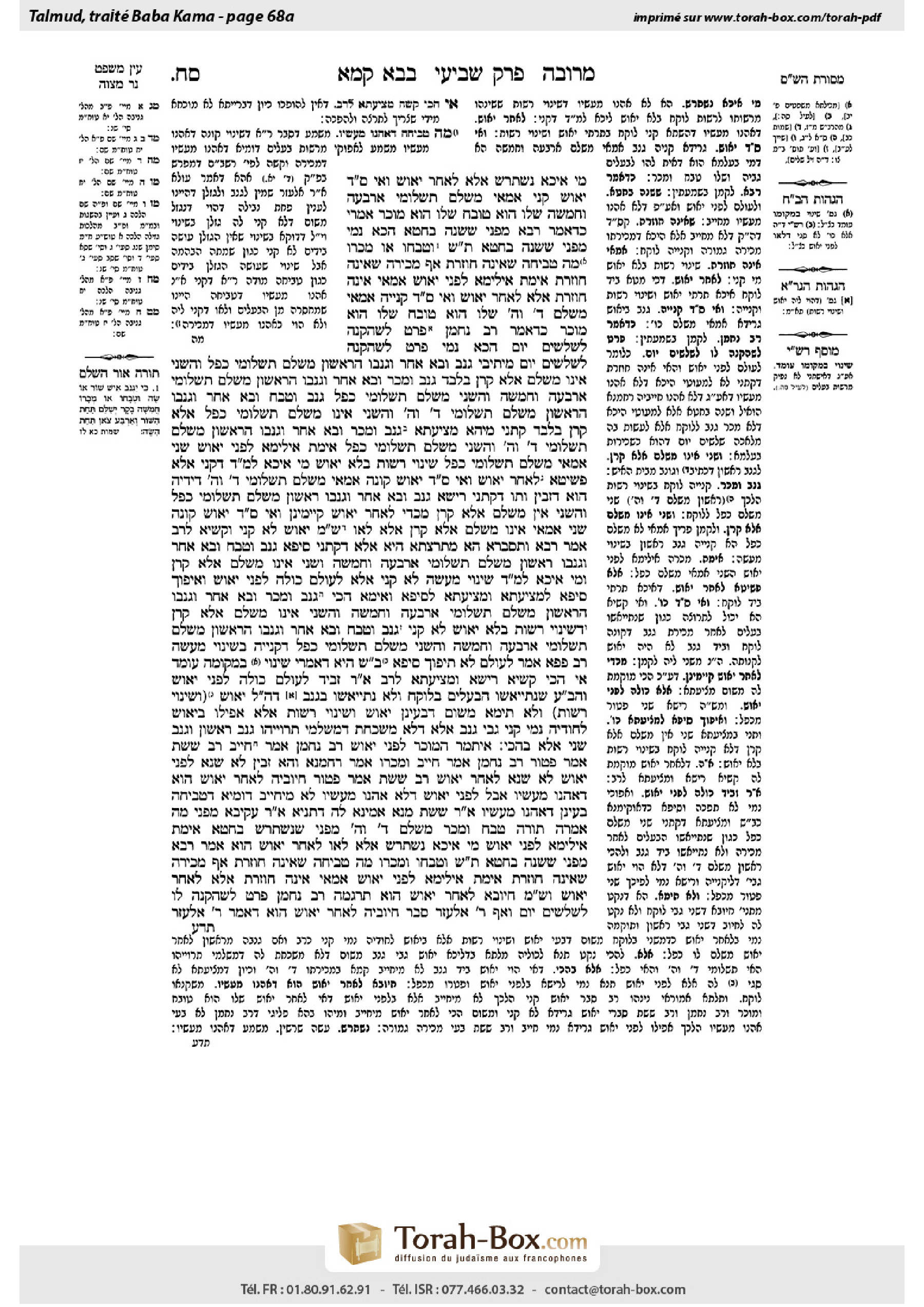
Bava Kamma 68a: Talmud study for Daf Yomi
Study the Talmud for Daf Yomi with scanned pages, Hebrew text, English translations from Sefaria and AI-generated French translations.
Passage selection and English or AI-generated French translation are available where the scan has annotations. Daf Study is independent of Torah-Box and Sefaria.
Browse Bava Kamma · בבא קמא · All tractatesBava Kamma 68a text and translations
This page of Bava Kamma includes the Aramaic text, an English translation and an AI-generated French translation, alongside the scan above.
בבא קמא ס״ח א · Aramaic and Hebrew text
מִי אִיכָּא נִשְׁתָּרֵשׁ? אֶלָּא לְאַחַר יֵאוּשׁ. וְאִי סָלְקָא דַעְתָּךְ יֵאוּשׁ קָנֵי, אַמַּאי מְשַׁלֵּם תַּשְׁלוּמֵי אַרְבָּעָה וַחֲמִשָּׁה? שֶׁלּוֹ הוּא טוֹבֵחַ, שֶׁלּוֹ הוּא מוֹכֵר!
אָמְרִי, כִּדְאָמַר רָבָא: מִפְּנֵי שֶׁשָּׁנָה בַּחֵטְא; הָכָא נָמֵי, מִפְּנֵי שֶׁשָּׁנָה בַּחֵטְא.
תָּא שְׁמַע: ״וּטְבָחוֹ אוֹ מְכָרוֹ״; מַה טְבִיחָה – שֶׁאֵינָהּ חוֹזֶרֶת, אַף מְכִירָה – שֶׁאֵינָהּ חוֹזֶרֶת.
אֵימַת? אִילֵּימָא לִפְנֵי יֵאוּשׁ, אַמַּאי אֵינָהּ חוֹזֶרֶת? אֶלָּא לְאַחַר יֵאוּשׁ. וְאִי סָלְקָא דַעְתָּךְ קַנְיֵיהּ, אַמַּאי מְשַׁלֵּם אַרְבָּעָה וַחֲמִשָּׁה? שֶׁלּוֹ הוּא טוֹבֵחַ, שֶׁלּוֹ הוּא מוֹכֵר!
כִּדְאָמַר רַב נַחְמָן: פְּרָט לְשֶׁהִקְנָה לִשְׁלשִׁים יוֹם, הָכָא נָמֵי, פְּרָט לְשֶׁהִקְנָה לִשְׁלשִׁים יוֹם.
מֵיתִיבִי: גָּנַב וּבָא אַחֵר וּגְנָבוֹ – הָרִאשׁוֹן מְשַׁלֵּם תַּשְׁלוּמֵי כֶפֶל, וְהַשֵּׁנִי אֵינוֹ מְשַׁלֵּם אֶלָּא קֶרֶן בִּלְבָד.
גָּנַב וּמָכַר, וּבָא אַחֵר וּגְנָבוֹ – הָרִאשׁוֹן מְשַׁלֵּם תַּשְׁלוּמֵי אַרְבָּעָה וַחֲמִשָּׁה, וְהַשֵּׁנִי מְשַׁלֵּם תַּשְׁלוּמֵי כֶפֶל. גָּנַב וְטָבַח, וּבָא אַחֵר וּגְנָבוֹ – הָרִאשׁוֹן מְשַׁלֵּם תַּשְׁלוּמֵי אַרְבָּעָה וַחֲמִשָּׁה, וְהַשֵּׁנִי אֵינוֹ מְשַׁלֵּם תַּשְׁלוּמֵי כֶפֶל, אֶלָּא קֶרֶן בִּלְבָד.
קָתָנֵי מִיהָא מְצִיעֲתָא: גָּנַב וּמָכַר, וּבָא אַחֵר וּגְנָבוֹ – הָרִאשׁוֹן מְשַׁלֵּם תַּשְׁלוּמֵי אַרְבָּעָה וַחֲמִשָּׁה, וְהַשֵּׁנִי מְשַׁלֵּם תַּשְׁלוּמֵי כֶפֶל.
אֵימַת? אִילֵּימָא לִפְנֵי יֵאוּשׁ, שֵׁנִי אַמַּאי מְשַׁלֵּם תַּשְׁלוּמֵי כֶפֶל? שִׁינּוּי רְשׁוּת בְּלֹא יֵאוּשׁ מִי אִיכָּא לְמַאן דְּאָמַר דְּקָנֵי?
אֶלָּא פְּשִׁיטָא לְאַחַר יֵאוּשׁ. וְאִי סָלְקָא דַעְתָּךְ יֵאוּשׁ קוֹנֶה, אַמַּאי מְשַׁלֵּם תַּשְׁלוּמֵי אַרְבָּעָה וַחֲמִשָּׁה? דִּידֵיהּ הוּא דְּזַבֵּין!
וְתוּ, דְּקָתָנֵי רֵישָׁא: גָּנַב, וּבָא אַחֵר וּגְנָבוֹ – רִאשׁוֹן מְשַׁלֵּם תַּשְׁלוּמֵי כֶפֶל, וְהַשֵּׁנִי אֵין מְשַׁלֵּם אֶלָּא קֶרֶן.
מִכְּדֵי לְאַחַר יֵאוּשׁ קָיְימִינַן; וְאִי סָלְקָא דַעְתָּךְ יֵאוּשׁ קוֹנֶה, שֵׁנִי אַמַּאי אֵינוֹ מְשַׁלֵּם אֶלָּא קֶרֶן? אֶלָּא לָאו שְׁמַע מִינַּהּ יֵאוּשׁ לָא קָנֵי, וְקַשְׁיָא לְרַב?
אָמַר רָבָא: וְתִסְבְּרָא הָא מְתָרַצְתָּא הִיא?! אֶלָּא דְּקָתָנֵי סֵיפָא: גָּנַב וְטָבַח, וּבָא אַחֵר וּגְנָבוֹ – רִאשׁוֹן מְשַׁלֵּם תַּשְׁלוּמֵי אַרְבָּעָה וַחֲמִשָּׁה, וְשֵׁנִי אֵינוֹ מְשַׁלֵּם אֶלָּא קֶרֶן; וּמִי אִיכָּא לְמַאן דְּאָמַר שִׁינּוּי מַעֲשֶׂה לָא קָנֵי?
אֶלָּא לְעוֹלָם כּוּלַּהּ לִפְנֵי יֵאוּשׁ, וְאֵיפוֹךְ סֵיפָא לִמְצִיעֲתָא וּמְצִיעֲתָא לְסֵיפָא, וְאֵימָא הָכִי: גָּנַב וּמָכַר, וּבָא אַחֵר וּגְנָבוֹ – הָרִאשׁוֹן מְשַׁלֵּם תַּשְׁלוּמֵי אַרְבָּעָה וַחֲמִשָּׁה, וְהַשֵּׁנִי אֵינוֹ מְשַׁלֵּם אֶלָּא קֶרֶן – דְּשִׁינּוּי רְשׁוּת בְּלֹא יֵאוּשׁ לָא קָנֵי.
גָּנַב וְטָבַח, וּבָא אַחֵר וּגְנָבוֹ – הָרִאשׁוֹן מְשַׁלֵּם תַּשְׁלוּמֵי אַרְבָּעָה וַחֲמִשָּׁה, וְהַשֵּׁנִי מְשַׁלֵּם תַּשְׁלוּמֵי כֶפֶל; דְּקַנְיֵיהּ בְּשִׁינּוּי מַעֲשֶׂה.
רַב פָּפָּא אָמַר: לְעוֹלָם לָא תֵּיפוֹךְ; סֵיפָא בֵּית שַׁמַּאי הִיא, דְּאָמְרִי: שִׁינּוּי בִּמְקוֹמוֹ עוֹמֵד.
אִי הָכִי, קַשְׁיָא רֵישָׁא וּמְצִיעֲתָא לְרַב!
אָמַר רַב זְבִיד: לְעוֹלָם כּוּלַּהּ לִפְנֵי יֵאוּשׁ, וְהָכָא בְּמַאי עָסְקִינַן – שֶׁנִּתְיָיאֲשׁוּ הַבְּעָלִים בְּלוֹקֵחַ וְלֹא נִתְיָיאֲשׁוּ בְּגַנָּב, דְּהָוֵה לֵיהּ יֵאוּשׁ וְשִׁינּוּי רְשׁוּת.
וְלָא תֵּימָא מִשּׁוּם דְּבָעֵינַן יֵאוּשׁ וְשִׁינּוּי רְשׁוּת, אֶלָּא אֲפִילּוּ בְּיֵאוּשׁ לְחוֹדֵיהּ נָמֵי קָנֵי גַּבֵּי גַנָּב;
אֶלָּא דְּלָא מַשְׁכַּחַתְּ דִּמְשַׁלְּמִי תַּרְוַיְיהוּ גַּנָּב רִאשׁוֹן וְגַנָּב שֵׁנִי, אֶלָּא בְּהָכִי.
אִיתְּמַר: הַמּוֹכֵר לִפְנֵי יֵאוּשׁ – רַב נַחְמָן אָמַר: חַיָּיב, רַב שֵׁשֶׁת אָמַר: פָּטוּר.
רַב נַחְמָן אָמַר חַיָּיב – ״וּמְכָרוֹ״ אָמַר רַחֲמָנָא, וְהָא זַבֵּין; לָא שְׁנָא לִפְנֵי יֵאוּשׁ, לָא שְׁנָא לְאַחַר יֵאוּשׁ. רַב שֵׁשֶׁת אָמַר פָּטוּר – חִיּוּבֵיהּ לְאַחַר יֵאוּשׁ הוּא, דְּאַהֲנוֹ מַעֲשָׂיו; אֲבָל לִפְנֵי יֵאוּשׁ דְּלָא אַהֲנוֹ מַעֲשָׂיו – לָא מִיחַיַּיב; דֻּומְיָא דִּטְבִיחָה בָּעֵינַן, דְּאַהֲנוֹ מַעֲשָׂיו.
אָמַר רַב שֵׁשֶׁת: מְנָא אָמֵינָא לָהּ? דְּתַנְיָא, אָמַר רַבִּי עֲקִיבָא: מִפְּנֵי מָה אָמְרָה תּוֹרָה טָבַח וּמָכַר מְשַׁלֵּם אַרְבָּעָה וַחֲמִשָּׁה? מִפְּנֵי שֶׁנִּשְׁתָּרֵשׁ בַּחֵטְא.
אֵימַת? אִילֵּימָא לִפְנֵי יֵאוּשׁ, מִי אִיכָּא נִשְׁתָּרֵשׁ? אֶלָּא לָאו לְאַחַר יֵאוּשׁ הוּא? אָמַר רָבָא: מִפְּנֵי שֶׁשָּׁנָה בַּחֵטְא.
תָּא שְׁמַע: ״וּטְבָחוֹ וּמְכָרוֹ״; מָה טְבִיחָה – שֶׁאֵינָהּ חוֹזֶרֶת, אַף מְכִירָה – שֶׁאֵינָהּ חוֹזֶרֶת. אֵימַת? אִילֵּימָא לִפְנֵי יֵאוּשׁ, אַמַּאי אֵינָהּ חוֹזֶרֶת? אֶלָּא לְאַחַר יֵאוּשׁ – וּשְׁמַע מִינַּהּ חִיּוּבָא לְאַחַר יֵאוּשׁ הוּא! תַּרְגְּמַהּ רַב נַחְמָן: פְּרָט לְשֶׁהִקְנָה לוֹ לִשְׁלשִׁים יוֹם.
וְאַף רַבִּי אֶלְעָזָר סָבַר חִיּוּבֵיהּ לְאַחַר יֵאוּשׁ הוּא, דְּאָמַר רַבִּי אֶלְעָזָר:
Bava Kamma 68a · English translation
is it possible to say that there is any entrenchment in sin? The sale does not take effect, as it occurred before the owner despaired, which means that the thief did not in fact deepen his sin by selling the animal. Rather, it must be that the sale occurred after the owner’s despair. And if it enters your mind that the owner’s despair causes the thief to acquire the animal, why does he pay the fourfold or fivefold payment? Since the animal belongs to him after the owner’s despair, in effect he slaughters his own animal or sells his own animal.
The Sages say: It is possible to explain the term: Entrenched in sin, in accordance with what Rava said: The thief is liable because he repeated his sin, i.e., he sinned a second time by going through the motions of the sale, regardless of the fact the sale was not legally binding. Here too, one can say that the thief is liable because he repeated his sin.
The Gemara suggests: Come and hear a proof from a baraita: It is written: “If a man steal an ox or a sheep, and slaughter it or sell it” (Exodus 21:37). Just as slaughter is an act that cannot be undone, so too the selling referred to here is an act that cannot be undone.
The Gemara analyzes the baraita: Now, when is a sale irreversible? If we say this sale occurred before the owner’s despair of recovering his stolen animal, why can it not be undone? Since the thief’s sale of the animal before the owner’s despair is ineffective, the sale is easily undone. Rather, the baraita must be speaking about a case where the thief sold the animal after the owner’s despair. And if it enters your mind that a thief acquires a stolen item after the owner’s despair, why does he pay the fourfold or fivefold payment for slaughtering or selling the animal at this point? He slaughters his own animal or he sells his own animal. Apparently, a thief does not acquire the stolen item after the owner’s despair.
The Gemara rejects this proof: The explanation for this baraita is as Rav Naḥman said in reference to a different baraita. Rav Naḥman said that when that baraita speaks of a sale that cannot be undone, this excludes one who transferred ownership of the animal to another in a temporary manner, e.g., for thirty days. Here too, one can answer in the same way, that it excludes one who transferred ownership of the animal for thirty days. Accordingly, if one sold the animal permanently, even if the sale was performed before the owner despaired and is therefore not legally binding, he is nevertheless required to pay the fourfold or fivefold payment.
The Gemara raises an objection from another baraita: If one stole an animal, and another person subsequently came and stole it from him, the first thief pays double payment to the owner, and the second thief pays only the principal to the first thief. This is because one who steals from a thief does not pay the double payment, as the mishna teaches.
If one stole an animal and sold it, and another individual came and stole it from the purchaser, the first thief pays the fourfold or fivefold payment to the owner, and the second thief pays the double payment to the purchaser, who has become the new owner of the animal. If one stole an animal and slaughtered it, and another person came and stole the slaughtered animal, the first thief pays the fourfold or fivefold payment to the owner, and the second thief does not pay the double payment but only the principal, in accordance with the halakha that one who steals from a thief does not pay the double payment.
The Gemara analyzes this baraita: In any event, the baraita teaches in the middle clause: If one stole an animal and sold it, and another came and stole it from the purchaser, the first thief pays the fourfold or fivefold payment to the owner, and the second thief pays the double payment to the purchaser.
When did this sale occur? If we say it happened before the owner’s despair, why does the second thief pay the double payment to the purchaser? Is there anyone who says that a change in possession of a stolen item, i.e., when it leaves the possession of the thief and enters the possession of another, without the additional factor of the owner’s despair, causes the one who has it to acquire the item? There is no such opinion. Therefore, the so-called purchaser of the animal does not become its owner, as the sale is invalid. This should be considered as a case of one who steals from a thief, and consequently there should be no double payment.
Rather, it is obvious that the sale occurred after the owner’s despair. And if it enters your mind that a thief acquires a stolen item after the owner’s despair, why should the first thief pay the fourfold or fivefold payment? After all, it is his own animal that he sold, having acquired it immediately upon the owner’s despair.
And furthermore, consider that which the baraita teaches in the first clause: If one stole an animal, and another subsequently came and stole it from him, the first thief pays the double payment to the owner, and the second thief pays only the principal to the first thief.
Now, in this baraita we are dealing with a situation after the owner’s despair, as the Gemara just established. And if it enters your mind that the owner’s despair causes the thief to acquire the item, why does the second thief pay only the principal? After the owner has despaired of recovering his item, the thief becomes the owner of the item, and the second thief should have to pay him double payment for stealing his property. Rather, must one not conclude from the baraita that the owner’s despair does not cause the thief to acquire the item? And this presents a difficulty to the opinion of Rav.
Rava said: And can you understand that the text of this baraita is accurate? But consider that which it teaches in the last clause: If one stole an animal and slaughtered it, and another came and stole the slaughtered animal, the first thief pays the fourfold or fivefold payment to the owner, and the second thief pays only the principal to the first thief. And is there anyone who says that a physical change brought about by an action does not cause the thief to acquire the item? There is no such opinion; the thief certainly becomes the owner of the animal after slaughtering it. Consequently, the second thief should have to pay the double payment to the thief for stealing his slaughtered animal. It must therefore be concluded that the text of the baraita has been corrupted and must be reformulated.
Rather, actually the entire baraita is referring to the stage before the owner’s despair. And you must reverse the halakha stated in the last clause with that stated in the middle clause, and reverse the halakha stated in the middle clause with that stated in the last clause, and say like this: If one stole an animal and sold it, and another came and stole it from the purchaser, the first thief pays the fourfold or fivefold payment to the owner, and the second thief pays only the principal to the purchaser, as a change in possession without the additional factor of owner’s despair does not cause one to acquire the item.
If one stole an animal and slaughtered it, and another came and stole the slaughtered animal, the first thief pays the fourfold or fivefold payment to the owner, and the second thief pays the double payment to the first thief, as the first thief acquired it through the physical change brought about by an action, i.e., slaughter.
Rav Pappa said: Actually, do not reverse the middle and last clauses of the baraita. With regard to the difficult last clause, it is in accordance with the opinion of Beit Shammai, who say: Even if an item has undergone a physical change, it remains in its place, i.e., a stolen item remains the property of the owner. A thief never attains ownership of it, even if it undergoes a physical change.
The Gemara asks: If so, if the baraita is not reversed, and if it is referring to the stage after the owner’s despair, then the first clause and the middle clause of the baraita present a difficulty to the opinion of Rav, who maintains that after the owner’s despair the item belongs entirely to the thief.
Rav Zevid said: Actually, the entire baraita is dealing with the stage before the owner’s despair. And with what are we dealing here, in the middle clause of the baraita? We are dealing with a case where the owners despaired of recovering the item when it was already in the possession of the purchaser, but they had not yet despaired when the item was in the possession of the thief. The purchaser is considered the owner because after the despair occurred, there were two factors in play, both the owner’s despair and a change in possession. The combination of these two factors effects acquisition of the item on behalf of the purchaser.
Rav Zevid continues: And do not say that in the middle clause the reason the owner’s item is acquired by another is only because we require two factors, i.e., the owner’s despair and change of possession. Rather, even in a case of the owner’s despair by itself, the item is acquired by the thief, in accordance with Rav’s opinion that despair alone effects acquisition on behalf of the thief.
Nevertheless, the baraita chose a case in which both of these factors are present because you will not find a case in which both of them, the first thief and the second thief, pay a penalty except in such a case. The first thief pays the fourfold or fivefold payment, and the second thief pays the double payment. Had the owner despaired before the sale, the first thief would have been considered the owner and would therefore be exempt from the additional payment.
§ It was stated: With regard to a thief who sells a stolen animal before the owner’s despair, Rav Naḥman says: He is liable to pay the fourfold or fivefold payment, despite the fact that the sale is invalid. Rav Sheshet says: He is exempt from this payment.
The two amora’im explain the reasons for their respective rulings. Rav Naḥman says: He is liable, because the Merciful One states with regard to the fourfold or fivefold payment: “And slaughter it or sell it” (Exodus 21:37), and he has sold it. There is no difference if the sale occurs before despair, and there is no difference if it takes place after despair. Rav Sheshet says: He is exempt, as his liability is in effect only if he sells the animal after the owner’s despair, when his action, i.e., the sale, is effective. But if he sells it before the owner’s despair, when his action is not effective, he is not liable, as we require that the sale be similar to the slaughter, as they are mentioned together, and when he slaughters the animal his action is effective.
Rav Sheshet said: From where do I say he is exempt? As it is taught in a baraita that Rabbi Akiva said: For what reason did the Torah say that a thief who slaughtered or sold a stolen animal pays the fourfold or fivefold payment? It is because he has become entrenched in sin by slaughtering or selling the animal he stole.
Rav Sheshet analyzes the baraita: When did this sale, referred to by Rabbi Akiva, occur? If we say that it happened before the owner’s despair, is it possible that there is any entrenchment in sin here? A sale before the owner’s despair is invalid, which means there is no deepening of his earlier sin. Rather, is it not the case that this is referring to a sale after the owner’s despair? Rava said: This is not a proof, as one can explain that the thief is entrenched in sin because he repeated his sin, i.e. sinned a second time, by his act of sale, regardless of the fact that the sale is invalid.
The Gemara suggests: Come and hear a proof for the opinion of Rav Sheshet from a different baraita: It is written: “And slaughter it or sell it” (Exodus 21:37). Just as slaughter is an act that cannot be undone, so too the selling referred to here is an act that cannot be undone. The Gemara analyzes this baraita: When did this sale take place? If we say that it happened before the owner’s despair of recovering his stolen item, why can it not be undone? The thief’s sale of the animal is invalid before the owner’s despair, and therefore the sale is easily undone. Rather, it must be referring to a sale that took place after the owner’s despair. And one can conclude from the baraita that there is liability to pay the fourfold or fivefold payment only if the animal is sold after the owner’s despair. Rav Naḥman rejected this proof, as he interpreted that baraita as serving to exclude one who transferred ownership of the animal temporarily, e.g., for thirty days.
The Gemara adds: And Rabbi Elazar also holds that the liability of a thief to pay the fourfold or fivefold payment applies if he sells it after the owner’s despair of recovering his stolen animal, as Rabbi Elazar says:
Bava Kamma 68a · Traduction française (IA)
Est-il possible de dire qu'il y a un enracinement dans le péché ? La vente ne prend effet, car cela s'est produit avant que l'owner ne perde espoir, ce qui signifie que le voleur n'a pas en effet aggravé son péché en vendant l'animal. Plutôt, il faut dire que la vente s'est produite après le désespoir de l'owner. Et si vous pensez que le désespoir de l'owner permet au voleur d'acquérir l'animal, pourquoi alors paie-t-il le quatre fois ou cinq fois ? Puisque l'animal appartient à lui après le désespoir de l'owner, en effet il sacrifie son propre animal ou le vend son propre animal.
Les Sages disent : Il est possible d'expliquer le terme : enraciné dans le péché, conformément à ce que Rava a dit : le voleur est responsable car il a répété son péché, c'est-à-dire qu'il a péché une seconde fois en faisant semblant de vendre, indépendamment du fait que la vente ne soit pas juridiquement valide. Ici aussi, on peut dire que le voleur est responsable car il a répété son péché.
Le Guemara suggère : Venez écouter une preuve à partir d'une baraïta : Il est écrit : « Si un homme vole un bœuf ou une brebis, et le sacrifie ou le vend » (Lévitique 21:37). Tout comme le sacrifice est une action irréversible, de même la vente mentionnée ici est une action irréversible.
Le Guemara analyse la baraïta : Maintenant, quand une vente est irréversible ? Si nous disons que cette vente s'est produite avant que l'propriétaire ne perde espoir de récupérer son animal volé, pourquoi ne peut-elle pas être annulée ? Puisque la vente de l'animal par le voleur avant le désespoir de l'propriétaire est inefficace, la vente est facilement annulable. Plutôt, la baraïta doit parler d'un cas où le voleur a vendu l'animal après le désespoir de l'propriétaire. Et si vous pensez que le voleur acquiert un objet volé après le désespoir de l'propriétaire, pourquoi alors paie-t-il le quatre fois ou cinq fois pour sacrifier ou vendre l'animal à ce moment ? Il sacrifie son propre animal ou il vend son propre animal. Apparemment, un voleur ne peut pas acquérir l'objet volé après le désespoir de l'propriétaire.
Le Guemara rejette cette preuve : L'explication de cette baraïta est, comme Rav Naḥman l'a dit à propos d'une autre baraïta. Rav Naḥman disait que lorsque cette baraïta parle d'une vente irréversible, cela exclut celui qui a transféré la propriété de l'animal à un autre de manière temporaire, par exemple pendant trente jours. Ici aussi, on peut répondre de la même manière, que cela exclut celui qui a transféré la propriété de l'animal pendant trente jours. Ainsi, si l'on a vendu l'animal de manière permanente, même si la vente s'est produite avant que l'propriétaire ne perde espoir et n'est donc pas juridiquement valide, il faut tout de même payer le quatre fois ou cinq fois.
Le Guemara soulève une objection à partir d'une autre baraïta : Si l'on a volé un animal, et qu'un autre personne est ensuite venu le voler à son tour, le premier voleur paie double à l'propriétaire, et le second voleur paie seulement le principal au premier voleur. Cela est dû au fait que celui qui vole un voleur ne paie pas double, comme le mishna l'enseigne.
Si l'on a volé un animal et l'a vendu, et qu'une autre personne vient le voler à l'acheteur, le premier voleur paie au propriétaire le quatre fois ou le cinq fois, et le second voleur paie au acheteur le double, qui est devenu le nouveau propriétaire de l'animal. Si l'on a volé un animal et l'a sacrifié, et qu'une autre personne vient voler l'animal sacrifié, le premier voleur paie au propriétaire le quatre fois ou le cinq fois, et le second voleur ne paie pas le double mais seulement le principal, conformément à la halakha qui stipule que celui qui vole un voleur ne paie pas le double.
Le Guemara analyse cette baraïta : En tout cas, la baraïta enseigne dans la clause intermédiaire : Si l'on a volé un animal et l'a vendu, et qu'une autre personne vient le voler à l'acheteur, le premier voleur paie au propriétaire le quatre fois ou le cinq fois, et le second voleur paie au acheteur le double.
Quand cette vente s'est-elle produite ? Si nous disons qu'elle s'est produite avant le désespoir du propriétaire, pourquoi le second voleur paie-t-il le double à l'acheteur ? Y a-t-il quelqu'un qui affirme que le changement de possession d'un objet volé, c'est-à-dire quand il quitte la possession du voleur et entre dans la possession d'un autre, sans le facteur supplémentaire du désespoir du propriétaire, cause l'acquisition de l'objet par celui qui l'a ? Il n'y a pas telle opinion. Ainsi, le soi-disant acheteur de l'animal ne devient pas son propriétaire, puisque la vente est invalide. Cela devrait être considéré comme un cas de celui qui vole un voleur, et par conséquent il ne devrait pas y avoir de double paiement.
Plutôt, il est évident que la vente s'est produite après le désespoir de l'propriétaire. Et si vous pensez que le voleur acquiert un objet volé après le désespoir de l'propriétaire, pourquoi le premier voleur paie-t-il le quatre fois ou cinq fois ? Après tout, c'est son propre animal qu'il a vendu, ayant acquis l'animal immédiatement après le désespoir de l'propriétaire.
Et de plus, considérez ce que la baraïta enseigne dans la première clause : Si l'on a volé un animal, et qu'une autre personne est venue le voler à son tour, le premier voleur paie le double à l'propriétaire, et le second voleur paie seulement le principal au premier voleur.
Maintenant, dans cette baraïta nous sommes en situation après le désespoir de l'propriétaire, comme le Guemara vient de l'établir. Et si vous pensez que le désespoir de l'propriétaire permet au voleur d'acquérir l'objet, pourquoi le second voleur paie-t-il seulement le principal ? Après que l'propriétaire ait perdu espoir de récupérer son objet, le voleur devient le propriétaire de l'objet, et le second voleur devrait payer double au voleur pour voler son bien. Plutôt, ne devons-nous pas conclure de la baraïta que le désespoir de l'propriétaire ne permet pas au voleur d'acquérir l'objet ? Et cela présente une difficulté à l'opinion de Rav.
Rava a dit : Et pouvez-vous comprendre que le texte de cette baraïta est exact ? Mais considérez ce que dit la dernière clause : Si l'on vole un animal et le tue, et qu'un autre vient et vole l'animal tué, le premier voleur paie la réparation quadruple ou quintuple à l'owner, et le second voleur paie seulement le principal au premier voleur. Et y a-t-il quelqu'un qui dise que le changement physique causé par une action ne cause pas au voleur d'acquérir l'objet ? Il n'y a pas d'opinion semblable ; le voleur devient certainement propriétaire de l'animal après avoir tué l'animal. Par conséquent, le second voleur devrait avoir à payer la réparation double au voleur pour avoir volé son animal tué. Il faut donc conclure que le texte de la baraïta a été corrompu et doit être reformulé.
Plutôt, en réalité, toute la baraïta fait référence à la phase avant l'abandon de l'owner. Et vous devez inverser la halakha énoncée dans la dernière clause avec celle énoncée dans la clause du milieu, et inverser la halakha énoncée dans la clause du milieu avec celle énoncée dans la dernière clause, et dire ainsi : Si l'on vole un animal et le vend, et qu'un autre vient et le vole au vendeur, le premier voleur paie la réparation quadruple ou quintuple à l'owner, et le second voleur paie seulement le principal au vendeur, car un changement de possession sans le facteur supplémentaire de l'abandon de l'owner ne cause pas l'acquisition de l'objet.
Si l'on vole un animal et le tue, et qu'un autre vient et vole l'animal tué, le premier voleur paie la réparation quadruple ou quintuple à l'owner, et le second voleur paie la réparation double au premier voleur, car le premier voleur a acquis l'animal grâce au changement physique causé par une action, c'est-à-dire la mise à mort.
Rav Pappa a dit : En réalité, ne révérsez pas les clauses du milieu et de la fin de la baraïta. En ce qui concerne la difficile dernière clause, elle est selon l'opinion de Beit Shammai, qui disent : Même si un objet a subi un changement physique, il reste à sa place, c'est-à-dire un objet volé reste la propriété de l'owner. Le voleur ne devient jamais propriétaire de lui, même s'il subit un changement physique.
La Guemara pose la question : Si c'est ainsi, si la baraïta n'est pas inversée, et si elle fait référence à la phase après l'abandon de l'owner, alors la première clause et la clause du milieu de la baraïta posent un problème à l'opinion de Rav, qui maintient que, après l'abandon de l'owner, l'objet appartient entièrement au voleur.
Rav Zevid a dit : En réalité, toute la baraïta traite de la phase avant l'abandon de l'owner. Et avec quoi sommes-nous ici, dans la clause du milieu de la baraïta ? Nous sommes dans un cas où les propriétaires ont désespéré de récupérer l'objet lorsqu'il était déjà en possession du vendeur, mais ils n'avaient pas encore désespéré lorsqu'il était en possession du voleur. Le vendeur est considéré comme le propriétaire, car après que l'abandon a eu lieu, deux facteurs étaient en jeu, à la fois l'abandon de l'owner et un changement de possession. La combinaison de ces deux facteurs entraîne l'acquisition de l'objet au nom du vendeur.
Rav Zevid continue : Et ne dites pas que dans la clause du milieu la raison pour laquelle l'objet de l'propriétaire est acquis par un autre est seulement parce que nous exigeons deux facteurs, c'est-à-dire l'abandon de l'propriétaire et un changement de possession. Plutôt, même dans un cas d'abandon de l'propriétaire seul, l'objet est acquis par le voleur, conformément à l'opinion de Rav que l'abandon seul entraîne l'acquisition au nom du voleur.
Cependant, la baraïta a choisi un cas où ces deux facteurs sont présents, car vous ne trouverez pas de cas où les deux voleurs, le premier et le second, paient une amende, sauf dans un tel cas. Le premier voleur paie la réparation quadruple ou quintuple, et le second voleur paie la réparation double. Si l'propriétaire avait désespéré avant la vente, le premier voleur aurait été considéré comme le propriétaire et serait donc exempt de la réparation supplémentaire.
§ Il a été dit : En ce qui concerne un voleur qui vend un animal volé avant l'abandon de l'propriétaire, Rav Naḥman dit : Il est tenu responsable de payer la réparation quadruple ou quintuple, malgré le fait que la vente est nulle. Rav Sheshet dit : Il est exempt de cette réparation.
Les deux amora’im expliquent les raisons de leurs décisions respectives. Rav Naḥman dit : Il est tenu responsable, car l'Éternel Miséricordieux dit concernant la réparation quadruple ou quintuple : « Et tu le tues ou le vends » (Exode 21:37), et il l'a vendu. Il n'y a pas de différence si la vente a lieu avant l'abandon, et il n'y a pas de différence si elle a lieu après l'abandon. Rav Sheshet dit : Il est exempt, car sa responsabilité est en vigueur uniquement s'il vend l'animal après l'abandon de l'propriétaire, lorsque son action, c'est-à-dire la vente, est efficace. Mais si il le vend avant l'abandon de l'propriétaire, lorsque son action n'est pas efficace, il n'est pas tenu responsable, car nous exigeons que la vente soit semblable à la mise à mort, car elles sont mentionnées ensemble, et lorsque il tue l'animal, son action est efficace.
Rav Sheshet a dit : D'où dis-je qu'il est exempt ? Comme il est enseigné dans une baraïta que Rabbi Akiva a dit : Pour quelle raison la Torah dit qu'un voleur qui a tué ou vendu un animal volé paie la réparation quadruple ou quintuple ? C'est parce qu'il s'est enraciné dans le péché en tuant ou en vendant l'animal qu'il a volé.
Rav Sheshet analyse la baraïta : À quel moment a eu lieu cette vente, mentionnée par Rabbi Akiva ? Si nous disons qu'elle a eu lieu avant l'abandon de l'propriétaire, est-il possible qu'il y ait un enracinement dans le péché ici ? Une vente avant l'abandon de l'propriétaire est nulle, ce qui signifie qu'il n'y a pas d'approfondissement de son péché initial. Plutôt, n'est-ce pas le cas que cela fait référence à une vente après l'abandon de l'propriétaire ? Rava a dit : Ce n'est pas une preuve, car on peut expliquer que le voleur s'est enraciné dans le péché parce qu'il a commis un second péché, c'est-à-dire son acte de vente, indépendamment du fait que la vente soit nulle.
La Guemara suggère : Viens entendre une preuve pour l'opinion de R. Šeshet à partir d'une autre baraïta : Il est écrit : « Et tu le tues ou le vends » (Exode 21:37). Tout comme tuer est une action qui ne peut être annulée, de même le virement mentionné ici est une action qui ne peut être annulée. La Guemara analyse cette baraïta : À quel moment a eu lieu cette vente ? Si l'on dit qu'elle s'est produite avant que l'propriétaire ne perde espoir de récupérer son animal volé, pourquoi ne peut-elle pas être annulée ? La vente du bétail par le voleur est invalide avant que l'propriétaire ne perde espoir, et par conséquent la vente peut être facilement annulée. Plutôt, il doit s'agir d'une vente qui s'est produite après que l'propriétaire ait perdu espoir. Et l'on peut conclure de cette baraïta que la responsabilité de payer la réparation quadruple ou quintuple s'applique uniquement si l'animal est vendu après que l'propriétaire ait perdu espoir. R. Naḥman a rejeté cette preuve, car il interprétait cette baraïta comme visant à exclure celui qui transfère temporairement la propriété de l'animal, par exemple pendant trente jours.
La Guemara ajoute : Et R. Eléazar également maintient que la responsabilité du voleur de payer la réparation quadruple ou quintuple s'applique si l'on vend l'animal après que l'propriétaire ait perdu espoir de le récupérer, comme dit R. Eléazar :
Traduction française générée par IA à partir de l’édition anglaise de Sefaria. Vérifie toujours un passage avec le texte source.
Text from Sefaria: William Davidson Edition - Vocalized Aramaic (CC BY NC); William Davidson Edition - English (CC BY NC).