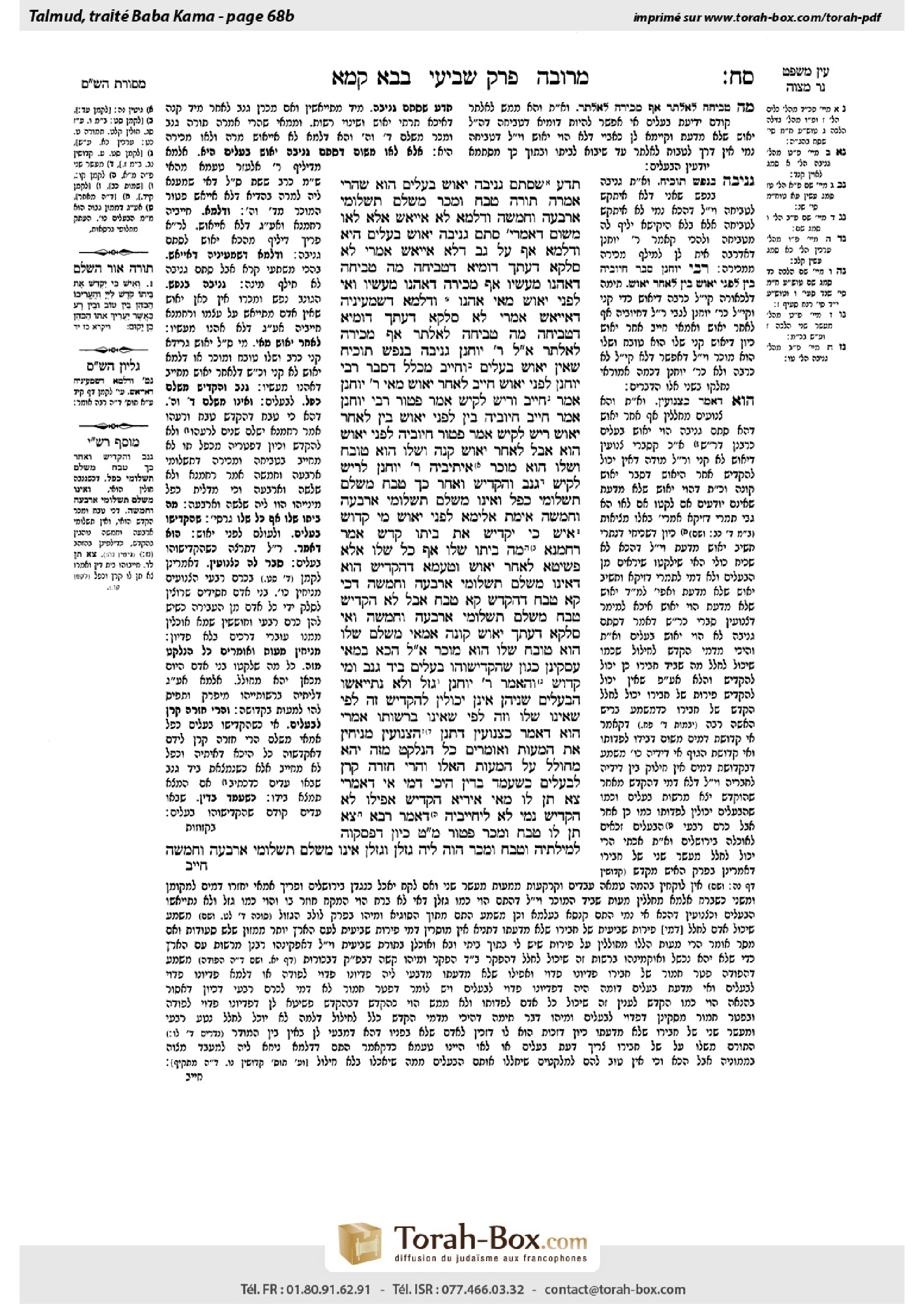
Bava Kamma 68b: Talmud study for Daf Yomi
Study the Talmud for Daf Yomi with scanned pages, Hebrew text, English translations from Sefaria and AI-generated French translations.
Passage selection and English or AI-generated French translation are available where the scan has annotations. Daf Study is independent of Torah-Box and Sefaria.
Browse Bava Kamma · בבא קמא · All tractatesBava Kamma 68b text and translations
This page of Bava Kamma includes the Aramaic text, an English translation and an AI-generated French translation, alongside the scan above.
בבא קמא ס״ח ב · Aramaic and Hebrew text
תֵּדַע שֶׁסְּתָם גְּנֵיבָה יֵאוּשׁ בְּעָלִים הוּא –
שֶׁהֲרֵי אָמְרָה תּוֹרָה: טָבַח וּמָכַר – מְשַׁלֵּם תַּשְׁלוּמֵי אַרְבָּעָה וַחֲמִשָּׁה. וְדִלְמָא לָא אִיָּיאַשׁ! אֶלָּא לָאו מִשּׁוּם דְּאָמְרִינַן: סְתָם גְּנֵיבָה – יֵאוּשׁ בְּעָלִים הִיא.
וְדִלְמָא אַף עַל גַּב דְּלָא אִיָּיאַשׁ!
אָמְרִי: לָא סָלְקָא דַּעְתָּךְ; דּוּמְיָא דִטְבִיחָה – מָה טְבִיחָה דְּאַהֲנוֹ מַעֲשָׂיו, אַף מְכִירָה דְּאַהֲנוֹ מַעֲשָׂיו. וְאִי לִפְנֵי יֵאוּשׁ, מַאי אַהֲנוֹ?
וְדִלְמָא דְּשַׁמְעִינֵיהּ דְּאִיָּיאַשׁ! אָמְרִי: לָא סָלְקָא דַּעְתָּךְ; דּוּמְיָא דִטְבִיחָה – מָה טְבִיחָה לְאַלְתַּר, אַף מְכִירָה לְאַלְתַּר.
אָמַר לוֹ רַבִּי יוֹחָנָן: גְּנֵיבָה בְּנֶפֶשׁ תּוֹכִיחַ – שֶׁאֵין יֵאוּשׁ בְּעָלִים, וְחַיָּיב! מִכְּלָל דְּסָבַר רַבִּי יוֹחָנָן: לִפְנֵי יֵאוּשׁ חַיָּיב.
לְאַחַר יֵאוּשׁ מַאי? רַבִּי יוֹחָנָן אָמַר: חַיָּיב, וְרֵישׁ לָקִישׁ אָמַר: פָּטוּר.
רַבִּי יוֹחָנָן אָמַר חַיָּיב – חִיּוּבֵיהּ בֵּין לִפְנֵי יֵאוּשׁ, בֵּין לְאַחַר יֵאוּשׁ. רֵישׁ לָקִישׁ אָמַר פָּטוּר – חִיּוּבֵיהּ לִפְנֵי יֵאוּשׁ הוּא, אֲבָל לְאַחַר יֵאוּשׁ – קָנָה, וְשֶׁלּוֹ הוּא טוֹבֵחַ וְשֶׁלּוֹ הוּא מוֹכֵר.
אֵיתִיבֵיהּ רַבִּי יוֹחָנָן לְרֵישׁ לָקִישׁ: גָּנַב וְהִקְדִּישׁ, וְאַחַר כָּךְ טָבַח – מְשַׁלֵּם תַּשְׁלוּמֵי כֶפֶל, וְאֵינוֹ מְשַׁלֵּם תַּשְׁלוּמֵי אַרְבָּעָה וַחֲמִשָּׁה.
אֵימַת? אִלֵּימָא לִפְנֵי יֵאוּשׁ, מִי קָדוֹשׁ?! ״אִישׁ כִּי יַקְדִּשׁ אֶת בֵּיתוֹ קֹדֶשׁ״ אָמַר רַחֲמָנָא – מָה בֵּיתוֹ שֶׁלּוֹ, אַף כֹּל שֶׁלּוֹ!
אֶלָּא פְּשִׁיטָא לְאַחַר יֵאוּשׁ; וְטַעְמָא דְּהִקְדִּישׁ הוּא דְּאֵינוֹ מְשַׁלֵּם תַּשְׁלוּמֵי אַרְבָּעָה וַחֲמִשָּׁה, דְּכִי קָא טָבַח – דְּהֶקְדֵּשׁ קָא טָבַח, אֲבָל לֹא הִקְדִּישׁ – טָבַח מְשַׁלֵּם תַּשְׁלוּמֵי אַרְבָּעָה וַחֲמִשָּׁה. וְאִי סָלְקָא דַעְתָּךְ יֵאוּשׁ קוֹנֶה, אַמַּאי מְשַׁלֵּם? שֶׁלּוֹ הוּא טוֹבֵחַ, שֶׁלּוֹ הוּא מוֹכֵר!
אֲמַר לֵיהּ: הָכָא בְּמַאי עָסְקִינַן – כְּגוֹן שֶׁהִקְדִּישׁוּהוּ בְּעָלִים בְּיַד גַּנָּב.
וּמִי קָדוֹשׁ?! וְהָאָמַר רַבִּי יוֹחָנָן: גָּזַל וְלֹא נִתְיָיאֲשׁוּ הַבְּעָלִים – שְׁנֵיהֶן אֵינָן יְכוֹלִין לְהַקְדִּישׁ, זֶה לְפִי שֶׁאֵינוֹ שֶׁלּוֹ, וְזֶה לְפִי שֶׁאֵינוֹ בִּרְשׁוּתוֹ! אָמְרִי: הוּא דְּאָמַר – כִּצְנוּעִין,
דִּתְנַן: הַצְּנוּעִין מַנִּיחִין אֶת הַמָּעוֹת, וְאוֹמְרִים: כׇּל הַנִּלְקָט מִזֶּה, יְהֵא מְחוּלָּל עַל הַמָּעוֹת הָאֵלּוּ.
וַהֲרֵי חָזְרָה קֶרֶן לַבְּעָלִים!
כְּשֶׁעָמַד בַּדִּין.
הֵיכִי דָמֵי? אִי דְּאָמְרִי ״צֵא תֵּן לוֹ״ – מַאי אִירְיָא הִקְדִּישׁ? אֲפִילּוּ לֹא הִקְדִּישׁ נָמֵי לָא לִיחַיְּיבֵיהּ!
דְּאָמַר רָבָא: ״צֵא תֵּן לוֹ״, טָבַח וּמָכַר – פָּטוּר. מַאי טַעְמָא?
כֵּיוָן דְּפַסְקוּהָ לְמִילְּתֵיהּ וְטָבַח וּמָכַר – הָוֵה לֵיהּ גַּזְלָן, וְגַזְלָן אֵינוֹ מְשַׁלֵּם תַּשְׁלוּמֵי אַרְבָּעָה וַחֲמִשָּׁה.
Bava Kamma 68b · English translation
Know that an ordinary case of theft is assumed to result in the owner’s despair of recovering the stolen item. In other words, in the absence of evidence to the contrary, one may assume that the victim of theft has despaired of recovering his item.
The reason is that the Torah stated that if a thief slaughtered or sold the animal he had stolen, he pays the fourfold or fivefold payment. But why is this so? Perhaps the owner did not yet despair at the time the thief sold the animal, in which case the sale is invalid, and there should be no fourfold or fivefold payment. Rather, is it not because we say that an ordinary case of theft is assumed to result in the owner’s despair of recovering the stolen item? This concludes the statement of Rabbi Elazar, which clearly indicates that there is no fourfold or fivefold payment if the animal is sold before the owner’s despair.
The Gemara asks a question with regard to Rabbi Elazar’s assumption: But perhaps the Torah obligates the thief to pay the fourfold or fivefold payment even if the owner has not yet despaired at the time of the sale, despite the fact that the sale is invalid, as Rav Naḥman stated.
In response to this question the Sages say: This cannot enter your mind, as Rabbi Elazar maintains that the juxtaposition of slaughtering and selling in the verse that states: “And slaughter it or sell it,” teaches that the thief’s sale of the animal is similar to his slaughter of it. Just as slaughter is a matter in which his action was effective, so too, the case of selling the animal is one in which his action was effective, i.e., the sale is valid. And if the sale occurred before the owner’s despair, in what sense were his actions effective?
The Gemara asks another question with regard to Rabbi Elazar’s reasoning: But perhaps the Torah requires the fourfold or fivefold payment only in the specific case where the animal is sold after we heard that the owner despaired of its recovery. The Sages respond to this and say: This cannot enter your mind, since, as explained above, the thief’s sale of the animal must be similar to his slaughter of it. Therefore, just as the thief is liable to pay the fourfold or fivefold payment for slaughtering the animal even if he does so immediately, so too, the halakha that he pays the fourfold or fivefold payment for selling it applies even if he does so immediately, before it is known that the owner has despaired of recovering the animal.
Rabbi Yoḥanan said to Rabbi Elazar: The case of stealing a human being, i.e., kidnapping, proves that your reasoning is incorrect. The Torah states: “And he who steals a man and sells him or if he is found in his hand, he shall be put to death” (Exodus 21:16). In this case there is no owner’s despair, as no one ever despairs of his own freedom. Consequently, the thief’s sale of the person he kidnapped is invalid, and yet the Torah states that he is liable to receive the death penalty for selling him. One can learn by inference from this question that Rabbi Yoḥanan holds that if the thief sells the stolen animal before the owner’s despair he is liable to pay the fourfold or fivefold payment.
§ The Gemara asks: If the thief sells the animal after the owner’s despair, what is the halakha? Rabbi Yoḥanan says: He is liable. And Reish Lakish says: He is exempt.
The Gemara elaborates: Rabbi Yoḥanan says: He is liable, as the thief’s liability applies whether the animal is sold before the owner’s despair or after his despair. Reish Lakish says: He is exempt, as the thief’s liability is in effect only if he sells the animal before the owner’s despair, but after the owner’s despair there is no liability, because the thief has acquired the animal by virtue of the owner’s despair, and therefore it is his own animal that he slaughters or his own animal that he sells.
Rabbi Yoḥanan raised an objection to the opinion of Reish Lakish from a baraita: If one stole an animal and consecrated it, and subsequently slaughtered it, he pays the double payment to the owner of the animal, but he does not pay the fourfold or fivefold payment. The Torah states: “The one whom the judges convict shall pay double to his neighbor” (Exodus 22:8). The word “neighbor” excludes the case of one who steals a consecrated item from the Temple treasury. Since there is no double payment to the Temple treasury there can be no fourfold or fivefold payment either, as the fourfold or fivefold payment is considered an addition to, not a replacement of, the double payment (see 75a). Therefore, a thief does not pay the fourfold or fivefold payment to the Temple treasury for slaughtering one of its animals.
The Gemara analyzes the baraita: When did the events described in the baraita occur? If we say they happened before the owner’s despair, is the animal consecrated at all? A thief cannot consecrate a stolen item before the owner despairs of recovering it, as the Merciful One states in the Torah: “And when a man shall sanctify his house to be holy unto the Lord” (Leviticus 27:14), from which it is derived: Just as one’s house belongs to him, so too, anything that one consecrates must belong to him, and therefore a thief cannot consecrate a stolen item.
Rather, it is obvious that the baraita is dealing with events that occurred after the owner’s despair. And yet the only reason that he does not pay the fourfold or fivefold payment is that he consecrated the animal, on the grounds that when he slaughtered it he slaughtered consecrated property. But if he did not consecrate the animal before he slaughtered it he would pay the fourfold or fivefold payment. And if it enters your mind that the owner’s despair serves to acquire the animal for the thief, why would he have to pay? At that point it is his own animal that he slaughters or his own animal that he sells.
Reish Lakish said to Rabbi Yoḥanan: With what are we dealing here? The baraita is referring to a case that occurred before the owner’s despair, and it is not the thief who consecrated the animal, as he cannot do so. Rather, we are dealing with a case where the owner consecrated the animal while it was in the thief’s possession.
The Gemara asks: And is the animal consecrated in this situation? But didn’t Rabbi Yoḥanan say: If one stole an item and the owner has not yet despaired of recovering it, neither of them is able to consecrate it. This one, the thief, cannot consecrate the item, because it does not belong to him; and that one, the owner, cannot consecrate it, because it is not in his possession. The Sages state an answer on behalf of Reish Lakish: He stated his opinion in accordance with the opinion of the pious ones [tzenuin], who acted not in accordance with the opinion of Rabbi Yoḥanan.
As we learned in a mishna (Ma’aser Sheni 5:1): The pious ones would set aside some coins and say: Anything that was picked from this vine by passersby shall be desacralized onto these coins. This mishna is referring to a grapevine in its fourth year after planting. The grapes on this vine must be either eaten in Jerusalem or redeemed with money that is then taken to Jerusalem and spent on food. The fruit may not be eaten outside Jerusalem without being redeemed. The pious ones were concerned that a passerby might help himself to some of their grapes, thereby transgressing a prohibition. Therefore, they would redeem any of their grapes that might be picked and eaten by passersby. Evidently, these pious ones were of the opinion that the owner of a stolen item can redeem it despite the fact that it is no longer in his possession. Likewise, they would say, contrary to the opinion of Rabbi Yoḥanan, that an owner of a stolen item can consecrate it even though it is no longer in his possession.
The Gemara asks a question with regard to Reish Lakish’s explanation of the baraita, that it is discussing a case where the owner of the animal consecrated it after it was stolen: But the principal amount, i.e., the stolen animal itself, has returned to the owner. By consecrating the animal, the owner has exercised his ownership of it, and it is therefore considered to have been returned to him at that point. The thief should therefore not be required to pay the double payment, as a thief is liable for double payment only when the stolen item is in his possession at the time of the trial, as it states: “The theft shall be found in his hand” (Exodus 22:3).
The Gemara answers: The baraita is discussing a case where the thief stood in judgment and was found guilty of theft before the owner consecrated the animal. Consequently, the liability to pay the double payment preceded the owner’s consecration of his property.
The Gemara raises a difficulty with regard to this answer: What are the circumstances of this trial of the thief? If it refers to a situation where the members of the court say to him: Go out and give the animal back to its owner, why does the baraita say that the thief is exempt from the fourfold or fivefold payment specifically because the owner consecrated the animal before it was slaughtered? Even if he did not consecrate it the thief should also not be liable to pay the fourfold or fivefold payment.
The Gemara elaborates. As Rava says: If the court tells a thief: Go out and give the stolen animal back to the owner and instead the thief slaughtered or sold it, he is exempt from the fourfold or fivefold payment. What is the reason for this?
Since the court has issued a definitive ruling in this matter, and he later slaughtered or sold the animal, he is considered a robber, and a robber does not pay the fourfold or fivefold payment. The difference between a thief, concerning whom the Torah prescribes the double payment and the fourfold or fivefold payment, and a robber, who does not incur these obligations, is that a thief acts stealthily, whereas a robber brazenly uses force to take an item from its owner. Once a court has obligated a thief to make restitution and he has defied this sentence, he is considered a robber, and therefore the fourfold or fivefold payment and its atonement are not applicable to him.
Bava Kamma 68b · Traduction française (IA)
Sachez que le vol ordinaire est supposé entraîner la désespérance de l'owner dans la récupération de l'objet volé. En d'autres termes, en l'absence de preuves contraire, on peut supposer que la victime du vol a désespéré de récupérer son objet.
La raison est que la Torah stipule que si un voleur tue ou vend l'animal qu'il a volé, il paie une réparation quadruple ou quintuple. Mais pourquoi est-ce ainsi ? Peut-être l'owner n'avait pas encore perdu espoir au moment où le voleur a vendu l'animal, dans ce cas la vente est nulle, et il ne devrait pas y avoir de réparation quadruple ou quintuple. Plutôt, n'est-ce pas parce que nous disons que le vol ordinaire est supposé entraîner la désespérance de l'owner dans la récupération de l'objet volé ? Cela conclut la déclaration du Rabbi Elazar, qui indique clairement qu'il n'y a pas de réparation quadruple ou quintuple si l'animal est vendu avant la désespérance de l'owner.
La Guemara pose une question concernant l'hypothèse du Rabbi Elazar : Mais peut-être la Torah impose au voleur de payer la réparation quadruple ou quintuple même si l'owner n'a pas encore perdu espoir au moment de la vente, malgré le fait que la vente est nulle, comme l'a dit Rav Naḥman.
En réponse à cette question, les Sages disent : Cela ne peut pas entrer dans votre esprit, car le Rabbi Elazar affirme que la juxtaposition de la mise à mort et de la vente dans la versette qui dit : « Et tu le tues ou le vends », enseigne que la vente du voleur de l'animal est semblable à sa mise à mort. Aussi bien que la mise à mort est une action efficace, de même la vente de l'animal est une action efficace, c'est-à-dire que la vente est valide. Et si la vente s'est produite avant la déception de l'owner, dans quel sens ses actions ont-elles été efficaces ?
La Guemara pose une autre question concernant la raisonnement du Rabbi Elazar : Mais peut-être la Torah exige la réparation quadruple ou quintuple uniquement dans le cas spécifique où l'animal est vendu après que l'owner ait perdu espoir de le récupérer. Les Sages répondent à cela et disent : Cela ne peut pas entrer dans votre esprit, car, comme expliqué ci-dessus, la vente de l'animal par le voleur doit être semblable à sa mise à mort. Ainsi, aussi bien que le voleur est tenu de payer la réparation quadruple ou quintuple pour avoir tué l'animal même s'il le fait immédiatement, de même la halakha qui stipule qu'il paie la réparation quadruple ou quintuple pour avoir vendu l'animal s'applique même s'il le fait immédiatement, avant que l'owner n'ait perdu espoir de récupérer l'animal.
Le Rabbi Yoḥanan dit au Rabbi Elazar : Le cas du vol d'un être humain, c'est-à-dire le kidnapping, prouve que votre raisonnement est incorrect. La Torah stipule : « Et celui qui vole un homme et le vend ou s'il est trouvé en sa possession, il sera mis à mort » (Exode 21:16). Dans ce cas, il n'y a pas de déception de l'owner, car personne ne désespère jamais de sa propre liberté. Par conséquent, la vente du voleur de la personne qu'il a kidnappé est nulle, et pourtant la Torah stipule qu'il est tenu de recevoir la peine de mort pour avoir vendu cette personne. On peut apprendre par cette question que le Rabbi Yoḥanan considère que si le voleur vend l'animal volé avant la déception de l'owner, il est tenu de payer la réparation quadruple ou quintuple.
§ La Guemara pose une question : Si le voleur vend l'animal après la déception de l'owner, quelle est la halakha ? Le Rabbi Yoḥanan dit : Il est tenu. Et Reish Lakish dit : Il est exempt.
La Guemara développe : Le Rabbi Yoḥanan dit : Il est tenu, car la responsabilité du voleur s'applique que l'animal soit vendu avant ou après la déception de l'owner. Reish Lakish dit : Il est exempt, car la responsabilité du voleur s'applique uniquement s'il vend l'animal avant la déception de l'owner, mais après la déception de l'owner, il n'y a pas de responsabilité, car le voleur a acquis l'animal par la déception de l'owner, et donc c'est son propre animal qu'il tue ou qu'il vend.
Le Rabbi Yoḥanan a soulevé une objection contre l'opinion de Reish Lakish à partir d'une baraïta : Si l'on a volé un animal et l'a consacré, et ensuite l'a tué, il paie la double réparation à l'owner de l'animal, mais il ne paie pas la réparation quadruple ou quintuple. La Torah stipule : « Celui que les juges condamnent paie double à son voisin » (Exode 22:8). Le mot « voisin » exclut le cas d'une personne qui vole un objet consacré du trésor du Temple. Comme il n'y a pas de double réparation versée au trésor du Temple, il n'y a pas non plus de réparation quadruple ou quintuple, car la réparation quadruple ou quintuple est considérée comme une addition, et non un remplacement, de la double réparation (voir 75a). Par conséquent, un voleur ne paie pas la réparation quadruple ou quintuple au trésor du Temple pour avoir tué l'un de ses animaux.
La Guemara analyse la baraïta : Quand les événements décrits dans la baraïta se sont-ils produits ? Si nous disons qu'ils se sont produits avant la déception de l'owner, l'animal est-il consacré du tout ? Un voleur ne peut pas consacrer un objet volé avant que l'owner ne perde espoir de le récupérer, car la Torah stipule : « Et quand un homme sanctifiera sa maison pour être saint à l'Éternel » (Lévitique 27:14), d'où on déduit : Comme la maison appartient à l'homme, de même tout ce qu'il consacre doit lui appartenir, et donc un voleur ne peut pas consacrer un objet volé.
Plutôt, il est évident que la baraïta traite d'événements qui se sont produits après la déception de l'owner. Et pourtant, le seul motif pour lequel il ne paie pas la réparation quadruple ou quintuple est qu'il a consacré l'animal, sur la base du fait qu'en tuant l'animal il a tué une propriété consacrée. Mais si l'animal n'avait pas été consacré avant qu'il ne soit tué, il aurait payé la réparation quadruple ou quintuple. Et si vous pensez que la déception de l'owner permet à l'acquérir l'animal au voleur, pourquoi devrait-il payer ? À ce moment, c'est son propre animal qu'il tue ou qu'il vend.
Reish Lakish a dit à Rabbi Yoḥanan : De quoi sommes-nous en train de parler ici ? La baraïta fait référence à un cas où l'animal a été volé avant que l'propriétaire ne perde espoir, et ce n'est pas le voleur qui a consacré l'animal, car il ne peut le faire. En réalité, nous parlons d'un cas où l'propriétaire a consacré l'animal alors qu'il était en possession du voleur.
Le Guemara pose une question : Et l'animal est-il consacré dans ce cas ? Mais n'a-t-il pas dit Rabbi Yoḥanan : Si l'on a volé un objet et que l'propriétaire n'a pas encore perdu espoir de le récupérer, ni l'un ni l'autre ne peuvent le consacrer. Ce voleur ne peut pas le consacrer, car il n'en est pas propriétaire ; et l'propriétaire non plus, car il n'en est pas en possession. Les Sages répondent en faveur de Reish Lakish : Il a exprimé son opinion conformément à l'opinion des justes [tzenuin], qui n'ont pas agi selon l'opinion de Rabbi Yoḥanan.
Comme nous l'avons appris dans une mitsva (Ma’aser Sheni 5:1) : Les justes réservaient certains deniers et disaient : Tout ce qui a été récolté de cette vigne par les passants sera désacralisé sur ces deniers. Cette mitsva fait référence à une vigne en quatrième année après la plantation. Les raisins de cette vigne doivent être mangés à Jérusalem ou rachetés avec de l'argent qui est ensuite porté à Jérusalem et dépensé en nourriture. Les fruits ne peuvent pas être mangés en dehors de Jérusalem sans être rachetés. Les justes s'inquiétaient que les passants puissent s'approprier quelques raisins de leurs vignes, en transgressant une interdiction. Ils rachaient donc tout fruit de leur vigne qui pouvait être récolté et mangé par les passants. Il semble que ces justes aient estimé que l'propriétaire d'un objet volé pouvait le racheter même s'il n'était plus en sa possession. De même, ils disaient, contrairement à l'opinion de Rabbi Yoḥanan, que l'propriétaire d'un objet volé pouvait le consacrer même s'il n'était plus en sa possession.
Le Guemara pose une question concernant l'explication de Reish Lakish de la baraïta, qui évoque un cas où l'propriétaire a consacré l'animal après qu'il ait été volé : Mais l'animal lui-même, c'est-à-dire le vol, est revenu à l'propriétaire. En consacrant l'animal, l'propriétaire a exercé son droit sur lui, et il est donc considéré comme revenu à lui à ce moment. Le voleur ne devrait donc pas être tenu de payer le double, car un voleur est tenu de payer le double seulement lorsque l'objet volé est en sa possession au moment du procès, comme il est dit : « Le vol sera trouvé en sa main » (Exode 22:3).
Le Guemara répond : La baraïta parle d'un cas où le voleur a été jugé et trouvé coupable de vol avant que l'propriétaire ne consacre l'animal. Ainsi, la responsabilité de payer le double a précédé la consécration de la propriété par l'propriétaire.
Le Guemara soulève une difficulté concernant cette réponse : Quelles sont les circonstances de ce procès du voleur ? Si cela fait référence à un cas où les membres du tribunal disent à lui : Sortez et restituez l'animal à son propriétaire, pourquoi la baraïta dit-elle que le voleur est exempt de la rétribution quadruple ou quintuple spécifiquement parce que l'propriétaire a consacré l'animal avant qu'il ne soit tué ? Même s'il n'a pas consacré l'animal, le voleur ne devrait pas être tenu de payer la rétribution quadruple ou quintuple.
Le Guemara développe. Comme Rava dit : Si le tribunal ordonne à un voleur de sortir et de restituer l'animal volé à son propriétaire, et que ce voleur le tue ou le vend au lieu de cela, il est exempt de la rétribution quadruple ou quintuple. Quelle est la raison de cela ?
Puisque le tribunal a rendu un verdict définitif dans cette affaire, et qu'il a ensuite tué ou vendu l'animal, il est considéré comme un voleur, et un voleur ne paie pas la rétribution quadruple ou quintuple. La différence entre un voleur, concernant lequel la Torah prescrit la rétribution double et la rétribution quadruple ou quintuple, et un voleur, qui n'incarne pas ces obligations, est que le voleur agit discrètement, tandis que le voleur agit de manière audacieuse en utilisant la force pour s'approprier d'un objet de son propriétaire. Une fois que le tribunal a imposé à un voleur de restituer, et qu'il défie cette sentence, il est considéré comme un voleur, et par conséquent, la rétribution quadruple ou quintuple et son atonement ne s'appliquent pas à lui.
Traduction française générée par IA à partir de l’édition anglaise de Sefaria. Vérifie toujours un passage avec le texte source.
Text from Sefaria: William Davidson Edition - Vocalized Aramaic (CC BY NC); William Davidson Edition - English (CC BY NC).