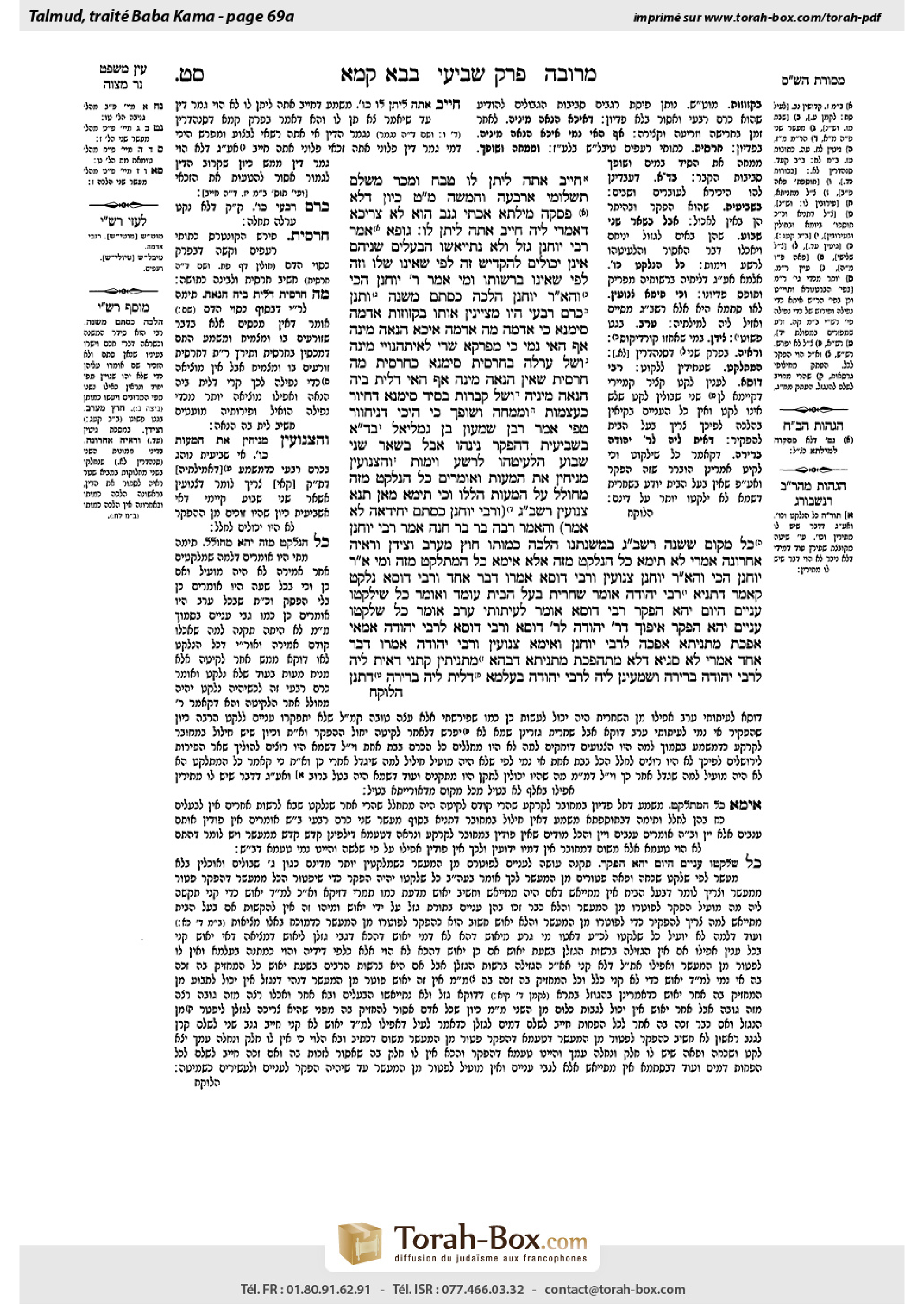
Bava Kamma 69a: Talmud study for Daf Yomi
Study the Talmud for Daf Yomi with scanned pages, Hebrew text, English translations from Sefaria and AI-generated French translations.
Passage selection and English or AI-generated French translation are available where the scan has annotations. Daf Study is independent of Torah-Box and Sefaria.
Browse Bava Kamma · בבא קמא · All tractatesBava Kamma 69a text and translations
This page of Bava Kamma includes the Aramaic text, an English translation and an AI-generated French translation, alongside the scan above.
בבא קמא ס״ט א · Aramaic and Hebrew text
״חַיָּיב אַתָּה לִיתֵּן לוֹ״, טָבַח וּמָכַר – מְשַׁלֵּם תַּשְׁלוּמֵי אַרְבָּעָה וַחֲמִשָּׁה. מַאי טַעְמָא? כֵּיוָן דְּלָא פְּסִקָה מִילְּתָא, אַכַּתִּי גַּנָּב הוּא!
לָא צְרִיכָא, דְּאָמְרִי לֵיהּ: ״חַיָּיב אַתָּה לִיתֵּן לוֹ״.
גּוּפָא, אָמַר רַבִּי יוֹחָנָן: גָּזַל וְלֹא נִתְיָיאֲשׁוּ הַבְּעָלִים – שְׁנֵיהֶם אֵינָן יְכוֹלִים לְהַקְדִּישׁ. זֶה לְפִי שֶׁאֵינוֹ שֶׁלּוֹ, וְזֶה לְפִי שֶׁאֵינוֹ בִּרְשׁוּתוֹ. וּמִי אָמַר רַבִּי יוֹחָנָן הָכִי? וְהָאָמַר רַבִּי יוֹחָנָן: הֲלָכָה כִּסְתַם מִשְׁנָה;
וּתְנַן: כֶּרֶם רְבָעִי הָיוּ מְצַיְּינִין אוֹתוֹ בִּקְזוּזוֹת אֲדָמָה – סִימָנָא כִּי אֲדָמָה, מָה אֲדָמָה – אִיכָּא הֲנָאָה מִינַּהּ, אַף הַאי נָמֵי כִּי מִפַּרְקָא – שְׁרֵי לְאִיתְהֲנוֹיֵי מִינַּהּ.
וְשֶׁל עׇרְלָה בְּחַרְסִית – סִימָנָא כְּחַרְסִית, מָה חַרְסִית שֶׁאֵין הֲנָאָה מִינַּהּ, אַף הַאי דְּלֵית (בֵּיהּ) הֲנָאָה מִינֵּיהּ.
וְשֶׁל קְבָרוֹת בְּסִיד – סִימָנָא דְּחִיוָּר כַּעֲצָמוֹת. וּמְמַחֶה וְשׁוֹפֵךְ כִּי הֵיכִי דְּנִיחַוַּור טְפֵי.
אָמַר רַבָּן שִׁמְעוֹן בֶּן גַּמְלִיאֵל: בַּמֶּה דְּבָרִים אֲמוּרִים – בִּשְׁבִיעִית, דְּהֶפְקֵר נִינְהוּ;
אֲבָל בִּשְׁאָר שְׁנֵי שָׁבוּעַ – הַלְעִיטֵהוּ לָרָשָׁע וְיָמוּת.
וְהַצְּנוּעִין מַנִּיחִין אֶת הַמָּעוֹת, וְאוֹמְרִים: ״כׇּל הַנִּלְקָט מִזֶּה, מְחוּלָּל עַל הַמָּעוֹת הַלָּלוּ״!
וְכִי תֵּימָא: מַאן תְּנָא צְנוּעִין – רַבָּן שִׁמְעוֹן בֶּן גַּמְלִיאֵל, וְרַבִּי יוֹחָנָן כִּסְתָם יְחִידָאָה לָא אָמַר;
וְהָאָמַר רַבָּה בַּר בַּר חָנָה אָמַר רַבִּי יוֹחָנָן: כׇּל מָקוֹם שֶׁשָּׁנָה רַבָּן שִׁמְעוֹן בֶּן גַּמְלִיאֵל בְּמִשְׁנָתֵנוּ – הֲלָכָה כְּמוֹתוֹ, חוּץ מֵעָרֵב וְצַיְדָן וּרְאָיָה אַחֲרוֹנָה!
אָמְרִי: לָא תֵּימָא ״כׇּל הַנִּלְקָט מִזֶּה״, אֶלָּא אֵימָא ״כָּל הַמִּתְלַקֵּט מִזֶּה״.
וּמִי אָמַר רַבִּי יוֹחָנָן הָכִי? וְהָאָמַר רַבִּי יוֹחָנָן: צְנוּעִין וְרַבִּי דּוֹסָא אָמְרוּ דָּבָר אֶחָד; וְרַבִּי דּוֹסָא ״נִלְקָט״ קָאָמַר!
דְּתַנְיָא, רַבִּי יְהוּדָה אוֹמֵר: שַׁחֲרִית – בַּעַל הַבַּיִת עוֹמֵד וְאוֹמֵר: ״כׇּל שֶׁיְּלַקְּטוּ עֲנִיִּים הַיּוֹם, יְהֵא הֶפְקֵר״.
רַבִּי דּוֹסָא אוֹמֵר, לְעִיתּוֹתֵי עֶרֶב אוֹמֵר: ״כׇּל שֶׁלָּקְטוּ עֲנִיִּים יְהֵא הֶפְקֵר״!
אֵיפוֹךְ דְּרַבִּי יְהוּדָה לְרַבִּי דּוֹסָא, וְרַבִּי דּוֹסָא לְרַבִּי יְהוּדָה. אַמַּאי אָפְכַתְּ מַתְנִיתָא? אִפְכַהּ לְרַבִּי יוֹחָנָן, וְאֵימָא: ״צְנוּעִין וְרַבִּי יְהוּדָה אָמְרוּ דָּבָר אֶחָד״!
אָמְרִי: לָא סַגִּיא דְּלָא מִתְהַפְכָא מַתְנִיתָא; דִּבְהָא מַתְנִיתִין קָתָנֵי דְּאִית לֵיהּ לְרַבִּי יְהוּדָה בְּרֵירָה, וְשָׁמְעִינַן לֵיהּ לְרַבִּי יְהוּדָה בְּעָלְמָא דְּלֵית לֵיהּ בְּרֵירָה – דִּתְנַן:
Bava Kamma 69a · English translation
Rava continues: But if the court says to the thief only: You are obligated to give the stolen animal back to its owner, without actually ordering him to pay, and he subsequently slaughtered or sold the animal, he pays the fourfold or fivefold payment. What is the reason for this? Since the court has not issued a definitive ruling in this matter, he is still considered a thief rather than a robber.
The Gemara answers: No, this is not a challenge to the ruling of Reish Lakish. It is necessary for the baraita to state the halakha in a case where they say to him only: You are obligated to give the stolen animal back to its owner. Consequently, he remains categorized as a thief.
§ The Gemara returns to the matter itself. Rabbi Yoḥanan says: If one stole an item and the owner has not yet despaired of recovering it, neither of them is able to consecrate it. This one, the thief, cannot consecrate it because it does not belong to him, and that one, the owner, cannot consecrate it because it is not in his possession. The Gemara asks: And did Rabbi Yoḥanan actually say this? But doesn’t Rabbi Yoḥanan say: The halakha is invariably in accordance with the ruling of an unattributed mishna, i.e., a mishna that states a halakha without citing it in the name of a particular Sage?
And there is a mishna of this kind (Ma’aser Sheni 5:1) that contradicts Rabbi Yoḥanan’s statement, as we learned in a mishna: With regard to a vineyard in its fourth year, they would demarcate it with clods of earth [bikzozot] placed around it on the ground, to alert people that they may not eat or derive any benefit from its grapes without redeeming them. The Gemara interrupts its quotation of the mishna to explain: This particular distinguishing mark of earth is used because a vineyard in its fourth year is like earth: Just as with regard to earth there is permission to derive benefit from it through its cultivation, so too, with this fruit, when it has been redeemed by means of coins, it is likewise permitted to benefit from it.
The Gemara resumes its citation from the mishna: And a grapevine of orla is demarcated with potsherds [ḥarsit] placed around it, to alert people that its grapes may not be eaten nor may any benefit be derived from them at all (see Leviticus 19:23). The Gemara explains: This particular distinguishing mark is used because orla is like potsherds: Just as no benefit is derived from potsherd, so too, no benefit may be derived from this orla.
The mishna continues: And an area of graves is demarcated with lime, to notify people that the demarcated area is ritually impure and will impart impurity to those who pass over it. The Gemara explains: The reason this particular distinguishing mark is used is that lime is white, like bones. The mishna further states: And one dissolves the lime in water and pours it out around the gravesite. The Gemara explains: This is performed in order that the lime should be whiter than in its non-dissolved form.
The Gemara resumes the citation from the mishna. Rabban Shimon ben Gamliel said: In what case is this statement, that vineyards of the fourth year and of orla require demarcation, said? During the Sabbatical Year. The Gemara explains: The reason is that all fruit that grows during that year may be taken by anyone (see Leviticus 25:5–6), as in that year all fruit is considered to be ownerless property.
The mishna continues: But during the other years of the Sabbatical cycle, when anyone who takes the grapes of another is guilty of theft, there is no requirement to demarcate these vineyards. This is in accordance with the adage: Feed it to the wicked man and let him die. That is, one is not required to take precautions to protect the wicked from the consequences of their own sins. Here too, there is no obligation to warn a thief that the grapes he is stealing are prohibited.
The mishna continues: But the pious ones would set aside some coins and say: Anything that was picked from this vine by passersby shall be desacralized onto these coins. These pious ones maintain that the owner can desacralize the grapes despite the fact that they are no longer in his possession. Similarly, contrary to the opinion of Rabbi Yoḥanan, they would claim that an owner can consecrate a stolen item even though it is no longer in his possession. Since this opinion is cited in the mishna without being attributed to any particular Sage, Rabbi Yoḥanan should have accepted this ruling.
And if you would say: Who is the tanna that taught this practice of the pious ones in the mishna? It is Rabban Shimon ben Gamliel, and Rabbi Yoḥanan did not say his principle that the halakha is always in accordance with an unattributed mishna when it follows an individual opinion; this suggestion does not alleviate the difficulty.
The Gemara explains: But doesn’t Rabba bar bar Ḥana say that Rabbi Yoḥanan says: Wherever Rabban Shimon ben Gamliel taught a statement in the corpus of our Mishna, the halakha is in accordance with his opinion, except for the case of the responsibility of the guarantor (see Bava Batra 173b), and the incident that occurred in the city of Tzaidan (see Gittin 74a), and the dispute with regard to evidence in the final disagreement (see Sanhedrin 31a). Consequently, even if the opinion of the pious ones was cited by Rabban Shimon ben Gamliel, Rabbi Yoḥanan should have accepted it as authoritative.
The Sages say, in explanation of the opinion of Rabbi Yoḥanan: When quoting the declaration of the pious ones, do not say in the past tense: Anything that was picked from this vine by passersby shall be desacralized onto these coins. Rather, say: Anything that will be picked from this vine shall be desacralized onto these coins. In other words, the desacralizing is performed before the fruit is picked, while it is still in the full possession of the owner of the vine.
The Gemara asks: And did Rabbi Yoḥanan actually say such a ruling? Could Rabbi Yoḥanan agree to this reformulation of the declaration of the pious ones? But doesn’t Rabbi Yoḥanan say: The pious ones and Rabbi Dosa said the same thing, i.e., their opinions are equivalent? And Rabbi Dosa says that this declaration is formulated in the past tense, as: Anything that was picked.
As it is taught in a baraita that Rabbi Yehuda says: In the morning the homeowner, i.e., the owner of a field, stands and says: Anything that the poor will pick today that is not rightfully theirs shall hereby be considered ownerless property. The poor are entitled to glean leftover grain from a field after it is harvested (Leviticus 23:22). Yet there are many halakhot involved in determining what produce they are entitled to take, and not all poor people are learned enough to know these halakhot. Consequently, there will inevitably be poor people who will take a certain amount of grain to which they are not entitled. For this reason, the owner of the field should relinquish, in advance, ownership over whatever the poor might unlawfully take.
Rabbi Dosa says: This is not the correct practice. Rather, toward evening the owner should say: Anything that the poor picked today that is not rightfully theirs shall hereby be considered ownerless property. Since Rabbi Yoḥanan stated that the opinions of the pious ones and Rabbi Dosa are the same, this indicates that the declaration of the pious ones was in the past tense, which means that they permitted redemption of fourth-year produce after it was already stolen. If so, the question remains: Why did Rabbi Yoḥanan not accept the ruling of the pious ones as authoritative?
The Gemara answers: Reverse the opinion of Rabbi Yehuda with that of Rabbi Dosa, and that of Rabbi Dosa with that of Rabbi Yehuda. According to this new version of the baraita, Rabbi Dosa does not permit the owner of an item to exercise any control over it after it has been stolen from him. The Gemara asks: Why do you reverse the baraita to avoid a contradiction between the statements of Rabbi Yoḥanan? It is better to reverse the statement of Rabbi Yoḥanan himself, and say that he actually stated: The pious ones and Rabbi Yehuda said the same thing, and leave the baraita intact.
The Gemara says: There is no alternative, as one cannot do otherwise than to reverse the baraita, as that would mean that in this baraita it teaches that Rabbi Yehuda holds that there is a principle of retroactive designation. And we have heard elsewhere that Rabbi Yehuda generally does not accept the principle of retroactive designation, as we learned in a mishna (Demai 7:4):
Bava Kamma 69a · Traduction française (IA)
Rava continue : Mais si la cour dit seulement au voleur : Tu es tenu de rendre l'animal volé à son propriétaire, sans lui ordonner explicitement de payer, et qu'il tue ou vend ensuite l'animal, il paie la réparation quatre fois ou cinq fois. Pourquoi cela ? Parce que la cour n'a pas rendu un jugement définitif sur cette affaire, il est encore considéré comme un voleur plutôt qu'un voleur.
La Guemara répond : Non, cela ne constitue pas un défi au jugement de Reish Lakish. Il est nécessaire que la baraïta énonce la halakha dans un cas où on dit seulement au voleur : Tu es tenu de rendre l'animal volé à son propriétaire. Ainsi, il reste classé comme un voleur.
§ La Guemara reprend l'affaire elle-même. Rabbi Yoḥanan dit : Si l'on a volé un objet et que le propriétaire n'a pas encore perdu espoir de le récupérer, ni l'un ni l'autre ne peut le sanctifier. Ce voleur ne peut le sanctifier car il ne lui appartient pas, et le propriétaire non plus car il ne le possède pas. La Guemara demande : Et Rabbi Yoḥanan a-t-il vraiment dit cela ? Mais ne dit-il pas plutôt : La halakha est toujours en conformité avec la décision d'une mishna non attribuée, c'est-à-dire une mishna qui énonce une halakha sans la rapporter à un sage particulier ?
Et il existe une Michna de ce genre (Ma’aser Sheni 5:1) qui contredit l'affirmation de Rabbi Yoḥanan, comme nous l'avons appris dans une Michna : Concernant un domaine en quatrième année, on le marque avec des boulettes de terre [bikzozot] placées autour, afin d'alerter les gens qu'ils ne peuvent pas manger ou en tirer quelque bénéfice que ce soit sans les racheter. La Guemara interrompt sa citation de la Michna pour expliquer : Ce marqueur particulier de terre est utilisé car un domaine en quatrième année est comme la terre : Tout comme on peut tirer un bénéfice de la terre par sa culture, ainsi aussi, avec ce fruit, lorsqu'il a été racheté par des monnaies, il est permis de le bénéficier.
La Guemara reprend sa citation de la Michna : Et une vigne d'orla est marquée avec des fragments de poterie [ḥarsit] placés autour, afin d'alerter les gens que ses raisins ne peuvent pas être mangés ni en tirer quelque bénéfice que ce soit (voir Lévitique 19:23). La Guemara explique : Ce marqueur particulier est utilisé car l'orla est comme les fragments de poterie : Tout comme aucun bénéfice n'est tiré des fragments de poterie, ainsi aussi, aucun bénéfice ne peut être tiré de cet orla.
La Michna continue : Et un domaine de sépultures est marqué avec de la chaux, afin d'alerter les gens que le domaine marqué est impur rituellement et transmet l'impureté à ceux qui le traversent. La Guemara explique : La raison pour laquelle ce marqueur particulier est utilisé est que la chaux est blanche, comme les os. La Michna ajoute encore : Et l'on dissout la chaux dans l'eau et on la verse autour du lieu des sépultures. La Guemara explique : Cela est fait afin que la chaux soit plus blanche qu'en forme non dissoute.
La Guemara reprend la citation de la mishna. Rabban Shimon ben Gamliel dit : Dans quel cas cette déclaration, que les vergers de la quatrième année et l'orla nécessitent un marquage, est-elle émise ? Pendant l'année sabbatique. La Guemara explique : La raison est que tout fruit qui pousse durant cette année peut être pris par n'importe qui (voir Lévitique 25:5–6), car durant cette année, tout fruit est considéré comme propriété sans propriétaire.
La mishna continue : Mais pendant les autres années du cycle sabbatique, lorsque celui qui prend les raisins d'un autre est coupable de vol, il n'y a pas de nécessité de marquer ces vergers. Cela correspond à l'adage : Alimente le mauvais homme et laisse-le mourir. C'est-à-dire qu'on n'est pas tenu de prendre des précautions pour protéger le mauvais de les conséquences de ses propres péchés. Ici aussi, il n'y a pas d'obligation de prévenir un voleur que les raisins qu'il vole sont interdits.
La mishna continue : Mais les justes mettaient de côté certaines monnaies et disaient : Tout ce qui a été récolté de cette vigne par les passants sera désacralisé sur ces monnaies. Ces justes maintenaient que le propriétaire peut désacraliser les raisins même s'ils ne sont plus en son possession. De même, contrairement à l'opinion de Rabbi Yoḥanan, ils affirmaient que le propriétaire peut sanctifier un objet volé même s'il n'est plus en son possession. Puisque cette opinion est citée dans la mishna sans être attribuée à un sage particulier, Rabbi Yoḥanan aurait dû accepter cette décision.
Et si l'on disait : Qui est le tanna qui a enseigné cette pratique des justes dans la michna ? C'est Rabban Shimon ben Gamliel, et Rabbi Yoḥanan n'a pas dit que son principe, selon lequel la halakha est toujours en conformité avec une michna non attribuée, s'applique lorsqu'elle suit un avis particulier ; cette suggestion ne résout pas le problème.
La Guemara explique : Mais ne dit-il pas Rabba bar bar Ḥana que Rabbi Yoḥanan dit : Partout où Rabban Shimon ben Gamliel a enseigné une déclaration dans le corpus de notre Michna, la halakha suit son avis, sauf dans le cas de la responsabilité du garant (voir Bava Batra 173b), et l'incident survenu dans la ville de Tzaidan (voir Gittin 74a), et le débat concernant les preuves dans le dernier désaccord (voir Sanhedrin 31a). Ainsi, même si l'opinion des justes avait été citée par Rabban Shimon ben Gamliel, Rabbi Yoḥanan aurait dû l'accepter comme autoritaire.
Les Sages disent, en expliquant l'opinion de Rabbi Yoḥanan : Lorsqu'on cite la déclaration des justes, ne dites pas au passé : Tout ce qui a été récolté de cette vigne par les passants sera désacralisé sur ces monnaies. Mais dites : Tout ce qui sera récolté de cette vigne sera désacralisé sur ces monnaies. En d'autres termes, le désacralisant est effectué avant que le fruit ne soit récolté, alors qu'il est encore en pleine possession du propriétaire de la vigne.
La Guemara pose la question : Rabbi Yoḥanan a-t-il vraiment dit une telle décision ? Rabbi Yoḥanan pourrait-il accepter cette reformulation de la déclaration des justes ? Mais ne dit-il pas Rabbi Yoḥanan : les justes et Rabbi Dosa ont dit la même chose, c'est-à-dire que leurs opinions sont équivalentes ? Et Rabbi Dosa dit que cette déclaration est formulée au passé, comme : Tout ce qui a été ramassé.
Comme il est enseigné dans une baraïta que Rabbi Yehuda dit : Le matin, le propriétaire, c'est-à-dire le propriétaire d'un champ, se lève et dit : Tout ce que les pauvres ramasseront aujourd'hui qui ne leur appartient pas sera considéré comme propriété sans propriétaire. Les pauvres ont le droit de ramasser les grains restants d'un champ après sa récolte (Lévitique 23:22). Cependant, il y a de nombreuses halakhot à déterminer ce que les pauvres peuvent prendre, et pas tous les pauvres sont suffisamment instruits pour connaître ces halakhot. Ainsi, il y aura inévitablement des pauvres qui prendront une certaine quantité de blé à laquelle ils n'ont pas droit. Pour cette raison, le propriétaire du champ devrait renoncer, à l'avance, à la propriété de tout ce que les pauvres pourraient prendre illégalement.
Rabbi Dosa dit : Ce n'est pas la bonne pratique. Plutôt, vers le soir, le propriétaire devrait dire : Tout ce que les pauvres ont ramassé aujourd'hui qui ne leur appartient pas sera considéré comme propriété sans propriétaire. Puisque Rabbi Yoḥanan a dit que les opinions des justes et de Rabbi Dosa sont équivalentes, cela indique que la déclaration des justes était au passé, ce qui signifie qu'ils permettaient la restitution des produits de la quatrième année après qu'ils aient déjà été volés. Si c'est le cas, la question reste : pourquoi Rabbi Yoḥanan n'a-t-il pas accepté la décision des justes comme autoritaire ?
La Guemara répond : Inversez l'opinion de Rabbi Yehuda avec celle de Rabbi Dosa, et celle de Rabbi Dosa avec celle de Rabbi Yehuda. Selon cette nouvelle version de la baraïta, Rabbi Dosa ne permet pas au propriétaire d'un objet de contrôler cet objet après qu'il ait été volé. La Guemara pose la question : pourquoi inversez-vous la baraïta pour éviter une contradiction entre les déclarations de Rabbi Yoḥanan ? Il est préférable d'inverser la déclaration de Rabbi Yoḥanan lui-même et de dire qu'il a effectivement dit : les justes et Rabbi Yehuda ont dit la même chose, et de laisser la baraïta intacte.
La Guemara dit : Il n'y a pas d'autre solution, car on ne peut pas faire autrement que d'inverser la baraïta, car cela signifierait que dans cette baraïta, elle enseigne que Rabbi Yehuda considère que le principe de désignation rétroactive existe. Et nous avons entendu ailleurs que Rabbi Yehuda ne reconnaît généralement pas le principe de désignation rétroactive, comme nous l'avons appris dans une mitsna (Demai 7:4) :
Traduction française générée par IA à partir de l’édition anglaise de Sefaria. Vérifie toujours un passage avec le texte source.
Text from Sefaria: William Davidson Edition - Vocalized Aramaic (CC BY NC); William Davidson Edition - English (CC BY NC).