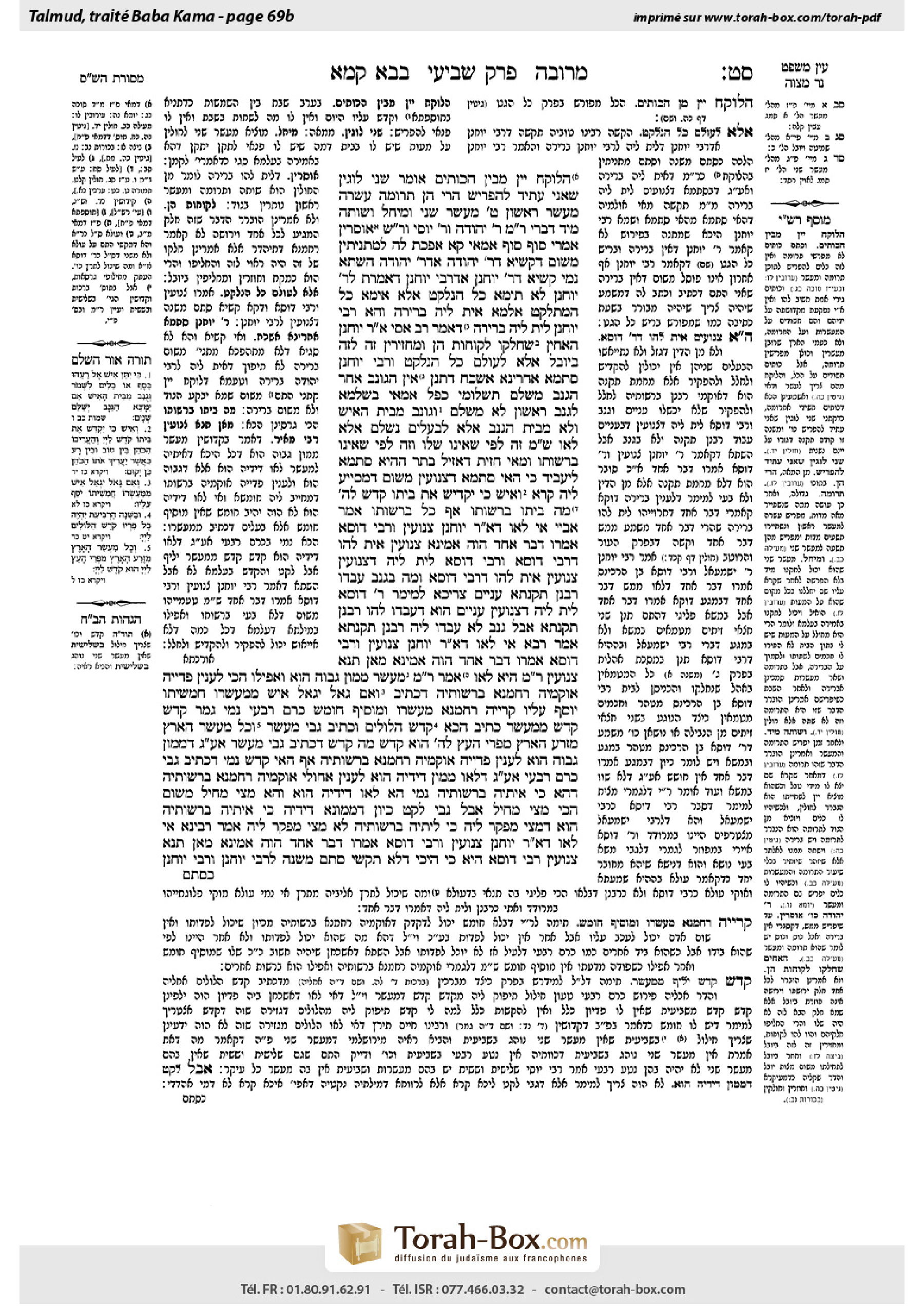
Bava Kamma 69b: Talmud study for Daf Yomi
Study the Talmud for Daf Yomi with scanned pages, Hebrew text, English translations from Sefaria and AI-generated French translations.
Passage selection and English or AI-generated French translation are available where the scan has annotations. Daf Study is independent of Torah-Box and Sefaria.
Browse Bava Kamma · בבא קמא · All tractatesBava Kamma 69b text and translations
This page of Bava Kamma includes the Aramaic text, an English translation and an AI-generated French translation, alongside the scan above.
בבא קמא ס״ט ב · Aramaic and Hebrew text
הַלּוֹקֵחַ יַיִן מִבֵּין הַכּוּתִים, אוֹמֵר: שְׁנֵי לוּגִּין שֶׁאֲנִי עָתִיד לְהַפְרִישׁ – הֲרֵי הֵן תְּרוּמָה; עֲשָׂרָה מַעֲשֵׂר רִאשׁוֹן; תִּשְׁעָה מַעֲשֵׂר שֵׁנִי; וּמֵיחֵל וְשׁוֹתֶה מִיָּד, דִּבְרֵי רַבִּי מֵאִיר.
רַבִּי יְהוּדָה וְרַבִּי יוֹסֵי וְרַבִּי שִׁמְעוֹן אוֹסְרִין.
אָמְרִי: סוֹף סוֹף, אַמַּאי קָא אָפְכַתְּ לַהּ לְמַתְנִיתִין – מִשּׁוּם דְּקַשְׁיָא דְּרַבִּי יְהוּדָה אַדְּרַבִּי יְהוּדָה; הַשְׁתָּא נָמֵי – קַשְׁיָא דְּרַבִּי יוֹחָנָן אַדְּרַבִּי יוֹחָנָן,
דְּאָמְרַתְּ לְרַבִּי יוֹחָנָן לָא תֵּימָא ״כׇּל הַנִּלְקָט״, אֶלָּא אֵימָא ״כָּל הַמִּתְלַקֵּט״ – אַלְמָא אִית לֵיהּ בְּרֵירָה; וְהָא רַבִּי יוֹחָנָן לֵית לֵיהּ בְּרֵירָה,
דְּאָמַר רַב אַסִּי אָמַר רַבִּי יוֹחָנָן: הָאַחִין שֶׁחָלְקוּ – לָקוֹחוֹת הֵן, וּמַחְזִירִין זֶה לָזֶה בַּיּוֹבֵל!
אֶלָּא לְעוֹלָם ״כׇּל הַנִּלְקָט״,
וְרַבִּי יוֹחָנָן סְתָמָא אַחֲרִינָא אַשְׁכַּח – דִּתְנַן: אֵין הַגּוֹנֵב אַחַר הַגַּנָּב מְשַׁלֵּם תַּשְׁלוּמֵי כֶפֶל. אַמַּאי? בִּשְׁלָמָא לְגַנָּב רִאשׁוֹן לָא מְשַׁלֵּם – ״וְגֻנַּב מִבֵּית הָאִישׁ״, וְלֹא מִבֵּית הַגַּנָּב; אֶלָּא לִבְעָלִים – נְשַׁלֵּם!
אֶלָּא לָאו שְׁמַע מִינַּהּ: זֶה לְפִי שֶׁאֵינוֹ שֶׁלּוֹ, וְזֶה לְפִי שֶׁאֵינוֹ בִּרְשׁוּתוֹ.
וּמַאי חָזֵי(ת) דְּאָזֵיל בָּתַר הַהִיא סְתָמָא? לֶיעְבֵּיד כִּי הַאי סְתָמָא דִּצְנוּעִין!
מִשּׁוּם דִּמְסַיַּיע לֵיהּ קְרָא: ״וְאִישׁ כִּי יַקְדִּשׁ אֶת בֵּיתוֹ קֹדֶשׁ לַה׳״ – מָה בֵּיתוֹ בִּרְשׁוּתוֹ, אַף כֹּל בִּרְשׁוּתוֹ.
אָמַר אַבָּיֵי: אִי לָאו דְּאָמַר רַבִּי יוֹחָנָן צְנוּעִין, וְרַבִּי דּוֹסָא אָמְרוּ דָּבָר אֶחָד, הֲוָה אָמֵינָא: צְנוּעִין אִית לְהוּ דְּרַבִּי דּוֹסָא, וְרַבִּי דּוֹסָא לֵית לֵיהּ דִּצְנוּעִין.
צְנוּעִין אִית לְהוּ דְּרַבִּי דּוֹסָא – וּמָה בְּגַנָּב עֲבַדוּ רַבָּנַן תַּקַּנְתָּא, עֲנִיִּים צְרִיכָא לְמֵימַר? רַבִּי דּוֹסָא לֵית לֵיהּ דִּצְנוּעִין – עֲנִיִּים הוּא דַּעֲבַדוּ לְהוּ רַבָּנַן תַּקַּנְתָּא, אֲבָל גַּנָּב לָא עֲבַדוּ לַיהּ רַבָּנַן תַּקַּנְתָּא.
אָמַר רָבָא, אִי לָאו דְּאָמַר רַבִּי יוֹחָנָן: צְנוּעִין וְרַבִּי דּוֹסָא אָמְרוּ דָּבָר אֶחָד, הֲוָה אָמֵינָא: מַאן תְּנָא צְנוּעִין – רַבִּי מֵאִיר הִיא;
לָאו אָמַר רַבִּי מֵאִיר: מַעֲשֵׂר מָמוֹן גָּבוֹהַּ הוּא, וַאֲפִילּוּ הָכִי לְעִנְיַן פְּדִיָּיה אוֹקְמֵיהּ רַחֲמָנָא בִּרְשׁוּתֵיהּ? דִּכְתִיב: ״וְאִם גָּאֹל יִגְאַל אִישׁ מִמַּעַשְׂרוֹ, חֲמִשִׁתוֹ יֹסֵף עָלָיו״ –
קַרְיֵיהּ רַחֲמָנָא ״מַעַשְׂרוֹ״, וּמוֹסִיף חוֹמֶשׁ.
כֶּרֶם רְבָעִי נָמֵי – גָּמַר ״קֹדֶשׁ״ ״קֹדֶשׁ״ מִמַּעֲשֵׂר, כְּתִיב הָכָא: ״קֹדֶשׁ הִלּוּלִים״, וּכְתִיב גַּבֵּי מַעֲשֵׂר: ״וְכׇל מַעְשַׂר הָאָרֶץ מִזֶּרַע הָאָרֶץ מִפְּרִי הָעֵץ לַה׳ הוּא קֹדֶשׁ״;
מָה ״קֹדֶשׁ״ דִּכְתִיב גַּבֵּי מַעֲשֵׂר – אַף עַל גַּב דְּמָמוֹן גָּבוֹהַּ הוּא, לְעִנְיַן פְּדִיָּיה אוֹקְמֵיהּ רַחֲמָנָא בִּרְשׁוּתֵיהּ; אַף הַאי ״קֹדֶשׁ״ נָמֵי דִּכְתִיב גַּבֵּי כֶּרֶם רְבָעִי – אַף עַל גַּב דְּלָאו מָמוֹן דִּידֵיהּ הוּא, לְעִנְיַן אַחוֹלֵי אוֹקְמֵיהּ רַחֲמָנָא בִּרְשׁוּתֵיהּ;
דְּהָא כִּי אִיתֵיהּ בִּרְשׁוּתֵיהּ נָמֵי – הָא לָאו דִּידֵיהּ הוּא, וְהָא מָצֵי מַחֵיל; מִשּׁוּם הָכִי מָצֵי מַחֵיל.
אֲבָל גַּבֵּי לֶקֶט – כֵּיוָן דְּמָמוֹנָא דִּידֵיהּ, כִּי אִיתֵיהּ בִּרְשׁוּתֵיהּ הוּא דְּמָצֵי מַפְקַר לֵיהּ, כִּי לֵיתֵיהּ בִּרְשׁוּתֵיהּ לָא מָצֵי מַפְקַר לֵיהּ.
אָמַר רָבִינָא: אִי לָאו דְּאָמַר רַבִּי יוֹחָנָן צְנוּעִין וְרַבִּי דּוֹסָא אָמְרוּ דָּבָר אֶחָד, הֲוָה אָמֵינָא: מַאן תַּנָּא צְנוּעִין – רַבִּי דּוֹסָא הִיא, כִּי הֵיכִי דְּלָא תִּקְשֵׁי סְתַם מִשְׁנָה לְרַבִּי יוֹחָנָן. וְרַבִּי יוֹחָנָן –
Bava Kamma 69b · English translation
In the case of one who purchases wine from among the Samaritans [Kutim], if there is reason to suspect that teruma and tithes were not separated, and he cannot separate them before the start of Shabbat, he acts as follows. If there are one hundred log of wine in the barrels, he says: Two log that I will separate in the future are teruma, as the mandated average measure of teruma is one-fiftieth; ten log are first tithe; and a tenth of the remainder, nine log, are second tithe. And he desacralizes the second tithe that he will separate in the future by transferring its sanctity onto money, and he may drink the wine immediately, relying on the separation that he will perform later. This is the statement of Rabbi Meir.
Rabbi Yehuda, Rabbi Yosei, and Rabbi Shimon prohibit one from doing so. The objection of these three Sages is presumably that this arrangement relies on the principle of retroactive designation, as at the time of the declaration the identity of the particular portions of wine that will be teruma and tithes is unknown, and these Sages do not accept this principle. It is apparent from this mishna that Rabbi Yehuda does not accept retroactive designation, and therefore he cannot be the one who said that the owner of the field may issue his declaration of relinquishment in the morning.
The Gemara says: Ultimately, why do you reverse the baraita that contains the opinions of Rabbi Yehuda and Rabbi Dosa? It is because there is a difficulty due to the contradiction between one statement of Rabbi Yehuda and another statement of Rabbi Yehuda. Now too, although you have reversed the baraita, a similar problem remains, as there is a difficulty due to the contradiction between one statement of Rabbi Yoḥanan and another statement of Rabbi Yoḥanan.
As you said, according to the opinion of Rabbi Yoḥanan: Do not say that anything that was picked from this vine by passersby shall be desacralized onto these coins. Rather, say that anything that will be picked from this vine shall be desacralized onto these coins. Apparently, Rabbi Yoḥanan here accepts the principle of retroactive designation. But it is established that Rabbi Yoḥanan does not accept the principle of retroactive designation.
As Rav Asi says that Rabbi Yoḥanan says: Brothers who divided property received as an inheritance are considered purchasers from each other, and as purchasers of land they must return the portions to each other in the Jubilee Year, at which point they may redistribute the property. This demonstrates that Rabbi Yoḥanan does not hold that it is retroactively clarified that each brother’s portion was designated for him directly upon their father’s death, but rather all the land was considered joint property until the brothers traded or bought their respective portions from each other at the time of the distribution of the estate.
In light of this objection, the Gemara retracts its previous assertion that Rabbi Yoḥanan reformulated the declaration of the pious ones. Rather, the pious ones actually declared in the past tense: Anything that was picked from this vine by passersby shall be desacralized onto these coins, i.e., the desacralizing took place after the grapes were stolen. If so, the question remains: Why did Rabbi Yoḥanan not accept the opinion of the pious ones, but instead ruled that the owner of an item cannot consecrate it after it has been stolen?
The Gemara answers: Rabbi Yoḥanan found a different unattributed mishna, which contradicts the opinion of the pious ones. As we learned in the mishna here (62b): One who steals an item after a thief has already stolen it, i.e., one who steals a stolen item, does not pay the double payment to the thief or to the prior owner. Why not? Granted that he does not pay to the first thief, as the verse states: “And it was stolen from the house of the man; if the thief shall be found he shall pay double” (Exodus 22:6), which indicates that the double payment applies in the case of an item “stolen from the house of the man,” i.e., from the owner’s jurisdiction, but not to an item stolen from the thief’s house. But let him pay the double payment to the owner, as it presumably still belonged to the owner when the second thief stole it.
Rather, must one not conclude from this that a stolen item is not under the full jurisdiction of either the owner or the thief? It is not under the jurisdiction of this one, the first thief, because it does not belong to him, and it is not under the jurisdiction of that one, the owner, because it is not in his possession. Therefore, neither of them can consecrate the stolen item.
The Gemara asks: Granted that this unattributed mishna disagrees with the mishna that cites the pious ones, but what did you see that led you to follow that unattributed mishna, the one that discusses the double payment? Let Rabbi Yoḥanan act, i.e., rule, in accordance with this unattributed mishna, which states the practice of the pious ones. On what basis did he choose one mishna over the other?
The Gemara answers: Rabbi Yoḥanan followed the mishna that discusses the double payment because there is a verse that supports it: “And when a man shall sanctify his house to be holy to the Lord” (Leviticus 27:14), from which it is derived: Just as one’s house is in his possession, so too anything that one consecrates must be in his possession, excluding items that have been stolen from him.
§ Abaye said: If Rabbi Yoḥanan had not said that the pious ones and Rabbi Dosa said the same thing, i.e., their rulings are identical, I would say that the pious ones accept the opinion of Rabbi Dosa, but Rabbi Dosa does not accept the opinion of the pious ones.
Abaye elaborates: The pious ones accept the opinion of Rabbi Dosa, for the following reason: And if the Sages instituted an ordinance for the sake of a thief, to prevent him from eating unredeemed fourth-year grapes, by allowing the owner to desacralize produce that is no longer in his possession, does it need to be said that they did so for the sake of innocent poor people, as Rabbi Dosa claimed? Conversely, Rabbi Dosa does not accept the opinion of the pious ones, as he says: It is for the sake of poor people that the Sages instituted an ordinance; but the Sages did not institute an ordinance for the sake of a thief, in line with the aforementioned principle: Feed it to the wicked man and let him die.
In a similar vein, Rava said: If Rabbi Yoḥanan had not said that the pious ones and Rabbi Dosa said the same thing, I would say that there is a fundamental difference between the cases of fourth-year produce and gleanings taken by the poor, as one could claim: Who is the tanna who taught the ruling of the pious ones? It is Rabbi Meir.
Doesn’t Rabbi Meir say that second tithe is property belonging to the Most High, rather than the possession of the one who separated it from his produce, and even so, with regard to redemption of the second tithe the Merciful One establishes it in his possession? As it is written concerning the second tithe: “And if a man will redeem any of his tithe, he shall add to it its fifth part” (Leviticus 27:31).
Although according to the opinion of Rabbi Meir, second tithe does not belong to the owner of the produce from which it was separated, nevertheless, with regard to redemption the Merciful One does distinguish between a stranger and one who separated it from his produce, as the Torah refers to the second tithe as “his tithe” and thereby decrees that he, the owner of the crop from which it is separated, can redeem it by adding one-fifth to its value, but no one else can do so. This indicates that although second-tithe produce is not in fact owned by the person, the Torah treats him as the owner of the produce.
With regard to a fourth-year vineyard as well, the Sages derive many of its halakhot from a verbal analogy between second tithe and fourth-year fruit, based on the use of the word “holy” in the context of fourth-year fruit and “holy” in the context of second tithe. It is written here, concerning fourth-year fruit trees: “And in the fourth year all its fruit shall be holy, for giving praise to the Lord” (Leviticus 19:24), and it is written with regard to second tithe: “And all the tithe of the land, whether of the seed of the land or of the fruit of the tree, is the Lord’s; it is holy” (Leviticus 27:30).
From this analogy it is derived: Just as in the case of the term “holy” that is written in connection to second tithe, even though it is property belonging to the Most High, with regard to redemption the Merciful One establishes it in the jurisdiction of the one who separated it, so too in the context of the word “holy” that is written in connection to the fourth-year vineyard, even though it is not his property, as it belongs to the Most High, with regard to desacralizing the Merciful One establishes it in the vineyard owner’s jurisdiction.
The effect of this determination is that even when the fruit is in his jurisdiction it is not his property, and yet he is able to desacralize it. And due to that reason the owner of the vineyard is able to desacralize the fruit even after a thief has taken it. Even in normal circumstances when one desacralizes his fourth-year fruit he is desacralizing fruit that does not belong to him. Consequently, there is no novelty in the ruling that one can desacralize fruit even after it has been taken by a thief.
But with regard to gleanings of the poor, since the extra sheaves that the poor people inadvertently take are the property of the owner of the field, it may be claimed that only when those sheaves are in his possession, i.e., they have not been taken by anyone else, can he relinquish his ownership of them, whereas when they are no longer in his possession he cannot relinquish his ownership of them. Consequently, the pious ones, who permitted redemption of fourth-year produce after it had been stolen, would not necessarily agree with Rabbi Dosa, who allowed the relinquishment of stolen sheaves.
In a similar vein, Ravina said: If Rabbi Yoḥanan had not said that the pious ones and Rabbi Dosa said the same thing, I would say: Who is the tanna who taught the opinion of the pious ones? It is Rabbi Dosa. I would have said this so that an unattributed mishna should not present a difficulty to the opinion of Rabbi Yoḥanan. And the reason why this would have resolved the difficulty is that Rabbi Yoḥanan
Bava Kamma 69b · Traduction française (IA)
Dans le cas d'une personne qui achète du vin auprès des Samaritains [Kutim], si on a des raisons de soupçonner que la terouma et les dîmes n'ont pas été séparés, et qu'il ne peut les séparer avant le début du Shabbat, il agit ainsi. Si il y a cent log de vin dans les tonneaux, il dit : Deux log que je séparerai à l'avenir sont la terouma, car la mesure imposée de la terouma est un cinquantième ; dix log sont la première dîme ; et un dixième du reste, neuf log, sont la deuxième dîme. Et il désacralise la deuxième dîme qu'il séparera à l'avenir en transférant sa sanctité sur de l'argent, et il peut boire le vin immédiatement, en se fondant sur la séparation qu'il effectuera plus tard. C'est la déclaration du Rabbi Meir.
Les Rabbis Yéhuda, Yosei et Shim'on interdisent cela. L'objection de ces trois Sages est probablement que cette disposition repose sur le principe de désignation rétroactive, car au moment de la déclaration, l'identité des portions spécifiques de vin qui seront la terouma et les dîmes est inconnue, et ces Sages ne reconnaissent pas ce principe. Il est apparu de cette mitsva que Rabbi Yéhuda ne reconnaît pas la désignation rétroactive, et donc il ne peut pas être celui qui a dit que l'propriétaire du champ peut émettre sa déclaration de renonciation le matin.
Le Guemara dit : Finalement, pourquoi inversez-vous la baraïta qui contient les opinions de Rabbi Yéhuda et de Rabbi Dosa ? C'est parce qu'il y a une difficulté due à la contradiction entre une déclaration de Rabbi Yéhuda et une autre déclaration de Rabbi Yéhuda. Maintenant aussi, bien que vous ayez inversé la baraïta, un problème similaire reste, car il y a une difficulté due à la contradiction entre une déclaration de Rabbi Yoḥanan et une autre déclaration de Rabbi Yoḥanan.
Comme vous l'avez dit, selon l'opinion de Rabbi Yoḥanan : Ne dites pas que tout ce qui a été récolté de cette vigne par des passants sera désacralisé sur ces pièces. Plutôt, dites que tout ce qui sera récolté de cette vigne sera désacralisé sur ces pièces. Apparemment, Rabbi Yoḥanan ici accepte le principe de désignation rétroactive. Mais il est établi que Rabbi Yoḥanan ne reconnaît pas le principe de désignation rétroactive.
Comme Rav Asi dit que Rabbi Yoḥanan dit : Les frères qui ont divisé la propriété reçue en héritage sont considérés comme des acheteurs les uns des autres, et comme acheteurs de terre, ils doivent rendre les portions les uns aux autres à l'année de jubilé, à ce moment-là ils peuvent redistribuer la propriété. Cela démontre que Rabbi Yoḥanan ne considère pas que chaque portion de frère était désignée pour lui directement à la mort de leur père, mais plutôt que toute la terre était considérée comme propriété commune jusqu'à ce que les frères aient échangé ou acheté leurs portions respectives les uns des autres au moment de la distribution de l'héritage.
En lumière de cette objection, le Guemara retire son affirmation précédente que Rabbi Yoḥanan a reformulé la déclaration des justes. Plutôt, les justes ont en réalité déclaré dans le passé : Tout ce qui a été récolté de cette vigne par des passants sera désacralisé sur ces pièces, c'est-à-dire que la désacralisation s'est produite après que les raisins avaient été volés. Si tel est le cas, la question reste : pourquoi Rabbi Yoḥanan n'a-t-il pas accepté l'opinion des justes, mais a-t-il plutôt jugé que l'propriétaire d'un objet ne peut pas le consacrer après qu'il ait été volé ?
Le Guemara répond : Rabbi Yoḥanan a trouvé une autre mitsva non attribuée, qui contredit l'opinion des justes. Comme nous l'avons appris dans la mitsva ici (62b) : Celui qui vole un objet après qu'un voleur a déjà volé, c'est-à-dire celui qui vole un objet volé, ne paie pas le double paiement au voleur ou à l'ancien propriétaire. Pourquoi pas ? Bien que ce ne soit pas le cas pour le premier voleur, car la Parabole dit : « Et il fut volé de la maison de l'homme ; si le voleur est trouvé, il paiera double » (Exode 22:6), ce qui indique que le double paiement s'applique dans le cas d'un objet « volé de la maison de l'homme », c'est-à-dire de la juridiction de l'owner, mais pas à un objet volé du voleur. Mais laissez-le payer le double paiement à l'owner, car il appartenait probablement à l'owner lorsque le second voleur l'a volé.
Plutôt, ne devons-nous pas conclure de cela que l'objet volé n'appartient pas pleinement à l'owner ou au voleur ? Il n'appartient pas à ce dernier, le premier voleur, car il ne lui appartient pas, et il n'appartient pas à celui-ci, l'owner, car il n'est pas en son possession. Ainsi, aucun des deux ne peut consacrer l'objet volé.
Le Guemara pose la question : Bien que cela soit établi que cette mitsva non attribuée diverge de la mitsva qui cite les justes, mais qu'avez-vous vu qui vous a conduit à suivre cette mitsva non attribuée, celle qui parle du double paiement ? Fassez agir Rabbi Yoḥanan, c'est-à-dire règlez selon cette mitsva non attribuée, qui énonce la pratique des justes. Sur quelle base a-t-il choisi une mitsva sur l'autre ?
Le Guemara répond : Rabbi Yoḥanan a suivi la Michna qui discute du double paiement, car il y a un verset qui le soutient : « Et quand un homme sanctifiera sa maison pour être saint à l'Éternel » (Lévitique 27:14), d'où on déduit : Comme la maison d'une personne est en son possession, ainsi tout ce que l'on consacre doit être en sa possession, excluant les objets volés.
§ Abaye dit : Si Rabbi Yoḥanan n'avait pas dit que les justes et Rabbi Dosa ont dit la même chose, c'est-à-dire que leurs décisions sont identiques, je dirais que les justes acceptent l'opinion de Rabbi Dosa, mais Rabbi Dosa ne reconnaît pas l'opinion des justes.
Abaye développe : Les justes acceptent l'opinion de Rabbi Dosa, pour la raison suivante : Et si les Sages ont institué un ordonnance en vue d'un voleur, afin de l'empêcher de manger des raisins de la quatrième année non rachetés, en permettant à l'owner de désacrifier des produits qui ne sont plus en son possession, est-ce qu'il faut dire qu'ils l'ont fait en vue des pauvres innocents, comme le prétend Rabbi Dosa ? À l'inverse, Rabbi Dosa ne reconnaît pas l'opinion des justes, car il dit : C'est en vue des pauvres que les Sages ont institué un ordonnance ; mais les Sages n'ont pas institué un ordonnance en vue d'un voleur, conformément au principe mentionné précédemment : Alimente le mauvais homme et laisse-le mourir.
Dans un sens similaire, Rava dit : Si Rabbi Yoḥanan n'avait pas dit que les justes et Rabbi Dosa disaient la même chose, je dirais que la différence fondamentale entre les cas des produits de la quatrième année et des épis pris par les pauvres est telle que l'on pourrait affirmer : Qui est le tanna qui a enseigné la décision des justes ? C'est Rabbi Meir.
Ne dit-on pas que Rabbi Meir affirme que la dîme de la deuxième année est la propriété du Très Haut, plutôt que la possession de celui qui l'a séparé de ses produits, et même ainsi, concernant le rachat de la dîme de la deuxième année, le Très Haut établit qu'elle est en son possession ? Il est écrit concernant la dîme de la deuxième année : « Et si un homme rachète l'une de ses dîmes, il ajoutera à celle-ci un cinquième de celle-ci » (Lévitique 27:31).
Bien que selon l'opinion de Rabbi Meir, la dîme de la deuxième année ne soit pas la propriété de l'owner des produits d'où elle a été séparée, néanmoins, concernant le rachat, le Très Haut distingue entre un étranger et celui qui l'a séparé de ses produits, car la Torah désigne la dîme de la deuxième année comme « sa dîme » et établit ainsi que lui, l'owner des produits d'où elle est séparée, peut la racheter en ajoutant un cinquième à sa valeur, mais personne d'autre ne peut le faire. Cela montre que bien que les produits de la dîme de la deuxième année ne soient pas effectivement la propriété de la personne, la Torah traite lui comme l'owner des produits.
Concernant un domaine de vigne de la quatrième année également, les Sages dérivent de nombreux halakhot d'une analogie verbale entre la dîme de la deuxième année et les fruits de la quatrième année, en se basant sur l'utilisation du mot « saint » dans le contexte des fruits de la quatrième année et « saint » dans le contexte de la dîme de la deuxième année. Il est écrit ici concernant les arbres de la quatrième année : « Et dans la quatrième année, tous ses fruits seront saints, pour l'hommage au Seigneur » (Lévitique 19:24), et il est écrit concernant la dîme de la deuxième année : « Et toute la dîme du pays, que ce soit de la semence du pays ou de la fruit de l'arbre, est du Seigneur ; elle est sainte » (Lévitique 27:30).
De cette analogie, on dérive : Tout comme dans le cas du mot « saint » qui est écrit en lien avec la dîme de la deuxième année, même si elle est la propriété du Très Haut, concernant le rachat, le Très Haut établit qu'elle est sous la juridiction de celui qui l'a séparé, de même, dans le contexte du mot « saint » qui est écrit en lien avec le domaine de vigne de la quatrième année, même si elle n'est pas sa propriété, car elle appartient au Très Haut, concernant le désacrifice, le Très Haut établit qu'il est sous la juridiction du propriétaire du domaine.
L'effet de cette détermination est que même lorsque les fruits sont sous sa juridiction, ils ne sont pas sa propriété, et pourtant, il est capable de les désacrifier. Et pour cette raison, le propriétaire du domaine de vigne est capable de désacrifier les fruits même après qu'un voleur les ait pris. Même dans les circonstances normales, lorsque l'on désacrifie ses fruits de la quatrième année, on désacrifie des fruits qui n'appartiennent pas à l'propriétaire. Ainsi, il n'y a pas de nouveauté dans la décision selon laquelle l'on peut désacrifier des fruits même après qu'ils aient été pris par un voleur.
Mais concernant les épis des pauvres, puisque les gerbes supplémentaires que les pauvres prennent accidentellement sont la propriété du propriétaire du champ, on pourrait affirmer que seul lorsque ces gerbes sont en son possession, c'est-à-dire qu'elles n'ont pas été prises par quelqu'un d'autre, peut-il renoncer à sa propriété sur elles, tandis que lorsque elles ne sont plus en son possession, il ne peut pas renoncer à sa propriété sur elles. Ainsi, les justes, qui ont permis le rachat des produits de la quatrième année après qu'ils aient été volés, ne seraient pas nécessairement d'accord avec Rabbi Dosa, qui permettait le renoncement aux gerbes volées.
Dans un sens similaire, Ravina dit : Si Rabbi Yoḥanan n'avait pas dit que les justes et Rabbi Dosa disaient la même chose, je dirais : Qui est le tanna qui a enseigné l'opinion des justes ? C'est Rabbi Dosa. J'aurais dit cela afin qu'une mésna non attribuée ne présente pas de difficulté à l'opinion de Rabbi Yoḥanan. Et la raison pour laquelle cela aurait résolu la difficulté est que Rabbi Yoḥanan
Traduction française générée par IA à partir de l’édition anglaise de Sefaria. Vérifie toujours un passage avec le texte source.
Text from Sefaria: William Davidson Edition - Vocalized Aramaic (CC BY NC); William Davidson Edition - English (CC BY NC).