Bava Kamma 70a: Talmud study for Daf Yomi
Study the Talmud for Daf Yomi with scanned pages, Hebrew text, English translations from Sefaria and AI-generated French translations.
Passage selection and English or AI-generated French translation are available where the scan has annotations. Daf Study is independent of Torah-Box and Sefaria.
Browse Bava Kamma · בבא קמא · All tractatesBava Kamma 70a text and translations
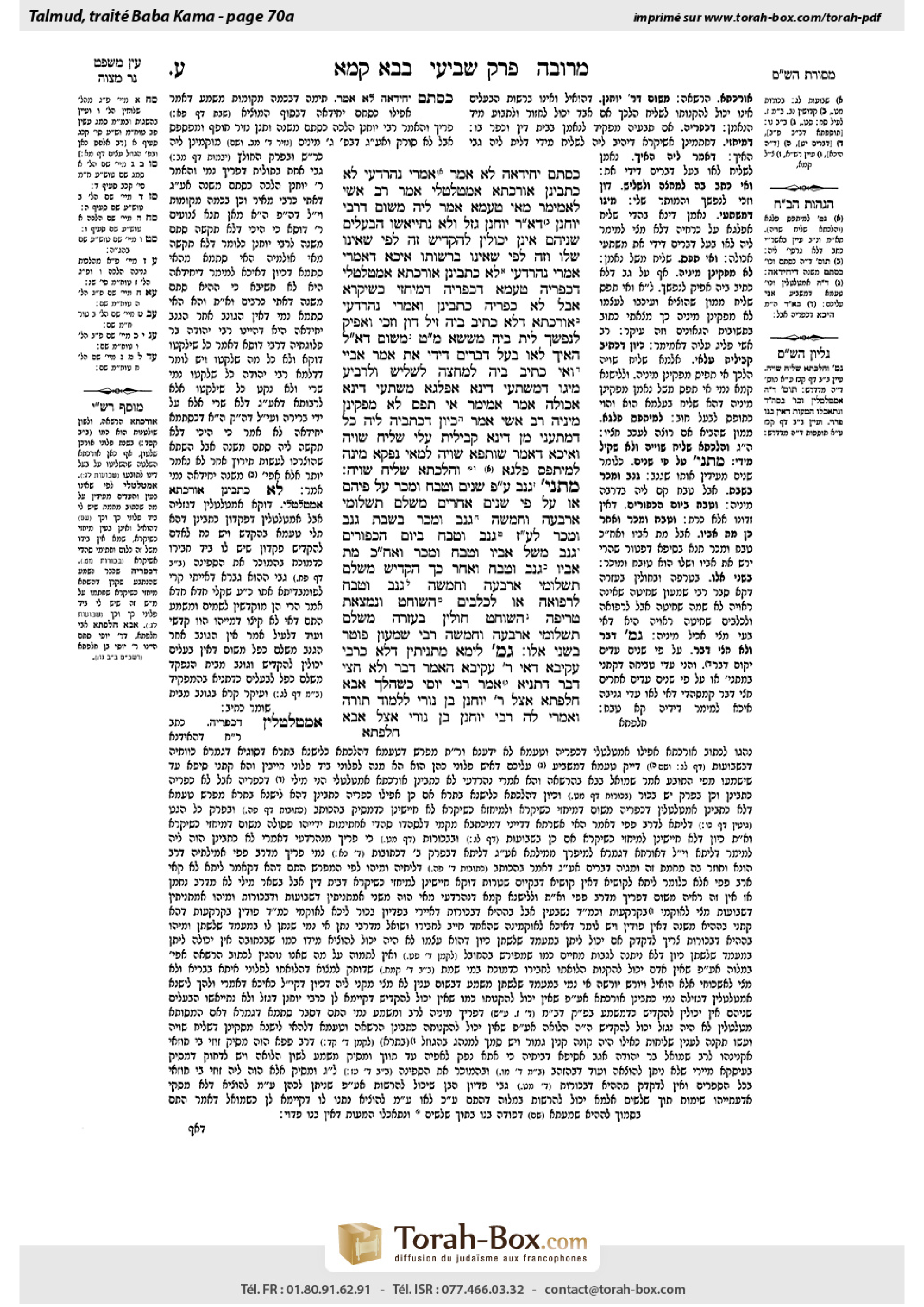
This page of Bava Kamma includes the Aramaic text, an English translation and an AI-generated French translation, alongside the scan above.
בבא קמא ע׳ א · Aramaic and Hebrew text
כִּסְתָם יְחִידָאָה לָא אָמַר.
אָמְרִי נְהַרְדָּעֵי: לָא כָּתְבִינַן אוֹרָכְתָּא אַמִּטַּלְטְלִי. אָמַר רַב אָשֵׁי לְאַמֵּימָר: מַאי טַעְמָא? אֲמַר לֵיהּ: מִשּׁוּם דְּרַבִּי יוֹחָנָן,
דְּאָמַר רַבִּי יוֹחָנָן: גָּזַל וְלֹא נִתְיָיאֲשׁוּ הַבְּעָלִים – שְׁנֵיהֶם אֵינָן יְכוֹלִין לְהַקְדִּישׁ; זֶה לְפִי שֶׁאֵינוֹ שֶׁלּוֹ, וְזֶה לְפִי שֶׁאֵינוֹ בִּרְשׁוּתוֹ.
אִיכָּא דְּאָמְרִי, אָמְרִי נְהַרְדָּעֵי: לָא כָּתְבִינַן אוֹרָכְתָּא אַמִּטַּלְטְלִי דְּכַפְרֵיהּ. טַעְמָא דְּכַפְרֵיהּ, דְּמִיחֲזֵי כְּשִׁיקְרָא; אֲבָל לָא כַּפְרֵיהּ – כָּתְבִינַן.
וְאָמְרִי נְהַרְדָּעֵי: אוֹרָכְתָּא דְּלָא כְּתִיב בֵּיהּ ״זִיל דּוּן וּזְכִי וְאַפֵּיק לְנַפְשָׁךְ״ – לֵית בֵּיהּ מְשָׁשָׁא. מַאי טַעְמָא? מִשּׁוּם דְּאָמַר לֵיהּ הַאיְךְ: לָאו בַּעַל דְּבָרִים דִּידִי אַתְּ.
אָמַר אַבָּיֵי: וְאִי כְּתִיב בֵּיהּ לְמֶחֱצָה לִשְׁלִישׁ וְלִרְבִיעַ, מִיגּוֹ דְּמִשְׁתַּעֵי דִּינָא אַפַּלְגָא, מִשְׁתַּעֵי דִּינָא אַכּוּלֵּהּ.
אָמַר אַמֵּימָר: אִי תְּפַס – לָא מַפְּקִינַן מִינֵּיהּ. רַב אָשֵׁי אָמַר: כֵּיוָן דְּכַתְבֵיהּ לֵיהּ ״כֹּל דְּמִתְעֲנֵי מִן דִּינָא קַבֵּילִית עֲלַי״ – שָׁלִיחַ שַׁוְּיֵהּ.
וְאִיכָּא דְּאָמַר: שׁוּתָּפָא שַׁוְּיֵהּ. לְמַאי נָפְקָא מִינַּהּ? לְמִיתְפַּס פַּלְגָא. וְהִלְכְתָא: שָׁלִיחַ שַׁוְּיֵהּ.
מַתְנִי׳ גָּנַב עַל פִּי שְׁנַיִם, וְטָבַח וּמָכַר עַל פִּיהֶם, אוֹ עַל פִּי שְׁנַיִם אֲחֵרִים – מְשַׁלֵּם תַּשְׁלוּמֵי אַרְבָּעָה וַחֲמִשָּׁה.
גָּנַב וּמָכַר בְּשַׁבָּת; גָּנַב וּמָכַר לַעֲבוֹדָה זָרָה; גָּנַב וְטָבַח בְּיוֹם הַכִּפּוּרִים;
גָּנַב מִשֶּׁל אָבִיו וְטָבַח וּמָכַר, וְאַחַר כָּךְ מֵת אָבִיו; גָּנַב וְטָבַח, וְאַחַר כָּךְ הִקְדִּישׁ – מְשַׁלֵּם תַּשְׁלוּמֵי אַרְבָּעָה וַחֲמִשָּׁה.
גָּנַב וְטָבַח לִרְפוּאָה אוֹ לִכְלָבִים; הַשּׁוֹחֵט וְנִמְצֵאת טְרֵיפָה; הַשּׁוֹחֵט חוּלִּין בַּעֲזָרָה – מְשַׁלֵּם תַּשְׁלוּמֵי אַרְבָּעָה וַחֲמִשָּׁה.
רַבִּי שִׁמְעוֹן פּוֹטֵר בִּשְׁנֵי אֵלּוּ.
גְּמָ׳ לֵימָא מַתְנִיתִין דְּלָא כְּרַבִּי עֲקִיבָא?
דְּאִי רַבִּי עֲקִיבָא, הָאָמַר: ״דָּבָר״ – וְלֹא חֲצִי דָבָר!
דְּתַנְיָא, אָמַר רַבִּי יוֹסֵי: כְּשֶׁהָלַךְ אַבָּא חֲלַפְתָּא אֵצֶל רַבִּי יוֹחָנָן בֶּן נוּרִי לִלְמוֹד תּוֹרָה, וְאָמְרִי לַהּ: רַבִּי יוֹחָנָן בֶּן נוּרִי אֵצֶל אַבָּא
Bava Kamma 70a · English translation
did not say to apply his principle, that the halakha is always in accordance with an unattributed mishna, in a case where the mishna expresses the opinion of an individual Sage. According to this interpretation Rabbi Yoḥanan does not rule in accordance with the mishna, due to the fact that it represents the opinion of an individual Sage, Rabbi Dosa. Rather, he follows the majority opinion. Yet now that Rabbi Yoḥanan said that the pious ones and Rabbi Dosa said the same thing, it cannot be claimed that they are one and the same Sage. Consequently, the ruling of the mishna is evidently accepted by at least two Sages, and therefore the difficulty from the mishna cannot be resolved by assigning it to a single Sage.
§ The Sages of Neharde’a say: One cannot write a document of authorization [orakhta] to assign another to collect a debt or a deposit of movable property on his behalf. Rav Ashi said to Ameimar: What is the reason for this halakha? Ameimar said to him: It is due to a principle stated by Rabbi Yoḥanan.
As Rabbi Yoḥanan says: If one stole an item and the owners have not yet despaired of recovering it, neither of them is able to consecrate it: This one, the thief, cannot consecrate the item because it does not belong to him, and that one, the owner, cannot consecrate it because it is not in his possession. The granting of authority to collect a debt involves the transfer of ownership of the item or money from the owner to the collector; otherwise the debtor could refuse to convey it to the collector. In the case of movable property, as it is being held by another, it is not in the possession of the owner; just as the owner cannot consecrate this item he cannot transfer ownership of it.
There are those who state a different version of this halakha. The Sages of Neharde’a say: One cannot write a document of authorization for the collection of movable property that the bailee or debtor has denied owing. The Gemara infers: According to this version, the only reason the document cannot be written is that the bailee or debtor has denied owing the item, as a document written under these circumstances has the appearance of falsehood, since the purported owner is transferring ownership of an item over which his own ownership is in doubt. But it can be inferred that if the bailee or debtor did not deny owing the item, one can write a document of authorization.
And the Sages of Neharde’a state another halakha with regard to this kind of document: A document of authorization in which it is not written: Go and take legal action against so-and-so and take possession of the owed property and collect it from him for yourself, has no substance, i.e., it is not a valid document. What is the reason for this? It is because the other party, the bailee or debtor, can say to the collector who presents a document without this clause: I am not legally answerable to you; I am willing to deal only with the person to whom the item is owed. To avoid this situation, the authorization document must transfer actual ownership of the item to the collector, who is now claiming it for himself.
Abaye said: And if it is written in the document that the owner transferred ownership of only half of the item to the collector, or a third or a quarter of it, this is sufficient. The reason is that since the bailee or debtor must relate to the judgment, i.e., engage in litigation with the collector, over the half or third or quarter of the item that has been transferred to the collector, he must relate to the judgment concerning all of it.
Ameimar said: If the collector who is empowered by the authorization seized the item he collected and kept it for himself, the court does not take it away from him, as the owner transferred ownership of the item to him in the document of authorization, as explained above. Rav Ashi disagreed with Ameimar and said: Since the owner wrote to the collector: I accept upon myself anything that develops as a result of this legal process, he has in effect rendered the collector an agent to act on his behalf, and therefore the agent cannot seize the item for himself.
And there is another opinion that states: The owner renders the collector a partner in the collected item, transferring ownership of half of it to him while maintaining ownership over the other half. The Gemara asks: What is the practical difference between this opinion and that of Rav Ashi? The Gemara answers: The difference is whether the collector has the power to seize half of the collected item for himself. If he is merely an agent of the owner, he cannot seize anything; if he is a partner he can seize up to half. The Gemara concludes: And the halakha is that the owner renders the collector his agent, and therefore this agent may not seize any portion of the collected item for himself.
MISHNA: The mishna lists a series of cases in which a thief is required to pay the fourfold or fivefold penalty. If one stole an animal, as established based on the testimony of two witnesses, and he subsequently slaughtered the animal or sold it, also based on the testimony of the same witnesses, or based on the testimony of two other witnesses, he pays the fourfold or fivefold payment.
If one stole an animal and sold it on Shabbat, or if he stole it and sold it for idol worship, or if he stole it and slaughtered it on Yom Kippur, he pays the fourfold or fivefold payment. Although his sale or slaughter in these circumstances involved a sin, he is not liable to receive the death penalty for the sale and must consequently pay the fourfold or fivefold payment.
If one stole an animal of his father’s and then slaughtered it or sold it, and afterward his father died and he inherited his father’s estate either on his own or in partnership with his brothers, or if he stole an animal and slaughtered it and afterward he consecrated it, he pays the fourfold or fivefold payment.
In the case of one who stole an animal and slaughtered it, not for the purpose of eating its meat, but to use it for medicinal purposes or to feed the meat to dogs, and likewise a thief who slaughters the animal to eat its meat but it was found to be an animal with a condition that will cause it to die within twelve months [tereifa], or a thief who slaughters a non-sacred animal in the Temple courtyard, he pays the fourfold or fivefold payment.
Rabbi Shimon exempts the thief from the fourfold or fivefold payment in these last two cases, as he maintains that the legal status of an act of slaughter that is not fit for accomplishing its full ritual purpose is not considered an act of slaughter.
GEMARA: The mishna teaches that if two witnesses testify about the theft of an animal and two others testify about its slaughter or sale, the thief pays the fourfold or fivefold payment. The Gemara suggests: Let us say that the mishna is not in accordance with the opinion of Rabbi Akiva, in his exposition of the verse: “Based on the testimony of two witnesses or on the testimony of three witnesses shall a matter be established” (Deuteronomy 19:15).
The Gemara elaborates: As, if it is in accordance with the opinion of Rabbi Akiva, the thief would be exempt from the fourfold or fivefold payment, as doesn’t Rabbi Akiva say that this verse teaches that witnesses’ testimony must refer to an entire matter, and not part of a matter? In the case discussed by the mishna the second set of witnesses testifies only that this man slaughtered or sold an ox or sheep, not that he stole it, and therefore their testimony alone would not render the thief liable to pay anything.
As it is taught in the Tosefta (Bava Batra 2:4) that Rabbi Yosei said: When father Ḥalafta went to study Torah with Rabbi Yoḥanan ben Nuri, and some say that he said: When Rabbi Yoḥanan ben Nuri went to study Torah with father
Bava Kamma 70a · Traduction française (IA)
il n'a pas dit de s'appliquer à son principe, que la halakha est toujours conforme à une mishna non attribuée, dans un cas où la mishna exprime l'opinion d'un sage individuel. Selon cette interprétation, Rabbi Yoḥanan ne rend pas son jugement conformément à la mishna, en raison du fait qu'elle représente l'opinion d'un sage individuel, Rabbi Dosa. Plutôt, il suit l'opinion majoritaire. Cependant, maintenant que Rabbi Yoḥanan a dit que les justes et Rabbi Dosa ont dit la même chose, on ne peut pas affirmer qu'ils soient un seul et même sage. Par conséquent, le jugement de la mishna est clairement accepté par au moins deux sages, et par conséquent, la difficulté liée à la mishna ne peut pas être résolue en attribuant cette mishna à un seul sage.
§ Les Sages de Neharde’a disent : On ne peut pas écrire un document d'autorisation [ou rakhta] pour désigner un autre à recouvrer une créance ou un dépôt de propriété mobile à sa place. Rav Ashi a dit à Ameimar : Quel est le motif de cette halakha ? Ameimar a répondu à lui : C'est en raison d'un principe énoncé par Rabbi Yoḥanan.
Comme Rabbi Yoḥanan dit : Si l'on a volé un objet et que les propriétaires n'ont pas encore désespéré de le récupérer, ni l'un ni l'autre ne peut le consacrer : celui-ci, le voleur, ne peut pas le consacrer car il ne lui appartient pas, et celui-là, le propriétaire, ne peut pas le consacrer car il ne le possède pas. L'autorisation à recouvrer une créance implique le transfert de la propriété de l'objet ou de l'argent du propriétaire au récolteur ; autrement, le débiteur pourrait refuser de le transmettre au récolteur. Dans le cas de propriété mobile, comme elle est détenue par un autre, elle n'appartient pas au propriétaire ; tout comme le propriétaire ne peut pas la consacrer, il ne peut pas transférer sa propriété.
Il y a ceux qui affirment une version différente de cette halakha. Les Sages de Neharde’a disent : On ne peut pas écrire un document d'autorisation pour la collecte de propriété mobile que le gardien ou le débiteur a nié de devoir. La Guemara conclut : Selon cette version, la seule raison pour laquelle ce document ne peut pas être écrit est que le gardien ou le débiteur a nié de devoir l'objet, car un document écrit dans ces circonstances a l'air de mensonge, puisque le prétendu propriétaire transfère la propriété d'un objet dont sa propre propriété est en question. On peut néanmoins déduire que si le gardien ou le débiteur n’a pas nié de devoir l’objet, on peut écrire un document d’autorisation.
Et les Sages de Neharde’a énoncent une autre halakha concernant ce type de document : Un document d'autorisation dans lequel il n'est pas écrit : « Allez prendre des mesures légales contre tel et tel et prenez possession de la propriété due et recouvrez-la pour vous-même » n’a pas de valeur, c’est-à-dire n’est pas un document valide. Quel est le motif de cela ? C’est parce que la partie adverse, le gardien ou le débiteur, peut dire au récolteur qui présente un document sans cette clause : « Je ne suis pas légalement responsable envers vous ; je suis prêt à traiter uniquement avec la personne à qui l’objet appartient. » Pour éviter cette situation, le document d’autorisation doit transférer la propriété réelle de l’objet au récolteur, qui prétend maintenant le revendiquer pour lui-même.
Abaye a dit : Et si on écrit dans le document que le propriétaire a transféré la propriété de la moitié de l’objet au récolteur, ou un tiers ou un quart de celui-ci, cela suffit. Le motif est que puisque le gardien ou le débiteur doit s’adresser à la décision, c’est-à-dire engager une procédure judiciaire avec le récolteur sur la moitié ou le tiers ou le quart de l’objet transféré au récolteur, il doit s’adresser à la décision concernant l’ensemble de l’objet.
Ameimar a dit : Si le récolteur autorisé par l'autorisation a saisi l'objet qu'il a recouvré et l'a gardé pour lui-même, la cour ne le lui retire pas, car le propriétaire a transféré la propriété de l'objet au récolteur dans le document d'autorisation, comme expliqué ci-dessus. Rav Ashi a désaccordé avec Ameimar et a dit : Puisque le propriétaire a écrit au récolteur : « Je m'engage à tout ce qui en découlera de ce processus légal », il a en fait rendu le récolteur son agent pour agir à sa place, et par conséquent, l'agent ne peut pas saisir l'objet pour lui-même.
Et il y a une autre opinion qui affirme : Le propriétaire rend le récolteur partenaire dans l'objet recouvré, transférant la propriété de la moitié de celui-ci à lui tout en conservant la propriété de l'autre moitié. La Guemara demande : Quelle est la différence pratique entre cette opinion et celle de Rav Ashi ? La Guemara répond : La différence réside dans le fait que le récolteur a le pouvoir de saisir la moitié de l'objet recouvré pour lui-même. Si il est simplement l'agent du propriétaire, il ne peut pas saisir quoi que ce soit ; si il est un partenaire, il peut saisir jusqu'à la moitié. La Guemara conclut : Et la halakha est que le propriétaire rend le récolteur son agent, et par conséquent, cet agent ne peut pas saisir aucune part de l'objet recouvré pour lui-même.
MICHNA : La mishna énumère une série de cas dans lesquels un voleur doit payer la sanction quatre fois ou cinq fois. Si l'on a volé un animal, comme établi sur le témoignage de deux témoins, et qu'il a ensuite tué l'animal ou l'a vendu, également sur le témoignage des mêmes témoins, ou sur le témoignage de deux autres témoins, il paie la sanction quatre fois ou cinq fois.
Si l'on a volé un animal et l'a vendu le sabbat, ou si l'on a volé un animal et l'a vendu pour l'idolâtrie, ou si l'on a volé un animal et l'a tué le jour de l'Expiation, il paie la sanction quatre fois ou cinq fois. Bien que sa vente ou son acte de tuer dans ces circonstances ait impliqué un péché, il n'est pas tenu responsable de la peine de mort pour la vente et doit donc payer la sanction quatre fois ou cinq fois.
Si l'on a volé un animal de son père et l'a ensuite tué ou vendu, et ensuite son père est mort et il a hérité de l'immobilier de son père, soit seul, soit en partenariat avec ses frères, ou si l'on a volé un animal et l'a tué et ensuite il l'a consacré, il paie la sanction quatre fois ou cinq fois.
Dans le cas d’un voleur qui a volé un animal et l’a tué, non pas pour manger sa viande, mais pour l’utiliser à des fins médicales ou pour nourrir des chiens, et de même un voleur qui tue l’animal pour en manger la viande mais qui découvre que l’animal est téréifé et mourra dans les douze mois, ou un voleur qui tue un animal non sacré dans le courtyard du Temple, il paie la réparation quadruple ou quintuple.
Rabbi Šimon exempt le voleur de la réparation quadruple ou quintuple dans ces deux derniers cas, car il considère que l’acte de sacrifice qui n’est pas adapté à accomplir pleinement son but rituel n’est pas considéré comme un acte de sacrifice.
GUEMARA : La mitsva enseigne que si deux témoins témoignent du vol d’un animal et deux autres témoignent de son sacrifice ou de sa vente, le voleur paie la réparation quadruple ou quintuple. La Guemara suggère : Disons que la mitsva ne suit pas l’opinion de Rabbi Akiva, dans son interprétation de la parole : « Selon le témoignage de deux témoins ou selon le témoignage de trois témoins sera établi une affaire » (Deutéronome 19:15).
La Guemara développe : Car, si elle suit l’opinion de Rabbi Akiva, le voleur serait exempt de la réparation quadruple ou quintuple, car n’est-ce pas ce que dit Rabbi Akiva que cette parole enseigne que le témoignage doit concerner une affaire entière, et non une partie d’une affaire ? Dans le cas discuté par la Michna, le second groupe de témoins témoigne seulement que cet homme a tué ou vendu un bœuf ou une brebis, pas qu’il l’a volé, et donc leur témoignage seul ne rendrait pas le voleur responsable de payer quoi que ce soit.
Comme il est enseigné dans la Tosefta (Bava Batra 2:4) que Rabbi Yosei a dit : Quand le père Ḥalafta est allé étudier la Torah avec Rabbi Yoḥanan ben Nuri, et certains disent qu’il a dit : Quand Rabbi Yoḥanan ben Nuri est allé étudier la Torah avec le père
Traduction française générée par IA à partir de l’édition anglaise de Sefaria. Vérifie toujours un passage avec le texte source.
Text from Sefaria: William Davidson Edition - Vocalized Aramaic (CC BY NC); William Davidson Edition - English (CC BY NC).