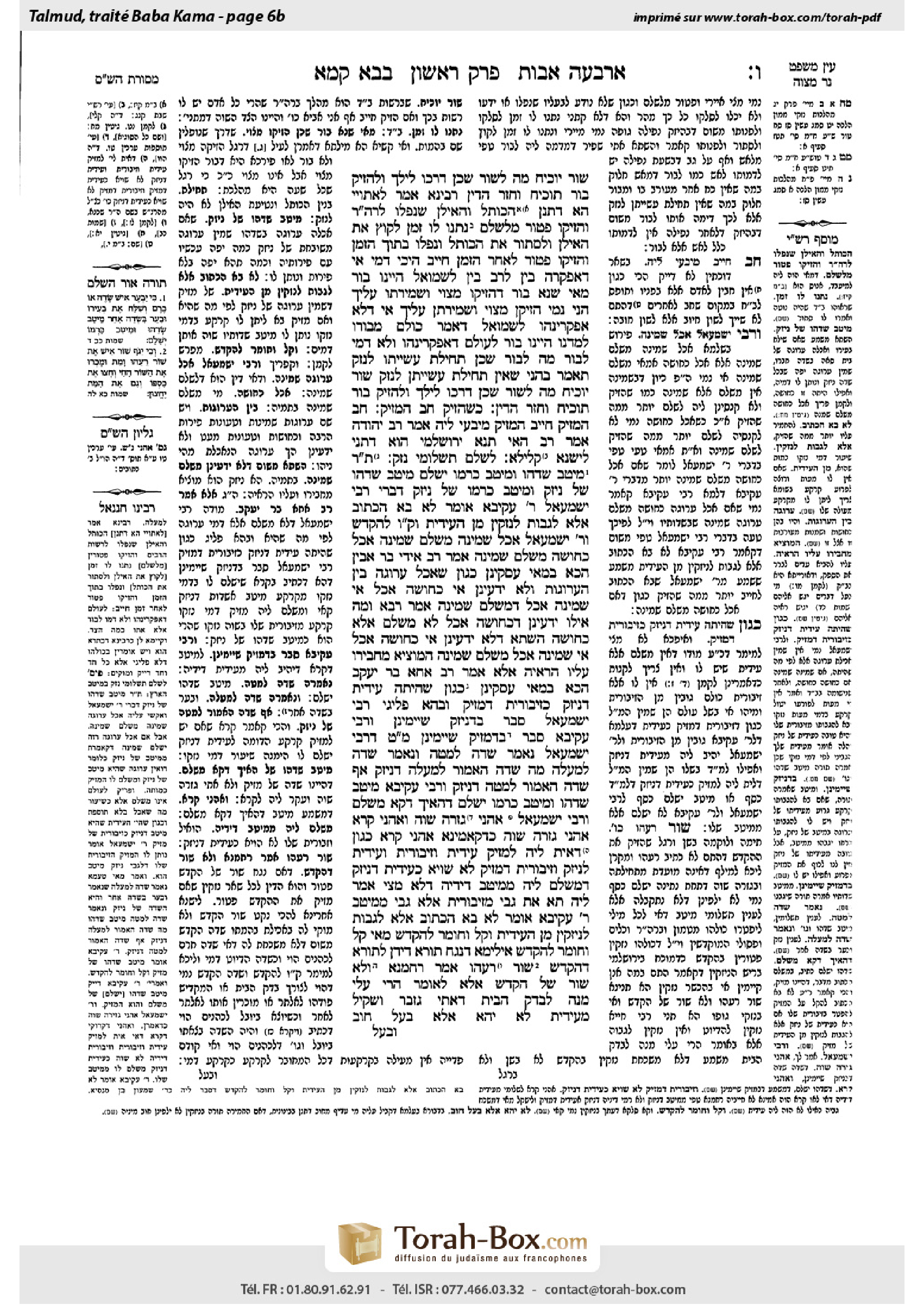
Bava Kamma 6b: Talmud study for Daf Yomi
Study the Talmud for Daf Yomi with scanned pages, Hebrew text, English translations from Sefaria and AI-generated French translations.
Passage selection and English or AI-generated French translation are available where the scan has annotations. Daf Study is independent of Torah-Box and Sefaria.
Browse Bava Kamma · בבא קמא · All tractatesBava Kamma 6b text and translations
This page of Bava Kamma includes the Aramaic text, an English translation and an AI-generated French translation, alongside the scan above.
בבא קמא ו׳ ב · Aramaic and Hebrew text
שׁוֹר יוֹכִיחַ!
מָה לְשׁוֹר שֶׁכֵּן דַּרְכּוֹ לֵילֵךְ וּלְהַזִּיק.
בּוֹר תּוֹכִיחַ! וְחָזַר הַדִּין.
רָבִינָא אָמַר, לְאֵתוֹיֵי הָא דִּתְנַן: הַכּוֹתֶל וְהָאִילָן שֶׁנָּפְלוּ לִרְשׁוּת הָרַבִּים, וְהִזִּיקוּ – פָּטוּר מִלְּשַׁלֵּם. נָתְנוּ לוֹ זְמַן לָקוֹץ אֶת הָאִילָן וְלִסְתּוֹר אֶת הַכּוֹתֶל, וְנָפְלוּ בְּתוֹךְ הַזְּמַן וְהִזִּיקוּ – פָּטוּר. לְאַחַר הַזְּמַן – חַיָּיב.
הֵיכִי דָמֵי? אִי דְּאַפְקְרֵהּ, בֵּין לְרַב בֵּין לִשְׁמוּאֵל – הַיְינוּ בּוֹר; מַאי שְׁנָא בּוֹר – דְּהֶזֵּיקוֹ מָצוּי, וּשְׁמִירָתוֹ עָלֶיךָ; הָנֵי נָמֵי – הֶזֵּיקָן מָצוּי, וּשְׁמִירָתָן עָלֶיךָ!
אִי דְּלָא אַפְקְרִינְהוּ, לִשְׁמוּאֵל דְּאָמַר: כּוּלָּם מִבּוֹרוֹ לָמַדְנוּ – הַיְינוּ בּוֹר!
לְעוֹלָם דְּאַפְקְרִינְהוּ; וְלָא דָּמֵי לְבוֹר, מָה לְבוֹר – שֶׁכֵּן תְּחִילַּת עֲשִׂיָּיתוֹ לְנֵזֶק; תֹּאמַר בְּהָנֵי – שֶׁאֵין תְּחִילַּת עֲשִׂיָּיתָן לְנֵזֶק.
שׁוֹר יוֹכִיחַ!
מָה לְשׁוֹר – שֶׁכֵּן דַּרְכּוֹ לֵילֵךְ וּלְהַזִּיק.
בּוֹר תּוֹכִיחַ! וְחָזַר הַדִּין.
כְּשֶׁהִזִּיק חָב הַמַּזִּיק. ״חָב הַמַּזִּיק״?! ״חַיָּיב הַמַּזִּיק״ מִיבְּעֵי לֵיהּ! אָמַר רַב יְהוּדָה אָמַר רַב: הַאי תַּנָּא יְרוּשַׁלְמִי הוּא, דְּתָנֵי לִישָּׁנָא קַלִּילָא.
לְשַׁלֵּם תַּשְׁלוּמֵי נֶזֶק. תָּנוּ רַבָּנַן: ״מֵיטַב שָׂדֵהוּ וּמֵיטַב כַּרְמוֹ יְשַׁלֵּם״ – מֵיטַב שָׂדֵהוּ שֶׁל נִיזָּק, וּמֵיטַב כַּרְמוֹ שֶׁל נִיזָּק, דִּבְרֵי רַבִּי יִשְׁמָעֵאל.
רַבִּי עֲקִיבָא אוֹמֵר: לֹא בָּא הַכָּתוּב אֶלָּא לִגְבּוֹת לַנִּזָּקִין מִן הָעִידִּית. וְקַל וָחוֹמֶר לַהֶקְדֵּשׁ.
וְרַבִּי יִשְׁמָעֵאל, אָכַל שְׁמֵינָה – מְשַׁלֵּם שְׁמֵינָה; אָכַל כְּחוּשָׁה – מְשַׁלֵּם שְׁמֵינָה?!
אָמַר רַב אִידִי בַּר אָבִין: הָכָא בְּמַאי עָסְקִינַן – כְּגוֹן שֶׁאָכַל עֲרוּגָה בֵּין הָעֲרוּגוֹת, וְלָא יָדְעִינַן אִי כְּחוּשָׁה אֲכַל אִי שְׁמֵינָה אֲכַל; דִּמְשַׁלֵּם שְׁמֵינָה.
אָמַר רָבָא: וּמָה אִילּוּ יָדְעִינַן דִּכְחוּשָׁה אֲכַל – לָא מְשַׁלֵּם אֶלָּא כְּחוּשָׁה; הַשְׁתָּא, דְּלָא יָדְעִינַן אִי כְּחוּשָׁה אֲכַל אִי שְׁמֵינָה אֲכַל, מְשַׁלֵּם שְׁמֵינָה?! הַמּוֹצִיא מֵחֲבֵירוֹ עָלָיו הָרְאָיָה!
אֶלָּא אָמַר רַב אַחָא בַּר יַעֲקֹב: הָכָא בְּמַאי עָסְקִינַן, כְּגוֹן שֶׁהָיְתָה עִידִּית דְּנִיזָּק – כְּזִיבּוּרִית דְּמַזִּיק.
וּבְהָא פְּלִיגִי – רַבִּי יִשְׁמָעֵאל סָבַר: בִּדְנִיזָּק שָׁיְימִינַן, וְרַבִּי עֲקִיבָא סָבַר: בִּדְמַזִּיק שָׁיְימִינַן.
מַאי טַעְמָא דְּרַבִּי יִשְׁמָעֵאל? נֶאֱמַר ״שָׂדֶה״ לְמַטָּה, וְנֶאֱמַר ״שָׂדֶה״ לְמַעְלָה; מָה שָׂדֶה הָאָמוּר לְמַעְלָה – דְּנִיזָּק, אַף שָׂדֶה הָאָמוּר לְמַטָּה – דְּנִיזָּק.
וְרַבִּי עֲקִיבָא, ״מֵיטַב שָׂדֵהוּ וּמֵיטַב כַּרְמוֹ יְשַׁלֵּם״ – דְּהַאיְךְ דְּקָא מְשַׁלֵּם.
וְרַבִּי יִשְׁמָעֵאל – אַהֲנִי גְּזֵרָה שָׁוָה, וְאַהְנִי קְרָא; אַהֲנִי גְּזֵרָה שָׁוָה – כִּדְקָאָמֵינָא.
אַהֲנִי קְרָא – כְּגוֹן דְּאִית לֵיהּ לְמַזִּיק עִידִּית וְזִיבּוּרִית, וְעִידִּית לְנִיזָּק; וְזִיבּוּרִית דְּמַזִּיק לָא שַׁוְיָא כְּעִידִּית דְּנִיזָּק, דִּמְשַׁלֵּם לֵיהּ מִמֵּיטַב דִּידֵיהּ –
דְּלָא מָצֵי אָמַר לֵיהּ: תָּא אַתְּ גְּבִי מִזִּיבּוּרִית, אֶלָּא גְּבִי מִמֵּיטָב.
רַבִּי עֲקִיבָא אוֹמֵר: לֹא בָּא הַכָּתוּב אֶלָּא לִגְבּוֹת לַנִּיזָּקִין מִן הָעִידִּית, וְקַל וָחוֹמֶר לַהֶקְדֵּשׁ. מַאי ״קַל וָחוֹמֶר לַהֶקְדֵּשׁ״?
אִילֵּימָא דִּנְגַח תּוֹרָא דִידַן לְתוֹרָא דְהֶקְדֵּשׁ, ״שׁוֹר רֵעֵהוּ״ אָמַר רַחֲמָנָא – וְלֹא שׁוֹר שֶׁל הֶקְדֵּשׁ!
אֶלָּא לָאוֹמֵר ״הֲרֵי עָלַי מָנֶה לְבֶדֶק הַבַּיִת״, דְּאָתֵי גִּזְבָּר וְשָׁקֵיל מֵעִידִּית.
לֹא יְהֵא אֶלָּא בַּעַל חוֹב,
Bava Kamma 6b · English translation
The Gemara suggests: The primary category of Ox will prove that this fact, that the ox, i.e., the cause of the damage, entered the public domain with permission, is not a reason to exempt its owner from payment, as that is the nature of the primary category of Ox, and one is liable for damage caused by his ox.
The Gemara questions the derivation from Ox: What is notable about Ox? It is notable in that it is the typical manner of the animals in these categories to proceed from one place to another and cause damage. By contrast, in the case of the sewage, it is not its typical manner to proceed and cause damage. Accordingly, how can one learn the halakha in this case from the primary category of Ox?
The Gemara suggests: If one attempts to challenge the derivation from Ox in this manner, it is possible to respond: The halakha of the primary category of Pit will prove that the lack of this characteristic, of the typical manner being to proceed and cause damage, is not a reason to exempt one from paying restitution for the damage, as that is the nature of Pit, and one is liable for damage caused by his pit. The Gemara notes: And as Pit and Ox each prove that the defining characteristic of the other is not decisive in establishing liability or exemption, the derivation has reverted to its starting point, and liability in these cases is derived from the common denominator of Pit and Ox. This is the halakha added by the common denominator stated in the mishna.
Ravina said: The stating of the common denominator in the mishna serves to add the halakha that one is liable to pay damages in this case that we learned in a mishna (117b): In the case of a wall or a tree that fell on its own into the public domain and caused damage, the owner of the wall or tree is exempt from paying damages because he is a victim of circumstances beyond his control. But if the court had sensed the potential danger and had allotted him a certain amount of time during which he was obligated to chop down the tree or to demolish the wall, and he had not yet done so, and the wall or tree fell into the public domain within the allotted time and caused damage, he is exempt from paying damages. If he did not do so and it fell after the allotted time expired, he is liable to pay the damages.
The Gemara asks: What are the circumstances? If it is a case where one declared the fallen tree or wall ownerless, both according to Rav and according to Shmuel, this is a subcategory of Pit. What is different about the primary category of Pit that it is defined as a unique category? What is different is that its damage is commonplace, and it is your property, and responsibility for its safeguarding, to prevent it from causing damage, is incumbent upon you. In these cases involving the tree and the wall, too, their damage is commonplace, and they are your property, and responsibility for their safeguarding, to prevent them from causing damage, is incumbent upon you.
If it is a case where one did not declare them ownerless, according to Shmuel, who says: We learned that one is liable for damage caused by all obstacles that he places in the public domain whether or not he declares them ownerless, from the halakhot with regard to one’s pit, this is a subcategory of Pit.
The Gemara answers: Actually, the mishna teaches one’s liability in a case where one declared the tree or wall ownerless, and even if he declared them ownerless, they are not similar to the primary category of Pit. What is notable about the primary category of Pit? It is notable in that its initial formation, i.e., the digging of the pit, is done in a manner that can result in damage. Will you say the same with regard to these cases, where their initial formation, i.e., the planting of the tree and the building of the wall, is not done in a manner that can result in damage?
The Gemara suggests: The primary category of Ox will prove that this factor, of not being initially formed in a manner that can result in damage, is not a reason to exempt its owner from payment, as that is the nature of the primary category of Ox, i.e., an ox is not born in a manner that results in damage, and one is liable for damage caused by his ox.
The Gemara questions the derivation from Ox: What is notable about Ox? It is notable in that it is the typical manner of the animals in these categories to proceed from one place to another and cause damage. By contrast, in the case of the tree and wall, it is not their typical manner to proceed and cause damage. Accordingly, how can one learn the halakha in these cases from the primary category of Ox?
The Gemara suggests: If one attempts to challenge the derivation from Ox in this manner, it is possible to respond: The halakha of the primary category of Pit will prove that the lack of this characteristic, of the typical manner being to proceed and cause damage, is not a reason to exempt one from paying restitution for the damage, as that is the nature of Pit, and one is liable for damage caused by his pit. The Gemara notes: And as Pit and Ox each prove that the defining characteristic of the other is not decisive in establishing liability or exemption, the derivation has reverted to its starting point, and liability in the cases of the tree and the wall is derived from the common denominator of Pit and Ox. This is the halakha added by the common denominator stated in the mishna.
§ The mishna states: And when a component of any of these categories causes damage, the owner or generator of the component that caused damage is obligated [ḥav] to pay restitution with best-quality land. The Gemara asks: Why does the tanna of the mishna use the unusual expression: The one liable for the damage is ḥav to pay? He should have used the more standard expression for liability: The one liable for the damage is ḥayyav to pay. The Gemara explains: Rav Yehuda said that Rav said: This tanna is a Jerusalemite, who teaches using a light and concise formulation, as ḥav is more concise than ḥayyav.
§ The mishna continues: The owner or generator of the component that caused damage is obligated to pay restitution for damage with best-quality land. The one liable for the damage is indebted to pay payments of restitution for damage with his superior-quality land. The Sages taught in a baraita: The Torah states with regard to paying damages: “Of the best of his field, and of the best of his vineyard he shall pay” (Exodus 22:4). What is the meaning of “his field” and “his vineyard”? It refers to that property of the injured party; the one liable for the damage pays from land of a quality that is commensurate to the best-quality field of the injured party and to the best-quality vineyard of the injured party, even if the property he damaged was of a lesser quality; this is the statement of Rabbi Yishmael.
Rabbi Akiva says that the verse comes only to allow injured parties to collect compensation from superior-quality land belonging to the one liable for the damage, in the event that he has no money or movable property. And by means of an a fortiori inference one can derive that the Temple treasury of consecrated property collects from superior-quality land.
The Gemara asks: And according to the opinion of Rabbi Yishmael, if one’s animal ate from a rich garden bed, it is understandable that he must pay the injured party the value of a rich garden bed. But if it ate from a poor garden bed, is it reasonable that he pays the value of a rich garden bed? While this is the straightforward meaning of his statement, it is untenable, as he would be paying more than the value of the damage he caused.
Rav Idi bar Avin said: With what are we dealing here? We are dealing with a case where the animal that caused the damage ate from one garden bed among other garden beds, and we do not know whether it ate from a poor one or it ate from a rich one. In such a case, the halakha is that the animal’s owner pays the injured party the value of a rich one.
Rava raised a question and said: And if we would know that the animal ate from a poor garden bed, its owner would have to pay only the value of a poor garden bed. Now that we do not know whether it ate from a poor garden bed or if it ate from a rich garden bed, is it reasonable that he should have to pay the value of a rich garden bed? There is a general principle governing monetary disputes that the burden of proof falls on the claimant. Therefore, so long as the injured party cannot prove that the animal ate from the rich garden bed, he should not be entitled to collect the value of such a garden bed.
Rather, Rav Aḥa bar Ya’akov said: With what are we dealing here? We are dealing with a case where, after appraising the damage, the court comes to collect from the one liable for the damage, but he does not have money available to pay for the damage. And the tanna’im disagree in a case where the superior-quality land [iddit], i.e., the best land, of the injured party is equal in quality to the inferior-quality land of the one liable for the damage, and the one liable for the damage also has land of superior quality.
And they disagree with regard to this: Rabbi Yishmael holds: We appraise the value of the land of the injured party, and therefore the one liable for the damage can pay with his inferior-quality fields, which are equal in quality to the best fields owned by the injured party. And Rabbi Akiva holds: We appraise the value of the land of the one liable for the damage and have him pay with his fields of superior quality.
The Gemara explains: What is the reason of Rabbi Yishmael? The word “field” is stated below, toward the end of the verse: “Of the best of his field, and of the best of his vineyard he shall pay” (Exodus 22:4). And the word “field” is also stated above, at the beginning of that same verse: “If a man causes a field or vineyard to be eaten, and he sends forth his animal, and it consumed in the field of another.” Just as the field which is stated above belongs to the injured party, so too the field stated below belongs to the injured party.
And Rabbi Akiva holds: When the verse says: “Of the best of his field and of the best of his vineyard he shall pay,” it means from the best of the one who is paying, i.e., from the best fields belonging to the one liable for the damage.
And how would Rabbi Yishmael respond to this? The verbal analogy between the two instances of the word “field” is effective, and the straightforward meaning of the verse itself is effective. The verbal analogy is effective, as I stated. It serves to teach that when it says that he pays from the best of his field, it means from land equal in quality to the best field owned by the injured party.
And the straightforward meaning of the verse itself is effective, as it serves to teach a different halakha, in a case where the one liable for the damage has superior-quality land and inferior-quality land, and the injured party has superior-quality land, and the inferior-quality land of the one liable for the damage is not as good as the superior-quality land of the injured party. In this case, the halakha is that the one liable for the damage pays the injured party from his best land, i.e., from the superior-quality land that he owns.
This is as the one liable for the damage is legally unable to say to him: You should come and collect from my inferior-quality land. He cannot say this because the standard for classifying land as being of superior-quality is set according to the injured party’s superior-quality land, and the inferior-quality land of the one liable for the damage is of a lower quality than that. Rather, the injured party collects his damages from the best-quality land of the one liable for the damage.
§ The baraita cited above teaches: Rabbi Akiva says that the verse comes only to allow injured parties to collect compensation from superior-quality land belonging to the one liable for the damage, in the event that he has no money or movable property. And by means of an a fortiori inference one can derive that the Temple treasury of consecrated property collects from superior-quality land. The Gemara asks: What is the a fortiori inference from ordinary damage to damage involving the consecrated property? To which case does this refer?
If we say that our ox, i.e., an ox belonging to a Jew, gored an ox that is consecrated property, there is a difficulty, as the Merciful One states: “And if one man’s ox hurts the ox of another” (Exodus 21:35). This teaches that the halakha applies only if the ox hurt an ox belonging to another Jew, but not if it hurt an ox that is consecrated property. In the latter case no damages are collected.
Rather, we say that the a fortiori inference is referring not to a case of damage but to one who vows and says: It is incumbent upon me to donate one hundred dinars for Temple maintenance. And the inference teaches that if the one who took the vow has no money, then the Temple treasurer comes and collects the hundred dinars from his superior-quality land.
The Gemara challenges this understanding: The Temple treasurer should not be treated any better than an ordinary creditor,
Bava Kamma 6b · Traduction française (IA)
La Guemara suggère : La catégorie principale de l'ox démontre que ce fait, à savoir que l'ox, c'est-à-dire la cause du préjudice, est entré dans le domaine public avec l'autorisation, n'est pas une raison d'exonérer son propriétaire du paiement, car c'est la nature de la catégorie principale de l'ox, et l'on est tenu responsable des préjudices causés par son ox.
La Guemara questionne la dérivation à partir de l'ox : Qu'est-ce qui est remarquable à propos de l'ox ? C'est ce qui est remarquable, à savoir qu'il est le mode typique des animaux de ces catégories de se déplacer d'un lieu à un autre et de causer des préjudices. À l'inverse, dans le cas des eaux usées, ce n'est pas son mode typique de se déplacer et de causer des préjudices. Ainsi, comment peut-on apprendre la halakha dans ce cas à partir de la catégorie principale de l'ox ?
La Guemara suggère : Si l'on tente de contester la dérivation à partir de l'ox de cette manière, il est possible de répondre : La halakha de la catégorie principale du trou démontre que l'absence de ce caractère, à savoir le mode typique de se déplacer et de causer des préjudices, n'est pas une raison d'exonérer l'on de payer la réparation des préjudices, car c'est la nature du trou, et l'on est tenu responsable des préjudices causés par son trou. La Guemara note : Et comme le trou et l'ox démontrent l'un l'autre que leur caractère définitoire n'est pas décisif pour établir la responsabilité ou l'exonération, la dérivation revient à son point de départ, et la responsabilité dans ces cas est dérivée du dénominateur commun du trou et de l'ox. C'est la halakha ajoutée par le dénominateur commun mentionné dans la mitsna.
Ravina dit : L'énoncé du dénominateur commun dans la mitsva sert à ajouter la halakha selon laquelle l'on est tenu de payer les dommages dans ce cas que nous avons appris dans une mitsva (117b) : Dans le cas d'un mur ou d'un arbre qui s'est effondré de lui-même dans le domaine public et a causé des préjudices, le propriétaire du mur ou de l'arbre est exempt de payer les dommages, car il est victime de circonstances hors de son contrôle. Mais si la cour avait perçu le danger potentiel et avait assigné à ce dernier un certain délai pendant lequel il était tenu de couper l'arbre ou de démolir le mur, et qu'il n'avait pas encore fait cela, et que le mur ou l'arbre s'était effondré dans le domaine public pendant le délai assigné et avait causé des préjudices, il est exempt de payer les dommages. Si, en revanche, il n'avait pas fait cela et qu'il s'était effondré après la fin du délai assigné, il est tenu de payer les dommages.
La Guemara pose la question : Quelles sont les circonstances ? Si c'est un cas où l'on a déclaré l'arbre ou le mur sans propriétaire, cela est une sous-catégorie du trou, selon Rav et selon Shmuel. Qu'est-ce qui diffère dans la catégorie principale du trou qui la définit comme une catégorie unique ? Ce qui diffère, c'est que son préjudice est courant, et c'est votre propriété, et la responsabilité de son gardiennage, pour empêcher qu'il cause des préjudices, incombe à vous. Dans ces cas concernant l'arbre et le mur, également, leur préjudice est courant, et ce sont vos propriétés, et la responsabilité de leur gardiennage, pour empêcher qu'ils causent des préjudices, incombe à vous.
Si c'est un cas où l'on n'a pas déclaré qu'ils sont sans propriétaire, selon Shmuel, qui dit : Nous avons appris que l'on est tenu responsable des préjudices causés par tous les obstacles que l'on place dans le domaine public, qu'on les déclare sans propriétaire ou non, à partir des halakhot concernant son trou, c'est une sous-catégorie du trou.
La Guemara répond : En réalité, la Michna enseigne la responsabilité dans le cas où l'on a déclaré l'arbre ou le mur sans propriétaire, et même si l'on les a déclarés sans propriétaire, ils ne sont pas semblables à la catégorie principale du trou. Qu'est-ce qui est remarquable à propos de la catégorie principale du trou ? C'est ce qui est remarquable, à savoir que sa formation initiale, c'est-à-dire le creusement du trou, est faite d'une manière qui peut causer des préjudices. Direz-vous la même chose concernant ces cas, où leur formation initiale, c'est-à-dire la plantation de l'arbre et la construction du mur, n'est pas faite d'une manière qui peut causer des préjudices ?
La Guemara suggère : La catégorie principale de l'âne démontre que ce facteur, d'être formé initialement d'une manière qui ne peut causer des préjudices, n'est pas une raison d'exonérer son propriétaire du paiement, car c'est la nature de la catégorie principale de l'âne, c'est-à-dire que l'âne n'est pas né d'une manière qui cause des préjudices, et l'on est tenu responsable des préjudices causés par son âne.
La Guemara questionne la dérivation à partir de l'âne : Qu'est-ce qui est remarquable à propos de l'âne ? C'est ce qui est remarquable, à savoir qu'il est le mode typique des animaux de ces catégories de se déplacer d'un lieu à un autre et de causer des préjudices. À l'inverse, dans le cas de l'arbre et du mur, ce n'est pas leur mode typique de se déplacer et de causer des préjudices. Ainsi, comment peut-on apprendre la halakha dans ces cas à partir de la catégorie principale de l'âne ?
La Guemara suggère : Si l'on tente de contester la dérivation à partir de l'âne de cette manière, il est possible de répondre : La halakha de la catégorie principale du trou démontre que l'absence de ce caractère, à savoir le mode typique de se déplacer et de causer des préjudices, n'est pas une raison d'exonérer l'on de payer la réparation des préjudices, car c'est la nature du trou, et l'on est tenu responsable des préjudices causés par son trou. La Guemara note : Et comme le trou et l'âne démontrent l'un l'autre que leur caractère définitoire n'est pas décisif pour établir la responsabilité ou l'exonération, la dérivation revient à son point de départ, et la responsabilité dans les cas de l'arbre et du mur est dérivée du dénominateur commun du trou et de l'âne. C'est la halakha ajoutée par le dénominateur commun mentionné dans la mitsva.
§ La mitsva stipule : Et quand un composant de n'importe quelle de ces catégories cause des préjudices, le propriétaire ou le créateur du composant qui a causé les préjudices est tenu [ḥav] de payer la réparation avec la meilleure terre. La Guemara pose la question : Pourquoi le tanna de la mitsva utilise-t-il l'expression inhabituelle : Celui qui est tenu responsable des préjudices est ḥav à payer ? Il aurait dû utiliser l'expression plus standard pour la responsabilité : Celui qui est tenu responsable des préjudices est ḥayyav à payer. La Guemara explique : Rav Yéhuda a dit que Rav a dit : Ce tanna est un Jérusalmite, qui enseigne en utilisant une formulation légère et concise, car ḥav est plus concise que ḥayyav.
§ La Michna continue : L'propriétaire ou le générateur de la composante qui a causé un préjudice est tenu de payer une compensation pour le préjudice avec un terrain de qualité supérieure. Celui tenu responsable du préjudice est dû à payer des compensations avec son terrain de qualité supérieure. Les Sages ont enseigné dans une baraïta : La Torah dit concernant le paiement des dommages : « De la meilleure de son champ et de la meilleure de son vigne il paiera » (Exode 22:4). Qu'entend-on par « son champ » et « sa vigne » ? Il s'agit de la propriété de la partie blessée ; celui tenu responsable du préjudice paie à partir d'un terrain de qualité correspondant à la meilleure qualité de champ et de vigne de la partie blessée, même si la propriété qu'il a endommagée était de moindre qualité ; c'est la déclaration de Rabbi Yishmael.
Rabbi Akiva dit que la versette vient uniquement permettre aux parties blessées de récupérer une compensation à partir d'un terrain de qualité supérieure appartenant à celui tenu responsable du préjudice, en cas où il n'a pas d'argent ou de biens mobiliers. Et par une déduction a fortiori, on peut déduire que le trésor du Temple des biens consacrés récupère à partir d'un terrain de qualité supérieure.
Le Guemara pose une question : Et selon l'opinion de Rabbi Yishmael, si un animal a mangé dans un lit de jardin riche, il est compréhensible qu'il doive payer à la partie blessée la valeur d'un lit de jardin riche. Mais si l'animal a mangé dans un lit de jardin pauvre, est-il raisonnable qu'il paie la valeur d'un lit de jardin riche ? Bien que ce soit le sens littéral de son déclaration, cela est inacceptable, car il paierait plus que la valeur du préjudice qu'il a causé.
Rav Idi bar Avin dit : Avec quoi sommes-nous en train de nous occuper ? Nous sommes en train de nous occuper d'un cas où l'animal qui a causé le préjudice a mangé dans un lit de jardin parmi d'autres lits de jardin, et nous ne savons pas s'il a mangé dans un lit pauvre ou dans un lit riche. Dans ce cas, la halakha est que l'propriétaire de l'animal paie à la partie blessée la valeur d'un lit riche.
Rava a soulevé une question et a dit : Et si nous savions que l'animal a mangé dans un lit de jardin pauvre, son propriétaire aurait dû payer seulement la valeur d'un lit de jardin pauvre. Maintenant que nous ne savons pas si l'animal a mangé dans un lit de jardin pauvre ou s'il a mangé dans un lit de jardin riche, est-il raisonnable qu'il doive payer la valeur d'un lit de jardin riche ? Il existe un principe général concernant les litiges monétaires selon lequel la charge de la preuve incombe à l'ayant droit. Ainsi, tant que la partie blessée ne peut pas prouver que l'animal a mangé dans le lit de jardin riche, il ne devrait pas être autorisé à récupérer la valeur d'un tel lit de jardin.
Plutôt, Rav Aḥa bar Ya’akov dit : Avec quoi sommes-nous en train de nous occuper ? Nous sommes en train de nous occuper d'un cas où, après l'évaluation du préjudice, la cour vient récupérer auprès de celui tenu responsable du préjudice, mais il n'a pas d'argent disponible pour payer le préjudice. Et les tannaïm s'opposent dans un cas où la terre de qualité supérieure [iddit], c'est-à-dire la meilleure terre, de la partie blessée est égale en qualité à la terre de moindre qualité de celui tenu responsable du préjudice, et celui tenu responsable du préjudice possède également une terre de qualité supérieure.
Et ils s'opposent à propos de cela : Rabbi Yishmael dit : Nous évaluons la valeur de la terre de la partie blessée, et donc celui tenu responsable du préjudice peut payer avec ses terres de moindre qualité, qui sont égales en qualité aux meilleurs champs possédés par la partie blessée. Et Rabbi Akiva dit : Nous évaluons la valeur de la terre de celui tenu responsable du préjudice et nous lui faisons payer avec ses champs de qualité supérieure.
Le Guemara explique : Quel est le raisonnement de Rabbi Yishmael ? Le mot « champ » est mentionné en bas, vers la fin de la versette : « De la meilleure de son champ et de la meilleure de son vigne il paiera » (Exode 22:4). Et le mot « champ » est également mentionné en haut, au début de cette même versette : « Si un homme cause un champ ou une vigne à être mangé, et il envoie son animal, et il a mangé dans le champ d'un autre. » Tout comme le champ qui est mentionné en haut appartient à la partie blessée, de même le champ mentionné en bas appartient à la partie blessée.
Et Rabbi Akiva dit : Lorsque la versette dit : « De la meilleure de son champ et de la meilleure de son vigne il paiera », cela signifie à partir de la meilleure des terres de celui qui paie, c'est-à-dire à partir des meilleurs champs appartenant à celui tenu responsable du préjudice.
Et comment Rabbi Yishmael répondrait-il à cela ? L'analogie verbale entre les deux occurrences du mot « champ » est efficace, et le sens littéral de la versette est efficace. L'analogie verbale est efficace, comme je l'ai dit. Elle sert à enseigner que lorsque la versette dit qu'il paie à partir de la meilleure de son champ, cela signifie à partir d'un terrain égal en qualité à la meilleure terre possédée par la partie blessée.
Et le sens littéral de la versette est efficace, car il sert à enseigner une autre halakha, dans un cas où celui tenu responsable du préjudice possède des terres de qualité supérieure et des terres de qualité inférieure, et la partie blessée possède des terres de qualité supérieure, et les terres de qualité inférieure de celui tenu responsable du préjudice ne sont pas aussi bonnes que les terres de qualité supérieure de la partie blessée. Dans ce cas, la halakha est que celui tenu responsable du préjudice paie à la partie blessée à partir de ses terres de meilleure qualité, c'est-à-dire à partir des terres de qualité supérieure qu'il possède.
C'est comme celui tenu responsable du préjudice ne peut pas légalement dire à la partie blessée : Vous devriez venir récupérer à partir de ma terre de qualité inférieure. Il ne peut pas dire cela car le critère pour classer une terre comme étant de qualité supérieure est fixé selon la terre de qualité supérieure de la partie blessée, et la terre de qualité inférieure de celui tenu responsable du préjudice est de moindre qualité. Plutôt, la partie blessée récupère ses dommages à partir de la meilleure qualité de terre de celui tenu responsable du préjudice.
§ La baraïta citée ci-dessus enseigne : Rabbi Akiva dit que la versette vient uniquement permettre aux parties blessées de réclamer une compensation à partir de terres de qualité supérieure appartenant à celui qui est responsable du dommage, en cas où il n’a pas d’argent ou de biens mobiliers. Et par une déduction a fortiori, on peut déduire que le trésor du Temple des biens consacrés collecte à partir de terres de qualité supérieure. La Guemara demande : De quelle déduction a fortiori s’agit-il, du dommage ordinaire au dommage impliquant les biens consacrés ? À quel cas cela fait-il référence ?
Si nous disons que notre bœuf, c’est-à-dire un bœuf appartenant à un Juif, a blessé un bœuf qui est un bien consacré, il y a une difficulté, car le Tout-Puissant dit : « Et si l’ox d’un homme blesse l’ox d’un autre » (Exode 21:35). Cela enseigne que la halakha s’applique uniquement si le bœuf a blessé un bœuf appartenant à un autre Juif, mais pas si le bœuf a blessé un bœuf qui est un bien consacré. Dans ce dernier cas, aucune compensation n’est recueillie.
Plutôt, nous disons que la déduction a fortiori ne s’applique pas à un cas de dommage, mais à celui qui fait un vœu et dit : Il m’est imposé de donner cent dinars pour la maintenance du Temple. Et la déduction enseigne que si celui qui a fait le vœu n’a pas d’argent, alors le trésor du Temple vient et recueille les cent dinars à partir de ses terres de qualité supérieure.
La Guemara remet en question cette interprétation : Le trésor du Temple ne devrait pas être traité différemment d’un créancier ordinaire,
Traduction française générée par IA à partir de l’édition anglaise de Sefaria. Vérifie toujours un passage avec le texte source.
Text from Sefaria: William Davidson Edition - Vocalized Aramaic (CC BY NC); William Davidson Edition - English (CC BY NC).