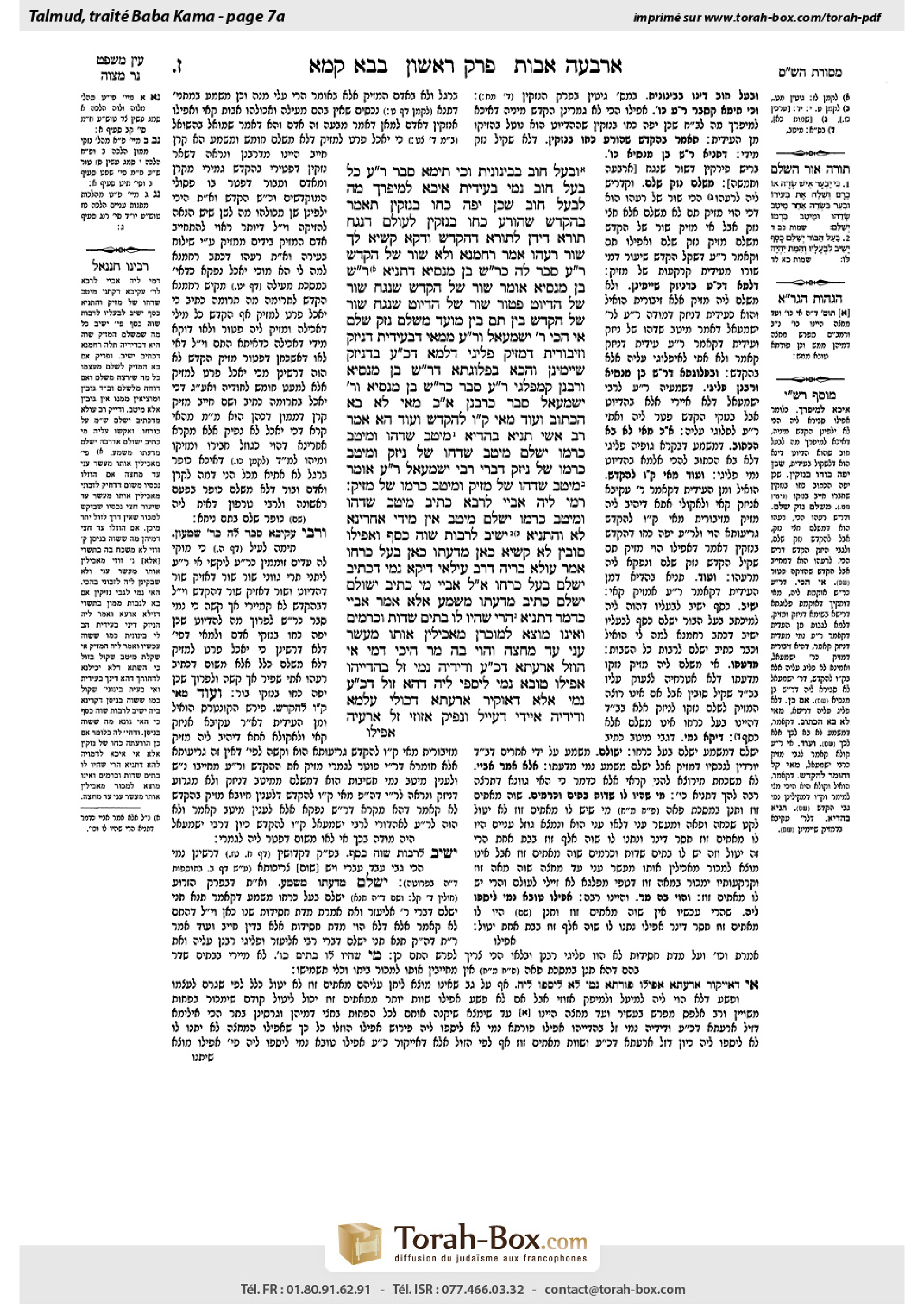
Bava Kamma 7a: Talmud study for Daf Yomi
Study the Talmud for Daf Yomi with scanned pages, Hebrew text, English translations from Sefaria and AI-generated French translations.
Passage selection and English or AI-generated French translation are available where the scan has annotations. Daf Study is independent of Torah-Box and Sefaria.
Browse Bava Kamma · בבא קמא · All tractatesBava Kamma 7a text and translations
This page of Bava Kamma includes the Aramaic text, an English translation and an AI-generated French translation, alongside the scan above.
בבא קמא ז׳ א · Aramaic and Hebrew text
וּבַעַל חוֹב בְּבֵינוֹנִית!
וְכִי תֵּימָא סָבַר רַבִּי עֲקִיבָא: בַּעַל חוֹב נָמֵי בְּעִידִּית; אִיכָּא לְמִיפְרַךְ: מָה לְבַעַל חוֹב – שֶׁכֵּן יִפָּה כֹּחוֹ בְּנִזָּקִין, תֹּאמַר בְּהֶקְדֵּשׁ – שֶׁהוֹרַע כֹּחוֹ בְּנִזָּקִין!
לְעוֹלָם דִּנְגַח תּוֹרָא דִידַן לְתוֹרָא דְהֶקְדֵּשׁ. וּדְקָא קַשְׁיָא לָךְ: ״שׁוֹר רֵעֵהוּ״ אָמַר רַחֲמָנָא – וְלֹא שׁוֹר שֶׁל הֶקְדֵּשׁ; רַבִּי עֲקִיבָא סָבַר לַהּ כְּרַבִּי שִׁמְעוֹן בֶּן מְנַסְיָא –
דְּתַנְיָא, רַבִּי שִׁמְעוֹן בֶּן מְנַסְיָא אוֹמֵר: שׁוֹר שֶׁל הֶקְדֵּשׁ שֶׁנָּגַח שׁוֹר שֶׁל הֶדְיוֹט – פָּטוּר; שׁוֹר שֶׁל הֶדְיוֹט שֶׁנָּגַח שׁוֹר שֶׁל הֶקְדֵּשׁ, בֵּין תָּם בֵּין מוּעָד – מְשַׁלֵּם נֶזֶק שָׁלֵם.
אִי הָכִי, רַבִּי יִשְׁמָעֵאל וְרַבִּי עֲקִיבָא – מִמַּאי דִּבְעִידִּית דְּנִיזָּק וְזִיבּוּרִית דְּמַזִּיק פְּלִיגִי? דִּלְמָא דְּכוּלֵּי עָלְמָא בִּדְנִיזָּק שָׁיְימִינַן, וְהָכָא בִּפְלוּגְתָּא דְּרַבִּי שִׁמְעוֹן בֶּן מְנַסְיָא וְרַבָּנַן קָמִפַּלְגִי –
רַבִּי עֲקִיבָא סָבַר כְּרַבִּי שִׁמְעוֹן בֶּן מְנַסְיָא, וְרַבִּי יִשְׁמָעֵאל סָבַר כְּרַבָּנַן!
אִם כֵּן, מַאי ״לֹא בָּא הַכָּתוּב״?
וְעוֹד, מַאי ״קַל וָחוֹמֶר לַהֶקְדֵּשׁ״?
וְעוֹד, הָא אָמַר רַב אָשֵׁי, תַּנְיָא בְּהֶדְיָא: ״מֵיטַב שָׂדֵהוּ וּמֵיטַב כַּרְמוֹ יְשַׁלֵּם״ – מֵיטַב שָׂדֵהוּ שֶׁל נִיזָּק, וּמֵיטַב כַּרְמוֹ שֶׁל נִיזָּק, דִּבְרֵי רַבִּי יִשְׁמָעֵאל. רַבִּי עֲקִיבָא אוֹמֵר: מֵיטַב שָׂדֵהוּ שֶׁל מַזִּיק, וּמֵיטַב כַּרְמוֹ שֶׁל מַזִּיק.
רָמֵי לֵיהּ אַבָּיֵי לְרָבָא, כְּתִיב: ״מֵיטַב שָׂדֵהוּ וּמֵיטַב כַּרְמוֹ יְשַׁלֵּם״ – מֵיטַב אִין, מִידֵּי אַחֲרִינָא לָא;
וְהָתַנְיָא: ״יָשִׁיב״ – לְרַבּוֹת שָׁוֶה כֶּסֶף, וַאֲפִילּוּ סוּבִּין!
לָא קַשְׁיָא; כָּאן מִדַּעְתּוֹ, כָּאן בְּעַל כׇּרְחוֹ.
אָמַר עוּלָּא בְּרֵיהּ דְּרַב עִילַּאי: דַּיְקָא נָמֵי, דִּכְתִיב: ״יְשַׁלֵּם״ – בְּעַל כׇּרְחוֹ.
אֲמַר לֵיהּ אַבָּיֵי: מִי כְּתִיב ״יְשׁוּלַּם״?! ״יְשַׁלֵּם״ כְּתִיב – מִדַּעְתּוֹ מַשְׁמַע!
אֶלָּא אָמַר אַבָּיֵי: כִּדְמָר – דְּתַנְיָא: הֲרֵי שֶׁהָיוּ לוֹ בָּתִּים שָׂדוֹת וּכְרָמִים, וְאֵינוֹ מוֹצֵא לְמוֹכְרָן – מַאֲכִילִין אוֹתוֹ מַעְשַׂר עָנִי, עַד מֶחֱצָה.
וְהָוֵי בָּהּ מָר: הֵיכִי דָמֵי? אִי (הוּזַל) [דְּזוּל] אַרְעָתָא דְּכוּלֵּי עָלְמָא, וְדִידֵיהּ נָמֵי זָל בַּהֲדַיְיהוּ – אֲפִילּוּ טוּבָא נָמֵי לִיסְפֵּי לֵיהּ, דְּהָא זוּל דְּכוּלֵּי עָלְמָא נָמֵי!
אֶלָּא דְּאוֹקִיר אַרְעָתָא דְּכוּלֵּי עָלְמָא, וְדִידֵיהּ – אַיְּידֵי דְּעָיֵיל וְנָפֵיק אַזּוּזֵי, זָל אַרְעֵיהּ?
Bava Kamma 7a · English translation
and the halakha of a creditor is to collect only from intermediate-quality land, not from superior-quality land.
And if you would say that Rabbi Akiva holds that a creditor can collect the money owed him from superior-quality land as well, there is still a difficulty; the a fortiori inference can still be refuted in the following manner: What is notable about an ordinary creditor? He is notable in that the Torah enhanced his power with regard to payment of damages, as an ordinary person can collect payment of damages for loss or injury caused by another’s ox. But can you say the same about the Temple treasury of consecrated property, with regard to which the Torah weakened its power with regard to payment of damages, not allowing it to collect such compensation? Accordingly, even if a creditor collects from superior-quality land, it does not necessarily follow that a Temple treasurer would also do so. It is therefore apparent that Rabbi Akiva’s a fortiori inference is not referring to the case of one who donates money to the Temple.
The Gemara rejects this: Actually, we can explain that we are dealing here with a case where our ox gored an ox that is consecrated property. And with regard to that which posed a difficulty for you about this explanation, i.e., that the Merciful One states: “The ox of another” (Exodus 21:35), which indicates that liability is incurred only for damaging another person’s ox but not for an ox consecrated to the Temple, Rabbi Akiva disagrees with that interpretation and holds in accordance with the opinion of Rabbi Shimon ben Menasya.
As it is taught in a baraita: Rabbi Shimon ben Menasya says: If an ox that is consecrated property gored an ox belonging to a common person [hedyot], the Temple treasury is exempt from liability. By contrast, in the case of an ox belonging to a common person that gored an ox that is consecrated property, whether the ox that gored the other ox was an innocuous ox, i.e., an ox with no consistent history of causing damage with the intent to injure, or it was a forewarned ox, i.e., an ox whose owner was forewarned because his ox had already gored another ox three times, the ox’s owner pays the full cost of the damage.
The Gemara asks: If so, from where do you know to say that Rabbi Akiva and Rabbi Yishmael disagree about a case where the superior-quality land belonging to the injured party and the inferior-quality land belonging to the one liable for the damage are equal in quality, and the one liable for the damage also has land of superior quality, as the dispute was previously interpreted by Rav Aḥa bar Ya’akov? Perhaps everyone, including Rabbi Akiva, agrees that we appraise the value of the land of the injured party, and here they disagree with regard to the dispute between Rabbi Shimon ben Menasya and the Rabbis.
The Gemara explains: Rabbi Akiva holds in accordance with the opinion of Rabbi Shimon ben Menasya, that in the case of damage caused by the ox of a common person to the property of the Temple treasury, compensation is collected from superior-quality land belonging to the one liable for the damage. And Rabbi Yishmael holds in accordance with the opinion of the Rabbis, that the owner of the ox bears no liability. In other words, perhaps in the baraita recording the dispute between Rabbi Yishmael and Rabbi Akiva (see 6b), Rabbi Yishmael first taught that land is appraised based on the quality of the injured party’s land, and then, although it is not explicit in the baraita, he continued to state his opinion that the Temple treasury is unable to collect damages. Accordingly, Rabbi Akiva can be understood as having first expressed his agreement concerning the valuation of land and then proceeding to dispute Rabbi Yishmael’s opinion with regard to the Temple treasury.
The Gemara rejects this suggestion: If it is so that this is the disagreement, then what is the meaning of Rabbi Akiva’s statement: The verse comes only to allow injured parties to collect compensation from superior-quality land? This indicates that Rabbi Akiva disagrees about how to understand this verse.
And furthermore, if the subject is the Temple treasury, what is the meaning of: And by means of an a fortiori inference one can derive that the Temple treasury of consecrated property collects from superior-quality land. If, as suggested, Rabbi Akiva holds in accordance with the opinion of Rabbi Shimon ben Menasya, then he maintains that damage to consecrated property is dealt with more stringently than damage to another person’s property, in that if one’s ox damages consecrated property one is liable for the full cost of the damage even if the ox was considered innocuous. If damage to consecrated property is dealt with more stringently, there is no basis to derive an a fortiori inference.
And furthermore, didn’t Rav Ashi say: It is taught explicitly in a baraita: The verse: “The best of his field and the best of his vineyard he shall pay” (Exodus 22:4), teaches that the appraisal is of the best of the field of the injured party, and of the best of the vineyard of the injured party. This is the statement of Rabbi Yishmael. Rabbi Akiva says: The appraisal is of the best of the field of the one liable for the damage, and of the best of the vineyard of the one liable for the damage. This clearly indicates that according to Rabbi Akiva compensation is collected from the superior-quality land belonging to the one liable for the damage.
§ The Gemara considers others issues concerning the form in which restitution should be paid: Abaye raises a contradiction and addresses it to Rava: It is written: “The best of his field and of the best of his vineyard he shall pay” (Exodus 22:4), which indicates that from his best-quality land, yes, he shall pay, but from something else, no, he shall not pay.
But isn’t it taught in a baraita: The verse states: “And if a man shall open a pit, or if a man shall dig a pit and not cover it, and an ox or a donkey fall therein, the owner of the pit shall pay; he shall recompense money to its owners” (Exodus 21:33–34)? Since the verse states: “The owner of the pit shall pay,” the additional term “he shall recompense” is superfluous. It therefore serves to include any item worth money, and even bran, a relatively inferior commodity, as valid forms of restitution.
Rava resolves the contradiction: This is not difficult. Here, the term “he shall recompense” is referring to a case where he pays of his own volition, without being taken to court, and he may therefore use any form of payment. There, the phrase “of the best of his field” is referring to a case where he pays against his will, after the injured party has sued him in court. Since he caused the injured party additional trouble, he must pay using his best-quality land.
Ulla, son of Rav Ilai, said: According to this explanation, the language of the verse is also precise, as it is written: “He shall pay,” a term that, as opposed to: “He shall recompense,” connotes that he is forced to pay against his will.
Abaye said to him that the precise meaning of the verse does not indicate that he is paying against his will: Is it written: He shall be paid, in the passive form, which would clearly indicate that he did not voluntarily initiate the payment himself but rather is paying against his will? No; “he shall pay” is written, which can also indicate that he pays of his own volition.
Rather, Abaye said an alternative resolution, similar to that with which the Master, i.e., Abaye’s teacher, Rabba, employed in order to resolve a different difficulty. As it is taught in a baraita: A wealthy person is not entitled to take a poor man’s tithe. He is instead expected to sell his assets and purchase food with the proceeds. But in the case of an individual who owns houses, fields, and vineyards, but at the present time cannot find buyers to whom he can sell them, one may feed him with food from the poor man’s tithe up until half the value of his assets.
And the Master discussed it and asked: What are the circumstances that led to him being unable to sell his land? If everyone’s land depreciated in value, and his land also depreciated along with theirs, let us provide him with even more than half the value of his assets, as, since everyone’s land also depreciated, the market value of his property is low and he is genuinely classified as a poor person, who may take as much poor man’s tithe as is given to him.
Rather, it must be that everyone else’s land appreciated in value, and with regard to his land, since people see that he goes in and goes out for money, i.e., he is in need of money, they reason that he will be forced to accept a lower offer for his property. Consequently, his land depreciated in value.
Bava Kamma 7a · Traduction française (IA)
et la halakha du créancier est de réclamer uniquement des terres de qualité intermédiaire, pas des terres de qualité supérieure.
Et si l'on disait que Rabbi Akiva considère que le créancier peut réclamer l'argent dû à partir de terres de qualité supérieure également, il reste toutefois une difficulté ; l'inférence a fortiori peut encore être réfutée de la manière suivante : Qu'est-ce qui rend un créancier ordinaire remarquable ? C'est que la Torah a renforcé son pouvoir en ce qui concerne le recouvrement des dommages, comme un homme ordinaire peut réclamer le recouvrement des dommages pour une perte ou une blessure causés par l'ox de quelqu'un d'autre. Mais peut-on dire la même chose concernant le trésor du Temple des biens consacrés, au sujet duquel la Torah a affaibli son pouvoir en ce qui concerne le recouvrement des dommages, ne permettant pas de réclamer une telle compensation ? Ainsi, même si un créancier réclame des terres de qualité supérieure, cela ne signifie pas nécessairement que le trésor du Temple ferait de même. Il est donc évident que l'inférence a fortiori de Rabbi Akiva ne se réfère pas au cas d'une personne qui donne de l'argent au Temple.
La Guemara rejette cette interprétation : En réalité, nous pouvons expliquer que nous sommes ici dans un cas où notre bœuf a blessé un bœuf qui est une propriété consacrée. Et concernant ce qui posait une difficulté pour vous à propos de cette explication, c'est-à-dire que l'Éternel dit : « L'ox de l'autre » (Exode 21:35), ce qui indique que la responsabilité est engagée uniquement pour endommager l'ox d'une autre personne, mais pas pour un ox consacré au Temple, Rabbi Akiva désaccorde cette interprétation et adopte l'opinion de Rabbi Shimon ben Menasya.
Comme il est enseigné dans une baraïta : Rabbi Shimon ben Menasya dit : Si un ox consacré a blessé un bœuf d'un homme ordinaire, le trésor du Temple est exempt de responsabilité. À l'inverse, dans le cas d'un bœuf d'un homme ordinaire qui a blessé un ox consacré, que l'ox qui a blessé l'autre soit un ox inoffensif, c'est-à-dire un ox sans histoire de blesser avec l'intention de nuire, ou un ox averti, c'est-à-dire un ox dont l'propriétaire a été averti parce que son ox avait déjà blessé un autre ox trois fois, l'propriétaire de l'ox paie le coût complet des dommages.
La Guemara pose la question : Si c'est ainsi, d'où sait-on dire que Rabbi Akiva et Rabbi Yishmael s'opposent dans un cas où la terre de qualité supérieure appartenant à la victime et la terre de qualité inférieure appartenant à celui qui est responsable des dommages sont égales en qualité, et que celui qui est responsable des dommages possède également une terre de qualité supérieure, comme la dispute était précédemment interprétée par Rav Aḥa bar Ya’akov ? Peut-être tout le monde, y compris Rabbi Akiva, est d'accord sur le fait que nous évaluons la valeur de la terre de la victime, et ici ils s'opposent concernant la dispute entre Rabbi Shimon ben Menasya et les Rabbins.
La Guemara explique : Rabbi Akiva suit l'opinion de Rabbi Shimon ben Menasya, selon laquelle, dans le cas où un bœuf d'un homme ordinaire cause des dommages à la propriété du trésor du Temple, la compensation est réclamée à partir de la terre de qualité supérieure appartenant à celui qui est responsable des dommages. Et Rabbi Yishmael suit l'opinion des Rabbins, selon laquelle l'propriétaire du bœuf n'est pas responsable. En d'autres termes, peut-être dans la baraïta qui rapporte la dispute entre Rabbi Yishmael et Rabbi Akiva (voir 6b), Rabbi Yishmael a d'abord enseigné que la terre est évaluée en fonction de la qualité de la terre de la victime, et ensuite, bien qu'il ne soit pas explicite dans la baraïta, il a continué à exprimer son opinion selon laquelle le trésor du Temple ne peut pas réclamer des dommages. Ainsi, Rabbi Akiva peut être compris comme ayant d'abord exprimé son accord concernant l'évaluation de la terre, puis poursuivant la dispute avec l'opinion de Rabbi Yishmael concernant le trésor du Temple.
La Guemara rejette cette suggestion : Si c'est ainsi que la dispute est, alors quelle est la signification de l'affirmation de Rabbi Akiva : La parole vient uniquement pour permettre aux parties blessées de réclamer une compensation à partir de terres de qualité supérieure ? Cela indique que Rabbi Akiva désaccorde sur la manière d'interpréter cette parole.
Et de plus, si la question porte sur le trésor du Temple, quelle est la signification de : « Et par une déduction a fortiori, on peut déduire que le trésor du Temple des biens consacrés collecte à partir de terres de qualité supérieure. Si, comme suggéré, Rabbi Akiva suit l'opinion de Rabbi Shim'on ben Menasya, alors il affirme que les dommages aux biens consacrés sont traités plus sévèrement que les dommages aux biens d'autrui, car si un bœuf de l'individu endommage des biens consacrés, il est tenu responsable du coût complet des dommages, même si le bœuf était considéré comme inoffensif. Si les dommages aux biens consacrés sont traités plus sévèrement, il n'y a pas de base pour une déduction a fortiori. »
Et de plus, n’a-t-il pas dit Rav Ashi : Il est enseigné explicitement dans une baraïta : La parole : « Le meilleur de son champ et du meilleur de son vignoble il le paiera » (Exode 22:4), enseigne que l’évaluation est du meilleur de la terre du partie blessée, et du meilleur du vignoble du partie blessée. C’est la déclaration de Rabbi Yishmael. Rabbi Akiva dit : L’évaluation est du meilleur de la terre du partie responsable du dommage, et du meilleur du vignoble du partie responsable du dommage. Cela montre clairement que selon Rabbi Akiva, la compensation est recueillie à partir de la terre de qualité supérieure appartenant au partie responsable du dommage.
§ La Guemara considère d’autres questions concernant la forme de restitution à payer : Abaye soulève une contradiction et la présente à Rava : Il est écrit : « Le meilleur de son champ et du meilleur de son vignoble il le paiera » (Exode 22:4), ce qui indique que oui, il paiera à partir de sa terre de qualité supérieure, mais non à partir de quelque chose d’autre, il ne paiera pas.
Mais n’est-ce pas enseigné dans une baraïta : La Parashah dit : « Et si un homme ouvre un puits, ou si un homme creuse un puits et ne le recouvre pas, et qu’un bœuf ou un âne tombe dedans, l’homme qui a ouvert le puits paiera ; il réparera l’argent à ses propriétaires » (Exode 21,33-34) ? Puisque la Parashah dit : « L’homme qui a ouvert le puits paiera », le terme supplémentaire « il réparera » est superflu. Il sert donc à inclure tout objet ayant de la valeur, même la farine, un produit relativement inférieur, comme forme de réparation valide.
Rava résout la contradiction : Ce n’est pas difficile. Ici, le terme « il réparera » fait référence à un cas où il paie de son propre gré, sans être emmené devant un tribunal, et il peut donc utiliser toute forme de paiement. Là, la phrase « des meilleurs de son champ » fait référence à un cas où il paie contre son gré, après que la partie blessée l’ait poursuivi devant un tribunal. Puisqu’il a causé à la partie blessée des ennuis supplémentaires, il doit payer en utilisant les meilleurs terres de son domaine.
Ulla, fils de Rav Ilai, dit : Selon cette explication, la formulation de la Parashah est aussi précise, car elle dit : « Il paiera », un terme qui, contrairement à : « Il réparera », suggère qu’il paie contre son gré.
Abaye dit à lui que la signification précise de la versette ne montre pas qu’il paie contre son gré : Est-ce écrit : « Il sera payé », au passif, ce qui indiquerait clairement qu’il n’a pas initié lui-même le paiement, mais qu’il paie contre son gré ? Non ; « il paiera » est écrit, ce qui peut aussi indiquer qu’il paie de son propre gré.
Abaye dit plutôt une autre résolution, semblable à celle que l’Maître, c’est-à-dire le maître d’Abaye, Rabba, a utilisée pour résoudre une difficulté différente. Comme il est enseigné dans une baraïta : Un homme riche n’a pas le droit de prendre la dîme du pauvre. Il est au contraire attendu de vendre ses biens et d’acheter de la nourriture avec les revenus. Mais dans le cas d’un individu qui possède des maisons, des champs et des vignobles, mais qui, à l’heure actuelle, ne peut pas trouver d’acheteurs à qui il puisse vendre, on peut nourrir lui avec la dîme du pauvre jusqu’à la moitié de la valeur de ses biens.
Et l’Maître en a discuté et a demandé : Quelles sont les circonstances qui ont conduit à ce qu’il ne puisse vendre ses terres ? Si toutes les terres ont perdu en valeur, et que ses terres ont également perdu en valeur avec les autres, donnons-lui même plus que la moitié de la valeur de ses biens, car, puisque toutes les terres ont également perdu en valeur, la valeur marchande de ses terres est faible et il est réellement classé comme un pauvre, qui peut prendre autant de dîme du pauvre qu’il est donné à lui.
Plutôt, il faut que toutes les terres des autres aient augmenté en valeur, et concernant ses terres, puisque les gens voient qu’il entre et sort pour de l’argent, c’est-à-dire qu’il a besoin d’argent, ils pensent qu’il sera contraint d’accepter une offre inférieure pour ses biens. En conséquence, ses terres ont perdu en valeur.
Traduction française générée par IA à partir de l’édition anglaise de Sefaria. Vérifie toujours un passage avec le texte source.
Text from Sefaria: William Davidson Edition - Vocalized Aramaic (CC BY NC); William Davidson Edition - English (CC BY NC).