Bava Kamma 70b: Talmud study for Daf Yomi
Study the Talmud for Daf Yomi with scanned pages, Hebrew text, English translations from Sefaria and AI-generated French translations.
Passage selection and English or AI-generated French translation are available where the scan has annotations. Daf Study is independent of Torah-Box and Sefaria.
Browse Bava Kamma · בבא קמא · All tractatesBava Kamma 70b text and translations
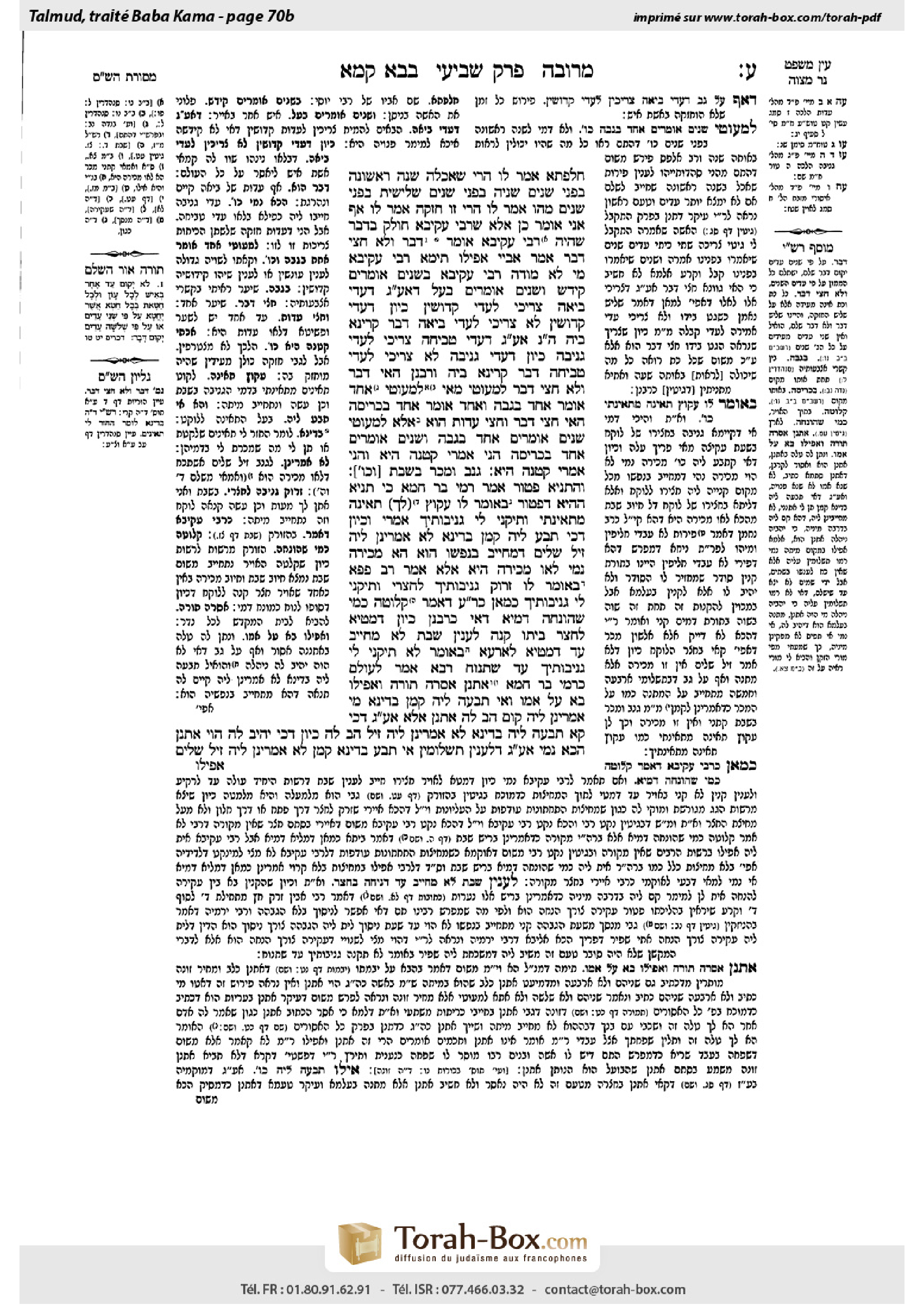
This page of Bava Kamma includes the Aramaic text, an English translation and an AI-generated French translation, alongside the scan above.
בבא קמא ע׳ ב · Aramaic and Hebrew text
חֲלַפְתָּא, אָמַר לוֹ:
הֲרֵי שֶׁאֲכָלָהּ שָׁנָה רִאשׁוֹנָה בִּפְנֵי שְׁנַיִם, שְׁנִיָּה בִּפְנֵי שְׁנַיִם, שְׁלִישִׁית בִּפְנֵי שְׁנַיִם, מַהוּ?
אָמַר לוֹ: הֲרֵי זוֹ חֲזָקָה. אָמַר לוֹ: אַף אֲנִי אוֹמֵר כֵּן, אֶלָּא שֶׁרַבִּי עֲקִיבָא חוֹלֵק בַּדָּבָר. שֶׁהָיָה רַבִּי עֲקִיבָא אוֹמֵר: ״דָּבָר״ – וְלֹא חֲצִי דָבָר.
אָמַר אַבָּיֵי: אֲפִילּוּ תֵּימָא רַבִּי עֲקִיבָא – מִי לָא מוֹדֶה רַבִּי עֲקִיבָא בִּשְׁנַיִם אוֹמְרִים ״קִידֵּשׁ״ וּשְׁנַיִם אוֹמְרִים ״בָּעַל״,
דְּאַף עַל גַּב דְּעֵדֵי בִיאָה צְרִיכִי לְעֵדֵי קִדּוּשִׁין – כֵּיוָן דְּעֵדֵי קִדּוּשִׁין לָא צְרִיכִי לְעֵדֵי בִיאָה, ״דָּבָר״ קָרֵינָא בֵּיהּ?
הָכָא נָמֵי, אַף עַל גַּב דְּעֵדֵי טְבִיחָה צְרִיכִי לְעֵדֵי גְנֵיבָה – כֵּיוָן דְּעֵדֵי גְנֵיבָה לָא צְרִיכִי לְעֵדֵי טְבִיחָה, ״דָּבָר״ קָרֵינָא בֵּיהּ.
וְרַבָּנַן – הַאי ״דָּבָר״ וְלֹא חֲצִי דָבָר, לְמַעוֹטֵי מַאי? לְמַעוֹטֵי אֶחָד אוֹמֵר אֶחָד בְּגַבָּהּ, וְאֶחָד אוֹמֵר אֶחָד בִּכְרֵיסָהּ.
הַאי חֲצִי דָבָר וַחֲצִי עֵדוּת הוּא!
אֶלָּא לְמַעוֹטֵי שְׁנַיִם אוֹמְרִים אֶחָד בְּגַבָּהּ, וּשְׁנַיִם אוֹמְרִים אֶחָד בִּכְרֵיסָהּ – הָנֵי אָמְרִי קְטַנָּה הִיא, וְהָנֵי אָמְרִי קְטַנָּה הִיא.
גָּנַב וּמָכַר בְּשַׁבָּת [וְכוּ׳]. וְהָתַנְיָא: פָּטוּר!
אָמַר רָמֵי בַּר חָמָא: כִּי תַּנְיָא הָהִיא דְּפָטוּר – בְּאוֹמֵר לוֹ: ״עֲקוֹץ לְךָ תְּאֵינָה מִתְּאֵינָתִי, וְתִיקְּנֵי לִי גְּנֵיבוּתָיךְ״.
אָמְרִי: וְכֵיוָן דְּכִי תָבַע לֵיהּ קַמַּן בְּדִינָא לָא אָמְרִינַן לֵיהּ: ״זִיל שַׁלֵּים״ – דְּמִחַיַּיב בְּנַפְשׁוֹ הוּא; הָא מְכִירָה נָמֵי לָאו מְכִירָה הִיא!
אֶלָּא אָמַר רַב פָּפָּא, בְּאוֹמֵר לוֹ: ״זְרוֹק גְּנֵיבוּתָיךְ לַחֲצֵרִי, וְתִיקְּנֵי לִי גְּנֵיבוּתָיךְ״.
כְּמַאן? כְּרַבִּי עֲקִיבָא, דְּאָמַר: קְלוּטָה – כְּמִי שֶׁהוּנְּחָה דָּמְיָא.
דְּאִי כְּרַבָּנַן, כֵּיוָן דְּמָטְיָא לַחֲצַר בֵּיתוֹ – קָנָה, לְעִנְיַן שַׁבָּת – לָא מְחַיַּיב עַד דְּמָטְיָא לְאַרְעָא!
בְּאוֹמֵר: ״לֹא תִּיקְּנֵי לִי גְּנֵיבוּתָיךְ עַד שֶׁתָּנוּחַ״.
רָבָא אָמַר: לְעוֹלָם כְּרָמֵי בַּר חָמָא; אֶתְנַן אָסְרָה תּוֹרָה – וַאֲפִילּוּ בָּא עַל אִמּוֹ; וְאִי תָּבְעָה לֵיהּ קַמַּן בְּדִינָא, מִי אָמְרִינַן לֵיהּ: ״קוּם הַב לַהּ אֶתְנַן״?!
אֶלָּא אַף עַל גַּב דְּכִי קָא תָבְעָה לֵיהּ בְּדִינָא – לָא אָמְרִינַן לֵיהּ ״זִיל הַב לָהּ״, כֵּיוָן דְּכִי יָהֵיב לַהּ – הָוֵי אֶתְנַן; הָכָא נָמֵי, אַף עַל גַּב דִּלְעִנְיַן תַּשְׁלוּמִין – אִי תָּבַע [לֵיהּ] בְּדִינָא קַמַּן לָא אָמְרִינַן לֵיהּ ״זִיל שַׁלֵּים״,
Bava Kamma 70b · English translation
Ḥalafta, he said to him the following in the course of their discussion of the halakhot of possession.
If one has been in possession of real estate for three years, this serves as proof of his claim that he is the legal owner. One who is able to prove uninterrupted possession for the necessary period is not required to produce documentary evidence of his legal title to the property. Rabbi Yoḥanan ben Nuri or father Ḥalafta asked: If one harvested and ate the produce of a field that he claims as his own the first year of the three years required for establishing possession of the land in the presence of two witnesses, and subsequently ate the produce of the second year in the presence of two other witnesses, and finally ate the produce of the third year in the presence of yet two other witnesses, what is the halakha? Can the three testimonies combine to establish full testimony that he ate the produce of three years, thereby confirming his ownership of the field?
Rabbi Ḥalafta said to Rabbi Yoḥanan ben Nuri, or vice versa: This is considered to establish presumptive ownership by the one who ate the produce. The other Sage said to him: I too say that this is so, but Rabbi Akiva disputes this matter, as Rabbi Akiva would say: The Torah requires that witnesses must testify with regard to a complete matter and not part of a matter. Since there must be testimony concerning consumption of the produce over three years, and each set of witnesses establishes only that it took place for one year, their separate testimonies do not combine. If so, the mishna is apparently not in accordance with the opinion of Rabbi Akiva.
The Gemara rejects this assertion. Abaye said: You can even say that the mishna is in accordance with the opinion of Rabbi Akiva. Doesn’t Rabbi Akiva concede that in a case where two witnesses say: So-and-so betrothed a certain woman, and two other witnesses say: Someone else subsequently engaged in sexual intercourse with that same woman, this is proof that the act of intercourse was adulterous?
The reason for this is that even though the witnesses testifying about the intercourse require the witnesses who testify about the betrothal, i.e., the testimony of the second set of witnesses is meaningless without the testimony of the first witnesses, nevertheless, since the witnesses testifying about the betrothal do not require the witnesses who testify about the intercourse, i.e., their testimony by itself establishes a halakhic status, we call the testimony of each pair a complete matter.
Here too, the same logic applies in the case of a thief who steals an animal and subsequently slaughters or sells it: Even though the witnesses who testify about the slaughter require the testimony of the witnesses about the theft in order for their testimony to have any halakhic significance, since the witnesses testifying about the theft do not require the testimony of the witnesses who testify about the slaughter, as their testimony alone establishes that person as a thief who is liable to pay the double payment, we call the testimony of each pair a complete matter.
The Gemara asks: And according to the opinion of the Rabbis, who disagree with Rabbi Akiva that the Torah stipulates that testimony must be about a matter and not half of a matter, the term “matter” (Deuteronomy 19:15) serves to exclude what? The Gemara answers: It serves to exclude a case involving testimony that a girl has reached majority, in which one witness says that he saw one hair on her lower back, and one witness says that he saw one hair on her lower abdomen. A girl is considered to have reached maturity when she has two pubic hairs. In this case, two witnesses separately testify that they have each seen one hair, and therefore each testimony is halakhically meaningless on its own. The Rabbis derive from the verse that these testimonies do not combine.
The Gemara raises a difficulty: In this case each testimony is obviously invalid, as it is half a matter and also half a testimony. Not only does each testimony refer to one hair, which is half a matter, it is submitted by one witness, which is half a testimony. Consequently, it is obvious that the girl is not considered of age in this case.
The Gemara therefore rejects this explanation. Rather, the Rabbis maintain that the term “matter” serves to exclude a case in which two witnesses say that they saw one hair on a girl’s back, and two other witnesses say that they saw one hair on her lower abdomen. In this case the testimony of either set of witnesses concerns only one hair, and therefore these witnesses are essentially saying that she is still a minor and those witnesses are saying that she is still a minor. Therefore, each testimony concerns only half of a matter.
§ The mishna teaches: If one stole an animal and sold it on Shabbat, he pays the fourfold or fivefold payment. The Gemara asks: But isn’t it taught in a baraita that in this case he is exempt from the fourfold or fivefold payment?
Rami bar Ḥama said: When it is taught in that baraita that he is exempt, this is referring to a case where the purchaser says to the thief: Pick off a fig for yourself from my fig tree on Shabbat, and through performing this act your stolen animal shall be acquired by me. Since the act of acquisition of the animal involved the type of Shabbat desecration for which one is liable to receive the death penalty, the thief is exempt from the monetary obligations he would ordinarily incur from this act, i.e., the fourfold or fivefold payment to the animal’s prior owner. This is in accordance with the principle that one who commits two or more transgressions by means of a single act, both of which entail punishment, is exempt from the lesser punishment.
The Sages say, questioning this explanation of the baraita: But since, if the purchaser would bring a legal claim against the thief before us, to force him to deliver the animal acquired by means of picking the fig, the court would not say to the thief: Go and pay him the animal you owe him, because the thief is liable to receive the death penalty for his desecration of Shabbat, this shows that the sale is not a valid sale at all. Therefore, the baraita would not call this exchange a sale and this interpretation of the baraita cannot be correct.
Rather, Rav Pappa said: The baraita is discussing a case where the purchaser said to the thief: Throw your stolen animal from the public domain into my enclosed courtyard, and your stolen animal will thereby be acquired by me. One can acquire an item if it is placed on his property. In this case, when the thief places the animal on the purchaser’s property he moves it from the public domain into the private domain, which is a desecration of Shabbat that entails the death penalty. Consequently, he is exempt from the fourfold or fivefold payment.
The Gemara asks: If this is the correct explanation of the baraita, in accordance with whose opinion is the baraita taught? It is in accordance with the opinion of Rabbi Akiva, who says: An item in the airspace of a certain area is considered as though it were at rest in that area.
As, if the baraita is in accordance with the opinion of the Rabbis, who hold that an item in the airspace of a certain area is not considered as though it were at rest in that area, once the animal reaches the airspace of the courtyard of the purchaser’s house he has acquired it, as one can acquire items that are in the airspace of his courtyard just like those on its ground, whereas with regard to moving an item from one domain to another on Shabbat the thief is not liable for Shabbat desecration until it reaches the ground. Since the thief’s monetary liability is not simultaneous with his incurring of the death penalty, he would not be exempt from payment.
The Gemara answers: It is possible that the baraita is in accordance with the opinion of the Rabbis as well, as one can explain that it is speaking of a case in which the purchaser says to the thief: Your stolen animal shall not be acquired by me until it rests on the ground. In that case, the acquisition of the animal and the Shabbat desecration are simultaneous.
Rava said: Actually, it is possible to explain the baraita as Rami bar Ḥama did, that the animal was acquired through the picking of a fig on Shabbat. And the objection raised earlier, that this act should not be considered a sale at all, is incorrect. This can be demonstrated by the fact that the Torah prohibits one to bring as an offering an animal given as the payment to a prostitute for services rendered (Deuteronomy 23:19). And this prohibition applies even if the man in question engaged in intercourse with his own mother, which is a capital offense. But if she would bring a legal claim before us, demanding the payment of the animal that was agreed upon as her fee, would we say to him: Arise and pay her the animal? The court would not say this, as the monetary liability was incurred simultaneously with the commission of a capital crime.
Rather, one must say that even though if she brings a legal claim against him demanding the payment of the animal that was agreed upon as her fee we do not say to him: Go and pay her, nevertheless, since if he does give it to her it is considered payment to a prostitute, it cannot be used as an offering. Here too, in the case of the acquisition of the animal through picking a fig, even though with regard to payment, if the purchaser would bring a legal claim before us against the thief, seeking to force him to deliver the animal, we would not say to him: Go pay,
Bava Kamma 70b · Traduction française (IA)
Ḥalafta lui a dit, au cours de leur discussion sur les halakhot de la possession, ce qui suit.
Si une personne a été en possession d'un terrain pendant trois ans, cela constitue une preuve de son droit de propriété. Celui qui peut prouver une possession continue pendant la période nécessaire n'a pas besoin de présenter des preuves documentaires de son titre de propriété. Rabbi Yoḥanan ben Nuri ou père Ḥalafta a demandé : Si une personne a récolté et mangé les produits d'un champ qu'elle affirme être le sien pendant la première année des trois années nécessaires pour établir la possession du terrain, devant deux témoins, puis a mangé les produits de la deuxième année devant deux autres témoins, et enfin a mangé les produits de la troisième année devant encore deux autres témoins, quelle est la halakha ? Les trois témoignages combinés suffisent-ils à établir un témoignage complet qu'il a mangé les produits pendant trois ans, confirmant ainsi sa propriété du champ ?
Rabbi Ḥalafta a dit à Rabbi Yoḥanan ben Nuri, ou inversement : Cela est considéré comme établir une possession présumée par celui qui a mangé les produits. L'autre Sage a dit à lui : Je dis également cela, mais Rabbi Akiva conteste cette question, car Rabbi Akiva dirait : La Torah exige que les témoins témoignent concernant une affaire complète et non une partie d'une affaire. Puisque la témoignage concernant la consommation des produits pendant trois ans est requis, et que chaque ensemble de témoins établit seulement qu'il s'est produit pendant une année, leurs témoignages séparés ne s'additionnent pas. Si tel est le cas, la mitsna semble ne pas être en accord avec l'opinion de Rabbi Akiva.
La Guemara rejette cette affirmation. Abaye a dit : On peut même dire que la mitsna est en accord avec l'opinion de Rabbi Akiva. N'est-ce pas que Rabbi Akiva reconnaît que dans un cas où deux témoins disent : tel homme a fiancé une certaine femme, et deux autres témoins disent : quelqu'un d'autre a ensuite eu des relations sexuelles avec cette même femme, cela constitue une preuve que l'acte de relations sexuelles était adultère ?
La raison de cela est que même si les témoins témoignant sur l'acte sexuel nécessitent les témoins qui témoignent sur le fiancement, c'est-à-dire que le témoignage du second ensemble de témoins est sans valeur sans le témoignage du premier, néanmoins, puisque les témoins témoignant sur le fiancement ne nécessitent pas les témoins qui témoignent sur l'acte sexuel, c'est-à-dire que leur témoignage seul établit un statut halakhique, on appelle le témoignage de chaque couple une affaire complète.
Ici aussi, la même logique s'applique dans le cas d'un voleur qui vole un animal et ensuite le tue ou le vend : Même si les témoins qui témoignent sur la mise à mort nécessitent le témoignage des témoins sur le vol afin que leur témoignage ait une signification halakhique, puisque les témoins témoignant sur le vol ne nécessitent pas le témoignage des témoins qui témoignent sur la mise à mort, car leur témoignage seul établit que cette personne est un voleur tenu responsable de la double réparation, on appelle le témoignage de chaque couple une affaire complète.
La Guemara pose une question : Et selon l'opinion des Sages, qui s'opposent à Rabbi Akiva et qui affirment que la Torah stipule que le témoignage doit concerner une affaire et non une moitié d'une affaire, le terme « affaire » (Deutéronome 19:15) sert à exclure quoi ? La Guemara répond : Il sert à exclure un cas impliquant un témoignage selon lequel une fille a atteint l'âge adulte, dans lequel un témoin dit qu'il a vu une seule mèche sur son dos, et un autre témoin dit qu'il a vu une seule mèche sur son ventre. Une fille est considérée comme majeure lorsqu'elle a deux mèches pubiennes. Dans ce cas, deux témoins témoignent séparément qu'ils ont chacun vu une mèche, et donc chaque témoignage est sans valeur halakhique. Les Sages dérivent de la parole que ces témoignages ne s'additionnent pas.
La Guemara soulève une difficulté : Dans ce cas, chaque témoignage est évidemment invalide, car il s'agit d'une moitié d'une affaire et aussi d'un témoignage incomplet. Non seulement chaque témoignage fait référence à une seule mèche, qui est une moitié d'une affaire, mais il est soumis par un seul témoin, qui est une moitié d'un témoignage. Ainsi, il est évident que la fille n'est pas considérée comme majeure dans ce cas.
La Guemara rejette donc cette explication. Plutôt, les Sages maintiennent que le terme « affaire » sert à exclure un cas où deux témoins disent qu'ils ont vu une seule mèche sur le dos d'une fille, et deux autres témoins disent qu'ils ont vu une seule mèche sur son ventre. Dans ce cas, le témoignage de chaque ensemble de témoins concerne seulement une mèche, et donc ces témoins sont essentiellement en train de dire qu'elle est encore mineure et ces témoins aussi. Ainsi, chaque témoignage concerne seulement la moitié d'une affaire.
§ La mitsna enseigne : Si l'on a volé un animal et l'a vendu le sabbat, il paie la réparation quatre fois ou cinq fois. La Guemara pose une question : Mais n'est-ce pas enseigné dans une baraïta que dans ce cas il est exempt de la réparation quatre fois ou cinq fois ?
Rami bar Ḥama a dit : Lorsque cela est enseigné dans cette baraïta qu'il est exempt, cela fait référence à un cas où l'acheteur dit au voleur : Pique-toi une figue de mon arbre à figues le sabbat, et par cet acte, ton animal volé sera acquis par moi. Puisque l'acte d'acquisition de l'animal impliquait une violation du sabbat pour laquelle on est puni par la mort, le voleur est exempt des obligations monétaires qu'il aurait normalement à subir à cause de cet acte, c'est-à-dire la réparation quatre fois ou cinq fois à l'ancien propriétaire de l'animal. Cela s'inscrit dans le principe selon lequel celui qui commet deux ou plusieurs transgressions par un seul acte, tous entraînant une punition, est exempt de la punition moindre.
Les Sages disent, questionnant cette explication de la baraïta : Mais puisque, si l'acheteur portait une action légale contre le voleur devant nous, pour l'obliger à lui remettre l'animal acquis par la cueillette des figues, la cour ne dirait pas au voleur : Va et paie-lui l'animal que tu lui dois, car le voleur est tenu de recevoir la peine de mort pour son délit de sabbat, cela montre que la vente n'est pas une vente valide du tout. Par conséquent, la baraïta ne qualifierait pas cet échange de vente et cette interprétation de la baraïta ne peut pas être correcte.
Plutôt, Rav Pappa dit : La baraïta discute d'un cas où l'acheteur dit au voleur : Jette ton animal volé du domaine public dans mon jardin clos, et ton animal volé sera ainsi acquis par moi. On peut acquérir un objet si on le place sur sa propriété. Dans ce cas, lorsque le voleur place l'animal sur la propriété de l'acheteur, il le transporte du domaine public vers le domaine privé, ce qui constitue une violation de sabbat entraînant la peine de mort. Par conséquent, il est exempt de la réparation quadruple ou quintuple.
La Guemara demande : Si c'est ainsi que la baraïta doit être interprétée, selon quel avis est-elle enseignée ? C'est selon l'avis de Rabbi Akiva, qui dit : Un objet dans l'espace aérien d'une certaine zone est considéré comme si on le tenait au repos dans cette zone.
Car, si la baraïta est selon l'avis des Rabbins, qui pensent qu'un objet dans l'espace aérien d'une certaine zone n'est pas considéré comme si on le tenait au repos dans cette zone, une fois que l'animal atteint l'espace aérien du jardin de la maison de l'acheteur, il est acquis par lui, car on peut acquérir des objets dans l'espace aérien de son jardin comme ceux sur le sol. En ce qui concerne le transport d'un objet d'un domaine à un autre le sabbat, le voleur n'est pas tenu de peine de mort jusqu'à ce que l'objet atteigne le sol. Puisque la responsabilité monétaire n'est pas simultanée à la commission du délit de mort, il ne serait pas exempt de la réparation.
La Guemara répond : Il est possible que la baraïta soit selon l'avis des Rabbins également, car on peut expliquer qu'il s'agit d'un cas où l'acheteur dit au voleur : Ton animal volé ne sera acquis par moi que lorsqu'il reposera sur le sol. Dans ce cas, l'acquisition de l'animal et la violation de sabbat sont simultanées.
Rava dit : En réalité, il est possible d'expliquer la baraïta comme Rami bar Ḥama le fit, à savoir que l'animal a été acquis par la cueillette d'une figue le sabbat. Et l'objection soulevée plus tôt, selon laquelle cet acte ne devrait pas être considéré comme une vente du tout, est incorrecte. Cela peut être démontré par le fait que la Torah interdit de présenter un animal comme offrande si celui-ci est donné comme paiement à une prostituée pour ses services (Deutéronome 23:19). Et cette interdiction s'applique même si la personne en question a eu des relations sexuelles avec sa mère, ce qui est un crime capital. Mais si elle portait une action légale contre lui, exigeant le paiement de l'animal convenu comme son prix, dirions-nous à lui : Lève-toi et paie-lui l'animal ? La cour ne dirait pas cela, car la responsabilité monétaire a été engagée simultanément à la commission d'un crime capital.
Plutôt, il faut dire que même si elle porte une action légale contre lui, exigeant le paiement de l'animal convenu comme son prix, nous ne disons pas à lui : Va et paie. Néanmoins, puisque si il lui donne l'animal, cela est considéré comme un paiement à une prostituée, il ne peut pas être utilisé comme offrande. De même, dans le cas de l'acquisition de l'animal par la cueillette d'une figue, même si, en ce qui concerne le paiement, si l'acheteur portait une action légale contre le voleur, exigeant qu'il lui remette l'animal, nous ne dirions pas à lui : Va paie,
Traduction française générée par IA à partir de l’édition anglaise de Sefaria. Vérifie toujours un passage avec le texte source.
Text from Sefaria: William Davidson Edition - Vocalized Aramaic (CC BY NC); William Davidson Edition - English (CC BY NC).