Bava Kamma 71a: Talmud study for Daf Yomi
Study the Talmud for Daf Yomi with scanned pages, Hebrew text, English translations from Sefaria and AI-generated French translations.
Passage selection and English or AI-generated French translation are available where the scan has annotations. Daf Study is independent of Torah-Box and Sefaria.
Browse Bava Kamma · בבא קמא · All tractatesBava Kamma 71a text and translations
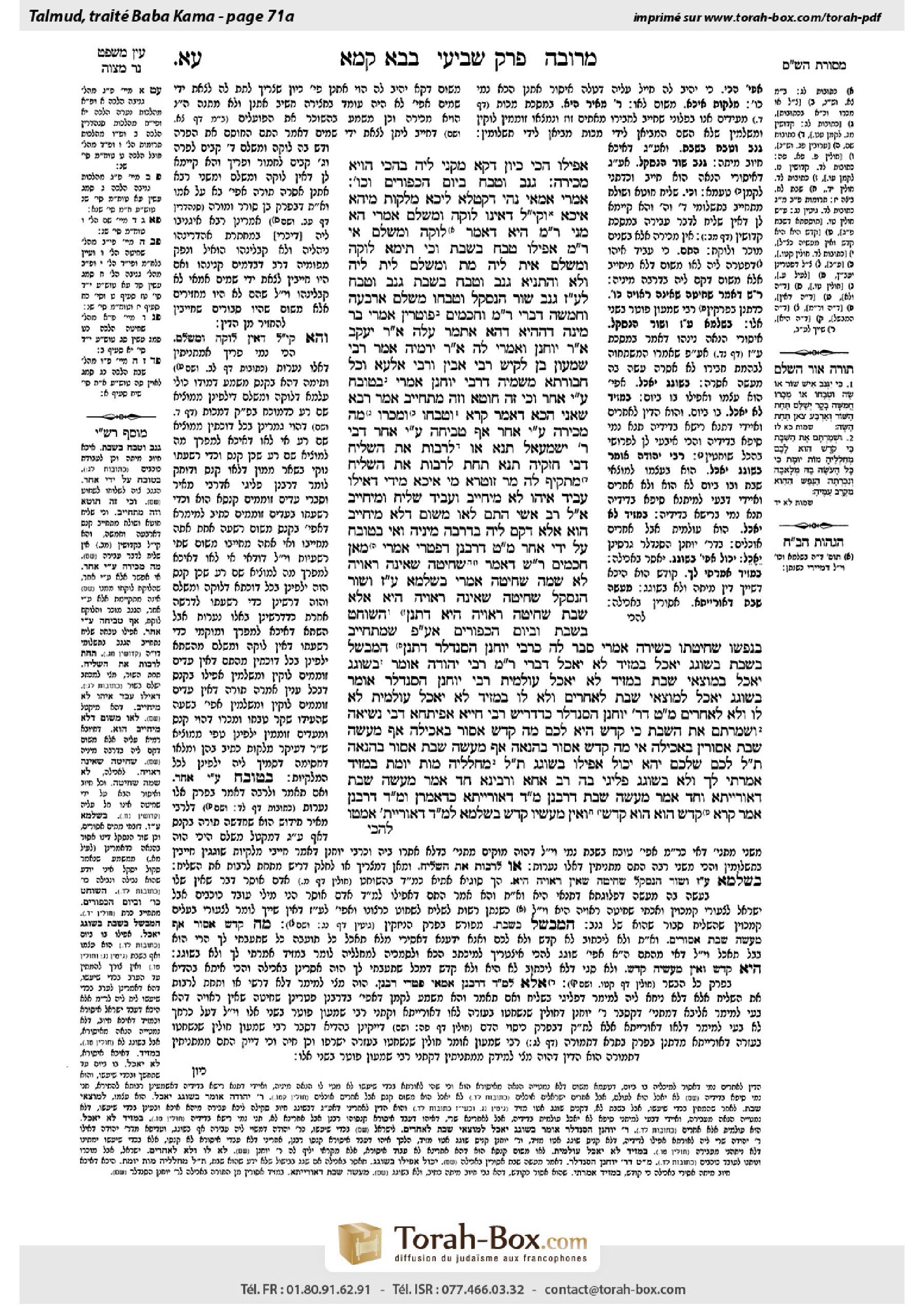
This page of Bava Kamma includes the Aramaic text, an English translation and an AI-generated French translation, alongside the scan above.
בבא קמא ע״א א · Aramaic and Hebrew text
אֲפִילּוּ הָכִי כֵּיוָן דְּקָא מַקְנֵי לֵיהּ בְּהָכִי – הָוְיָא מְכִירָה.
גָּנַב וְטָבַח בְּיוֹם הַכִּפּוּרִים וְכוּ׳. אָמְרִי: אַמַּאי? נְהִי דִּקְטָלָא לֵיכָּא, מַלְקוֹת מִיהָא אִיכָּא – וְקַיְימָא לַן דְּאֵינוֹ לוֹקֶה וּמְשַׁלֵּם!
אָמְרִי: הָא מַנִּי – רַבִּי מֵאִיר הִיא, דְּאָמַר: לוֹקֶה וּמְשַׁלֵּם.
אִי רַבִּי מֵאִיר, אֲפִילּוּ טָבַח בְּשַׁבָּת! וְכִי תֵּימָא: לוֹקֶה וּמְשַׁלֵּם אִית לֵיהּ, מֵת וּמְשַׁלֵּם לֵית לֵיהּ;
וְלָא?! וְהָתַנְיָא: גָּנַב וְטָבַח בַּשַּׁבָּת; גָּנַב וְטָבַח לַעֲבוֹדָה זָרָה; גָּנַב שׁוֹר הַנִּסְקָל וּטְבָחוֹ – מְשַׁלֵּם אַרְבָּעָה וַחֲמִשָּׁה, דִּבְרֵי רַבִּי מֵאִיר. וַחֲכָמִים פּוֹטְרִין!
אָמְרִי: בַּר מִינַּהּ דְּהַהִיא, דְּהָא אִתְּמַר עֲלַהּ: אָמַר רַבִּי יַעֲקֹב אָמַר רַבִּי יוֹחָנָן, וְאָמְרִי לַהּ אָמַר רַבִּי יִרְמְיָה אָמַר רַבִּי שִׁמְעוֹן בֶּן לָקִישׁ, רַבִּי אָבִין וְרַבִּי אִלְעָא וְכֹל חֲבוּרָתָא מִשְּׁמֵיהּ דְּרַבִּי יוֹחָנָן אָמְרִי: בְּטוֹבֵחַ עַל יְדֵי אַחֵר.
וְכִי זֶה חוֹטֵא וְזֶה מִתְחַיֵּיב?!
אָמַר רָבָא: שָׁאנֵי הָכָא, דְּאָמַר קְרָא: ״וּטְבָחוֹ וּמְכָרוֹ״ – מָה מְכִירָה עַל יְדֵי אַחֵר, אַף טְבִיחָה עַל יְדֵי אַחֵר.
דְּבֵי רַבִּי יִשְׁמָעֵאל תָּנָא: ״אוֹ״ – לְרַבּוֹת אֶת הַשָּׁלִיחַ. דְּבֵי חִזְקִיָּה תָּנָא: ״תַּחַת״ – לְרַבּוֹת אֶת הַשָּׁלִיחַ.
מַתְקֵיף לַהּ מָר זוּטְרָא: מִי אִיכָּא מִידֵּי דְּאִילּוּ עָבֵיד אִיהוּ – לָא מִיחַיַּיב, וְעָבֵיד שָׁלִיחַ וּמִיחַיַּיב?
אֲמַר לֵיהּ רַב אָשֵׁי: הָתָם לָאו מִשּׁוּם דְּלָא מִיחַיַּיב הוּא, אֶלָּא דְּקָם לֵיהּ בִּדְרַבָּה מִינֵּיהּ.
וְאִי בְּטוֹבֵחַ עַל יְדֵי אַחֵר, מַאי טַעְמָא דְּרַבָּנַן דְּפָטְרִי?
אָמְרִי: מַאן חֲכָמִים – רַבִּי שִׁמְעוֹן, דְּאָמַר: שְׁחִיטָה שֶׁאֵינָהּ רְאוּיָה – לֹא שְׁמָהּ שְׁחִיטָה.
אָמְרִי: בִּשְׁלָמָא עֲבוֹדָה זָרָה וְשׁוֹר הַנִּסְקָל – שְׁחִיטָה שֶׁאֵינָהּ רְאוּיָה הִיא; אֶלָּא שַׁבָּת – שְׁחִיטָה רְאוּיָה הִיא! דִּתְנַן: הַשּׁוֹחֵט בַּשַּׁבָּת וּבְיוֹם הַכִּפּוּרִים, אַף עַל פִּי שֶׁמִּתְחַיֵּיב בְּנַפְשׁוֹ – שְׁחִיטָתוֹ כְּשֵׁירָה!
אָמְרִי: סָבַר לַהּ כְּרַבִּי יוֹחָנָן הַסַּנְדְּלָר.
דִּתְנַן: הַמְבַשֵּׁל בַּשַּׁבָּת – בְּשׁוֹגֵג יֵאָכֵל, בְּמֵזִיד לֹא יֵאָכֵל; דִּבְרֵי רַבִּי מֵאִיר. רַבִּי יְהוּדָה אוֹמֵר: בְּשׁוֹגֵג – יֵאָכֵל בְּמוֹצָאֵי שַׁבָּת, בְּמֵזִיד – לֹא יֵאָכֵל עוֹלָמִית.
רַבִּי יוֹחָנָן הַסַּנְדְּלָר אוֹמֵר: בְּשׁוֹגֵג – יֵאָכֵל לְמוֹצָאֵי שַׁבָּת לַאֲחֵרִים, וְלֹא לוֹ; בְּמֵזִיד – לֹא יֵאָכֵל עוֹלָמִית, לֹא לוֹ וְלֹא לַאֲחֵרִים.
מַאי טַעְמָא דְּרַבִּי יוֹחָנָן הַסַּנְדְּלָר? כִּדְדָרֵישׁ רַבִּי חִיָּיא אַפִּיתְחָא דְּבֵי נְשִׂיאָה: ״וּשְׁמַרְתֶּם אֶת הַשַּׁבָּת כִּי קֹדֶשׁ הִוא לָכֶם״ – מָה קֹדֶשׁ אָסוּר בַּאֲכִילָה, אַף מַעֲשֵׂה שַׁבָּת אֲסוּרִין בַּאֲכִילָה.
אִי – מָה קֹדֶשׁ אָסוּר בַּהֲנָאָה, אַף מַעֲשֵׂה שַׁבָּת אָסוּר בַּהֲנָאָה?! תַּלְמוּד לוֹמַר: ״לָכֶם״ – שֶׁלָּכֶם יְהֵא.
יָכוֹל אֲפִילּוּ בְּשׁוֹגֵג? תַּלְמוּד לוֹמַר: ״מְחַלְּלֶיהָ מוֹת יוּמָת״ – בְּמֵזִיד אָמַרְתִּי לְךָ, וְלֹא בְּשׁוֹגֵג.
פְּלִיגִי בַּהּ רַב אַחָא וְרָבִינָא, חַד אָמַר: מַעֲשֵׂה שַׁבָּת דְּאוֹרָיְיתָא, וְחַד אָמַר: מַעֲשֵׂה שַׁבָּת דְּרַבָּנַן.
מַאן דְּאָמַר דְּאוֹרָיְיתָא – כְּדַאֲמַרַן. וּמַאן דְּאָמַר דְּרַבָּנַן – אָמַר קְרָא: ״קֹדֶשׁ הוּא״ – הוּא קֹדֶשׁ, וְאֵין מַעֲשָׂיו קֹדֶשׁ.
בִּשְׁלָמָא לְמַאן דְּאָמַר דְּאוֹרָיְיתָא, אַמְּטוּ
Bava Kamma 71a · English translation
and even so, since the thief transfers ownership to the purchaser in this manner, it is considered a valid sale, and he is required to pay the fourfold or fivefold payment.
§ The mishna teaches: If one stole an animal and slaughtered it on Yom Kippur he pays the fourfold or fivefold payment. The Sages say, questioning this ruling: Why is he liable to pay it? Although there is no penalty of execution for slaughtering on Yom Kippur, nevertheless there is the penalty of lashes; and we maintain that one is not sentenced to be flogged and obligated to pay for the same act.
The Sages say in response: In accordance with whose opinion is this mishna taught? It is taught in accordance with the opinion of Rabbi Meir, who says: One is sentenced to be flogged and obligated to pay for the same action.
The Gemara asks: If the mishna is in accordance with the opinion of Rabbi Meir, then even if he slaughtered the animal on Shabbat, which is a capital offense, he should be obligated to pay the fourfold or fivefold payment, whereas the mishna (74b) states that in this case he is exempt. And if you would say that Rabbi Meir holds that one is sentenced to be flogged and obligated to pay for the same act, but he does not hold that one is sentenced to the death penalty and obligated to pay for the same act, this is incorrect.
And is it correct to say that Rabbi Meir does not maintain that one can be sentenced to the death penalty and to pay for the same act? But isn’t it taught in a baraita: If one stole an animal and slaughtered it on Shabbat, or if he stole an animal and slaughtered it for idol worship, or if he stole an ox that is sentenced to be stoned, from which it is prohibited to derive any benefit, and he slaughtered it, he pays the fourfold or fivefold payment; this is the statement of Rabbi Meir. And the Rabbis exempt him from this payment. Apparently Rabbi Meir maintains that one can be held liable for monetary payment and for capital punishment for the same act, e.g., slaughtering on Shabbat or slaughtering for idol worship.
The Sages say in response: Stand apart from this baraita, i.e., this baraita should not be understood in a straightforward manner, as it was stated concerning it: Rabbi Ya’akov says that Rabbi Yoḥanan says, and some say it was Rabbi Yirmeya who says that Rabbi Shimon ben Lakish says, and Rabbi Avin and Rabbi Ela and the entire group of disciples of Rabbi Yoḥanan also say in the name of Rabbi Yoḥanan: The baraita is speaking of a thief who slaughters the stolen animal through the agency of another person, i.e., he instructed another to slaughter it, and that agent did so on Shabbat or for idolatrous purposes. The thief pays the fourfold or fivefold payment because he himself did not commit a capital offense.
The Gemara asks: How can it be that a thief is liable to pay the fourfold or fivefold payment if another person slaughters the stolen animal for him? But is it so that this one sins and that one becomes liable?
The Gemara provides several reasons why in the case of fourfold or fivefold payment it is possible for the thief to be liable for another’s actions. Rava said: It is different here, as the verse states: “And slaughter it or sell it” (Exodus 21:37), thereby juxtaposing the two acts of slaughtering and selling. It is derived that just as there is liability for the fourfold or fivefold payment through selling, which by definition is performed by means of another party, so too, there is liability for slaughtering when it is performed by means of another party.
The school of Rabbi Yishmael teaches: The word “or” in the phrase: “And slaughter it or sell it,” serves to include a case in which the agent slaughters or sells the animal at the behest of the thief. The school of Ḥizkiyya teaches: The separate word “for” [taḥat] in the phrase: “He shall pay five oxen for an ox, and four sheep for a sheep,” which could have been avoided by using the mere prefix of the letter beit, serves to include a case in which the agent slaughters the animal on behalf of the thief.
Mar Zutra objects to this explanation of the baraita: Is there anything with regard to which if one performs it himself he is not liable, and if his agent performs it on his behalf one is liable? How is it possible for an agent to have more power than the one who appointed him? Can it be that if the thief himself slaughtered the animal on Shabbat he would be exempt, whereas if he has it slaughtered by another he is liable?
Rav Ashi said to him: There, in the case of the thief who slaughters a stolen animal on Shabbat, it is not because he is not liable that he does not pay the fourfold or fivefold payment; rather, he is liable but he is excused from payment because he receives the greater of the two punishments, i.e., execution, for desecrating Shabbat. When he appoints an agent he has no liability for desecrating Shabbat, and therefore he pays for the slaughter.
The Gemara asks: But if the baraita is speaking about a thief who slaughters through the agency of another person, what is the reason of the Rabbis, who exempt the thief from payment? The thief did not himself do any act for which he is liable to receive the death penalty.
The Sages say in explanation: Who are these Rabbis of the baraita? It is Rabbi Shimon, who said: The legal status of an act of slaughter that is not fit for accomplishing its full ritual purpose is not considered an act of slaughter. Since slaughtering on Shabbat or slaughtering for idolatrous purposes does not render the meat fit for consumption, Rabbi Shimon rules that there is no liability for the fourfold or fivefold payment.
The Sages say, questioning this explanation: Granted, slaughtering for idol worship and slaughtering an ox that is sentenced to be stoned are cases of slaughter that is not fit, as in both of these cases it is prohibited to derive any benefit from the animal’s flesh. But slaughtering on Shabbat is a fit slaughter. As we learned in a mishna (Ḥullin 14a): In the case of one who slaughters an animal on Shabbat or on Yom Kippur, although he is liable to receive the death penalty for desecrating Shabbat, his slaughter is valid and the meat may be eaten.
The Sages say in response: Rabbi Shimon holds in accordance with the opinion of Rabbi Yoḥanan HaSandlar, who disagrees with that mishna and prohibits eating the meat of an animal slaughtered on Shabbat.
As we learned in a mishna (Terumot 2:3): In the case of one who cooks food on Shabbat, if he acted unwittingly he may eat the food, but if he acted intentionally he may not eat it; this is the statement of Rabbi Meir. Rabbi Yehuda says: If he acted unwittingly he may eat the food only upon the conclusion of Shabbat, and if he acted intentionally he may not eat it ever, although others may partake of it.
Rabbi Yoḥanan HaSandlar says: If he cooked the food unwittingly it may be eaten upon the conclusion of Shabbat by others only, but not by him; and if he acted intentionally it may not be eaten ever, neither by him nor by others. Slaughter, like cooking, is a desecration of Shabbat that entails the death penalty. It follows that Rabbi Yoḥanan HaSandlar maintains that the meat of an animal intentionally slaughtered on Shabbat may never be eaten. If so, this is a slaughter that does not render the meat fit for consumption, and therefore according to the opinion of Rabbi Shimon there is no fourfold or fivefold payment.
The Gemara asks: What is the reason for the opinion of Rabbi Yoḥanan HaSandlar? The Gemara explains: This is as Rabbi Ḥiyya taught at the entrance to the house of the Nasi. It is written: “And you shall observe Shabbat, for it is holy [kodesh] to you; one who profanes it shall be put to death” (Exodus 31:14). Just as it is prohibited to eat a sacred item consecrated to the Temple [kodesh], so too is it prohibited to eat food produced though action that desecrates Shabbat.
The Gemara asks: If so, perhaps the analogy should be extended: Just as it is prohibited to derive benefit from a sacred item, so too should it be prohibited to derive benefit from a product of an action that desecrates Shabbat. The Gemara answers: The verse states: “It is holy to you” (Exodus 31:14), indicating that it shall be yours for deriving benefit. Although food cooked on Shabbat may not be eaten, it is permitted to benefit from it in other ways.
The Gemara further asks: Based on the analogy between a sacred item and the product of an action that desecrates Shabbat, one might have thought that even if the action were performed unwittingly it should be prohibited to consume the product, like a sacred item. To counter this, the verse states: “One who profanes it shall be put to death” (Exodus 31:14), indicating that it is with regard to one who desecrates Shabbat intentionally that I said this analogy to you, as the verse clearly is referring to one who is liable to receive the death penalty, but not one who desecrates Shabbat unwittingly, who is not executed.
The Gemara comments: Rav Aḥa and Ravina disagree with regard to this matter. One said that the product of an action that constitutes a desecration of Shabbat is forbidden by Torah law, and one said that the product of an action that constitutes a desecration of Shabbat is forbidden by rabbinic law.
The Gemara elaborates: The one who says it is forbidden by Torah law explains as we said, that the prohibition is based on the verse as interpreted by Rabbi Ḥiyya. And the one who says it is forbidden by rabbinic law would say that the verse states: “It is holy,” from which he infers: It, the day itself, is holy but the products of its prohibited actions are not holy, and therefore they are not compared to sacred items and may be eaten by Torah law.
The Gemara asks: Granted, according to the one who said that products of a prohibited act are prohibited by Torah law, it is for
Bava Kamma 71a · Traduction française (IA)
Et même ainsi, puisque le voleur transfère la propriété à l'acheteur de cette manière, cela constitue une vente valide, et il est tenu de payer la réparation quadruple ou quintuple.
§ La Michna enseigne : Si l'on vole un animal et le tue le Yom Kippur, il paie la réparation quadruple ou quintuple. Les Sages disent, en questionnant cette décision : Pourquoi est-il tenu de payer cela ? Bien qu'il n'y ait pas de peine de mort pour tuer le Yom Kippur, il y a néanmoins la peine de flagellation ; et nous maintenons que l'on n'est pas condamné à être flagellé et tenu de payer pour la même action.
Les Sages disent en réponse : Selon quel avis est enseignée cette Michna ? Elle est enseignée selon l'avis de Rabbi Meir, qui dit : On est condamné à être flagellé et tenu de payer pour la même action.
La Guemara pose la question : Si la Michna est selon l'avis de Rabbi Meir, alors même s'il a tué l'animal le Shabbat, qui est une offense capitale, il devrait être tenu de payer la réparation quadruple ou quintuple, alors que la Michna (74b) dit que dans ce cas il est exempt. Et si l'on disait que Rabbi Meir maintient que l'on est condamné à être flagellé et tenu de payer pour la même action, mais qu'il ne maintient pas que l'on est condamné à la peine de mort et tenu de payer pour la même action, cela est incorrect.
Et est-ce correct de dire que Rabbi Meir ne maintient pas que l'on peut être condamné à la peine de mort et tenu de payer pour la même action ? Mais n'est-il pas enseigné dans une baraïta : Si l'on vole un animal et le tue le Shabbat, ou s'il vole un animal et le tue pour l'idolâtrie, ou s'il vole un bœuf condamné à la pierre, dont il est interdit d'extraire quelque bénéfice, et il le tue, il paie la réparation quadruple ou quintuple ; c'est l'avis de Rabbi Meir. Et les Rabbins l'exonèrent. Apparemment, Rabbi Meir maintient que l'on peut être tenu de payer en monnaie et de recevoir la peine de mort pour la même action, par exemple, tuer le Shabbat ou tuer pour l'idolâtrie.
Les Sages disent en réponse : Éloignez-vous de cette baraïta, c'est-à-dire cette baraïta ne doit pas être comprise de manière directe, car il a été dit à son sujet : Rabbi Ya'akov dit que Rabbi Yoḥanan dit, et certains disent que c'était Rabbi Yirmeya qui dit que Rabbi Shimon ben Lakish dit, et Rabbi Avin et Rabbi Ela et l'ensemble des disciples de Rabbi Yoḥanan disent également en nom de Rabbi Yoḥanan : La baraïta parle d'un voleur qui tue l'animal volé par l'intermédiaire d'un autre, c'est-à-dire qu'il a ordonné à un autre de le tuer, et cet agent l'a fait le Shabbat ou pour des raisons idolâtres. Le voleur paie la réparation quadruple ou quintuple car lui-même n'a pas commis une offense capitale.
La Guemara pose la question : Comment peut-il être que le voleur soit tenu de payer la réparation quadruple ou quintuple si un autre tue l'animal volé pour lui ? Mais est-ce que l'un commet un péché et que l'autre devient responsable ?
La Guemara donne plusieurs raisons pourquoi, dans le cas de la réparation quadruple ou quintuple, le voleur peut être tenu responsable des actions d'autrui. Rava dit : C'est différent ici, car la Parashia dit : « Et tu le tues ou le vends » (Exode 21:37), juxtaposant ainsi les deux actes de tuer et de vendre. On en déduit que justement comme il y a une responsabilité pour la réparation quadruple ou quintuple par la vente, qui par définition est accomplie par un tiers, ainsi il y a une responsabilité pour le tuer quand il est accompli par un tiers.
La scolie de Rabbi Yishmael enseigne : Le mot « ou » dans la phrase : « Et tu le tues ou le vends », sert à inclure un cas où l'agent tue ou vend l'animal selon l'ordre du voleur. La scolie de Ḥizkiyya enseigne : Le mot séparé « pour » [taḥat] dans la phrase : « Il paiera cinq bœufs pour un bœuf, et quatre agneaux pour un agneau », qui aurait pu être évité en utilisant simplement la préposition beth, sert à inclure un cas où l'agent tue l'animal au nom du voleur.
Mar Zutra s'oppose à cette explication de la baraïta : Y a-t-il quelque chose pour lequel si l'on le fait lui-même on n'est pas responsable, et si son agent le fait à sa place on est responsable ? Comment peut-il être que l'agent ait plus de pouvoir que celui qui l'a désigné ? Peut-on imaginer que si le voleur lui-même tue l'animal le Shabbat il serait exempt, alors que s'il le fait tuer par un autre il est responsable ?
Rav Ashi dit à lui : Là, dans le cas du voleur qui tue un animal volé le Shabbat, ce n'est pas parce qu'il n'est pas responsable qu'il ne paie pas la réparation quadruple ou quintuple ; plutôt, il est responsable mais il est exempt de paiement car il reçoit la plus grande des deux peines, c'est-à-dire l'exécution, pour avoir profané le Shabbat. Lorsqu'il désigne un agent, il n'a pas de responsabilité pour avoir profané le Shabbat, et donc il paie pour le tuer.
La Guemara pose la question : Mais si la baraïta parle d'un voleur qui tue par l'intermédiaire d'un autre, quelle est la raison des Rabbins, qui exemptent le voleur du paiement ? Le voleur n'a pas lui-même accompli d'acte pour lequel il est tenu de recevoir la peine de mort.
Les Sages disent en explication : Qui sont ces Rabbins de la baraïta ? C'est Rabbi Shimon, qui dit : Le statut juridique d'un acte de boucherie qui n'est pas adapté à accomplir son but rituel complet n'est pas considéré comme un acte de boucherie. Puisque tuer le Shabbat ou tuer pour l'idolâtrie ne rend pas la viande propre à la consommation, Rabbi Shimon décide qu'il n'y a pas de responsabilité pour la réparation quadruple ou quintuple.
Les Sages disent, en questionnant cette explication : Cela est vrai, l'abattage pour l'idolâtrie et l'abattage d'un bœuf condamné à la pierre sont des cas d'abattage non conforme, car dans ces deux cas il est interdit d'extraire quelque bénéfice que ce soit de la viande de l'animal. Mais l'abattage le samedi est un abattage conforme. Comme nous l'avons appris dans une mitsva (Ḥullin 14a) : Dans le cas d'une personne qui abat un animal le samedi ou le jour de l'Expiation, bien qu'il soit punissable de mort pour avoir profané le samedi, son abattage est valide et la viande peut être mangée.
Les Sages répondent : Rabbi Shimon suit l'opinion de Rabbi Yoḥanan HaSandlar, qui s'oppose à cette mitsva et interdit de manger la viande d'un animal abattu le samedi.
Comme nous l'avons appris dans une mitsva (Terumot 2:3) : Dans le cas d'une personne qui cuisine un aliment le samedi, s'il l'a fait sans intention il peut manger ce aliment, mais s'il l'a fait intentionnellement il ne peut pas le manger ; c'est l'opinion de Rabbi Meir. Rabbi Yehuda dit : S'il l'a fait sans intention il peut manger ce aliment seulement après la fin du samedi, et s'il l'a fait intentionnellement il ne peut pas le manger jamais, même si d'autres peuvent en profiter.
Rabbi Yoḥanan HaSandlar dit : S'il a cuisiné l'aliment sans intention, il peut être mangé après la fin du sabbat par d'autres seulement, pas par lui-même ; et s'il l'a fait intentionnellement, il ne peut pas être mangé jamais, ni par lui-même ni par d'autres. L'abattage, comme la cuisson, est une profanation du sabbat qui entraîne la peine de mort. Il en suit que Rabbi Yoḥanan HaSandlar maintient que la viande d'un animal abattu intentionnellement le sabbat ne peut jamais être mangée. Si c'est ainsi, c'est un abattage qui ne rend la viande comestible, et donc selon l'opinion de Rabbi Shimon, il n'y a pas de paiement quadruple ou quintuple.
Le Guemara pose la question : Quel est le fondement de l'opinion de Rabbi Yoḥanan HaSandlar ? Le Guemara explique : C'est comme Rabbi Ḥiyya a enseigné à l'entrée de la maison du Nasi. Il est écrit : « Et vous observerez le sabbat, car il est saint [kodesh] pour vous ; celui qui le profane sera mis à mort » (Exode 31:14). Tout comme il est interdit de manger un objet sacré consacré au Temple [kodesh], de même il est interdit de manger un aliment produit par une action qui profane le sabbat.
Le Guemara pose la question : Si c'est ainsi, peut-être l'analogue devrait être étendu : Tout comme il est interdit d'extraire un bénéfice d'un objet sacré, de même il devrait être interdit d'extraire un bénéfice d'un produit d'une action qui profane le sabbat. Le Guemara répond : Le verset dit : « Il est saint pour vous » (Exode 31:14), indiquant qu'il vous appartient pour extraire un bénéfice. Bien que la nourriture cuisinée le samedi ne puisse pas être mangée, il est permis d'en tirer d'autres bénéfices.
Le Guemara pose une autre question : Selon l'analogie entre un objet sacré et le produit d'une action qui profane le sabbat, on pourrait penser que même si l'action a été commise sans intention, il serait interdit de consommer le produit, comme un objet sacré. Pour y remédier, le verset dit : « Celui qui profane le sabbat sera mis à mort » (Exode 31:14), indiquant que c'est en ce qui concerne celui qui profane le sabbat intentionnellement que j'ai établi cette analogie, car le verset fait clairement référence à celui qui est punissable de mort, mais pas à celui qui profane le sabbat sans intention, qui n'est pas exécuté.
Le Guemara commente : Rav Aḥa et Ravina s'opposent sur ce point. L'un affirme que le produit d'une action constituant une profanation du sabbat est interdit par la Loi juive, et l'autre affirme que le produit d'une action constituant une profanation du sabbat est interdit par la loi rabbinique.
Le Guemara développe : Celui qui affirme qu'il est interdit par la Loi juive explique comme nous l'avons dit, que l'interdiction est fondée sur le verset, selon l'interprétation de Rabbi Ḥiyya. Et celui qui affirme qu'il est interdit par la loi rabbinique dirait que le verset dit : « Il est saint », d'où il déduit : C'est le jour lui-même qui est saint, mais les produits de ses actions interdites ne sont pas saints, et par conséquent ils ne sont pas comparables aux objets sacrés et peuvent être mangés selon la Loi juive.
Le Guemara pose la question : Cela étant, selon celui qui affirme que les produits d'une action interdite sont interdits par la Loi juive, c'est pour
Traduction française générée par IA à partir de l’édition anglaise de Sefaria. Vérifie toujours un passage avec le texte source.
Text from Sefaria: William Davidson Edition - Vocalized Aramaic (CC BY NC); William Davidson Edition - English (CC BY NC).