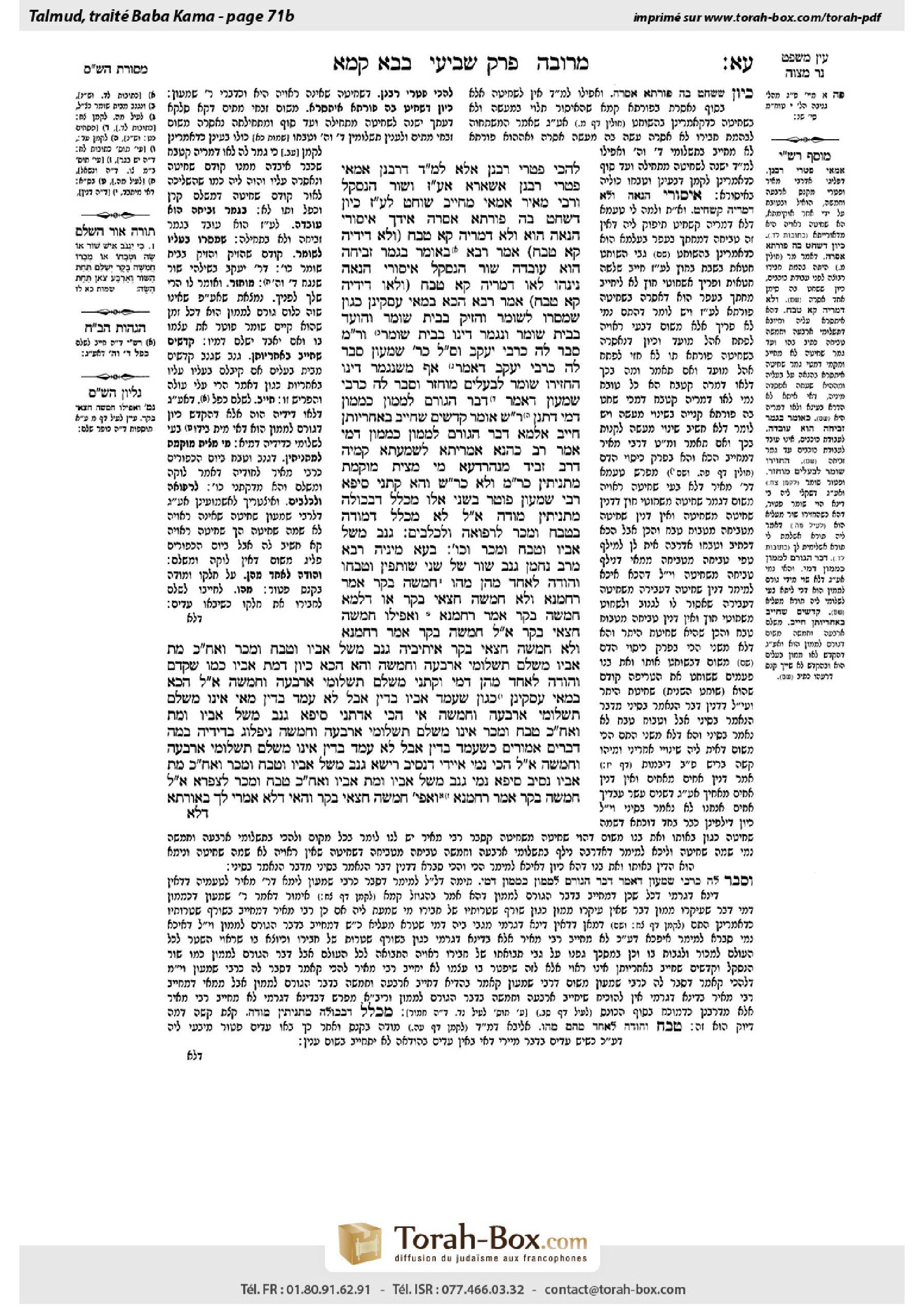
Bava Kamma 71b: Talmud study for Daf Yomi
Study the Talmud for Daf Yomi with scanned pages, Hebrew text, English translations from Sefaria and AI-generated French translations.
Passage selection and English or AI-generated French translation are available where the scan has annotations. Daf Study is independent of Torah-Box and Sefaria.
Browse Bava Kamma · בבא קמא · All tractatesBava Kamma 71b text and translations
This page of Bava Kamma includes the Aramaic text, an English translation and an AI-generated French translation, alongside the scan above.
בבא קמא ע״א ב · Aramaic and Hebrew text
לְהָכִי פָּטְרִי רַבָּנַן; אֶלָּא לְמַאן דְּאָמַר דְּרַבָּנַן, אַמַּאי פָּטְרִי רַבָּנַן?
אַשְּׁאָרָא – אַעֲבוֹדָה זָרָה וְשׁוֹר הַנִּסְקָל.
וְרַבִּי מֵאִיר – אַמַּאי מְחַיֵּיב שׁוֹחֵט לַעֲבוֹדָה זָרָה?
כֵּיוָן דִּשְׁחַט בַּהּ פּוּרְתָּא – אַסְרַהּ; אִידַּךְ – אִיסּוּרֵי הֲנָאָה הוּא, וְלָא דְּמָרַיהּ קָא טָבַח (וְלָא דִּידֵיהּ קָא טָבַח)!
אָמַר רָבָא: בְּאוֹמֵר בִּגְמַר זְבִיחָה הוּא עוֹבְדָהּ.
שׁוֹר הַנִּסְקָל – אִיסּוּרֵי הֲנָאָה נִינְהוּ; לָאו דְּמָרֵיהּ קָא טָבַח, וְלָאו דִּידֵיהּ קָא טָבַח!
אָמַר רָבָא: הָכָא בְּמַאי עָסְקִינַן – כְּגוֹן שֶׁמְּסָרוֹ לְשׁוֹמֵר; וְהִזִּיק בְּבֵית שׁוֹמֵר, וְהוּעַד בְּבֵית שׁוֹמֵר, וְנִגְמַר דִּינוֹ בְּבֵית שׁוֹמֵר. וְרַבִּי מֵאִיר סָבַר לַהּ כְּרַבִּי יַעֲקֹב, וְסָבַר לַהּ כְּרַבִּי שִׁמְעוֹן;
סָבַר לַהּ כְּרַבִּי יַעֲקֹב – דְּאָמַר: אַף מִשֶּׁנִּגְמַר דִּינוֹ, הֶחְזִירוֹ שׁוֹמֵר לַבְּעָלִים – מוּחְזָר.
וְסָבַר לַהּ כְּרַבִּי שִׁמְעוֹן – דְּאָמַר: דָּבָר הַגּוֹרֵם לְמָמוֹן, כְּמָמוֹן דָּמֵי.
דִּתְנַן, רַבִּי שִׁמְעוֹן אוֹמֵר: קֳדָשִׁים שֶׁחַיָּיב בְּאַחְרָיוּתָן – חַיָּיב; אַלְמָא דָּבָר הַגּוֹרֵם לְמָמוֹן – כְּמָמוֹן דָּמֵי.
אָמַר רַב כָּהֲנָא, אַמְרִיתָא לִשְׁמַעְתָּא קַמֵּיהּ דְּרַב זְבִיד מִנְּהַרְדְּעָא: מִי מָצֵית מוֹקְמַתְּ מַתְנִיתִין כְּרַבִּי מֵאִיר, וְלָא כְּרַבִּי שִׁמְעוֹן? וְהָא קָתָנֵי סֵיפָא: רַבִּי שִׁמְעוֹן פּוֹטֵר בִּשְׁנֵי אֵלּוּ; מִכְּלָל דִּבְכוּלַּהּ מַתְנִיתִין מוֹדֵה!
אֲמַר לֵיהּ: לָא; מִכְּלָל דְּמוֹדֵה בְּטָבַח וּמָכַר לִרְפוּאָה וְלִכְלָבִים.
גָּנַב מִשֶּׁל אָבִיו וְטָבַח וּמָכַר וְכוּ׳. בְּעָא מִינֵּיהּ רָבָא מֵרַב נַחְמָן: גָּנַב שׁוֹר שֶׁל שְׁנֵי שׁוּתָּפִין, וּטְבָחוֹ, וְהוֹדָה לְאֶחָד מֵהֶן, מַהוּ?
״חֲמִשָּׁה בָּקָר״ אָמַר רַחֲמָנָא – וְלֹא חֲמִשָּׁה חֲצָאֵי בָקָר; אוֹ דִּלְמָא, ״חֲמִשָּׁה בָּקָר״ אָמַר רַחֲמָנָא – וַאֲפִילּוּ חֲמִשָּׁה חֲצָאֵי בָקָר? אֲמַר לֵיהּ: ״חֲמִשָּׁה בָּקָר״ אָמַר רַחֲמָנָא – וְלֹא חֲמִשָּׁה חֲצָאֵי בָקָר.
אֵיתִיבֵיהּ: גָּנַב מִשֶּׁל אָבִיו, וְטָבַח וּמָכַר, וְאַחַר כָּךְ מֵת אָבִיו – מְשַׁלֵּם תַּשְׁלוּמֵי אַרְבָּעָה וַחֲמִשָּׁה. וְהָא הָכָא, כֵּיוָן דְּמֵת אָבִיו – כְּמוֹ שֶׁקָּדַם וְהוֹדָה לְאֶחָד מֵהֶן דָּמֵי, וְקָתָנֵי: מְשַׁלֵּם תַּשְׁלוּמֵי אַרְבָּעָה וַחֲמִשָּׁה!
אֲמַר לֵיהּ: הָכָא בְּמַאי עָסְקִינַן – כְּגוֹן שֶׁעָמַד אָבִיו בַּדִּין.
אֲבָל לֹא עָמַד בַּדִּין, מַאי – אֵינוֹ מְשַׁלֵּם תַּשְׁלוּמֵי אַרְבָּעָה וַחֲמִשָּׁה? אִי הָכִי, אַדְּתָנֵי סֵיפָא: גָּנַב מִשֶּׁל אָבִיו, וָמֵת, וְאַחַר כָּךְ טָבַח וּמָכַר – אֵינוֹ מְשַׁלֵּם תַּשְׁלוּמֵי אַרְבָּעָה וַחֲמִשָּׁה; נִיפְלוֹג בְּדִידֵיהּ: בַּמֶּה דְּבָרִים אֲמוּרִים – כְּשֶׁעָמַד בַּדִּין, אֲבָל לֹא עָמַד בַּדִּין – אֵינוֹ מְשַׁלֵּם תַּשְׁלוּמֵי אַרְבָּעָה וַחֲמִשָּׁה!
אֲמַר לֵיהּ: הָכִי נָמֵי; אַיְּידֵי דְּנָסֵיב רֵישָׁא: גָּנַב מִשֶּׁל אָבִיו, וְטָבַח וּמָכַר, וְאַחַר כָּךְ מֵת אָבִיו; נָסֵיב סֵיפָא נָמֵי: גָּנַב מִשֶּׁל אָבִיו, וּמֵת אָבִיו, וְאַחַר כָּךְ טָבַח וּמָכַר.
לְצַפְרָא אֲמַר לֵיהּ: ״חֲמִשָּׁה בָּקָר״ אָמַר רַחֲמָנָא – וַאֲפִילּוּ חֲמִשָּׁה חֲצָאֵי בָּקָר. וְהַאי דְּלָא אֲמַרִי לָךְ בְּאוּרְתָּא –
Bava Kamma 71b · English translation
this reason that the Rabbis exempt the thief from the fourfold or fivefold payment when he slaughters the animal on Shabbat, as slaughter on Shabbat does not render the meat permitted for consumption. But according to the one who says that the product of a prohibited act on Shabbat may be eaten by Torah law but is forbidden by rabbinic law, why do the Rabbis exempt the thief when he appoints an agent to slaughter the animal for him and the agent performs this action on Shabbat?
The Gemara answers: When the Rabbis exempt him from the fourfold or fivefold payment, they are not referring to the case where the thief’s agent slaughters the animal on Shabbat. Rather, they were speaking of the rest of the cases listed in the baraita, namely, an agent who slaughters the animal for idol worship and one who slaughters an ox that is sentenced to be stoned.
The Gemara asks another question with regard to the interpretation of the baraita presented above: And with regard to Rabbi Meir, granted he maintains that the legal status of an act of slaughter not fit for accomplishing its full ritual purpose is nevertheless considered an act of slaughter. But why is the thief liable to pay the fourfold or fivefold payment when his agent slaughters the animal for idol worship?
Once he slaughtered the animal a bit, at the very start of the act of slaughter, he has prohibited the animal, with regard to deriving benefit, as an animal sacrificed to idolatry. When he slaughters the other part it is already prohibited with regard to deriving benefit, which means that it is not an animal that belongs to its owner that he slaughters, and it is not an animal that belongs to him that he slaughters. Since deriving benefit from the animal is prohibited, it has no value; therefore, there is no ownership.
Rava said: This is referring to one who says prior to the slaughter that only with the completion of the slaughter does he worship the idolatry. Therefore, the prohibition does not take effect until that stage, which is also when the liability to pay the fourfold or fivefold payment is incurred.
The Gemara raises a question with regard to another of the cases of the baraita: An ox that is sentenced to be stoned is an item from which deriving benefit is prohibited. Consequently, when a thief or his agent slaughters this animal, it is not an animal that belongs to its owner that he slaughters, and it is not an animal that belongs to him that he slaughters. Why does Rabbi Meir obligate him to pay the fourfold or fivefold payment?
Rava said: With what are we dealing here? This is a case where the owners entrusted the ox to a bailee and the ox fatally injured someone while in the bailee’s house, and it was forewarned while in the bailee’s house, and it was sentenced to be stoned while in the bailee’s house, and the thief then stole it from the bailee’s house and slaughtered it. Rava continues: And Rabbi Meir holds in accordance with the opinion of Rabbi Ya’akov, and he also holds in accordance with the opinion of Rabbi Shimon.
He holds in accordance with the opinion of Rabbi Ya’akov, who says: Even after the ox was sentenced to be stoned, if the bailee returned it to its owners before it was killed, it is considered returned. Although the ox is now worthless, as no benefit may be derived from it, since the bailee returned a physically intact ox, the owner has no claim against him.
And Rabbi Meir also holds in accordance with the opinion of Rabbi Shimon, who says: An item whose elimination causes financial loss is considered to have monetary value. With regard to an item that is otherwise worthless, if its elimination causes monetary loss due to the fact that it must be replaced, it is considered to be of value. In this case, although the ox is worthless in and of itself, when the thief slaughters it he prevents the bailee from returning it intact to the owner and causes him to be obligated to pay the owner the value of the ox before it was sentenced to be stoned. Consequently, the thief must reimburse the bailee, as the ox effectively has value for that bailee.
As we learned in a mishna (74b): Rabbi Shimon says: In the case of sacrificial animals for which the owner bears financial responsibility to replace any of them with another animal if it is lost or it dies, the thief is obligated to pay the fourfold or fivefold payment if he slaughters the animal. Although one is generally not liable to pay the double payment for stealing consecrated items, Rabbi Shimon maintains that this case is different, since as a result of the animal’s theft the owner sustains a loss by being required to substitute another animal for it. Since the animal’s loss has financial ramifications for the owner apart from any inherent value it has, it has value for him. Apparently, Rabbi Shimon holds that an item whose elimination causes financial loss is considered to have monetary value.
Rav Kahana said: I recited this halakha, according to which the mishna follows the opinion of Rabbi Meir, in front of Rav Zevid of Neharde’a, and I asked him: Is it correct to say that you can establish the mishna in accordance with the opinion of Rabbi Meir, and not in accordance with the opinion of Rabbi Shimon? But isn’t it taught in the last clause of the mishna: Rabbi Shimon exempts the thief from the fourfold or fivefold payment in these last two cases. One can learn by inference that in all the rest of the cases in the mishna, apart from these two, Rabbi Shimon concedes that the thief pays the fourfold or fivefold payment.
Rav Zevid said to him: No; that is not the correct inference from the mishna. Rather, by inference one can learn only that Rabbi Shimon concedes that the thief pays the fourfold or fivefold payment in the cases mentioned immediately prior to this one, specifically in a case where the thief slaughtered or sold the animal in order that it should be used for medicinal purposes or for feeding to dogs. Therefore, it can be correct to establish the mishna in accordance with the opinion of Rabbi Meir and not in accordance with the opinion of Rabbi Shimon.
§ The mishna teaches: If one stole an animal of his father’s and then slaughtered or sold it, and afterward his father died, he pays the fourfold or fivefold payment to his father’s other heirs. Rava raised a dilemma before Rav Naḥman: If one stole an ox belonging to two partners and slaughtered it, and subsequently admitted the theft to one of the partners, which means that he is exempt from paying the fourfold or fivefold payment to that partner, in accordance with the principle that one who admits his own guilt is exempt from fines, what is the halakha with regard to payment to the other partner?
The Gemara explains the sides of the dilemma: The Merciful One states in the Torah: “He shall pay five oxen for an ox” (Exodus 21:37), which indicates five full oxen, but not five half-oxen. Or perhaps when the Merciful One states “five oxen,” this means that even five half-oxen must be paid in a case of this kind. Rav Naḥman said to Rava: The Merciful One states: “Five oxen,” which means five full oxen, but not five half-oxen.
Rava raised an objection to him from the mishna: If one stole an animal of his father’s and then slaughtered or sold it, and afterward his father died, he pays the fourfold or fivefold payment. But here, since his father died and the thief has inherited part of the stolen animal himself, it is similar to the case of one who stole from two partners and went ahead and admitted the theft to one of them, i.e., to himself. In the case of the mishna he is exempt from paying the portion of the fine that is for himself, and yet the mishna teaches that he pays the other heirs their portion of the fourfold or fivefold payment.
Rav Naḥman said to Rava: With what are we dealing here? With a case where his father stood against his son the thief in his trial, and the son was convicted for the theft and slaughter of his father’s animal. In this case, the liability to pay the fourfold or fivefold payment was established before the father’s death, and at that time the payment was five full oxen.
Rava asked him: And if the thief had not yet stood trial before the father’s death, what would be the halakha, according to your opinion? Would he not be required to pay the fourfold or fivefold payment? If so, rather than teaching in the latter clause of the mishna (74b): If one stole his father’s animal and the father died, and afterward he slaughtered or sold it, he does not pay the fourfold or fivefold payment; let the mishna make a distinction within the same type of case, as follows: In what case is this statement, i.e., that the thief is required to pay the fourfold or fivefold payment, said? It is when the thief stood trial in his father’s lifetime; but if he did not stand trial in his father’s lifetime he does not pay the fourfold or fivefold payment.
Rav Naḥman said to him: Indeed, the mishna could have mentioned that case. However, since the tanna of the mishna has to cite the first clause, which discusses one who stole an animal of his father’s and slaughtered or sold it, and afterward his father died, he cites the latter clause as well, by means of a similar case: If one stole his father’s animal and his father died, and afterward he slaughtered or sold the animal.
This discussion between Rava and Rav Naḥman occurred in the evening. On the following morning, Rav Naḥman retracted his statement and said to Rava: The Merciful One states: “Five oxen,” and this means that even five half-oxen are included. Rav Naḥman explained his change of mind: And the reason that I did not say this to you last night
Bava Kamma 71b · Traduction française (IA)
Ce raisonnement permet aux Sages de dispenser le voleur de la réparation quadruple ou quintuple lorsqu'il tue l'animal le sabbat, car la mise à mort le sabbat ne rend pas la viande consommable. Mais selon celui qui affirme que le produit d'une action interdite le sabbat peut être mangé selon la Loi juive, mais est interdit selon la loi rabbinique, pourquoi les Sages dispensent-ils le voleur lorsqu'il désigne un agent pour tuer l'animal à sa place et que l'agent exécute cette action le sabbat ?
La Guemara répond : Lorsque les Sages dispensent de la réparation quadruple ou quintuple, ils ne font référence qu'au cas où l'agent du voleur tue l'animal le sabbat. Ils parlaient plutôt des autres cas évoqués dans la baraïta, à savoir un agent qui tue l'animal pour l'idolâtrie et celui qui tue un bœuf condamné à être lapidé.
La Guemara pose une autre question concernant l'interprétation de la baraïta mentionnée ci-dessus : Et concernant Rabbi Meir, supposons qu'il maintienne que l'acte de sacrifice non adapté à accomplir pleinement son but rituel est tout de même considéré comme un acte de sacrifice. Mais pourquoi le voleur est-il tenu de payer la réparation quadruple ou quintuple lorsqu'il fait tuer l'animal pour l'idolâtrie par son agent ?
Une fois qu'il a tué l'animal à peine, à l'origine de l'acte de sacrifice, il a interdit l'animal, en ce qui concerne l'usage, comme un animal sacrifié à l'idolâtrie. Lorsqu'il tue la seconde partie, il est déjà interdit en ce qui concerne l'usage, ce qui signifie qu'il ne s'agit pas d'un animal appartenant à son propriétaire qu'il tue, ni d'un animal appartenant à lui qu'il tue. Puisque l'usage de l'animal est interdit, il n'a plus de valeur ; par conséquent, il n'y a plus de propriété.
Rava dit : Cela fait référence à celui qui dit avant la mise à mort que seul à la fin de la mise à mort il adore l'idolâtrie. Par conséquent, l'interdiction ne prend effet qu'à ce stade, qui est aussi celui où la responsabilité de payer la réparation quadruple ou quintuple est engagée.
La Guemara soulève une question concernant un autre cas de la baraïta : Un bœuf condamné à être lapidé est un objet dont l'usage est interdit. Par conséquent, lorsqu'un voleur ou son agent tue cet animal, il ne s'agit pas d'un animal appartenant à son propriétaire qu'il tue, ni d'un animal appartenant à lui qu'il tue. Pourquoi Rabbi Meir impose-t-il de payer la réparation quadruple ou quintuple ?
Rava dit : De quoi sommes-nous en train de parler ? C'est le cas où les propriétaires ont confié le bœuf à un dépositaire et que ce bœuf a blessé mortellement quelqu'un pendant qu'il était chez le dépositaire, qu'il était averti pendant qu'il était chez le dépositaire, et qu'il a été condamné à être lapidé pendant qu'il était chez le dépositaire, et que le voleur a ensuite volé ce bœuf chez le dépositaire et l'a tué. Rava continue : Et Rabbi Meir suit l'opinion de Rabbi Ya'akov, et il suit aussi l'opinion de Rabbi Shimon.
Il suit l'opinion de Rabbi Ya'akov, qui dit : Même après que le bœuf ait été condamné à être lapidé, si le dépositaire le rend aux propriétaires avant qu'il ne soit tué, il est considéré comme rendu. Bien que le bœuf soit désormais sans valeur, car aucun usage ne peut en être tiré, puisque le dépositaire a rendu un bœuf intact, le propriétaire n'a pas de réclamation contre lui.
Et Rabbi Meir suit également l'opinion de Rabbi Shimon, qui dit : Un objet dont l'élimination cause une perte financière est considéré comme ayant une valeur monétaire. En ce qui concerne un objet autrement sans valeur, si son élimination cause une perte financière en raison du fait qu'il doit être remplacé, il est considéré comme ayant une valeur. Dans ce cas, bien que le bœuf soit sans valeur en soi, lorsque le voleur le tue, il empêche le dépositaire de le rendre intact au propriétaire et cause à ce dernier d'être tenu de payer la valeur du bœuf avant qu'il ne soit condamné à être lapidé. Par conséquent, le voleur doit indemniser le dépositaire, car le bœuf a une valeur pour ce dernier.
Comme nous l'avons appris dans une mitsva (74b) : Rabbi Shimon dit : Dans le cas d'animaux sacrés pour lesquels le propriétaire est tenu financièrement de remplacer tout animal perdu ou mort, le voleur est tenu de payer la réparation quadruple ou quintuple s'il tue l'animal. Bien qu'une personne ne soit généralement pas tenue de payer la double réparation pour voler des objets sacrés, Rabbi Shimon maintient que ce cas est différent, car en raison du vol de l'animal, le propriétaire subit une perte en étant tenu de remplacer l'animal. Puisque la perte de l'animal a des répercussions financières pour le propriétaire en dehors de toute valeur intrinsèque qu'il peut avoir, il a une valeur pour lui. Apparemment, Rabbi Shimon considère qu'un objet dont l'élimination cause une perte financière est considéré comme ayant une valeur monétaire.
Rav Kahana dit : J'ai récité cette halakha, selon laquelle la mitsva suit l'opinion de Rabbi Meir, devant Rav Zevid de Neharde’a, et j'ai demandé : Est-ce correct de dire que l'on peut établir la mitsva selon l'opinion de Rabbi Meir, et non selon celle de Rabbi Shimon ? Mais n'est-ce pas enseigné dans la dernière phrase de la mitsva : Rabbi Shimon dispense le voleur de la réparation quadruple ou quintuple dans ces deux derniers cas. On peut en déduire que dans tous les autres cas de la mitsva, à l'exception de ces deux, Rabbi Shimon reconnaît que le voleur paie la réparation quadruple ou quintuple.
Rav Zevid dit à lui : Non ; cela n'est pas l'inférence correcte tirée de la Michna. En réalité, par l'inférence, on peut apprendre seulement que Rabbi Shimon reconnaît que le voleur paie le quadruple ou le quintuple dans les cas mentionnés immédiatement avant celui-ci, spécifiquement dans un cas où le voleur a tué ou vendu l'animal afin qu'il soit utilisé à des fins médicales ou pour nourrir des chiens. Ainsi, il peut être correct d'établir la Michna conformément à l'opinion de Rabbi Meir et non conformément à celle de Rabbi Shimon.
§ La Michna enseigne : Si l'on a volé un animal appartenant à son père et ensuite l'a tué ou vendu, et que par la suite son père est mort, il paie le quadruple ou le quintuple à ses autres héritiers. Rava posa un dilemme devant Rav Naḥman : Si l'on a volé un bœuf appartenant à deux associés et l'a tué, et que par la suite il a avoué la volerie à l'un des associés, ce qui signifie qu'il est exempt de payer le quadruple ou le quintuple à cet associé, conformément au principe que celui qui avoue sa propre faute est exempt des amendes, quelle est la halakha concernant le paiement à l'autre associé ?
La Guemara explique les côtés du dilemme : L'Éternel dit dans la Torah : « Il paiera cinq bœufs pour un bœuf » (Exode 21:37), ce qui indique cinq bœufs entiers, mais pas cinq bœufs demi. Ou peut-être que lorsque l'Éternel dit « cinq bœufs », cela signifie que même cinq bœufs demi doivent être payés dans un cas de ce genre. Rav Naḥman dit à Rava : L'Éternel dit : « Cinq bœufs », ce qui signifie cinq bœufs entiers, mais pas cinq bœufs demi.
Rava souleva une objection contre lui en vertu de la Michna : Si l'on a volé un animal appartenant à son père et ensuite l'a tué ou vendu, et que par la suite son père est mort, il paie le quadruple ou le quintuple. Mais ici, puisque son père est mort et que le voleur a hérité d'une partie de l'animal volé lui-même, cela est semblable au cas d'une personne ayant volé à deux associés et ayant avoué la volerie à l'un d'entre eux, c'est-à-dire à lui-même. Dans le cas de la Michna, il est exempt de payer la part de l'amende qui lui appartient, et pourtant la Michna enseigne qu'il paie la part des héritiers restants du quadruple ou du quintuple.
Rav Naḥman dit à Rava : De quel cas sommes-nous en train de parler ? D'un cas où son père s'est opposé à son fils voleur lors de son procès, et le fils a été condamné pour le vol et la mise à mort de l'animal de son père. Dans ce cas, la responsabilité de payer le quadruple ou le quintuple a été établie avant la mort du père, et à ce moment-là, le paiement était de cinq bœufs entiers.
Rava demanda à Rav Naḥman : Et si le voleur n'avait pas encore été jugé avant la mort de son père, quelle serait la halakha, selon votre opinion ? Ne serait-il pas tenu de payer le quadruple ou le quintuple ? Si c'est le cas, plutôt que d'enseigner dans la clause ultérieure de la mitsna (74b) : Si l'on a volé l'animal de son père et que le père est mort, et ensuite l'a tué ou vendu, il ne paie pas le quadruple ou le quintuple ; la mitsna devrait faire une distinction au sein du même type de cas, comme suit : Dans quel cas cette déclaration, c'est-à-dire que le voleur est tenu de payer le quadruple ou le quintuple, est-elle formulée ? C'est lorsque le voleur a été jugé pendant la vie de son père ; mais si il n'a pas été jugé pendant la vie de son père, il ne paie pas le quadruple ou le quintuple.
Rav Naḥman dit à Rava : En effet, la mitsna aurait pu mentionner ce cas. Cependant, puisque le tanna de la mitsna doit citer la première clause, qui discute d'une personne ayant volé un animal de son père et l'ayant tué ou vendu, et que son père est mort, il cite également la clause ultérieure par le biais d'un cas similaire : Si l'on a volé l'animal de son père et que son père est mort, et ensuite l'a tué ou vendu l'animal.
Cette discussion entre Rava et Rav Naḥman s'est produite le soir. Le lendemain matin, Rav Naḥman a rétracté son affirmation et a dit à Rava : L'Éternel dit : « Cinq bœufs », et cela signifie que même cinq bœufs demi sont inclus. Rav Naḥman expliqua son changement d'avis : Et la raison pour laquelle je n'ai pas dit cela à vous la nuit dernière
Traduction française générée par IA à partir de l’édition anglaise de Sefaria. Vérifie toujours un passage avec le texte source.
Text from Sefaria: William Davidson Edition - Vocalized Aramaic (CC BY NC); William Davidson Edition - English (CC BY NC).