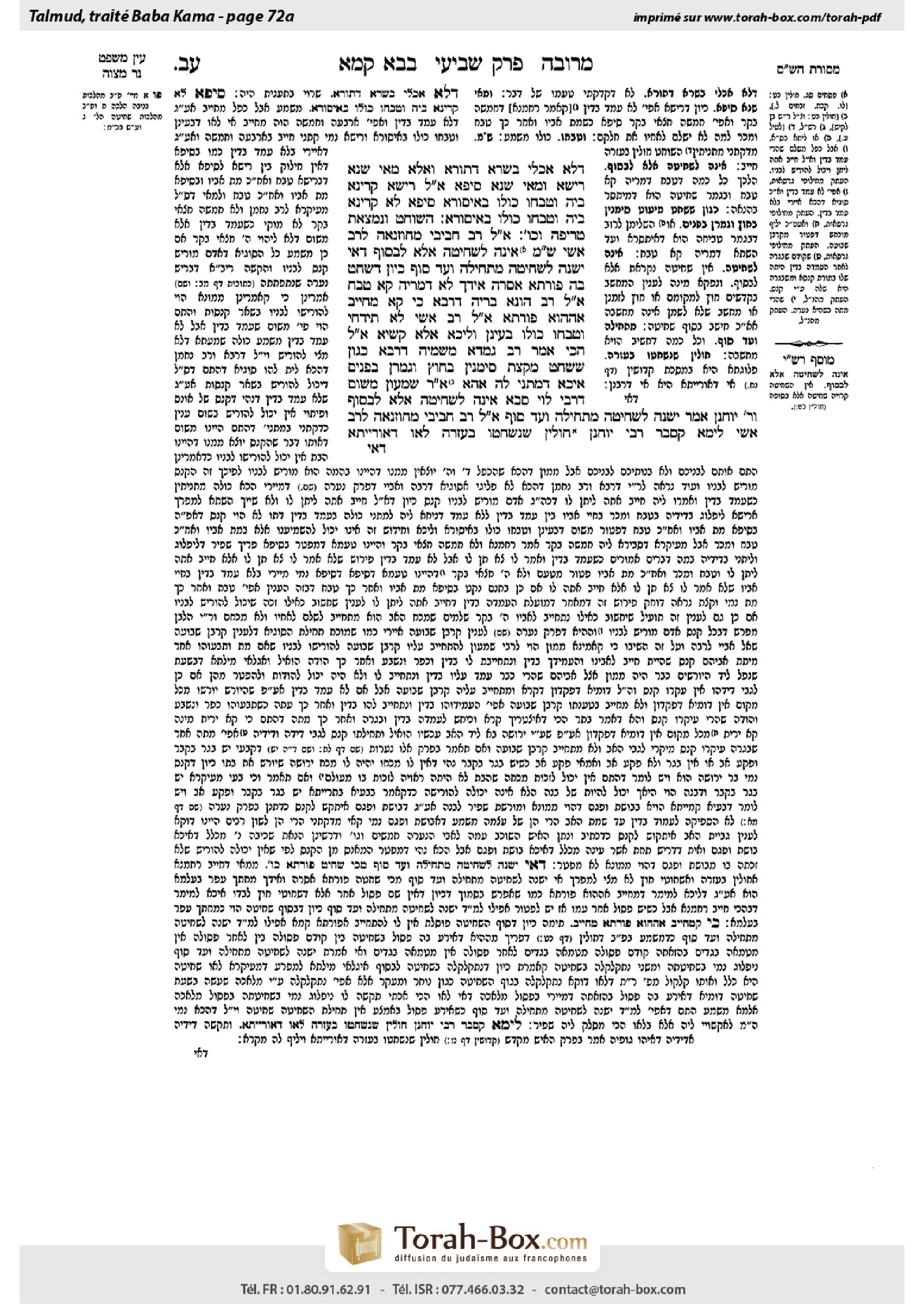
Bava Kamma 72a: Talmud study for Daf Yomi
Study the Talmud for Daf Yomi with scanned pages, Hebrew text, English translations from Sefaria and AI-generated French translations.
Passage selection and English or AI-generated French translation are available where the scan has annotations. Daf Study is independent of Torah-Box and Sefaria.
Browse Bava Kamma · בבא קמא · All tractatesBava Kamma 72a text and translations
This page of Bava Kamma includes the Aramaic text, an English translation and an AI-generated French translation, alongside the scan above.
בבא קמא ע״ב א · Aramaic and Hebrew text
דְּלָא אֲכַלִי בִּשְׂרָא דְתוֹרָא.
וְאֶלָּא מַאי שְׁנָא רֵישָׁא וּמַאי שְׁנָא סֵיפָא?
אֲמַר לֵיהּ: רֵישָׁא קָרֵינָא בֵּיהּ ״וּטְבָחוֹ״ כּוּלּוֹ בְּאִיסּוּרָא, סֵיפָא לָא קָרֵינָא בַּיהּ ״וּטְבָחוֹ״ כּוּלּוֹ בְּאִיסּוּרָא.
הַשּׁוֹחֵט וְנִמְצֵאת טְרֵיפָה וְכוּ׳. אֲמַר לֵיהּ רַב חֲבִיבִי מָחוֹזְנָאָה לְרַב אָשֵׁי: שְׁמַע מִינַּהּ, אֵינָהּ לִשְׁחִיטָה אֶלָּא לְבַסּוֹף.
דְּאִי יֶשְׁנָהּ לִשְׁחִיטָה מִתְּחִילָּה וְעַד סוֹף, כֵּיוָן דִּשְׁחַט בַּהּ פּוּרְתָּא – אַסְרַהּ, אִידַּךְ – לָא דְּמָרַיהּ קָא טָבַח!
אֲמַר לֵיהּ רַב הוּנָא בְּרֵיהּ דְּרָבָא: כִּי קָא מִחַיַּיב – אַהָהוּא פּוּרְתָּא. אֲמַר לֵיהּ רַב אָשֵׁי: לָא תִּידְחֲיַ[יהּ], ״וּטְבָחוֹ״ כּוּלּוֹ בָּעֵינַן – וְלֵיכָּא.
אֶלָּא קַשְׁיָא! אֲמַר לֵיהּ, הָכִי אָמַר רַב גַּמָּדָא מִשְּׁמֵיהּ דְּרָבָא: כְּגוֹן שֶׁשָּׁחַט מִקְצָת סִימָנִין בַּחוּץ, וּגְמָרָן בִּפְנִים.
אִיכָּא דְּמַתְנֵי לַהּ אַהָא – אָמַר רַבִּי שִׁמְעוֹן מִשּׁוּם דְּרַבִּי לֵוִי סָבָא: אֵינָהּ לִשְׁחִיטָה אֶלָּא לְבַסּוֹף. וְרַבִּי יוֹחָנָן אָמַר: יֶשְׁנָהּ לִשְׁחִיטָה מִתְּחִילָּה וְעַד סוֹף. אֲמַר לֵיהּ רַב חֲבִיבִי מָחוֹזְנָאָה לְרַב אָשֵׁי, לֵימָא קָסָבַר רַבִּי יוֹחָנָן: חוּלִּין שֶׁנִּשְׁחֲטוּ בַּעֲזָרָה – לָאו דְּאוֹרָיְיתָא?
Bava Kamma 72a · English translation
is because I had not eaten ox meat. In other words, I was fasting yesterday and was unable to concentrate properly.
Rava responded to him: But if the Torah requires even a partial payment of the fourfold or fivefold payment, what is different in the first clause, in which the son must pay, and what is different in the latter clause, where he is exempt?
Rav Naḥman said to him: In the first clause, where the father’s animal was stolen and slaughtered in his lifetime, I read about this case the verse: “If a man steal an ox or a sheep, and slaughter it” (Exodus 21:37), which indicates that the thief slaughtered the ox or the sheep entirely in a prohibited manner. In the latter clause, where the animal was slaughtered after the father’s death, I do not read about this case the verse: “And slaughter it,” which describes a slaughter that was performed entirely in a prohibited manner, because the animal already partially belonged to him, and his own portion of the ox was slaughtered in a permitted manner.
§ The mishna teaches: A thief who slaughters the animal but it was found to be a tereifa, and likewise a thief who slaughters a non-sacred animal in the Temple courtyard, pays the fourfold or fivefold payment. Rav Ḥavivi of Meḥoza said to Rav Ashi: Conclude from the mishna that the act of slaughtering is considered to have been performed only at the end of the slaughtering process.
Rav Ḥavivi of Meḥoza explains: As, if you say that the act of slaughtering lasts from beginning to end, i.e., the halakhic ramifications of slaughtering are in effect throughout the process, one could raise a question with regard to the case of one who slaughters a non-sacred animal in the Temple courtyard: Once he slaughtered the animal a bit, at the very start of the act of slaughter, he has prohibited the animal, with regard to deriving benefit, as a non-sacred animal slaughtered in the Temple courtyard. When he slaughters the other part, it is already prohibited with regard to deriving benefit, which means that it is not an animal that belongs to its owner that he slaughters. Since deriving benefit from the animal is prohibited, it has no value; therefore, there is no ownership.
Rav Huna, son of Rava, said to Rav Ḥavivi in response: It is possible to explain the mishna even if one maintains that the halakhic ramifications of slaughtering are in effect throughout the slaughter. As, when does the thief become obligated to pay the fourfold or fivefold payment? It is when he performs that first bit of slaughter in the beginning, before the animal becomes forbidden. Rav Ashi said to Rav Huna: Do not dismiss Rav Ḥavivi’s objection with this explanation. The verse: “If a man steal an ox or a sheep, and slaughter it” (Exodus 21:37), indicates that to impose liability to pay the fourfold or fivefold payment we require that the thief slaughtered it completely, and after having slaughtered it just a bit there is no complete slaughter yet.
Rav Huna said to Rav Ashi: But if you are correct, the mishna is difficult according to the one who maintains that the halakhic ramifications of slaughtering are in effect throughout the slaughter. Rav Ashi said to Rav Huna: This is what Rav Gamda said in the name of Rava, concerning this question: The mishna is discussing a case where the thief slaughtered, i.e., severed, part of the two organs that must be severed in ritual slaughter, i.e., the trachea and the esophagus [simanin], outside the Temple, and finished slaughtering them inside the Temple. Therefore, the animal became prohibited with regard to deriving benefit only at the final stage of slaughter, concomitant with the liability to pay the fourfold or fivefold payment.
There are those who teach that the preceding exchange took place with regard to the following dispute: Rabbi Shimon ben Lakish says in the name of Rabbi Levi the Elder: The act of slaughtering is considered to have been performed only at the end of the slaughtering process. And Rabbi Yoḥanan says: The act of slaughtering lasts from beginning to end. Rav Ḥavivi of Meḥoza said to Rav Ashi: Shall we say that Rabbi Yoḥanan holds that the prohibition against deriving benefit from non-sacred animals that were slaughtered in the Temple courtyard is not by Torah law?
Bava Kamma 72a · Traduction française (IA)
car c'est parce que je n'avais pas mangé de viande de bœuf. En d'autres termes, j'étais en jeûne hier et n'ai pas réussi à m'attacher correctement.
Rava répondit à lui : Mais si la Torah exige même un paiement partiel des quatre ou cinq fois, qu'y a-t-il de particulier dans la première clause, où le fils doit payer, et qu'y a-t-il de particulier dans la seconde clause, où il est exempt ?
Rav Naḥman dit à lui : Dans la première clause, où l'animal du père a été volé et tué pendant sa vie, je lis ce cas dans la parole : « Si un homme vole un bœuf ou une brebis, et le tue » (Exode 21:37), ce qui indique que le voleur a tué le bœuf ou la brebis entièrement de manière interdite. Dans la seconde clause, où l'animal a été tué après la mort du père, je ne lis pas ce cas dans la parole : « et le tue », qui décrit une mise à mort effectuée entièrement de manière interdite, car l'animal appartenait déjà partiellement à lui, et sa part du bœuf a été tuée de manière permise.
§ La mitsva enseigne : Un voleur qui tue l'animal mais qui est trouvé être un tereifa, et de même un voleur qui tue un animal non sacré dans le courtyard du Temple, paie le quatre ou cinq fois. Rav Ḥavivi de Meḥoza dit à Rav Ashi : Concluez de la mitsva que l'acte de mise à mort est considéré comme ayant été effectué seulement à la fin du processus de mise à mort.
Rav Ḥavivi de Meḥoza explique : Comme, si vous dites que l'acte de mise à mort dure du début à la fin, c'est-à-dire que les ramifications halakhiques de la mise à mort sont en vigueur tout au long du processus, on pourrait soulever une question concernant le cas d'une personne qui tue un animal non sacré dans le courtyard du Temple : Une fois qu'il a tué l'animal un peu, au début de l'acte de mise à mort, il a rendu l'animal interdit, en ce qui concerne l'usage, comme un animal non sacré tué dans le courtyard du Temple. Lorsqu'il tue l'autre partie, il est déjà interdit en ce qui concerne l'usage, ce qui signifie qu'il ne s'agit pas d'un animal qui appartient à son propriétaire qu'il tue. Puisque l'usage de l'animal est interdit, il n'a plus de valeur ; donc, il n'y a plus de propriété.
Rav Huna, fils de Rava, dit à Rav Ḥavivi en réponse : Il est possible d'expliquer la mitsna même si l'on maintient que les ramifications halakhiques de la mise à mort sont en vigueur tout au long de la mise à mort. Comme, quand le voleur devient tenu de payer le quatre ou cinq fois ? C'est quand il effectue cette première partie de la mise à mort au début, avant que l'animal ne devienne interdit. Rav Ashi dit à Rav Huna : Ne rejetez pas l'objection de Rav Ḥavivi avec cette explication. La parole : « Si un homme vole un bœuf ou une brebis, et le tue » (Exode 21:37), indique que pour imposer la responsabilité de payer le quatre ou cinq fois, nous exigeons que le voleur l'ait tué entièrement, et après avoir tué l'animal juste un peu, il n'y a pas encore une mise à mort complète.
Rav Huna dit à Rav Ashi : Mais si vous avez raison, la mitsva est difficile selon celui qui maintient que les ramifications halakhiques de la mise à mort sont en vigueur tout au long de la mise à mort. Rav Ashi dit à Rav Huna : C'est ce que Rav Gamda a dit au nom de Rava, concernant cette question : La mitsva discute d'un cas où le voleur a tué, c'est-à-dire a sectionné, une partie des deux organes qui doivent être sectionnés dans la mise à mort rituelle, c'est-à-dire la trachée et l'œsophage [simanin], en dehors du Temple, et a terminé la mise à mort à l'intérieur du Temple. Ainsi, l'animal est devenu interdit en ce qui concerne l'usage seulement à la fin de la mise à mort, en même temps que la responsabilité de payer le quatre ou cinq fois.
Il y a ceux qui enseignent que l'échange précédent s'est produit concernant le débat suivant : Rabbi Shimon ben Lakish dit au nom de Rabbi Levi l'Aîné : L'acte de mise à mort est considéré comme ayant été effectué seulement à la fin du processus de mise à mort. Et Rabbi Yoḥanan dit : L'acte de mise à mort dure du début à la fin. Rav Ḥavivi de Meḥoza dit à Rav Ashi : Devons-nous dire que Rabbi Yoḥanan maintient que l'interdiction d'usage des animaux non sacrés tués dans le courtyard du Temple n'est pas selon la Loi divine ?
Traduction française générée par IA à partir de l’édition anglaise de Sefaria. Vérifie toujours un passage avec le texte source.
Text from Sefaria: William Davidson Edition - Vocalized Aramaic (CC BY NC); William Davidson Edition - English (CC BY NC).