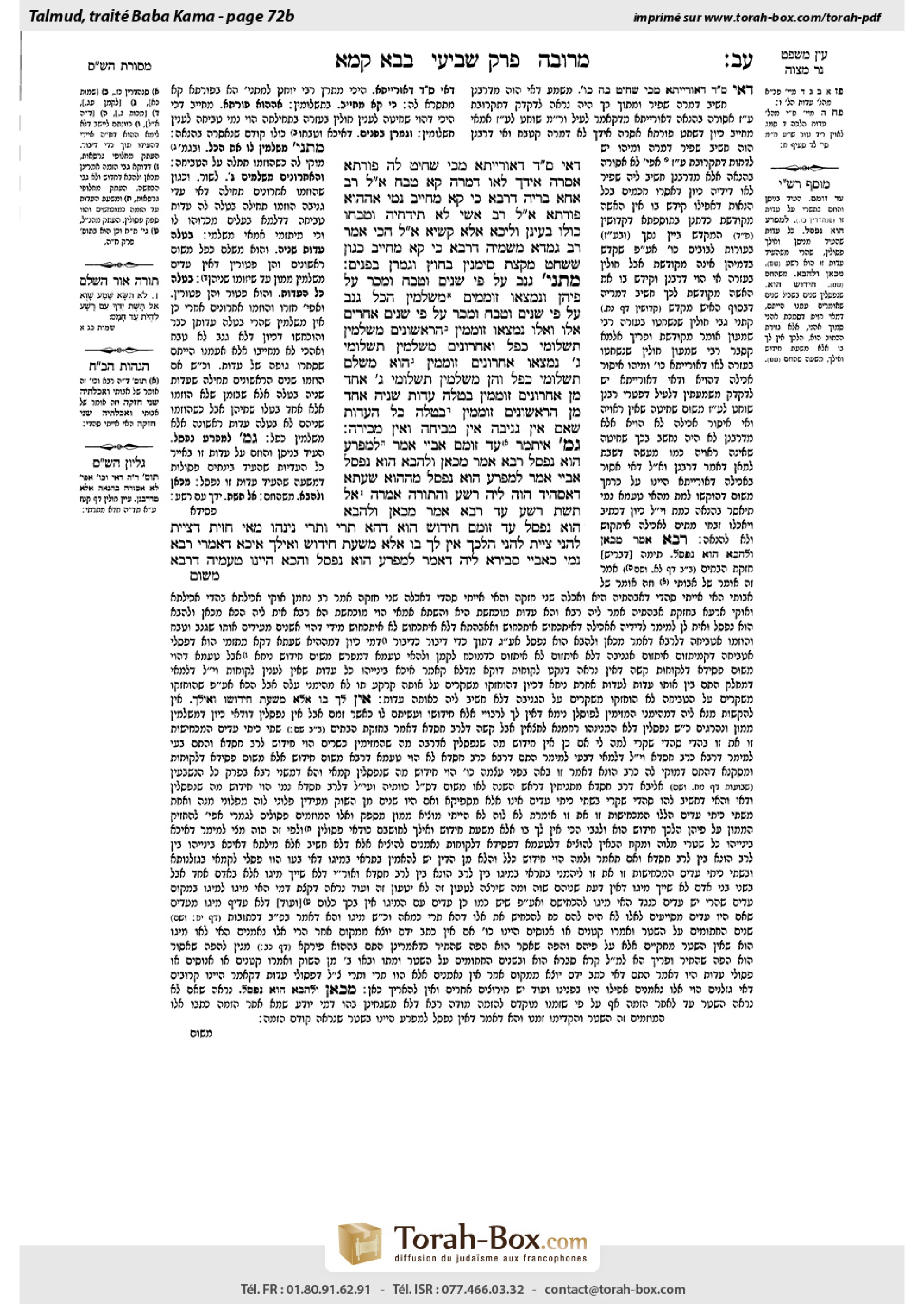
Bava Kamma 72b: Talmud study for Daf Yomi
Study the Talmud for Daf Yomi with scanned pages, Hebrew text, English translations from Sefaria and AI-generated French translations.
Passage selection and English or AI-generated French translation are available where the scan has annotations. Daf Study is independent of Torah-Box and Sefaria.
Browse Bava Kamma · בבא קמא · All tractatesBava Kamma 72b text and translations
This page of Bava Kamma includes the Aramaic text, an English translation and an AI-generated French translation, alongside the scan above.
בבא קמא ע״ב ב · Aramaic and Hebrew text
דְּאִי סָלְקָא דַעְתָּךְ דְּאוֹרָיְיתָא, מִכִּי שָׁחֵיט לַהּ פּוּרְתָּא – אַסְרַהּ, אִידַּךְ – לָאו דְּמָרַהּ קָא טָבַח!
אֲמַר לֵיהּ רַב אַחָא בְּרֵיהּ דְּרָבָא: כִּי קָא מִחַיַּיב נָמֵי – אַהָהוּא פּוּרְתָּא. אֲמַר לֵיהּ רַב אָשֵׁי: לָא תִּידְחֲיַהּ, ״וּטְבָחוֹ״ כּוּלּוֹ בָּעֵינַן – וְלֵיכָּא.
אֶלָּא קַשְׁיָא! אֲמַר לֵיהּ, הָכִי אָמַר רַב גַּמָּדָא מִשְּׁמֵיהּ דְּרָבָא: כִּי קָא מְחַיֵּיב – כְּגוֹן שֶׁשָּׁחַט מִקְצָת סִימָנִין בַּחוּץ, וּגְמָרָן בִּפְנִים.
מַתְנִי׳ גָּנַב עַל פִּי שְׁנַיִם, וְטָבַח וּמָכַר עַל פִּיהֶן, וְנִמְצְאוּ זוֹמְמִים – מְשַׁלְּמִין הַכֹּל.
גָּנַב עַל פִּי שְׁנַיִם, וְטָבַח וּמָכַר עַל פִּי שְׁנַיִם אֲחֵרִים, אֵלּוּ וָאֵלּוּ נִמְצְאוּ זוֹמְמִין – הָרִאשׁוֹנִים מְשַׁלְּמִין תַּשְׁלוּמֵי כֶפֶל, וְאַחֲרוֹנִים מְשַׁלְּמִין תַּשְׁלוּמֵי שְׁלֹשָׁה.
נִמְצְאוּ אַחֲרוֹנִים זוֹמְמִין – הוּא מְשַׁלֵּם תַּשְׁלוּמֵי כֶפֶל, וְהֵן מְשַׁלְּמִין תַּשְׁלוּמֵי שְׁלֹשָׁה.
אֶחָד מִן אַחֲרוֹנִים זוֹמְמִין – בָּטְלָה עֵדוּת שְׁנִיָּה. אֶחָד מִן הָרִאשׁוֹנִים זוֹמְמִין – בָּטְלָה כׇּל הָעֵדוּת; שֶׁאִם אֵין גְּנֵיבָה – אֵין טְבִיחָה וְאֵין מְכִירָה.
גְּמָ׳ אִיתְּמַר: עֵד זוֹמֵם – אַבָּיֵי אָמַר: לְמַפְרֵעַ הוּא נִפְסָל, רָבָא אָמַר: מִכָּאן וּלְהַבָּא הוּא נִפְסָל.
אַבָּיֵי אָמַר לְמַפְרֵעַ הוּא נִפְסָל – מֵהָהוּא שַׁעְתָּא דְּאַסְהֵיד הָוֵה לֵיהּ רָשָׁע, וְהַתּוֹרָה אָמְרָה: ״אַל תָּשֶׁת רָשָׁע עֵד״.
רָבָא אָמַר מִכָּאן וּלְהַבָּא הוּא נִפְסָל – עֵד זוֹמֵם חִידּוּשׁ הוּא; דְּהָא תְּרֵי וּתְרֵי נִינְהוּ – מַאי חָזֵית דְּצָיְיתַ[תְּ] לְהָנֵי? צְיֵית לְהָנֵי!
הִלְכָּךְ אֵין לְךָ בּוֹ אֶלָּא מִשְּׁעַת חִידּוּשׁ וְאֵילָךְ.
אִיכָּא דְאָמְרִי: רָבָא נָמֵי כְּאַבַּיֵּי סְבִירָא לֵיהּ, דְּאָמַר לְמַפְרֵעַ הוּא נִפְסָל; וְהָכָא הַיְינוּ טַעְמֵיהּ דְּרָבָא –
Bava Kamma 72b · English translation
As, if it enters your mind that it is prohibited by Torah law the mishna here would be difficult, for as soon as he slaughtered the animal a bit, at the very start of the act of slaughter, he has prohibited the animal, with regard to deriving benefit, as a non-sacred animal slaughtered in the Temple courtyard. When he slaughters the other part it is already prohibited with regard to deriving benefit, which means that it is not an animal that belongs to its owner that he slaughters.
Rav Aḥa, son of Rava, said to Rav Ḥavivi: It is possible to explain the mishna even according to the opinion that the halakhic ramifications of slaughtering are in effect throughout the slaughter, and even if one maintains that it is prohibited by Torah law to benefit from a non-sacred animal slaughtered in the Temple. As, when does the thief become obligated to pay the fourfold or fivefold payment as well? It is when he performs that first bit of slaughter in the beginning, before the animal becomes forbidden. Rav Ashi said to Rav Huna: Do not dismiss Rav Ḥavivi’s suggestion with this explanation. The verse: “If a man steal an ox or a sheep, and slaughter it” (Exodus 21:37), indicates that in order to impose liability to pay the fourfold or fivefold payment we require that the thief slaughtered it completely, and after having slaughtered it just a bit there is no complete slaughter yet.
Rav Huna said to Rav Ashi: But if you are correct, the mishna is difficult. Rav Ashi said to Rav Huna: This is what Rav Gamda said in the name of Rava: When does the mishna state that the thief is obligated to pay the fourfold or fivefold payment? It is in a case where the thief slaughtered part of the simanim outside the Temple, and finished slaughtering them inside the Temple. Therefore, the animal became prohibited with regard to deriving benefit only at the final stage of slaughter, concomitant with the liability to pay the fourfold or fivefold payment.
MISHNA: If one stole an ox or a sheep, as established based on the testimony of two witnesses, and he subsequently slaughtered the animal or sold it, also based on the testimony of the same witnesses, and these witnesses were found to be conspiring witnesses, these witnesses pay everything, i.e., not only the principal amount but also the fourfold or fivefold payment. This is in accordance with the Torah’s decree with regard to conspiring witnesses: “You shall do to him as he had conspired to do to his brother” (Deuteronomy 19:19). Since these witnesses attempted to obligate the alleged thief to pay the fourfold or fivefold payment, they themselves must pay that full amount.
With regard to one who stole an ox or a sheep, as established based on the testimony of two witnesses, and he subsequently slaughtered the animal or sold it, based on the testimony of two other witnesses, if both these witnesses and those witnesses were found to be conspiring witnesses, the first set of witnesses, who testified about the theft of the animal, pay the alleged thief the double payment, which is what they had conspired to cause him to pay. And the last set of witnesses, who attested to the slaughter or sale of the animal, pay the alleged thief a twofold payment for a sheep or a threefold payment for an ox, which they had conspired to cause him to pay over and above the double payment.
If only the witnesses in the last set were found to be conspiring witnesses, while the testimony about the theft remains intact, the thief pays the double payment to the animal’s owner and the second set of witnesses pay the alleged thief the twofold or threefold payment, the amount over and above the double payment, which is what they had conspired to cause him to pay.
If only one individual from the last set of witnesses was found to be a conspiring witness, the second testimony is nullified, as it was not submitted by two valid witnesses, whereas the first testimony remains intact. If one individual from the first set of witnesses is found to be a conspiring witness, the entire testimony concerning the thief is nullified. The reason is that if there is no theft established by reliable testimony there is no liability for slaughtering the animal and there is no liability for selling it.
GEMARA: One who is rendered a conspiring witness is barred from providing testimony in the future. The Gemara cites a fundamental dispute with regard to this disqualification. It was stated concerning a conspiring witness: Abaye says: He is disqualified retroactively, from when he provided his testimony. Any testimony he may have provided after that point in time is retroactively nullified. Rava says: He is disqualified only from that point forward, i.e., from when he was established to be a conspiring witness, but not retroactively from when he provided his testimony.
The Gemara explains the reasons for the two opinions: Abaye says he is disqualified retroactively because it is from that time when he testified that he is considered a wicked man, and the Torah said: “Do not put your hand with the wicked to be an unrighteous witness” (Exodus 23:1), which is interpreted to mean: Do not allow a wicked man to serve as a witness.
Rava says that he is disqualified only from that point forward because the disqualification of a conspiring witness is a novelty, i.e., it is not based on logic. The reason is that this is a case of two witnesses against two other witnesses, in which case neither testimony should be accepted. What did you see that causes you to listen to the second set of witnesses, who testify that the first set were not at the scene of the purported event? You could instead listen to the first set of witnesses, who testify to the event, and disbelieve the second set. Yet the Torah teaches that the second set of witnesses is always deemed credible and the first set is subjected to punishment as conspiring witnesses.
Therefore, as the disqualification of the conspiring witnesses is an anomaly, you have the right to disqualify them only from the time of the novelty and onward, i.e., this counterintuitive disqualification is not applied retroactively.
There are those who say that Rava also holds like Abaye, who says that by rights a conspiring witness should be disqualified retroactively from when he provided his testimony, and here this is Rava’s reason for not disqualifying him retroactively:
Bava Kamma 72b · Traduction française (IA)
Si, en pensant que cela est interdit par la loi juive, la michna ici serait difficile, car dès qu'il a tué l'animal, même un peu, au début de l'acte de sacrifice, il l'a rendu interdit en ce qui concerne l'usage, comme un animal non sacré tué dans le courtyard du Temple. Lorsqu'il tue l'autre partie, il est déjà interdit en ce qui concerne l'usage, ce qui signifie que ce n'est pas un animal appartenant à son propriétaire qu'il tue.
Rav Aḥa, fils de Rava, dit à Rav Ḥavivi : Il est possible d'expliquer la michna même selon l'opinion qui considère que les conséquences halakhiques du sacrifice s'appliquent tout au long du sacrifice, et même si l'on maintient que c'est interdit par la loi juive d'obtenir un bénéfice d'un animal non sacré tué dans le Temple. En effet, quand devient-il obligatoire de payer quatre fois ou cinq fois la valeur de l'animal ? C'est quand il effectue ce premier petit acte de sacrifice au début, avant que l'animal ne devienne interdit. Rav Ashi dit à Rav Huna : Ne rejetez pas l'explication de Rav Ḥavivi avec cette explication. La parole : « Si un homme vole un bœuf ou une brebis, et le tue » (Exode 21:37), indique que pour imposer la responsabilité de payer quatre fois ou cinq fois la valeur, nous exigeons que le voleur ait entièrement tué l'animal, et après avoir tué l'animal juste un peu, il n'y a pas encore un sacrifice complet.
Rav Huna dit à Rav Ashi : Mais si vous avez raison, la michna est difficile. Rav Ashi dit à Rav Huna : C'est ce que Rav Gamda a dit au nom de Rava : Quand la michna dit que le voleur est obligé de payer quatre fois ou cinq fois la valeur ? C'est dans le cas où le voleur a tué une partie des signes en dehors du Temple, et a terminé le sacrifice à l'intérieur du Temple. Ainsi, l'animal est devenu interdit en ce qui concerne l'usage seulement à la fin du sacrifice, en même temps que la responsabilité de payer quatre fois ou cinq fois la valeur.
MICHNA : Si l'on a volé un bœuf ou une brebis, comme établi par le témoignage de deux témoins, et qu'on a ensuite tué l'animal ou l'a vendu, également sur la base du témoignage des mêmes témoins, et que ces témoins ont été trouvés être des témoins conjurés, ces témoins paient tout, c'est-à-dire non seulement la somme principale mais aussi quatre fois ou cinq fois la valeur. Cela s'inscrit dans la déclaration de la Torah concernant les témoins conjurés : « Vous ferez à lui ce qu'il avait conspiré de faire à son frère » (Deutéronome 19:19). Puisque ces témoins ont tenté d'obliger le voleur présumé à payer quatre fois ou cinq fois la valeur, ils eux-mêmes doivent payer cette somme totale.
Concernant celui qui a volé un bœuf ou une brebis, comme établi par le témoignage de deux témoins, et qu'il a ensuite tué l'animal ou l'a vendu, sur le témoignage de deux autres témoins, si ces témoins et les témoins précédents ont été trouvés être des témoins conjurés, les premiers témoins, qui ont témoigné du vol de l'animal, paient au voleur présumé la double somme, ce qui est ce qu'ils avaient conspiré à lui faire payer. Et les derniers témoins, qui ont attesté de la mort ou de la vente de l'animal, paient au voleur présumé une double somme pour une brebis ou une triple somme pour un bœuf, ce qui est ce qu'ils avaient conspiré à lui faire payer en plus de la double somme.
Si seulement les témoins de la dernière série ont été trouvés être des témoins conjurés, tandis que le témoignage concernant le vol reste intact, le voleur paie la double somme à l'propriétaire de l'animal et les témoins de la deuxième série paient au voleur présumé la double ou triple somme, la quantité en plus de la double somme, ce qui est ce qu'ils avaient conspiré à lui faire payer.
Si seule une personne parmi les témoins de la dernière série a été trouvée être un témoin conjuré, le deuxième témoignage est annulé, car il n'a pas été soumis par deux témoins valides, tandis que le premier témoignage reste intact. Si une personne parmi les témoins du premier groupe a été trouvée être un témoin conjuré, le témoignage concernant le voleur est annulé. La raison est que si le vol n'est pas établi par un témoignage fiable, il n'y a pas de responsabilité pour tuer l'animal et il n'y a pas de responsabilité pour vendre l'animal.
GUEMARA : Celui qui est rendu témoin conjuré est exclu de témoigner à l'avenir. La Guemara cite un débat fondamental concernant cette exclusion. Il a été dit concernant un témoin conjuré : Abaye dit : Il est exclu rétroactivement, depuis le moment où il a donné son témoignage. Tout témoignage qu'il a pu donner après ce moment est annulé rétroactivement. Rava dit : Il est exclu uniquement à partir de ce moment, c'est-à-dire depuis qu'il a été établi être un témoin conjuré, mais pas rétroactivement depuis le moment où il a donné son témoignage.
La Guemara explique les raisons des deux opinions : Abaye dit qu'il est exclu rétroactivement car c'est à partir de ce moment-là qu'il est considéré comme un homme malveillant, et la Torah dit : « Ne mets pas ta main avec les méchants pour être un témoin injuste » (Lévitique 23:1), ce qui est interprété pour signifier : Ne permettez pas à un homme malveillant de servir de témoin.
Rava dit qu'il est disqualifié uniquement à partir de ce moment-là, car la disqualification d'un témoin conjuré est une nouveauté, c'est-à-dire qu'elle ne repose pas sur la logique. La raison est que c'est un cas de deux témoins contre deux autres témoins, dans lequel cas aucun témoignage ne devrait être accepté. Qu'est-ce que tu as vu qui te fait écouter les témoins de la deuxième série, qui témoignent que les témoins de la première série n'étaient pas présents à l'événement prétendu ? Tu pourrais plutôt écouter les témoins de la première série, qui témoignent de l'événement, et douter des témoins de la deuxième série. Cependant, la Torah enseigne que les témoins de la deuxième série sont toujours considérés comme crédibles et les témoins de la première série sont punis comme témoins conjurés.
Par conséquent, comme l'invalidation des témoins complotant est une exception, vous avez le droit d'invalider uniquement à partir du moment de la nouveauté et par la suite, c'est-à-dire que cette invalidation contre-intuitive ne s'applique pas de manière rétroactive.
Certains disent que Rava partage aussi l'opinion d'Abaye, qui affirme qu'un témoin complotant devrait être invalidé de manière rétroactive à partir du moment où il a témoigné, et ici c'est la raison de Rava pour ne pas invalider de manière rétroactive :
Traduction française générée par IA à partir de l’édition anglaise de Sefaria. Vérifie toujours un passage avec le texte source.
Text from Sefaria: William Davidson Edition - Vocalized Aramaic (CC BY NC); William Davidson Edition - English (CC BY NC).