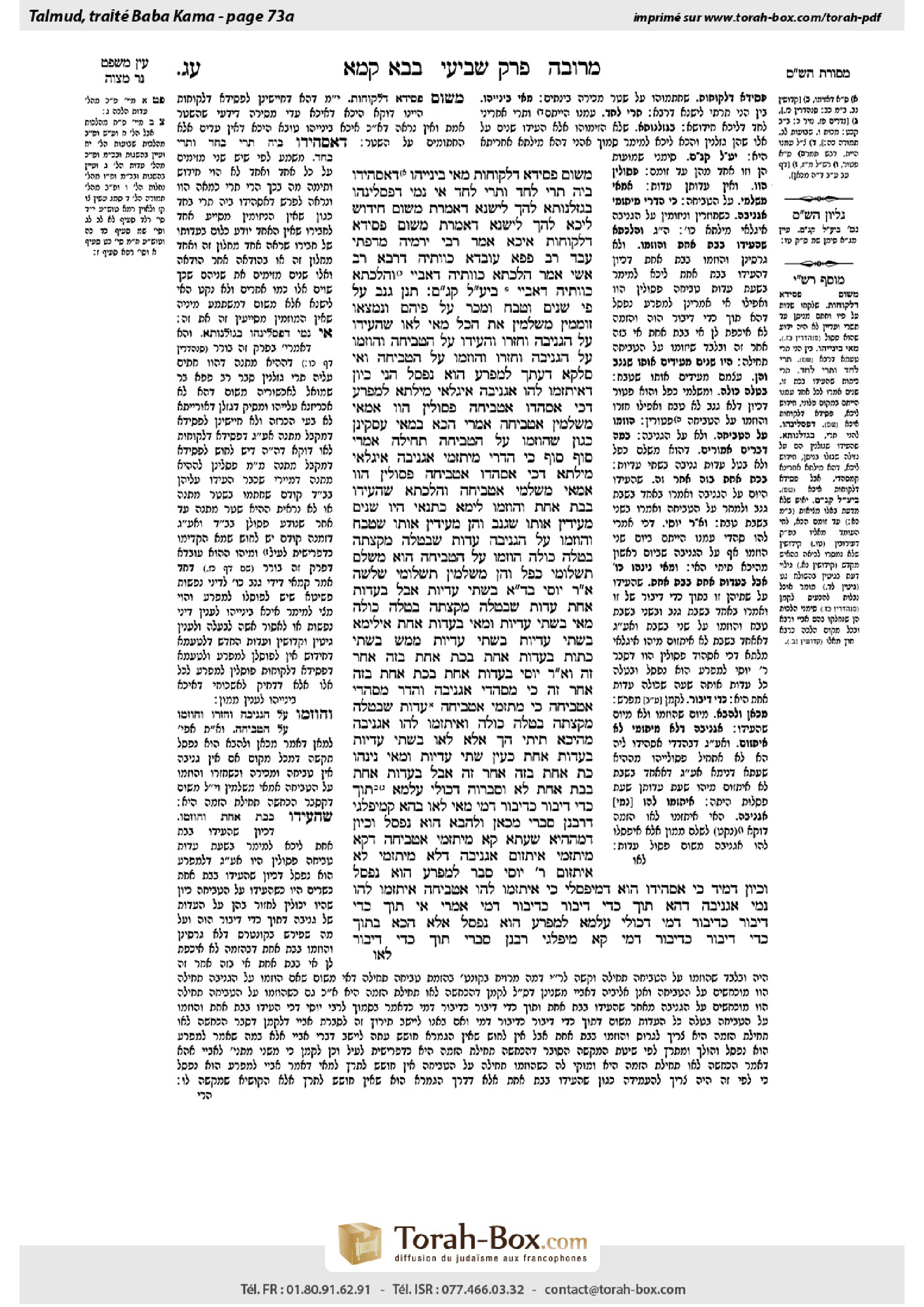
Bava Kamma 73a: Talmud study for Daf Yomi
Study the Talmud for Daf Yomi with scanned pages, Hebrew text, English translations from Sefaria and AI-generated French translations.
Passage selection and English or AI-generated French translation are available where the scan has annotations. Daf Study is independent of Torah-Box and Sefaria.
Browse Bava Kamma · בבא קמא · All tractatesBava Kamma 73a text and translations
This page of Bava Kamma includes the Aramaic text, an English translation and an AI-generated French translation, alongside the scan above.
בבא קמא ע״ג א · Aramaic and Hebrew text
מִשּׁוּם פְּסֵידָא דְלָקוֹחוֹת.
מַאי בֵּינַיְיהוּ? דְּאַסְהִידוּ בֵּיהּ תְּרֵי לְחַד, וּתְרֵי לְחַד. אִי נָמֵי דְּפַסְלִינְהוּ בְּגַזְלָנוּתָא.
לְהָךְ לִישָּׁנָא דְּאָמְרַתְּ מִשּׁוּם חִידּוּשׁ – לֵיכָּא. לְהָךְ לִישָּׁנָא דְּאָמְרַתְּ מִשּׁוּם פְּסֵידָא דְלָקוֹחוֹת – אִיכָּא.
אָמַר רַבִּי יִרְמְיָה מִדִּפְתִּי: עֲבַד רַב פָּפָּא עוֹבָדָא כְּווֹתֵיהּ דְּרָבָא. רַב אָשֵׁי אָמַר: הִלְכְתָא כְּווֹתֵיהּ דְּאַבָּיֵי. וְהִלְכְתָא כְּווֹתֵיהּ דְּאַבָּיֵי בְּיע״ל קג״ם.
תְּנַן: גָּנַב עַל פִּי שְׁנַיִם, וְטָבַח וּמָכַר עַל פִּיהֶם, וְנִמְצְאוּ זוֹמְמִין – מְשַׁלְּמִין אֶת הַכֹּל.
מַאי, לָאו שֶׁהֵעִידוּ עַל הַגְּנֵיבָה, וְחָזְרוּ וְהֵעִידוּ עַל הַטְּבִיחָה, וְהוּזַּמּוּ עַל הַגְּנֵיבָה וְחָזְרוּ וְהוּזַּמּוּ עַל הַטְּבִיחָה?
וְאִי סָלְקָא דַעְתָּךְ לְמַפְרֵעַ הוּא נִפְסָל, הָנֵי – כֵּיוָן דְּאִיתַּזַּמוּ לְהוּ אַגְּנֵיבָה, אִיגַּלַּאי מִילְּתָא לְמַפְרֵעַ דְּכִי אַסְהִדוּ אַטְּבִיחָה – פְּסוּלִין הֲווֹ; אַמַּאי מְשַׁלְּמִין אַטְּבִיחָה?
אָמְרִי: הָכָא בְּמַאי עָסְקִינַן – כְּגוֹן שֶׁהוּזַּמּוּ עַל הַטְּבִיחָה תְּחִילָּה.
אָמְרִי: סוֹף סוֹף, כִּי הָדְרִי מִיתַּזְּמִי אַגְּנֵיבָה, אִיגַּלַּאי מִילְּתָא דְּכִי אַסְהִדוּ אַטְּבִיחָה – פְּסוּלִין הֲווֹ; אַמַּאי מְשַׁלְּמִי אַטְּבִיחָה?
וְהִלְכְתָא: שֶׁהֵעִידוּ בְּבַת אַחַת, וְהוּזַּמּוּ.
לֵימָא כְּתַנָּאֵי: הָיוּ שְׁנַיִם מְעִידִין אוֹתוֹ שֶׁגָּנַב, וְהֵן מְעִידִין אוֹתוֹ שֶׁטָּבַח, וְהוּזַּמּוּ עַל הַגְּנֵיבָה – עֵדוּת שֶׁבָּטְלָה מִקְצָתָהּ, בָּטְלָה כּוּלָּהּ.
הוּזַּמּוּ עַל הַטְּבִיחָה – הוּא מְשַׁלֵּם תַּשְׁלוּמֵי כֶפֶל, וְהֵן מְשַׁלְּמִין תַּשְׁלוּמֵי שְׁלֹשָׁה.
אָמַר רַבִּי יוֹסֵי: בַּמֶּה דְּבָרִים אֲמוּרִים – בִּשְׁתֵּי עֵדִיּוֹת, אֲבָל בְּעֵדוּת אַחַת – עֵדוּת שֶׁבָּטְלָה מִקְצָתָהּ, בָּטְלָה כּוּלָּהּ.
מַאי ״בִּשְׁתֵּי עֵדִיּוֹת״, וּמַאי ״בְּעֵדוּת אַחַת״? אִילֵימָא ״בִּשְׁתֵּי עֵדִיּוֹת״ – בִּשְׁתֵּי עֵדִיּוֹת מַמָּשׁ, בִּשְׁתֵּי כִּתּוֹת; ״בְּעֵדוּת אַחַת״ – בְּכַת אַחַת בְּזֶה אַחַר זֶה;
וְאָמַר רַבִּי יוֹסֵי: בְּעֵדוּת אַחַת – בְּכַת אַחַת בְּזֶה אַחַר זֶה, כִּי מַסְהֲדִי אַגְּנֵיבָה וַהֲדַר מַסְהֲדִי אַטְּבִיחָה, כִּי מִתַּזְּמִי אַטְּבִיחָה – עֵדוּת שֶׁבָּטְלָה מִקְצָתָהּ בָּטְלָה כּוּלָּהּ, וְאִיתַּזַּמוּ לְהוּ אַגְּנֵיבָה; מֵהֵיכָא תֵּיתֵי הָךְ?
אֶלָּא לָאו ״בִּשְׁתֵּי עֵדִיּוֹת״ – בְּעֵדוּת אַחַת כְּעֵין שְׁתֵּי עֵדִיּוֹת, וּמַאי נִינְהוּ – כַּת אַחַת בְּזֶה אַחַר זֶה; אֲבָל בְּעֵדוּת אַחַת בְּבַת אַחַת – לֹא.
וְסַבְרוּהָ, דְּכוּלֵּי עָלְמָא: תּוֹךְ כְּדֵי דִיבּוּר – כְּדִיבּוּר דָּמֵי.
מַאי, לָאו בְּהָא קָמִיפַּלְגִי – דְּרַבָּנַן סָבְרִי: מִכָּאן וּלְהַבָּא הוּא נִפְסָל, וְכֵיוָן דְּמֵהַהִיא שַׁעְתָּא קָא מִיתַּזְּמִי – אַטְּבִיחָה דְּקָא מִיתַּזְּמִי, אִיתַּזּוּם; אַגְּנֵיבָה דְּלָא מִיתַּזְּמִי, לָא אִיתַּזּוּם.
רַבִּי יוֹסֵי סָבַר: לְמַפְרֵעַ הוּא נִפְסָל, וְכֵיוָן דְּמִיָּד כִּי אַסְהִידוּ הוּא דְּמִיפַּסְלִי, אִי אִיתַּזַּמוּ לְהוּ אַטְּבִיחָה – אִיתַּזַּמוּ לְהוּ נָמֵי אַגְּנֵיבָה, דְּהָא תּוֹךְ כְּדֵי דִיבּוּר – כְּדִיבּוּר דָּמֵי.
אָמְרִי: אִי תּוֹךְ כְּדֵי דִיבּוּר כְּדִיבּוּר דָּמֵי, דְּכוּלֵּי עָלְמָא לְמַפְרֵעַ הוּא נִפְסָל. אֶלָּא הָכָא בְּתוֹךְ כְּדֵי דִיבּוּר כְּדִיבּוּר דָּמֵי קָא מִיפַּלְגִי – רַבָּנַן סָבְרִי: תּוֹךְ כְּדֵי דִיבּוּר
Bava Kamma 73a · English translation
It is due to the potential monetary loss for purchasers, whose acquisitions had been validated by these witnesses between the time of the witnesses’ first testimony and when they were rendered conspiring witnesses. If the disqualification of the witnesses were applied retroactively, as by right it should, all these transactions would be nullified, which would cause a loss to these purchasers.
The Gemara asks: What is the practical difference between these two explanations of Rava’s opinion? After all, according to both explanations Rava did not apply the disqualification of conspiring witnesses retroactively. The Gemara explains that there is a difference in a case where two witnesses testify about one of the witnesses that he was not at the scene of the supposed crime, and two other witnesses testify about the other one witness in a similar manner. Alternatively, there is a practical difference between the two explanations in a case where two witnesses disqualified the first set of witnesses by testifying that they had once committed robbery and are therefore unfit to give testimony.
The Gemara elaborates: According to this version in which you say that Rava’s rejection of retroactive disqualification was because it is a novelty, in these two circumstances there is no novelty, and therefore he would agree that the disqualification should be retroactive. According to that version in which you say that Rava’s concern was due to a potential loss for purchasers, in these two circumstances there is a concern for a potential loss for purchasers. Consequently, in these circumstances as well Rava would reject retroactive disqualification.
Rabbi Yirmeya of Difti related: Rav Pappa once took action, i.e., ruled in a case, in accordance with the opinion of Rava, and rejected retroactive disqualification of conspiring witnesses. Rav Ashi said: The halakha is in accordance with the opinion of Abaye with regard to retroactive disqualification of conspiring witnesses. The Gemara provides a principle: And in disputes between Abaye and Rava the halakha is in accordance with the opinion of Rava, except for six cases in which the halakha is in accordance with the opinion of Abaye. They are: In the cases represented by the mnemonic yod-ayin-lamed kuf-gimmel-mem. These halakhot are the following: Unknown despair [ye’ush]; conspiring witness [eidim] who are disqualified retroactively; a side post [leḥi] standing alone; betrothal [kiddushin] that is not given to consummation; revealing intent with a bill of divorce [get]; and an apostate [mumar] who sins rebelliously.
The Gemara asks a question with regard to Abaye’s opinion from that which we learned in the mishna: If one stole an ox or a sheep, as established based on the testimony of two witnesses, and he slaughtered the animal or sold it, also based on the testimony of the same witnesses, and these witnesses were found to be conspiring witnesses, these conspiring witnesses pay everything, including the fourfold or fivefold payment.
The Gemara explains the question: What, is it not referring to a case in which the events occurred in the following sequence: The witnesses testified concerning the theft of the animal, and then testified concerning the animal’s slaughter. And subsequently they were rendered conspiring witnesses for their testimony concerning the theft, and then they were rendered conspiring witnesses for their testimony concerning the slaughter.
And if it enters your mind to say, in accordance with the opinion of Abaye, that a conspiring witness is disqualified retroactively from the time he provided his testimony, then with regard to these witnesses, once they are rendered conspiring witnesses concerning the theft, the matter becomes clarified retroactively that when they testified concerning the slaughter they were disqualified to serve as witnesses. Consequently, that testimony should be rejected. Why, then, must they pay the fourfold or fivefold payment for their testimony concerning the animal’s slaughter?
The Sages say in response: With what are we dealing here? We are dealing with a case where the events did not happen in this sequence. Rather, the witnesses were first rendered conspiring witnesses with regard to their testimony concerning the animal’s slaughter, and only afterward were they rendered conspiring witnesses with regard to the theft.
The Sages say, in rejection of this answer: Ultimately, when they are subsequently rendered conspiring witnesses with regard to their testimony concerning the theft, the matter becomes clarified retroactively that when they testified concerning the slaughter they were disqualified from providing testimony. Why, then, must they pay the fourfold or fivefold payment for their testimony concerning the animal’s slaughter?
The Gemara gives its final answer: And the halakha is in accordance with the opinion of Abaye, since the mishna can be explained as discussing a case where the witnesses testified concerning the theft of the animal and its slaughter at the same time, and afterward they were rendered conspiring witnesses with regard to testimony about both matters. Therefore, even if the disqualification of these witnesses is established retroactively, they were not disqualified when they provided their single testimony concerning the theft and the slaughter.
The Gemara proposes: Let us say that the dispute between Abaye and Rava is parallel to a dispute between tanna’im. As it is taught in a baraita: In a case where there were two witnesses testifying against someone, claiming that he stole an animal, and they subsequently testify against him that he slaughtered the animal, and they were rendered conspiring witnesses only with regard to their testimony concerning the theft, the halakha is in accordance with the principle that testimony that was partially invalidated is entirely invalidated. In other words, the testimony concerning the slaughter of the animal is null and void, as there is no longer any testimony that the animal was ever stolen. Therefore, the witnesses pay the double payment for having attempted to cause the alleged thief to pay that amount, while the accused is entirely exempt.
But if they were rendered conspiring witnesses only with regard to their testimony concerning the slaughter, their testimony about the theft remains valid. Consequently, the thief pays the double payment, and the witnesses pay a twofold or threefold payment for having attempted to cause the thief to pay this amount, which is the fine for slaughter or sale beyond his double payment.
The baraita continues: Rabbi Yosei said: In what case is this statement said? It is said when the theft and the slaughter were established by two separate testimonies. But if these matters were established by one single testimony, then even if they were rendered conspiring witnesses with regard to the testimony concerning the slaughter, the halakha is in accordance with the principle that testimony that was partially invalidated is entirely invalidated. When the testimony concerning the slaughter is invalidated the testimony concerning the theft is likewise negated, and the alleged thief is not required to pay the double payment. This concludes the baraita.
The Gemara analyzes Rabbi Yosei’s statement. What did Rabbi Yosei mean when he said: By two separate testimonies, and what did he mean when he said: By one single testimony? If we say that the phrase: By two separate testimonies, means literally by two separate testimonies, i.e., by two separate sets of witnesses, one of which testifies concerning the theft while the other testifies concerning the slaughter, this would mean that the expression: By one single testimony, means by one set of witnesses that testifies to both the theft and the slaughter, one matter after the other.
And if so, when Rabbi Yosei then says that the facts are established by one testimony, he meant one set of witnesses testifying about both matters, one matter after the other, i.e., that they testify concerning the theft and then testify concerning the slaughter. Therefore, when they are rendered conspiring witnesses only with regard to the slaughter, the halakha is determined in accordance with the principle that testimony that was partially invalidated is entirely invalidated. And consequently Rabbi Yosei would maintain that they are considered to have been rendered conspiring witnesses concerning the theft as well. The Gemara asks: From where would this be derived? Why should the earlier testimony about the theft be negated by their status as conspiring witnesses from the later testimony concerning the slaughter?
Rather, is it not the case that when Rabbi Yosei said: By two testimonies, he meant: By a single testimony that is similar to two testimonies. And what is that? It is one set of witnesses who testify about both the theft and the slaughter, one matter after the other, at two separate times. But if these matters were established by one single testimony, when the witnesses testified about both matters at the same time, Rabbi Yosei concedes that these are not considered two separate testimonies, despite the fact that they refer to two different events.
The Gemara continues to analyze the dispute between Rabbi Yosei and the Rabbis: The amora’im discussing this matter assumed that according to everyone, i.e., both Rabbi Yosei and the Rabbis, if a witness pauses briefly in his testimony and then continues to testify, it is considered one long testimony. This is in accordance with the principle that the legal status of a pause or retraction within the time required for speaking a short phrase is like that of continuous speech. Therefore, the two testimonies, the one concerning the theft and the one concerning the slaughter, are considered a single testimony.
The Gemara asks with regard to the above: What, is it not with regard to this that Rabbi Yosei and the Rabbis disagree? As the Rabbis maintain, like Rava, that a conspiring witness is disqualified from here on, i.e., from when he is rendered a conspiring witness. And since it was only from that time, when the other witnesses testify about them, that they are rendered conspiring witnesses, it is only with regard to their testimony concerning the animal’s slaughter that they are rendered conspiring witnesses, whereas concerning the theft itself they are not rendered conspiring witnesses.
And Rabbi Yosei holds, like Abaye, that a conspiring witness is disqualified retroactively, from when he provided his testimony. And consequently, since they are disqualified immediately when they testify, if they are rendered conspiring witnesses concerning the slaughter they are rendered conspiring witnesses concerning the theft as well, as the legal status of a pause or retraction within the time required for speaking a short phrase is like that of continuous speech, i.e., the two testimonies are considered one unit.
The Sages say, in rejection of this opinion: If it were accepted that the legal status of a pause or retraction within the time required for speaking a short phrase is like that of continuous speech, everyone would agree that the witnesses are disqualified retroactively, and their testimony with regard to the theft would also be negated. But here they disagree about that very issue, i.e., whether the legal status of a pause or retraction within the time required for speaking a short phrase is like that of continuous speech. The Rabbis maintain that if the pause is within the time required for speaking a short phrase, then the two aspects of the testimony provided by the witnesses
Bava Kamma 73a · Traduction française (IA)
C’est en raison du préjudice monétaire potentiel subi par les acheteurs, dont les acquisitions avaient été validées par ces témoins entre le moment de leur première déclaration et celui où ils sont devenus des témoins complices. Si la disqualification des témoins était appliquée de manière rétroactive, comme il le devrait, toutes ces transactions seraient annulées, ce qui causerait un préjudice à ces acheteurs.
La Guemara pose la question : Quelle est la différence pratique entre ces deux explications de l’opinion de Rava ? Après tout, selon les deux explications, Rava n’a pas appliqué la disqualification des témoins complices de manière rétroactive. La Guemara explique que cette différence existe dans le cas où deux témoins témoignent sur l’un des témoins qu’il n’était pas présent sur la scène du crime supposé, et deux autres témoins témoignent de la même manière sur l’autre témoin. Alternativement, il existe une différence pratique entre les deux explications dans le cas où deux témoins ont disqualifié la première série de témoins en témoignant qu’ils avaient déjà commis un vol et sont donc inaptes à témoigner.
La Guemara développe : Selon cette version où vous dites que le rejet de la disqualification rétroactive par Rava est dû à une nouveauté, dans ces deux circonstances il n’y a pas de nouveauté, et donc il accepterait que la disqualification soit rétroactive. Selon cette version où vous dites que l’inquiétude de Rava était liée à un préjudice potentiel pour les acheteurs, dans ces deux circonstances il y a un préjudice potentiel pour les acheteurs. Par conséquent, dans ces circonstances également, Rava refuserait la disqualification rétroactive.
Rabbi Yirmeya de Difti rapporte : Rav Pappa a une fois rendu un jugement, c’est-à-dire a pris une décision, conformément à l’opinion de Rava, et a rejeté la disqualification rétroactive des témoins complices. Rav Ashi dit : La halakha suit l’opinion d’Abaye concernant la disqualification rétroactive des témoins complices. La Guemara énonce un principe : Et dans les désaccords entre Abaye et Rava, la halakha suit l’opinion de Rava, sauf pour six cas où la halakha suit l’opinion d’Abaye. Ils sont : Les cas représentés par le mnémonique yod-ayin-lamed kuf-gimmel-mem. Ces halakhot sont les suivantes : L’abandon désespéré [ye’ush] ; les témoins complices [eidim] qui sont disqualifiés rétroactivement ; un postérieur [leḥi] seul ; le mariage [kiddushin] qui n’est pas donné à la consommation ; la révélation de l’intention avec un divorce [get] ; et un apostat [mumar] qui péche révolté.
La Guemara pose une question concernant l’opinion d’Abaye à partir de ce que nous avons appris dans la michna : Si l’on a volé un bœuf ou une brebis, comme établi sur le témoignage de deux témoins, et qu’il a tué l’animal ou l’a vendu, également sur le témoignage des mêmes témoins, et que ces témoins ont été trouvés être des témoins complices, ces témoins complices paient tout, y compris le paiement quadruple ou quintuple.
La Guemara explique cette question : Qu’est-ce que cela ne signifie pas un cas où les événements se sont produits dans la séquence suivante : Les témoins ont témoigné sur le vol de l’animal, puis ont témoigné sur la mort de l’animal. Et ensuite ils sont devenus des témoins complices pour leur témoignage sur le vol, puis des témoins complices pour leur témoignage sur la mort.
Et si vous avez l'idée de dire, selon l'opinion d'Abaye, qu'un témoin complice est disqualifié rétroactivement à partir du moment où il a donné son témoignage, alors, concernant ces témoins, une fois qu'ils sont devenus des témoins complices concernant le vol, la situation devient claire rétroactivement que lorsqu'ils ont témoigné sur la mise à mort de l'animal, ils étaient inaptes à témoigner. Par conséquent, ce témoignage devrait être rejeté. Pourquoi, alors, doivent-ils payer le paiement quadruple ou quintuple pour leur témoignage concernant la mise à mort de l'animal ?
Les Sages disent en réponse : Avec quoi sommes-nous en train de nous occuper ? Nous sommes en train de nous occuper d'un cas où les événements n'ont pas eu lieu dans cette séquence. Plutôt, les témoins ont été d'abord rendus témoins complices concernant leur témoignage sur la mise à mort de l'animal, et ensuite seulement rendus témoins complices concernant le vol.
Les Sages disent, en rejetant cette réponse : Finalement, lorsque ces témoins sont ultérieurement rendus témoins complices concernant leur témoignage sur le vol, la situation devient claire rétroactivement que lorsqu'ils ont témoigné sur la mise à mort de l'animal, ils étaient inaptes à témoigner. Pourquoi, alors, doivent-ils payer le paiement quadruple ou quintuple pour leur témoignage concernant la mise à mort de l'animal ?
La Guemara donne sa réponse finale : Et la halakha suit l’opinion d’Abaye, car la michna peut être expliquée comme discutant un cas où les témoins ont témoigné sur le vol de l’animal et sa mort en même temps, et ensuite ils sont devenus des témoins complices concernant le témoignage sur les deux sujets. Par conséquent, même si la disqualification de ces témoins est établie rétroactivement, ils n’étaient pas disqualifiés lorsqu’ils ont donné leur témoignage unique concernant le vol et la mort.
La Guemara propose : Disons que le débat entre Abaye et Rava est comparable à un débat entre des tannaïm. Comme il est enseigné dans une baraïta : Dans un cas où deux témoins témoignaient contre quelqu'un, affirmant qu'il avait volé un animal, et ensuite témoignaient contre lui qu'il avait tué l'animal, et qu'ils étaient rendus témoins conjurés uniquement concernant leur témoignage concernant le vol, la halakha suit le principe que le témoignage partiellement invalidé est entièrement invalidé. En d'autres termes, le témoignage concernant la mort de l'animal est nul et non avenant, car il n'y a plus de témoignage selon lequel l'animal avait été volé. Ainsi, les témoins paient le double paiement pour avoir tenté de faire payer à l'accusé cette somme, tandis que l'accusé est entièrement exempt.
Mais si ils étaient rendus témoins conjurés uniquement concernant leur témoignage concernant la mort de l'animal, leur témoignage concernant le vol reste valide. Par conséquent, l'accusé paie le double paiement, et les témoins paient un paiement double ou triple pour avoir tenté de faire payer à l'accusé cette somme, qui est la sanction pour la mort ou la vente au-delà de son double paiement.
La baraïta continue : Rabbi Yosei dit : Dans quel cas cette déclaration est-elle faite ? C'est lorsque le vol et la mort de l'animal ont été établis par deux témoignages séparés. Mais si ces faits ont été établis par un seul témoignage, alors même s'ils ont été rendus témoins conjurés concernant le témoignage concernant la mort de l'animal, la halakha suit le principe que le témoignage partiellement invalidé est entièrement invalidé. Lorsque le témoignage concernant la mort de l'animal est invalidé, le témoignage concernant le vol est également nul, et l'accusé n'est pas tenu de payer le double paiement. Cela conclut la baraïta.
La Guemara analyse la déclaration de Rabbi Yosei. Que voulait dire Rabbi Yosei lorsqu'il a dit : Par deux témoignages séparés, et que voulait-il dire lorsqu'il a dit : Par un seul témoignage ? Si nous disons que l'expression : Par deux témoignages séparés, signifie littéralement par deux témoignages séparés, c'est-à-dire par deux ensembles de témoins, l'un témoignant concernant le vol et l'autre concernant la bataille, cela signifierait que l'expression : Par un seul témoignage, signifie par un ensemble de témoins qui témoignent à la fois du vol et de la bataille, un fait après l'autre.
Et si c'est ainsi, lorsque Rabbi Yosei dit ensuite que les faits sont établis par un seul témoignage, il voulait dire un ensemble de témoins témoignant à la fois des deux faits, un fait après l'autre, c'est-à-dire qu'ils témoignent du vol et ensuite de la bataille. Par conséquent, lorsque ces témoins sont rendus témoins conjurés uniquement concernant la bataille, la halakha est déterminée selon le principe que le témoignage partiellement invalidé est entièrement invalidé. Et ainsi Rabbi Yosei maintiendrait qu'ils sont considérés comme étant rendus témoins conjurés concernant le vol également. La Guemara demande : D'où cela serait-il dérivé ? Pourquoi le témoignage antérieur concernant le vol serait-il nulifié par leur statut de témoins conjurés à partir du témoignage ultérieur concernant la bataille ?
Plutôt, n'est-ce pas le cas que lorsque Rabbi Yosei a dit : Par deux témoignages, il voulait dire : Par un seul témoignage similaire à deux témoignages. Et qu'est-ce que cela ? C'est un ensemble de témoins qui témoignent à la fois du vol et de la mise à mort, un fait après l'autre, à deux moments différents. Mais si ces faits ont été établis par un seul témoignage, lorsque les témoins témoignent à la fois du vol et de la mise à mort à la même fois, Rabbi Yosei reconnaît que ces témoignages ne sont pas considérés comme deux témoignages séparés, malgré le fait qu'ils concernent deux événements différents.
La Guemara continue d'analyser le débat entre Rabbi Yosei et les Rabbins : Les amoraïm discutant de cette question supposent que, selon tout le monde, c'est-à-dire à la fois Rabbi Yosei et les Rabbins, si un témoin fait une pause brève dans son témoignage et reprend ensuite, cela est considéré comme un seul témoignage. Cela s'inscrit dans le principe que la pause ou la rétractation dans le temps requis pour parler d'une courte phrase est comme le discours continu. Par conséquent, les deux témoignages, celui concernant le vol et celui concernant la mise à mort, sont considérés comme un seul témoignage.
La Guemara pose la question concernant ce qui précède : Qu'est-ce que cela, n'est-ce pas concernant cela que Rabbi Yosei et les Rabbins s'opposent ? Comme les Rabbins maintiennent, comme Rava, que le témoin conjuré est disqualifié à partir de ce moment, c'est-à-dire à partir du moment où il est rendu témoin conjuré. Et puisque c'était seulement à partir de ce moment, lorsque les autres témoins témoignent à leur sujet, qu'ils sont rendus témoins conjurés, c'est seulement concernant leur témoignage concernant la mise à mort de l'animal qu'ils sont rendus témoins conjurés, tandis que concernant le vol lui-même ils ne sont pas rendus témoins conjurés.
Et Rabbi Yosei maintient, comme Abaye, que le témoin conjuré est disqualifié de manière rétroactive à partir du moment où il a témoigné. Par conséquent, puisque ils sont disqualifiés immédiatement lorsqu'ils témoignent, si ils sont rendus témoins conjurés concernant la bataille, ils sont également rendus témoins conjurés concernant le vol, car le statut juridique d'une pause ou d'une rétractation dans le temps requis pour parler d'une courte phrase est comme celui du discours continu, c'est-à-dire que les deux témoignages sont considérés comme une seule unité.
Les Sages disent, en rejet de cette opinion : Si l'on acceptait que le statut juridique d'une pause ou d'une rétractation pendant le temps requis pour prononcer une courte phrase est comparable à celui d'une parole continue, tout le monde serait d'accord sur le fait que les témoins sont disqualifiés de manière rétroactive, et que leur témoignage concernant le vol serait également nul. Mais ici ils divergent sur cette question même, à savoir si le statut juridique d'une pause ou d'une rétractation pendant le temps requis pour prononcer une courte phrase est comparable à celui d'une parole continue. Les Rabbins affirment que si la pause est dans le temps requis pour prononcer une courte phrase, alors les deux aspects du témoignage fourni par les témoins
Traduction française générée par IA à partir de l’édition anglaise de Sefaria. Vérifie toujours un passage avec le texte source.
Text from Sefaria: William Davidson Edition - Vocalized Aramaic (CC BY NC); William Davidson Edition - English (CC BY NC).