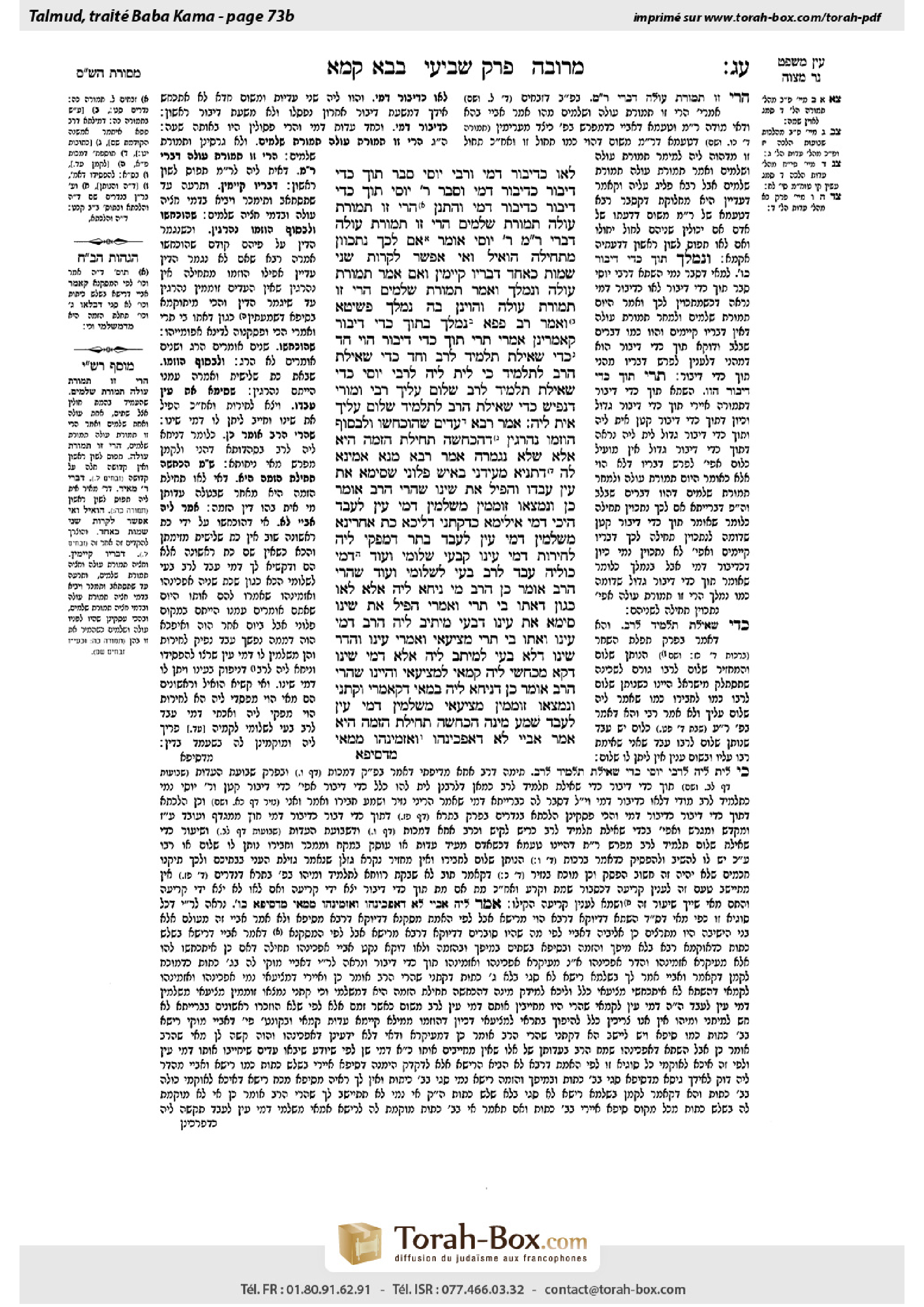
Bava Kamma 73b: Talmud study for Daf Yomi
Study the Talmud for Daf Yomi with scanned pages, Hebrew text, English translations from Sefaria and AI-generated French translations.
Passage selection and English or AI-generated French translation are available where the scan has annotations. Daf Study is independent of Torah-Box and Sefaria.
Browse Bava Kamma · בבא קמא · All tractatesBava Kamma 73b text and translations
This page of Bava Kamma includes the Aramaic text, an English translation and an AI-generated French translation, alongside the scan above.
בבא קמא ע״ג ב · Aramaic and Hebrew text
לָאו כְּדִיבּוּר דָּמֵי, וְרַבִּי יוֹסֵי סָבַר: תּוֹךְ כְּדֵי דִיבּוּר כְּדִיבּוּר דָּמֵי.
וְסָבַר רַבִּי יוֹסֵי: תּוֹךְ כְּדֵי דִיבּוּר כְּדִיבּוּר דָּמֵי? וְהָתְנַן: ״הֲרֵי זוֹ תְּמוּרַת עוֹלָה, תְּמוּרַת שְׁלָמִים״ – הֲרֵי זוֹ תְּמוּרַת עוֹלָה, דִּבְרֵי רַבִּי מֵאִיר.
רַבִּי יוֹסֵי אוֹמֵר: אִם לְכָךְ נִתְכַּוֵּון מִתְּחִילָּה, הוֹאִיל וְאִי אֶפְשָׁר לִקְרוֹת שְׁנֵי שֵׁמוֹת כְּאֶחָד – דְּבָרָיו קַיָּימִין. וְאִם אָמַר: ״תְּמוּרַת עוֹלָה״, וְנִמְלַךְ וְאָמַר: ״תְּמוּרַת שְׁלָמִים״ – הֲרֵי זוֹ תְּמוּרַת עוֹלָה.
וְהָוֵינַן בַּהּ: נִמְלַךְ – פְּשִׁיטָא!
וְאָמַר רַב פָּפָּא: נִמְלַךְ בְּתוֹךְ כְּדֵי דִיבּוּר קָאָמְרִינַן.
אָמְרִי: תְּרֵי ״תּוֹךְ כְּדֵי דִיבּוּר״ הָוֵי – חַד כְּדֵי שְׁאֵילַת תַּלְמִיד לְרַב, וְחַד כְּדֵי שְׁאֵילַת הָרַב לְתַלְמִיד. כִּי לֵית לֵיהּ לְרַבִּי יוֹסֵי – כְּדֵי שְׁאֵילַת תַּלְמִיד לְרַב ״שָׁלוֹם עָלֶיךָ רַבִּי וּמוֹרִי״, דִּנְפִישׁ; כְּדֵי שְׁאֵילַת הָרַב לְתַלְמִיד ״שָׁלוֹם עָלֶיךָ״ – אִית לֵיהּ.
אָמַר רָבָא: עֵדִים שֶׁהוּכְחֲשׁוּ וּלְבַסּוֹף הוּזַּמּוּ – נֶהֱרָגִין. דְּהַכְחָשָׁה תְּחִילַּת הֲזַמָּה הִיא, אֶלָּא שֶׁלֹּא נִגְמְרָה.
אָמַר רָבָא: מְנָא אָמֵינָא לַהּ? דְּתַנְיָא: ״מְעִידַנִי בְּאִישׁ פְּלוֹנִי שֶׁסִּימֵּא אֶת עֵין עַבְדּוֹ וְהִפִּיל אֶת שִׁינּוֹ״ – שֶׁהֲרֵי הָרַב אוֹמֵר כֵּן; וְנִמְצְאוּ זוֹמְמִין – מְשַׁלְּמִין דְּמֵי עַיִן לָעֶבֶד.
הֵיכִי דָמֵי? אִילֵּימָא כִּדְקָתָנֵי, דְּלֵיכָּא כַּת אַחֲרִינָא; מְשַׁלְּמִין דְּמֵי עַיִן לָעֶבֶד?! בָּתַר דְּמַפְּקִי לֵיהּ לְחֵירוּת – דְּמֵי עֵינוֹ קָבָעֵי שַׁלּוֹמֵי?
וְעוֹד, דְּמֵי כּוּלֵּיהּ עֶבֶד לְרַב בָּעֵי לְשַׁלּוֹמֵי! וְעוֹד, ״שֶׁהֲרֵי הָרַב אוֹמֵר כֵּן״ – הָרַב מִי נִיחָא לֵיהּ?
אֶלָּא לָאו כְּגוֹן דַּאֲתוֹ בֵּי תְרֵי, וְאָמְרִי: ״הִפִּיל אֶת שִׁינּוֹ, סִימֵּא אֶת עֵינוֹ״ – דְּבָעֵי מֵיתִיב לֵיהּ הָרַב דְּמֵי עֵינוֹ; וַאֲתוֹ בֵּי תְרֵי מְצִיעָאֵי, וְאָמְרִי: ״עֵינוֹ, וַהֲדַר שִׁינּוֹ״ – דְּלָא בָּעֵי לְמִיתַּב לֵיהּ אֶלָּא דְּמֵי שִׁינּוֹ, דְּקָא מַכְחֲשִׁי לֵיהּ קַמָּאֵי לִמְצִיעָאֵי.
וְהַיְינוּ ״שֶׁהֲרֵי הָרַב אוֹמֵר כֵּן״ – דְּנִיחָא לֵיהּ בְּמַאי דְּקָאָמְרִי.
וְקָתָנֵי: ״וְנִמְצְאוּ זוֹמְמִין״ – מְצִיעָאֵי, ״מְשַׁלְּמִין דְּמֵי עַיִן לָעֶבֶד״.
שְׁמַע מִינַּהּ: הַכְחָשָׁה – תְּחִילַּת הֲזַמָּה הִיא!
אָמַר אַבָּיֵי: לָא,
דְּאַפְכִינְהוּ וְאַזְּמִינְהוּ.
מִמַּאי?
Bava Kamma 73b · English translation
are not like one testimony of continuous speech, but are considered separate testimonies, and therefore the testimony concerning the theft remains valid. And Rabbi Yosei maintains that the legal status of a pause within the time required for speaking a short phrase is like that of continuous speech, and therefore the testimony about the theft is disqualified together with the testimony concerning the slaughter.
The Gemara asks: But does Rabbi Yosei really maintain that the legal status of a statement interrupted or retracted within the time required for speaking a short phrase is like that of continuous speech? But didn’t we learn otherwise in a mishna (Temura 25b): If one designates an animal by saying: This animal is hereby a substitute for a burnt-offering, a substitute for a peace-offering, he has issued two contradictory statements and therefore this animal is considered a substitute for a burnt-offering, i.e., only the first part of his statement is accepted. This is the statement of Rabbi Meir.
Rabbi Yosei says: If he intended this outcome from the outset, that the animal should serve both as the substitute of a burnt-offering and as the substitute of a peace-offering, since it is impossible for one to call it by two names at once, i.e., the only way he can make his intent known is by issuing these two apparently contradictory declarations consecutively, his statement stands, and the animal has the status of both a substitute for a burnt-offering and a substitute for a peace-offering. But if he said: This animal is a substitute for a burnt-offering and then changed his mind and said: A substitute for a peace-offering, it is a substitute for a burnt-offering.
And we discussed this ruling: If he changed his mind before saying: A substitute for a peace-offering, it is obvious that he cannot remove the status he already applied to the animal, and the animal certainly remains a substitute for a burnt-offering. Rabbi Yosei would not have issued such an obvious ruling.
And Rav Pappa said in response to this question: We are speaking of a case where the individual changed his mind within the time required for speaking a short phrase. Rabbi Yosei holds that when one adds to a statement after a pause, even if the addition was made within a short time, it is considered a separate statement, which does not reverse the initial declaration. This contradicts the explanation given for the baraita cited above, according to which Rabbi Yosei maintains that when one adds to an existing statement within the time required for speaking a short phrase it is considered continuous speech.
The Sages say in response: There are two time frames that are referred to as being within the time required for speaking a short phrase. One is the time required for a student to greet a rabbi, and the other one is the time required for the rabbi to greet a student. When does Rabbi Yosei hold that a statement added within the time required for speaking a short phrase is not considered continuous speech? When the words are added within the time required for a student to greet his rabbi using the phrase: Peace be upon you, my rabbi and teacher, as that is a long pause. By contrast, if the statement is added within the shorter time frame required for the rabbi to greet his student: Peace be upon you, Rabbi Yosei is of the opinion that the added words constitute speech that is continuous with the original statement.
§ Rava says: Witnesses to a capital crime who were first contradicted by two other witnesses, and ultimately they, the first set of witnesses, were rendered conspiring witnesses, are killed, in accordance with the punishment for conspiring witnesses involved in a capital case, despite the fact that their testimony was already disqualified prior to the discovery of their conspiracy. The reason is that the contradiction of testimony is the start of determining that testimony is conspiring testimony, only the process has not yet been completed at the time of the contradiction.
Rava said: From where do I say that this is so? As it is taught in a baraita (Tosefta, Makkot 1:3) that if witnesses say: We testify with regard to so-and-so that he blinded his Canaanite slave’s eye and afterward knocked out his tooth, and therefore the master is obligated to pay him compensation for the value of his tooth, as that is what the master says, i.e., this testimony is advantageous to the master, and subsequently they were found to be conspiring witnesses, they pay the value of an eye to the slave.
Rava explains that the baraita as written is problematic: What are the circumstances of this case? If we say that it is exactly as it is taught in the baraita, i.e., that there is no other set of witnesses other than those whose statement is quoted in the baraita and the opposing set of witnesses who establish them as conspiring witnesses, several problems arise: First, why should they pay the value of an eye to the slave? After emancipating him by testifying that his master has blinded him, should they be required to pay him the value of his eye?
And furthermore, they should be required to pay the value of the entire slave to the master, as they intended to cause him to lose ownership of his slave through their false testimony. And furthermore, why does the baraita say: As that is what the master says, i.e., this testimony is advantageous to the master. Is it really satisfactory to the master that his slave be emancipated as a result of this testimony?
Rather, it must be that this case involves another, competing, testimony that is not mentioned in the baraita. Is it not correct to say that the baraita is dealing with a case where prior to the testimonies mentioned in the baraita two other witnesses came and said: The master first knocked out the slave’s tooth and then blinded his eye, in which case the master is required to emancipate the slave and also to give him the value of his eye; and then an intermediate set of two witnesses came and said the testimony quoted in the baraita, that first the master blinded the slave’s eye and then knocked out his tooth? According to this account the master would still be required to emancipate the slave, but he would be required to give him only the value of his tooth, which is much less than the value of an eye. In this case the testimony of the first set of witnesses contradicts the testimony of the intermediate ones.
And this is the meaning of the clause: As that is what the master says, i.e., this testimony is advantageous to the master. It means that what the intermediate witnesses say, i.e., that he owes the value of a tooth, is satisfactory to him, as according to the claim of the first set, he owes the value of an eye. Since there are now contradictory testimonies, the testimony stating the claim of a loss of lesser value is accepted, and in that case the master would have to pay the slave only for the value of his tooth, in addition to emancipating him. This judgment corresponds exactly to the testimony of the intermediate set of witnesses.
And the baraita subsequently teaches: And then the intermediate set of witnesses were found to be conspiring witnesses, as a third set of witnesses testified that the intermediate set was not at the scene of the incident at all. Therefore, the intermediate set of witnesses pays the value of an eye to the slave less the value of a tooth, as this is the amount of monetary damage the slave stood to incur as a result of their testimony.
Rava concludes his proof: Learn from the baraita that the contradiction of testimony is the start of determining that testimony is conspiring testimony. Although the testimony of the intermediate set of witnesses had already been contradicted before it was shown to be conspiring testimony, nevertheless, they can still be established as conspiring witnesses at that later stage, which means that they must pay an amount equivalent to the loss they were attempting to cause through their testimony.
Abaye said: No. There is another possible interpretation for the baraita, which answers the questions raised above and yet does not serve as proof for Rava’s opinion. According to this interpretation, the contradictory testimony was given after, not before, the testimony mentioned in the baraita.
It is possible that the baraita is discussing a case where a second set of witnesses both reversed the order of events, by testifying that the tooth was knocked out before the blinding of the eye, and at the same time rendered the first set witnesses as conspiring witnesses, by testifying that those original witnesses were not at the scene of the supposed events they claimed to have witnessed. It can be argued, albeit in a far-fetched manner, that the testimony of the first set of witnesses is considered to be to the master’s advantage even at this stage, because he knows what really happened, as reflected in the testimony of the later witnesses. Accordingly, Rava maintains that there are a total of three sets of witnesses in the case of the baraita, while Abaye says that there are only two sets.
Abaye elaborates: From where do I say that my interpretation of the baraita is correct?
Bava Kamma 73b · Traduction française (IA)
ils ne sont pas comme un seul témoignage de parole continue, mais sont considérés comme des témoignages séparés, et par conséquent le témoignage concernant le vol reste valide. Et Rabbi Yosei maintient que la pause au sein du temps requis pour prononcer une courte phrase est considérée comme une parole continue, et par conséquent le témoignage concernant le vol est disqualifié ensemble avec celui concernant la boucherie.
La Guemara pose la question : Mais Rabbi Yosei maintient-t-il vraiment que le statut juridique d'une déclaration interrompue ou rétractée au sein du temps requis pour prononcer une courte phrase est comme celui de la parole continue ? Mais n'avons-nous pas appris autrement dans une mitsna (Temura 25b) : Si l'on désigne un animal en disant : Cet animal est désormais un substitut pour un holocauste, un substitut pour un sacrifice de paix, il a émis deux déclarations contradictoires et par conséquent cet animal est considéré comme un substitut pour un holocauste, c'est-à-dire que seule la première partie de sa déclaration est acceptée. C'est la déclaration de Rabbi Meir.
Rabbi Yosei dit : Si l'intention était d'obtenir ce résultat dès le début, que l'animal serve à la fois de substitut pour un holocauste et pour un sacrifice de paix, puisque c'est impossible de nommer l'animal par deux noms à la fois, c'est-à-dire que la seule façon dont il peut faire connaître son intention est d'émettre ces deux déclarations apparemment contradictoires consécutivement, sa déclaration est valable, et l'animal a le statut de substitut pour un holocauste et pour un sacrifice de paix. Mais si l'on dit : Cet animal est un substitut pour un holocauste et puis change d'avis et dit : Un substitut pour un sacrifice de paix, il est un substitut pour un holocauste.
Et nous avons discuté de cette décision : Si l'on a changé d'avis avant de dire : Un substitut pour un sacrifice de paix, il est évident qu'on ne peut pas retirer le statut déjà appliqué à l'animal, et l'animal reste certainement un substitut pour un holocauste. Rabbi Yosei n'aurait pas émis une telle décision évidente.
Et Rav Pappa a répondu à cette question : Nous parlons d'un cas où l'individu a changé d'avis au sein du temps requis pour prononcer une courte phrase. Rabbi Yosei maintient que lorsque l'on ajoute à une déclaration après une pause, même si l'ajout a été fait dans un court temps, il est considéré comme une déclaration séparée, qui ne révoque pas la déclaration initiale. Cela contredit l'explication donnée pour la baraïta citée ci-dessus, selon laquelle Rabbi Yosei maintient que lorsque l'on ajoute à une déclaration existante au sein du temps requis pour prononcer une courte phrase, cela est considéré comme une parole continue.
Les Sages répondent en disant : Il y a deux cadres de temps qui sont désignés comme étant au sein du temps requis pour prononcer une courte phrase. L'un est le temps requis pour qu'un étudiant salue un rabbi, et l'autre est le temps requis pour que le rabbi salue un étudiant. Quand Rabbi Yosei maintient-t-il que les mots ajoutés au sein du temps requis pour prononcer une courte phrase ne sont pas considérés comme une parole continue ? Quand les mots sont ajoutés au sein du temps requis pour que l'étudiant salue son rabbi en disant : Paix sur toi, mon rabbi et mon maître, car c'est une pause longue. Par contraste, si la déclaration est ajoutée au sein du temps plus court requis pour que le rabbi salue son étudiant : Paix sur toi, Rabbi Yosei est d'avis que les mots ajoutés constituent une parole continue avec la déclaration initiale.
§ Rava dit : Les témoins d'un crime capital qui ont été d'abord contredits par deux autres témoins, et finalement, ces premiers témoins, sont considérés comme des témoins complices, sont tués, conformément à la peine pour des témoins complices impliqués dans un cas capital, malgré le fait que leur témoignage avait déjà été disqualifié avant la découverte de leur complicité. La raison est que la contradiction du témoignage est le début de la détermination que le témoignage est un témoignage complice, et que le processus n'a pas encore été achevé au moment de la contradiction.
Rava dit : D'où dis-je que c'est ainsi ? Comme il est enseigné dans une baraïta (Tosefta, Makkot 1:3) que si des témoins disent : Nous témoignons concernant tel et tel qu'il a aveuglé l'œil de son esclave cananéen et ensuite a fait tomber ses dents, et par conséquent le maître est tenu de lui payer une compensation pour la valeur de ses dents, comme c'est ce que dit le maître, c'est-à-dire que ce témoignage est avantageux pour le maître, et ensuite ils ont été trouvés être des témoins complices, ils paient la valeur d'un œil à l'esclave.
Rava explique que la baraïta telle qu'elle est écrite est problématique : Quelles sont les circonstances de ce cas ? Si nous disons qu'il est exactement comme il est enseigné dans la baraïta, c'est-à-dire qu'il n'y a pas d'autre ensemble de témoins que ceux dont la déclaration est citée dans la baraïta et l'ensemble opposé de témoins qui établissent qu'ils sont des témoins complices, plusieurs problèmes surgissent : Premièrement, pourquoi devraient-ils payer la valeur d'un œil à l'esclave ? Après avoir libéré l'esclave en témoignant qu'il a été aveuglé par son maître, devraient-ils être tenus de lui payer la valeur de son œil ?
Et de plus, ils devraient être tenus de payer la valeur du serviteur entier au maître, car ils ont voulu provoquer la perte de propriété du maître sur son serviteur par leur témoignage faux. Et de plus, pourquoi la baraïta dit-elle : Comme c'est ce que dit le maître, c'est-à-dire que ce témoignage est avantageux pour le maître. Est-ce vraiment satisfaisant pour le maître que son serviteur soit libéré en raison de ce témoignage ?
Plutôt, il doit s'agir d'un cas impliquant un autre témoin, un témoin concurrent, qui n'est pas mentionné dans la baraïta. N'est-ce pas correct de dire que la baraïta traite d'un cas où, avant les témoins mentionnés dans la baraïta, deux autres témoins sont venus et ont déclaré : Le maître a d'abord fait tomber la dent du serviteur, puis l'a aveuglé, dans ce cas le maître est tenu de libérer le serviteur et aussi de lui verser la valeur de son œil ; et ensuite un groupe intermédiaire de deux témoins est venu et a déclaré la témoignage cité dans la baraïta, à savoir que le maître a d'abord aveuglé l'œil du serviteur et puis a fait tomber sa dent ? Selon ce témoignage, le maître serait toujours tenu de libérer le serviteur, mais il serait tenu de lui verser seulement la valeur de sa dent, ce qui est bien moins que la valeur d'un œil. Dans ce cas, le témoignage du premier groupe de témoins contredit celui du groupe intermédiaire.
Et c'est la signification de la clause : Comme c'est ce que dit le maître, c'est-à-dire que ce témoignage est avantageux pour le maître. Cela signifie que ce que disent les témoins intermédiaires, c'est-à-dire qu'il doit verser la valeur d'une dent, est satisfaisant pour lui, car selon la déclaration du premier groupe, il doit verser la valeur d'un œil. Comme il y a maintenant des témoignages contradictoires, le témoignage affirmant la perte d'une valeur moindre est accepté, et dans ce cas, le maître devrait payer au serviteur seulement la valeur de sa dent, en plus de le libérer. Ce jugement correspond exactement au témoignage du groupe intermédiaire de témoins.
Et la baraïta enseigne ensuite : Et le groupe intermédiaire de témoins a été trouvé complice, car un troisième groupe de témoins a témoigné qu'ils n'étaient pas présents sur les lieux de l'incident. Par conséquent, le groupe intermédiaire de témoins doit verser la valeur d'un œil au serviteur moins la valeur d'une dent, car c'est la somme de dommages matériels que le serviteur a pu subir en raison de leur témoignage.
Rava conclut sa démonstration : Apprends de la baraïta que la contradiction des témoignages est le point de départ pour déterminer que des témoins sont complices. Bien que le témoignage du groupe intermédiaire de témoins ait déjà été contredit avant qu'il ne soit montré qu'ils étaient des témoins complices, néanmoins, ils peuvent encore être établis comme des témoins complices à ce stade ultérieur, ce qui signifie qu'ils doivent verser une somme équivalente à la perte qu'ils tentaient de causer par leur témoignage.
Abaye dit : Non. Il existe une autre interprétation possible de la baraïta, qui répond aux questions soulevées ci-dessus et ne sert pas de preuve pour l'opinion de Rava. Selon cette interprétation, le témoignage contradictoire a été donné après, et non avant, le témoignage mentionné dans la baraïta.
Il est possible que la baraïta traite d'un cas où un deuxième groupe de témoins a inversé l'ordre des événements, en témoignant que la dent avait été arrachée avant l'aveuglement de l'œil, et en même temps a rendu les témoins initiaux des témoins complices, en témoignant que ces témoins initiaux n'étaient pas présents sur les lieux des événements qu'ils prétendaient avoir vus. On peut arguer, bien que de manière peu plausible, que le témoignage des témoins initiaux est considéré comme avantageux pour le maître à ce stade, car il sait ce qui s'est réellement produit, comme reflété dans le témoignage des témoins ultérieurs. Ainsi, Rava affirme qu'il y a un total de trois groupes de témoins dans le cas de la baraïta, tandis qu'Abaye affirme qu'il n'y a que deux groupes.
Abaye développe : D'où dis-je que mon interprétation de la baraïta est correcte ?
Traduction française générée par IA à partir de l’édition anglaise de Sefaria. Vérifie toujours un passage avec le texte source.
Text from Sefaria: William Davidson Edition - Vocalized Aramaic (CC BY NC); William Davidson Edition - English (CC BY NC).