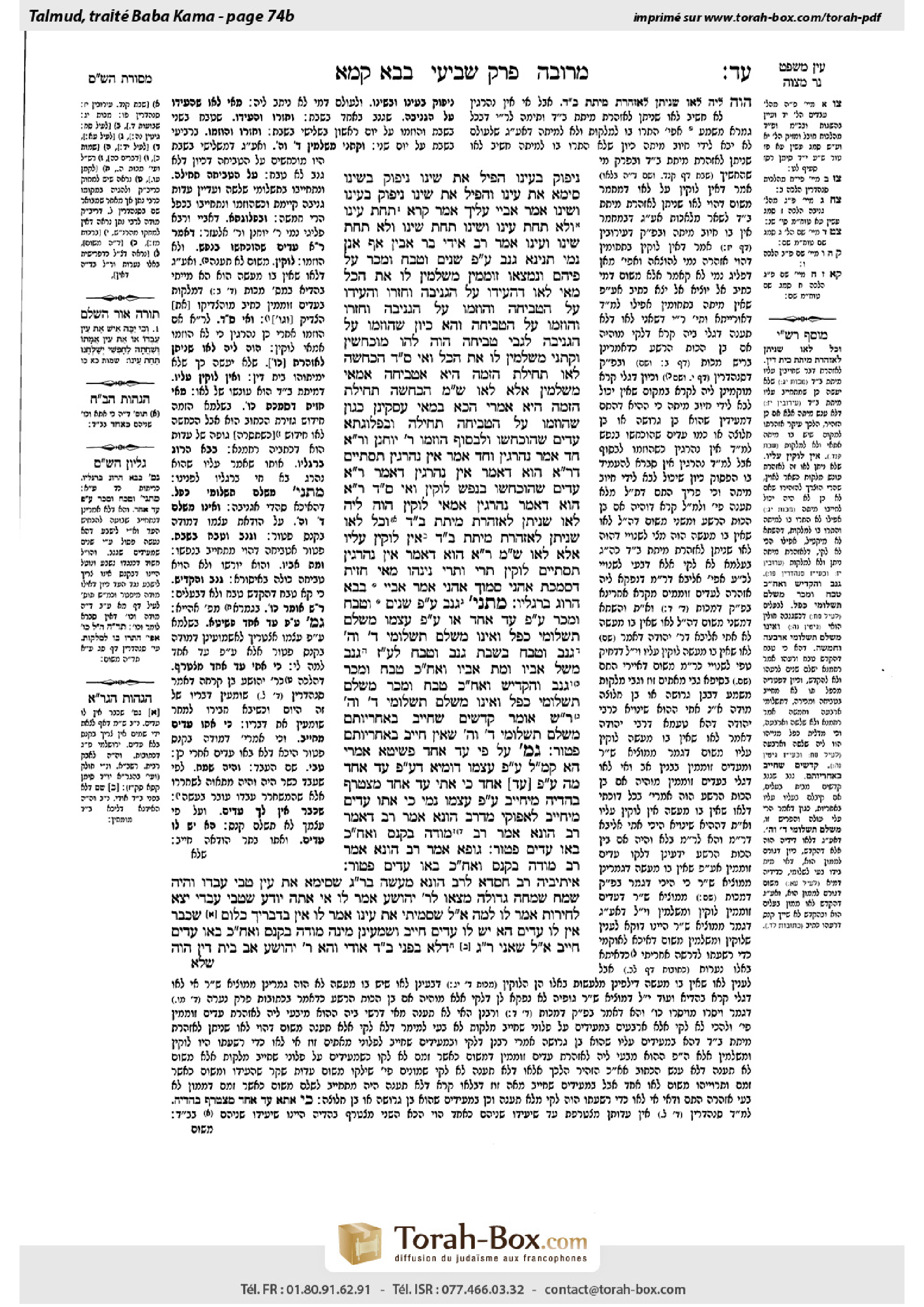
Bava Kamma 74b: Talmud study for Daf Yomi
Study the Talmud for Daf Yomi with scanned pages, Hebrew text, English translations from Sefaria and AI-generated French translations.
Passage selection and English or AI-generated French translation are available where the scan has annotations. Daf Study is independent of Torah-Box and Sefaria.
Browse Bava Kamma · בבא קמא · All tractatesBava Kamma 74b text and translations
This page of Bava Kamma includes the Aramaic text, an English translation and an AI-generated French translation, alongside the scan above.
בבא קמא ע״ד ב · Aramaic and Hebrew text
נִיפּוֹק בְּעֵינוֹ; הִפִּיל אֶת שִׁינּוֹ – נִיפּוֹק בְּשִׁינּוֹ; סִימֵּא אֶת עֵינוֹ וְהִפִּיל אֶת שִׁינּוֹ – נִיפּוֹק בְּעֵינוֹ וְשִׁינּוֹ!
אָמַר אַבָּיֵי, עָלֶיךָ אָמַר קְרָא: ״תַּחַת עֵינוֹ״ – וְלֹא תַּחַת עֵינוֹ וְשִׁינּוֹ, ״תַּחַת שִׁינּוֹ״ – וְלֹא תַּחַת שִׁינּוֹ וְעֵינוֹ.
אָמַר רַב אִידִי בַּר אָבִין, אַף אֲנַן נָמֵי תְּנֵינָא: גָּנַב עַל פִּי שְׁנַיִם, וְטָבַח וּמָכַר עַל פִּיהֶם, וְנִמְצְאוּ זוֹמְמִין – מְשַׁלְּמִין לוֹ אֶת הַכֹּל.
מַאי, לָאו דְּהֵעִידוּ עַל הַגְּנֵיבָה וְחָזְרוּ וְהֵעִידוּ עַל הַטְּבִיחָה, וְהוּזַּמּוּ עַל הַגְּנֵיבָה וְחָזְרוּ וְהוּזַּמּוּ עַל הַטְּבִיחָה?
וְהָא כֵּיוָן שֶׁהוּזַּמּוּ עַל הַגְּנֵיבָה – לְגַבֵּי טְבִיחָה הָווּ לְהוּ מוּכְחָשִׁין, וְקָתָנֵי: מְשַׁלְּמִין לוֹ אֶת הַכֹּל. וְאִי סָלְקָא דַעְתָּךְ הַכְחָשָׁה לָאו תְּחִילַּת הֲזָמָה הִיא, אַטְּבִיחָה אַמַּאי מְשַׁלְּמִין? אֶלָּא לָאו שְׁמַע מִינַּהּ הַכְחָשָׁה תְּחִילַּת הֲזָמָה הִיא?
אָמְרִי: הָכָא בְּמַאי עָסְקִינַן – כְּגוֹן שֶׁהוּזַּמּוּ עַל הַטְּבִיחָה תְּחִילָּה,
וּבִפְלוּגְתָּא: עֵדִים שֶׁהוּכְחֲשׁוּ וּלְבַסּוֹף הוּזַּמּוּ – רַבִּי יוֹחָנָן וְרַבִּי אֶלְעָזָר, חַד אָמַר: נֶהֱרָגִין, וְחַד אָמַר: אֵין נֶהֱרָגִין.
תִּסְתַּיֵּים דְּרַבִּי אֶלְעָזָר הוּא דְּאָמַר אֵין נֶהֱרָגִין – דְּאָמַר רַבִּי אֶלְעָזָר: עֵדִים שֶׁהוּכְחֲשׁוּ בְּנֶפֶשׁ – לוֹקִין.
וְאִי סָלְקָא דַּעְתָּךְ רַבִּי אֶלְעָזָר הוּא דְּאָמַר נֶהֱרָגִין – אַמַּאי לוֹקִין? הָוֵה לֵיהּ לָאו שֶׁנִּיתַּן לְאַזְהָרַת מִיתַת בֵּית דִּין, וְכׇל לָאו שֶׁנִּיתַּן לְאַזְהָרַת מִיתַת בֵּית דִּין – אֵין לוֹקִין עָלָיו!
אֶלָּא לָאו שְׁמַע מִינַּהּ, רַבִּי אֶלְעָזָר הוּא דְּאָמַר אֵין נֶהֱרָגִין? תִּסְתַּיַּים.
לוֹקִין?! תְּרֵי וּתְרֵי נִינְהוּ, מַאי חָזֵית דְּסָמְכַתְּ אַהָנֵי? סְמוֹךְ אַהָנֵי!
אָמַר אַבָּיֵי: בְּבָא הָרוּג בְּרַגְלָיו.
מַתְנִי׳ גָּנַב עַל פִּי שְׁנַיִם, וְטָבַח וּמָכַר עַל פִּי עֵד אֶחָד אוֹ עַל פִּי עַצְמוֹ – מְשַׁלֵּם תַּשְׁלוּמֵי כֶפֶל, וְאֵינוֹ מְשַׁלֵּם תַּשְׁלוּמֵי אַרְבָּעָה וַחֲמִשָּׁה.
גָּנַב וְטָבַח בַּשַּׁבָּת; גָּנַב וְטָבַח לַעֲבוֹדָה זָרָה; גָּנַב מִשֶּׁל אָבִיו, וּמֵת אָבִיו, וְאַחַר כָּךְ טָבַח וּמָכַר; גָּנַב וְהִקְדִּישׁ, וְאַחַר כָּךְ טָבַח וּמָכַר – מְשַׁלֵּם תַּשְׁלוּמֵי כֶפֶל, וְאֵינוֹ מְשַׁלֵּם תַּשְׁלוּמֵי אַרְבָּעָה וַחֲמִשָּׁה.
רַבִּי שִׁמְעוֹן אוֹמֵר: קֳדָשִׁים – שֶׁחַיָּיב בְּאַחְרָיוּתָם, מְשַׁלֵּם. תַּשְׁלוּמֵי אַרְבָּעָה וַחֲמִשָּׁה – שֶׁאֵין חַיָּיב בְּאַחְרָיוּתָם, פָּטוּר.
גְּמָ׳ עַל פִּי עֵד אֶחָד – פְּשִׁיטָא!
אָמְרִי: הָא קָא מַשְׁמַע לַן, עַל פִּי עַצְמוֹ – דּוּמְיָא דְּעַל פִּי עֵד אֶחָד; מָה עַל פִּי [עֵד] אֶחָד – כִּי אָתֵי עֵד אֶחָד מִצְטָרֵף בַּהֲדֵיהּ, מִיחַיַּיב; עַל פִּי עַצְמוֹ נָמֵי – כִּי אָתוּ עֵדִים, מִיחַיַּיב.
לְאַפּוֹקֵי מִדְּרַב הוּנָא אָמַר רַב – דְּאָמַר רַב הוּנָא אָמַר רַב: מוֹדֶה בִּקְנָס, וְאַחַר כָּךְ בָּאוּ עֵדִים – פָּטוּר.
גּוּפָא – אָמַר רַב הוּנָא אָמַר רַב: מוֹדֶה בִּקְנָס, וְאַחַר כָּךְ בָּאוּ עֵדִים – פָּטוּר. אֵיתִיבֵיהּ רַב חִסְדָּא לְרַב הוּנָא: מַעֲשֶׂה בְּרַבָּן גַּמְלִיאֵל שֶׁסִּימֵּא אֶת עֵין טָבִי עַבְדּוֹ, וְהָיָה שָׂמֵחַ שִׂמְחָה גְּדוֹלָה.
מְצָאוֹ לְרַבִּי יְהוֹשֻׁעַ, אָמַר לוֹ: ״אִי אַתָּה יוֹדֵעַ שֶׁטָּבִי עַבְדִּי יָצָא לְחֵירוּת?״ אָמַר לוֹ: ״לָמָּה?״ אָמַר לוֹ: ״שֶׁסִּמִּיתִי אֶת עֵינוֹ״. אָמַר לוֹ: ״אֵין בִּדְבָרֶיךָ כְּלוּם, שֶׁכְּבָר אֵין לוֹ עֵדִים״.
הָא יֵשׁ לוֹ עֵדִים – חַיָּיב, וְשָׁמְעִינַן מִינַּהּ: מוֹדֶה בִּקְנָס, וְאַחַר כָּךְ בָּאוּ עֵדִים – חַיָּיב!
אֲמַר לֵיהּ: שָׁאנֵי רַבָּן גַּמְלִיאֵל, דְּלָא בִּפְנֵי בֵּית דִּין אוֹדִי. וְהָא רַבִּי יְהוֹשֻׁעַ אַב בֵּית דִּין הֲוָה!
Bava Kamma 74b · English translation
the slave should go free on account of his eye, and if he knocked out his tooth he should go free on account of his tooth, and if the master both blinded his eye and knocked out his tooth, the slave should go free on account of both his eye and his tooth, without the master having to pay damages for the loss of his tooth.
Abaye said to him in response: With regard to your claim, the verse states: “And if a man smites the eye of his slave or the eye of his maidservant and destroys it, he shall let him go free for his eye’s sake” (Exodus 21:26). The phrase “for his eye’s sake” indicates: But not for the sake of both his eye and his tooth. The same can be inferred from the subsequent verse: “And if he smites out his bondman’s tooth or his bondwoman’s tooth, he shall let him go free for his tooth’s sake” (Exodus 21:27). The phrase “for his tooth’s sake” indicates: But not for the sake of both his eye and his tooth.
The Gemara returns to Rava’s opinion that the contradiction of testimony is the start of determining that testimony is conspiring testimony. Rav Idi bar Avin said: We too can learn from the mishna that Rava’s claim is correct, as it teaches (72b): If one stole an ox or a sheep, as established based on the testimony of two witnesses, and he subsequently slaughtered the animal or sold it, also based on the testimony of the same witnesses, and these witnesses were found to be conspiring witnesses, these conspiring witnesses must pay everything, i.e., not only the principal amount but also the fourfold or fivefold payment.
What, is it not referring to a case where they testified concerning the theft and then testified concerning the slaughter, and they were subsequently rendered conspiring witnesses with regard to the theft and then were rendered conspiring witnesses with regard to the slaughter?
Rav Idi bar Avin states his inference: But once they were rendered conspiring witnesses with regard to the theft, their testimony with regard to the slaughter is in effect contradicted, i.e., nullified, as testimony concerning the slaughter of an animal without prior testimony establishing that the animal was stolen is meaningless. And yet the mishna teaches that the witnesses must pay everything. And if it enters your mind that the contradiction of testimony is not the start of determining that testimony is conspiring testimony, why should they pay a fine for lying about the slaughter? Their testimony concerning the slaughter was rendered irrelevant before it was established as conspiring testimony. Rather, must one not conclude from this mishna that the contradiction of testimony is the start of determining that testimony is conspiring testimony?
The Sages say in refutation of this inference: With what are we dealing here? We are dealing with a case where the witnesses were rendered conspiring witnesses with regard to the slaughter first, before they were rendered conspiring witnesses in their testimony concerning the theft itself. In this case, the testimony concerning the slaughter was not rendered irrelevant before it was rendered conspiring testimony.
And this is a matter in the dispute between other amora’im, before Rava and Abaye discussed it. As it was stated: With regard to witnesses to a capital crime who were first contradicted by two other witnesses and ultimately were rendered conspiring witnesses, this is a matter of dispute between Rabbi Yoḥanan and Rabbi Elazar. One said: These witnesses are killed, like all conspiring witnesses in a capital case, as the contradiction of testimony is the start of determining that testimony is conspiring testimony, and one said: They are not killed.
The Gemara suggests: It may be concluded that it is Rabbi Elazar who says they are not killed. As Rabbi Elazar says: Witnesses who were contradicted in a case involving the taking of a life, i.e., a capital case, are flogged for violating the prohibition: “You shall not bear false witness against your neighbor” (Exodus 20:13).
And if it enters your mind that it is Rabbi Elazar who says that witnesses to a capital crime who were first contradicted and ultimately found to be conspiring witnesses are killed, why are they flogged in this case? There is always the possibility that they might be rendered conspiring witnesses, which would render them liable to receive court-imposed capital punishment. Consequently, this is a case of a prohibition given as warning of liability for court-imposed capital punishment, and there is a principle that one is not flogged for violating any prohibition given as warning of liability for court-imposed capital punishment.
Rather, isn’t it correct to conclude from this statement that it is Rabbi Elazar who says that witnesses to a capital crime who were first contradicted and ultimately were found to be conspiring witnesses are not killed? The Gemara affirms: It may be concluded that this is so.
The Gemara asks a question with regard to Rabbi Elazar’s opinion that witnesses who were contradicted in a capital case are flogged. Why are they flogged simply because their testimony was contradicted? They are two witnesses, and they are contradicted by two other witnesses. What did you see in the testimony of the second set of witnesses that leads you to rely on those witnesses to the extent that the first set of witnesses is flogged? You could just as well rely on these witnesses, i.e., the first witnesses. How can the court ever determine with certainty that a given testimony is false based merely on contradictory testimony?
Abaye said: The contradiction to which Rabbi Elazar is referring involves a case where the witnesses testified that they saw a certain person murdered, and subsequently the individual who was allegedly killed came to the court on his feet, conclusively disproving their testimony.
MISHNA: If one stole an ox or a sheep, as established based on the testimony of two witnesses, and he subsequently slaughtered or sold the stolen animal, as established based on the testimony of one witness or based on his own admission, i.e., he himself admitted that he performed these acts, without there being any witness testimony, he pays the double payment, but he does not pay the fourfold or fivefold payment.
If one stole an animal and slaughtered it on Shabbat, which is a capital offense, or if he stole an animal and slaughtered it for the purpose of idol worship, or if he stole his father’s animal and subsequently his father died, and afterward he slaughtered or sold it, or if he stole an animal and subsequently he consecrated it as an offering and afterward he slaughtered or sold it, in all these cases the thief pays the double payment, but he does not pay the fourfold or fivefold payment.
Rabbi Shimon says: In the case of sacrificial animals for which the owner bears financial responsibility to replace with another animal if one of the original animals that one stole is lost or dies, the thief is obligated to pay the fourfold or fivefold payment if he slaughters one of the animals. If it is a sacrificial animal for which the owner bears no financial responsibility, the thief is exempt from the fourfold or fivefold payment.
GEMARA: The mishna teaches that if the fact that the thief slaughtered or sold the animal was established based on the testimony of one witness, he is exempt from the fourfold or fivefold payment. The Gemara asks: Isn’t this obvious?
The Sages say in response: By stating this case, the mishna teaches us this halakha: The case of the thief slaughtering the animal established based on the testimony of one witness is similar to a case where it is established based on his own admission. Just as in the case where the slaughter is established based on the testimony of one witness, if one other witness comes and corroborates the testimony of the first, he joins together with the first witness and together their testimony is rendered a valid testimony of two, and the thief becomes obligated to pay the fourfold or fivefold payment, so too, where the slaughter is established based on his own admission, if witnesses come after his admission he becomes obligated to pay the fourfold or fivefold payment.
The Gemara comments: This interpretation of the mishna serves to exclude that which Rav Huna says that Rav says. As Rav Huna says that Rav says: One who admits he is liable to pay a fine is exempt from payment, even if afterward witnesses come and testify to his liability.
Since Rav Huna’s halakha was mentioned, the Gemara discusses in detail the matter itself. Rav Huna says that Rav says: One who admits he is liable to pay a fine is exempt from payment, even if afterward witnesses come and testify to his liability. Rav Ḥisda raised an objection to Rav Huna from a baraita: There was an incident involving Rabban Gamliel, who blinded the eye of his Canaanite slave Tavi, and he experienced great joy as a result. Rabban Gamliel had long wanted to emancipate Tavi, but it is generally prohibited to emancipate a Canaanite slave. The injury provided a fortuitous opportunity for Rabban Gamliel to emancipate his slave, as blinding the eye of one’s slave results in his emancipation (see Exodus 21:27).
Rabban Gamliel encountered Rabbi Yehoshua and said to him: Do you know that my slave Tavi was emancipated? Rabbi Yehoshua said to him: Why? What circumstances enabled you to emancipate him? Rabban Gamliel said to him: I was able to do so, as I blinded his eye. Rabbi Yehoshua said to Rabban Gamliel: Your statement is nothing, and is not grounds for his emancipation, as he has no witnesses who can testify that you did this to him. The principle is that one does not pay a fine based on his own admission. One pays a fine only based on the testimony of witnesses. The requirement to emancipate one’s slave after injuring his eye is a type of fine.
The Gemara infers from the baraita: But if Tavi had witnesses who could testify with regard to the injury, Rabban Gamliel would be obligated to emancipate him, even if they testify after Rabban Gamliel’s admission. And we can learn from this that one who admits that he is liable to pay a fine is liable, even if afterward witnesses come and testify with regard to his liability.
Rav Huna said to Rav Ḥisda: This case involving Rabban Gamliel is different, as he admitted to his actions when he was not in the presence of a court. An admission not in the presence of a court does not exempt the perpetrator from paying the relevant fine. The Gemara challenges: But Rabbi Yehoshua was the president of the court, so it is likely that the encounter took place in court.
Bava Kamma 74b · Traduction française (IA)
l’esclave doit être libéré à cause de son œil, et s’il a fait tomber une de ses dents, il doit être libéré à cause de sa dent, et s’il a à la fois perdu l’œil et fait tomber la dent de l’esclave, l’esclave doit être libéré à cause de son œil et de sa dent, sans que le maître doive payer des dommages pour la perte de la dent de l’esclave.
Abaye répondit à cela en disant : En ce qui concerne votre affirmation, la Parashah dit : « Et si un homme frappe l’œil de son esclave ou l’œil de sa servante et le détruit, il doit le libérer à cause de son œil » (Exode 21:26). L’expression « à cause de son œil » indique : mais pas à cause de son œil et de sa dent. On peut en déduire la même chose à partir de la Parashah suivante : « Et si il arrache la dent de son esclave ou de sa servante, il doit le libérer à cause de sa dent » (Exode 21:27). L’expression « à cause de sa dent » indique : mais pas à cause de son œil et de sa dent.
Le Guemara revient sur l’opinion de Rava selon laquelle la contradiction des témoins est le début de la détermination que les témoins sont des témoins conjurés. Rav Idi bar Avin dit : Nous aussi, nous pouvons apprendre de la Michna que l’affirmation de Rava est correcte, car elle enseigne (72b) : Si l’on a volé un bœuf ou une brebis, comme établi sur le témoignage de deux témoins, et qu’il a ensuite tué l’animal ou l’a vendu, également sur le témoignage des mêmes témoins, et que ces témoins ont été trouvés être des témoins conjurés, ces témoins conjurés doivent payer tout, c’est-à-dire non seulement la somme principale mais aussi le paiement quadruple ou quintuple.
Qu’est-ce que cela ne signifie pas qu’un cas où ils ont témoigné concernant le vol et ensuite témoigné concernant la mise à mort, et qu’ensuite ils ont été rendus témoins conjurés concernant le vol et ensuite témoins conjurés concernant la mise à mort ?
Rav Idi bar Avin énonce son raisonnement : Mais une fois qu’ils ont été rendus témoins conjurés concernant le vol, leur témoignage concernant la mise à mort est en effet contredit, c’est-à-dire annulé, car le témoignage concernant la mise à mort d’un animal sans avoir d’abord témoigné qu’il avait été volé est sans valeur. Et pourtant la Michna enseigne que les témoins doivent payer tout. Et si cela entre dans votre esprit que la contradiction des témoins n’est pas le début de la détermination que les témoins sont des témoins conjurés, pourquoi devraient-ils payer une amende pour avoir menti sur la mise à mort ? Leur témoignage concernant la mise à mort a été rendu irrélevante avant qu’il ne soit établi qu’ils étaient des témoins conjurés. Plutôt, ne devons-nous pas conclure de cette Michna que la contradiction des témoins est le début de la détermination que les témoins sont des témoins conjurés ?
Les Sages disent en réfutation de ce raisonnement : Avec quels cas sommes-nous en train de nous occuper ? Nous sommes en train de nous occuper d’un cas où les témoins ont été rendus témoins conjurés concernant la mise à mort avant qu’ils ne soient rendus témoins conjurés concernant leur témoignage concernant le vol lui-même. Dans ce cas, le témoignage concernant la mise à mort n’a pas été rendu irrélevante avant qu’il ne soit établi qu’ils étaient des témoins conjurés.
Et c’est une question de débat entre d’autres amoraïm, avant que Rava et Abaye n’aient discuté de cela. Comme il a été dit : En ce qui concerne les témoins d’un crime capital qui ont été d’abord contredits par deux autres témoins et finalement rendus témoins conjurés, c’est une question de débat entre Rabbi Yoḥanan et Rabbi Elazar. L’un a dit : Ces témoins sont tués, comme tous les témoins conjurés dans un cas capital, car la contradiction des témoins est le début de la détermination que les témoins sont des témoins conjurés, et l’autre a dit : Ils ne sont pas tués.
Le Guemara suggère : On peut conclure que c’est Rabbi Elazar qui dit qu’ils ne sont pas tués. Comme Rabbi Elazar dit : Les témoins qui ont été contredits dans un cas impliquant la prise de vie, c’est-à-dire un cas capital, sont battus pour avoir violé l’interdiction : « Tu ne porteras pas de faux témoignage contre ton prochain » (Lévitique 20:13).
Et si cela entre dans votre esprit que c’est Rabbi Elazar qui dit que les témoins d’un crime capital qui ont été d’abord contredits et finalement trouvés être des témoins conjurés sont tués, pourquoi sont-ils battus dans ce cas ? Il y a toujours la possibilité qu’ils puissent être rendus témoins conjurés, ce qui rendrait leur punition de mort imposée par la cour. Par conséquent, c’est un cas d’un interdit donné comme avertissement de responsabilité pour une punition de mort imposée par la cour, et il y a un principe selon lequel on ne bat pas pour avoir violé un interdit donné comme avertissement de responsabilité pour une punition de mort imposée par la cour.
Plutôt, n’est-ce pas correct de conclure de cette déclaration que c’est Rabbi Elazar qui affirme que les témoins d’un crime capital qui ont été d’abord contredits et finalement trouvés être des témoins conjurés ne sont pas tués ? La Guemara confirme : On peut conclure que c’est ainsi.
La Guemara pose une question concernant l’opinion de Rabbi Elazar selon laquelle les témoins contredits dans un cas capital sont battus. Pourquoi sont-ils battus simplement parce que leur témoignage a été contredit ? Ils sont deux témoins, et ils ont été contredits par deux autres témoins. Qu’est-ce que vous avez vu dans le témoignage des témoins secondaires qui vous fait confier en eux à ce point que les premiers témoins sont battus ? Vous auriez tout aussi bien pu confier en ces témoins, c’est-à-dire les premiers témoins. Comment la cour peut-elle jamais déterminer avec certitude qu’un témoignage est faux uniquement sur la base d’un témoignage contradictoire ?
Abaye dit : La contradiction à laquelle Rabbi Elazar fait référence concerne un cas où les témoins ont témoigné qu’ils avaient vu une certaine personne assassinée, et ensuite l’individu qui était censé avoir été tué est venu devant la cour sur ses pieds, démentant clairement leur témoignage.
MICHNA : Si l'on vole un bœuf ou une brebis, selon le témoignage de deux témoins, et qu'il tue ou vend ensuite l'animal volé, selon le témoignage d'un seul témoin ou selon son propre aveu, c'est-à-dire qu'il admet lui-même avoir accompli ces actes, sans témoignage, il paie la double somme, mais il ne paie pas la quadruple ou la quintuple somme.
Si l'on vole un animal et qu'il le tue le sabbat, ce qui est un crime capital, ou si l'on vole un animal et qu'il le tue à des fins d'idolâtrie, ou si l'on vole l'animal de son père et que son père meurt, et ensuite il tue ou vend l'animal, ou si l'on vole un animal et qu'il le consacre ensuite comme offrande, et ensuite il le tue ou le vend, dans tous ces cas, le voleur paie la double somme, mais il ne paie pas la quadruple ou la quintuple somme.
Rabbi Shimon dit : Dans le cas d'animaux sacrés pour lesquels l'propriétaire est tenu financièrement de remplacer un animal perdu ou mort, le voleur est tenu de payer la quadruple ou la quintuple somme s'il tue un de ces animaux. Si c'est un animal sacré pour lequel l'propriétaire n'a pas de responsabilité financière, le voleur est exempt de la quadruple ou la quintuple somme.
GUEMARA : La mitsna enseigne que si le fait que le voleur a tué ou vendu l'animal est établi selon le témoignage d'un seul témoin, il est exempt de la quadruple ou la quintuple somme. La Guemara demande : N'est-ce pas évident ?
Les Sages répondent en disant : En énonçant ce cas, la mitsna nous enseigne cette halakha : Le cas du voleur qui tue l'animal établi selon le témoignage d'un seul témoin est semblable à un cas où il est établi selon son propre aveu. Aussi longtemps que dans le cas où la mise à mort est établie selon le témoignage d'un seul témoin, si un autre témoin vient et confirme le témoignage du premier, il s'associe avec le premier témoin et ensemble leur témoignage est considéré comme un témoignage valide de deux, et le voleur est tenu de payer la quadruple ou la quintuple somme, de même, dans le cas où la mise à mort est établie selon son propre aveu, si des témoins viennent après son aveu, il est tenu de payer la quadruple ou la quintuple somme.
La Guemara commente : Cette interprétation de la mitsna sert à exclure ce que Rav Huna dit que Rav dit. Comme Rav Huna dit que Rav dit : Celui qui admet qu'il est tenu de payer une amende est exempt de paiement, même si après cela des témoins viennent témoigner de son responsabilité.
Puisque la halakha de Rav Huna a été mentionnée, la Guemara discute en détail de la question elle-même. Rav Huna dit que Rav dit : Celui qui admet qu'il est tenu de payer une amende est exempt de paiement, même si après cela des témoins viennent témoigner de son responsabilité. Rav Ḥisda a soulevé un objection contre Rav Huna à partir d'une baraïta : Il y avait un incident concernant Rabban Gamliel, qui a aveuglé l'œil de son esclave cananéen Tavi, et il a éprouvé une grande joie en conséquence. Rabban Gamliel avait longtemps souhaité l'émanciper, mais il est généralement interdit d'émanciper un esclave cananéen. La blessure a offert une opportunité fortuite à Rabban Gamliel d'émanciper son esclave, car aveuger l'œil d'un esclave entraîne son émancipation (voir Exode 21:27).
Rabban Gamliel a rencontré Rabbi Yehoshua et lui a dit : Savez-vous que mon esclave Tavi a été émancipé ? Rabbi Yehoshua lui a dit : Pourquoi ? Quelles circonstances vous ont permis d'émanciper lui ? Rabban Gamliel lui a dit : J'ai pu le faire, car j'ai aveuglé son œil. Rabbi Yehoshua a dit à Rabban Gamliel : Votre déclaration est sans importance, et n'est pas la raison de son émancipation, car il n'y a pas de témoins qui puissent témoigner que vous avez fait cela à lui. Le principe est que l'on ne paie une amende sur la base d'une admission personnelle. L'amende est payée uniquement sur la base des témoignages. L'obligation d'émanciper un esclave après avoir blessé son œil est un type d'amende.
La Guemara déduit de la baraïta : Mais si Tavi avait des témoins qui pouvaient témoigner concernant la blessure, Rabban Gamliel aurait été tenu d'émanciper lui, même si ils témoignent après l'admission de Rabban Gamliel. Et nous pouvons apprendre de cela que celui qui admet qu'il est tenu de payer une amende est tenu, même si après cela des témoins viennent témoigner concernant sa responsabilité.
Rav Huna a dit à Rav Ḥisda : Ce cas concernant Rabban Gamliel est différent, car il a admis ses actions lorsqu'il n'était pas en présence d'un tribunal. Une admission faite en dehors de la présence d'un tribunal ne dispense pas le coupable de payer l'amende correspondante. La Guemara conteste : Mais Rabbi Yehoshua était le président du tribunal, donc il est probable que la rencontre a eu lieu en tribunal.
Traduction française générée par IA à partir de l’édition anglaise de Sefaria. Vérifie toujours un passage avec le texte source.
Text from Sefaria: William Davidson Edition - Vocalized Aramaic (CC BY NC); William Davidson Edition - English (CC BY NC).