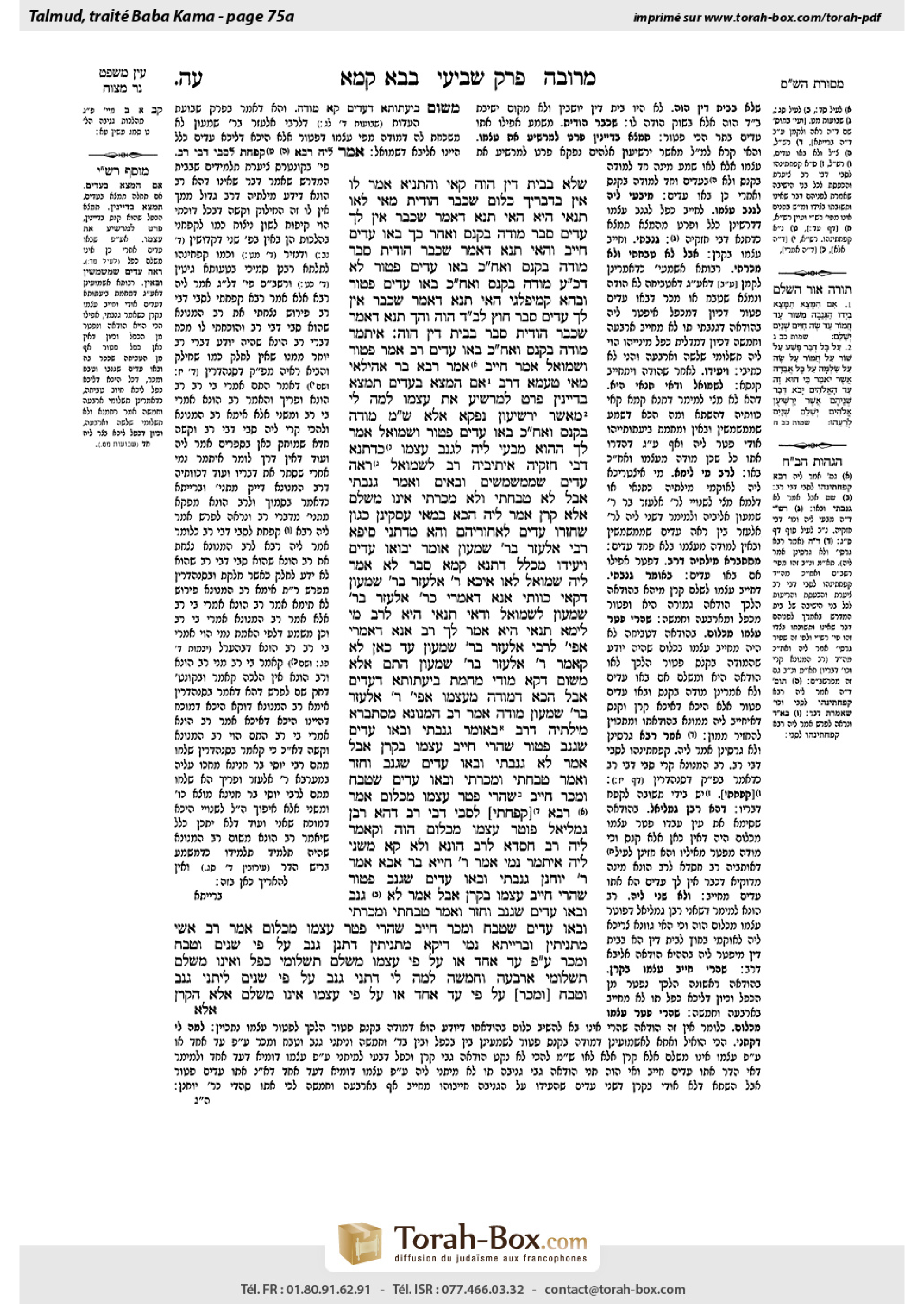
Bava Kamma 75a: Talmud study for Daf Yomi
Study the Talmud for Daf Yomi with scanned pages, Hebrew text, English translations from Sefaria and AI-generated French translations.
Passage selection and English or AI-generated French translation are available where the scan has annotations. Daf Study is independent of Torah-Box and Sefaria.
Browse Bava Kamma · בבא קמא · All tractatesBava Kamma 75a text and translations
This page of Bava Kamma includes the Aramaic text, an English translation and an AI-generated French translation, alongside the scan above.
בבא קמא ע״ה א · Aramaic and Hebrew text
שֶׁלֹּא בְּבֵית דִּין הֲוָה קָאֵי.
וְהָתַנְיָא, אָמַר לוֹ: אֵין בִּדְבָרֶיךָ כְּלוּם, שֶׁכְּבָר הוֹדִיתָ,
מַאי, לָאו תַּנָּאֵי הִיא – הַאי תַּנָּא דְּאָמַר ״שֶׁכְּבָר אֵין לְךָ עֵדִים״, סָבַר: מוֹדֶה בִּקְנָס וְאַחַר כָּךְ בָּאוּ עֵדִים – חַיָּיב; וְהַאי תַּנָּא דְּאָמַר ״שֶׁכְּבָר הוֹדִיתָ״, סָבַר: מוֹדֶה בִּקְנָס וְאַחַר כָּךְ בָּאוּ עֵדִים – פָּטוּר?
לָא; דְּכוּלֵּי עָלְמָא, מוֹדֶה בִּקְנָס וְאַחַר כָּךְ בָּאוּ עֵדִים – פָּטוּר; וּבְהָא קָמִיפַּלְגִי – הַאי תַּנָּא דְּאָמַר ״שֶׁכְּבָר אֵין לְךָ עֵדִים״, סָבַר: חוּץ לְבֵית דִּין הֲוָה. וְהָךְ תַּנָּא דְּאָמַר ״שֶׁכְּבָר הוֹדִיתָ״, סָבַר: בְּבֵית דִּין הֲוָה.
אִיתְּמַר: מוֹדֶה בִּקְנָס, וְאַחַר כָּךְ בָּאוּ עֵדִים – רַב אָמַר: פָּטוּר, וּשְׁמוּאֵל אָמַר: חַיָּיב.
אָמַר רָבָא בַּר אֲהִילַאי: מַאי טַעְמָא דְּרַב? ״אִם הִמָּצֵא״ – בְּעֵדִים, ״תִמָּצֵא״ – בְּדַיָּינִין; פְּרָט לְמַרְשִׁיעַ אֶת עַצְמוֹ.
לְמָה לִי? מֵ״אֲשֶׁר יַרְשִׁיעֻן״ נָפְקָא! אֶלָּא שְׁמַע מִינַּהּ, מוֹדֶה בִּקְנָס וְאַחַר כָּךְ בָּאוּ עֵדִים – פָּטוּר!
וּשְׁמוּאֵל אָמַר לָךְ: הָהוּא מִבְּעֵי לֵיהּ לְגַנָּב עַצְמוֹ, כִּדְתָנָא דְּבֵי חִזְקִיָּה.
אֵיתִיבֵיהּ רַב לִשְׁמוּאֵל: רָאָה עֵדִים שֶׁמְּמַשְׁמְשִׁים וּבָאִים, וְאָמַר: ״גָּנַבְתִּי, אֲבָל לֹא טָבַחְתִּי וְלֹא מָכַרְתִּי״ – אֵינוֹ מְשַׁלֵּם אֶלָּא קֶרֶן! אֲמַר לֵיהּ: הָכָא בְּמַאי עָסְקִינַן – כְּגוֹן שֶׁחָזְרוּ עֵדִים לַאֲחוֹרֵיהֶם.
וְהָא מִדְּתָנֵי סֵיפָא, רַבִּי אֶלְעָזָר בְּרַבִּי שִׁמְעוֹן אוֹמֵר: יָבוֹאוּ עֵדִים וְיָעִידוּ; מִכְּלָל דְּתַנָּא קַמָּא סָבַר: לָא!
אֲמַר לֵיהּ שְׁמוּאֵל: לָאו אִיכָּא רַבִּי אֶלְעָזָר בְּרַבִּי שִׁמְעוֹן דְּקָאֵי כְּווֹתִי? אֲנָא דַּאֲמַרִי – כְּרַבִּי אֶלְעָזָר בְּרַבִּי שִׁמְעוֹן.
לִשְׁמוּאֵל וַדַּאי תַּנָּאֵי הִיא; לְרַב מִי לֵימָא תַּנָּאֵי הִיא?
אָמַר לְךָ רַב: אֲנָא דַּאֲמַרִי – אֲפִילּוּ לְרַבִּי אֶלְעָזָר בְּרַבִּי שִׁמְעוֹן; עַד כָּאן לָא קָאָמַר רַבִּי אֶלְעָזָר בְּרַבִּי שִׁמְעוֹן הָתָם, אֶלָּא מִשּׁוּם דְּקָא מוֹדֵי מֵחֲמַת בִּיעֲתוּתָא דְעֵדִים; אֲבָל הָכָא, דְּמוֹדֶה מֵעַצְמוֹ – אֲפִילּוּ רַבִּי אֶלְעָזָר בְּרַבִּי שִׁמְעוֹן מוֹדֶה.
אָמַר רַב הַמְנוּנָא: מִסְתַּבְּרָא מִילְּתֵיהּ דְּרַב בְּאוֹמֵר ״גָּנַבְתִּי״, וּבָאוּ עֵדִים שֶׁגָּנַב – פָּטוּר, שֶׁהֲרֵי חִיֵּיב עַצְמוֹ בְּקֶרֶן.
אֲבָל אָמַר ״לֹא גָּנַבְתִּי״, וּבָאוּ עֵדִים שֶׁגָּנַב, וְחָזַר וְאָמַר ״טָבַחְתִּי וּמָכַרְתִּי״, וּבָאוּ עֵדִים שֶׁטָּבַח וּמָכַר – חַיָּיב, שֶׁהֲרֵי פָּטַר עַצְמוֹ מִכְּלוּם.
אָמַר רָבָא: קַפַּחְתִּינְהוּ לְסָבֵי דְּבֵי רַב. דְּהָא רַבָּן גַּמְלִיאֵל פּוֹטֵר עַצְמוֹ מִכְּלוּם הֲוָה, וְקָאָמַר לֵיהּ רַב חִסְדָּא לְרַב הוּנָא – וְלָא קָא מְשַׁנֵּי לֵיהּ.
אִיתְּמַר נָמֵי, אָמַר רַבִּי חִיָּיא בַּר אַבָּא אָמַר רַבִּי יוֹחָנָן: ״גָּנַבְתִּי״, וּבָאוּ עֵדִים שֶׁגָּנַב – פָּטוּר, שֶׁהֲרֵי חִיֵּיב עַצְמוֹ בְּקֶרֶן. אֲבָל אָמַר ״לֹא גָּנַבְ[תִּי]״, וּבָאוּ עֵדִים שֶׁגָּנַב, וְחָזַר וְאָמַר ״טָבַחְתִּי וּמָכַרְתִּי״, וּבָאוּ עֵדִים שֶׁטָּבַח וּמָכַר – חַיָּיב, שֶׁהֲרֵי פָּטַר עַצְמוֹ מִכְּלוּם.
אָמַר רַב אָשֵׁי: מַתְנִיתִין וּבָרַיְיתָא נָמֵי דַּיְקָא; מַתְנִיתִין – דִּתְנַן: גָּנַב עַל פִּי שְׁנַיִם, וְטָבַח וּמָכַר עַל פִּי עֵד אֶחָד אוֹ עַל פִּי עַצְמוֹ – מְשַׁלֵּם תַּשְׁלוּמֵי כֶפֶל, וְאֵינוֹ מְשַׁלֵּם תַּשְׁלוּמֵי אַרְבָּעָה וַחֲמִשָּׁה.
לְמָה לִי דְּתָנֵי גָּנַב עַל פִּי שְׁנַיִם? לִיתְנֵי: גָּנַב וְטָבַח [וּמָכַר] עַל פִּי עֵד אֶחָד אוֹ עַל פִּי עַצְמוֹ – אֵינוֹ מְשַׁלֵּם אֶלָּא הַקֶּרֶן!
Bava Kamma 75a · English translation
The Gemara answers: Nevertheless, Rabbi Yehoshua was not present in court when Rabban Gamliel encountered him.
The Gemara asks a question from a different source: But isn’t it taught in a baraita that Rabbi Yehoshua said to Rabban Gamliel: Your statement is nothing, as you have already admitted to inflicting the injury yourself? This indicates that even if witnesses would subsequently testify about the injury, Rabban Gamliel would not emancipate Tavi.
The Gemara suggests: What, is it not the case that the difference between these two baraitot is a dispute between tanna’im? This tanna of the first baraita, who says that Rabbi Yehoshua’s statement was: As you have no witnesses, holds that one who admits that he is liable to pay a fine is liable to pay the fine if afterward witnesses come and testify to his liability. And that tanna of the second baraita, who says that Rabbi Yehoshua’s statement was: As you have already admitted, holds that one who admits that he is liable to pay a fine is exempt from payment, even if afterward witnesses come and testify to his liability.
The Gemara rejects this suggestion: No; it is possible to understand the baraitot differently. Everyone agrees that one who admits he is liable to pay a fine is exempt, even if afterward witnesses come and testify to his liability. And they disagree with regard to the following: This tanna, who says that Rabbi Yehoshua said: As you have no witnesses, holds that Rabbi Yehoshua was outside the court when Rabban Gamliel encountered him, and therefore his admission is disregarded. And that tanna, who says that Rabbi Yehoshua said: As you have already admitted, holds that Rabbi Yehoshua was in the court when Rabban Gamliel met him, so Rabban Gamliel’s admission is a valid admission.
The Gemara analyzes in detail the dispute alluded to above: It was stated with regard to one who admits that he is liable to pay a fine, and afterward witnesses come and testify to his liability, that Rav says he is exempt, and Shmuel says he is liable.
Rava bar Ahilai said: What is the reason for the ruling of Rav? With regard to theft, which is subject to a fine of double payment, the Torah states: “If the theft shall be found in his possession alive, whether it is an ox, or a donkey, or a sheep, he shall pay double” (Exodus 22:3). The verb for “shall be found” is doubled, as the verse states “himmatze timmatze.” Rav derives from the repetition that there are two matters that are found: The double payment is imposed only if it is found [himmatze], i.e., it is revealed that he stole the item, through the testimony of witnesses, and the theft is found [timmatze], as determined through judges. This excludes one who incriminates himself through his own admission.
Rav asks: But why do I need the Torah to teach this here? This principle is already derived from a different source: “The one whom the judges convict shall pay double to his neighbor” (Exodus 22:8), which indicates that self-incrimination is insufficient to render one liable for double payment. Rather, conclude from the fact that there are two verses to serve as the source for this principle that one who admits he is liable to pay a fine is exempt from paying even if afterward witnesses come and testify to his liability. The second verse teaches this additional novelty.
And Shmuel would explain the double expression differently. He could have said to you: That verse is necessary to teach that a thief himself must pay double payment, i.e., the double payment is imposed not only upon a bailee who takes a false oath that the article entrusted to him was stolen, but it is also imposed upon a thief, as the school of Ḥizkiyya taught earlier in this chapter (63b).
Rav raised an objection to Shmuel from the following baraita: If a thief saw witnesses who were approaching with the intent to testify against him, and at that point he said: I admit that I stole an animal, but I did not slaughter or sell it, he pays only the principal. This indicates that even if those witnesses subsequently testify, the thief remains exempt from the double payment as well as the fourfold or fivefold payment. Shmuel said to him in response: With what are we dealing here in this baraita? With a case where the witnesses returned back, i.e., ultimately they did not testify.
Rav raised an objection: But this interpretation is impossible, as can be seen from the fact that the latter clause of the baraita teaches: Rabbi Elazar, son of Rabbi Shimon, says: Let the witnesses come and testify. This means that their testimony will be accepted and the thief will be required to pay the relevant fines. By inference it may be deduced that the first tanna holds that no, there is no point in the witnesses testifying, as the thief will be exempt in any case.
Shmuel said to Rav: Isn’t there the opinion of Rabbi Elazar, son of Rabbi Shimon, which stands in accordance with my opinion? When I said that one who admits that he is liable to pay a fine and afterward witnesses testified that he committed that act is deemed liable, I said this ruling in accordance with the opinion of Rabbi Elazar, son of Rabbi Shimon.
The Gemara comments: According to Shmuel, his opinion on this matter is certainly subject to a dispute between tanna’im, as he himself was forced to admit that his opinion is in accordance only with the opinion of Rabbi Elazar, son of Rabbi Shimon, not that of the first tanna of the baraita. But according to Rav, shall we say that his opinion too is necessarily subject to this dispute between tanna’im?
The Gemara explains: Rav could have said to you: I say my opinion in accordance with the rulings of both tanna’im of the baraita, even according to the opinion of Rabbi Elazar, son of Rabbi Shimon. Rabbi Elazar, son of Rabbi Shimon, says that the testimony of the witnesses obligates the thief to pay a fine even after his admission only there, in that specific case, because the thief admitted his guilt solely due to his fear of the impending testimony of the witnesses. But here, in an ordinary case of admission, where there is no impending testimony to incriminate him, and he admits his guilt of his own volition, even Rabbi Elazar, son of Rabbi Shimon, would concede that the thief is exempt from payment even if witnesses subsequently testify that he is liable.
Rav Hamnuna said: Rav’s statement is more reasonable in a case where the thief says: I stole an item, and subsequently witnesses came and testified that he stole that item. In that case it is logical that the thief is exempt from paying the fine despite the witnesses’ testimony, because he at least obligated himself to pay the principal amount via his admission.
But if he says: I did not steal anything, and witnesses came and testified that he did steal an animal, and subsequently the thief says: Yes, I did steal the animal, and I also slaughtered it, or I also sold it, and witnesses came and testified that he slaughtered or sold it, he is liable to pay the fourfold or fivefold payment. The reason he is liable is that through his admission he sought to exempt himself from any payment whatsoever. In order for an admission to exempt the perpetrator from a fine, it must include an admission that he is liable to pay some payment.
Rava said: In this case I have gotten the better [kipaḥti] of the elders of the school of Rav, which is a reference to Rav Hamnuna. The reason is that in the baraita that discusses Rabban Gamliel injuring his slave, he was seeking to exempt himself from any payment whatsoever through his admission, and yet earlier in the Gemara it was said that Rav Ḥisda stated this baraita to Rav Huna to challenge Rav Huna’s opinion, and Rav Huna did not answer him that Rabban Gamliel’s case was different because his admission served to exempt him entirely.
The Gemara notes: It was also stated that Rabbi Ḥiyya bar Abba says that Rabbi Yoḥanan says the same opinion as Rav Hamnuna. If a thief says: I stole an item, and witnesses came and testified that he stole that item, the thief is exempt from paying the fine despite the witnesses’ testimony, because he at least obligates himself, through his admission, to pay the principal. But if he says: I did not steal anything, and witnesses came and testified that he did steal an animal, and subsequently the thief says: Yes, I did steal the animal, and I also slaughtered it, or I also sold it, and then witnesses came and testified that he slaughtered or sold it, he is liable to pay the fourfold or fivefold payment, as through his admission he was seeking to exempt himself from any payment whatsoever.
Rav Ashi said: There is a mishna and a baraita that are also precisely formulated in accordance with this opinion. The mishna is as we learned (74b): If one stole an ox or a sheep, as established based on the testimony of two witnesses, and he subsequently slaughtered or sold the stolen animal, as established based on the testimony of one witness or based on his own admission, he pays the double payment, but he does not pay the fourfold or fivefold payment.
Why do I need the mishna to teach in the beginning of this case: If one stole an ox or a sheep, as established based on the testimony of two witnesses? Let the mishna teach the case more simply: If one stole an animal and then slaughtered or sold it, as established based on the testimony of one witness or based on his own admission, he pays only the principal. This would serve to teach the same principle in a less complicated manner, without the need for two additional witnesses.
Bava Kamma 75a · Traduction française (IA)
La Guemara répond : Cependant, le maître Yéhoshua n'était pas présent en cour lorsque Rabban Gamliel l'avait rencontré.
La Guemara pose une question tirée d'une source différente : Mais n'est-il pas enseigné dans une baraïta que le maître Yéhoshua a dit à Rabban Gamliel : Votre déclaration est vide, car vous avez déjà admis avoir causé l'injure ? Cela indique que même si des témoins s'exprimaient ultérieurement sur l'injure, Rabban Gamliel ne libérerait pas Tavi.
La Guemara suggère : Quoi, n'est-ce pas le cas que la différence entre ces deux baraïtotes est un débat entre des tannaïm ? Ce tanna de la première baraïta, qui dit que la déclaration du maître Yéhoshua était : Vous n'avez pas de témoins, affirme que celui qui admet qu'il est tenu de payer une amende est tenu de la payer si des témoins viennent ultérieurement témoigner de sa responsabilité. Et ce tanna de la deuxième baraïta, qui dit que la déclaration du maître Yéhoshua était : Vous avez déjà admis, affirme que celui qui admet qu'il est tenu de payer une amende est exempt de payer, même si des témoins viennent ultérieurement témoigner de sa responsabilité.
La Guemara rejette cette suggestion : Non ; il est possible de comprendre les baraitot différemment. Tout le monde convient que celui qui admet qu'il est tenu de payer une amende est exempt, même si des témoins viennent ultérieurement témoigner de sa responsabilité. Et ils débattent sur le suivant : Ce tanna, qui dit que le maître Yéhoshua a dit : Vous n'avez pas de témoins, affirme que le maître Yéhoshua était en dehors de la cour lorsque Rabban Gamliel l'avait rencontré, et donc son admission est négligée. Et ce tanna, qui dit que le maître Yéhoshua a dit : Vous avez déjà admis, affirme que le maître Yéhoshua était en cour lorsque Rabban Gamliel l'avait rencontré, donc l'admission de Rabban Gamliel est une admission valide.
La Guemara analyse en détail le débat évoqué ci-dessus : Il a été dit concernant celui qui admet qu'il est tenu de payer une amende, et ensuite des témoins viennent témoigner de sa responsabilité, que Rav dit qu'il est exempt, et Shmuel dit qu'il est tenu.
Rava bar Ahilai dit : Quel est le motif de la décision de Rav ? Concernant le vol, qui est soumis à une amende double, la Torah dit : « Si le vol est trouvé en son possession vivant, qu'il s'agisse d'un bœuf, d'un âne ou d'une brebis, il devra payer double » (Exode 22:3). Le verbe pour « être trouvé » est doublé, comme le verset dit « himmatze timmatze ». Rav dérive de la répétition que deux choses sont trouvées : L'amende double est imposée uniquement si elle est trouvée [himmatze], c'est-à-dire qu'il est révélé qu'il a volé l'objet, grâce aux témoins, et le vol est trouvé [timmatze], comme déterminé par les juges. Cela exclut celui qui s'accuse lui-même par son propre aveu.
Rav demande : Mais pourquoi ai-je besoin de la Torah pour enseigner cela ici ? Ce principe est déjà tiré d'une source différente : « Celui que les juges condamnent devra payer double à son voisin » (Exode 22:8), ce qui indique que l'autocrimination n'est pas suffisante pour rendre quelqu'un responsable de l'amende double. Plutôt, concluez du fait qu'il y a deux versets pour servir de source à ce principe que celui qui admet qu'il est tenu de payer une amende est exempt de payer même si des témoins viennent ultérieurement témoigner de sa responsabilité. Le deuxième verset enseigne cette nouveauté supplémentaire.
Et Shmuel expliquerait la double expression différemment. Il aurait pu dire à vous : Ce verset est nécessaire pour enseigner que le voleur lui-même doit payer l'amende double, c'est-à-dire que l'amende double est imposée non seulement sur un dépositaire qui prend un faux serment que l'article confié à lui a été volé, mais elle est aussi imposée sur un voleur, comme l'école de Chizkiyya avait enseigné plus tôt dans ce chapitre (63b).
Rav a soulevé une objection contre Shmuel à partir de la suivante baraïta : Si un voleur a vu des témoins qui approchaient avec l'intention de témoigner contre lui, et à ce moment-là il a dit : J'admet que j'ai volé un animal, mais je n'ai pas tué ou vendu, il paie seulement le principal. Cela indique que même si ces témoins témoignent ultérieurement, le voleur reste exempt de l'amende double ainsi que de l'amende quadruple ou quintuple. Shmuel a répondu à lui en disant : Avec quels témoins sommes-nous ici dans cette baraïta ? Avec un cas où les témoins sont revenus, c'est-à-dire qu'ils n'ont finalement pas témoigné.
Rav a soulevé une objection : Mais cette interprétation est impossible, comme on peut le voir à partir du fait que la dernière partie de la baraïta enseigne : Rabbi Elazar, fils de Rabbi Shimon, dit : Faites venir les témoins et qu'ils témoignent. Cela signifie que leur témoignage sera accepté et que le voleur sera tenu de payer les amendes pertinentes. Par déduction, on peut en déduire que le premier tanna affirme que non, il n'y a pas de point à ce que les témoins témoignent, car le voleur restera exempt dans tous les cas.
Shmuel a dit à Rav : N'y a-t-il pas l'opinion de Rabbi Elazar, fils de Rabbi Shimon, qui correspond à mon opinion ? Lorsque j'ai dit que celui qui admet qu'il est tenu de payer une amende et que des témoins ont ensuite témoigné qu'il a commis cet acte est considéré comme tenu, j'ai dit cette décision selon l'opinion de Rabbi Elazar, fils de Rabbi Shimon.
La Guemara commente : Selon Shmuel, son opinion sur cette question est certainement sujette à un débat entre des tannaïm, car il a lui-même été contraint d'admettre que son opinion correspond uniquement à celle de Rabbi Elazar, fils de Rabbi Shimon, et non à celle du premier tanna de la baraïta. Mais selon Rav, devons-nous dire que son opinion aussi est nécessairement sujette à ce débat entre tannaïm ?
La Guemara explique : Rav aurait pu dire : Je dis mon opinion conformément aux décisions des deux tannaïm de la baraïta, même selon l'opinion de Rabbi Elazar, fils de Rabbi Shimon. Rabbi Elazar, fils de Rabbi Shimon, dit que le témoignage des témoins oblige le voleur à payer une amende même après son admission, uniquement dans ce cas précis, car le voleur a admis sa culpabilité uniquement en raison de sa peur du témoignage imminent des témoins. Mais ici, dans un cas ordinaire d'admission, où il n'y a pas de témoignage imminent à l'incriminer, et qu'il admet sa culpabilité de son propre gré, même Rabbi Elazar, fils de Rabbi Shimon, reconnaîtrait que le voleur est exempt de paiement même si des témoins subséquents témoignent qu'il est coupable.
Rav Hamnuna dit : L'expression de Rav est plus raisonnable dans le cas où le voleur dit : J'ai volé un objet, et ensuite des témoins sont venus témoigner qu'il avait volé cet objet. Dans ce cas, il est logique que le voleur soit exempt de payer l'amende malgré le témoignage des témoins, car il s'est au moins engagé à payer la somme principale via son admission.
Mais si il dit : Je n'ai pas volé quoi que ce soit, et des témoins sont venus témoigner qu'il avait volé un animal, et ensuite le voleur dit : Oui, j'ai volé l'animal, et j'ai aussi tué ou vendu cet animal, et des témoins sont venus témoigner qu'il avait tué ou vendu cet animal, il est tenu de payer l'amende quadruple ou quintuple. La raison pour laquelle il est tenu est que, par son admission, il cherchait à s'écarter de toute amende. Pour que l'admission exempt le coupable d'une amende, elle doit inclure une admission qu'il est tenu de payer une amende.
Rava dit : Dans ce cas, j'ai obtenu le meilleur [kipaḥti] des anciens de l'école de Rav, ce qui fait référence à Rav Hamnuna. La raison est que dans la baraïta qui discute de Rabban Gamliel blessant son serviteur, il cherchait à s'écarter de toute amende par son admission, et pourtant plus tôt dans la Guemara, il a été dit que Rav Ḥisda a formulé cette baraïta à Rav Huna pour le défier dans son opinion, et Rav Huna n'a pas répondu qu'il s'agissait d'un cas différent, car son admission servait à l'écarter entièrement.
La Guemara note : Il a également été dit que Rabbi Ḥiyya bar Abba a dit que Rabbi Yoḥanan partage l'opinion de Rav Hamnuna. Si un voleur dit : J'ai volé un objet, et des témoins sont venus témoigner qu'il avait volé cet objet, le voleur est exempt de payer l'amende malgré le témoignage des témoins, car il s'engage, par son admission, à payer la somme principale. Mais si il dit : Je n'ai pas volé quoi que ce soit, et des témoins sont venus témoigner qu'il avait volé un animal, et ensuite le voleur dit : Oui, j'ai volé l'animal, et j'ai aussi tué ou vendu cet animal, et des témoins sont venus témoigner qu'il avait tué ou vendu cet animal, il est tenu de payer l'amende quadruple ou quintuple, car par son admission il cherchait à s'écarter de toute amende.
Rav Ashi dit : Il existe une mitsva et une baraïta qui sont également formulées exactement selon cette opinion. La mitsva est celle que nous avons apprise (74b) : Si l'on a volé un bœuf ou une brebis, comme établi grâce au témoignage de deux témoins, et qu'il a ensuite tué ou vendu l'animal volé, comme établi grâce au témoignage d'un seul témoin ou grâce à son propre admission, il paie l'amende double, mais il ne paie pas l'amende quadruple ou quintuple.
Pourquoi ai-je besoin de la Michna pour enseigner dans ce cas initial : Si l'on a volé un bœuf ou une brebis, comme établi grâce au témoignage de deux témoins ? Que la Michna enseigne le cas plus simplement : Si l'on a volé un animal et ensuite l'a tué ou vendu, comme établi grâce au témoignage d'un seul témoin ou grâce à son propre admission, il paie seulement le principal. Cela servirait à enseigner le même principe de manière moins complexe, sans avoir besoin de deux témoins supplémentaires.
Traduction française générée par IA à partir de l’édition anglaise de Sefaria. Vérifie toujours un passage avec le texte source.
Text from Sefaria: William Davidson Edition - Vocalized Aramaic (CC BY NC); William Davidson Edition - English (CC BY NC).