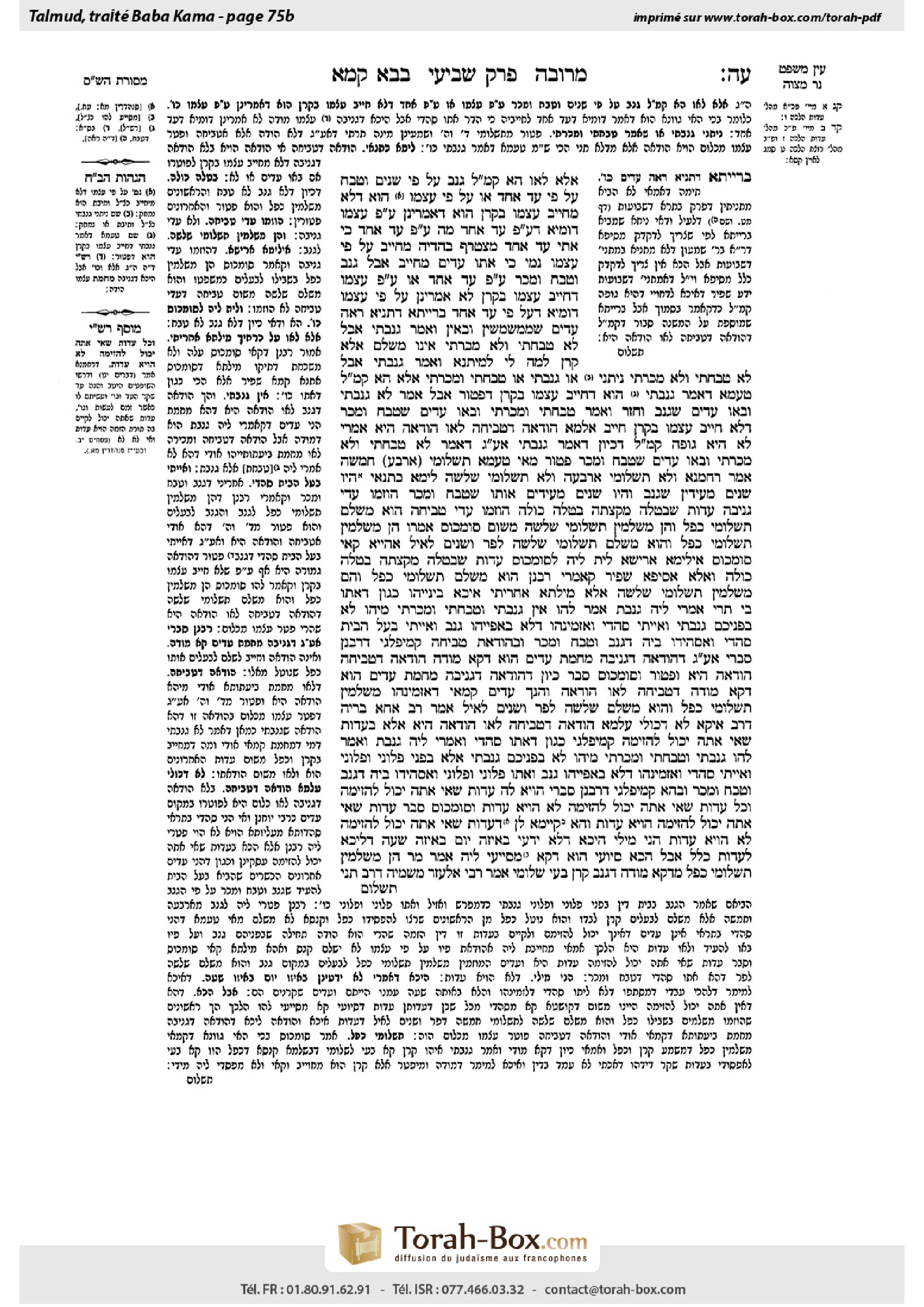
Bava Kamma 75b: Talmud study for Daf Yomi
Study the Talmud for Daf Yomi with scanned pages, Hebrew text, English translations from Sefaria and AI-generated French translations.
Passage selection and English or AI-generated French translation are available where the scan has annotations. Daf Study is independent of Torah-Box and Sefaria.
Browse Bava Kamma · בבא קמא · All tractatesBava Kamma 75b text and translations
This page of Bava Kamma includes the Aramaic text, an English translation and an AI-generated French translation, alongside the scan above.
בבא קמא ע״ה ב · Aramaic and Hebrew text
אֶלָּא לָאו הָא קָא מַשְׁמַע לַן: גָּנַב עַל פִּי שְׁנַיִם וְטָבַח עַל פִּי עֵד אֶחָד אוֹ עַל פִּי עַצְמוֹ – הוּא דְּלָא מְחַיֵּיב עַצְמוֹ בְּקֶרֶן,
הוּא דְּאָמְרִינַן עַל פִּי עַצְמוֹ דּוּמְיָא דְּעַל פִּי עֵד אֶחָד; מָה עַל פִּי עֵד אֶחָד – כִּי אָתֵי עֵד אֶחָד מִצְטָרֵף בַּהֲדֵיהּ, מִחַיַּיב; עַל פִּי עַצְמוֹ נָמֵי – כִּי אָתוּ עֵדִים, מִחַיַּיב.
אֲבָל גָּנַב וְטָבַח וּמָכַר עַל פִּי עֵד אֶחָד אוֹ עַל פִּי עַצְמוֹ – דְּחִיֵּיב עַצְמוֹ בְּקֶרֶן, לָא אָמְרִינַן עַל פִּי עַצְמוֹ דֻּומְיָא דְּעַל פִּי עֵד אֶחָד.
בָּרַיְיתָא – דְּתַנְיָא: רָאָה עֵדִים שֶׁמְּמַשְׁמְשִׁין וּבָאִין, וְאָמַר: ״גָּנַבְתִּי, אֲבָל לֹא טָבַחְתִּי וְלֹא מָכַרְתִּי״ – אֵינוֹ מְשַׁלֵּם אֶלָּא קֶרֶן. לְמָה לִי לְמִיתְנֵא: ״וְאָמַר גָּנַבְתִּי אֲבָל לֹא טָבַחְתִּי וְלֹא מָכַרְתִּי״? נִיתְנֵי: ״אוֹ גָּנַבְתִּי אוֹ טָבַחְתִּי וּמָכַרְתִּי״!
אֶלָּא הָא קָא מַשְׁמַע לַן: טַעְמָא דְּאָמַר ״גָּנַבְתִּי״ הוּא דְּחִיֵּיב עַצְמוֹ בְּקֶרֶן – דְּפָטוּר; אֲבָל אָמַר ״לֹא גָּנַבְתִּי״ וּבָאוּ עֵדִים שֶׁגָּנַב, וְחָזַר וְאָמַר ״טָבַחְתִּי וּמָכַרְתִּי״ וּבָאוּ עֵדִים שֶׁטָּבַח וּמָכַר, דְּלֹא חִיֵּיב עַצְמוֹ בְּקֶרֶן – חַיָּיב. אַלְמָא הוֹדָאָה דִּטְבִיחָה לָאו הוֹדָאָה הִיא!
אָמְרִי: לָא, הִיא גּוּפַהּ קָא מַשְׁמַע לַן – דְּכֵיוָן דְּאָמַר: ״גָּנַבְתִּי״; אַף עַל גַּב דְּאָמַר ״לֹא טָבַחְתִּי וְלֹא מָכַרְתִּי״, וּבָאוּ עֵדִים שֶׁטָּבַח וּמָכַר – פָּטוּר. מַאי טַעְמָא?
תַּשְׁלוּמֵי (אַרְבַּע) חֲמִשָּׁה אָמַר רַחֲמָנָא, וְלֹא תַּשְׁלוּמֵי אַרְבָּעָה וְלֹא תַּשְׁלוּמֵי שְׁלֹשָׁה.
לֵימָא כְּתַנָּאֵי – הָיוּ שְׁנַיִם מְעִידִין שֶׁגָּנַב, וְהָיוּ שְׁנַיִם מְעִידִים אוֹתוֹ שֶׁטָּבַח וּמָכַר; הוּזַּמּוּ עֵדֵי גְנֵיבָה – עֵדוּת שֶׁבָּטְלָה מִקְצָתָהּ בָּטְלָה כּוּלָּהּ.
הוּזַּמּוּ עֵדֵי טְבִיחָה – הוּא מְשַׁלֵּם תַּשְׁלוּמֵי כֶפֶל, וְהֵן מְשַׁלְּמִין תַּשְׁלוּמֵי שְׁלֹשָׁה. מִשּׁוּם סוֹמְכוֹס אָמְרוּ: הֵן מְשַׁלְּמִין תַּשְׁלוּמֵי כֶפֶל, וְהוּא מְשַׁלֵּם תַּשְׁלוּמֵי שְׁלֹשָׁה לַפָּר וּשְׁנַיִם לָאַיִל.
אַהֵיָיא קָאֵי סוֹמְכוֹס? אִילֵּימָא אַרֵישָׁא – לֵית לֵיהּ לְסוֹמְכוֹס עֵדוּת שֶׁבָּטְלָה מִקְצָתָהּ בָּטְלָה כּוּלָּהּ?
וְאֶלָּא אַסֵּיפָא – שַׁפִּיר קָאָמְרִי רַבָּנַן: הוּא מְשַׁלֵּם תַּשְׁלוּמֵי כֶפֶל, וְהֵם מְשַׁלְּמִין תַּשְׁלוּמֵי שְׁלֹשָׁה!
אֶלָּא מִילְּתָא אַחֲרִיתִי אִיכָּא בֵּינַיְיהוּ – כְּגוֹן דְּאָתוּ בֵּי תְרֵי אָמְרִי לֵיהּ ״גָּנַבְתָּ״; אֲמַר לְהוּ: ״אִין, גָּנַבְתִּי וְטָבַחְתִּי וּמָכַרְתִּי, מִיהוּ לֹא בִּפְנֵיכֶם גָּנַבְתִּי״, וְאַיְיתִי סָהֲדִי וְאַזְּמִינְהוּ – דְּלָא בְּאַפַּיְיהוּ גְּנַב; וְאַיְיתִי בַּעַל הַבַּיִת סָהֲדֵי וְאַסְהִידוּ בֵּיהּ דְּגָנַב וְטָבַח וּמָכַר.
וּבְהוֹדָאַת טְבִיחָה קָמִיפַּלְגִי –
דְּרַבָּנַן סָבְרִי: אַף עַל גַּב דְּהוֹדָאָה דִגְנֵיבָה מֵחֲמַת עֵדִים הוּא דְּקָא מוֹדֵה, הוֹדָאָה דִטְבִיחָה הוֹדָאָה הִיא, וּפָטוּר.
וְסוֹמְכוֹס סָבַר: כֵּיוָן דְּהוֹדָאָה דִּגְנֵיבָה מֵחֲמַת עֵדִים הוּא דְּקָא מוֹדֵה, דִּטְבִיחָה לָאו הוֹדָאָה.
וְהָנָךְ עֵדִים קַמָּאֵי דְּאַזְּמִינְהוּ – מְשַׁלְּמִין תַּשְׁלוּמֵי כֶפֶל; וְהוּא מְשַׁלֵּם שְׁלֹשָׁה לַפָּר וּשְׁנַיִם לָאַיִל.
אָמַר רַב אַחָא בְּרֵיהּ דְּרַב אִיקָא: לָא; דְּכוּלֵּי עָלְמָא – הוֹדָאָה דִטְבִיחָה לָאו הוֹדָאָה הִיא;
אֶלָּא בְּעֵדוּת שֶׁאִי אַתָּה יָכוֹל לַהֲזִימָּהּ קָמִיפַּלְגִי – כְּגוֹן דְּאָתוּ סָהֲדֵי וְאָמְרִי לֵיהּ: ״גָּנַבְתָּ״, וְאָמַר לְהוּ: ״גָּנַבְתִּי וְטָבַחְתִּי וּמָכַרְתִּי, מִיהוּ לֹא בִּפְנֵיכֶם גָּנַבְתִּי אֶלָּא בִּפְנֵי פְּלוֹנִי וּפְלוֹנִי״; וְאַיְיתִי סָהֲדִי וְאַזְּמִינְהוּ – דְּלָא בְּאַפַּיְיהוּ גְּנַב; וַאֲתוֹ פְּלוֹנִי וּפְלוֹנִי וְאַסְהִידוּ בֵּיהּ דְּגָנַב וְטָבַח וּמָכַר.
וּבְהָא קָמִיפַּלְגִי – דְּרַבָּנַן סָבְרִי הָוְיָא לַהּ עֵדוּת שֶׁאִי אַתָּה יָכוֹל לַהֲזִימָּהּ, וְכׇל עֵדוּת שֶׁאִי אַתָּה יָכוֹל לַהֲזִימָּהּ – לָא הָוְיָא עֵדוּת.
וְסוֹמְכוֹס סָבַר: עֵדוּת שֶׁאִי אַתָּה יָכוֹל לַהֲזִימָּהּ – הָוְיָא עֵדוּת.
וְהָא קַיְימָא לַן דְּעֵדוּת שֶׁאִי אַתָּה יָכוֹל לַהֲזִימָּהּ לָא הָוְיָא עֵדוּת! הָנֵי מִילֵּי הֵיכָא דְּלָא יָדְעִי בְּאֵיזֶה יוֹם בְּאֵיזֶה שָׁעָה – דְּלֵיכָּא לְעֵדוּת כְּלָל; אֲבָל הָכָא – סַיּוֹעֵי הוּא דְּקָא מְסַיְּיעִי לֵיהּ.
אָמַר מָר: הֵן מְשַׁלְּמִין תַּשְׁלוּמֵי כֶפֶל. מִדְּקָא מוֹדֵה דִּגְנַב – קֶרֶן בָּעֵי שַׁלּוֹמֵי?! אָמַר רַבִּי אֶלְעָזָר מִשְּׁמֵיהּ דְּרַב, תְּנִי:
Bava Kamma 75b · English translation
Rather, is it not correct to say that by citing the more complicated case, this is what the mishna teaches us: It is only in this case, where it is established that the thief stole an animal based on the testimony of two witnesses, and it is established that he slaughtered or sold it based on the testimony of one witness or based on his own admission, and where he does not obligate himself through his admission to pay the principal, that he is obligated to pay the fine.
The Gemara elaborates: In other words, it is only in that case, where the theft is established based on the testimony of two witnesses, that we say that liability based on his own admission is similar to the testimony of one witness, in that just as when the slaughter is established based on the testimony of one witness, if one other witness later comes he joins together with the first witness and together their testimony is rendered a valid testimony of two witnesses and the thief becomes liable to pay, so too, in a case when the slaughter is established based on his own admission, if witnesses subsequently come and testify, he becomes liable to pay the fine, as his admission would not have rendered him liable to pay any payment.
But if it is established that the thief stole an animal and slaughtered or sold it, all based on the testimony of one witness or based on his own admission, in which case through his admission he obligates himself to pay the principal amount, we do not say that when witnesses testify subsequent to his own admission it is similar to when they arrive subsequent to the testimony of one witness, and he is liable to pay the fine in both cases. Rather, since in this case his admission would have rendered him liable to pay the principal due to the fact that the theft was not established based on the testimony of two witnesses, it is considered a proper admission, which exempts him from paying the fine.
The baraita that supports Rav Hamnuna’s opinion is the one cited earlier, as it is taught: If a thief saw witnesses who were approaching with the intent to testify against him, and at that point he said: I admit that I stole an animal, but I did not slaughter or sell it, he pays only the principal. Why do I need the baraita to teach: And the thief said: I admit that I stole an animal but I did not slaughter or sell it? Let it teach a simpler case, in which the thief said either: I stole the animal, or: I slaughtered it, or: I sold it.
Rather, by choosing the more complicated case, this is what the baraita teaches us: The only reason that the thief is exempt from payment is that he says: I stole the animal, as in that case he obligated himself to pay the principal. But if he says: I did not steal, and witnesses came and testified that he did steal an animal, and subsequently he changed his claim and says: I slaughtered it, or: I sold it, and then witnesses came and confirmed that he slaughtered or sold it, in which case the thief did not obligate himself to pay the principal or any other payment, he would be liable to pay the fourfold or fivefold payment. Apparently, an admission to the slaughter of a stolen animal is not considered a valid admission, as such an admission does not obligate the perpetrator to pay a fine.
The Gemara says, in rejection of this second proof: No, it is possible to explain the reason the tanna of the baraita chose to present this case in a different manner, as it teaches us this halakha itself: That once the thief says: I stole the animal, even if he also says: I did not slaughter or sell it, and later witnesses came and testified that he slaughtered or sold it, he is exempt from paying the fourfold or fivefold payment. What is the reason for this exemption?
The reason is that the Merciful One states in the Torah that there is a payment of four sheep for a sheep and five oxen for an ox (see Exodus 21:37). This indicates that a thief can be rendered liable to pay, respectively, a fourfold or fivefold payment, but not a fourfold payment for an ox, nor a threefold payment for a sheep. In other words, one should not view the fines as independent of each other, that if the thief is found with the animal he pays as a fine the double payment, and if he slaughtered or sold it he pays a different fine, i.e., the fourfold or fivefold payment. Rather, the fourfold or fivefold payment comprises the principal, the double payment, and an additional two or three times the principal. By admitting to his act of theft, the thief exempts himself from the double payment, and the remaining fine for slaughtering a sheep would be a threefold payment, or a fourfold payment for an ox, which are not mandated by the Torah.
The Gemara proposes: Let us say that the opinion of Rav Hamnuna and Rabbi Yoḥanan is the subject of a dispute between tanna’im. As it is taught in a baraita: If two witnesses testify that someone stole an animal, and two others testify against him that he slaughtered or sold the animal, and the witnesses who had testified concerning the theft were rendered conspiring witnesses, the thief is exempt from all payment, as testimony that was partially invalidated is entirely invalidated. If the testimony concerning the theft was undermined, the testimony concerning the slaughter or sale is thereby rendered irrelevant. Consequently, the alleged thief is exempt from any payment.
If the witnesses who testified concerning the slaughter or sale were rendered conspiring witnesses, but the testimony concerning the theft remains credible, the thief pays the double payment, and the conspiring witnesses pay a threefold payment, as that is the loss they sought to impose on the thief. The Sages said in the name of Sumakhos: The witnesses pay the double payment, and the thief pays a threefold payment for an ox and a twofold payment for a ram. This concludes the baraita.
The Gemara analyzes the statement of Sumakhos: To which clause in the baraita is Sumakhos referring? If we say that he is referring to the first clause, in which the testimony concerning the theft is invalidated, this is impossible. Doesn’t Sumakhos accept the principle that testimony that was partially invalidated is entirely invalidated, in this case rendering the testimony concerning the slaughter or sale irrelevant if there is no testimony concerning the theft?
But rather, he must be referring to the latter clause of the baraita, in which the testimony concerning the slaughter or sale is invalidated. This, too, is impossible, as in this case the Rabbis, i.e., the first tanna of the baraita, say well, i.e., what they state is reasonable, and the thief pays the double payment and the witnesses pay a threefold payment. On what basis would Sumakhos dispute this ruling?
Rather, it must be that Sumakhos is referring to a different case entirely, one that is not mentioned explicitly in the baraita, and a different matter is at the core of the dispute between them. Sumakhos is referring to a case where two people come and say to the thief: You stole an animal. The thief said to them in reply: Yes, I did steal the animal, and moreover, I slaughtered it, or: I sold it. But I did not steal it in your presence, and your testimony that you saw me steal it is false. And subsequently the thief brought new witnesses who rendered the original witnesses conspiring witnesses, by testifying that they were in a different place at the time they claimed that the theft occurred, thereby proving that the thief did not steal in their presence. And finally, the owner of the animal brought other witnesses who testified that the thief stole the animal and slaughtered or sold it.
And Sumakhos and the Rabbis disagree over whether an admission to the slaughter of a stolen animal is a valid admission, even though it does not lead to liability to pay any payment. Both parties to the dispute agree that the admission of a perpetrator only in response to the testimony of witnesses is not a valid admission.
The dispute between them is that the Rabbis maintain that even though the thief’s admission concerning the theft itself is not a valid admission because it is due only to the witnesses who have testified against him that he admits his guilt, nevertheless, his admission concerning the slaughter of the animal is a valid admission, despite the fact it does not render the thief liable to pay a fine, and he is therefore exempt from the fourfold or fivefold payment. The conspiring witnesses must pay the double payment to the thief, since this is the amount of financial damage they sought to impose on him, while the thief pays the double payment to the owner, as valid witnesses ultimately testified that he stole the animal.
And Sumakhos maintains that since the admission concerning the theft itself is not a valid admission because it was due only to the testimony of the witnesses that he admits his guilt, so too, the admission concerning the slaughter is not a valid admission, because it does not obligate him to pay a fine, as stated by Rav Hamnuna and Rabbi Yoḥanan.
And consequently, those first witnesses to the theft, who were rendered conspiring witnesses, pay the double payment, as that is the amount of financial damage they sought to impose on him, and the thief pays the double payment to the owner of the animal, as valid witnesses ultimately testified that he stole it, and since his admission is invalid he must pay an additional threefold payment, for a total of a fivefold payment for an ox, or a twofold payment, for a total of a fourfold payment, for a ram. If this is their dispute, Sumakhos is in agreement with the opinion of Rav Hamnuna and Rabbi Yoḥanan, while the Rabbis disagree with this opinion.
Rav Aḥa, son of Rav Ika, said: No; it is possible to explain the baraita differently, as follows: Everyone, i.e., both Sumakhos and the Rabbis, maintains that an admission concerning the slaughter of a stolen animal is not a valid admission, as it does not render the perpetrator liable to pay any payment.
Rather, they disagree over the concept of testimony that you cannot render conspiratory testimony. Sumakhos and the Rabbis disagree with regard to a case where witnesses come and say to the thief: You stole an animal. And the thief said to them in response: I did steal an animal, and moreover, I slaughtered it, or: I sold it. But you are false witnesses, as it was not in your presence that I stole the animal, but in the presence of so-and-so and so-and-so. And the thief subsequently brought witnesses who established the first set of witnesses as conspiring witnesses by testifying that the thief did not steal the animal in their presence. And finally, so-and-so and so-and-so, the two people mentioned by the thief, came and testified against the thief, saying that he stole the animal and also slaughtered or sold it.
And it is with regard to this point that they disagree, that the Rabbis maintain that the testimony of so-and-so and so-and-so is testimony that you cannot render conspiratory testimony, as the thief himself admits that their testimony is true. And any testimony that you cannot render conspiratory testimony is not considered valid testimony. Their testimony is therefore discounted, which leaves only the thief’s statement. The thief pays the money he admitted he owes, i.e., the principal of the theft, but he is exempt from paying a fine. Meanwhile, the first witnesses, who had been rendered conspiring witnesses, pay the thief the double payment.
And Sumakhos maintains that testimony that you cannot render conspiratory testimony is nevertheless considered valid testimony. Therefore, the testimony of so-and-so and so-and-so is valid, and the thief must pay the fourfold or fivefold payment. Sumakhos states that the thief pays a threefold payment for an ox and a twofold payment for a ram. The reason is that the thief receives a double payment from the first, conspiring witnesses, which he gives to the owner of the animal, along with the remainder of the payment. This amounts to a threefold payment for an ox and twofold payment for a ram that he is required to pay from his own funds.
The Gemara asks: But do we not maintain as an accepted principle that testimony that you cannot render conspiratory testimony is not valid testimony? It is not reasonable to suggest that Sumakhos would disagree with that principle. The Gemara answers: This statement applies in a case where witnesses say that they do not know on which day or at which time of day the events in question occurred, in which case no one could ever say to them: You were in a different place at that time, thereby rendering them conspiring witnesses. With regard to such a case one can say that in effect there is no testimony at all, as the vague statement of the witnesses does not allow them to be prosecuted as conspiring witnesses. But here the thief is supporting their testimony, which renders it more credible.
The Master said in the baraita that the Sages stated in the name of Sumakhos: The witnesses pay the double payment. The Gemara asks: From the fact that the thief admits that he stole the animal, he is required to pay the principal amount regardless of any subsequent testimony provided by witnesses. Why, then, should the conspiring witnesses be required to pay a double payment, which includes the principal amount? Rabbi Elazar says in the name of Rav: Teach the baraita differently, and instead say that Sumakhos said that the witnesses are liable for
Bava Kamma 75b · Traduction française (IA)
Plutôt, n'est-ce pas correct de dire que, en citant le cas plus complexe, la Michna nous enseigne ceci : C'est uniquement dans ce cas, où il est établi que le voleur a volé un animal sur le témoignage de deux témoins, et où il est établi qu'il l'a tué ou vendu sur le témoignage d'un seul témoin ou sur son propre aveu, et où il ne s'engage pas par son aveu à payer le principal, qu'il est tenu de payer la peine.
La Guemara développe : En d'autres termes, c'est uniquement dans ce cas, où le vol est établi sur le témoignage de deux témoins, que nous disons que la responsabilité fondée sur son aveu est semblable au témoignage d'un seul témoin, en ce sens que, justement lorsque la mise à mort est établie sur le témoignage d'un seul témoin, si un autre témoin arrive plus tard, il s'associe avec le premier témoin et leur témoignage ensemble devient un témoignage valide de deux témoins et le voleur devient responsable de payer, de même, dans le cas où la mise à mort est établie sur son propre aveu, si des témoins arrivent plus tard et témoignent, il devient responsable de payer la peine, car son aveu ne l'aurait pas rendu responsable de payer quoi que ce soit.
Mais si il est établi que le voleur a volé un animal et l'a tué ou vendu, tout cela sur le témoignage d'un seul témoin ou sur son propre aveu, dans le cas où son aveu l'engage à payer le principal, nous ne disons pas que lorsque des témoins témoignent après son propre aveu, cela est semblable au cas où ils arrivent après le témoignage d'un seul témoin, et il est responsable de payer la peine dans les deux cas. Plutôt, puisque dans ce cas son aveu aurait rendu responsable de payer le principal en raison du fait que le vol n'était pas établi sur le témoignage de deux témoins, il est considéré comme un aveu approprié, qui l'exonère de payer la peine.
La baraïta qui soutient l'opinion de Rav Hamnuna est celle citée plus tôt, comme il est enseigné : Si un voleur voit des témoins qui approchent avec l'intention de témoigner contre lui, et à ce moment-là il dit : Je reconnais que j'ai volé un animal, mais je n'ai pas tué ou vendu, il paie seulement le principal. Pourquoi ai-je besoin de la baraïta pour enseigner : Et le voleur dit : Je reconnais que j'ai volé un animal mais je n'ai pas tué ou vendu ? Laissons-la enseigner un cas plus simple, dans lequel le voleur dit soit : J'ai volé l'animal, soit : J'ai tué, soit : J'ai vendu.
Plutôt, en choisissant le cas plus complexe, c'est ce que la baraïta nous enseigne : La seule raison pour laquelle le voleur est exempt de paiement est qu'il dit : J'ai volé l'animal, car dans ce cas il s'est engagé à payer le principal. Mais si il dit : Je n'ai pas volé, et des témoins arrivent et témoignent qu'il a volé un animal, et ensuite il change son allégation et dit : J'ai tué, ou : J'ai vendu, et ensuite des témoins viennent et confirment qu'il a tué ou vendu, dans ce cas le voleur n'a pas s'engagé à payer le principal ou tout autre paiement, il serait tenu de payer le paiement quadruple ou quintuple. Apparemment, un aveu concernant la mise à mort d'un animal volé n'est pas considéré comme un aveu valide, car un tel aveu ne rend pas le coupable responsable de payer une peine.
La Guemara dit, en rejetant cette deuxième preuve : Non, il est possible d'expliquer la raison pour laquelle le tanna de la baraïta a choisi de présenter ce cas sous une autre forme, comme il enseigne cette halakha elle-même : Que lorsque le voleur dit : J'ai volé l'animal, même s'il dit aussi : Je n'ai pas tué ou vendu, et plus tard des témoins viennent et témoignent qu'il a tué ou vendu, il est exempt de payer le paiement quadruple ou quintuple. Quelle est la raison de cette exemption ?
La raison est que l'Éternel, le Miséricordieux, indique dans la Torah qu'il faut payer quatre agneaux pour un agneau et cinq bœufs pour un bœuf (voir Exode 21:37). Cela montre que le voleur peut être tenu responsable de payer, respectivement, un paiement quadruple ou quintuple, mais pas un paiement quadruple pour un bœuf, ni un paiement triple pour un agneau. En d'autres termes, on ne devrait pas considérer les amendes comme indépendantes les unes des autres : si le voleur est trouvé avec l'animal, il paie une amende double, et si il a tué ou vendu l'animal, il paie une autre amende, c'est-à-dire un paiement quadruple ou quintuple. En réalité, le paiement quadruple ou quintuple inclut le principal, le paiement double, ainsi que deux ou trois fois le principal. En admettant son acte de vol, le voleur s'exonère du paiement double, et la peine restante pour avoir tué un agneau serait un paiement triple, ou un paiement quadruple pour un bœuf, ce qui n'est pas prescrit par la Torah.
La Guemara propose : Faisons-nous dire que l'opinion de Rav Hamnuna et de Rabbi Yoḥanan est l'objet d'un débat entre des tannaïm. Comme il est enseigné dans une baraïta : Si deux témoins affirment que quelqu'un a volé un animal, et deux autres témoins affirment qu'il a tué ou vendu l'animal, et les témoins ayant témoigné sur le vol sont devenus des témoins conjurés, le voleur est exempt de tout paiement, car un témoignage partiellement invalidé est entièrement invalidé. Si le témoignage concernant le vol est affaibli, le témoignage concernant la mise à mort ou la vente devient ainsi inutile. Par conséquent, le voleur est exempt de tout paiement.
Si les témoins qui avaient témoigné concernant la mise à mort ou la vente sont devenus des témoins conjurés, mais le témoignage concernant le vol reste crédible, le voleur paie le double, et les témoins conjurés paient le triple, car c'est la perte qu'ils cherchaient à imposer au voleur. Les Sages disent en nom de Sumakhos : Les témoins paient le double, et le voleur paie le triple pour un bœuf et le double pour un agneau. Cela conclut la baraïta.
La Guemara examine la déclaration de Sumakhos : À quel verset de la baraïta fait-il référence Sumakhos ? Si nous disons qu'il fait référence au premier verset, celui où le témoignage concernant le vol est invalidé, cela est impossible. N'est-ce pas que Sumakhos accepte le principe selon lequel un témoignage partiellement invalidé est entièrement invalidé, dans ce cas rendant le témoignage concernant la boucherie ou la vente inutile s'il n'y a pas de témoignage concernant le vol ?
Mais plutôt, il doit faire référence au second verset de la baraïta, celui où le témoignage concernant la boucherie ou la vente est invalidé. Cela est également impossible, car dans ce cas, les Rabbins, c'est-à-dire le premier tanna de la baraïta, disent bien, c'est-à-dire ce qu'ils affirment est raisonnable, et le voleur paie le double paiement et les témoins paient un triple paiement. Sur quelle base Sumakhos contesterait-il cette décision ?
Plutôt, il doit être que Sumakhos fait référence à un cas tout à fait différent, celui qui n'est pas mentionné explicitement dans la baraïta, et une autre question est au cœur du désaccord entre eux. Sumakhos fait référence à un cas où deux personnes viennent et disent au voleur : Tu as volé un animal. Le voleur répond en disant : Oui, j'ai volé l'animal, et de plus, j'ai tué ou vendu. Mais je n'ai pas volé en votre présence, et votre témoignage selon lequel vous avez vu que je volais est faux. Par la suite, le voleur apporte de nouveaux témoins qui rendent les témoins initiaux témoins conjurés, en témoignant qu'ils étaient ailleurs à l'époque où ils affirmaient que le vol s'était produit, prouvant ainsi que le voleur n'avait pas volé en leur présence. Enfin, le propriétaire de l'animal apporte d'autres témoins qui témoignent que le voleur a volé l'animal et l'a tué ou vendu.
Et Sumakhos et les Rabbins s'opposent sur le fait que l'admission concernant la boucherie d'un animal volé soit une admission valide, même si elle ne conduit pas à une responsabilité de paiement. Les deux parties au désaccord s'accordent sur le fait que l'admission d'un coupable uniquement en réponse au témoignage des témoins n'est pas une admission valide.
Le désaccord entre eux est le suivant : les Rabbins maintiennent que même si l'admission du voleur concernant le vol lui-même n'est pas une admission valide, car elle est due uniquement au témoignage des témoins qui l'ont accusé, néanmoins, son admission concernant la boucherie de l'animal est une admission valide, malgré le fait qu'elle ne rend pas le voleur responsable de payer une amende, et il est donc exempt du paiement quadruple ou quintuple. Les témoins conjurés doivent payer le double paiement au voleur, car c'est le montant de la dommage financier qu'ils cherchaient à imposer, tandis que le voleur paie le double paiement au propriétaire, comme des témoins valides ont finalement témoigné qu'il avait volé l'animal.
Et Sumakhos maintient que puisque l'admission concernant le vol lui-même n'est pas une admission valide, car elle est due uniquement au témoignage des témoins qui l'ont accusé, de même, l'admission concernant la boucherie n'est pas une admission valide, car elle ne rend pas le voleur responsable de payer une amende, comme l'affirment Rav Hamnuna et Rabbi Yoḥanan.
Et par conséquent, ceux qui étaient les premiers témoins du vol, qui ont été rendus témoins conjurés, paient le double paiement, car c'est le montant du dommage financier qu'ils cherchaient à imposer, et le voleur paie le double paiement au propriétaire de l'animal, car des témoins valides ont finalement témoigné qu'il avait volé l'animal. Et puisque son admission est invalide, il doit payer un supplément triple paiement, pour un total de paiement quintuple pour un bœuf, ou un paiement double, pour un total de paiement quadruple pour un agneau. Si c'est leur désaccord, Sumakhos est d'accord avec l'opinion de Rav Hamnuna et Rabbi Yoḥanan, tandis que les Rabbins s'opposent à cette opinion.
Rav Aḥa, fils de Rav Ika, dit : Non ; il est possible d'interpréter différemment la baraïta, comme suit : Tout le monde, c'est-à-dire à la fois Sumakhos et les Rabbins, maintient que l'admission concernant la boucherie d'un animal volé n'est pas une admission valide, car elle ne rend pas le coupable responsable de payer quoi que ce soit.
Plutôt, ils s'opposent sur le concept de témoignage que vous ne pouvez pas rendre témoins conjurés. Sumakhos et les Rabbins s'opposent concernant un cas où des témoins viennent et disent au voleur : Tu as volé un animal. Et le voleur répond en disant : J'ai volé un animal, et de plus, j'ai tué ou vendu. Mais vous êtes des témoins faux, car ce n'était pas en votre présence que j'ai volé l'animal, mais en présence de tel et tel. Et le voleur apporte ensuite des témoins qui établissent les premiers témoins comme témoins conjurés en témoignant que le voleur n'a pas volé l'animal en leur présence. Enfin, tel et tel, les deux personnes mentionnées par le voleur, viennent témoigner contre le voleur, disant qu'il a volé l'animal et aussi tué ou vendu.
Et c'est à ce point précis qu'ils s'opposent : les Rabbins maintiennent que le témoignage de tel et tel est un témoignage que vous ne pouvez pas rendre conjuré, car le voleur lui-même admet que leur témoignage est vrai. Et tout témoignage que vous ne pouvez pas rendre conjuré n'est pas considéré comme un témoignage valide. Leur témoignage est donc rejeté, ce qui laisse seulement l'affirmation du voleur. Le voleur paie l'argent qu'il a admis d'admettre, c'est-à-dire le principal du vol, mais il est exempt de payer une amende. En revanche, les premiers témoins, qui avaient été rendus témoins conjurés, paient au voleur le double paiement.
Et Sumakhos affirme que le témoignage que l'on ne peut pas rendre de témoignage conjuré est toutefois considéré comme témoignage valide. Ainsi, le témoignage de telle et telle est valide, et le voleur doit payer une réparation quadruple ou quintuple. Sumakhos affirme que le voleur paie une réparation triple pour un bœuf et une réparation double pour un agneau. La raison est que le voleur reçoit une réparation double du premier, témoins conjurés, qu'il donne au propriétaire de l'animal, avec le reste de la réparation. Cela équivaut à une réparation triple pour un bœuf et une réparation double pour un agneau qu'il est tenu de payer à partir de ses propres fonds.
La Guemara demande : Mais ne maintenons-nous pas comme un principe accepté que le témoignage que l'on ne peut pas rendre de témoignage conjuré n'est pas considéré comme témoignage valide ? Il n'est pas raisonnable de suggérer que Sumakhos puisse désaccorder avec ce principe. La Guemara répond : Cette déclaration s'applique à un cas où les témoins disent qu'ils ne savent pas le jour ou l'heure à laquelle les événements en question se sont produits, dans lequel cas personne ne pourrait jamais dire à eux : Vous étiez ailleurs à ce moment-là, ce qui les rendrait témoins conjurés. En ce qui concerne de tels cas, on peut dire qu'en effet il n'y a pas de témoignage du tout, car l'expression vague des témoins ne permet pas de les poursuivre comme témoins conjurés. Mais ici le voleur soutient leur témoignage, ce qui le rend plus crédible.
Le Maître a dit dans la baraïta que les Sages ont dit en nom de Sumakhos : Les témoins paient la réparation double. La Guemara demande : D'après le fait que le voleur admet qu'il a volé l'animal, il est tenu de payer le montant principal indépendamment de tout témoignage ultérieur des témoins. Pourquoi, alors, les témoins conjurés devraient-ils être tenus de payer une réparation double, qui inclut le montant principal ? Rabbi Elazar dit en nom de Rav : Enseigne la baraïta différemment, et au lieu de dire cela, dis que Sumakhos a dit que les témoins sont responsables de
Traduction française générée par IA à partir de l’édition anglaise de Sefaria. Vérifie toujours un passage avec le texte source.
Text from Sefaria: William Davidson Edition - Vocalized Aramaic (CC BY NC); William Davidson Edition - English (CC BY NC).