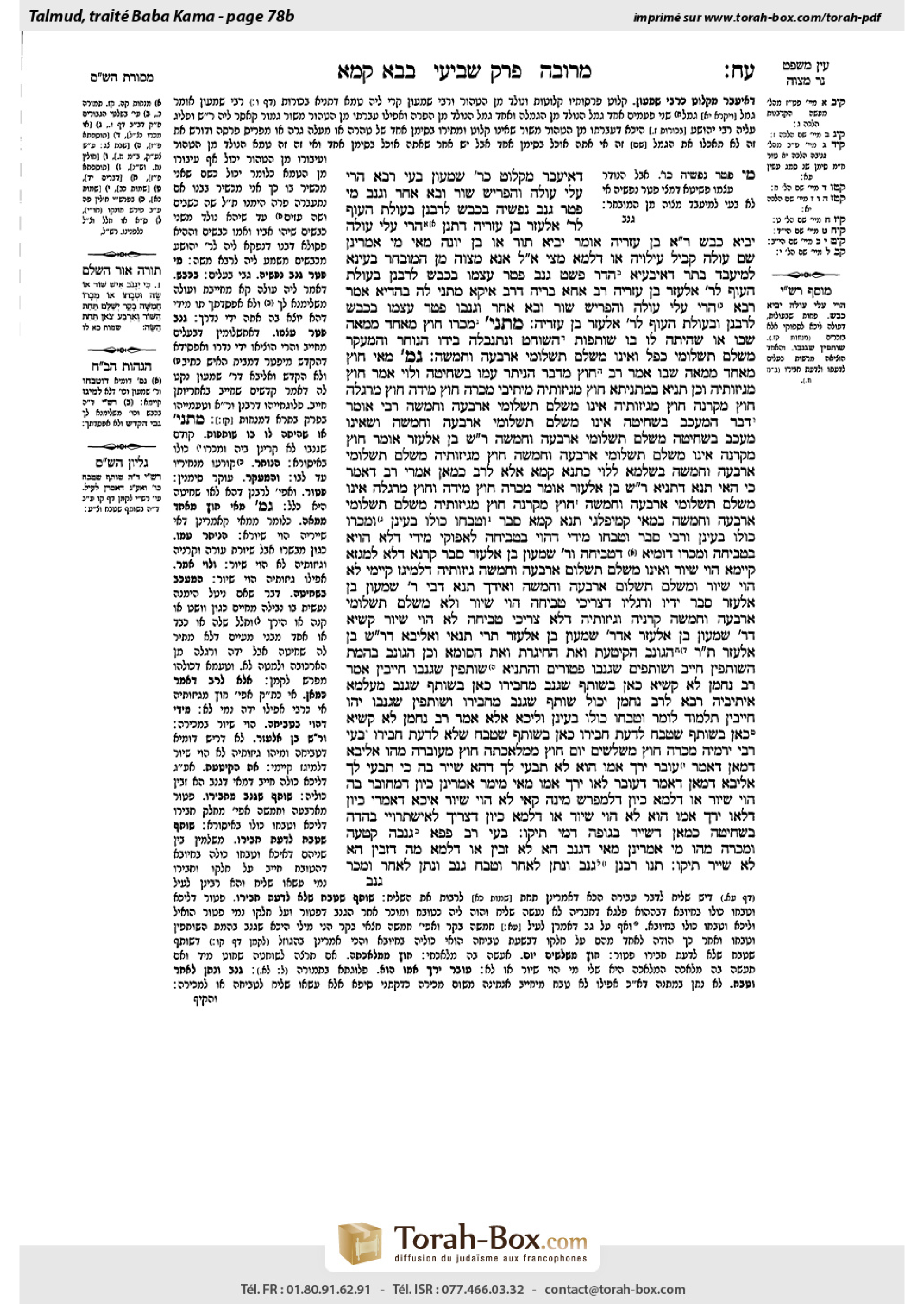
Bava Kamma 78b: Talmud study for Daf Yomi
Study the Talmud for Daf Yomi with scanned pages, Hebrew text, English translations from Sefaria and AI-generated French translations.
Passage selection and English or AI-generated French translation are available where the scan has annotations. Daf Study is independent of Torah-Box and Sefaria.
Browse Bava Kamma · בבא קמא · All tractatesBava Kamma 78b text and translations
This page of Bava Kamma includes the Aramaic text, an English translation and an AI-generated French translation, alongside the scan above.
בבא קמא ע״ח ב · Aramaic and Hebrew text
דְּאִיעַבַּר מִקָּלוּט, כְּרַבִּי שִׁמְעוֹן.
בָּעֵי רָבָא: ״הֲרֵי עָלַי עוֹלָה״, וְהִפְרִישׁ שׁוֹר, וּבָא אַחֵר וְגָנַב; מִי פָּטַר גַּנָּב נַפְשֵׁיהּ בְּכֶבֶשׂ – לְרַבָּנַן, בְּעוֹלַת הָעוֹף – לְרַבִּי אֶלְעָזָר בֶּן עֲזַרְיָה? דִּתְנַן: ״הֲרֵי עָלַי עוֹלָה״ – יָבִיא כֶּבֶשׂ. רַבִּי אֶלְעָזָר בֶּן עֲזַרְיָה אוֹמֵר: יָבִיא תּוֹר אוֹ בֶּן יוֹנָה.
מַאי? מִי אָמְרִינַן: שֵׁם עוֹלָה קַבֵּיל עִילָּוֵיהּ; אוֹ דִלְמָא, מָצֵי אֲמַר לֵיהּ: אֲנָא מִצְוָה מִן הַמּוּבְחָר בָּעֵינָא לְמֶיעְבַּד?
בָּתַר דְּאִיבַּעְיָא, הֲדַר פַּשְׁטַהּ: גַּנָּב פֹּטֵר עַצְמוֹ בְּכֶבֶשׂ לְרַבָּנַן, בְּעוֹלַת הָעוֹף לְרַבִּי אֶלְעָזָר בֶּן עֲזַרְיָה.
רַב אַחָא בְּרֵיהּ דְּרַב אִיקָא מַתְנֵי לַהּ בְּהֶדְיָא – אָמַר רָבָא: ״הֲרֵי עָלַי עוֹלָה״ וְהִפְרִישׁ שׁוֹר, וּבָא אַחֵר וּגְנָבוֹ – פֹּטֵר עַצְמוֹ בְּכֶבֶשׂ לְרַבָּנַן, וּבְעוֹלַת הָעוֹף לְרַבִּי אֶלְעָזָר בֶּן עֲזַרְיָה.
מַתְנִי׳ מְכָרוֹ חוּץ מֵאֶחָד מִמֵּאָה שֶׁבּוֹ, אוֹ שֶׁהָיְתָה לוֹ בּוֹ שׁוּתָּפוּת; הַשּׁוֹחֵט וְנִתְנַבְּלָה בְּיָדוֹ, הַנּוֹחֵר, וְהַמְעַקֵּר – מְשַׁלֵּם תַּשְׁלוּמֵי כֶפֶל, וְאֵינוֹ מְשַׁלֵּם תַּשְׁלוּמֵי אַרְבָּעָה וַחֲמִשָּׁה.
גְּמָ׳ מַאי ״חוּץ מֵאֶחָד מִמֵּאָה שֶׁבּוֹ״? אָמַר רַב: חוּץ מִדָּבָר הַנִּיתָּר עִמּוֹ בִּשְׁחִיטָה. וְלֵוִי אָמַר: חוּץ מִגִּיזּוֹתֶיהָ. וְכֵן תַּנְיָא בְּמַתְנִיתָא: חוּץ מִגִּיזּוֹתֶיהָ.
מֵיתִיבִי: מְכָרָהּ חוּץ מִיָּדָהּ, חוּץ מֵרַגְלָהּ, חוּץ מִקַּרְנָהּ, חוּץ מִגִּיזּוֹתֶיהָ – אֵינוֹ מְשַׁלֵּם תַּשְׁלוּמֵי אַרְבָּעָה וַחֲמִשָּׁה. רַבִּי אוֹמֵר: דָּבָר הַמְעַכֵּב בִּשְׁחִיטָה – אֵינוֹ מְשַׁלֵּם תַּשְׁלוּמֵי אַרְבָּעָה וַחֲמִשָּׁה,
וְשֶׁאֵינוֹ מְעַכֵּב בִּשְׁחִיטָה – מְשַׁלֵּם תַּשְׁלוּמֵי אַרְבָּעָה וַחֲמִשָּׁה.
רַבִּי שִׁמְעוֹן בֶּן אֶלְעָזָר אוֹמֵר: חוּץ מִקַּרְנָהּ – אֵינוֹ מְשַׁלֵּם תַּשְׁלוּמֵי אַרְבָּעָה וַחֲמִשָּׁה, חוּץ מִגִּיזּוֹתֶיהָ – מְשַׁלֵּם תַּשְׁלוּמֵי אַרְבָּעָה וַחֲמִשָּׁה.
בִּשְׁלָמָא לְלֵוִי – כְּתַנָּא קַמָּא; אֶלָּא לְרַב – כְּמַאן?
אָמְרִי: רַב דְּאָמַר – כִּי הַאי תַּנָּא, דְּתַנְיָא, רַבִּי שִׁמְעוֹן בֶּן אֶלְעָזָר אוֹמֵר: מְכָרָהּ חוּץ מִיָּדָהּ וְחוּץ מֵרַגְלָהּ – אֵינוֹ מְשַׁלֵּם תַּשְׁלוּמֵי אַרְבָּעָה וַחֲמִשָּׁה. חוּץ מִקַּרְנָהּ, חוּץ מִגִּיזּוֹתֶיהָ – מְשַׁלֵּם תַּשְׁלוּמֵי אַרְבָּעָה וַחֲמִשָּׁה.
בְּמַאי קָמִיפַּלְגִי? תַּנָּא קַמָּא סָבַר: ״וּטְבָחוֹ״ כּוּלּוֹ בָּעֵינַן, ״וּמְכָרוֹ״ כּוּלּוֹ בָּעֵינַן.
וְרַבִּי סָבַר: ״וּטְבָחוֹ״ – מִידֵּי דְּהָוֵי בִּטְבִיחָה, לְאַפּוֹקֵי מִידֵּי דְּלָא הָוְיָא בִּטְבִיחָה; ״וּמְכָרוֹ״ – דֻּומְיָא דִּטְבִיחָה.
וְרַבִּי שִׁמְעוֹן בֶּן אֶלְעָזָר סָבַר: קַרְנָא, דְּלָא לְמִגַּז קָיְימָא – הָוֵי שִׁיּוּר, וְאֵינוֹ מְשַׁלֵּם תַּשְׁלוּם אַרְבָּעָה וַחֲמִשָּׁה; גִּיזּוֹתֶיהָ, דִּלְמִיגַּז קָיְימִי – לָא הָוֵי שִׁיּוּר, וּמְשַׁלֵּם תַּשְׁלוּם אַרְבָּעָה וַחֲמִשָּׁה.
וְאִידַּךְ תַּנָּא דְּבֵי רַבִּי שִׁמְעוֹן בֶּן אֶלְעָזָר סָבַר: יָדָיו וְרַגְלָיו, דִּצְרִיכִי טְבִיחָה – הָוֵי שִׁיּוּר, וְלָא מְשַׁלֵּם תַּשְׁלוּמֵי אַרְבָּעָה וַחֲמִשָּׁה; קַרְנֶיהָ וְגִיזּוֹתֶיהָ, דְּלָא צְרִיכִי טְבִיחָה – לָא הָוֵי שִׁיּוּר.
קַשְׁיָא דְּרַבִּי שִׁמְעוֹן בֶּן אֶלְעָזָר אַדְּרַבִּי שִׁמְעוֹן בֶּן אֶלְעָזָר! תְּרֵי תַּנָּאֵי וְאַלִּיבָּא דְּרַבִּי שִׁמְעוֹן בֶּן אֶלְעָזָר.
תָּנוּ רַבָּנַן: הַגּוֹנֵב הַקִּיטַּעַת וְאֶת הַחִיגֶּרֶת וְאֶת הַסּוֹמָא, וְכֵן הַגּוֹנֵב בֶּהֱמַת הַשּׁוּתָּפִין – חַיָּיב. וְשׁוּתָּפִים שֶׁגָּנְבוּ – פְּטוּרִים. וְהָתַנְיָא: שׁוּתָּפִין שֶׁגָּנְבוּ – חַיָּיבִין!
אָמַר רַב נַחְמָן: לָא קַשְׁיָא; כָּאן בְּשׁוּתָּף שֶׁגָּנַב מֵחֲבֵירוֹ, כָּאן בְּשׁוּתָּף שֶׁגָּנַב מֵעָלְמָא.
אֵיתִיבֵיהּ רָבָא לְרַב נַחְמָן: יָכוֹל שׁוּתָּף שֶׁגָּנַב מֵחֲבֵירוֹ, וְשׁוּתָּפִים שֶׁגָּנְבוּ, יְהוּ חַיָּיבִין; תַּלְמוּד לוֹמַר: ״וּטְבָחוֹ״ כּוּלּוֹ בָּעֵינַן – וְלֵיכָּא!
אֶלָּא אָמַר רַב נַחְמָן: לָא קַשְׁיָא; כָּאן בְּשׁוּתָּף שֶׁטָּבַח לְדַעַת חֲבֵירוֹ, כָּאן בְּשׁוּתָּף שֶׁטָּבַח שֶׁלֹּא לְדַעַת חֲבֵירוֹ.
בָּעֵי רַבִּי יִרְמְיָה: מְכָרָהּ חוּץ מִשְּׁלֹשִׁים יוֹם; חוּץ מִמְּלַאכְתָּהּ; חוּץ מֵעוּבָּרָהּ; מַהוּ?
אַלִּיבָּא דְּמַאן דְּאָמַר עוּבָּר יֶרֶךְ אִמּוֹ הוּא – לָא תִּבְּעֵי לָךְ, דְּהָא שַׁיַּיר בַּהּ; כִּי תִּבְּעֵי לָךְ – אַלִּיבָּא דְּמַאן דְּאָמַר דְּעוּבָּר לָאו יֶרֶךְ אִמּוֹ; מַאי? מֵימָר אָמְרִינַן: כֵּיוָן דִּמְחוּבָּר בַּהּ – הָוֵי שִׁיּוּר; אוֹ דִלְמָא, כֵּיוָן דִּלְמִפְרַשׁ מִינַּהּ קָאֵי, לָא הָוֵי שִׁיּוּר?
אִיכָּא דְּאָמְרִי: כֵּיוָן דְּלָאו יֶרֶךְ אִמּוֹ הוּא – לָא הָוֵי שִׁיּוּר; אוֹ דִלְמָא, כֵּיוָן דִּצְרִיךְ לְאִישְׁתְּרוֹיֵי בַּהֲדַהּ בִּשְׁחִיטָה – כְּמַאן דְּשַׁיַּיר בְּגוּפַהּ דָּמֵי? תֵּיקוּ.
בָּעֵי רַב פָּפָּא: גְּנָבָהּ, קְטָעָהּ וּמְכָרָהּ, מַהוּ? מִי אָמְרִינַן: מַאי דִּגְנַב – הָא לָא זַבֵּין; אוֹ דִלְמָא, מָה דְּזַבֵּין – הָא לָא שַׁיַּיר? תֵּיקוּ.
תָּנוּ רַבָּנַן: גָּנַב, וְנָתַן לְאַחֵר וְטָבַח; גָּנַב, וְנָתַן לְאַחֵר וּמָכַר;
Bava Kamma 78b · English translation
that the mother animal became impregnated from an animal with non-cloven hooves that was born from a kosher mother and father. This is in accordance with the opinion of Rabbi Shimon, who maintains that the offspring resulting from this, which does not have cloven hooves, is not kosher. Since the animal’s father is not kosher according to the opinion of Rabbi Shimon, the offspring is also not kosher, in accordance with Rava’s principle.
Rava raises a dilemma: With regard to one who says: It is incumbent upon me to bring a burnt-offering, and he subsequently set aside a bull for this purpose, and another person came and stole the bull, can the thief exempt himself from liability by repaying the owner with a sheep, according to the opinion of the Rabbis, or by repaying him with a bird to be used as a bird burnt-offering, according to the opinion of Rabbi Elazar ben Azarya? This is as we learned in a mishna (Menaḥot 107a): If one says: It is incumbent upon me to bring a burnt-offering, he must bring a bull or a sheep as a burnt-offering to fulfill his vow. Rabbi Elazar ben Azarya says: He may even bring a turtledove or a young pigeon as a burnt-offering.
Rava elaborates: What is the halakha in this case? Do we say that he accepted upon himself to sacrifice an animal with the status of a burnt-offering, in which case any animal that fulfills this requirement will suffice? If so, the thief may compensate the owner with a sheep or bird, as the owner can sacrifice that animal as a burnt-offering. Or perhaps the owner can say to the thief: I want to perform the mitzva in the optimal manner, which is by sacrificing a bull. Therefore, you must pay me back with a bull.
After he raised the dilemma, Rava himself subsequently resolved it: The thief can exempt himself from liability by repaying the owner with a sheep, according to the opinion of the Rabbis, or by repaying him with a bird to be used as a bird burnt-offering, according to the opinion of Rabbi Elazar ben Azarya.
Rav Aḥa, son of Rav Ika, teaches this halakha explicitly, i.e., without the question-and-answer format: Rava says: With regard to one who says: It is incumbent upon me to bring a burnt-offering, and he subsequently set aside a bull for this purpose, and another person came and stole the bull, the thief can exempt himself from liability by repaying the owner with a sheep, according to the opinion of the Rabbis, or by repaying him with a bird to be used as a bird burnt-offering, according to the opinion of Rabbi Elazar ben Azarya.
MISHNA: If a thief sold a stolen animal in a partial fashion, e.g., except for one one-hundredth of it, which he kept for himself; or if he had a partnership in owning the animal before stealing it; or in the case of a thief who slaughtered the stolen animal and it became non-kosher meat in his hand because he slaughtered it improperly; or in the case of a thief who ripped open the animal rather than slaughtering it halakhically; or in the case of a thief who tore loose the gullet or windpipe of the animal as he slaughtered it, rendering the slaughter invalid, in all these cases he pays the double payment but does not pay the fourfold or fivefold payment. The fourfold or fivefold payment applies only if the animal is entirely sold or if it is slaughtered in accordance with the halakhic definition of animal slaughter.
GEMARA: What does the mishna mean when it states that the thief sold the animal except for one one-hundredth of it? Which part of the animal must the thief keep for himself for him to be exempt from the fourfold or fivefold payment? Rav says: The mishna means that he sold it except for some part of the animal that becomes permitted through its slaughter. This does not apply to horns or a sheep’s fleece, which do not require slaughter in order to be used. And Levi says: The mishna’s statement applies even if the thief sold the entire animal except for its fleece. And it is likewise taught in a baraita: The thief is exempt even if he sells the whole animal except for its fleece.
The Gemara raises an objection to the opinion of Rav from a baraita: If the thief sold the whole animal except for its foreleg, or except for its hind leg, or except for its horn, or except for its fleece, he does not pay the fourfold or fivefold payment. Rabbi Yehuda HaNasi says: If the thief sells the animal except for some part of it whose absence invalidates its slaughter, he does not pay the fourfold or fivefold payment.
Rabbi Yehuda HaNasi continues: But if he leaves out from the sale a part of the animal whose absence does not invalidate the slaughter, he pays the fourfold or fivefold payment. If an animal is missing one of its vital organs, e.g., its liver, one of its intestines, its gullet, or its windpipe, it is considered already dead and its slaughter at this stage would be invalid. For the thief to be exempt from the fourfold or fivefold payment on the grounds of an incomplete sale, he must retain one of these organs for himself.
The baraita continues: Rabbi Shimon ben Elazar says: If the thief sells the whole animal except for its horn, he does not pay the fourfold or fivefold payment. If he sells the whole animal except for its fleece, he does pay the fourfold or fivefold payment.
The Gemara explains the objection from this baraita: Granted, according to the opinion of Levi this baraita does not present a difficulty, as his ruling is exactly like that of the first tanna. But according to the opinion of Rav it does present a difficulty, as in accordance with whose opinion does his ruling accord? None of the three opinions expressed in the baraita correlate with that of Rav.
The Sages say in response: Rav says his opinion in accordance with the opinion of this tanna, as it is taught in another baraita: Rabbi Shimon ben Elazar says: If the thief sold the entire animal except for its foreleg or except for its hind leg, he does not pay the fourfold or fivefold payment. If he sold the entire animal except for its horn or except for its fleece, he does pay the fourfold or fivefold payment.
The Gemara analyzes the four opinions of the tanna’im presented in these baraitot. With regard to what principle do they disagree? The first tanna holds that when the Torah states: “If a man steals an ox or a sheep, and slaughters it or sells it, he shall pay five oxen for an ox and four sheep for a sheep” (Exodus 21:37), the term “and slaughters it” indicates that we require him to slaughter all of it for him to incur liability to pay the fourfold or fivefold payment. Likewise, the term “or sells it” teaches that we require him to sell all of it, not leaving any portion at all for himself, even the fleece.
And Rabbi Yehuda HaNasi holds that the term “and slaughters it” is referring to parts of the animal that are affected by its slaughter, which serves to exclude parts of the animal that are not affected by its slaughter. When the Torah immediately adds the term “or sells it,” this indicates that selling is similar to slaughter. Consequently, if the sale excludes the animal’s fleece or horns, i.e., those parts that are not affected by slaughter, there is still fourfold or fivefold payment.
And Rabbi Shimon ben Elazar holds, according to the first version of his opinion, that the animal’s horn, which is not meant to be cut off in the animal’s lifetime, is considered a significant withholding if the thief keeps that part for himself, and he does not pay the fourfold or fivefold payment. By contrast, fleece, which is meant to be cut off in the animal’s lifetime, is not considered a significant withholding if the thief keeps it for himself, and therefore he must pay the fourfold or fivefold payment.
And the other tanna of the school of Rabbi Shimon ben Elazar holds that the animal’s forelegs and hind legs, which require slaughter for them to be put to their usual use, i.e., for eating, are considered a significant withholding if the thief keeps one of them for himself, and consequently he does not pay the fourfold or fivefold payment. By contrast, its horns and its fleece, which do not require slaughter in order to be used, are not considered a significant withholding if the thief keeps them for himself.
The Gemara asks: This presents a difficulty, as there is a contradiction between one statement of Rabbi Shimon ben Elazar and another opinion presented in the name of Rabbi Shimon ben Elazar. The Gemara answers: The two rulings represent the reports of two tanna’im, and they disagree with regard to the opinion of Rabbi Shimon ben Elazar.
The Sages taught in a baraita: One who steals an animal that is missing a limb, or that is lame, or that is blind, and he subsequently sold it, and similarly, one who steals an animal belonging to several partners and he subsequently sold it, is liable to pay the fourfold or fivefold payment. But several partners who stole an animal together and sell it are exempt from the fourfold or fivefold payment. The Gemara asks: But isn’t it taught in another baraita to the contrary, that several partners who stole an animal together and sell it are liable to pay the fourfold or fivefold payment?
The Gemara resolves the contradiction: Rav Naḥman said that this is not difficult. Here, where the baraita states that he is exempt, it is referring to one partner who stole an animal from another partner. There, where the baraita states that he is liable, it is dealing with a partner, who, together with other thieves, stole an animal from someone else outside their group.
Rava raised an objection to Rav Naḥman from another baraita: One might have thought that a partner who stole an animal from another partner and slaughtered it, and likewise partners who jointly stole an animal and one of them slaughtered it, should be liable to pay the fourfold or fivefold payment. To counter this, the verse states: “And slaughters it,” which indicates that we require liability for slaughtering all of it, and in these cases it is not so. One who steals an animal that he partly owns is not liable for slaughtering his own portion. Likewise, when several partners steal an animal, the one who slaughters it is not liable for slaughtering the portions of his fellow thieves.
Rather, Rav Naḥman said a different resolution of the contradiction: This is not difficult. Both baraitot are speaking of partners who together stole an animal from someone else. Here, where the baraita states that the thief is liable, it is referring to a partner who slaughtered the animal with the knowledge and consent of another partner. In such a case the one slaughtering is acting as the agent of the partner as well and is fully liable for the slaughter. There, where the baraita states that the thief is exempt, it is speaking of a partner who slaughtered the animal without the knowledge of another partner in the theft. Consequently, the one slaughtering is acting solely on his own and is not liable for the slaughter of his partner’s share, which is why he is exempt from any payment.
§ Rabbi Yirmeya raises several dilemmas: If the thief sold the animal except for thirty days, i.e., the thief reserved the right to use the animal himself for thirty days before the sale takes effect, what is the halakha? If he sold it except for its work, i.e., he stipulated with the buyer that any work the animal performs would be for the thief’s own benefit and profit, what is the halakha? If he stole a pregnant animal and sold it except for its fetus, what is the halakha?
The Gemara elaborates on the last dilemma: According to the one who says that a fetus is considered as its mother’s thigh, i.e., a part of its mother, you should not raise the dilemma, as it is clear that the thief, by retaining the fetus, has withheld part of the animal. When you should raise the dilemma, it is according to the opinion of the one who says that a fetus is not considered as its mother’s thigh, i.e., it has the status of an independent being. What is the halakha in this case? Do we say that since it is in fact attached to the mother, if the thief keeps the fetus for himself it is considered a significant withholding? Or perhaps, since it stands to become detached from the mother it is not considered a significant withholding?
There are those who state a different analysis of this dilemma: Since a fetus is not considered as its mother’s thigh, it is not considered a significant withholding, or perhaps, since it needs its mother to be rendered permitted for consumption through the mother’s slaughter, it is considered as though the thief has withheld a part of the mother’s body. The Gemara concludes: All these dilemmas shall stand unresolved.
Rav Pappa raises a dilemma: If one stole an animal, severed one of its limbs, and then sold it, what is the halakha? Do we say that the essential factor is that part of what he stole he has not sold, as the missing limb was not sold, and therefore he is exempt from the fourfold or fivefold payment? Or perhaps the essential factor is that with regard to that which he sold he has not withheld any part for himself. Once again, the Gemara states that this dilemma shall stand unresolved.
§ The Sages taught in a baraita: If one stole an animal and gave it to another and that person slaughtered it for him, or if he stole an animal and gave it to another and that person sold it for him, the thief is liable to pay the fourfold or fivefold payment, as performing these actions through an agent is equivalent to performing them by oneself.
Bava Kamma 78b · Traduction française (IA)
que la bête mère ait été enceinte d'une bête née d'une mère et d'un père kasher, dont les pieds ne sont pas cloisonnés. Cela correspond à l'opinion du Rabbi Shimon, qui affirme que l'animal issu de cela, qui n'a pas de pieds cloisonnés, n'est pas kasher. Puisque le père de l'animal n'est pas kasher selon l'opinion du Rabbi Shimon, l'animal est également non kasher, conformément au principe de Rava.
Rava soulève un dilemme : Concernant celui qui dit : Il m'est imposé de présenter un holocauste, et il a ensuite réservé un taureau à cet effet, et un autre homme est venu et a volé le taureau, peut le voleur s'écarter de la responsabilité en réparant l'owner avec un agneau, selon l'opinion des Rabbins, ou en réparant avec un oiseau à utiliser comme holocauste d'oiseau, selon l'opinion du Rabbi Elazar ben Azarya ? Cela correspond à ce que nous avons appris dans une mitsva (Menaḥot 107a) : Si l'on dit : Il m'est imposé de présenter un holocauste, il doit présenter un taureau ou un agneau comme holocauste pour remplir sa promesse. Le Rabbi Elazar ben Azarya dit : Il peut même présenter un moineau ou un petit pigeon comme holocauste.
Rava développe : Quelle est la halakha dans ce cas ? Disons-nous qu'il a accepté de sacrifier un animal ayant le statut d'un holocauste, dans ce cas tout animal remplissant cette exigence suffira ? Si c'est ainsi, le voleur peut compenser l'owner avec un agneau ou un oiseau, car l'owner peut sacrifier cet animal comme holocauste. Ou peut-être l'owner peut dire au voleur : Je veux accomplir la mitsva de la manière optimale, qui est de sacrifier un taureau. Par conséquent, vous devez me réparer avec un taureau.
Après avoir soulevé ce dilemme, Rava résout lui-même ce problème : Le voleur peut s'écarter de la responsabilité en réparant l'owner avec un agneau, selon l'opinion des Rabbins, ou en réparant avec un oiseau à utiliser comme holocauste d'oiseau, selon l'opinion du Rabbi Elazar ben Azarya.
Rav Aḥa, fils de Rav Ika, enseigne explicitement cette halakha, c'est-à-dire sans le format question-réponse : Rava dit : Concernant celui qui dit : Il m'est imposé de présenter un holocauste, et il a ensuite réservé un taureau à cet effet, et un autre homme est venu et a volé le taureau, le voleur peut s'écarter de la responsabilité en réparant l'owner avec un agneau, selon l'opinion des Rabbins, ou en réparant avec un oiseau à utiliser comme holocauste d'oiseau, selon l'opinion du Rabbi Elazar ben Azarya.
MICHNA : Si un voleur vend un animal volé de manière partielle, par exemple, sauf un centième de celui-ci, qu'il garde pour lui-même ; ou s'il avait une part dans la propriété de l'animal avant de le voler ; ou dans le cas d'un voleur qui a tué l'animal volé et qui l'a rendu non-kasher en sa possession en raison d'un meurtre inapproprié ; ou dans le cas d'un voleur qui a déchiré l'animal plutôt que de le sacrifier halakhiquement ; ou dans le cas d'un voleur qui a déchiré le gosier ou le larynx de l'animal lors de son sacrifice, rendant le sacrifice invalide, dans tous ces cas il paie la double réparation mais ne paie pas la quadruple ou quintuple réparation. La quadruple ou quintuple réparation s'applique uniquement si l'animal est entièrement vendu ou si le sacrifice est effectué conformément à la définition halakhique du sacrifice d'animal.
GUEMARA : Qu'entend la mitsva par le fait que le voleur a vendu l'animal sauf un centième de celui-ci ? Quelle partie de l'animal doit conserver le voleur pour lui-même afin d'être exempt de la quadruple ou quintuple réparation ? Rav dit : La mitsva signifie qu'il a vendu l'animal sauf une partie de celui-ci qui devient permis grâce à son sacrifice. Cela ne s'applique pas aux cornes ou à la laine d'un mouton, qui n'ont pas besoin de sacrifice pour être utilisés. Et Levi dit : La déclaration de la mitsva s'applique même si le voleur a vendu l'animal entier sauf sa laine. Et cela est également enseigné dans une baraïta : Le voleur est exempt même s'il vend l'animal entier sauf sa laine.
La Guemara soulève un objet contre l'opinion de Rav à partir d'une baraïta : Si le voleur a vendu l'animal entier sauf sa patte avant, ou sa patte arrière, ou sa corne, ou sa laine, il ne paie pas la quadruple ou quintuple réparation. Rabbi Yehuda HaNasi dit : Si le voleur vend l'animal sauf une partie de celui-ci dont l'absence invalide son sacrifice, il ne paie pas la quadruple ou quintuple réparation.
Rabbi Yehuda HaNasi continue : Mais si il laisse de côté une partie de l'animal dont l'absence ne rend pas le sacrifice invalide, il paie la quadruple ou quintuple réparation. Si un animal manque d'un de ses organes vitaux, par exemple son foie, l'un de ses intestins, son gosier ou son larynx, il est considéré comme déjà mort et son sacrifice à ce stade serait invalide. Pour que le voleur soit exempt de la quadruple ou quintuple réparation en raison d'une vente incomplète, il doit conserver l'un de ces organes pour lui-même.
La baraïta continue : Rabbi Shimon ben Elazar dit : Si le voleur vend l'animal entier sauf sa corne, il ne paie pas la quadruple ou quintuple réparation. Si le voleur vend l'animal entier sauf sa laine, il paie la quadruple ou quintuple réparation.
La Guemara explique l'objection tirée de cette baraïta : Cela est admis, selon l'opinion de Levi, cette baraïta ne présente pas de difficulté, car son jugement correspond exactement à celui du premier tanna. Mais selon l'opinion de Rav, cela présente une difficulté, car selon quel avis correspond son jugement ? Aucun des trois avis exprimés dans la baraïta ne correspond à celui de Rav.
Les Sages répondent : Rav dit qu'il suit l'opinion de ce tanna, comme il est enseigné dans une autre baraïta : Rabbi Shim'on ben Elazar dit : Si le voleur vend l'animal entier à l'exception de ses pattes avant ou arrière, il ne paie pas la réparation quadruple ou quintuple. Si, en revanche, il vend l'animal entier à l'exception de ses cornes ou de sa laine, il paie la réparation quadruple ou quintuple.
L'analyse de la Guemara porte sur les quatre opinions des tannaïm présentées dans ces baraitot. Sur quel principe ces opinions divergent-elles ? Le premier tanna affirme que lorsque la Torah dit : « Si un homme vole un bœuf ou une brebis, et le tue ou le vend, il paiera cinq bœufs pour un bœuf et quatre brebis pour une brebis » (Exode 21:37), le terme « et le tue » indique que nous exigeons qu'il tue l'animal entier pour qu'il soit tenu responsable de la réparation quadruple ou quintuple. De même, le terme « ou le vend » enseigne que nous exigeons qu'il vende l'animal entier, sans laisser aucune partie pour lui-même, même la laine.
Et Rabbi Yehuda HaNasi affirme que le terme « et le tue » fait référence aux parties de l'animal affectées par la mise à mort, ce qui sert à exclure les parties non affectées par la mise à mort. Lorsque la Torah ajoute immédiatement le terme « ou le vend », cela indique que la vente est similaire à la mise à mort. Ainsi, si la vente exclut les cornes ou la laine de l'animal, c'est-à-dire les parties non affectées par la mise à mort, la réparation quadruple ou quintuple est toujours due.
Et Rabbi Shim'on ben Elazar affirme, selon la première version de son opinion, que la corne de l'animal, qui n'est pas censée être coupée durant sa vie, est considérée comme une retenue significative si le voleur la garde pour lui-même, et il ne paie pas la réparation quadruple ou quintuple. En revanche, la laine, qui est censée être coupée durant la vie de l'animal, n'est pas considérée comme une retenue significative si le voleur la garde pour lui-même, et il doit donc payer la réparation quadruple ou quintuple.
Et le tanna de la scolie de Rabbi Shim'on ben Elazar affirme que les pattes avant et arrière de l'animal, qui nécessitent la mise à mort pour être utilisées normalement, c'est-à-dire pour l'alimentation, sont considérées comme une retenue significative si le voleur en garde une pour lui-même, et il ne paie donc pas la réparation quadruple ou quintuple. En revanche, ses cornes et sa laine, qui n'ont pas besoin de mise à mort pour être utilisées, ne sont pas considérées comme une retenue significative si le voleur les garde pour lui-même.
La Guemara pose une question : cela présente une contradiction, car il y a un désaccord entre une déclaration de Rabbi Shim'on ben Elazar et une autre opinion rapportée au nom de Rabbi Shim'on ben Elazar. La Guemara répond : ces deux décisions représentent les rapports de deux tannaïm, et ils divergent concernant l'opinion de Rabbi Shim'on ben Elazar.
Les Sages ont enseigné dans une baraïta : celui qui vole un animal manquant d'une partie, ou qui est boiteux, ou qui est aveugle, et qui vend ensuite cet animal, ainsi que celui qui vole un animal appartenant à plusieurs partenaires et qui le vend ensuite, est tenu responsable de la réparation quadruple ou quintuple. Mais plusieurs partenaires qui ont volé un animal ensemble et le vendent sont exemptés de la réparation quadruple ou quintuple. La Guemara pose une question : n'est-ce pas enseigné dans une autre baraïta contraire, que plusieurs partenaires qui ont volé un animal ensemble et le vendent sont tenu responsables de la réparation quadruple ou quintuple ?
La Guemara résout la contradiction : Rav Naḥman a dit que cela n'est pas difficile. Ici, où la baraïta dit qu'il est exempt, il s'agit d'un partenaire qui a volé un animal d'un autre partenaire. Là, où la baraïta dit qu'il est tenu responsable, il s'agit d'un partenaire qui, avec d'autres voleurs, a volé un animal d'une personne extérieure à leur groupe.
Rava a soulevé une objection contre Rav Naḥman à partir d'une autre baraïta : on pourrait penser qu'un partenaire qui a volé un animal d'un autre partenaire et l'a tué, ainsi que des partenaires qui ont ensemble volé un animal et l'un d'entre eux l'a tué, devrait être tenu responsable de la réparation quadruple ou quintuple. Pour contrecarrer cela, la Torah dit : « et le tue », ce qui indique que nous exigeons la responsabilité pour avoir tué l'animal entier, et dans ces cas-ci, ce n'est pas le cas. Celui qui vole un animal qu'il possède en partie n'est pas tenu responsable de la mise à mort de sa propre part. De même, lorsqu'un certain nombre de partenaires volent un animal, celui qui le tue n'est pas tenu responsable de la mise à mort des parts de ses complices.
Plutôt, Rav Naḥman a proposé une autre résolution de la contradiction : cela n'est pas difficile. Les deux baraitot parlent de partenaires qui ont ensemble volé un animal d'une autre personne. Ici, où la baraïta indique que le voleur est tenu responsable, il s'agit d'un partenaire qui a tué l'animal avec le consentement d'un autre partenaire. Dans ce cas, celui qui tue agit comme l'agent du partenaire et est pleinement tenu responsable de la mise à mort. Là, où la baraïta indique que le voleur est exempt, il s'agit d'un partenaire qui a tué l'animal sans le consentement d'un autre partenaire dans le vol. Ainsi, celui qui tue agit seul et n'est pas tenu responsable de la mise à mort de la part de son partenaire, ce qui est pourquoi il est exempt de toute réparation.
§ Rabbi Yirmeya soulève plusieurs dilemmes : si le voleur vend l'animal à l'exception de trente jours, c'est-à-dire qu'il a réservé le droit d'utiliser l'animal lui-même pendant trente jours avant que la vente ne prenne effet, quelle est la halakha ? Si il vend l'animal à l'exception de son travail, c'est-à-dire qu'il a stipulé avec l'acheteur que tout travail que l'animal effectuera sera à son propre bénéfice et profit, quelle est la halakha ? Si il a volé un animal enceinte et a vendu l'animal à l'exception de son fœtus, quelle est la halakha ?
La Guemara développe le dernier dilemme : Selon celui qui affirme qu’un fœtus est considéré comme la cuisse de sa mère, c’est-à-dire une partie de sa mère, vous ne devez pas soulever ce dilemme, car il est clair que le voleur, en conservant le fœtus, a retenu une partie de l’animal. Lorsque vous devez soulever ce dilemme, c’est selon l’opinion de celui qui affirme qu’un fœtus n’est pas considéré comme la cuisse de sa mère, c’est-à-dire qu’il a le statut d’un être indépendant. Quelle est la halakha dans ce cas ? Disons-nous que puisque le fœtus est effectivement attaché à la mère, si le voleur le conserve pour lui-même, cela constitue une retenue significative ? Ou bien, puisque le fœtus peut devenir détaché de la mère, il n’est pas considéré comme une retenue significative ?
Certains affirment une analyse différente de ce dilemme : Puisque le fœtus n’est pas considéré comme la cuisse de sa mère, il n’est pas considéré comme une retenue significative, ou bien, puisque le fœtus a besoin de sa mère pour être rendu permis à la consommation par la mise à mort de celle-ci, il est considéré comme si le voleur avait retenu une partie du corps de la mère. La Guemara conclut : Tous ces dilemmes resteront sans solution.
Rav Pappa soulève un dilemme : Si l’on a volé un animal, sectionné l’un de ses membres et puis vendu cet animal, quelle est la halakha ? Disons-nous que l’élément essentiel est que la partie qu’il a volé n’a pas été vendue, puisque le membre manquant n’a pas été vendu, et donc il est exempt de la réparation quadruple ou quintuple ? Ou bien, disons-nous que l’élément essentiel est que concernant la partie qu’il a vendue, il n’a pas retenu aucune partie pour lui-même. À nouveau, la Guemara indique que ce dilemme restera sans solution.
§ Les Sages ont enseigné dans une baraïta : Si l'on a volé un animal et l'a donné à un autre, et que celui-ci l'a sacrifié à sa place, ou si l'on a volé un animal et l'a donné à un autre, et que celui-ci l'a vendu à sa place, le voleur est tenu de payer la réparation quadruple ou quintuple, car accomplir ces actions par un agent est équivalent à les accomplir soi-même.
Traduction française générée par IA à partir de l’édition anglaise de Sefaria. Vérifie toujours un passage avec le texte source.
Text from Sefaria: William Davidson Edition - Vocalized Aramaic (CC BY NC); William Davidson Edition - English (CC BY NC).