Bava Kamma 79a: Talmud study for Daf Yomi
Study the Talmud for Daf Yomi with scanned pages, Hebrew text, English translations from Sefaria and AI-generated French translations.
Passage selection and English or AI-generated French translation are available where the scan has annotations. Daf Study is independent of Torah-Box and Sefaria.
Browse Bava Kamma · בבא קמא · All tractatesBava Kamma 79a text and translations
This page of Bava Kamma includes the Aramaic text, an English translation and an AI-generated French translation, alongside the scan above.
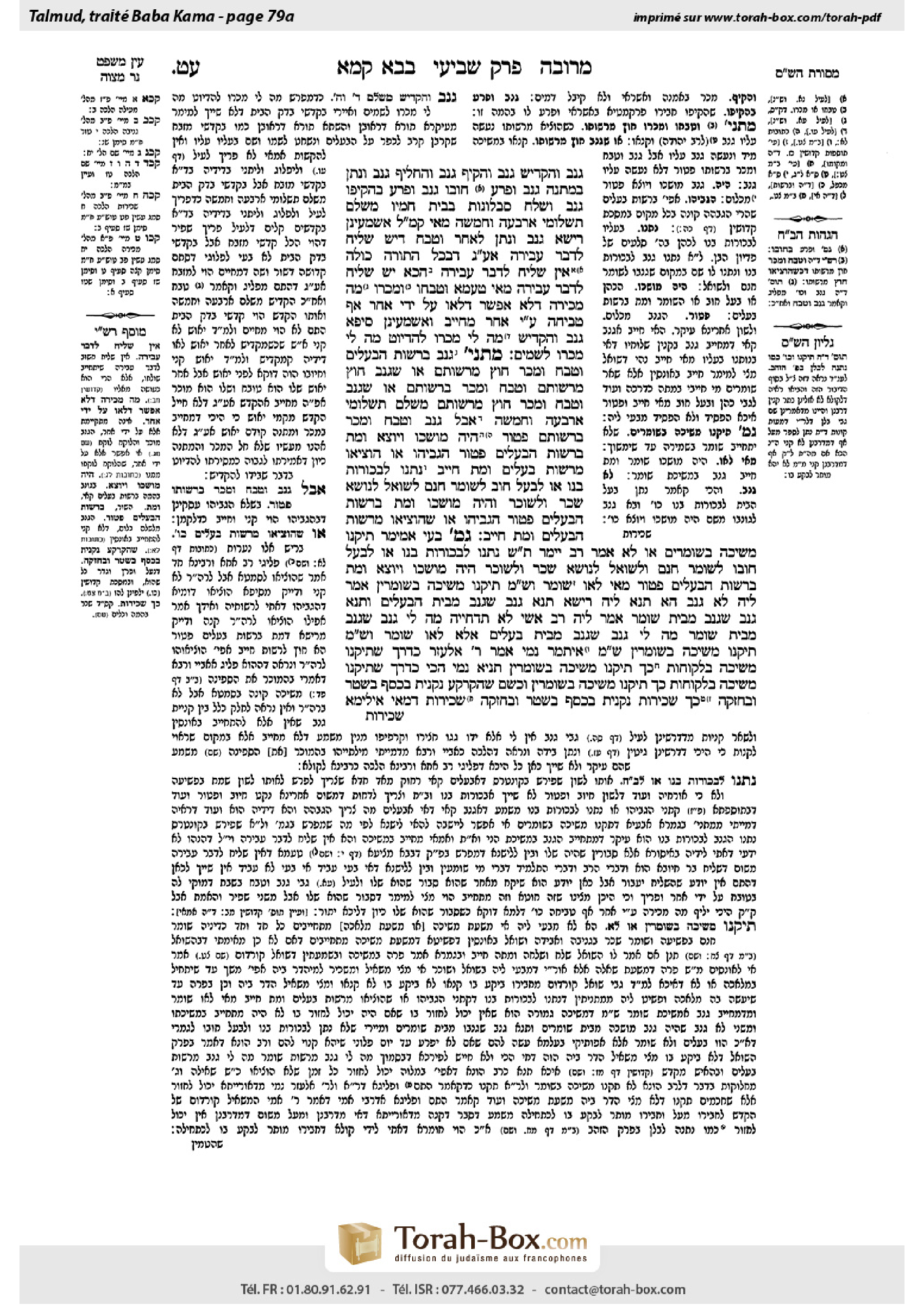
בבא קמא ע״ט א · Aramaic and Hebrew text
גָּנַב וְהִקְדִּישׁ; גָּנַב וְהִקִּיף; גָּנַב וְהֶחְלִיף; גָּנַב וְנָתַן בְּמַתָּנָה; גָּנַב וּפָרַע חוֹבוֹ; גָּנַב וּפָרַע בְּהֶקֵּיפוֹ; גָּנַב וְשָׁלַח סִבְלוֹנוֹת בְּבֵית חָמִיו – מְשַׁלֵּם תַּשְׁלוּמֵי אַרְבָּעָה וַחֲמִשָּׁה.
מַאי קָא מַשְׁמַע לַן? אַשְׁמְעִינַן רֵישָׁא גָּנַב וְנָתַן לְאַחֵר וְטָבַח – דְּיֵשׁ שָׁלִיחַ לִדְבַר עֲבֵירָה. אַף עַל גַּב דִּבְכׇל הַתּוֹרָה כּוּלָּהּ אֵין שָׁלִיחַ לִדְבַר עֲבֵירָה, הָכָא יֵשׁ שָׁלִיחַ לִדְבַר עֲבֵירָה.
מַאי טַעְמָא? ״וּטְבָחוֹ״ וּ״מְכָרוֹ״; מָה מְכִירָה – דְּלָא אֶפְשָׁר דְּלָאו עַל יְדֵי אַחֵר, אַף טְבִיחָה עַל יְדֵי אַחֵר – מִחַיַּיב.
וְאַשְׁמְעִינַן סֵיפָא גָּנַב וְהִקְדִּישׁ – מָה לִי מְכָרוֹ לְהֶדְיוֹט, מָה לִי מְכָרוֹ לַשָּׁמַיִם.
מַתְנִי׳ גָּנַב בִּרְשׁוּת הַבְּעָלִים, וְטָבַח וּמָכַר חוּץ מֵרְשׁוּתָם; אוֹ שֶׁגָּנַב חוּץ מֵרְשׁוּתָם, וְטָבַח וּמָכַר בִּרְשׁוּתָם; אוֹ שֶׁגָּנַב וְטָבַח וּמָכַר חוּץ מֵרְשׁוּתָם – מְשַׁלֵּם תַּשְׁלוּמֵי אַרְבָּעָה וַחֲמִשָּׁה. אֲבָל גָּנַב וְטָבַח וּמָכַר בִּרְשׁוּתָם – פָּטוּר.
הָיָה מוֹשְׁכוֹ וְיוֹצֵא, וּמֵת בִּרְשׁוּת הַבְּעָלִים – פָּטוּר. הִגְבִּיהוֹ אוֹ הוֹצִיאוֹ מֵרְשׁוּת בְּעָלִים, וָמֵת – חַיָּיב.
נְתָנוֹ לִבְכוֹרוֹת בְּנוֹ אוֹ לְבַעַל חוֹב, לְשׁוֹמֵר חִנָּם, לְשׁוֹאֵל, לְנוֹשֵׂא שָׂכָר וּלְשׂוֹכֵר; וְהָיָה מוֹשְׁכוֹ, וּמֵת בִּרְשׁוּת הַבְּעָלִים – פָּטוּר. הִגְבִּיהוֹ אוֹ שֶׁהוֹצִיאוֹ מֵרְשׁוּת הַבְּעָלִים, וָמֵת – חַיָּיב.
גְּמָ׳ בָּעֵי אַמֵּימָר: תִּיקְּנוּ מְשִׁיכָה בְּשׁוֹמְרִים, אוֹ לֹא?
אָמַר רַב יֵימַר, תָּא שְׁמַע: נְתָנוֹ לִבְכוֹרוֹת בְּנוֹ אוֹ לְבַעַל חוֹבוֹ, לְשׁוֹמֵר חִנָּם וּלְשׁוֹאֵל, לְנוֹשֵׂא שָׂכָר וּלְשׂוֹכֵר; הָיָה מוֹשְׁכוֹ וְיוֹצֵא, וּמֵת בִּרְשׁוּת הַבְּעָלִים – פָּטוּר. מַאי, לָאו שׁוֹמֵר – וּשְׁמַע מִינַּהּ תִּיקְּנוּ מְשִׁיכָה בְּשׁוֹמְרִין?
אֲמַר לֵיהּ: לָא, גַּנָּב.
הָא תְּנָא לֵיהּ רֵישָׁא! תְּנָא גַּנָּב שֶׁגָּנַב מִבֵּית הַבְּעָלִים, וּתְנָא גַּנָּב שֶׁגָּנַב מִבֵּית שׁוֹמֵר.
אֲמַר לֵיהּ רַב אָשֵׁי: לָא תְּדַחֲיֵיהּ; מָה לִי גַּנָּב שֶׁגָּנַב מִבֵּית שׁוֹמֵר, מָה לִי גַּנָּב שֶׁגָּנַב מִבֵּית בְּעָלִים?
אֶלָּא לָאו שׁוֹמֵר – וּשְׁמַע מִינַּהּ תִּיקְּנוּ מְשִׁיכָה בְּשׁוֹמְרִין? שְׁמַע מִינַּהּ. אִיתְּמַר נָמֵי, אָמַר רַבִּי אֶלְעָזָר: כְּדֶרֶךְ שֶׁתִּיקְּנוּ מְשִׁיכָה בְּלָקוֹחוֹת, כָּךְ תִּיקְּנוּ מְשִׁיכָה בְּשׁוֹמְרִין.
תַּנְיָא נָמֵי הָכִי: כְּדֶרֶךְ שֶׁתִּיקְּנוּ מְשִׁיכָה בְּלָקוֹחוֹת, כָּךְ תִּיקְּנוּ מְשִׁיכָה בְּשׁוֹמְרִין. וּכְשֵׁם שֶׁהַקַּרְקַע נִקְנֵית בְּכֶסֶף, בִּשְׁטָר וּבַחֲזָקָה, כָּךְ שְׂכִירוּת נִקְנֵית בְּכֶסֶף, בִּשְׁטָר וּבַחֲזָקָה.
שְׂכִירוּת דְּמַאי? אִילֵימָא
Bava Kamma 79a · English translation
The baraita continues: If he stole an animal and consecrated it, or if he stole an animal and sold it on credit, i.e., without receiving any money for it at the time, or if he stole an animal and exchanged it for another item, or if he stole an animal and gave it to another as a gift, or if he stole an animal and used it to repay his debt, or if he stole an animal and used it to pay for an item he purchased on credit, or if he stole an animal and sent it in the form of presents to his betrothed in his father-in-law’s house, in all of these cases he pays the fourfold or fivefold payment, as these acts are all considered forms of selling. This concludes the baraita.
The Gemara asks: What is this baraita teaching us? All of the halakhot it states are obvious. The Gemara answers: The first clause teaches us, through the case of one who stole an animal and gave it to another and that person slaughtered or sold it on his behalf, that in this case there is agency for transgression. Even though in the entire Torah there is a principle that there is no agency for transgression, here there is agency for transgression. The Torah’s principle is that a transgression committed by an agent who was appointed by another person is not considered the act of the one who appointed the agent, but the independent act of the agent himself. The case discussed by this baraita is an exception to the rule, as here, the agent’s slaughter or sale of the animal is legally considered the action of the thief.
What is the reason that this case is an exception to the principle? It is because the verse states: “And slaughters it or sells it” (Exodus 21:37), which juxtaposes the two acts of slaughtering and selling. This teaches that just as one becomes liable for selling, which by definition is impossible without another party, i.e., the buyer, so too one becomes liable for slaughtering even when it is by means of another party, i.e., when the thief instructs another person to slaughter the animal on his behalf.
And the latter clause of the baraita teaches us a novelty in the case of one who stole an animal and consecrated it. The novelty is that this is considered a sale despite the fact that there is no purchaser. This is due to the following argument: What difference is it to me if he sold the animal to an ordinary person, and what difference is it to me if he sold it to Heaven by consecrating it? If the animal changes ownership, it is considered a sale, and it does not matter if the new owner is an ordinary person or the Temple treasury.
MISHNA: If one stole an animal in its owner’s domain, i.e., he took hold of it or established control over it but had not yet removed it from the owner’s premises, and then he slaughtered it or sold it outside of the owner’s domain; or if he stole an animal outside of the owner’s domain and slaughtered it or sold it in the owner’s domain; or if he stole an animal and slaughtered it or sold it, and all of this occurred outside the owner’s domain, in all of these cases, he must pay the fourfold or fivefold payment. But if he stole it and slaughtered or sold it, and all of this occurred in the owner’s domain, he is exempt from any of the fines for theft, as it is not considered theft until the stolen object is actually removed from the owner’s premises.
If the thief was in the process of leading the animal and leaving the owner’s premises, and it died while it was still in the owner’s domain, the thief is exempt from all fines. If he lifted it up or led it out of the owner’s domain and then the animal died, he is liable for his theft. For an act to be considered theft, the thief must acquire the item by pulling it or moving it, which are ineffective forms of acquisition on the owner’s premises; or by lifting it up, which is effective even when performed in the owner’s domain.
If the thief gave the animal as payment for the redemption of his firstborn son, or as payment to a creditor, or conveyed it for safeguarding to an unpaid bailee, or lent it to a borrower, or conveyed it for safeguarding to a paid bailee, or leased it to a renter, and he was leading out the animal and it died in the owner’s domain, the thief is exempt from all fines. If that individual, following the thief’s instructions, lifted up the animal or led it out of the owner’s domain, and it subsequently died, the thief is liable for the theft. The thief is liable for instructing another to remove the animal for the purposes of payment of a debt, safekeeping, borrowing, or rental, as this is tantamount to the thief taking it with his own hands.
GEMARA: Ameimar raises a dilemma: Did the Sages institute the requirement of pulling or leading an animal with regard to bailees, or not? When an animal or other item is purchased, the parties to the sale are not bound by the deal until the purchaser performs an act of acquisition, one of which is pulling the animal or leading it along. Did the Sages institute an ordinance that the same applies to bailees? In other words, does the bailee’s obligation to safeguard the animal or item begin as soon as he consents to watch it, or only after he has taken the animal and moved it even minimally?
Rav Yeimar said: Come and hear a proof from the mishna: If the thief gave the animal as payment for the redemption of his firstborn son, or as payment to a creditor, or conveyed it for safeguarding to an unpaid bailee, or lent it to a borrower, or conveyed it for safeguarding to a paid bailee, or rented it to a renter, and he was leading out the animal and it died in the owner’s domain, the thief is exempt from payment. What, is it not talking about the bailee leading out the animal, when it states that the thief is exempt? And if so, conclude from this mishna that the Sages instituted the requirement of pulling with regard to bailees. If the bailee’s obligation begins immediately upon his consent to watch over the item, it would be considered stolen by the thief at that stage, even before the bailee moves it.
Ameimar said to Rav Yeimar: No, this is not necessarily the correct interpretation of the mishna. The mishna may mean that the owner gave the animal to his creditor or to a bailee, and subsequently a thief came to steal it from the house of the creditor or the bailee, and it was the thief who was leading the animal out of those premises when it died.
Rav Yeimar asked: How can that clause of the mishna refer to an animal that died as the thief was leading it out? The mishna already taught this halakha in the first clause. Ameimar answered: Nevertheless, it is possible that the mishna taught this halakha concerning a thief who stole an animal from its owner’s house, and then taught it again with regard to a thief who stole an animal from a bailee’s house.
Rav Ashi said to Ameimar: Do not reject Rav Yeimar’s argument by means of this alternative interpretation of the mishna. It is not reasonable to assert that the mishna taught this halakha twice, as what difference is it to me if the thief stole it from the bailee’s house and what difference is it to me if the thief stole it from the owner’s house? There is no halakhic distinction between these two cases. Therefore, the mishna would not have discussed both of them.
Rather, is it not more reasonable to say that the mishna should be interpreted as meaning that the bailee was leading the animal out of the owner’s house at the behest of the thief, as Rav Yeimar claimed? And therefore, one should conclude from the mishna that the Sages instituted the requirement of pulling with regard to bailees. The Gemara affirms: Conclude from the mishna that they did. It was also stated explicitly that Rabbi Elazar says: Just as the Sages instituted the requirement of pulling with regard to purchasers, so too they instituted the requirement of pulling with regard to bailees.
This is also taught in a baraita: Just as the Sages instituted the requirement of pulling with regard to purchasers, so too they instituted the requirement of pulling with regard to bailees. And just as land is acquired by the payment of money, by the writing of a deed of sale, or by the purchaser taking possession of the land through working it, so too a rental deal is finalized by the payment of money, by the writing of a deed of rent, or by the renter taking possession of the land. This concludes the baraita.
The Gemara asks: When the baraita speaks of rental, it is referring to rental of what kind of property? If we say
Bava Kamma 79a · Traduction française (IA)
La baraïta continue : Si l'on a volé un animal et l'a consacré, ou si l'on a volé un animal et l'a vendu à crédit, c'est-à-dire sans avoir reçu d'argent à l'époque, ou si l'on a volé un animal et l'a échangé contre un autre objet, ou si l'on a volé un animal et l'a donné en cadeau à un autre, ou si l'on a volé un animal et l'a utilisé pour rembourser sa dette, ou si l'on a volé un animal et l'a utilisé pour payer un objet acheté à crédit, ou si l'on a volé un animal et l'a envoyé sous forme de présents à sa fiancée dans la maison de son père, dans tous ces cas, il paie la réparation quatre fois ou cinq fois, car ces actes sont tous considérés comme des ventes. Cela conclut la baraïta.
Le Guemara pose la question : Qu'enseigne cette baraïta ? Tous les halakhot qu'elle mentionne sont évidents. Le Guemara répond : La première clause nous enseigne, par le cas d'une personne qui a volé un animal et l'a donné à un autre, et que ce dernier a sacrifié ou vendu l'animal à sa place, que dans ce cas, il y a une représentation de transgression. Même si dans toute la Torah il y a un principe selon lequel il n'y a pas de représentation de transgression, ici il y a une représentation de transgression. Le principe de la Torah est que une transgression commise par un agent désigné par une autre personne n'est pas considérée comme l'acte de celui qui a désigné l'agent, mais comme l'acte indépendant de l'agent lui-même. Le cas discuté par cette baraïta est une exception à la règle, car ici, la sacrifice ou la vente de l'animal par l'agent est juridiquement considérée comme l'action du voleur.
Quelle est la raison pour laquelle ce cas est une exception au principe ? C'est parce que la parabible dit : « Et il le sacrifie ou le vend » (Exode 21:37), qui juxtapose les deux actes de sacrifice et de vente. Cela enseigne que tout comme l'on est tenu responsable de la vente, qui par définition est impossible sans un autre partie, c'est-à-dire l'acheteur, de même l'on est tenu responsable du sacrifice même lorsqu'il est réalisé par un autre partie, c'est-à-dire lorsque le voleur instruit une autre personne de sacrifier l'animal à sa place.
Et la seconde clause de la baraïta nous enseigne une nouveauté dans le cas d'une personne qui a volé un animal et l'a consacré. La nouveauté est que cela est considéré comme une vente malgré le fait qu'il n'y ait pas d'acheteur. Cela est dû à l'argument suivant : Quelle différence fait-il pour moi si l'on a vendu l'animal à une personne ordinaire, et quelle différence fait-il pour moi si l'on a vendu l'animal à Dieu en le consacrant ? Si l'animal change de propriétaire, cela est considéré comme une vente, et cela n'a pas d'importance si le nouveau propriétaire est une personne ordinaire ou le trésor du Temple.
MICHNA : Si l'on a volé un animal dans le domaine de son propriétaire, c'est-à-dire qu'on a pris possession de lui ou qu'on a établi un contrôle sur lui mais qu'on n'avait pas encore enlevé l'animal des lieux du propriétaire, et ensuite on l'a sacrifié ou vendu en dehors du domaine du propriétaire ; ou si l'on a volé un animal en dehors du domaine du propriétaire et l'a sacrifié ou vendu dans le domaine du propriétaire ; ou si l'on a volé un animal et l'a sacrifié ou vendu, et cela s'est produit en dehors du domaine du propriétaire, dans tous ces cas, il doit payer la réparation quatre fois ou cinq fois. Mais si l'on a volé l'animal et l'a sacrifié ou vendu, et cela s'est produit dans le domaine du propriétaire, il est exempt de toute amende pour vol.
Si le voleur était en train de conduire l'animal et de quitter la propriété du propriétaire, et que l'animal est mort alors qu'il était encore dans la propriété du propriétaire, le voleur est exempt de toute amende. Si l'on a soulevé l'animal ou l'a conduit hors de la propriété du propriétaire et ensuite l'animal est mort, il est tenu responsable de son vol. Pour qu'un acte soit considéré comme un vol, le voleur doit acquérir l'objet en le tirant ou en le déplaçant, qui sont des formes inefficaces d'acquisition dans la propriété du propriétaire ; ou en le soulevant, qui est efficace même lorsqu'il est effectué dans la propriété du propriétaire.
Si le voleur a donné l'animal comme paiement pour la délivrance de son premier-né, ou comme paiement à un créancier, ou l'a confié pour la garde à un gardien non rémunéré, ou l'a prêté à un emprunteur, ou l'a confié pour la garde à un gardien rémunéré, ou l'a loué à un locataire, et qu'il était en train de conduire l'animal et qu'il est mort dans la propriété du propriétaire, le voleur est exempt de toute amende. Si cette personne, suivant les instructions du voleur, a soulevé l'animal ou l'a conduit hors de la propriété du propriétaire, et qu'il est ensuite mort, le voleur est tenu responsable du vol. Le voleur est tenu responsable d'avoir instruit un autre de retirer l'animal à des fins de paiement d'une dette, de garde, de prêt ou de location, car cela équivaut à ce que le voleur l'ait fait lui-même.
GUEMARA : Ameimar soulève un dilemme : Les Sages ont-ils institué la nécessité de tirer ou de conduire un animal concernant les gardiens ? Lorsqu'un animal ou un autre objet est acheté, les parties à l'achat ne sont pas liées par le contrat jusqu'à ce que l'acheteur accomplisse une acquisition, l'une desquelles est de tirer l'animal ou de le conduire. Les Sages ont-ils institué un ordonnance selon laquelle cela s'applique également aux gardiens ? En d'autres termes, l'obligation du gardien de garder l'animal ou l'objet commence-t-elle dès qu'il consent à le surveiller, ou seulement après qu'il ait pris l'animal et l'ait déplacé même légèrement ?
Rav Yeimar dit : Viens écouter une preuve dans la mishna : Si le voleur a donné l'animal comme paiement pour la délivrance de son premier-né, ou comme paiement à un créancier, ou l'a confié pour la garde à un gardien non rémunéré, ou l'a prêté à un emprunteur, ou l'a confié pour la garde à un gardien rémunéré, ou l'a loué à un locataire, et qu'il était en train de conduire l'animal et qu'il est mort dans le domaine du propriétaire, le voleur est exempt de paiement. Qu'est-ce que cela ne parle pas du gardien qui conduit l'animal, lorsque cela dit que le voleur est exempt ? Et si c'est ainsi, concluez de cette mishna que les Sages ont institué la nécessité de tirer concernant les gardiens. Si l'obligation du gardien commence immédiatement à son consentement à surveiller l'objet, cela serait considéré comme volé par le voleur à cette étape, même avant que le gardien ne le déplace.
Ameimar a dit à Rav Yeimar : Non, cela n'est pas nécessairement l'interprétation correcte de la mitsna. La mitsna peut signifier que l'owner a donné l'animal à son créancier ou à un dépositaire, et ensuite un voleur est venu voler cet animal à la maison du créancier ou du dépositaire, et c'est le voleur qui menait l'animal hors de ces lieux lorsqu'il est mort.
Rav Yeimar a demandé : Comment cette clause de la mitsna peut-elle faire référence à un animal mort alors que le voleur le menait hors de la maison ? La mitsna a déjà enseigné cette halakha dans la première clause. Ameimar a répondu : Néanmoins, il est possible que la mitsna ait enseigné cette halakha concernant un voleur qui avait volé un animal de la maison de son propriétaire, et puis l'a répétée concernant un voleur qui avait volé un animal de la maison d'un dépositaire.
Rav Ashi a dit à Ameimar : N'ignorez pas l'argument de Rav Yeimar en utilisant cette autre interprétation de la mitsna. Il n'est pas raisonnable d'affirmer que la mitsna a enseigné cette halakha deux fois, car quelle différence cela fait-il pour moi si le voleur a volé l'animal de la maison du dépositaire et quelle différence cela fait-il pour moi si le voleur a volé l'animal de la maison du propriétaire ? Il n'y a pas de distinction halakhique entre ces deux cas. Par conséquent, la mitsna n'aurait pas discuté des deux cas.
Plutôt, n'est-il pas plus raisonnable de dire que la mitsva devrait être interprétée comme signifiant que le dépositaire menait l'animal hors de la maison du propriétaire à la demande du voleur, comme Rav Yeimar l'avait affirmé ? Et par conséquent, on devrait conclure de la mitsva que les Sages ont institué la nécessité de tirer concernant les dépositaires. La Guemara confirme : Concluez de la mitsva qu'ils l'ont fait. Il a également été dit explicitement que Rabbi Eléazar dit : Comme les Sages ont institué la nécessité de tirer concernant les acheteurs, ainsi aussi ils l'ont instituée concernant les dépositaires.
Cela est également enseigné dans une baraïta : Comme les Sages ont institué la nécessité de tirer concernant les acheteurs, ainsi aussi ils l'ont instituée concernant les dépositaires. Et comme la terre est acquise par le paiement d'argent, par l'écriture d'un contrat de vente, ou par l'acheteur qui prend possession de la terre en la cultivant, ainsi aussi un contrat de location est finalisé par le paiement d'argent, par l'écriture d'un contrat de location, ou par la prise de possession de la terre par le locataire. Cela conclut la baraïta.
La Guemara pose la question : Lorsque la baraïta parle de location, elle fait référence à quel type de propriété ? Si nous disons
Traduction française générée par IA à partir de l’édition anglaise de Sefaria. Vérifie toujours un passage avec le texte source.
Text from Sefaria: William Davidson Edition - Vocalized Aramaic (CC BY NC); William Davidson Edition - English (CC BY NC).