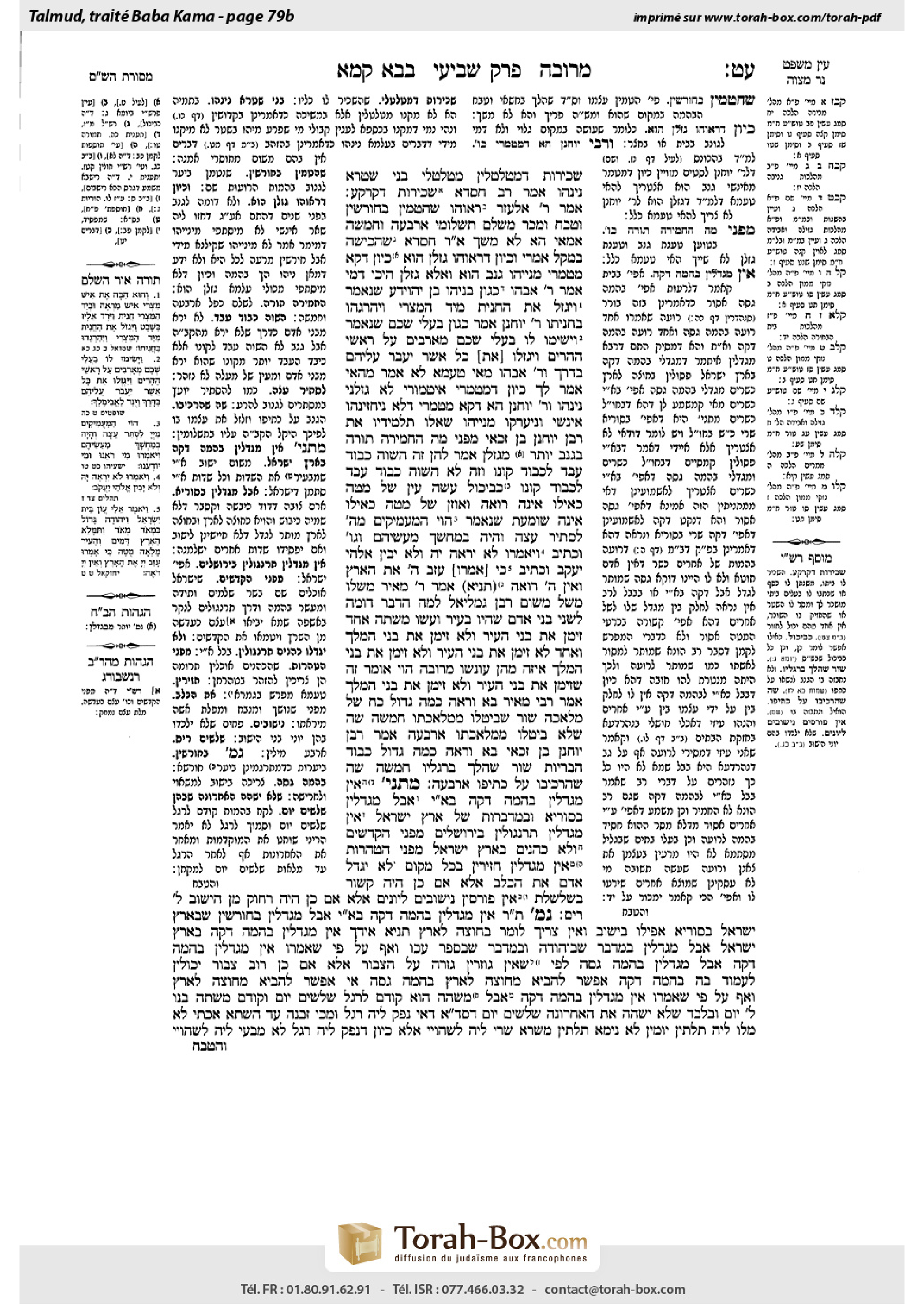
Bava Kamma 79b: Talmud study for Daf Yomi
Study the Talmud for Daf Yomi with scanned pages, Hebrew text, English translations from Sefaria and AI-generated French translations.
Passage selection and English or AI-generated French translation are available where the scan has annotations. Daf Study is independent of Torah-Box and Sefaria.
Browse Bava Kamma · בבא קמא · All tractatesBava Kamma 79b text and translations
This page of Bava Kamma includes the Aramaic text, an English translation and an AI-generated French translation, alongside the scan above.
בבא קמא ע״ט ב · Aramaic and Hebrew text
שְׂכִירוּת דְּמִטַּלְטְלִין, מִטַּלְטְלִי בְּנֵי שְׁטָרָא נִינְהוּ?! אָמַר רַב חִסְדָּא: שְׂכִירוּת דְּקַרְקַע.
אָמַר רַבִּי אֶלְעָזָר: רָאוּהוּ שֶׁהִטְמִין בָּחוֹרָשִׁין וְטָבַח וּמָכַר – מְשַׁלֵּם תַּשְׁלוּמֵי אַרְבָּעָה וַחֲמִשָּׁה. אַמַּאי? הָא לֹא מָשַׁךְ! אָמַר רַב חִסְדָּא: שֶׁהִכִּישָׁהּ בְּמַקֵּל.
אָמְרִי: וְכֵיוָן דְּרָאוּהוּ, גַּזְלָן הוּא! כֵּיוָן דְּקָא מִטַּמַּרי מִנַּיְיהוּ, גַּנָּב הוּא.
וְאֶלָּא גַּזְלָן הֵיכִי דָּמֵי? אָמַר רַבִּי אֲבָהוּ: כְּגוֹן בְּנָיָהוּ בֶּן יְהוֹיָדָע, שֶׁנֶּאֱמַר: ״וַיִּגְזֹל אֶת הַחֲנִית מִיַּד הַמִּצְרִי, וַיַּהַרְגֵהוּ בַּחֲנִיתוֹ״.
רַבִּי יוֹחָנָן אָמַר: כְּגוֹן בַּעֲלֵי שְׁכֶם, שֶׁנֶּאֱמַר: ״וַיָּשִׂימוּ לוֹ בַעֲלֵי שְׁכֶם מְאָרְבִים עַל רָאשֵׁי הֶהָרִים, וַיִּגְזְלוּ [אֵת] כׇּל אֲשֶׁר יַעֲבֹר עֲלֵיהֶם בַּדָּרֶךְ״.
וְרַבִּי אֲבָהוּ – מַאי טַעְמָא לָא אָמַר מֵהַאי? אָמַר לָךְ: כֵּיוָן דְּמִטַּמְּרִי אִיטַּמּוֹרֵי, לָא גַּזְלָנֵי נִינְהוּ. וְרַבִּי יוֹחָנָן – הָא דְּקָא מִטַּמְּרִי, דְּלָא נִיחְזִינְהוּ אִינָשֵׁי וְנִיעְרְקוּ מִנַּיְיהוּ.
שָׁאֲלוּ תַּלְמִידָיו אֶת רַבָּן יוֹחָנָן בֶּן זַכַּאי: מִפְּנֵי מָה הֶחְמִירָה תּוֹרָה בְּגַנָּב יוֹתֵר מִגַּזְלָן? אָמַר לָהֶן: זֶה – הִשְׁוָה כְּבוֹד עֶבֶד לִכְבוֹד קוֹנוֹ, וְזֶה – לֹא הִשְׁוָה כְּבוֹד עֶבֶד לִכְבוֹד קוֹנוֹ.
כִּבְיָכוֹל עָשָׂה עַיִן שֶׁל מַטָּה כְּאִילּוּ אֵינָהּ רוֹאָה, וְאוֹזֶן שֶׁל מַטָּה כְּאִילּוּ אֵינָהּ שׁוֹמַעַת, שֶׁנֶּאֱמַר: ״הוֹי הַמַּעֲמִיקִים מֵה׳ לַסְתִּר עֵצָה, וְהָיָה בְמַחְשָׁךְ מַעֲשֵׂיהֶם וְגוֹ׳״; וּכְתִיב: ״וַיֹּאמְרוּ לֹא יִרְאֶה יָּהּ וְלֹא יָבִין אֱלֹהֵי יַעֲקֹב״; וּכְתִיב: ״כִּי [אָמְרוּ] עָזַב ה׳ אֶת הָאָרֶץ, וְאֵין ה׳ רֹאֶה״.
תַּנְיָא, אָמַר רַבִּי מֵאִיר: מָשְׁלוּ מָשָׁל מִשּׁוּם רַבָּן גַּמְלִיאֵל, לְמָה הַדָּבָר דּוֹמֶה? לִשְׁנֵי בְּנֵי אָדָם שֶׁהָיוּ בְּעִיר וְעָשׂוּ מִשְׁתֶּה, אֶחָד זִימֵּן אֶת בְּנֵי הָעִיר וְלֹא זִימֵּן אֶת בְּנֵי הַמֶּלֶךְ, וְאֶחָד לֹא זִימֵּן אֶת בְּנֵי הָעִיר וְלֹא זִימֵּן אֶת בְּנֵי הַמֶּלֶךְ. אֵיזֶה מֵהֶן עוֹנְשׁוֹ מְרוּבֶּה? הֱוֵי אוֹמֵר: זֶה שֶׁזִּימֵּן אֶת בְּנֵי הָעִיר וְלֹא זִימֵּן אֶת בְּנֵי הַמֶּלֶךְ.
אָמַר רַבִּי מֵאִיר: בֹּא וּרְאֵה כַּמָּה גָּדוֹל כֹּחַ שֶׁל מְלָאכָה: שׁוֹר, שֶׁבִּיטְּלוֹ מִמְּלַאכְתּוֹ – חֲמִשָּׁה; שֶׂה, שֶׁלֹּא בִּיטְּלוֹ מִמְּלַאכְתּוֹ – אַרְבָּעָה.
אָמַר רַבָּן יוֹחָנָן בֶּן זַכַּאי, בֹּא וּרְאֵה כַּמָּה גָּדוֹל כְּבוֹד הַבְּרִיּוֹת: שׁוֹר, שֶׁהָלַךְ בְּרַגְלָיו – חֲמִשָּׁה; שֶׂה, שֶׁהִרְכִּיבוֹ עַל כְּתֵיפוֹ – אַרְבָּעָה.
מַתְנִי׳ אֵין מְגַדְּלִין בְּהֵמָה דַּקָּה בְּאֶרֶץ יִשְׂרָאֵל; אֲבָל מְגַדְּלִין בְּסוּרְיָא, וּבַמִּדְבָּרוֹת שֶׁל אֶרֶץ יִשְׂרָאֵל.
אֵין מְגַדְּלִין תַּרְנְגוֹלִין בִּירוּשָׁלַיִם, מִפְּנֵי הַקֳּדָשִׁים; וְלֹא כֹּהֲנִים בְּאֶרֶץ יִשְׂרָאֵל, מִפְּנֵי הַטְּהָרוֹת.
אֵין מְגַדְּלִין חֲזִירִין – בְּכׇל מָקוֹם. לֹא יְגַדֵּל אָדָם אֶת הַכֶּלֶב, אֶלָּא אִם כֵּן הָיָה קָשׁוּר בְּשַׁלְשֶׁלֶת. אֵין פּוֹרְסִין נִישּׁוּבִים לְיוֹנִים, אֶלָּא אִם כֵּן הָיָה רָחוֹק מִן הַיִּשּׁוּב שְׁלֹשִׁים רִיס.
גְּמָ׳ תָּנוּ רַבָּנַן: אֵין מְגַדְּלִין בְּהֵמָה דַּקָּה בְּאֶרֶץ יִשְׂרָאֵל, אֲבָל מְגַדְּלִין בָּחוֹרָשִׁין שֶׁל אֶרֶץ יִשְׂרָאֵל. בְּסוּרְיָא – אֲפִילּוּ בַּיִּשּׁוּב, וְאֵין צָרִיךְ לוֹמַר בְּחוּצָה לָאָרֶץ.
תַּנְיָא אִידַּךְ: אֵין מְגַדְּלִין בְּהֵמָה דַּקָּה בְּאֶרֶץ יִשְׂרָאֵל; אֲבָל מְגַדְּלִין בַּמִּדְבָּר שֶׁבִּיהוּדָה, וּבַמִּדְבָּר שֶׁבִּסְפַר עַכּוֹ. וְאַף עַל פִּי שֶׁאָמְרוּ אֵין מְגַדְּלִין בְּהֵמָה דַּקָּה, אֲבָל מְגַדְּלִין בְּהֵמָה גַּסָּה; לְפִי שֶׁאֵין גּוֹזְרִין גְּזֵרָה עַל הַצִּבּוּר אֶלָּא אִם כֵּן רוֹב צִבּוּר יְכוֹלִין לַעֲמוֹד בָּהּ.
בְּהֵמָה דַּקָּה אֶפְשָׁר לְהָבִיא מֵחוּצָה לָאָרֶץ, בְּהֵמָה גַּסָּה אִי אֶפְשָׁר לְהָבִיא מֵחוּצָה לָאָרֶץ.
וְאַף עַל פִּי שֶׁאָמְרוּ אֵין מְגַדְּלִין בְּהֵמָה דַּקָּה – אֲבָל מְשַׁהָהּ הוּא קוֹדֶם לָרֶגֶל שְׁלֹשִׁים יוֹם, וְקוֹדֶם מִשְׁתֵּה בְּנוֹ שְׁלֹשִׁים יוֹם. וּבִלְבַד שֶׁלֹּא יְשַׁהֶה אֶת הָאַחֲרוֹנָה שְׁלֹשִׁים יוֹם.
דְּסָלְקָא דַּעְתָּךְ אָמֵינָא דְּאִי נְפַק לֵיהּ רֶגֶל, וּמִכִּי זַבְנַהּ עַד הַשְׁתָּא אַכַּתִּי לָא מְלוֹ לֵיהּ תְּלָתִין יוֹמִין; לָא נֵימָא תְּלָתִין מִשְׁרָא שְׁרֵי לֵיהּ לְשַׁהוֹיֵי, אֶלָּא כֵּיוָן דִּנְפַק לֵיהּ רֶגֶל – לָא מִבְּעֵי לֵיהּ לְשַׁהוֹיֵי.
Bava Kamma 79b · English translation
it is speaking of the rental of movable property, is movable property subject to the writing of a deed? Rather, Rav Ḥisda said: It is referring to the rental of land.
§ Rabbi Elazar says: If people saw a thief who was hiding in the woods near a herd of grazing animals, and that individual emerged and slaughtered or sold one of the animals from the herd, he pays the fourfold or fivefold payment. The Gemara asks: Why is the thief liable to the fourfold or fivefold payment? But he did not pull the animal. Rabbi Elazar is apparently describing a case where the thief emerged from the forest and slaughtered one of the animals without first moving it, and there is no fourfold or fivefold payment unless the thief first steals the animal. Rav Ḥisda says: This is referring to a case where he hit the animal with a stick, causing it to move.
With regard to Rabbi Elazar’s statement, the Sages say: But since people saw him doing all this, he is a robber, not a thief, and the fourfold or fivefold payment applies only to thieves. A thief is one who sneaks into a house or other private property; one who commits his act brazenly, in public, is classified as a robber. The Gemara answers: Since he was hiding from them, he is considered a thief, despite the fact that they saw him.
The Gemara asks: But if so, what are the circumstances of a robber? Rabbi Abbahu said: Robbers are like the case of Benaiah ben Jehoiada, as it is stated concerning him: “He slew an Egyptian, a goodly man; and the Egyptian had a spear in his hand; but he went down to him with a staff, and he robbed the spear out of the Egyptian’s hand, and slew him with his own spear” (II Samuel 23:21).
Rabbi Yoḥanan said: A different example of a robber is a case like that of the men of Shechem, as it is stated: “And the men of Shechem set ambushers for him on the tops of the mountains, and they robbed all that came along that way by them” (Judges 9:25).
The Gemara asks: And what is the reason that Rabbi Abbahu did not say the example from this verse, which discusses the men of Shechem? He could have said to you: Since the men of Shechem were hiding in ambush, they are not considered robbers but thieves. And how would Rabbi Yoḥanan respond to this claim? This fact that they were hiding was not because they were hesitant to steal in view of the public. Rather, they acted in this manner so that the travelers should not see them in advance and flee from them.
§ The Gemara concludes its discussion of theft with several aggadic statements. His students asked Rabban Yoḥanan ben Zakkai: For what reason was the Torah stricter with a thief than with a robber? Only a thief is required to pay the double, fourfold, or fivefold payment, not a robber. Rabban Yoḥanan ben Zakkai said to them in response: This one, the robber, equated the honor of the servant to the honor of his Master, and that one, the thief, did not equate the honor of the servant to the honor of his Master. The robber fears neither God nor people, as he is not afraid to rob in public. The thief does not fear God but he does fear other people, which demonstrates that he is more concerned about humans than God.
As it were, the thief establishes the eye below, i.e., God’s eye, as though it does not see, and the ear below, i.e., God’s ear, as though it does not hear. The Gemara cites verses that describe people who imagine that God does not see their actions, as it is stated: “Woe to them who seek deeply to hide their counsel from the Lord, and their works are in the dark, and they say: Who sees us, and who knows us?” (Isaiah 29:15). And it is written: “And they say: The Lord will not see, neither will the God of Jacob give heed” (Psalms 94:7). And it is written: “For they say: The Lord has forsaken the land, and the Lord does not see” (Ezekiel 9:9).
It is taught in a baraita that Rabbi Meir said: To illustrate the severity of a thief over a robber, as per Rabban Yoḥanan ben Zakkai’s explanation, they stated a parable in the name of Rabban Gamliel. To what is this matter comparable? To two people who were living in the same city, and both of them prepared a feast. One of them invited the people of the city to his feast but he did not invite the king’s sons. And the other did not invite the people of the city and also did not invite the king’s sons. Which of them deserves a greater punishment? You must say that it is this one who invited the people of the city but did not invite the king’s sons. Likewise, both the thief and the robber show disdain for God, but the robber does not display more respect for people.
The Gemara discusses why there is a fourfold payment for a sheep but a fivefold payment for an ox. Rabbi Meir said: Come and see how great the power of labor is. The theft of an ox, which was forced by the thief to cease its labor, leads to a fivefold payment; whereas the theft of a sheep, which was not forced by the thief to cease its labor, as a sheep performs no labor, leads to only a fourfold payment.
Rabban Yoḥanan ben Zakkai said: Come and see how great human dignity is. The theft of an ox, which walked on its own legs as the thief stole it, leads to a fivefold payment, whereas the theft of a sheep, which the thief carried on his shoulder as he walked, thereby causing himself embarrassment, leads to only a fourfold payment.
MISHNA: One may not raise small domesticated animals, i.e., sheep and goats, in settled areas of Eretz Yisrael, as they graze on people’s crops. But one may raise them in Syria, despite the fact that with regard to many other halakhot Syria is treated like Eretz Yisrael, and in the wilderness of Eretz Yisrael.
One may not raise chickens in Jerusalem, due to the sacrificial meat that is common there. There is a concern that chickens will pick up garbage that imparts ritual impurity and bring it into contact with sacrificial meat, thereby rendering it ritually impure. And priests may not raise chickens anywhere in Eretz Yisrael, because of the many foods in a priest’s possession that must be kept ritually pure, e.g., teruma.
Furthermore, one may not raise pigs anywhere, and a person may not raise a dog unless it is tied with chains. One may spread out traps [nishovim] for pigeons only if this was performed at a distance of at least thirty ris, which is 8,000 cubits, from any settled area, to ensure that privately owned pigeons are not caught in the traps.
GEMARA: The Sages taught in a baraita: One may not raise small domesticated animals, i.e., sheep and goats, in settled areas of Eretz Yisrael. But one may raise them in the forests of Eretz Yisrael. In Syria, it is permitted to do so even in a settled area. And, needless to say, it is permitted to do so outside of Eretz Yisrael.
It is taught in another baraita: One may not raise small domesticated animals in settled areas of Eretz Yisrael. But one may raise them in the wilderness that is in Judea and in the wilderness that is on the border near Akko. And even though the Sages said that one may not raise small domesticated animals, nevertheless, one may raise large, domesticated animals, i.e., cattle, because the Sages issue a decree upon the public only if a majority of the public is able to abide by it.
This difference is that it is possible for someone to bring small domesticated animals from outside of Eretz Yisrael in the event that they are needed. But it is not possible for someone to bring large, domesticated animals from outside of Eretz Yisrael whenever he needs one, since there is a constant need for them as beasts of burden. Therefore, the Sages did not issue a decree with regard to these types of animals.
The baraita continues: And even though they said that one may not raise small domesticated animals, however, one may keep these animals on his premises for thirty days before a pilgrimage Festival, and thirty days before the wedding feast of one’s son, when many animals are needed for food, provided that he does not leave the last one, i.e., the animal which he purchased immediately before the Festival, for thirty days.
The Gemara clarifies the final line of the baraita: The baraita needs to state this ruling as it might enter your mind to say that if the pilgrimage Festival has passed and thirty days have not yet elapsed from the time when he bought the animal until now, he may keep the animal until thirty days have elapsed. To counter this, the baraita teaches that we do not say: It is permitted to keep it for a total of thirty days. Rather, once the pilgrimage Festival has passed, he should not keep it any longer.
Bava Kamma 79b · Traduction française (IA)
Il s'agit du louage de biens mobiliers. Les biens mobiliers sont-ils soumis à l'écriture d'un contrat ? Plutôt, Rav Ḥisda a dit : il s'agit du louage de terre.
§ Rabbi Elazar dit : si des gens ont vu un voleur qui se cachait dans la forêt près d'un troupeau de bêtes paissant, et que cette personne est sortie et a tué ou vendu l'une des bêtes du troupeau, il paie la réparation quadruple ou quintuple. La Guemara pose la question : pourquoi le voleur est-il tenu responsable de la réparation quadruple ou quintuple ? Mais il n'a pas tiré la bête. Rabbi Elazar décrit apparemment un cas où le voleur est sorti de la forêt et a tué l'une des bêtes sans d'abord la déplacer, et il n'y a pas de réparation quadruple ou quintuple à moins que le voleur ne vole d'abord la bête. Rav Ḥisda dit : il s'agit d'un cas où il a frappé la bête avec un bâton, la faisant bouger.
En ce qui concerne l'affirmation de Rabbi Elazar, les Sages disent : mais puisque les gens l'ont vu faire cela, il est un voleur, pas un voleur, et la réparation quadruple ou quintuple s'applique uniquement aux voleurs. Un voleur est celui qui s'introduit furtivement dans une maison ou une autre propriété privée ; celui qui commet son acte ouvertement, en public, est classé comme un voleur. La Guemara répond : puisqu'il était caché d'eux, il est considéré comme un voleur, malgré le fait qu'ils l'aient vu.
La Guemara pose la question : mais alors, quels sont les circonstances d'un voleur ? Rabbi Abbahu a dit : les voleurs sont comme le cas de Benaïah ben Jéhoïada, comme il est dit à son sujet : « Il tua un Égyptien, un homme de valeur ; et l'Égyptien avait une lance en main ; mais il descendit vers lui avec un bâton, et il arracha la lance de la main de l'Égyptien, et le tua avec sa propre lance » (II Samuel 23:21).
Rabbi Yoḥanan a dit : un autre exemple de voleur est le cas des hommes de Sichem, comme il est dit : « Et les hommes de Sichem mirent des embusques pour lui sur les sommets des montagnes, et ils volèrent tout ce qui passait par là » (Juges 9:25).
La Guemara pose la question : et pourquoi Rabbi Abbahu n'a-t-il pas dit l'exemple tiré de cette versette, qui parle des hommes de Sichem ? Il aurait pu dire : puisque les hommes de Sichem étaient cachés, ils ne sont pas considérés comme des voleurs mais comme des voleurs. Et comment Rabbi Yoḥanan répondrait-il à cette affirmation ? Ce fait qu'ils étaient cachés n'était pas à cause de leur hésitation à voler en public. Ils agissaient ainsi pour que les voyageurs ne les voient pas à l'avance et ne fuient pas.
§ La Guemara conclut ainsi sa discussion sur le vol avec plusieurs déclarations aggadiques. Ses élèves ont demandé à Rabban Yoḥanan ben Zakkai : Pourquoi la Torah est-elle plus sévère envers le voleur qu'envers le voleur ? Seul le voleur est tenu de payer la double, la quadruple ou la quintuple réparation, pas le voleur. Rabban Yoḥanan ben Zakkai a répondu à eux : celui-ci, le voleur, a égalisé l'honneur du serviteur à celui de son maître, et celui-là, le voleur, n'a pas égalisé l'honneur du serviteur à celui de son maître. Le voleur n'a ni peur de Dieu ni de la gente, car il n'a pas peur de voler en public. Le voleur n'a pas peur de Dieu mais il craint les autres, ce qui montre qu'il est plus préoccupé par les humains que par Dieu.
En somme, le voleur établit l'œil en bas, c'est-à-dire l'œil de Dieu, comme s'il ne le voyait pas, et l'oreille en bas, c'est-à-dire l'oreille de Dieu, comme s'il ne l'entendait pas. La Guemara cite des versets qui décrivent des gens qui imaginent que Dieu ne voit pas leurs actions, comme il est dit : « Malheur à ceux qui cherchent à cacher leur conseil de l'Éternel, et leurs œuvres sont dans l'obscurité, et ils disent : Qui nous voit, et qui nous connaît ? » (Isaïe 29:15). Et il est écrit : « Et ils disent : L'Éternel ne voit pas, ni le Dieu de Jacob ne prend garde » (Psaumes 94:7). Et il est écrit : « Car ils disent : L'Éternel a abandonné la terre, et l'Éternel ne voit pas » (Ezechiel 9:9).
Il est enseigné dans une baraïta que Rabbi Meir a dit : pour illustrer la sévérité du voleur par rapport au voleur, selon l'explication de Rabban Yoḥanan ben Zakkai, ils ont évoqué une parabole au nom de Rabban Gamliel. À quoi cela est-il comparable ? À deux personnes qui vivaient dans la même ville, et qui avaient tous deux préparé un festin. L'une d'entre elles a invité les habitants de la ville à son festin mais n'a pas invité les fils du roi. L'autre n'a pas invité les habitants de la ville et n'a pas non plus invité les fils du roi. Quel est celui qui mérite une punition plus grande ? Vous devez dire que c'est celui qui a invité les habitants de la ville mais n'a pas invité les fils du roi. De même, à la fois le voleur et le voleur montrent un mépris pour Dieu, mais le voleur ne montre pas plus de respect pour les gens.
La Guemara discute pourquoi il y a une réparation quadruple pour une brebis mais une réparation quintuple pour un bœuf. Rabbi Meir a dit : viens voir combien la force du travail est grande. Le vol d'un bœuf, qui a été contraint par le voleur à cesser son travail, entraîne une réparation quintuple ; tandis que le vol d'une brebis, qui n'a pas été contraint par le voleur à cesser son travail, car la brebis ne travaille pas, entraîne seulement une réparation quadruple.
Rabban Yoḥanan ben Zakkai a dit : viens voir combien la dignité humaine est grande. Le vol d'un bœuf, qui marchait sur ses propres jambes lorsque le voleur l'a volé, entraîne une réparation quintuple, tandis que le vol d'une brebis, que le voleur a porté sur son épaule en marchant, causant ainsi à lui-même une humiliation, entraîne seulement une réparation quadruple.
MICHNA : On ne doit pas élever des petits animaux domestiques, c'est-à-dire des brebis et des chèvres, dans les zones habitées de la Terre d'Israël, car ils paissent sur les cultures des gens. Mais on peut les élever en Syrie, malgré le fait que, concernant de nombreuses autres halakhot, la Syrie est traitée comme la Terre d'Israël, et dans le désert de la Terre d'Israël.
On ne peut pas élever des poulets à Jérusalem, en raison de la viande sacrificielle qui y est courante. Il y a une crainte que les poulets ramassent des déchets qui transmettent l'impureté rituelle et les mettent en contact avec la viande sacrificielle, ce qui la rendrait impure rituellement. Et les prêtres ne peuvent pas élever des poulets nulle part en Terre d'Israël, en raison des nombreux aliments qu'ils possèdent qui doivent rester rituellement purs, par exemple la terouma.
De plus, on ne peut pas élever des porcs nulle part, et une personne ne peut pas élever un chien à moins qu'il ne soit attaché avec des chaînes. On peut étendre des pièges [nishovim] pour des pigeons uniquement si cela a été fait à une distance d'au moins trente ris, soit 8 000 coudées, d'aucun lieu habité, afin d'assurer que les pigeons privés ne soient pas capturés dans les pièges.
GUEMARA : Les Sages ont enseigné dans une baraïta : On ne peut pas élever des petits animaux domestiques, c'est-à-dire des moutons et des chèvres, dans les lieux habités de Terre d'Israël. Mais on peut les élever dans les forêts de Terre d'Israël. En Syrie, il est permis de le faire même dans un lieu habité. Et, sans aucun doute, il est permis de le faire en dehors de Terre d'Israël.
Il est enseigné dans une autre baraïta : On ne peut pas élever des petits animaux domestiques dans les lieux habités de la Terre d'Israël. Mais on peut les élever dans les déserts de Judée et dans les déserts situés à la frontière près d'Acre. Et même si les Sages ont dit qu'on ne peut pas élever des petits animaux domestiques, néanmoins, on peut élever des grands animaux domestiques, c'est-à-dire des bœufs, car les Sages émettent un décret concernant le public uniquement si la majorité du public peut y adhérer.
Cette différence réside dans le fait qu'il est possible pour quelqu'un d'apporter des petits animaux domestiques de l'extérieur de la Terre d'Israël en cas de besoin. Mais il n'est pas possible pour quelqu'un d'apporter des grands animaux domestiques de l'extérieur de la Terre d'Israël chaque fois qu'il en a besoin, car il y a une constante nécessité d'eux en tant que bêtes de somme. Par conséquent, les Sages n'ont pas émis de décret concernant ces types d'animaux.
La baraïta continue : Et même s'ils ont dit qu'on ne peut pas élever des petits animaux domestiques, cependant, on peut garder ces animaux sur ses terres pendant trente jours avant un festival de pèlerinage, et trente jours avant le mariage de son fils, lorsqu'on a besoin de nombreux animaux pour la nourriture, à condition qu'il ne laisse pas le dernier animal, c'est-à-dire l'animal acheté juste avant le festival, pendant trente jours.
La Guemara clarifie la dernière ligne de la baraïta : La baraïta doit énoncer cette décision, car il pourrait entrer en vous l'idée de dire que si le festival de pèlerinage est passé et que trente jours n'ont pas encore écoulé depuis le moment où il a acheté l'animal jusqu'à présent, il peut garder l'animal jusqu'à ce que trente jours aient écoulé. Pour contrecarrer cela, la baraïta enseigne que nous ne disons pas : Il est permis de le garder pendant un total de trente jours. Plutôt, une fois que le festival de pèlerinage est passé, il ne doit pas le garder plus longtemps.
Traduction française générée par IA à partir de l’édition anglaise de Sefaria. Vérifie toujours un passage avec le texte source.
Text from Sefaria: William Davidson Edition - Vocalized Aramaic (CC BY NC); William Davidson Edition - English (CC BY NC).