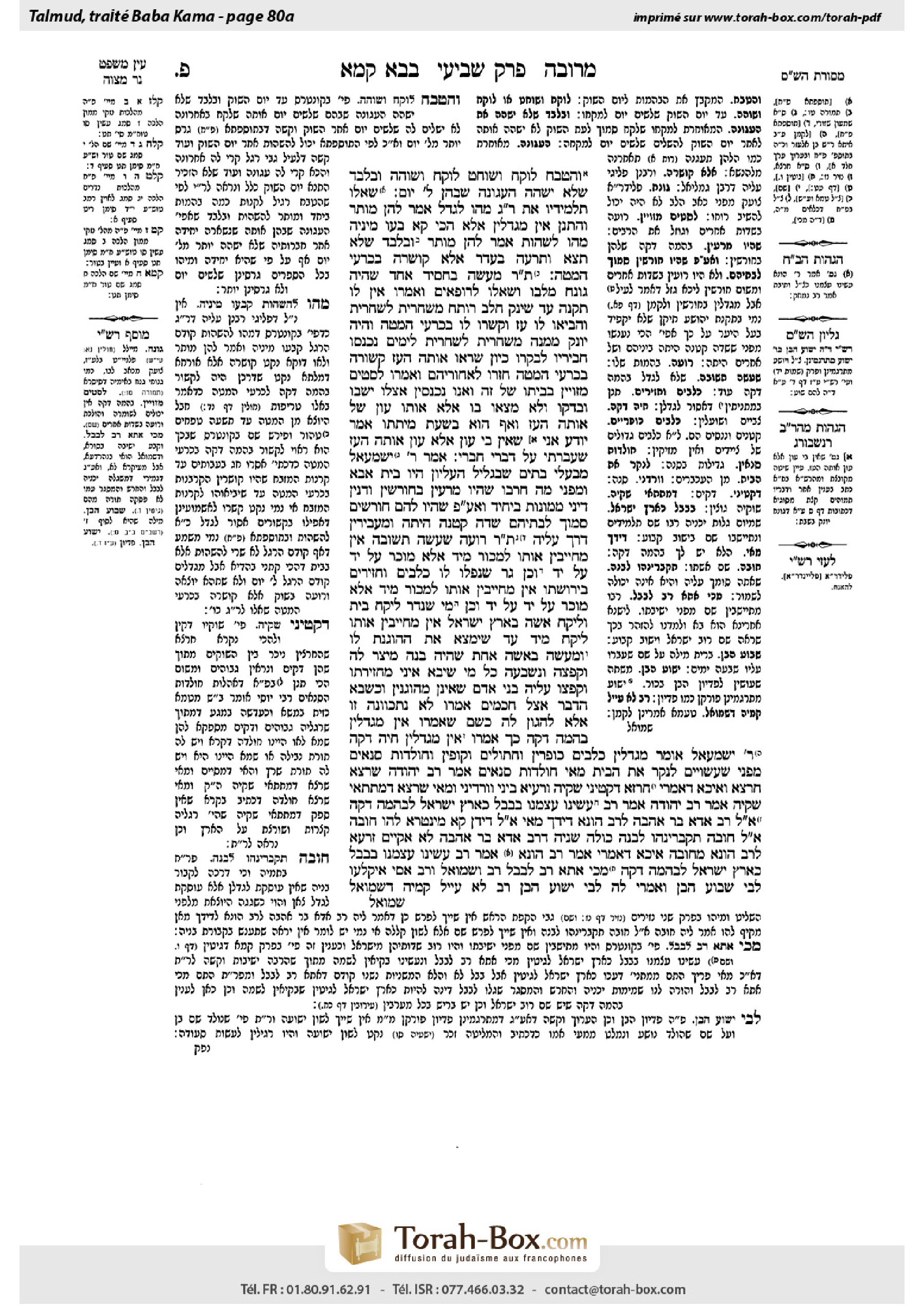
Bava Kamma 80a: Talmud study for Daf Yomi
Study the Talmud for Daf Yomi with scanned pages, Hebrew text, English translations from Sefaria and AI-generated French translations.
Passage selection and English or AI-generated French translation are available where the scan has annotations. Daf Study is independent of Torah-Box and Sefaria.
Browse Bava Kamma · בבא קמא · All tractatesBava Kamma 80a text and translations
This page of Bava Kamma includes the Aramaic text, an English translation and an AI-generated French translation, alongside the scan above.
בבא קמא פ׳ א · Aramaic and Hebrew text
וְהַטַּבָּח לוֹקֵחַ וְשׁוֹחֵט, לוֹקֵחַ וְשׁוֹהֶה – וּבִלְבַד שֶׁלֹּא יְשַׁהֶה הָעֲגוּנָה שֶׁבָּהֶן שְׁלֹשִׁים יוֹם.
שָׁאֲלוּ תַּלְמִידָיו אֶת רַבָּן גַּמְלִיאֵל: מַהוּ לְגַדֵּל? אָמַר לָהֶן: מוּתָּר. וְהָתְנַן: אֵין מְגַדְּלִין!
אֶלָּא הָכִי קָא בָּעוּ מִינֵּיהּ: מַהוּ לְשַׁהוֹת? אָמַר לָהֶן: מוּתָּר, וּבִלְבַד שֶׁלֹּא תֵּצֵא וְתִרְעֶה בָּעֵדֶר; אֶלָּא קוֹשְׁרָהּ בְּכַרְעֵי הַמִּטָּה.
תָּנוּ רַבָּנַן: מַעֲשֶׂה בְּחָסִיד אֶחָד שֶׁהָיָה גּוֹנֵחַ מִלִּבּוֹ, וְשָׁאֲלוּ לָרוֹפְאִים, וְאָמְרוּ: אֵין לוֹ תַּקָּנָה עַד שֶׁיִּנַק חָלָב רוֹתֵחַ מִשַּׁחֲרִית לְשַׁחֲרִית. וְהֵבִיאוּ לוֹ עֵז וְקָשְׁרוּ לוֹ בְּכַרְעֵי הַמִּטָּה, וְהָיָה יוֹנֵק מִמֶּנָּה מִשַּׁחֲרִית לְשַׁחֲרִית.
לְיָמִים נִכְנְסוּ חֲבֵירָיו לְבַקְּרוֹ, כֵּיוָן שֶׁרָאוּ אוֹתָהּ הָעֵז קְשׁוּרָה בְּכַרְעֵי הַמִּטָּה – חָזְרוּ לַאֲחוֹרֵיהֶם, וְאָמְרוּ: לִסְטִים מְזוּיָּין בְּבֵיתוֹ שֶׁל זֶה, וְאָנוּ נִכְנָסִין אֶצְלוֹ?!
יָשְׁבוּ וּבָדְקוּ, וְלֹא מָצְאוּ בּוֹ אֶלָּא אוֹתוֹ עָוֹן שֶׁל אוֹתָהּ הָעֵז. וְאַף הוּא בִּשְׁעַת מִיתָתוֹ אָמַר: יוֹדֵעַ אֲנִי שֶׁאֵין בִּי עָוֹן אֶלָּא עֲוֹן אוֹתָהּ הָעֵז, שֶׁעָבַרְתִּי עַל דִּבְרֵי חֲבֵרַי.
אָמַר רַבִּי יִשְׁמָעֵאל: מִבַּעֲלֵי בָתִּים שֶׁבַּגָּלִיל הָעֶלְיוֹן הָיוּ בֵּית אַבָּא; וּמִפְּנֵי מָה חָרְבוּ? שֶׁהָיוּ מַרְעִין בָּחוֹרָשִׁין, וְדָנִין דִּינֵי מָמוֹנוֹת בְּיָחִיד. וְאַף עַל פִּי שֶׁהָיוּ לָהֶם חוֹרָשִׁים סָמוּךְ לְבָתֵּיהֶם, שָׂדֶה קְטַנָּה הָיְתָה וּמַעֲבִירִין דֶּרֶךְ עָלֶיהָ.
תָּנוּ רַבָּנַן: רוֹעֶה שֶׁעָשָׂה תְּשׁוּבָה – אֵין מְחַיְּיבִין אוֹתוֹ לִמְכּוֹר מִיָּד, אֶלָּא מוֹכֵר עַל יָד עַל יָד. וְכֵן גֵּר שֶׁנָּפְלוּ לוֹ כְּלָבִים וַחֲזִירִים בִּירוּשָּׁתוֹ – אֵין מְחַיְּיבִין אוֹתוֹ לִמְכּוֹר מִיָּד, אֶלָּא מוֹכֵר עַל יָד עַל יָד.
וְכֵן מִי שֶׁנָּדַר לִיקַּח בַּיִת וְלִיקַּח אִשָּׁה בְּאֶרֶץ יִשְׂרָאֵל – אֵין מְחַיְּיבִין אוֹתוֹ לִיקַּח מִיָּד, עַד שֶׁיִּמְצָא אֶת הַהוֹגֶנֶת לוֹ.
וּמַעֲשֶׂה בְּאִשָּׁה אַחַת שֶׁהָיָה בְּנָהּ מֵיצֵר לָהּ, וְקָפְצָה וְנִשְׁבְּעָה: ״כׇּל מִי שֶׁיָּבֹא, אֵינִי מַחְזִירָתוֹ״, וְקָפְצוּ עָלֶיהָ בְּנֵי אָדָם שֶׁאֵינָן מְהוּגָּנִין. וּכְשֶׁבָּא הַדָּבָר אֵצֶל חֲכָמִים, אָמְרוּ: לֹא נִתְכַּוְּונָה זוֹ אֶלָּא לְהָגוּן לָהּ.
כְּשֵׁם שֶׁאָמְרוּ אֵין מְגַדְּלִין בְּהֵמָה דַּקָּה, כָּךְ אָמְרוּ אֵין מְגַדְּלִין חַיָּה דַּקָּה. רַבִּי יִשְׁמָעֵאל אוֹמֵר: מְגַדְּלִין כְּלָבִים כּוּפְרִין, וַחֲתוּלִים, וְקוֹפִין, וְחוּלְדּוֹת סְנָאִים – מִפְּנֵי שֶׁעֲשׂוּיִים לְנַקֵּר אֶת הַבַּיִת.
מַאי חוּלְדּוֹת סְנָאִים? אָמַר רַב יְהוּדָה: שִׁרְצָא חַרְצָא. וְאִיכָּא דְּאָמְרִי: חַרְזָא – דְּקַטִּינֵי שָׁקַיהּ, וְרָעֲיָא בֵּינֵי וַורְדִּינֵי. וּמַאי שִׁרְצָא? דְּמִתַּתִּאי שָׁקַיהּ.
אָמַר רַב יְהוּדָה אָמַר רַב: עָשִׂינוּ עַצְמֵנוּ בְּבָבֶל כְּאֶרֶץ יִשְׂרָאֵל לִבְהֵמָה דַּקָּה. אֲמַר לֵיהּ רַב אַדָּא בַּר אַהֲבָה לְרַב הוּנָא: דִּידָךְ מַאי?
אֲמַר לֵיהּ: דִּידַן קָא מְינַטְּרָא לְהוּ חוּבָּה. אֲמַר לֵיהּ: חוּבָּה תִּקְבְּרִינְהוּ לִבְנַהּ. כּוּלְּהוּ שְׁנֵיהּ דְּרַב אַדָּא בַּר אַהֲבָה לָא אִקַּיַּים זַרְעָא לְרַב הוּנָא מֵחוּבָּה. אִיכָּא דְּאָמְרִי, אָמַר רַב הוּנָא אָמַר רַב: עָשִׂינוּ עַצְמֵנוּ בְּבָבֶל כְּאֶרֶץ יִשְׂרָאֵל לִבְהֵמָה דַּקָּה, מִכִּי אֲתָא רַב לְבָבֶל.
רַב וּשְׁמוּאֵל וְרַב אַסִּי אִיקְּלַעוּ לְבֵי שְׁבוּעַ הַבֵּן, וְאָמְרִי לַהּ לְבֵי יְשׁוּעַ הַבֵּן. רַב לָא עָיֵיל קַמֵּיהּ דִּשְׁמוּאֵל,
Bava Kamma 80a · English translation
The baraita continues: And a butcher may buy small domesticated animals and slaughter them, and again buy small domesticated animals and keep them for a while, provided that he does not keep the last one of them that he bought beyond thirty days.
His students asked Rabban Gamliel: What is the halakha with regard to raising small domesticated animals in Eretz Yisrael? Rabban Gamliel said to them: It is permitted. The Gemara interrupts its citation of the baraita to pose a question: How could Rabban Gamliel say this? But didn’t we learn in the mishna: One may not raise small domesticated animals in Eretz Yisrael?
Rather, the text of the baraita must be emended, and they actually raised this dilemma before him: What is the halakha with regard to keeping them for a while? The Gemara resumes the quotation of the baraita: Rabban Gamliel said to them: It is permitted, provided that the animal does not go out and graze among the flock. Rather, one should tie it to the legs of the bed in his house.
The Sages taught in a baraita: There was an incident involving a certain pious man who was groaning, i.e., suffering, due to a pain in his heart. Those caring for the man asked the physicians what to do for him, and they said: There is no other remedy for him but that he should suckle warm milk every morning. And they brought him a she-goat and tied it to the leg of the bed for him, and he would suckle milk from it every morning.
Days later, his friends came in to visit him. When they saw that she-goat tied to the legs of the bed, they turned back, saying: There is an armed bandit in this man’s house, and we are going in to visit him? They referred to the goat in this manner because small animals habitually graze on the vegetation of others, thereby stealing their crops.
His friends sat down and investigated this pious man’s behavior, and they could not find any sin attributable to him except that sin of keeping that she-goat in his house. That man himself also said at the time of his death: I know for a fact that I have no sin attributable to me except the sin of keeping that she-goat in my house, as I transgressed the statement of my colleagues, the Sages.
Rabbi Yishmael said: The members of my father’s family were among the wealthy property holders in the upper Galilee. And for what reason were they destroyed? It was due to the fact that they would graze flocks in the forests, and also because they would judge cases of monetary law by means of a single judge. And even though there were forests close to their houses, and therefore there should have been no problem for them to take their animals to graze in these forests, there was a small, private field and they would convey the animals on a path through it.
§ The Sages taught in a baraita: If there is a shepherd of small domesticated animals who repented, the court does not obligate him to sell all his animals immediately. Rather, he may sell them gradually. And likewise, in the case of a convert who came into possession of dogs and pigs (see 83a) as part of his inheritance, the court does not obligate him to sell all of them immediately. Rather, he may sell them gradually.
And similarly, with regard to one who vowed to purchase a house or to marry a woman in Eretz Yisrael, the court does not obligate him to acquire the first house or marry the first woman he sees immediately upon his arrival in Eretz Yisrael. Instead, he may wait until he finds the house or wife appropriate for him.
And there was an incident involving a certain unmarried woman who had a son who was distressing her, and she jumped up and took an oath impulsively: Any man who comes to marry me and will discipline my son, I will not turn him away. And unworthy men jumped at the opportunity to marry her. And when the matter came before the Sages, they said: She need not marry one of these men, as this woman’s intention in her oath was certainly to marry only a man who is appropriate for her.
The baraita continues: Just as the Sages said that one may not raise small domesticated animals, i.e., sheep and goats, so too they said that one may not raise small undomesticated animals. Rabbi Yishmael says: One may raise village dogs, cats, monkeys, and genets, because they serve to clean the house of mice and other vermin.
The Gemara asks: What are these genets? Rav Yehuda said: These are known in Aramaic as shartza ḥartza. And there are those who say that in Aramaic this animal is called ḥarza. This creature has short thighs and it grazes among the thorn bushes. And what is the reason that they are called shartza, a term that generally refers to creeping creatures that slither [shoretz] rather than walk? It is because its thighs are so short that it appears to slither instead of walking on legs.
§ Rav Yehuda says that Rav says: We in Babylonia have rendered ourselves like the residents of Eretz Yisrael with regard to the prohibition of the Sages against raising small domesticated animals. Rav Adda bar Ahava said to Rav Huna: What of your sheep and goats? How can you raise these animals in Babylonia?
Rav Huna said to him: Ḥova, my wife, watches the animals to ensure that they do not graze on land belonging to others. Rav Adda bar Ahava cursed Rav Huna and said to him: May Ḥova bury her son! In all the years of Rav Adda bar Ahava, no children of Rav Huna from Ḥova survived, due to this curse. There are those who say a different version of the above statement: Rav Huna says that Rav says: We in Babylonia rendered ourselves like those of Eretz Yisrael with regard to raising small domesticated animals, from the time when Rav came to Babylonia.
§ Rav and Shmuel and Rav Asi once happened to be present at a house where a celebration was being held marking the passage of a week of a newborn son, i.e., a circumcision. And some say it was a house where a celebration was being held marking the redemption of a firstborn son. Rav would not enter before Shmuel, for reasons the Gemara will explain;
Bava Kamma 80a · Traduction française (IA)
La baraïta continue : Et un boucher peut acheter des petits animaux domestiques et les sacrifier, et à nouveau acheter des petits animaux domestiques et les garder un moment, à condition qu'il ne garde pas le dernier qu'il a acheté plus de trente jours.
Ses élèves demandèrent à Rabban Gamliel : Quel est le halakha concernant l'élevage des petits animaux domestiques en Terre d'Israël ? Rabban Gamliel leur dit : C'est permis. La Guemara interrompt sa citation de la baraïta pour poser une question : Comment Rabban Gamliel a-t-il pu dire cela ? N'avons-nous pas appris dans la mishna : On ne peut pas élever des petits animaux domestiques en Terre d'Israël ?
Plutôt, le texte de la baraïta doit être corrigé, et ils ont effectivement soulevé ce dilemme devant lui : Quel est le halakha concernant la conservation d'un moment ? La Guemara reprend la citation de la baraïta : Rabban Gamliel leur dit : C'est permis, à condition que l'animal ne sorte pas et ne paisse parmi le troupeau. Plutôt, on devrait le lier aux jambes du lit de sa maison.
Les Sages enseignèrent dans une baraïta : Il y avait un homme pieux qui souffrait, c'est-à-dire qui était tourmenté, à cause d'une douleur au cœur. Ceux qui s'occupaient de cet homme demandèrent aux médecins ce qu'ils devaient faire pour lui, et ils dirent : Il n'y a pas d'autre remède pour lui que de téter du lait chaud chaque matin. Et ils lui amenèrent une chèvre femelle et la lièrent à la jambe du lit pour lui, et il téterait du lait d'elle chaque matin.
Plus tard, ses amis vinrent le voir. Lorsqu'ils virent la chèvre femelle liée aux jambes du lit, ils reculèrent en disant : Il y a un bandit armé dans la maison de cet homme, et nous entrons pour le visiter ? Ils faisaient référence à la chèvre de cette manière car les petits animaux habituellement paissent sur la végétation des autres, volant ainsi leurs récoltes.
Ses amis s'assirent et investiguèrent le comportement de cet homme pieux, et ils ne trouvèrent aucun péché à son encontre sauf le péché de garder cette chèvre femelle dans sa maison. Cet homme lui-même dit à son moment de mort : Je sais certainement que je n'ai aucun péché à mon encontre sauf le péché de garder cette chèvre femelle dans ma maison, car j'ai enfreint la déclaration de mes collègues, les Sages.
Rabbi Yishmael dit : Les membres de ma famille paternelle étaient parmi les propriétaires riches du Galil supérieur. Et pour quelle raison furent-ils détruits ? C'était à cause du fait qu'ils laissaient paître leurs troupeaux dans les forêts, et aussi à cause du fait qu'ils jugeaient les affaires de droit civil par le biais d'un seul juge. Et même s'il y avait des forêts proches de leurs maisons, et donc il ne devrait pas y avoir de problème pour eux de prendre leurs animaux pour paître dans ces forêts, il y avait un petit champ privé et ils faisaient passer les animaux par un chemin à travers ce champ.
§ Les Sages enseignèrent dans une baraïta : Si un berger d'animaux domestiques petits s'est repenti, la cour ne l'oblige pas à vendre tous ses animaux immédiatement. Plutôt, il peut les vendre progressivement. Et de même, dans le cas d'un converti qui a acquis des chiens et des porcs (voir 83a) en tant qu'héritage, la cour ne l'oblige pas à vendre tous d'entre eux immédiatement. Plutôt, il peut les vendre progressivement.
Et de même, concernant celui qui a juré d'acheter une maison ou de se marier avec une femme en Terre d'Israël, la cour ne l'oblige pas à acquérir la première maison ou à se marier avec la première femme qu'il voit immédiatement à son arrivée en Terre d'Israël. Au contraire, il peut attendre jusqu'à ce qu'il trouve la maison ou la femme appropriée pour lui.
Et il y avait un incident concernant une femme célibataire qui avait un fils qui la tourmentait, et elle se leva et prit un serment impulsivement : Tout homme qui viendra me marier et qui disciplinera mon fils, je ne le rejeterai pas. Et des hommes indignes sautèrent à l'occasion de se marier avec elle. Et lorsque l'affaire fut portée devant les Sages, ils dirent : Elle n'a pas besoin de se marier avec l'un de ces hommes, car l'intention de cette femme dans son serment était certainement de se marier uniquement avec un homme approprié pour elle.
La baraïta continue : Tout comme les Sages dirent que l'on ne peut pas élever des petits animaux domestiques, c'est-à-dire des moutons et des chèvres, de même ils dirent que l'on ne peut pas élever des petits animaux sauvages. Rabbi Yishmael dit : On peut élever des chiens de village, des chats, des singes et des genets, car ils servent à nettoyer la maison des rats et autres nuisibles.
La Guemara demande : Quels sont ces genets ? Rav Yehuda dit : Ce sont connus en araméen comme shartza ḥartza. Et il y a ceux qui disent que dans l'araméen cet animal est appelé ḥarza. Cette créature a des cuisses courtes et paît parmi les buissons épineux. Et quelle est la raison qu'ils sont appelés shartza, un terme qui désigne généralement des créatures rampantes qui glissent [shoretz] plutôt que de marcher ? C'est parce que ses cuisses sont si courtes qu'il semble glisser plutôt que de marcher sur des jambes.
§ Rav Yehuda dit que Rav dit : Nous à Babylone nous sommes devenus semblables aux habitants de Terre d'Israël concernant l'interdiction des Sages d'élever des petits animaux domestiques. Rav Adda bar Ahava dit à Rav Huna : Et vos moutons et chèvres ? Comment pouvez-vous élever ces animaux à Babylone ?
Rav Huna dit à lui : Ḥova, ma femme, surveille les animaux pour s'assurer qu'ils ne paissent pas sur les terres d'autrui. Rav Adda bar Ahava maudit Rav Huna et dit à lui : Que Ḥova enterrerait son fils ! Durant toutes les années de Rav Adda bar Ahava, aucun enfant de Rav Huna issu de Ḥova n'a survécu, à cause de cette malédiction. Il y a ceux qui disent une version différente de l'affirmation ci-dessus : Rav Huna dit que Rav dit : Nous à Babylone nous sommes devenus semblables à ceux de Terre d'Israël concernant l'interdiction des Sages d'élever des petits animaux domestiques, depuis le moment où Rav est venu à Babylone.
§ Rav et Shmuel et Rav Asi furent un jour présents dans une maison où célébrait-on la semaine du circoncis d’un fils nouveau-né, c’est-à-dire la cérémonie du kérém. Et certains disent qu’il s’agissait d’une maison où célébrait-on la délivrance d’un premier-né. Rav ne pénétrait dans la maison que après Shmuel, pour des raisons que la Guemara expliquera plus tard ;
Traduction française générée par IA à partir de l’édition anglaise de Sefaria. Vérifie toujours un passage avec le texte source.
Text from Sefaria: William Davidson Edition - Vocalized Aramaic (CC BY NC); William Davidson Edition - English (CC BY NC).