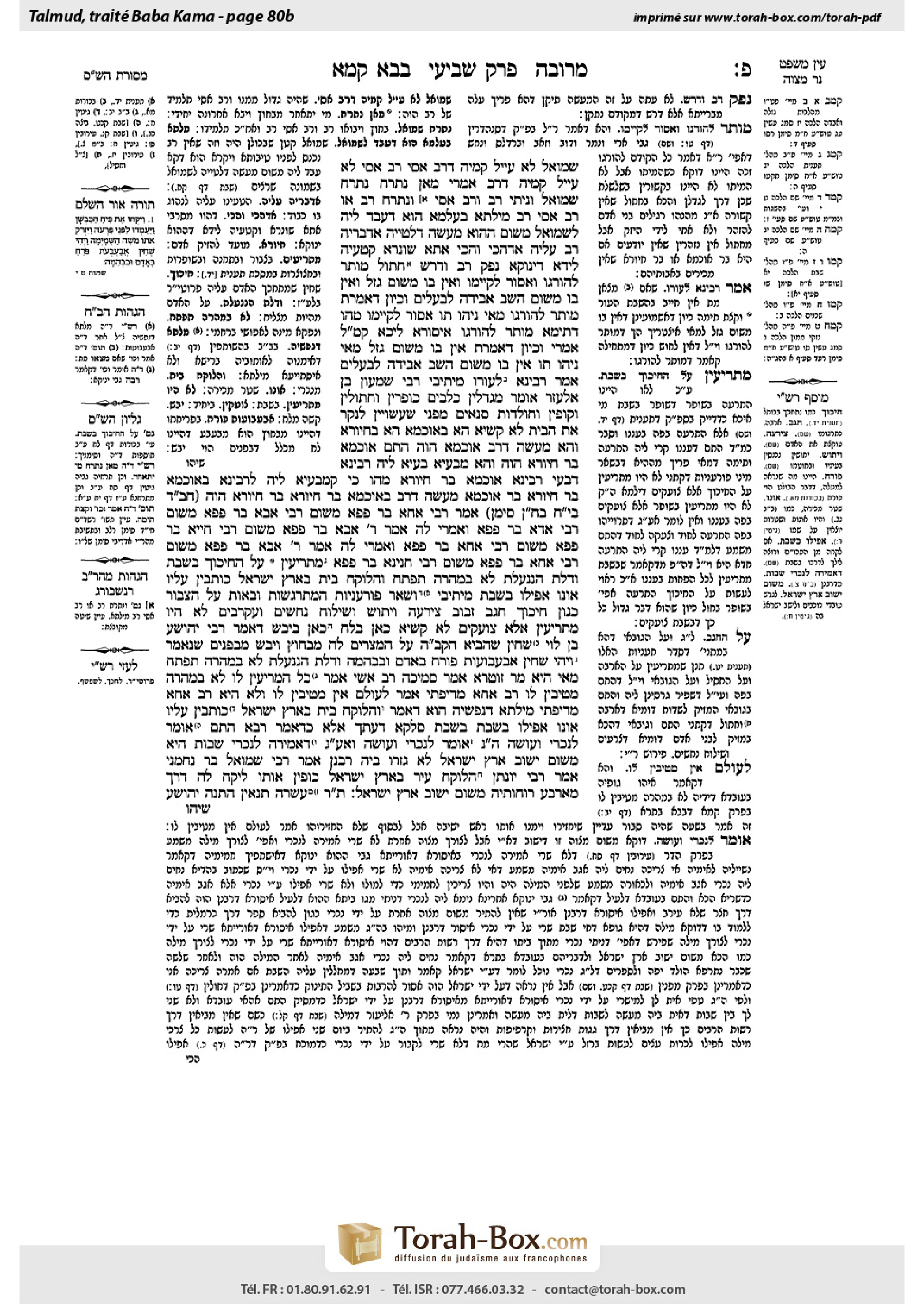
Bava Kamma 80b: Talmud study for Daf Yomi
Study the Talmud for Daf Yomi with scanned pages, Hebrew text, English translations from Sefaria and AI-generated French translations.
Passage selection and English or AI-generated French translation are available where the scan has annotations. Daf Study is independent of Torah-Box and Sefaria.
Browse Bava Kamma · בבא קמא · All tractatesBava Kamma 80b text and translations
This page of Bava Kamma includes the Aramaic text, an English translation and an AI-generated French translation, alongside the scan above.
בבא קמא פ׳ ב · Aramaic and Hebrew text
שְׁמוּאֵל לָא עָיֵיל קַמֵּיהּ דְּרַב אַסִּי, רַב אַסִּי לָא עָיֵיל קַמֵּיהּ דְּרַב. אָמְרִי: מַאן נִתָּרַח? נִתָּרַח שְׁמוּאֵל וְנֵיתֵי רַב וְרַב אַסִּי.
וְנִתָּרַח רַב אוֹ רַב אַסִּי! רַב – מִילְּתָא בְּעָלְמָא הוּא דַּעֲבַד לֵיהּ לִשְׁמוּאֵל; מִשּׁוּם הָהוּא מַעֲשֶׂה דְּלַטְיֵיהּ, אַדְבְּרֵיהּ רַב עֲלֵיהּ.
אַדְּהָכִי וְהָכִי, אֲתָא שׁוּנָרָא קַטְעֵיהּ לִידָא דְּיָנוֹקָא. נְפַק רַב וּדְרַשׁ: חָתוּל – מוּתָּר לְהוֹרְגוֹ, וְאָסוּר לְקַיְּימוֹ, וְאֵין בּוֹ מִשּׁוּם גָּזֵל, וְאֵין בּוֹ מִשּׁוּם הָשֵׁב אֲבֵידָה לַבְּעָלִים.
וְכֵיוָן דְּאָמְרַתְּ ״מוּתָּר לְהוֹרְגוֹ״, מַאי נִיהוּ תּוּ ״אָסוּר לְקַיְּימוֹ״? מַהוּ דְּתֵימָא: מוּתָּר לְהוֹרְגוֹ, אִיסּוּרָא לֵיכָּא; קָא מַשְׁמַע לַן.
אָמְרִי: וְכֵיוָן דְּאָמְרַתְּ ״אֵין בּוֹ מִשּׁוּם גָּזֵל״, מַאי נִיהוּ תּוּ ״אֵין בּוֹ מִשּׁוּם הָשֵׁב אֲבֵידָה לַבְּעָלִים״? אָמַר רָבִינָא: לְעוֹרוֹ.
מֵיתִיבִי, רַבִּי שִׁמְעוֹן בֶּן אֶלְעָזָר אוֹמֵר: מְגַדְּלִין כְּלָבִים כּוּפְרִין, וַחֲתוּלִין, וְקוֹפִין, וְחוּלְדּוֹת סְנָאִים – מִפְּנֵי שֶׁעֲשׂוּיִין לְנַקֵּר אֶת הַבַּיִת! לָא קַשְׁיָא; הָא בְּאוּכָּמָא, הָא בְּחִיוּוֹרָא.
וְהָא מַעֲשֶׂה דְּרַב – אוּכָּמָא הֲוָה! הָתָם – אוּכָּמָא בַּר חִיוָּרָא הֲוָה. וְהָא מִבְעָיא בָּעֵיא לֵיהּ רָבִינָא!
דְּבָעֵי רָבִינָא: אוּכָּמָא בַּר חִיוָּרָא, מַהוּ? כִּי קָמִבַּעְיָא לֵיהּ לְרָבִינָא – בְּאוּכָּמָא בַּר חִיוָּרָא בַּר אוּכָּמָא; מַעֲשֶׂה דְּרַב – בְּאוּכָּמָא בַּר חִיוָּרָא בַּר חִיוָּרָא הֲוָה.
(חב״ד בי״ח בח״ן – סִימָן.) אָמַר רַבִּי אַחָא בַּר פָּפָּא מִשּׁוּם רַבִּי אַבָּא בַּר פָּפָּא מִשּׁוּם רַבִּי אַדָּא בַּר פָּפָּא, וְאָמְרִי לַהּ: אָמַר רַבִּי אַבָּא בַּר פָּפָּא מִשּׁוּם רַבִּי חִיָּיא בַּר פָּפָּא מִשּׁוּם רַבִּי אַחָא בַּר פָּפָּא, וְאָמְרִי לַהּ: אָמַר רַבִּי אַבָּא בַּר פָּפָּא מִשּׁוּם רַבִּי אַחָא בַּר פָּפָּא מִשּׁוּם רַבִּי חֲנִינָא בַּר פָּפָּא:
מַתְרִיעִין עַל הַחִיכּוּךְ בְּשַׁבָּת, וְדֶלֶת הַנִּנְעֶלֶת לֹא בִּמְהֵרָה תִּפָּתַח, וְהַלּוֹקֵחַ בַּיִת בְּאֶרֶץ יִשְׂרָאֵל – כּוֹתְבִין עָלָיו אוֹנוֹ אֲפִילּוּ בְּשַׁבָּת.
מֵיתִיבִי: וּשְׁאָר פּוּרְעָנִיּוֹת הַמִּתְרַגְּשׁוֹת וּבָאוֹת עַל הַצִּבּוּר – כְּגוֹן חִיכּוּךְ, חָגָב, זְבוּב, צִירְעָה וְיַתּוּשׁ, וְשִׁילּוּחַ נְחָשִׁים וְעַקְרַבִּים – לֹא הָיוּ מַתְרִיעִין, אֶלָּא צוֹעֲקִים!
לָא קַשְׁיָא; כָּאן בְּלַח, כָּאן בְּיָבֵשׁ. דְּאָמַר רַבִּי יְהוֹשֻׁעַ בֶּן לֵוִי: שְׁחִין שֶׁהֵבִיא הַקָּדוֹשׁ בָּרוּךְ הוּא עַל הַמִּצְרִים – לַח מִבַּחוּץ וְיָבֵשׁ מִבִּפְנִים, שֶׁנֶּאֱמַר: ״וַיְהִי שְׁחִין אֲבַעְבֻּעֹת פּוֹרֵחַ בָּאָדָם וּבַבְּהֵמָה״.
״וְדֶלֶת הַנִּנְעֶלֶת לֹא בִּמְהֵרָה תִּפָּתַח״, מַאי הִיא? מָר זוּטְרָא אָמַר: סְמִיכָה. רַב אָשֵׁי אָמַר: כׇּל הַמְּרִיעִין לוֹ, לֹא בִּמְהֵרָה מְטִיבִין לוֹ. רַב אַחָא מִדִּיפְתִּי אָמַר: לְעוֹלָם אֵין מְטִיבִין לוֹ. וְלָא הִיא, רַב אַחָא מִדִּיפְתִּי מִילְּתָא דְּנַפְשֵׁיהּ הוּא דְּאָמַר.
וְהַלּוֹקֵחַ בַּיִת בְּאֶרֶץ יִשְׂרָאֵל – כּוֹתְבִין עָלָיו אוֹנוֹ אֲפִילּוּ בְּשַׁבָּת. בְּשַׁבָּת סָלְקָא דַּעְתָּךְ?!
אֶלָּא כִּדְאָמַר רָבָא הָתָם: אוֹמֵר לְגוֹי וְעוֹשֶׂה; הָכִי נָמֵי, אוֹמֵר לְגוֹי וְעוֹשֶׂה. וְאַף עַל גַּב דַּאֲמִירָה לְגוֹי שְׁבוּת הִיא, מִשּׁוּם יִשּׁוּב אֶרֶץ יִשְׂרָאֵל לָא גְּזַרוּ בֵּיהּ רַבָּנַן.
אָמַר רַבִּי שְׁמוּאֵל בַּר נַחְמָנִי אָמַר רַבִּי יוֹנָתָן: הַלּוֹקֵחַ עִיר בְּאֶרֶץ יִשְׂרָאֵל, כּוֹפִין אוֹתוֹ לִיקַּח לָהּ דֶּרֶךְ מֵאַרְבַּע רוּחוֹתֶיהָ, מִשּׁוּם יִשּׁוּב אֶרֶץ יִשְׂרָאֵל.
תָּנוּ רַבָּנַן, עֲשָׂרָה תְּנָאִין הִתְנָה יְהוֹשֻׁעַ:
Bava Kamma 80b · English translation
Shmuel would not enter before Rav Asi, as he considered Rav Asi to be greater than he; and Rav Asi would not enter before Rav, as Rav was his teacher. They said: Which of us should stay behind and let the other two come in before him? They decided: Let Shmuel stay behind, and let Rav and Rav Asi come inside in that order. Afterward, Shmuel himself would enter.
The Gemara asks: And why didn’t they decide to let Rav or Rav Asi stay behind? The Gemara explains: It was a mere gesture that Rav performed for Shmuel in initially stating that Shmuel should precede him, as Rav did not really feel that Shmuel was superior to him. Rather, on account of that incident in which he inadvertently cursed Shmuel, Rav took upon himself to treat Shmuel with deference.
In the meantime, while all this was going on, a cat [shunara] came and severed the hand of the baby. Rav emerged from the house and taught: With regard to a cat, it is permitted to kill it even if it is privately owned; and it is prohibited to maintain it in one’s possession; and it is not subject to the prohibition against theft if one takes it from its owner; and, in the case of a lost cat, it is not subject to the obligation of returning a lost item to its owner.
The Gemara asks a question with regard to Rav’s statement: And since you said that it is permitted to kill it, what is the need to state further that it is prohibited to maintain it in one’s possession? If a cat is considered such a dangerous animal that it is permitted to kill it, of course one cannot keep it in his possession. The Gemara answers: Lest you say that although Rav ruled that it is permitted to kill it, he concedes that there is no prohibition in keeping it, Rav therefore teaches us that it is also prohibited to keep it in one’s possession.
The Sages say, further questioning Rav’s statement: And since you said that it is not subject to the prohibition against theft if one takes it from its owner, what is the need to state further that it is not subject to the obligation of returning a lost item to its owner in the case of a lost cat? If one may actively steal a cat, certainly there is no obligation to return it when found. Ravina said in response: Rav was referring to its hide.
The Gemara raises an objection from a baraita against Rav’s ruling that it is prohibited to keep a cat. Rabbi Shimon ben Elazar says: One may raise village dogs, cats, monkeys, and genets, because they serve to clean the house of mice and other vermin. The Gemara resolves the apparent contradiction: It is not difficult. This ruling in the baraita is stated with regard to a black cat, which is harmless, whereas that ruling of Rav is stated with regard to a white cat, which is dangerous.
The Gemara raises a difficulty against this answer: But in the incident of Rav it was a black cat. Since this cat severed the baby’s hand, it was obviously a vicious, dangerous animal. The Gemara answers: There it was a black cat, but it was the offspring of a white one. The offspring of a white cat is dangerous, even if it itself is black. The Gemara further objects: But didn’t Ravina raise this very issue as a dilemma?
As Ravina raised a dilemma: What is the halakha with regard to a black cat that is the offspring of a white one? Is it also dangerous like its parent? The Gemara answers: When Ravina raised the dilemma, it was with regard to a black cat that is the offspring of a white cat that itself is the offspring of a black cat. By contrast, in the incident with Rav it was a black cat that was the offspring of a white one, which was itself the offspring of a white cat. That animal is definitely dangerous.
§ The Gemara provides a mnemonic device for the distinguishing letters in the various names of the sons of Rav Pappa in the ensuing list: Ḥet beit dalet, beit yod ḥet, beit ḥet nun. Rabbi Aḥa bar Pappa says the following three statements in the name of Rabbi Abba bar Pappa, who said them in the name of Rabbi Adda bar Pappa. And some say Rabbi Abba bar Pappa says them in the name of Rabbi Ḥiyya bar Pappa, who said them in the name of Rabbi Aḥa bar Pappa. And some say Rabbi Abba bar Pappa says them in the name of Rabbi Aḥa bar Pappa, who said them in the name of Rabbi Ḥanina bar Pappa.
The three statements are as follows: The court sounds the alarm on Shabbat over a breakout of sores; and a door that is locked will not be opened quickly; and with regard to one who purchases a house in Eretz Yisrael, one writes a bill of sale for this transaction even on Shabbat.
The Gemara raises an objection from a baraita: After explaining how the public engages in prayer when there is a drought, the baraita teaches: And with regard to all other types of calamities that break out upon the community, other than drought, such as sores, a plague of locusts, flies, hornets, or mosquitoes, or infestations of snakes or scorpions, the court would not sound the alarm on Shabbat, but the people would cry out. This indicates that it is not proper to sound the alarm on Shabbat for an epidemic of sores.
The Gemara answers: This is not difficult. Here it is referring to moist sores; whereas there it is referring to dry sores, which are more dangerous than moist ones. As Rabbi Yehoshua ben Levi says: The boils that the Holy One, Blessed be He, brought upon the Egyptians were moist on the outside and dry on the inside, as it is stated: “And it became a boil breaking out with oozing upon man and upon beast” (Exodus 9:10). The phrase “breaking out” is referring to the exterior of the wound. Since the verse specifies that the outside was oozing with secretions, it can be inferred that the inside was dry. This indicates that the sores can be of either type.
The Gemara analyzes the second of the three statements: And a door that is locked will not be opened quickly. This is clearly a metaphor, but to what is it referring? Mar Zutra said: It is a metaphor for rabbinic ordination. If one meets with resistance in his quest to receive ordination, he should take it as a sign that this opportunity will not soon open up for him again. Rav Ashi said: It means that anyone who is treated poorly will not soon be treated well. Rav Aḥa of Difti said: He will never be treated well. The Gemara comments: But that is not so; Rav Aḥa of Difti was saying only a matter that reflected what had occurred to him.
The Gemara turns its attention to the third statement: And with regard to one who purchases a house in Eretz Yisrael, one writes a bill of sale for this transaction even on Shabbat. The Gemara asks: Can it enter your mind that one may write this bill of sale on Shabbat? Writing on Shabbat is a prohibited labor for which one is liable to receive the death penalty.
The Gemara explains: Rather, this is as Rava said there, with regard to a similar issue, that one tells a gentile to do it, and he does so. Here, too, it is referring to a situation where he tells a gentile to write a bill of sale for the house, and he does it. And even though telling a gentile to perform an action that is prohibited for a Jew on Shabbat is generally a violation of a rabbinic decree, as the Sages prohibited telling a gentile to perform prohibited labor on behalf of a Jew on Shabbat, here the Sages did not impose this decree, due to the mitzva of settling Eretz Yisrael.
Rabbi Shmuel bar Naḥmani says that Rabbi Yonatan says: With regard to one who purchases a city in Eretz Yisrael, the court forces him to purchase a path to the city from all four of its sides, due to the importance of settling Eretz Yisrael.
§ The Sages taught in a baraita: Joshua stipulated ten conditions when he apportioned Eretz Yisrael among the tribes:
Bava Kamma 80b · Traduction française (IA)
Shmuel ne rentrait pas avant Rav Asi, car il considérait Rav Asi comme supérieur à lui ; et Rav Asi ne rentrait pas avant Rav, car Rav était son maître. Ils dirent : Qui d’entre nous doit rester en arrière et permettre aux deux autres d’entrer avant lui ? Ils décidèrent : Que Shmuel reste en arrière, et que Rav et Rav Asi entrent dans cet ordre. Après cela, Shmuel lui-même entrerait.
La Guemara demande : Et pourquoi n’ont-ils pas décidé que soit Rav ou Rav Asi reste en arrière ? La Guemara explique : C’était un simple geste que Rav avait fait pour Shmuel en disant initialement qu’il devait le précéder, car Rav ne ressentait pas vraiment que Shmuel fût supérieur à lui. En réalité, à cause d’un incident où il avait involontairement maudis Shmuel, Rav s’était engagé à traiter Shmuel avec déférence.
En même temps, pendant que tout cela se passait, un chat [shunara] est venu et a coupé la main du bébé. Rav est sorti de la maison et a enseigné : En ce qui concerne un chat, il est permis de le tuer même s’il est propriété privée ; il est interdit de le garder en possession ; et il n’est pas soumis à l’interdiction de vol si l’on prend possession de lui à partir de son propriétaire ; et, dans le cas d’un chat perdu, il n’est pas soumis à l’obligation de rendre un objet perdu à son propriétaire.
La Guemara pose une question concernant l’affirmation de Rav : Et puisque vous avez dit qu’il est permis de le tuer, pourquoi mentionner davantage qu’il est interdit de le garder en possession ? Si un chat est considéré comme un animal si dangereux qu’il est permis de le tuer, il est évident que l’on ne peut pas le garder en possession. La Guemara répond : Pour éviter que l’on ne dise que bien que Rav ait jugé qu’il était permis de le tuer, il reconnaît qu’il n’y a pas d’interdiction à le garder, Rav enseigne donc que c’est aussi interdit de le garder en possession.
Les Sages interrogent davantage l’affirmation de Rav : Et puisque vous avez dit qu’il n’est pas soumis à l’interdiction de vol si l’on prend possession de lui à partir de son propriétaire, pourquoi mentionner davantage qu’il n’est pas soumis à l’obligation de rendre un objet perdu à son propriétaire dans le cas d’un chat perdu ? Si l’on peut voler activement un chat, certainement il n’y a pas d’obligation de le rendre quand on le trouve. Ravina répondit en réponse : Rav faisait référence à sa peau.
La Guemara soulève une objection contre la décision de Rav concernant l’interdiction de garder un chat. Rabbi Shimon ben Elazar dit : On peut élever des chiens de village, des chats, des singes et des genets, car ils servent à nettoyer la maison des rats et autres nuisibles. La Guemara résout la contradiction apparente : Ce n’est pas difficile. Cette décision dans la baraïta est formulée concernant un chat noir, qui est inoffensif, tandis que celle de Rav est formulée concernant un chat blanc, qui est dangereux.
La Guemara soulève une difficulté contre cette réponse : Mais dans l’incident de Rav, c’était un chat noir. Puisque ce chat avait coupé la main du bébé, il était évidemment un animal méchant et dangereux. La Guemara répond : Il s’agissait là d’un chat noir, mais il était le fils d’un chat blanc. Le fils d’un chat blanc est dangereux, même s’il est lui-même noir. La Guemara soulève encore une objection : Mais n’a-t-il pas été question de ce problème par Ravina lui-même ?
Comme Ravina avait soulevé un dilemme : Quelle est la halakha concernant un chat noir qui est le fils d’un chat blanc ? Est-il aussi dangereux que son père ? La Guemara répond : Lorsque Ravina avait soulevé ce dilemme, il s’agissait d’un chat noir qui est le fils d’un chat blanc qui lui-même est le fils d’un chat noir. À l’inverse, dans l’incident de Rav, c’était un chat noir qui était le fils d’un chat blanc, qui lui-même était le fils d’un chat blanc. Cet animal est certainement dangereux.
§ La Guemara fournit un dispositif mnémonique pour distinguer les lettres dans les différents noms des fils de Rav Pappa dans la liste suivante : Ḥet beit dalet, beit yod ḥet, beit ḥet nun. Rabbi Aḥa bar Pappa dit les trois affirmations suivantes au nom de Rabbi Abba bar Pappa, qui les avait dits au nom de Rabbi Adda bar Pappa. Et certains disent que Rabbi Abba bar Pappa les dit au nom de Rabbi Ḥiyya bar Pappa, qui les avait dits au nom de Rabbi Aḥa bar Pappa. Et certains disent que Rabbi Abba bar Pappa les dit au nom de Rabbi Aḥa bar Pappa, qui les avait dits au nom de Rabbi Ḥanina bar Pappa.
Les trois affirmations sont les suivantes : Le tribunal sonne l’alarme le sabbat en cas d’épidémie de plaies ; et une porte verrouillée ne sera pas ouverte rapidement ; et concernant celui qui achète une maison en Eretz Yisrael, on écrit un acte de vente pour cette transaction même le sabbat.
La Guemara soulève une objection à partir d’une baraïta : Après avoir expliqué comment le public prie lors d’une sécheresse, la baraïta enseigne : Et concernant toutes les autres sortes de calamités qui frappent la communauté, à l’exception de la sécheresse, comme les plaies, une épidémie de moustiques, de mouches, de guêpes, de mouches, ou des infestations de serpents ou de scorpions, le tribunal ne sonne pas l’alarme le sabbat, mais les gens pleurent. Cela indique que ce n’est pas approprié de sonner l’alarme le sabbat pour une épidémie de plaies.
La Guemara répond : Ce n’est pas difficile. Ici, il s’agit de plaies humides ; là, il s’agit de plaies sèches, qui sont plus dangereuses que les humides. Comme Rabbi Yehoshua ben Levi dit : Les cloques que l’Éternel, béni soit Son Nom, a fait subir aux Égyptiens étaient humides à l’extérieur et sèches à l’intérieur, comme il est dit : « Et il devint une cloaque qui se répandait avec des sécrétions sur l’homme et sur la bête » (Exode 9:10). L’expression « se répandait » fait référence à la surface de la plaie. Puisque le verset spécifie que l’extérieur était couvert de sécrétions, on peut en déduire que l’intérieur était sec. Cela indique que les plaies peuvent être de n’importe quel type.
La Guemara analyse la deuxième des trois déclarations : « Et une porte verrouillée ne s'ouvre pas rapidement. » Cela est clairement une métaphore, mais à quoi fait-elle référence ? Mar Zutra dit : C'est une métaphore pour l'ordination rabbinique. Si l'on rencontre une résistance dans sa quête d'ordination, il doit considérer cela comme un signe que cette opportunité ne s'ouvrira plus pour lui très bientôt. Rav Ashi dit : Cela signifie que celui qui est maltraité ne sera pas traité bien très bientôt. Rav Aḥa de Difti dit : Il ne sera jamais traité bien. La Guemara commente : Mais cela n'est pas vrai ; Rav Aḥa de Difti parlait seulement d'une affaire qui reflétait ce qui s'était produit à son égard.
La Guemara se tourne ensuite vers la troisième déclaration : « Et concernant celui qui achète une maison en Eretz Yisrael, on écrit un contrat de vente pour cette transaction même le sabbat. » La Guemara demande : Est-ce que cela entre dans votre tête que l'on puisse écrire ce contrat de vente le sabbat ? Écrire le sabbat est une activité interdite, pour laquelle on est tenu de recevoir la peine de mort.
La Guemara explique : Plutôt, cela correspond à ce que Rava a dit là-dessus, concernant une question similaire, à savoir qu'on demande à un non-Juif de le faire, et il le fait. Ici aussi, il s'agit d'une situation où l'on demande à un non-Juif d'écrire un contrat de vente pour la maison, et il le fait. Et même si demander à un non-Juif d'accomplir une action interdite pour un Juif le sabbat constitue généralement une violation d'un décret rabbinique, car les Sages ont interdit de demander à un non-Juif d'accomplir un travail interdit pour un Juif le sabbat, ici les Sages n'ont pas imposé ce décret, en raison de la mitsva de peupler Eretz Yisrael.
Rabbi Shmuel bar Naḥmani dit que Rabbi Yonatan dit : Concernant celui qui achète une ville en Eretz Yisrael, le tribunal le force à acheter un chemin jusqu'à la ville depuis les quatre côtés, en raison de l'importance de peupler Eretz Yisrael.
§ Les Sages ont enseigné dans une baraïta : Josué a stipulé dix conditions lorsqu'il a réparti Eretz Yisrael entre les tribus :
Traduction française générée par IA à partir de l’édition anglaise de Sefaria. Vérifie toujours un passage avec le texte source.
Text from Sefaria: William Davidson Edition - Vocalized Aramaic (CC BY NC); William Davidson Edition - English (CC BY NC).