Bava Kamma 81a: Talmud study for Daf Yomi
Study the Talmud for Daf Yomi with scanned pages, Hebrew text, English translations from Sefaria and AI-generated French translations.
Passage selection and English or AI-generated French translation are available where the scan has annotations. Daf Study is independent of Torah-Box and Sefaria.
Browse Bava Kamma · בבא קמא · All tractatesBava Kamma 81a text and translations
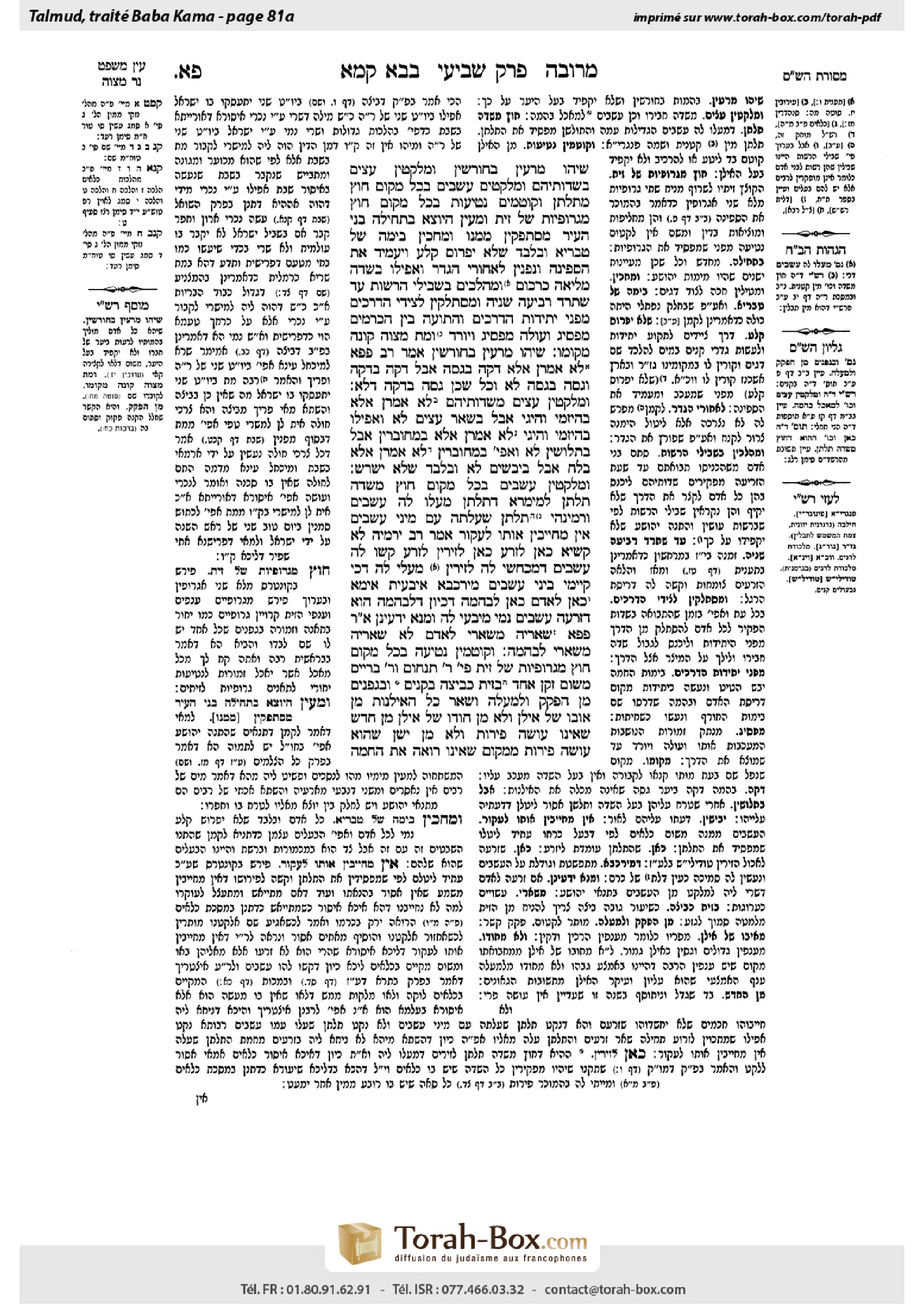
This page of Bava Kamma includes the Aramaic text, an English translation and an AI-generated French translation, alongside the scan above.
בבא קמא פ״א א · Aramaic and Hebrew text
שֶׁיְּהוּ מַרְעִין בָּחוֹרָשִׁין; וּמְלַקְּטִין עֵצִים בִּשְׂדוֹתֵיהֶם; וּמְלַקְּטִים עֲשָׂבִים בְּכׇל מָקוֹם – חוּץ מִתִּלְתָּן; וְקוֹטְמִים נְטִיעוֹת בְּכׇל מָקוֹם – חוּץ מִגְּרוֹפִיּוֹת שֶׁל זַיִת; וּמַעְיָן הַיּוֹצֵא בַּתְּחִילָּה – בְּנֵי הָעִיר מִסְתַּפְּקִין מִמֶּנּוּ; וּמְחַכִּין בְּיַמָּהּ שֶׁל טְבֶרְיָא, וּבִלְבַד שֶׁלֹּא יִפְרוֹס קֶלַע וְיַעֲמִיד אֶת הַסְּפִינָה;
וְנִפְנִין לַאֲחוֹרֵי הַגָּדֵר, וַאֲפִילּוּ בְּשָׂדֶה מְלֵיאָה כַּרְכּוֹם; וּמְהַלְּכִים בִּשְׁבִילֵי הָרְשׁוּת, עַד שֶׁתֵּרֵד רְבִיעָה שְׁנִיָּה; וּמִסְתַּלְּקִין לְצִידֵּי הַדְּרָכִים מִפְּנֵי יְתֵידוֹת הַדְּרָכִים; וְהַתּוֹעֶה בֵּין הַכְּרָמִים – מְפַסֵּיג וְעוֹלֶה מְפַסֵּיג וְיוֹרֵד; וּמֵת מִצְוָה קוֹנֶה מְקוֹמוֹ.
שֶׁיְּהוּ מַרְעִין בָּחוֹרָשִׁין. אָמַר רַב פָּפָּא: לָא אֲמַרַן אֶלָּא דַּקָּה בְּגַסָּה, אֲבָל דַּקָּה בְּדַקָּה וְגַסָּה בְּגַסָּה – לָא. וְכׇל שֶׁכֵּן גַּסָּה בְּדַקָּה דְּלָא.
וּמְלַקְּטִין עֵצִים מִשְּׂדוֹתֵיהֶם. לָא אֲמַרַן אֶלָּא בְּהִיזְמֵי וְהִיגֵי, אֲבָל בִּשְׁאָר עֵצִים – לָא. וַאֲפִילּוּ בְּהִיזְמֵי וְהִיגֵי – לָא אֲמַרַן אֶלָּא בִּמְחוּבָּרִין, אֲבָל בִּתְלוּשִׁין – לָא.
וַאֲפִילּוּ בִּמְחוּבָּרִין – לָא אֲמַרַן אֶלָּא בְּלַחִין, אֲבָל בִּיבֵשִׁין – לָא. וּבִלְבַד שֶׁלֹּא יְשָׁרֵשׁ.
וּמְלַקְּטִין עֲשָׂבִים בְּכׇל מָקוֹם, חוּץ מִשְּׂדֵה תִּלְתָּן. לְמֵימְרָא דְּתִלְתָּן מְעַלּוּ לַהּ עֲשָׂבִים? וּרְמִינְהִי: תִּלְתָּן שֶׁעָלְתָה עִם מִינֵי עֲשָׂבִים – אֵין מְחַיְּיבִין אוֹתוֹ לַעֲקוֹר!
אָמַר רַב יִרְמְיָה: לָא קַשְׁיָא; כָּאן לְזֶרַע, כָּאן לְזִירִין. לְזֶרַע – קָשׁוּ לַהּ עֲשָׂבִים, דְּמַכְחֲשִׁי לַהּ; לְזִירִין – מְעַלֵּי לַהּ, דְּכִי קָיְימִי בֵּינֵי עֲשָׂבִים – מִירַכְּבָא.
אִיבָּעֵית אֵימָא: כָּאן לְאָדָם, כָּאן לִבְהֵמָה. דְּכֵיוָן דְּלִבְהֵמָה הוּא דְּזַרְעַהּ, עֲשָׂבִים נָמֵי מִיבְּעֵי לַהּ. וּמְנָא יָדְעִינַן? אָמַר רַב פָּפָּא: שָׁארְיָה מְשָׁארֵי – לְאָדָם, לָא שָׁארְיָה מְשָׁארֵי – לִבְהֵמָה.
וְקוֹטְמִין נְטִיעָה בְּכׇל מָקוֹם, חוּץ מִגְּרוֹפִיּוֹת שֶׁל זַיִת. פֵּירְשׁוּ רַבִּי תַּנְחוּם וְרַבִּי בִּרְיָיס מִשּׁוּם זָקֵן אֶחָד: בְּזַיִת – כְּבֵיצָה. בְּקָנִים וּבִגְפָנִים – מִן הַפְּקָק וּלְמַעְלָה. וּשְׁאָר כׇּל הָאִילָנוֹת – מִן אוּבּוֹ שֶׁל אִילָן, וְלֹא מִן חוּדּוֹ שֶׁל אִילָן;
מִן חָדָשׁ שֶׁאֵינוֹ עוֹשֶׂה פֵּירוֹת, וְלֹא מִן יָשָׁן שֶׁהוּא עוֹשֶׂה פֵּירוֹת; מִמְּקוֹם שֶׁאֵינוֹ רוֹאֶה אֶת הַחַמָּה,
Bava Kamma 81a · English translation
The conditions are that people shall have the right to graze their animals in forests, even on private property; and that they shall have the right to gather wood from each other’s fields, to be used as animal fodder; and that they shall have the right to gather wild vegetation for animal fodder in any place except for a field of fenugreek; and that they shall have the right to pluck off a shoot anywhere for propagation and planting, except for olive shoots; and that the people of the city shall have the right to take supplies of water from a spring on private property, even from a spring that emerges for the first time; and that they shall have the right to fish in the Sea of Tiberias, i.e., the Sea of Galilee, provided that the fisherman does not build an underwater fence to catch fish, thereby causing an impediment to boats.
The baraita continues the list of Joshua’s ten conditions: And people shall have the right to relieve themselves outdoors behind a fence, even in a field that is full of saffron [karkom]; and they shall have the right to walk in permitted paths, i.e., those paths that cut through a private field, throughout the summer until the second rainfall, when crops begin to sprout; and they shall have the right to veer off to the sides of the roads onto private property because of hard protrusions [yeteidot] of the road; and one who becomes lost among the vineyards shall have the right to cut down branches and enter an area of the vineyard, or cut down branches and exit an area of the vineyard, until he finds his way back to the road; and that a corpse with no one to bury it [met mitzva] acquires its place and is buried where it was found.
The first condition mentioned in the baraita is that people shall have the right to graze their animals in forests. Rav Pappa said: We said this only with regard to small domesticated animals, i.e., sheep or goats, that graze in a forest of large trees. Small animals grazing in a forest of this kind would not destroy it. But in the case of small animals grazing in a forest with small growth, or large animals, e.g., oxen, grazing in a forest of large trees, these practices are not permitted, as in either of these scenarios the practice would destroy the forest. And, all the more so, it is understood that large animals grazing in a forest with small growth is not permitted.
The Gemara discusses the next condition mentioned in the baraita: And that they shall have the right to gather wood from each other’s fields, to be used as animal fodder. The Gemara comments: We said this only with regard to twigs of thorns and shrubs, as the field’s owner does not care about these. But with regard to other types of wood, it is not permitted. And even with regard to twigs of thorns and shrubs, we said this only when they are attached to the ground. But when they have been detached by the owner it is not permitted, as he has already claimed them for himself.
And even when they are attached we said this only when the twigs are still moist, but when they are completely dry it is not permitted, as the owner requires these for firewood. Moreover, it is permitted only provided that one does not uproot the thorn bush or shrub from the ground, but it is prohibited to pull them out with their roots.
The Gemara further discusses Joshua’s conditions: And that they shall have the right to gather wild vegetation for animal fodder in any place except for a field of fenugreek. The Gemara asks: Is this to say that wild vegetation is good for fenugreek, and therefore the owner wants it to be left in his field? The Gemara raises a contradiction from a mishna that deals with diverse kinds (Kilayim 2:5): With regard to fenugreek that sprouted alongside various types of wild vegetation, one is not required to uproot the vegetation. Although it is generally prohibited to grow different species of vegetables together in one patch, if the species have a negative impact on each other’s growth, it is not prohibited. In this case the wild vegetation may be left alongside the fenugreek because it is harmful to it, and the halakhot of diverse kinds do not apply in a case of this kind.
Rav Yirmeya said: This is not difficult. Here, the mishna is referring to a case where the fenugreek was planted for its seeds; there, the baraita that lists Joshua’s conditions is referring to fenugreek planted for its stalks. When it is planted for its seeds, wild vegetation is bad for it, as it weakens the fenugreek and lowers its yield. But when it is planted for its stalks, wild vegetation is good for it, as when it is situated among vegetation it climbs on it and thereby grows to a larger size.
If you wish, say instead another answer: Here, the mishna is referring to a case where the fenugreek was planted for human consumption; and there, the baraita is referring to fenugreek planted for animal consumption. Since the owner sowed the fenugreek for animal consumption, the wild vegetation is also required by him, as this too can be used for animal fodder. And how can we know if a particular fenugreek field was planted for human or animal consumption, and thereby know whether the vegetation may be picked and taken? Rav Pappa said: If he planted it in rows [mesharei], it is for human consumption; if he did not plant in rows but planted haphazardly, it is for animal consumption.
The baraita teaches: And that they shall have the right to pluck off a shoot anywhere for propagation and planting, except for olive shoots, as this would cause damage to the olive tree. Rabbi Tanḥum and Rabbi Berayes explained this in the name of a certain elder: With regard to olive trees, one must leave a shoot the size of an egg on the trunk when detaching it from the trunk; in the case of reeds and grape vines, he may take shoots only from the place of the first knot and above. And with regard to all other trees, shoots may be taken only from the thick part of the tree, where there are many branches growing, but not from the thin part of the tree.
Furthermore, one may take from a new branch, which does not yet produce fruit, but not from old branches, which do produce fruit; and one may take from a place that does not face the sun,
Bava Kamma 81a · Traduction française (IA)
Les conditions sont que les gens aient le droit de laisser paître leurs bêtes dans les forêts, même sur les propriétés privées ; et qu'ils aient le droit de ramasser du bois dans les champs des uns des autres, à utiliser comme nourriture pour les bêtes ; et qu'ils aient le droit de ramasser des plantes sauvages pour nourriture animale n'importe où, sauf dans un champ de fenouil ; et qu'ils aient le droit de détacher un jeune pousser partout pour la multiplication et la plantation, sauf pour les pousses d'olivier ; et que les habitants de la ville aient le droit de puiser de l'eau d'une source sur une propriété privée, même d'une source qui sort pour la première fois ; et qu'ils aient le droit de pêcher dans la mer de Tibériade, c'est-à-dire la mer de Galilée, à condition que le pêcheur ne construise pas un filet sous l'eau pour attraper les poissons, ce qui causerait un obstacle aux bateaux.
La baraïta continue la liste des dix conditions de Josué : Et les gens aient le droit de s'écarter en plein air derrière un mur, même dans un champ rempli de safran [karkom] ; et qu'ils aient le droit de marcher sur des chemins autorisés, c'est-à-dire ceux qui traversent un champ privé, tout au long de l'été jusqu'au deuxième orage, lorsque les cultures commencent à pousser ; et qu'ils aient le droit de s'écarter des routes sur une propriété privée en raison de protubérances [yeteidot] de la route ; et celui qui se perd dans les vignobles ait le droit de couper des branches et d'entrer dans une partie du vignoble, ou de couper des branches et de sortir d'une partie du vignoble, jusqu'à ce qu'il retrouve le chemin ; et que le corps d'une personne décédée sans personne pour le faire enterrer [met mitsva] acquière sa place et soit enterré là où il a été trouvé.
La première condition mentionnée dans la baraïta est que les gens aient le droit de laisser paître leurs bêtes dans les forêts. Rav Pappa a dit : Nous avons dit cela uniquement concernant les petits animaux domestiques, c'est-à-dire les moutons ou les chèvres, qui paissent dans une forêt de grands arbres. Les petits animaux paissant dans une forêt de ce type ne détruiront pas celle-ci. Mais dans le cas de petits animaux paissant dans une forêt de petite végétation, ou de grands animaux, par exemple les bœufs, paissant dans une forêt de grands arbres, ces pratiques ne sont pas permises, car dans aucun de ces cas la pratique ne détruirait la forêt. Et, de toute évidence, il est compris que les grands animaux paissant dans une forêt de petite végétation ne sont pas permis.
Le Guemara discute de la prochaine condition mentionnée dans la baraïta : Et qu'ils aient le droit de ramasser du bois dans les champs les uns des autres, à utiliser comme nourriture pour les bêtes. Le Guemara commente : Nous avons dit cela uniquement concernant les branches de buissons et de plantes épineuses, car le propriétaire ne s'occupe pas de ces choses. Mais concernant d'autres types de bois, cela n'est pas permis. Et même concernant les branches de buissons et de plantes épineuses, nous avons dit cela uniquement lorsqu'elles sont encore fixées au sol. Mais lorsqu'elles ont été détachées par le propriétaire, cela n'est pas permis, car il a déjà revendiqué ces branches pour lui-même.
Et même lorsqu'elles sont encore fixées, nous avons dit cela uniquement lorsqu'elles sont encore humides, mais lorsqu'elles sont complètement sèches, cela n'est pas permis, car le propriétaire a besoin de ces branches pour du bois de chauffage. De plus, cela est permis uniquement à condition que l'on ne déracine pas le buisson ou la plante épineuse du sol, mais il est interdit de les tirer avec leurs racines.
Le Guemara poursuit l'analyse des conditions de Josué : Et qu'ils aient le droit de ramasser des plantes sauvages pour nourriture animale n'importe où, sauf dans un champ de fenouil. Le Guemara pose la question : Est-ce que cela signifie que les plantes sauvages sont bénéfiques pour le fenouil, et donc que le propriétaire veut les laisser dans son champ ? Le Guemara soulève une contradiction à partir d'une mitsva qui traite des diverses espèces (Kilayim 2:5) : Concernant le fenouil qui a germé avec diverses espèces de plantes sauvages, on n'est pas tenu de déraciner les plantes. Bien que ce soit généralement interdit de cultiver différentes espèces de légumes ensemble dans un même champ, si les espèces ont un impact négatif les unes sur les autres, cela n'est pas interdit. Dans ce cas, les plantes sauvages peuvent être laissées à côté du fenouil car elles sont nuisibles à celui-ci, et les halakhot des diverses espèces ne s'appliquent pas dans un cas de ce genre.
Rav Yirmeya a dit : Ce n'est pas difficile. Ici, la mitsva fait référence à un cas où le fenouil a été planté pour ses graines ; là, la baraïta qui liste les conditions de Josué fait référence au fenouil planté pour ses tiges. Lorsqu'il est planté pour ses graines, les plantes sauvages sont nuisibles pour lui, car elles affaiblissent le fenouil et réduisent sa récolte. Mais lorsqu'il est planté pour ses tiges, les plantes sauvages sont bénéfiques pour lui, car lorsqu'elles sont situées parmi des plantes, elles montent dessus et grandissent ainsi à une taille plus grande.
Si vous le souhaitez, dites plutôt une autre réponse : Ici, la mitsna fait référence à un cas où le fenouil a été planté à des fins de consommation humaine ; là, la baraïta fait référence au fenouil planté à des fins de consommation animale. Puisque le propriétaire a semé le fenouil à des fins de consommation animale, les plantes sauvages sont également nécessaires à lui, car elles peuvent également être utilisées comme nourriture animale. Et comment pouvons-nous savoir si un champ de fenouil a été planté à des fins de consommation humaine ou animale, et ainsi savoir si les plantes peuvent être ramassées et emportées ? Rav Pappa a dit : S'il l'a planté en rangs [mesharei], c'est pour la consommation humaine ; s'il ne l'a pas planté en rangs mais de manière aléatoire, c'est pour la consommation animale.
La baraïta enseigne : Et qu'ils aient le droit de détacher un jeune pousser partout pour la multiplication et la plantation, sauf pour les pousses d'olivier, car cela causerait un dommage à l'olivier. Rabbi Tanḥum et Rabbi Berayes ont expliqué cela au nom d'un certain vieillard : Concernant les arbres d'olivier, il faut laisser un jeune pousser de la taille d'un œuf sur le tronc lorsqu'on le détache du tronc ; concernant les roseaux et les vignes, on peut prendre des pousses uniquement à partir du premier nœud et au-dessus. Et concernant tous les autres arbres, on peut prendre des pousses uniquement à partir de la partie épaisse de l'arbre, où il y a beaucoup de branches, mais pas de la partie fine de l'arbre.
De plus, on peut prendre des jeunes branches, qui ne produisent pas encore de fruits, mais pas les branches anciennes, qui produisent des fruits ; et on peut prendre d'un lieu qui ne se trouve pas exposé au soleil,
Traduction française générée par IA à partir de l’édition anglaise de Sefaria. Vérifie toujours un passage avec le texte source.
Text from Sefaria: William Davidson Edition - Vocalized Aramaic (CC BY NC); William Davidson Edition - English (CC BY NC).