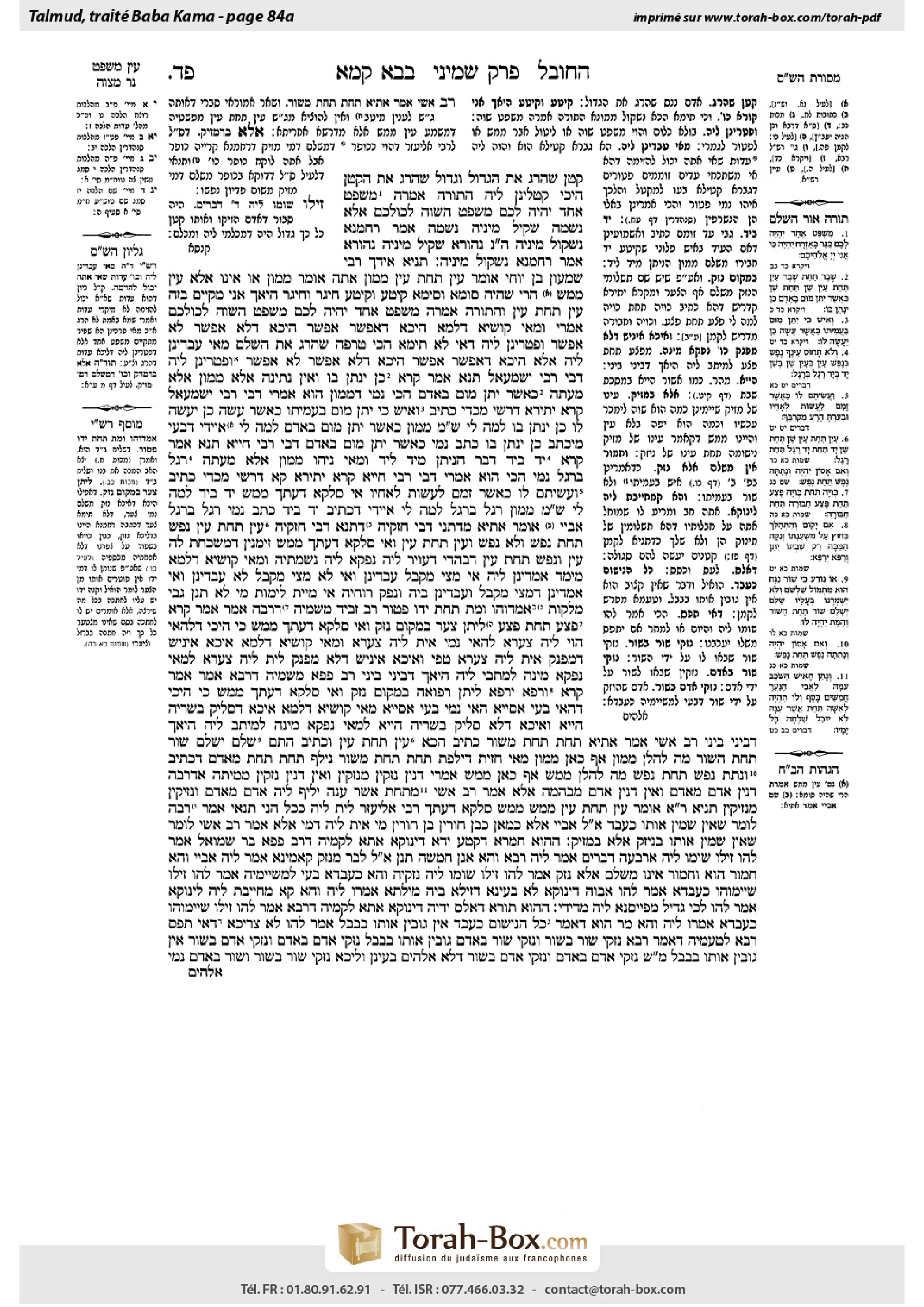
Bava Kamma 84a: Talmud study for Daf Yomi
Study the Talmud for Daf Yomi with scanned pages, Hebrew text, English translations from Sefaria and AI-generated French translations.
Passage selection and English or AI-generated French translation are available where the scan has annotations. Daf Study is independent of Torah-Box and Sefaria.
Browse Bava Kamma · בבא קמא · All tractatesBava Kamma 84a text and translations
This page of Bava Kamma includes the Aramaic text, an English translation and an AI-generated French translation, alongside the scan above.
בבא קמא פ״ד א · Aramaic and Hebrew text
קָטָן שֶׁהָרַג אֶת הַגָּדוֹל וְגָדוֹל שֶׁהָרַג אֶת הַקָּטָן, הֵיכִי קָטְלִינַן לֵיהּ? הַתּוֹרָה אָמְרָה: ״מִשְׁפַּט אֶחָד יִהְיֶה לָכֶם״ – מִשְׁפָּט הַשָּׁוֶה לְכוּלְּכֶם! אֶלָּא נְשָׁמָה שְׁקַיל מִינֵּיהּ, נְשָׁמָה אָמַר רַחֲמָנָא נִשְׁקוֹל מִינֵּיהּ; הָכִי נָמֵי, נְהוֹרָא שְׁקַיל מִינֵּיהּ, נְהוֹרָא אָמַר רַחֲמָנָא נִשְׁקוֹל מִינֵּיהּ!
תַּנְיָא אִידַּךְ, רַבִּי שִׁמְעוֹן בֶּן יוֹחַי אוֹמֵר: ״עַיִן תַּחַת עַיִן״ – מָמוֹן. אַתָּה אוֹמֵר מָמוֹן, אוֹ אֵינוֹ אֶלָּא עַיִן מַמָּשׁ? הֲרֵי שֶׁהָיָה סוֹמֵא, וְסִימֵּא; קִיטֵּעַ, וְקִיטַּע; חִיגֵּר, וְחִיגֵּר; הֵיאַךְ אֲנִי מְקַיֵּים בָּזֶה ״עַיִן תַּחַת עַיִן״ – וְהַתּוֹרָה אָמְרָה: ״מִשְׁפַּט אֶחָד יִהְיֶה לָכֶם״, מִשְׁפָּט הַשָּׁוֶה לְכוּלְּכֶם?
אָמְרִי: וּמַאי קוּשְׁיָא? דִּלְמָא הֵיכָא דְּאֶפְשָׁר – אֶפְשָׁר; הֵיכָא דְּלָא אֶפְשָׁר – לָא אֶפְשָׁר, וּפָטְרִינַן לֵיהּ! דְּאִי לָא תֵּימָא הָכִי, טְרֵפָה שֶׁהָרַג אֶת הַשָּׁלֵם – מַאי עָבְדִינַן לֵיהּ?
אֶלָּא הֵיכָא דְּאֶפְשָׁר – אֶפְשָׁר; הֵיכָא דְּלָא אֶפְשָׁר – לָא אֶפְשָׁר, וּפָטְרִינַן לֵיהּ!
דְּבֵי רַבִּי יִשְׁמָעֵאל תָּנָא, אָמַר קְרָא: ״כֵּן יִנָּתֶן בּוֹ״ – וְאֵין נְתִינָה אֶלָּא מָמוֹן. אֶלָּא מֵעַתָּה, ״כַּאֲשֶׁר יִתֵּן מוּם בָּאָדָם״ – הָכִי נָמֵי דְּמָמוֹן הוּא?
אָמְרִי: דְּבֵי רַבִּי יִשְׁמָעֵאל – קְרָא יַתִּירָא דָּרְשִׁי; מִכְּדֵי כְּתִיב: ״וְאִישׁ כִּי יִתֵּן מוּם בַּעֲמִיתוֹ, כַּאֲשֶׁר עָשָׂה כֵּן יֵעָשֶׂה לוֹ״; ״כֵּן יִנָּתֶן בּוֹ״ לְמָה לִי? שְׁמַע מִינַּהּ: מָמוֹן. ״כַּאֲשֶׁר יִתֵּן מוּם בָּאָדָם״ – לְמָה לִי? אַיְּידֵי דְּבָעֵי מִיכְתַּב ״כֵּן יִנָּתֶן בּוֹ״, כְּתַב נָמֵי ״כַּאֲשֶׁר יִתֵּן מוּם בָּאָדָם״.
דְּבֵי רַבִּי חִיָּיא תָּנָא, אָמַר קְרָא: ״יָד בְּיָד״ – דָּבָר הַנִּיתָּן מִיָּד לְיָד; וּמַאי נִיהוּ? מָמוֹן. אֶלָּא מֵעַתָּה, ״רֶגֶל בְּרָגֶל״ נָמֵי הָכִי הוּא?!
אָמְרִי: דְּבֵי רַבִּי חִיָּיא – קְרָא יַתִּירָא קָא דָרְשִׁי; מִכְּדֵי כְּתִיב: ״וַעֲשִׂיתֶם לוֹ כַּאֲשֶׁר זָמַם לַעֲשׂוֹת לְאָחִיו״; אִי סָלְקָא דַעְתָּךְ מַמָּשׁ, ״יָד בְּיָד״ לְמָה לִי? שְׁמַע מִינַּהּ: מָמוֹן. ״רֶגֶל בְּרָגֶל״ לְמָה לִי? אַיְּידֵי דִּכְתִיב ״יָד בְּיָד״, כְּתַב נָמֵי ״רֶגֶל בְּרָגֶל״.
אַבָּיֵי אוֹמֵר: אָתְיָא מִדְּתָנֵי דְּבֵי חִזְקִיָּה, דְּתָנָא דְּבֵי חִזְקִיָּה: ״עַיִן תַּחַת עַיִן״; ״נֶפֶשׁ תַּחַת נָפֶשׁ״ – וְלֹא נֶפֶשׁ וְעַיִן תַּחַת עַיִן. וְאִי סָלְקָא דַעְתָּךְ מַמָּשׁ, זִימְנִין דְּמַשְׁכַּחַתְּ לַהּ עַיִן וָנֶפֶשׁ תַּחַת עַיִן – דְּבַהֲדֵי דְּעַוַּיר לֵיהּ, נְפַקָא לֵיהּ נִשְׁמְתֵיהּ.
וּמַאי קוּשְׁיָא? דִּלְמָא מֵימָד אָמְדִינַן לֵיהּ; אִי מָצֵי מְקַבֵּל – עָבְדִינַן, וְאִי לָא מָצֵי מְקַבֵּל – לָא עָבְדִינַן; וְאִי אָמְדִינַן דְּמָצֵי מְקַבֵּל, וְעָבְדִינַן בֵּיהּ וּנְפַק רוּחֵיהּ – אִי מָיֵית, לֵימוּת! מִי לָא תְּנַן גַּבֵּי מַלְקוֹת: אֲמָדוּהוּ, וּמֵת תַּחַת יָדוֹ – פָּטוּר?
רַב זְבִיד מִשְּׁמֵיהּ דְּרַבָּה אָמַר, אָמַר קְרָא: ״פֶּצַע תַּחַת פָּצַע״ – לִיתֵּן צַעַר בִּמְקוֹם נֶזֶק. וְאִי סָלְקָא דַּעְתָּךְ מַמָּשׁ – כִּי הֵיכִי דִּלְהַאי הָוֵי לֵיהּ צַעֲרָא, לְהַאי נָמֵי אִית לֵיהּ צַעֲרָא!
וּמַאי קוּשְׁיָא? דִּלְמָא אִיכָּא אִינִישׁ דִּמְפַנַּק – אִית לֵיהּ צַעֲרָא טְפֵי, וְאִיכָּא אִינִישׁ דְּלָא מְפַנַּק – לֵית לֵיהּ צַעֲרָא! לְמַאי נָפְקָא מִינַּהּ? לְמִתַּבי לֵיהּ הַיְאךְ דְּבֵינֵי בֵּינֵי.
רַב פָּפָּא מִשְּׁמֵיהּ דְּרָבָא אָמַר, אָמַר קְרָא: ״וְרַפֹּא יְרַפֵּא״ – לִיתֵּן רְפוּאָה בִּמְקוֹם נֶזֶק. וְאִי סָלְקָא דַעְתָּךְ מַמָּשׁ – כִּי הֵיכִי דְּהַאי בָּעֵי אָסְיָיא, הַאי נָמֵי בָּעֵי אָסְיָיא!
מַאי קוּשְׁיָא? דִּלְמָא אִיכָּא דְּסָלֵיק בִּשְׂרֵיהּ הַיָּיא, וְאִיכָּא דְּלָא סָלֵיק בִּשְׂרֵיהּ הַיָּיא! לְמַאי נָפְקָא מִינַּהּ? לְמִיתַּב לֵיהּ הַיְאךְ דְּבֵינֵי בֵּינֵי.
רַב אָשֵׁי אָמַר: אָתְיָא ״תַּחַת״–״תַּחַת״ מִשּׁוֹר; כְּתִיב הָכָא: ״עַיִן תַּחַת עַיִן״, וּכְתִיב הָתָם: ״שַׁלֵּם יְשַׁלֵּם שׁוֹר תַּחַת הַשּׁוֹר״ – מָה לְהַלָּן מָמוֹן, אַף כָּאן מָמוֹן.
מַאי חָזֵית דְּיָלְפַתְּ ״תַּחַת״–״תַּחַת״ מִשּׁוֹר? נֵילַף ״תַּחַת״–״תַּחַת״ מֵאָדָם – דִּכְתִיב: ״וְנָתַתָּ נֶפֶשׁ תַּחַת נֶפֶשׁ״; מָה לְהַלָּן מַמָּשׁ, אַף כָּאן מַמָּשׁ!
אָמְרִי: דָּנִין נְזָקִין מִנְּזָקִין, וְאֵין דָּנִין נְזָקִין מִמִּיתָה. אַדְּרַבָּה! דָּנִין אָדָם מֵאָדָם, וְאֵין דָּנִין אָדָם מִבְּהֵמָה!
אֶלָּא אָמַר רַב אָשֵׁי: מִ״תַּחַת אֲשֶׁר עִנָּהּ״ יָלֵיף לֵיהּ – אָדָם מֵאָדָם, וּנְזִיקִין מִנְּזִיקִין.
תַּנְיָא, רַבִּי אֱלִיעֶזֶר אוֹמֵר: ״עַיִן תַּחַת עַיִן״ – מַמָּשׁ. ״מַמָּשׁ״ סָלְקָא דַּעְתָּךְ?! רַבִּי אֱלִיעֶזֶר לֵית לֵיהּ כְּכֹל הָנֵי תַּנָּאֵי?!
אָמַר רַבָּה: לוֹמַר שֶׁאֵין שָׁמִין אוֹתוֹ כְּעֶבֶד. אֲמַר לֵיהּ אַבָּיֵי: אֶלָּא כְּמַאן, כְּבֶן חוֹרִין?! בֶּן חוֹרִין מִי אִית לֵיהּ דָּמֵי? אֶלָּא אָמַר רַב אָשֵׁי: לוֹמַר שֶׁאֵין שָׁמִין אוֹתוֹ בְּנִיזָּק, אֶלָּא בְּמַזִּיק.
הָהוּא חַמְרָא דְּקַטַּע יְדָא דְיָנוֹקָא. אֲתָא לְקַמֵּיהּ דְּרַב פָּפָּא בַּר שְׁמוּאֵל, אֲמַר לְהוּ: זִילוּ שׁוּמוּ לֵיהּ אַרְבָּעָה דְּבָרִים. אָמַר לֵיהּ רָבָא: וְהָא אֲנַן חֲמִשָּׁה תְּנַן! אֲמַר לֵיהּ: לְבַר מִנֶּזֶק קָאָמֵינָא. אֲמַר לֵיהּ אַבָּיֵי: וְהָא חֲמוֹר הוּא, וַחֲמוֹר אֵינוֹ מְשַׁלֵּם אֶלָּא נֶזֶק! אֲמַר לְהוּ: זִילוּ שׁוּמוּ לֵיהּ נִזְקֵיהּ. וְהָא כְּעַבְדָּא בָּעֵי לְמִשְׁיְימֵיהּ! אֲמַר לְהוּ: זִילוּ שַׁיְימוּהּו כְּעַבְדָּא.
אֲמַר לְהוּ אֲבוּהּ דְּיָנוֹקָא: לָא בָּעֵינָא, דְּזִילָא בֵּיהּ מִילְּתָא. אֲמַרוּ לֵיהּ: וְהָא קָא מְחַיְּיבַתְּ לֵיהּ לְיָנוֹקָא! אֲמַר לְהוּ: לְכִי גָדֵיל, מְפַיֵּיסְנָא לֵיהּ מִדִּידִי.
הָהוּא תּוֹרָא דַּאֲלַס יְדֵיהּ דְּיָנוֹקָא. אֲתָא לְקַמֵּיהּ דְּרָבָא, אֲמַר לְהוּ: זִילוּ שַׁיְימוּהּו כְּעַבְדָּא. אֲמַרוּ לֵיהּ: וְהָא מָר הוּא דְּאָמַר: כׇּל הַנִּישּׁוֹם כְּעֶבֶד – אֵין גּוֹבִין אוֹתוֹ בְּבָבֶל! אֲמַר לְהוּ: לָא צְרִיכָא, דְּאִי תְּפַס.
רָבָא לְטַעְמֵיהּ, דְּאָמַר רָבָא: נִזְקֵי שׁוֹר בְּשׁוֹר, וְנִזְקֵי שׁוֹר בְּאָדָם – גּוֹבִין אוֹתוֹ בְּבָבֶל. נִזְקֵי אָדָם בְּאָדָם, וְנִזְקֵי אָדָם בְּשׁוֹר – אֵין גּוֹבִין אוֹתוֹ בְּבָבֶל.
מַאי שְׁנָא נִזְקֵי אָדָם בְּאָדָם וְנִזְקֵי אָדָם בְּשׁוֹר, דְּלָא – ״אֱלֹהִים״ בָּעֵינַן, וְלֵיכָּא; נִזְקֵי שׁוֹר בְּשׁוֹר וְשׁוֹר בְּאָדָם נָמֵי –
Bava Kamma 84a · English translation
in the case of a small person who killed a large person, or a large person who killed a small person, how do we kill the murderer? If one suggests that in such a case a monetary penalty will be imposed, the Torah stated: “You shall have one manner of law” (Leviticus 24:22), teaching that the law shall be equal for all of you, so the punishment must be the same for all murderers. Rather, explain that since the murderer took the life of the victim, the Merciful One states that the court should likewise take the life from him. So too, since the one who caused the injury took the sight from the eye of the injured party, the Merciful One states that the court should likewise take the sight from his eye. Therefore, the Gemara does not accept the derivation of Rabbi Dostai ben Yehuda, in accordance with the objection of the Sages.
The Gemara presents another derivation: It is taught in another baraita that Rabbi Shimon ben Yoḥai says: “An eye for an eye” (Leviticus 24:20), is referring to monetary restitution. Do you say that this is referring to monetary restitution, or is it only teaching that the one who caused the injury must lose an actual eye? There may be a case where there was a blind person and he blinded another, or there was one with a severed limb and he severed the limb of another, or there was a lame person and he caused another to be lame. In this case, how can I fulfill “an eye for an eye” literally, when he is already lacking the limb that must be injured? If one will suggest that in that case, a monetary penalty will be imposed, that can be refuted: But the Torah stated: “You shall have one manner of law” (Leviticus 24:22), which teaches that the law shall be equal for all of you.
The Sages object to this derivation and say: And what is the difficulty? Perhaps in a case where it is possible to render the guilty party liable according to the punishment listed in the Torah, it is possible and the court does so; but in a case where it is not possible to enact such a punishment, it is not possible, and we exempt him. As if you do not say so, that punishing one and exempting another is not counter to the principle of: “One manner of law,” then by the same logic, in the case of one who has a wound that will cause him to die within twelve months [tereifa] and who killed a healthy person, what do we do to him?
Rather, one must say that in a case where it is possible to render the guilty party liable according to the punishment listed in the Torah, it is possible and the court does so; but in a case where it is not possible to do so, it is not possible, and we exempt him. Therefore, the Gemara does not accept the derivation of Rabbi Shimon ben Yoḥai, in accordance with the objection of the Sages.
The Gemara presents another derivation: The school of Rabbi Yishmael taught that the verse states: “A fracture for a fracture, an eye for an eye, a tooth for a tooth; as he has given a blemish to a person, so shall it be given unto him” (Leviticus 24:20), and giving can refer only to a payment of money. The Gemara challenges: But if that is so, then when the same verse states: “As he has given [yitten] a blemish to a person,” does this word, “yitten,” also refer to money? The word “yitten” means that he caused an actual injury, even though it employs a term whose literal meaning is give.
The Sages say in response: The rabbis of the school of Rabbi Yishmael are interpreting a superfluous verse. Now, it is written: “And if a man gives a blemish to his neighbor; as he has done, so shall it be done to him” (Leviticus 24:19), so why do I need the verse: “So shall it be given unto him” (Leviticus 24:20)? Learn from the repetition that the verse is referring to monetary restitution. The Gemara asks: But if this is so, why do I need the verse: “As he has given [yitten] a blemish to a person” (Leviticus 24:20)? What does the usage of the term “yitten” teach? The Gemara answers: In fact, it does not teach anything, but rather, since the Merciful One needs to write at the end of that verse: “So shall it be given unto him,” where the employment of a term of giving is accurate, the Merciful One also wrote earlier in the verse: “As he has given [yitten] a blemish to a person.”
The Gemara presents another derivation: The school of Rabbi Ḥiyya taught that the verse states with regard to conspiring witnesses: “And your eye shall not pity; a life for a life, an eye for an eye, a tooth for a tooth, a hand for a hand, a foot for a foot” (Deuteronomy 19:21). This teaches that the witnesses pay compensation with that which is given from hand to hand. And what type of compensation is that? Monetary restitution. The Gemara challenges: But if that is so, is the phrase: “A foot for a foot” (Deuteronomy 19:21), also like that, i.e., is it teaching that the witnesses pay compensation with an item passed from foot to foot?
The Sages say: The rabbis of the school of Rabbi Ḥiyya are interpreting a superfluous phrase in the verse. Now, it is written: “And you shall do to him as he purposed to do to his brother” (Deuteronomy 19:19). If it enters your mind to say that the verse means this literally, why do I need the Torah to specify: “A hand for a hand” (Deuteronomy 19:21)? The punishment will be whatever he purported to do to his brother. Learn from the extra phrase that the punishment is monetary restitution. If so, why do I need the phrase: “A foot for a foot” (Deuteronomy 19:21)? Since it is written: “A hand for a hand,” the Merciful One also wrote in the Torah: “A foot for a foot.”
The Gemara presents another derivation: Abaye says that this principle is derived from that which was taught by the school of Ḥizkiyya, as the school of Ḥizkiyya taught that the Torah states: “An eye for an eye” (Exodus 21:24), and: “A life for a life” (Exodus 21:23), but not an eye and a life for an eye. And if it enters your mind to say that the verse means this literally, there could be times when you find a case where both an eye and a life are taken for an eye, i.e., when the one who caused the damage is so weak that as the court blinds his eye, his soul departs from his body.
The Gemara objects: And what is the difficulty? Perhaps we evaluate the physical condition of the guilty party; if he can withstand this punishment, then we do blind his eye; if he cannot withstand this punishment, then we do not do so and he goes unpunished. And if we evaluate him and determine that he can withstand this punishment, and we do so to him and blind his eye, and yet his soul departs his body as a result, if he dies, he will die. Didn’t we learn in a mishna with regard to lashes (Makkot 22b): If one was sentenced to be flogged, and the court evaluated him and determined that he could withstand a certain number of lashes, and he dies at the hand of the officer tasked with administering the lashes, then the officer is exempt, even though the one who was flogged was not sentenced to the death penalty? Therefore, the Gemara does not accept the derivation of Abaye.
The Gemara presents another derivation: Rav Zevid said in the name of Rabba that the verse states: “A wound for a wound” (Exodus 21:25), to teach that one who injures another must pay compensation for pain, even in a case where he pays compensation for damage. And if it enters your mind that the phrase: “An eye for an eye” (Exodus 21:24), refers to the removal of an actual eye from the one who injured the other, then just as it is so that the injured party has pain from the loss of his eye, the one who caused him injury also has pain when the court removes his eye; why then does the Torah require that he pay compensation for pain as well?
The Gemara objects: And what is the difficulty? Perhaps there is a person who is delicate, so he has more pain, and there is a person who is not delicate, so he does not have the same amount of pain. Therefore, even if the court actually removes an eye for an eye, the one who caused the injury might still need to compensate the injured party for pain. What is the practical difference when the Torah states: “A wound for a wound” (Exodus 21:25)? It renders the one who caused the injury liable to give the injured party compensation for the difference between them in pain tolerance. Therefore, the Gemara does not accept the derivation of Rav Zevid.
The Gemara presents another derivation: Rav Pappa said in the name of Rava that concerning one who was injured by another, who must pay for damage, the verse states: “If he rises again, and walks outside upon his staff, then he that struck him shall be absolved; only he shall pay for his loss of livelihood, and shall cause him to be thoroughly healed” (Exodus 21:19), which teaches that one who injures another must pay compensation for medical costs even in a case where he pays compensation for damage. And if it enters your mind that the phrase: “An eye for an eye” (Exodus 21:24), is referring to an actual eye, then just as it is so that the injured party needs healing, the one who caused him the injury also needs healing after the court removes his eye; why, then, does the Torah require that he pay compensation for medical costs as well?
The Gemara objects: What is the difficulty? Perhaps there is one whose flesh heals quickly, and there is another whose flesh does not heal quickly. Therefore, even if the court actually removes an eye for an eye, the one who caused the injury might still need to compensate the injured party for medical costs. What is the practical difference when the Torah states: “And shall cause him to be thoroughly healed” (Exodus 21:19)? It renders the one who caused the injury liable to give the injured party compensation for the difference between their respective medical costs.
The Gemara presents another derivation: Rav Ashi said that the fact that one who injures another pays monetary restitution is derived from a verbal analogy of the word “for,” as written with regard to injuries caused to people from the word “for,” as written with regard to an ox that gored another ox. It is written here: “An eye for an eye” (Exodus 21:24), and it is written there, with regard to a forewarned ox that gored the ox of another: “He shall pay an ox for an ox” (Exodus 21:36). Just as there, the verse does not mean that the owner pays compensation with an actual ox, but rather pays monetary restitution, so too here, one who injures another pays monetary restitution.
The Gemara asks: What did you see that led you to derive the halakha from a verbal analogy of the word “for” as stated in the verse with regard to injuries to a person from the word “for” as stated with regard to an ox? Let us learn a verbal analogy of the word “for” as stated in the verse with regard to injuries to a person from the word “for” as stated with regard to a person, as it is written about one who kills another: “You shall give a life for a life” (Exodus 21:23). Just as there, the court punishes the guilty party by taking his actual life, so too here, why not say that the court should take his actual eye?
The Sages say in response: The halakha concerning damages is derived from a verse concerning damages, and the halakha concerning damages is not derived from a verse concerning death. The Gemara objects: On the contrary, say that the halakha concerning a person is derived from a verse concerning a person, and the halakha concerning a person is not derived from a verse concerning animals.
Rather, Rav Ashi retracted his original statement and said a different derivation: The halakha is derived from a verbal analogy of the word “for” as written with regard to injuries from the word “for” as written with regard to a man who rapes a woman, who must pay monetary compensation. The verse states: “Then the man that lay with her shall give to the girl’s father fifty shekels of silver, and she shall be his wife, for he has afflicted her; he may not send her away all his days” (Deuteronomy 22:29). Based on this verbal analogy, the halakha concerning a person is derived from a verse concerning a person, and the halakha concerning damages is derived from a verse concerning damages.
§ It is taught in a baraita that Rabbi Eliezer says: The verse that states: “An eye for an eye” (Exodus 21:24), is referring to an actual eye. The Gemara asks: Can it enter your mind that the verse is referring to an actual eye? Doesn’t Rabbi Eliezer understand the verse like all these tanna’im, who explained that this verse is referring to monetary payment?
Rabba said in response: Rabbi Eliezer means to say that the court does not appraise the injured party as a slave to assess the compensation for the injury. Abaye said to Rabba: Rather, like whom does the court appraise the injured party? If you say that the court appraises him like a freeman, does a freeman have monetary value? Rather, Rav Ashi said: Rabbi Eliezer means to say that the court does not appraise the injured party as if he were going to be sold as a slave, but rather, they appraise the one who caused him damage. The court appraises how much the latter’s value would be reduced were he to sustain the same injury he caused to the injured party, and he pays this amount as indemnity.
§ The Gemara relates: There was a certain donkey that severed the hand of a child. The case came before Rav Pappa bar Shmuel. He said to the officers of the court: Go appraise the four types of indemnity for the child. Rava said to him: But didn’t we learn in the mishna that there are five types of indemnity? Rav Pappa bar Shmuel said to him: I was saying to include the indemnities the responsible party is liable to pay other than damage. Abaye said to him: But was this not a donkey that caused this injury, and the owner of a donkey that causes injury pays only for the damage? Rav Pappa bar Shmuel said to the officers of the court: Go appraise for the child the value of his damage. They said to him: But doesn’t the child need to be appraised as a slave? He said to them: Go appraise him as a slave.
The father of the child said to them: I do not want my child to be appraised as a slave, because this matter would demean him. They said to the father: But you are acting to the detriment of the child, as he will not receive compensation for his injury. He said to them: When he matures, I will appease him with my own money, rather than see him demeaned now.
The Gemara relates another incident: There was a certain ox that chewed [da’alas] the hand of a child, injuring him. The case came before Rava. He said to the officers of the court: Go appraise him as a slave. They said to Rava: But wasn’t it you, Master, who said: With regard to anyone who is appraised as a slave in order to determine the amount of a monetary penalty, that penalty is not collected by courts in Babylonia? Rava said to them: It is not necessary to appraise his value in order to force the guilty party to pay restitution, but it is nevertheless necessary to determine his value. This is because if the injured party seizes property from the one who caused him injury, and that property is equal in value to what the payment should be, the court will not compel him to return it.
The Gemara notes: Rava conforms to his standard line of reasoning, as Rava says: Compensation for damage to an ox caused by an ox and for damage to an ox caused by a person is collected by courts in Babylonia, but compensation for damage to a person caused by a person and for damage to a person caused by an ox is not collected by courts in Babylonia.
The Gemara clarifies: What is different about compensation for damage to a person caused by a person and for damage to a person caused by an ox, that it is not collected in Babylonia? If you say that we require ordained judges to collect damages, and there are not any ordained judges in Babylonia, then so too, in a case of damage caused by an ox to an ox, and damage caused by a person to an ox,
Bava Kamma 84a · Traduction française (IA)
Dans le cas d'une personne petite qui a tué une personne grande, ou d'une personne grande qui a tué une personne petite, comment tuons-nous le meurtrier ? Si l'on suggère que dans un tel cas une amende monétaire sera imposée, la Torah dit : « Vous aurez une seule manière de loi » (Lévitique 24:22), enseignant que la loi doit être égale pour tous, donc la punition doit être la même pour tous les meurtriers. En revanche, expliquez que puisque le meurtrier a pris la vie de la victime, le Tout-Puissant dit que la cour doit également prendre la vie de lui. De même, puisque celui qui a causé l'injury a ôté la vue à l'œil de la victime, le Tout-Puissant dit que la cour doit également ôter la vue de son œil. Ainsi, la Guemara ne valide pas la dérivation de Rabbi Dostai ben Yehuda, conformément à l'objection des Sages.
La Guemara présente une autre dérivation : Il est enseigné dans une autre baraïta que Rabbi Shimon ben Yoḥai dit : « Un œil pour un œil » (Lévitique 24:20), fait référence à une restitution monétaire. Dis-tu que cela fait référence à une restitution monétaire, ou est-ce seulement enseigner que celui qui a causé l'injury doit perdre un œil réel ? Il peut y avoir un cas où un aveugle a fait aveugler une autre personne, ou un homme avec un membre sectionné a sectionné le membre d'une autre personne, ou un homme boiteux a rendu un autre boiteux. Dans ce cas, comment puis-je accomplir « un œil pour un œil » littéralement, lorsque la personne manque déjà le membre qui doit être blessé ? Si l'on suggère que dans ce cas une amende monétaire sera imposée, cela peut être réfuté : Mais la Torah dit : « Vous aurez une seule manière de loi » (Lévitique 24:22), enseignant que la loi doit être égale pour tous.
Les Sages s'opposent à cette dérivation et disent : Et quelle est la difficulté ? Peut-être dans un cas où il est possible de rendre le coupable responsable selon la punition énoncée dans la Torah, il est possible et la cour le fait ; mais dans un cas où il n'est pas possible d'appliquer telle punition, il n'est pas possible, et nous exemptons. Comme si tu ne disais pas cela, que punir l'un et exempter l'autre n'est pas contraire au principe : « Une seule manière de loi », alors par la même logique, dans le cas d'une personne qui a une blessure qui le fera mourir dans les douze mois [tereifa] et qui a tué une personne saine, que faisons-nous de lui ?
En revanche, il faut dire que dans un cas où il est possible de rendre le coupable responsable selon la punition énoncée dans la Torah, il est possible et la cour le fait ; mais dans un cas où il n'est pas possible de le faire, il n'est pas possible, et nous exemptons. Ainsi, la Guemara ne valide pas la dérivation de Rabbi Shimon ben Yoḥai, conformément à l'objection des Sages.
La Guemara présente une autre dérivation : La maison de Rabbi Yishmael enseignait que la parabole dit : « Une fracture pour une fracture, un œil pour un œil, un dents pour une dents ; comme il a donné [yitten] une blemish à une personne, ainsi sera donné à lui » (Lévitique 24:20), et donner peut faire référence uniquement à une restitution monétaire. La Guemara conteste : Mais si c'est ainsi, alors lorsque la même parabole dit : « Comme il a donné [yitten] une blemish à une personne », ce mot, « yitten », fait-il également référence à de l'argent ? Le mot « yitten » signifie que l'on a causé une blessure réelle, même s'il utilise un terme dont la signification littérale est donner.
Les Sages répondent en disant : Les rabbins de la maison de Rabbi Yishmael interprètent une parole superflue. Maintenant, il est écrit : « Et si un homme donne une blemish à son voisin ; comme il a fait, ainsi sera fait à lui » (Lévitique 24:19), alors pourquoi ai-je besoin de la parabole : « Ainsi sera donné à lui » (Lévitique 24:20) ? Apprends-en par la répétition que la parabole fait référence à une restitution monétaire. La Guemara demande : Mais si c'est ainsi, pourquoi ai-je besoin de la parabole : « Comme il a donné [yitten] une blemish à une personne » (Lévitique 24:20) ? Qu'enseigne l'usage du terme « yitten » ? La Guemara répond : En réalité, il ne nous enseigne rien, mais plutôt, puisque le Tout-Puissant a besoin d'écrire à la fin de cette parabole : « Ainsi sera donné à lui », où l'emploi d'un terme de donner est exact, le Tout-Puissant a également écrit plus tôt dans la parabole : « Comme il a donné [yitten] une blemish à une personne. »
La Guemara présente une autre dérivation : La maison de Rabbi Ḥiyya enseignait que la parabole dit concernant les témoins conspirateurs : « Et ton œil ne doit pas avoir de pitié ; une vie pour une vie, un œil pour un œil, une main pour une main, un pied pour un pied » (Dt 19:21). Cela enseigne que les témoins paient une compensation avec ce qui est donné de la main à la main. Et quel type de compensation est-ce ? La restitution monétaire. La Guemara conteste : Mais si c'est ainsi, la phrase : « Un pied pour un pied » (Dt 19:21), fait-elle également référence à cela, c'est-à-dire enseigne-t-elle que les témoins paient une compensation avec un objet passé du pied à pied ?
Les Sages disent : Les rabbins de la maison de Rabbi Ḥiyya interprètent une phrase superflue dans la Torah. Maintenant, il est écrit : « Et tu feras à lui comme il avait l'intention de faire à son frère » (Dt 19:19). Si tu penses que la Torah signifie cela littéralement, pourquoi ai-je besoin de la Torah pour spécifier : « Une main pour une main » (Dt 19:21) ? La punition sera ce qu'il avait l'intention de faire à son frère. Apprends-en par la phrase supplémentaire que la punition est une restitution monétaire. Si c'est ainsi, pourquoi ai-je besoin de la phrase : « Un pied pour un pied » (Dt 19:21) ? Puisque cela est écrit : « Une main pour une main », le Tout-Puissant a également écrit dans la Torah : « Un pied pour un pied. »
La Guemara présente une autre dérivation : Abaye dit que ce principe est dérivé de ce qui a été enseigné par la maison de Ḥizkiyya, comme la maison de Ḥizkiyya enseignait que la Torah dit : « Un œil pour un œil » (Ex 21:24), et : « Une vie pour une vie » (Ex 21:23), mais pas un œil et une vie pour un œil. Et si tu penses que la Torah signifie cela littéralement, il peut y avoir des cas où tu trouves un cas où à la fois un œil et une vie sont pris pour un œil, c'est-à-dire lorsque celui qui a causé les dommages est si faible que lorsque la cour lui arrache l'œil, son âme quitte son corps.
La Guemara s'oppose : Et quelle est la difficulté ? Peut-être que nous évaluons l'état physique du coupable ; si celui-ci peut supporter cette punition, alors nous lui faisons aveugler l'œil ; si celui-ci ne peut pas supporter cette punition, alors nous ne le faisons pas et il reste impuni. Et si nous évaluons et déterminons qu'il peut supporter cette punition, et que nous le faisons ainsi et lui faisons aveugler l'œil, et pourtant son âme quitte son corps en conséquence, s'il meurt, il meurt. N'avons-nous pas appris dans une mitsva concernant les fessures (Makkot 22b) : Si l'on avait été condamné à être flagellé, et que le tribunal avait évalué et déterminé qu'il pouvait supporter un certain nombre de fessures, et qu'il meurt à la main de l'officier chargé de lui administrer les fessures, alors l'officier est exempt, même si celui qui avait été flagellé n'avait pas été condamné à la peine de mort ? Ainsi, la Guemara ne reprend pas la dérivation d'Abaye.
La Guemara présente une autre dérivation : Rav Zevid, en nom de Rabba, dit que le verset : « Une plaie pour une plaie » (Exode 21:25), enseigne que celui qui blesse un autre doit payer une compensation pour la douleur, même dans un cas où il paie une compensation pour les dommages. Et si vous pensez que la phrase : « Un œil pour un œil » (Exode 21:24), fait référence à la suppression d'un œil réel du coupable, alors justement, comme la victime a de la douleur à cause de la perte de son œil, celui qui a causé la blessure a aussi de la douleur lorsque le tribunal retire son œil ; pourquoi donc la Torah exige-t-elle qu'il paie une compensation pour la douleur également ?
La Guemara s'oppose : Et quelle est la difficulté ? Peut-être qu'il y a une personne délicate, qui ressent plus de douleur, et une personne non délicate, qui ne ressent pas la même douleur. Ainsi, même si le tribunal retire effectivement un œil pour un œil, celui qui a causé la blessure pourrait encore devoir compenser la victime pour la douleur. Quel est le différend pratique lorsque la Torah dit : « Une plaie pour une plaie » (Exode 21:25) ? Elle rend celui qui a causé la blessure responsable de la différence entre eux en termes de tolérance à la douleur. Ainsi, la Guemara ne reprend pas la dérivation de Rav Zevid.
La Guemara présente une autre dérivation : Rav Pappa, en nom de Rava, dit que concernant celui qui a été blessé par un autre, qui doit payer pour les dommages, le verset dit : « Si il se relève et marche à l'extérieur sur sa béquille, alors celui qui l'a frappé sera exempt ; seulement il paiera la perte de son revenu, et fera en sorte qu'il soit soigné en toute sécurité » (Exode 21:19), ce qui enseigne que celui qui blesse un autre doit payer une compensation pour les frais médicaux même dans un cas où il paie une compensation pour les dommages. Et si vous pensez que la phrase : « Un œil pour un œil » (Exode 21:24), fait référence à un œil réel, alors justement, comme la victime a besoin de soins, celui qui a causé la blessure a aussi besoin de soins après que le tribunal ait retiré son œil ; pourquoi donc la Torah exige-t-elle qu'il paie une compensation pour les frais médicaux également ?
La Guemara s'oppose : Quelle est la difficulté ? Peut-être qu'il y a une personne dont la chair guérit rapidement, et une autre dont la chair ne guérit pas rapidement. Ainsi, même si le tribunal retire effectivement un œil pour un œil, celui qui a causé la blessure pourrait encore devoir compenser la victime pour les frais médicaux. Quel est le différend pratique lorsque la Torah dit : « Et fasse en sorte qu'il soit soigné en toute sécurité » (Exode 21:19) ? Elle rend celui qui a causé la blessure responsable de la différence entre leurs frais médicaux.
La Guemara présente une autre dérivation : Rav Ashi dit que le fait que celui qui blesse un autre doive payer une compensation monétaire est dérivé d'une analogie verbale du mot « pour », comme écrit concernant les blessures causées aux personnes, comme écrit concernant un bœuf qui a écrasé un autre bœuf. Il est écrit ici : « Un œil pour un œil » (Exode 21:24), et il est écrit là, concernant un bœuf averti qui a écrasé le bœuf d'un autre : « Il paiera un bœuf pour un bœuf » (Exode 21:36). Justement là, le verset ne signifie pas que l'owner paie une compensation avec un bœuf réel, mais plutôt une compensation monétaire, ainsi ici, celui qui blesse un autre paie une compensation monétaire.
La Guemara demande : Qu'est-ce que vous avez vu qui vous a conduit à dériver la halakha d'une analogie verbale du mot « pour » comme dit dans le verset concernant les blessures à une personne du mot « pour » comme dit concernant un bœuf ? Apprenons une analogie verbale du mot « pour » comme dit dans le verset concernant les blessures à une personne du mot « pour » comme dit concernant une personne, comme il est écrit sur celui qui tue un autre : « Vous donnerez une vie pour une vie » (Exode 21:23). Justement là, le tribunal punit le coupable en prenant sa vie réelle, ainsi ici, pourquoi ne pas dire que le tribunal devrait prendre son œil réel ?
Les Sages répondent : La halakha concernant les dommages est dérivée d'un verset concernant les dommages, et la halakha concernant les dommages n'est pas dérivée d'un verset concernant la mort. La Guemara s'oppose : Au contraire, disons que la halakha concernant une personne est dérivée d'un verset concernant une personne, et la halakha concernant les dommages n'est pas dérivée d'un verset concernant les animaux.
Plutôt, Rav Ashi a rétracté son affirmation originale et a dit une autre dérivation : La halakha est dérivée d'une analogie verbale du mot « pour » comme écrit concernant les blessures, du mot « pour » comme écrit concernant un homme qui viole une femme, qui doit payer une compensation monétaire. Le verset dit : « Alors l'homme qui a couché avec elle donnera à la mère de la fille cinquante sicles d'argent, et elle sera sa femme, pour qu'il ait blessé ; il ne peut pas la renvoyer toute sa vie » (Deutéronome 22:29). Basé sur cette analogie verbale, la halakha concernant une personne est dérivée d'un verset concernant une personne, et la halakha concernant les dommages est dérivée d'un verset concernant les dommages.
§ Il est enseigné dans une baraïta que Rabbi Eliezer dit : La parole qui dit : « Un œil pour un œil » (Exode 21:24), fait référence à un œil réel. La Guemara demande : Est-ce que cela entre dans votre tête que la parole fasse référence à un œil réel ? N’est-ce pas que Rabbi Eliezer comprend la parole comme tous ces tanna’im, qui expliquent que cette parole fait référence à un paiement monétaire ?
Rabba répondit en disant : Rabbi Eliezer veut dire que la cour ne considère pas la partie blessée comme un esclave pour évaluer la compensation de la blessure. Abaye dit à Rabba : Et par rapport à qui la cour considère-t-elle la partie blessée ? Si vous dites que la cour considère qu’il est un homme libre, un homme libre a-t-il une valeur monétaire ? Plutôt, Rav Ashi dit : Rabbi Eliezer veut dire que la cour ne considère pas la partie blessée comme si elle devait être vendue comme esclave, mais plutôt, ils évaluent celui qui a causé la blessure. La cour évalue combien la valeur de ce dernier serait réduite s’il subissait la même blessure que celle qu’il a causée à la partie blessée, et il paie cette somme comme indemnité.
§ La Guemara rapporte : Il y avait un certain âne qui a coupé la main d’un enfant. Le cas est venu devant Rav Pappa bar Shmuel. Il dit aux officiers de la cour : Allez évaluer les quatre types d’indemnité pour l’enfant. Rava dit à lui : Mais n’avons-nous pas appris dans la mishna que les indemnités sont cinq ? Rav Pappa bar Shmuel dit à lui : Je disais pour inclure les indemnités que la partie responsable est tenue de payer en dehors du dommage. Abaye dit à lui : Mais ce n’était pas un âne qui a causé cette blessure, et l’propriétaire d’un âne qui cause une blessure paie seulement pour le dommage ? Rav Pappa bar Shmuel dit aux officiers de la cour : Allez évaluer la valeur du dommage pour l’enfant. Ils dirent à lui : Mais l’enfant n’a-t-il pas besoin d’être évalué comme un esclave ? Il dit à eux : Allez l’évaluer comme un esclave.
Le père de l’enfant dit à eux : Je ne veux pas que mon enfant soit évalué comme un esclave, car cela le déshonorerait. Ils dirent au père : Mais vous agissez à son préjudice, car il ne recevra pas d’indemnité pour sa blessure. Il dit à eux : Lorsqu’il sera majeur, je le rachèterai avec mes propres deniers, plutôt que de le voir déshonoré maintenant.
La Guemara rapporte un autre incident : Il y avait un certain bœuf qui a mâché [da’alas] la main d’un enfant, le blessant. Le cas est venu devant Rava. Il dit aux officiers de la cour : Allez évaluer sa valeur comme un esclave. Ils dirent à Rava : Mais n’était-ce pas vous, Maître, qui avez dit : En ce qui concerne toute personne évaluée comme un esclave afin de déterminer la somme d’une amende monétaire, cette amende n’est pas recueillie par les tribunaux en Babylone ? Rava dit à eux : Il n’est pas nécessaire d’évaluer sa valeur afin de faire payer la réparation, mais il est toutefois nécessaire de déterminer sa valeur. Cela est parce que si la partie blessée saisit des biens de celui qui l’a blessé, et que ces biens sont égaux en valeur à ce que la réparation devrait être, la cour ne forcera pas celui-ci à les restituer.
La Guemara note : Rava suit sa ligne de raisonnement habituelle, car Rava dit : La réparation du dommage à un bœuf causé par un bœuf et la réparation du dommage à un bœuf causé par une personne est recueillie par les tribunaux en Babylone, mais la réparation du dommage à une personne causé par une personne et la réparation du dommage à une personne causé par un bœuf n’est pas recueillie par les tribunaux en Babylone.
La Guemara précise : Qu’est-ce qui diffère entre la réparation du dommage causé à une personne par une personne et celle du dommage causé à une personne par un bœuf, que cela n’est pas recueilli en Babylone ? Si vous dites que nous exigeons des juges ordonnés pour recueillir les dommages, et qu’il n’y a pas de juges ordonnés en Babylone, alors de même, dans le cas d’un dommage causé par un bœuf à un bœuf et d’un dommage causé par une personne à un bœuf,
Traduction française générée par IA à partir de l’édition anglaise de Sefaria. Vérifie toujours un passage avec le texte source.
Text from Sefaria: William Davidson Edition - Vocalized Aramaic (CC BY NC); William Davidson Edition - English (CC BY NC).