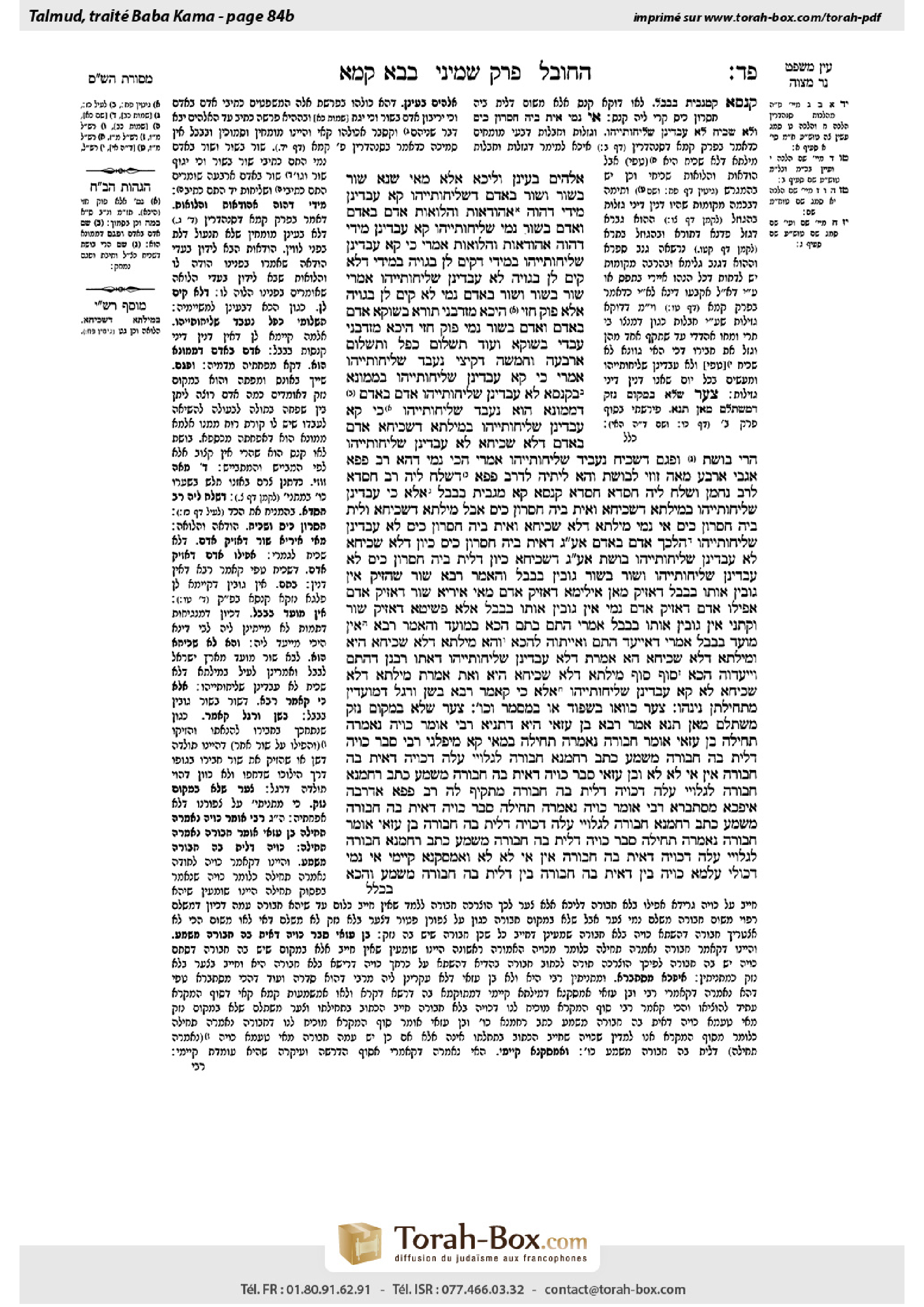
Bava Kamma 84b: Talmud study for Daf Yomi
Study the Talmud for Daf Yomi with scanned pages, Hebrew text, English translations from Sefaria and AI-generated French translations.
Passage selection and English or AI-generated French translation are available where the scan has annotations. Daf Study is independent of Torah-Box and Sefaria.
Browse Bava Kamma · בבא קמא · All tractatesBava Kamma 84b text and translations
This page of Bava Kamma includes the Aramaic text, an English translation and an AI-generated French translation, alongside the scan above.
בבא קמא פ״ד ב · Aramaic and Hebrew text
״אֱלֹהִים״ בָּעֵינַן, וְלֵיכָּא!
אֶלָּא מַאי שְׁנָא שׁוֹר בְּשׁוֹר וְשׁוֹר בְּאָדָם? דִּשְׁלִיחוּתַיְיהוּ קָא עָבְדִינַן – מִידֵּי דְּהָוֵה אַהוֹדָאוֹת וְהַלְוָאוֹת. אָדָם בְּאָדָם וְאָדָם בְּשׁוֹר נָמֵי, שְׁלִיחוּתַיְיהוּ קָא עָבְדִינַן – מִידֵּי דְּהָוֵה אַהוֹדָאוֹת וְהַלְוָאוֹת!
אָמְרִי: כִּי קָא עָבְדִינַן שְׁלִיחוּתַיְיהוּ – בְּמִידֵּי דְּקִים לַן בְּגַוֵּיהּ; בְּמִידֵּי דְּלָא קִים לַן בְּגַוֵּיהּ – לָא עָבְדִינַן שְׁלִיחוּתַיְיהוּ.
אָמְרִי: שׁוֹר בְּשׁוֹר וְשׁוֹר בְּאָדָם נָמֵי לָא קִים לַן בְּגַוֵּיהּ – אֶלָּא פּוֹק חֲזִי (הֵיכָא) [כַּמָּה] מִזְדַּבְּנִי תּוֹרֵי בְּשׁוּקָא; אָדָם בְּאָדָם וְאָדָם בְּשׁוֹר נָמֵי, פּוֹק חֲזִי (הֵיכָא) [כַּמָּה] מִזְדַּבְּנִי עַבְדֵי בְּשׁוּקָא!
וְעוֹד, תַּשְׁלוּם כֶּפֶל וְתַשְׁלוּם אַרְבָּעָה וַחֲמִשָּׁה, דְּקִיצִי, נַעֲבֵד שְׁלִיחוּתַיְיהוּ!
אָמְרִי: כִּי קָא עָבְדִינַן שְׁלִיחוּתַיְיהוּ – בְּמָמוֹנָא, בִּקְנָסָא – לָא עָבְדִינַן שְׁלִיחוּתַיְיהוּ.
אָדָם בְּאָדָם, דְּמָמוֹנָא הוּא, נַעֲבֵד שְׁלִיחוּתַיְיהוּ! כִּי קָא עָבְדִינַן שְׁלִיחוּתַיְיהוּ בְּמִילְּתָא דִשְׁכִיחָא, אָדָם בְּאָדָם דְּלָא שְׁכִיחָא – לָא עָבְדִינַן שְׁלִיחוּתַיְיהוּ.
הֲרֵי בּוֹשֶׁת וּפְגָם, דִּשְׁכִיחַ, נַעֲבֵיד שְׁלִיחוּתַיְיהוּ! אָמְרִי: הָכִי נָמֵי; דְּהָא רַב פָּפָּא אַגְבִּי אַרְבַּע מְאָה זוּזֵי לְבוֹשֶׁת. וְהָא לֵיתֵיהּ לִדְרַב פָּפָּא! דִּשְׁלַח לֵיהּ רַב חִסְדָּא לְרַב נַחְמָן, וּשְׁלַח לֵיהּ: חִסְדָּא חִסְדָּא, קְנָסָא קָא מַגְבֵּית בְּבָבֶל?!
אֶלָּא כִּי עָבְדִינַן שְׁלִיחוּתַיְיהוּ – בְּמִילְּתָא דִשְׁכִיחָא, וְאִית בֵּיהּ חֶסְרוֹן כִּיס; אֲבָל מִילְּתָא דִשְׁכִיחָא וְלֵית בֵּיהּ חֶסְרוֹן כִּיס, אִי נָמֵי מִילְּתָא דְלָא שְׁכִיחָא וְאִית בֵּיהּ חֶסְרוֹן כִּיס – לָא עָבְדִינַן שְׁלִיחוּתַיְיהוּ. הִלְכָּךְ, אָדָם בְּאָדָם – אַף עַל גַּב דְּאִית בֵּיהּ חֶסְרוֹן כִּיס, כֵּיוָן דְּלָא שְׁכִיחָא – לָא עָבְדִינַן שְׁלִיחוּתַיְיהוּ; בּוֹשֶׁת – אַף עַל גַּב דִשְׁכִיחָא, כֵּיוָן דְּלֵית בֵּיהּ חֶסְרוֹן כִּיס – לָא עָבְדִינַן שְׁלִיחוּתַיְיהוּ.
וְשׁוֹר בְּשׁוֹר גּוֹבִין בְּבָבֶל? וְהָאָמַר רָבָא: שׁוֹר שֶׁהִזִּיק – אֵין גּוֹבִין אוֹתוֹ בְּבָבֶל. דְּאַזֵּיק מַאן? אִילֵימָא דְּאַזֵּיק אָדָם, מַאי אִירְיָא שׁוֹר דְּאַזֵּיק אָדָם? אֲפִילּוּ אָדָם דְּאַזֵּיק אָדָם נָמֵי אֵין גּוֹבִין אוֹתוֹ בְּבָבֶל! אֶלָּא פְּשִׁיטָא – דְּאַזֵּיק שׁוֹר, וְקָתָנֵי: אֵין גּוֹבִין אוֹתוֹ בְּבָבֶל!
אָמְרִי: הָתָם בְּתָם, הָכָא בְּמוּעָד. וְהָאָמַר רָבָא: אֵין מוּעָד בְּבָבֶל! אָמְרִי: דְּאִיַּיעַד הָתָם וְאַיְּיתוּהּ לְהָכָא.
וְהָא מִילְּתָא דְּלָא שְׁכִיחָא הִיא, וּמִילְּתָא דְלָא שְׁכִיחָא הָא אָמְרַתְּ דְּלָא עָבְדִינַן שְׁלִיחוּתַיְיהוּ! דַּאֲתוֹ רַבָּנַן דְּהָתָם, וְיַיעֲדוּהּ הָכָא. סוֹף סוֹף, מִילְּתָא דְלָא שְׁכִיחָא הִיא, וְאַתְּ אָמְרַתְּ מִילְּתָא דְלָא שְׁכִיחָא לָא (קָא) עָבְדִינַן שְׁלִיחוּתַיְיהוּ!
אֶלָּא כִּי קָאָמַר רָבָא – בְּשֵׁן וָרֶגֶל, דְּמוּעָדִין מִתְּחִילָּתָן נִינְהוּ.
צַעַר – כְּווֹאוֹ בְּשַׁפּוּד אוֹ בְּמַסְמֵר וְכוּ׳. צַעַר שֶׁלֹּא בִּמְקוֹם נֶזֶק מִשְׁתַּלֵּם – מַאן תַּנָּא? אָמַר רָבָא: בֶּן עַזַּאי הִיא – דְּתַנְיָא, רַבִּי אוֹמֵר: ״כְּוִיָּה״ נֶאֶמְרָה תְּחִילָּה. בֶּן עַזַּאי אוֹמֵר: ״חַבּוּרָה״ נֶאֶמְרָה תְּחִילָּה.
בְּמַאי קָא מִיפַּלְגִי? רַבִּי סָבַר: ״כְּוִיָּה״ – דְּלֵית בַּהּ חַבּוּרָה מַשְׁמַע; כְּתַב רַחֲמָנָא ״חַבּוּרָה״ לְגַלּוֹיֵי עֲלַהּ דִּכְוִיָּה – דְּאִית בַּהּ חַבּוּרָה אִין, אִי לָא לָא.
וּבֶן עַזַּאי סָבַר: ״כְּוִיָּה״ – דְּאִית בַּהּ חַבּוּרָה מַשְׁמַע; כְּתַב רַחֲמָנָא ״חַבּוּרָה״ לְגַלּוֹיֵי עֲלַהּ דִּכְוִיָּה – דְּלֵית בַּהּ חַבּוּרָה.
מַתְקֵיף לַהּ רַב פָּפָּא: אַדְּרַבָּה, אִיפְּכָא מִסְתַּבְּרָא! רַבִּי אוֹמֵר ״כְּוִיָּה״ נֶאֶמְרָה תְּחִילָּה – סָבַר: ״כְּוִיָּה״ – דְּאִית בַּהּ חַבּוּרָה מַשְׁמַע; כְּתַב רַחֲמָנָא ״חַבּוּרָה״ לְגַלּוֹיֵי עֲלַהּ דִּכְוִיָּה – דְּלֵית בַּהּ חַבּוּרָה.
בֶּן עַזַּאי אוֹמֵר ״חַבּוּרָה״ נֶאֶמְרָה תְּחִילָּה – סָבַר: ״כְּוִיָּה״ – דְּלֵית בַּהּ חַבּוּרָה מַשְׁמַע; כְּתַב רַחֲמָנָא ״חַבּוּרָה״ לְגַלּוֹיֵי עֲלַהּ דִּכְוִיָּה – דְּאִית בַּהּ חַבּוּרָה אִין, אִי לָא לָא. וְאַמַּסְּקָנָא קָיְימִי.
אִי נָמֵי, דְּכוּלֵּי עָלְמָא: ״כְּוִיָּה״ – בֵּין דְּאִית בָּהּ חַבּוּרָה בֵּין דְּלֵית בַּהּ חַבּוּרָה מַשְׁמַע; וְהָכָא
Bava Kamma 84b · English translation
say that we require ordained judges [elohim] and there are not any ordained judges in Babylonia.
Rather, what is different about damage to an ox caused by an ox and damage to an ox caused by a man, so that Babylonian judges can rule in these cases even though they are not ordained? The difference is that we, the judges of Babylonia, perform the agency of the judges of Eretz Yisrael, just as we do with regard to the halakhot of admissions and loans, as we are permitted to rule in those cases as agents of the ordained judges in Eretz Yisrael. If so, then in cases of damage caused to a person by a person and cases of damage caused to a person by an ox as well, why not say that the judges of Babylonia perform the agency of the judges of Eretz Yisrael, just as it is with regard to the halakhot of admissions and loans?
The Sages state, with regard to the distinction: When we, the judges of Babylonia, perform the agency of the judges of Eretz Yisrael, we do so in matters where the ruling is clear to us; but in matters where the ruling is not clear to us, such as in the case of an injury to a person, which requires an appraisal, we do not perform the agency of the judges of Eretz Yisrael.
The Sages state an objection: In cases of damage caused to an ox by an ox, and damage caused to an ox by a man, cases that we do judge in Babylonia, the ruling is also not clear to us, as the damage must be appraised. Rather, how is the judgment assessed in those cases? We say: Go out and see how much an ox is sold for in the marketplace, and thereby assess the value of the damages, without a detailed appraisal. If so, in the case of damage caused to a person by a person, and damage caused to a person by an ox, say too: Go out and see how a slave is sold in the slave market. Why, then, are these latter cases not judged in Babylonia?
And furthermore, in the case of payment of double the principal incurred by a thief, and in the case of the fourfold or fivefold payment incurred by a thief who stole a sheep or ox and then slaughtered or sold the animal, where the payments are fixed and there is no need for an appraisal, we should perform the agency of the judges of Eretz Yisrael.
The Sages state, with regard to the distinction: When we perform the agency of the judges of Eretz Yisrael, we do so only in cases where the guilty party pays monetary restitution for a loss he caused. But in cases of a penalty, such as the double, fourfold, or fivefold payments of a thief, we do not perform the agency of the judges of Eretz Yisrael.
The Gemara asks: In cases of damage caused to a person by a person, where the liable party pays monetary restitution, should we perform the agency of the judges of Eretz Yisrael? The Gemara answers: When we perform the agency of the judges of Eretz Yisrael, we do so only in cases that are common. Therefore, in cases of damage caused to a person by a person, cases that are uncommon, we do not perform the agency of the judges of Eretz Yisrael.
The Gemara challenges: But accordingly, for indemnities paid to a woman for humiliation and degradation after being raped or seduced, a case that is common, we should perform the agency of the judges of Eretz Yisrael. The Sages say in response: Indeed, we do collect compensation for humiliation and degradation in Babylonia, as Rav Pappa collected four hundred dinars as compensation for humiliation when he judged these cases. The Gemara questions this explanation: But the other Sages do not agree with that ruling of Rav Pappa, as Rav Ḥisda sent this question to Rav Naḥman, asking if he should collect compensation for humiliation and degradation, and Rav Naḥman sent him the following reply: Ḥisda, Ḥisda, do you collect a penalty in Babylonia?
Rather, explain the distinction this way: When we perform the agency of the judges of Eretz Yisrael, we do so only in a matter that is common and involves, i.e., the payment is for, a monetary loss. But in a matter that is common but does not involve a monetary loss, or in an uncommon matter which does involve a monetary loss, we do not perform the agency of the judges of Eretz Yisrael. Therefore, in a case of an injury caused to a person by a person, even though it involves a monetary loss, since it is uncommon, we do not perform the agency of the judges of Eretz Yisrael. In a case of humiliation, even though it is common, since it does not involve a monetary loss, we do not perform the agency of the judges of Eretz Yisrael.
The Gemara challenges the halakha itself: But is it in fact the case that the courts in Babylonia collect restitution for damage caused to an ox by an ox? But doesn’t Rava say: If an ox caused damage, the courts in Babylonia do not collect the compensation. The Gemara clarifies: To whom did the ox cause damage? If we say that it damaged a person, why did Rava specifically state his halakha in a case where there is an ox that damaged a person? Even in a case of a person who damaged a person, which is more common, the court does not collect the compensation in Babylonia. Rather, it is obvious that Rava meant that the ox damaged an ox. And Rava teaches: The court does not collect the compensation in Babylonia.
The Sages say in response: There, Rava stated his ruling with regard to an innocuous ox, i.e., an ox that was not forewarned, whose owner pays for the damage as a penalty; and penalties are not collected in Babylonia. Here, Rava states his ruling with regard to a forewarned ox, and payment for damage it causes is not a penalty, but rather serves as compensation. The Gemara challenges: But doesn’t Rava say: There are no forewarned oxen in Babylonia, as an ox can be forewarned only by ordained judges? The Sages say in response: This is a case where an ox was forewarned there, in Eretz Yisrael, and then its owners brought it here, to Babylonia.
The Gemara objects: But this is an uncommon matter, as forewarned oxen are not frequently transported from Eretz Yisrael to Babylonia. And with regard to an uncommon matter, did you not say that we do not perform the agency of the judges of Eretz Yisrael? The Gemara answers: This is a case where the Rabbis from there, i.e., Eretz Yisrael, who are ordained, came and declared this ox forewarned, here, i.e., in Babylonia. The Gemara challenges this interpretation: Ultimately, this is an uncommon matter, and you say that with regard to an uncommon matter that we do not perform the agency of the judges of Eretz Yisrael.
Rather, explain that when Rava says that courts in Babylonia collect restitution for damage caused by an ox, he means with regard to damage in the categories of Eating and Trampling, which are forewarned from the outset. All agree that since these are common forms of damage and involve monetary loss, the judges of Babylonia perform the agency of the judges of Eretz Yisrael and collect compensation for the damage.
§ The Gemara returns to its discussion of the mishna, which states: How is payment for pain assessed? If one burned another with a skewer or with a hot nail, or even if he burned him on his fingernail, where he would not cause a bruise that would affect the victim’s value on the slave market, the court evaluates how much money a person with a similar threshold for pain as the victim is willing to take in order to be made to suffer in this way. The Gemara comments: This teaches that even when the pain is not in a place that causes damage to the injured party, the one who caused the injury must pay compensation. The Gemara asks: Who is the tanna who taught this statement? Rava said: This is the opinion of ben Azzai, as it is taught in a baraita: With regard to the verse: “Keviyya for keviyya, a wound for a wound, ḥabura for ḥabura” (Exodus 21:25), Rabbi Yehuda HaNasi says: A burn [keviyya] is the first term stated in the verse, and ben Azzai says: A bruise [ḥabura] is the first term stated in the verse.
The Gemara explains the baraita: Ben Azzai certainly agrees that the first term in the verse, “keviyya,” means a burn. With regard to what do they disagree? Rabbi Yehuda HaNasi holds that “keviyya” indicates an injury with no bruise, and that one would be liable to pay for injuring another even in that manner; therefore, when the Merciful One writes in the Torah: “Ḥabura,” it is to reveal about the meaning of “keviyya” that if the burn also has a bruise, then yes, the one who caused the injury must pay compensation for pain; but if the burn has no bruise, then no, the one who caused the injury does not pay compensation for pain alone.
And ben Azzai holds that “keviyya” indicates a burn that also has a bruise, and that one would be liable to pay for injuring another only in that manner; therefore, when the Merciful One writes in the Torah: “Ḥabura,” it is to reveal about the meaning of “keviyya” that even if it is a burn with no bruise, the one who caused the injury must pay compensation for pain alone, even though there is no damage.
Rav Pappa objects to Rava’s explanation of the baraita: On the contrary, the opposite stands to reason, as Rabbi Yehuda HaNasi says: A burn [keviyya] is the first term stated in the verse, since he holds that “keviyya” indicates a burn that also has a bruise, and one would be liable to pay for injuring another only in that manner. Therefore, when the Merciful One writes in the Torah: “Ḥabura,” it is to reveal about the meaning of “keviyya” that even if it is a burn with no bruise, the one who caused the injury must pay compensation for pain alone, even though there is no damage.
Rav Pappa continues: And ben Azzai says that a bruise [ḥabura] is the first term stated in the verse, as he holds that “keviyya” indicates an injury with no bruise, and that one would be liable to pay for injuring another even in that manner. Therefore, when the Merciful One writes in the Torah: “Ḥabura,” it is to reveal about the meaning of “keviyya” that if the burn also has a bruise, then yes, the one who caused the injury must pay compensation for pain; but if the burn has no bruise, then no, the one who caused the injury does not pay compensation for pain alone. And according to this explanation, the statements of Rabbi Yehuda HaNasi and ben Azzai with regard to the meaning of the terms in the verse are based on their final understanding of the verse. The term: The first term stated, is referring to the understanding of the first term after the second term has been written, not what the understanding of the first term would have been if not for the addition of the second term. According to the explanation of Rav Pappa, the mishna here is in accordance with the opinion of Rabbi Yehuda HaNasi.
The Gemara offers another explanation of the dispute between Rabbi Yehuda HaNasi and ben Azzai: Alternatively, everyone agrees that “keviyya” indicates an injury whether there is a bruise or whether there is not a bruise. And here,
Bava Kamma 84b · Traduction française (IA)
dire que nous exigeons des juges ordonnés [élohim] et qu'il n'y a pas de juges ordonnés en Babylone.
Plutôt, quelle est la différence entre le dommage causé à un bœuf par un bœuf et le dommage causé à un bœuf par un homme, de sorte que les juges babyloniens puissent rendre un jugement dans ces cas même s'ils ne sont pas ordonnés ? La différence est que nous, les juges de Babylone, exécutons l'agence des juges d'Israël, tout comme nous le faisons concernant les halakhot des admissions et des prêts, car nous sommes autorisés à rendre des jugements dans ces cas en tant qu'agents des juges ordonnés d'Israël. Si c'est ainsi, alors dans les cas de dommage causé à une personne par une personne et de dommage causé à une personne par un bœuf également, pourquoi ne pas dire que les juges de Babylone exécutent l'agence des juges d'Israël, tout comme c'est le cas concernant les halakhot des admissions et des prêts ?
Les Sages disent, concernant la distinction : Lorsque nous, les juges de Babylone, exécutons l'agence des juges d'Israël, nous le faisons dans les affaires où le jugement est clair pour nous ; mais dans les affaires où le jugement n'est pas clair pour nous, comme dans le cas d'une blessure à une personne, qui nécessite une expertise, nous n'exécutons pas l'agence des juges d'Israël.
Les Sages énoncent une objection : Dans les cas de dommage causé à un bœuf par un bœuf et de dommage causé à un bœuf par un homme, des cas que nous jugeons en Babylone, le jugement est également incertain pour nous, car le dommage doit être évalué. Plutôt, comment est-il évalué ce jugement dans ces cas ? Nous disons : Sortez et voyez combien un bœuf est vendu sur le marché, et ainsi évaluez la valeur des dommages, sans expertise détaillée. Si c'est ainsi, dans le cas de dommage causé à une personne par une personne et de dommage causé à une personne par un bœuf, dites aussi : Sortez et voyez combien un esclave est vendu sur le marché des esclaves. Pourquoi alors ces derniers cas ne sont-ils pas jugés en Babylone ?
Et de plus, dans le cas du paiement double du principal commis par un voleur, et dans le cas des paiements quadruples ou quintuples commis par un voleur qui a volé un mouton ou un bœuf et puis a tué ou vendu l'animal, où les paiements sont fixes et n'ont pas besoin d'expertise, nous devrions exécuter l'agence des juges d'Israël.
Les Sages énoncent, concernant la distinction : Lorsque nous exécutons l'agence des juges d'Israël, nous le faisons uniquement dans les cas où la partie coupable paie une réparation monétaire pour une perte qu'il a causée. Mais dans les cas de peine, comme les paiements doubles, quadruples ou quintuples d'un voleur, nous n'exécutons pas l'agence des juges d'Israël.
Le Guemara pose la question : Dans les cas de dommage causé à une personne par une personne, où la partie responsable paie une réparation monétaire, devons-nous exécuter l'agence des juges d'Israël ? Le Guemara répond : Lorsque nous exécutons l'agence des juges d'Israël, nous le faisons uniquement dans les cas qui sont courants. Par conséquent, dans les cas de dommage causé à une personne par une personne, des cas qui sont rares, nous n'exécutons pas l'agence des juges d'Israël.
Le Guemara conteste : Mais ainsi, pour les indemnités payées à une femme pour l'humiliation et la dégradation après un viol ou une séduction, un cas qui est courant, devrions-nous exécuter l'agence des juges d'Israël. Les Sages répondent en réponse : En effet, nous collectons une compensation pour l'humiliation et la dégradation en Babylone, comme Rav Pappa a collecté quatre cents dinars comme compensation pour l'humiliation lorsqu'il a jugé ces cas. Le Guemara questionne cette explication : Mais les autres Sages ne sont pas d'accord avec cette décision de Rav Pappa, comme Rav Ḥisda a envoyé cette question à Rav Naḥman, demandant s'il devait collecter une compensation pour l'humiliation et la dégradation, et Rav Naḥman a répondu ainsi : Ḥisda, Ḥisda, collectez-vous une peine en Babylone ?
Plutôt, expliquez la distinction ainsi : Lorsque nous exécutons l'agence des juges d'Israël, nous le faisons uniquement dans une affaire qui est courante et implique, c'est-à-dire que le paiement est pour, une perte monétaire. Mais dans une affaire qui est courante mais ne implique pas une perte monétaire, ou dans une affaire rare qui implique une perte monétaire, nous n'exécutons pas l'agence des juges d'Israël. Par conséquent, dans le cas d'une blessure causée à une personne par une personne, même si cela implique une perte monétaire, puisque c'est rare, nous n'exécutons pas l'agence des juges d'Israël. Dans le cas d'une humiliation, même si c'est courant, puisque cela ne implique pas une perte monétaire, nous n'exécutons pas l'agence des juges d'Israël.
Le Guemara conteste la halakha elle-même : Mais est-ce vraiment le cas que les tribunaux de Babylone collectent la réparation pour un dommage causé à un bœuf par un bœuf ? Mais ne dit pas Rava : Si un bœuf a causé un dommage, les tribunaux de Babylone ne collectent pas la compensation. Le Guemara clarifie : À qui le bœuf a-t-il causé un dommage ? Si nous disons qu'il a blessé une personne, pourquoi Rava a-t-il spécifiquement formulé sa halakha dans un cas où il y a un bœuf qui a blessé une personne ? Même dans le cas d'une personne qui a blessé une personne, qui est plus courant, le tribunal ne collecte pas la compensation en Babylone. Plutôt, il est évident que Rava voulait dire que le bœuf a blessé un bœuf. Et Rava enseigne : Le tribunal ne collecte pas la compensation en Babylone.
Les Sages répondent en réponse : Là, Rava a formulé sa décision concernant un bœuf inoffensif, c'est-à-dire un bœuf qui n'était pas averti, dont l'owner paie la réparation comme une peine ; et les peines ne sont pas collectées en Babylone. Ici, Rava formule sa décision concernant un bœuf averti, et le paiement pour le dommage qu'il cause n'est pas une peine, mais plutôt une réparation. Le Guemara conteste : Mais ne dit pas Rava : Il n'y a pas de bœufs avertis en Babylone, car un bœuf peut être averti seulement par des juges ordonnés ? Les Sages répondent en réponse : C'est un cas où un bœuf était averti là, en Eretz Yisrael, et ensuite ses propriétaires l'ont amené ici, en Babylone.
La Guemara s'oppose : Mais c'est une affaire inhabituelle, car les bœufs avertis ne sont pas fréquemment transportés d'Israël vers Babylone. Et concernant une affaire inhabituelle, n'avez-vous pas dit que nous ne faisons pas l'agence des juges d'Israël ? La Guemara répond : C'est un cas où les sages de là-bas, c'est-à-dire d'Israël, qui sont ordonnés, sont venus et ont déclaré ce bœuf averti, ici, c'est-à-dire à Babylone. La Guemara conteste cette interprétation : Finalement, c'est une affaire inhabituelle, et vous dites que concernant une affaire inhabituelle nous ne faisons pas l'agence des juges d'Israël.
Plutôt, expliquez que lorsque Rava dit que les tribunaux de Babylone collectent la réparation pour les dommages causés par un bœuf, il entend dire concernant les dommages dans les catégories de Manger et de Piétiner, qui sont avertis dès le départ. Tout le monde convient que puisque ces sont des formes courantes de dommages et impliquent une perte monétaire, les juges de Babylone font l'agence des juges d'Israël et collectent la réparation pour le dommage.
§ La Guemara reprend sa discussion sur la mitsna, qui stipule : Comment est évalué le paiement pour la douleur ? Si l'on brûle un autre avec un fer ou avec un clou brûlant, ou même si l'on brûle son ongle, là où cela ne cause pas un ecchymose qui affecterait la valeur du victime sur le marché des esclaves, la cour évalue combien d'argent une personne ayant un seuil de douleur similaire à celui du victime est prête à accepter pour être soumise à cette douleur. La Guemara commente : Cela enseigne que même lorsque la douleur n'est pas dans un lieu qui cause un dommage au parti blessé, celui qui a causé la blessure doit payer une réparation. La Guemara demande : Qui est le tanna qui a enseigné cette déclaration ? Rava dit : C'est l'opinion de Ben Azzai, comme il est enseigné dans une baraïta : Concernant la parole : « Keviyya pour keviyya, une plaie pour une plaie, ḥabura pour ḥabura » (Exode 21:25), Rabbi Yehuda HaNasi dit : Une brûlure [keviyya] est le premier terme mentionné dans la parole, et Ben Azzai dit : Une ecchymose [ḥabura] est le premier terme mentionné dans la parole.
La Guemara explique la baraïta : Ben Azzai convient certainement que le premier terme dans la parole, « keviyya », signifie une brûlure. Concernant quoi discutent-ils ? Rabbi Yehuda HaNasi affirme que « keviyya » indique une blessure sans ecchymose, et qu'on est tenu de payer pour avoir blessé un autre même ainsi ; donc, lorsque l'Éternel a écrit dans la Torah : « ḥabura », c'est pour révéler la signification de « keviyya » que si la brûlure a aussi une ecchymose, alors oui, celui qui a causé la blessure doit payer une réparation pour la douleur ; mais si la brûlure n'a pas d'ecchymose, alors non, celui qui a causé la blessure ne paie pas une réparation pour la douleur seule.
Et Ben Azzai affirme que « keviyya » indique une brûlure qui a aussi une ecchymose, et qu'on est tenu de payer pour avoir blessé un autre uniquement ainsi ; donc, lorsque l'Éternel a écrit dans la Torah : « ḥabura », c'est pour révéler la signification de « keviyya » que même si c'est une brûlure sans ecchymose, celui qui a causé la blessure doit payer une réparation pour la douleur seule, même s'il n'y a pas de dommage.
Rav Pappa s'oppose à l'explication de Rava sur la baraïta : Au contraire, l'opposé est logique, car Rabbi Yehuda HaNasi dit : Une brûlure [keviyya] est le premier terme mentionné dans la parole, car il affirme que « keviyya » indique une brûlure qui a aussi une ecchymose, et qu'on est tenu de payer pour avoir blessé un autre uniquement ainsi. Donc, lorsque l'Éternel a écrit dans la Torah : « ḥabura », c'est pour révéler la signification de « keviyya » que même si c'est une brûlure sans ecchymose, celui qui a causé la blessure doit payer une réparation pour la douleur seule, même s'il n'y a pas de dommage.
Rav Pappa continue : Et Ben Azzai dit que l'ecchymose [ḥabura] est le premier terme mentionné dans la parole, car il considère que « keviyya » indique une blessure sans ecchymose, et qu'on est tenu de payer pour avoir blessé un autre même ainsi. Donc, lorsque l'Éternel a écrit dans la Torah : « ḥabura », c'est pour révéler la signification de « keviyya » que si la brûlure a aussi une ecchymose, alors oui, celui qui a causé la blessure doit payer une réparation pour la douleur ; mais si la brûlure n'a pas d'ecchymose, alors non, celui qui a causé la blessure ne paie pas une réparation pour la douleur seule. Et selon cette explication, les déclarations de Rabbi Yehuda HaNasi et de Ben Azzai concernant la signification des termes dans la parole sont basées sur leur compréhension finale de la parole. Le terme : Le premier terme mentionné, fait référence à la compréhension du premier terme après que le deuxième terme ait été écrit, pas à ce que la compréhension du premier terme aurait été si le deuxième terme n'avait pas été ajouté. Selon l'explication de Rav Pappa, la mitsva ici est en conformité avec l'opinion de Rabbi Yehuda HaNasi.
La Guemara propose une autre explication du débat entre Rabbi Yehuda HaNasi et Ben Azzai : Alternativement, tout le monde convient que « keviyya » indique une blessure, qu'il y ait une ecchymose ou non. Et ici,
Traduction française générée par IA à partir de l’édition anglaise de Sefaria. Vérifie toujours un passage avec le texte source.
Text from Sefaria: William Davidson Edition - Vocalized Aramaic (CC BY NC); William Davidson Edition - English (CC BY NC).