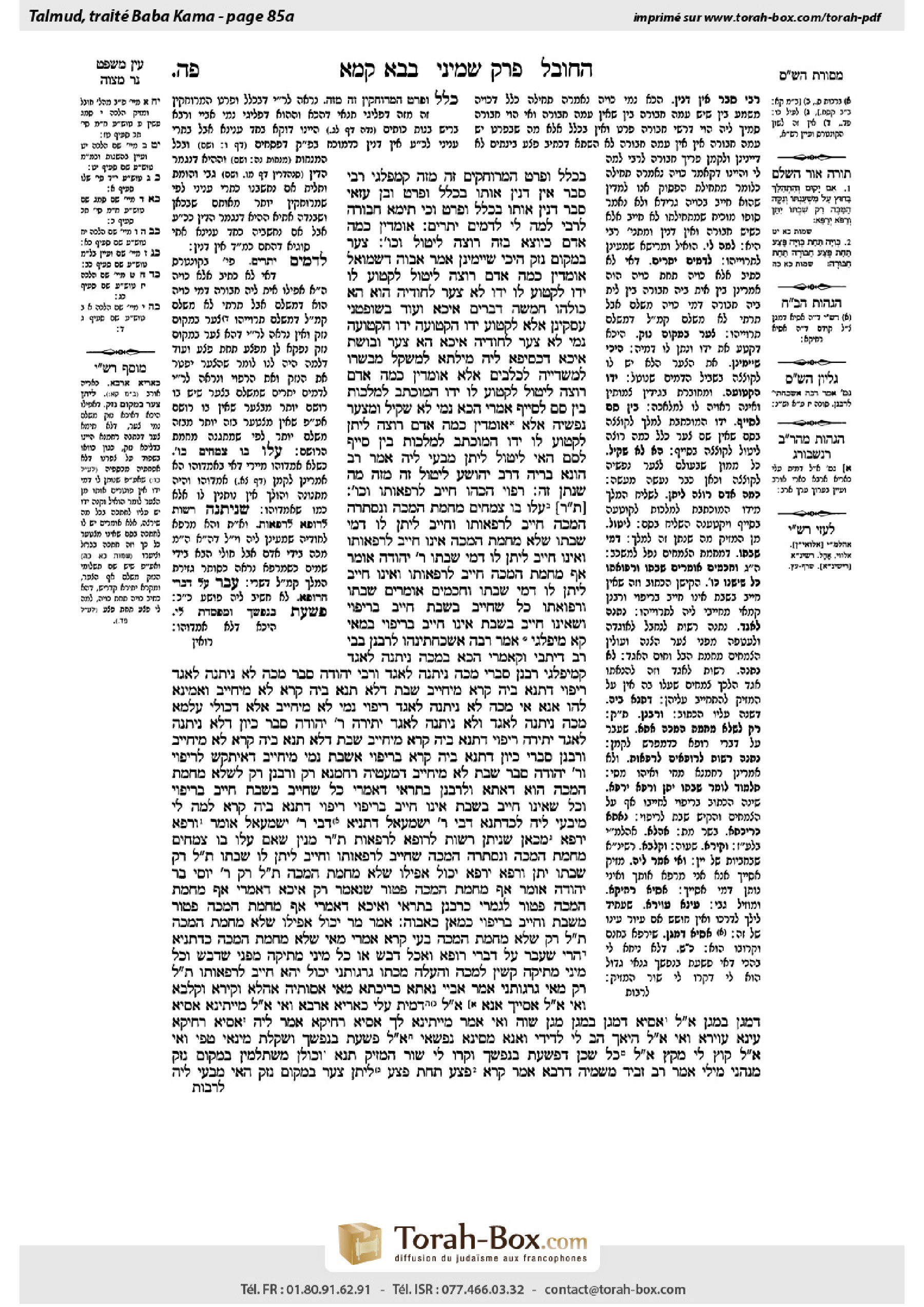
Bava Kamma 85a: Talmud study for Daf Yomi
Study the Talmud for Daf Yomi with scanned pages, Hebrew text, English translations from Sefaria and AI-generated French translations.
Passage selection and English or AI-generated French translation are available where the scan has annotations. Daf Study is independent of Torah-Box and Sefaria.
Browse Bava Kamma · בבא קמא · All tractatesBava Kamma 85a text and translations
This page of Bava Kamma includes the Aramaic text, an English translation and an AI-generated French translation, alongside the scan above.
בבא קמא פ״ה א · Aramaic and Hebrew text
בִּכְלָל וּפְרָט הַמְרוּחָקִים זֶה מִזֶּה קָמִיפַּלְגִי –
רַבִּי סָבַר: אֵין דָּנִין אוֹתוֹ בִּכְלָל וּפְרָט, וּבֶן עַזַּאי סָבַר: דָּנִין אוֹתוֹ בִּכְלָל וּפְרָט. וְכִי תֵּימָא ״חַבּוּרָה״ לְרַבִּי לְמָה לִי? לְדָמִים יְתֵרִים.
אוֹמְדִין כַּמָּה אָדָם כַּיּוֹצֵא בָּזֶה רוֹצֶה לִיטּוֹל וְכוּ׳. צַעַר בִּמְקוֹם נֶזֶק, הֵיכִי שָׁיְימִינַן?
אָמַר אֲבוּהּ דִּשְׁמוּאֵל: אוֹמְדִין כַּמָּה אָדָם רוֹצֶה לִיטּוֹל לִקְטוֹעַ לוֹ יָדוֹ. לִקְטוֹעַ לוֹ יָדוֹ?! לָא צַעַר לְחוֹדֵיהּ הוּא – הָא כּוּלְּהוּ חֲמִשָּׁה דְּבָרִים אִיכָּא! וְעוֹד, בְּשׁוּפְטָנֵי עָסְקִינַן?! אֶלָּא לִקְטוֹעַ יָדוֹ הַקְּטוּעָה. יָדוֹ הַקְּטוּעָה נָמֵי לָא צַעַר לְחוֹדֵיהּ אִיכָּא, הָא צַעַר וּבוֹשֶׁת אִיכָּא – דִּכְסִיפָא לֵיהּ מִילְּתָא לְמִשְׁקַל מִבְּשָׂרוֹ לְמִשְׁדְּיֵיהּ לִכְלָבִים!
אֶלָּא אוֹמְדִין כַּמָּה אָדָם רוֹצֶה לִיטּוֹל לִקְטוֹעַ לוֹ יָדוֹ הַמּוּכְתֶּבֶת לַמַּלְכוּת, בֵּין סַם לְסַיִיף. אָמְרִי: הָכָא נָמֵי לָא שָׁקֵיל וּמְצַעַר נַפְשֵׁיהּ!
אֶלָּא אוֹמְדִין כַּמָּה אָדָם רוֹצֶה לִיתֵּן לִקְטוֹעַ לוֹ יָדוֹ הַמּוּכְתֶּבֶת לַמַּלְכוּת, בֵּין סַיִיף לְסַם.
הַאי ״לִיטּוֹל״?! ״לִיתֵּן״ מִבְּעֵי לֵיהּ! אָמַר רַב הוּנָא בְּרֵיהּ דְּרַב יְהוֹשֻׁעַ: לִיטּוֹל זֶה מִזֶּה, מַה שֶּׁנָּתַן זֶה.
רִפּוּי – הִכָּהוּ, חַיָּיב לְרַפּאוֹתוֹ וְכוּ׳. [תָּנוּ רַבָּנַן:] עָלוּ בּוֹ צְמָחִים מֵחֲמַת הַמַּכָּה, וְנִסְתְּרָה הַמַּכָּה – חַיָּיב לְרַפּאוֹתוֹ, וְחַיָּיב לִיתֵּן לוֹ דְּמֵי שִׁבְתּוֹ. שֶׁלֹּא מֵחֲמַת הַמַּכָּה – אֵינוֹ חַיָּיב לְרַפּאוֹתוֹ, וְאֵינוֹ חַיָּיב לִיתֵּן לוֹ דְּמֵי שִׁבְתּוֹ.
רַבִּי יְהוּדָה אוֹמֵר: אַף מֵחֲמַת הַמַּכָּה – חַיָּיב לְרַפּאוֹתוֹ, וְאֵינוֹ חַיָּיב לִיתֵּן לוֹ דְּמֵי שִׁבְתּוֹ. וַחֲכָמִים אוֹמְרִים: שִׁבְתּוֹ – וּרְפוּאָתוֹ; כֹּל שֶׁחַיָּיב בְּשֶׁבֶת – חַיָּיב בְּרִיפּוּי, וְשֶׁאֵינוֹ חַיָּיב בְּשֶׁבֶת – אֵינוֹ חַיָּיב בְּרִיפּוּי.
בְּמַאי קָא מִיפַּלְגִי? אָמַר רַבָּה: אַשְׁכַּחְתִּינְהוּ לְרַבָּנַן בְּבֵי רַב דְּיָתְבִי וְקָאָמְרִי: הָכָא בְּמַכָּה נִיתְּנָה לְאֶגֶד קָמִיפַּלְגִי –
רַבָּנַן סָבְרִי: מַכָּה נִיתְּנָה לְאֶגֶד. וְרַבִּי יְהוּדָה סָבַר: מַכָּה לֹא נִיתְּנָה לְאֶגֶד; רִיפּוּי, דִּתְנָא בֵּיהּ קְרָא – מִיחַיַּיב; שֶׁבֶת, דְּלָא תְּנָא בֵּיהּ קְרָא – לָא מִיחַיַּיב.
וְאָמֵינָא לְהוּ אֲנָא: אִי מַכָּה לֹא נִיתְּנָה לְאֶגֶד, רִיפּוּי נָמֵי לָא מִיחַיַּיב! אֶלָּא דְּכוּלֵּי עָלְמָא – מַכָּה נִיתְּנָה לְאֶגֶד, וְלֹא נִיתְּנָה לְאֶגֶד יְתֵירָה.
רַבִּי יְהוּדָה סָבַר: כֵּיוָן דְּלֹא נִיתְּנָה לְאֶגֶד יְתֵירָה, רִיפּוּי דִּתְנָא בֵּיהּ קְרָא – מִיחַיַּיב, שֶׁבֶת דְּלָא תְּנָא בֵּיהּ קְרָא – לָא מִיחַיַּיב. וְרַבָּנַן סָבְרִי: כֵּיוָן דִּתְנָא בֵּיהּ קְרָא בְּרִיפּוּי – אַשֶּׁבֶת נָמֵי מִיחַיַּיב, דְּאִיתַּקַּשׁ לְרִיפּוּי.
וְרַבִּי יְהוּדָה סָבַר: שֶׁבֶת לָא מִיחַיַּיב, דְּמַעֲטֵיהּ רַחֲמָנָא ״רַק״. וְרַבָּנַן – ״רַק״, לְשֶׁלֹּא מֵחֲמַת הַמַּכָּה הוּא דַּאֲתָא.
וּלְרַבָּנַן בָּתְרָאֵי, דְּאָמְרִי: כֹּל שֶׁחַיָּיב בְּשֶׁבֶת – חַיָּיב בְּרִיפּוּי, וְכֹל שֶׁאֵינוֹ חַיָּיב בְּשֶׁבֶת – אֵינוֹ חַיָּיב בְּרִיפּוּי; רִיפּוּי דִּתְנָא בֵּיהּ קָרָא – לְמָה לִי? מִיבְּעֵי לֵיהּ לְכִדְתָנָא דְּבֵי רַבִּי יִשְׁמָעֵאל – דְּתַנְיָא, דְּבֵי רַבִּי יִשְׁמָעֵאל אוֹמֵר: ״וְרַפֹּא יְרַפֵּא״ – מִכָּאן שֶׁנִּיתַּן רְשׁוּת לָרוֹפֵא לְרַפּאוֹת.
תָּנוּ רַבָּנַן: מִנַּיִן שֶׁאִם עָלוּ בּוֹ צְמָחִים מֵחֲמַת הַמַּכָּה וְנִסְתְּרָה הַמַּכָּה, שֶׁחַיָּיב לְרַפּאוֹתוֹ, וְחַיָּיב לִיתֵּן לוֹ שִׁבְתּוֹ? תַּלְמוּד לוֹמַר: ״רַק שִׁבְתּוֹ יִתֵּן, וְרַפֹּא יְרַפֵּא״. יָכוֹל אֲפִילּוּ שֶׁלֹּא מֵחֲמַת הַמַּכָּה? תַּלְמוּד לוֹמַר: ״רַק״. רַבִּי יוֹסֵי בַּר יְהוּדָה אוֹמֵר: אַף מֵחֲמַת הַמַּכָּה פָּטוּר, שֶׁנֶּאֱמַר: ״רַק״.
אִיכָּא דְּאָמְרִי ״אַף מֵחֲמַת הַמַּכָּה פָּטוּר״ – לִגְמָרֵי, כְּרַבָּנַן בָּתְרָאֵי; וְאִיכָּא דְּאָמְרִי ״אַף מֵחֲמַת הַמַּכָּה פָּטוּר״ – מִשֶּׁבֶת, וְחַיָּיב בְּרִיפּוּי; כְּמַאן? כַּאֲבוּהּ.
אָמַר מָר: יָכוֹל אֲפִילּוּ שֶׁלֹּא מֵחֲמַת הַמַּכָּה? תַּלְמוּד לוֹמַר: ״רַק״. שֶׁלֹּא מֵחֲמַת הַמַּכָּה בָּעֵי קְרָא?!
אָמְרִי: מַאי ״שֶׁלֹּא מֵחֲמַת הַמַּכָּה״ – כִּדְתַנְיָא: הֲרֵי שֶׁעָבַר עַל דִּבְרֵי רוֹפֵא וְאָכַל דְּבַשׁ אוֹ כׇּל מִינֵי מְתִיקָה, מִפְּנֵי שֶׁדְּבַשׁ וְכׇל מִינֵי מְתִיקָה קָשִׁין לַמַּכָּה; וְהֶעֱלָה מַכָּתוֹ גַּרְגּוּתְנִי; יָכוֹל יְהֵא חַיָּיב לְרַפּאוֹתוֹ? תַּלְמוּד לוֹמַר: ״רַק״. מַאי ״גַּרְגּוּתְנִי״? אָמַר אַבָּיֵי: נָאתָא כְּרִיכְתָּא. מַאי אָסוּתֵיהּ? אַהֲלָא וְקִירָא וְקַלְבָּא.
וְאִי אֲמַר לֵיהּ: ״אָסְיָיךְ אֲנָא״, אֲמַר לֵיהּ: ״דָּמֵית עֲלַי כְּאַרְיָא אָרְבָא״. וְאִי אֲמַר לֵיהּ: ״מַיְיתִינָא אָסְיָא דְּמַגָּן (בְּמַגָּן)״, אֲמַר לֵיהּ: ״אָסְיָא דְּמַגָּן (בְּמַגָּן) – מַגָּן שָׁוֵה״.
וְאִי אָמַר: ״מַיְיתִינָא לָךְ אָסְיָא רַחִיקָא״, אֲמַר לֵיהּ: ״אָסְיָא רַחִיקָא – עֵינָא עָוַירא״.
וְאִי אֲמַר לֵיהּ הַיְאךְ: ״הַב לִי לְדִידִי, וַאֲנָא מַסֵּינָא נַפְשַׁאי״, אֲמַר לֵיהּ: ״פָּשְׁעַתְּ בְּנַפְשָׁךְ וְשָׁקְלַתְּ מִינַּאי טְפֵי״. וְאִי אֲמַר לֵיהּ: ״קוּץ לִי מִקָּץ״, אֲמַר לֵיהּ: ״כׇּל שֶׁכֵּן דְּפָשְׁעַתְּ בְּנַפְשָׁךְ, וְקָרוּ לִי: ״שׁוֹר הַמַּזִּיק״.
תָּנָא: וְכוּלָּן מִשְׁתַּלְּמִין בִּמְקוֹם נֶזֶק. מְנָהָנֵי מִילֵּי? אָמַר רַב זְבִיד מִשְּׁמֵיהּ דְּרָבָא, אָמַר קְרָא: ״פֶּצַע תַּחַת פָּצַע״ – לִיתֵּן צַעַר בִּמְקוֹם נֶזֶק.
הַאי מִבְּעֵי לֵיהּ
Bava Kamma 85a · English translation
Rabbi Yehuda HaNasi and ben Azzai disagree over whether the hermeneutical principle of a generalization and a detail is applied with regard to a generalization and a detail that are distant from each other. When a generalization is followed by a detail, the halakha applies only in the case specified in the detail. The verse states: “Keviyya for keviyya, a wound for a wound, ḥabura for ḥabura” (Exodus 21:25). The word “keviyya,” as stated in the beginning of the verse, is a generalization that includes burns not accompanied by bruises as well as burns accompanied by bruises. “Ḥabura,” as stated at the end of the verse, is a detail of a burn that is accompanied by a bruise. The Torah distances the detail, “ḥabura,” from the generalization, “keviyya,” by stating the halakha of: “A wound for a wound” between them.
Rabbi Yehuda HaNasi holds that since there is an intervening phrase between the generalization and the detail, one does not derive the halakha from the verse concerning burns and bruises by employing the principle of a generalization and a detail. Therefore, the one who caused the injury is liable to pay compensation for pain in all cases of burns, even those that are not accompanied by bruises. And ben Azzai holds that one does derive the halakha from the verse concerning burns and bruises by employing the principle of a generalization and a detail, and therefore the one who caused the injury is liable to pay compensation for pain only if the burn is accompanied by a bruise. And if you would say: According to the opinion of Rabbi Yehuda HaNasi, why do I need the Torah to state the halakha of “ḥabura for ḥabura,” as that is included as a subset of “keviyya”? The phrase mentioning “ḥabura” is necessary to teach the halakha of additional money, i.e., in a case where someone caused a burn with a bruise, he pays additional compensation for the bruise beyond that for the burn.
§ The mishna teaches: How is the payment for pain assessed? The court evaluates how much money a person with a similar threshold for pain as the victim is willing to take in order to be made to suffer in this way. The one who burned the victim must then pay this amount. The Gemara asks: How do we appraise pain in a case where the injured party also suffered personal injury?
Shmuel’s father says: The court evaluates how much money a person is willing to take to allow someone to sever his hand. The Gemara objects: Do you really mean to sever his hand? Wouldn’t this evaluation be not just for pain, but to include all five types of indemnity? Moreover, are we dealing with fools, who would accept money to have their hands severed? The Gemara answers: Rather, the court evaluates how much money a person would accept to allow someone to sever his already severed hand, which is of no use. The Gemara objects: In the case of his severed hand also, there is not pain alone, but there is both pain and humiliation, because it is an embarrassing matter for him if someone were to take a part of his flesh to throw it to dogs.
The Gemara answers: Rather, the court evaluates how much a person is willing to take to allow someone to sever his hand, which is already condemned by a written decree from the government to be severed, changing the decree from having it severed by means of a drug, which is not accompanied by pain, to having it severed by means of a sword, which is accompanied by pain. The amount of money he would accept to have his hand severed by a sword instead of by the drug is his compensation. The Sages say in objection: Here too, one would not take money and cause himself pain in this way, so there is no indemnity to evaluate.
The Gemara answers: Rather, the court evaluates how much a person would give to have someone sever his hand, which is already condemned by a written decree from the government to be severed, changing the decree from having it be severed by means of a sword, which is accompanied by pain, to having it be severed by means of a drug, which is not accompanied by pain.
The Gemara objects: If this is the case, then this wording of the mishna: To take, is imprecise; it should have said: To give. Rav Huna, son of Rav Yehoshua, said: The mishna means that the court evaluates how much this one, the injured party, will take from that one, i.e., the one who caused the injury, based on what this man, the injured party, would have given to the government to have his hand severed by a drug rather than with a sword.
§ The mishna teaches: How is payment for medical costs assessed? If one struck another, then he is liable to heal him by paying for his medical costs. The Sages taught in a baraita (Tosefta 9:4): If growths appeared on the injured area due to the injury, and the wound reopened, then the one who caused the injury is again liable to heal him by covering his medical costs, and is liable to give him the value of his loss of livelihood while he recovers from the reopened wound. But if the growths that appeared are not due to the injury, he is not liable to heal him by covering his medical costs, and he is not liable to give him the value of his loss of livelihood.
The baraita continues: Rabbi Yehuda says that even if the growths appeared due to the injury, he is liable to heal him by covering his medical costs, but he is not liable to give him the value of his loss of livelihood. And the Rabbis say: The one who caused the injury is not liable at all, because the Torah states the halakhot of compensation for his loss of livelihood and his medical costs together. This teaches that anyone who is liable to pay compensation for loss of livelihood is also liable to pay compensation for medical costs, and anyone who is not liable to pay compensation for loss of livelihood is also not liable to pay compensation for medical costs.
The Gemara asks: With regard to what do they disagree? Rabba said: I found the Sages in the study hall of Rav when they were sitting and were stating an explanation: Here, Rabbi Yehuda and the Rabbis disagree about whether a wound may be wrapped in a bandage, i.e., whether one is permitted to bandage his wound to lessen the pain, at the risk of causing damaging side effects.
Rabba explains: The Rabbis, i.e., the first tanna in the baraita, hold that a wound may be wrapped in a bandage. Consequently, if the bandage causes side effects which lead the injured party to incur additional medical expenses, those expenses are considered to have resulted from the original injury. And Rabbi Yehuda holds that a wound may not be wrapped in a bandage. Therefore, with regard to medical costs, about which the verse repeated the obligation to pay them, by stating: “And shall cause him to be thoroughly healed [verappo yerappe]” (Exodus 21:19), the one who caused the injury is liable to pay compensation. But for loss of livelihood, about which the verse did not repeat the obligation to pay it, the one who caused the injury is not liable to pay compensation.
Rabba continues: And I said to them that if Rabbi Yehuda were to hold that a wound may not be wrapped in a bandage, then the one who caused the injury should also not be liable to pay compensation for medical costs, as he is not liable to compensate the injured party for damage resulting from his own irresponsible behavior. Rather, the disagreement is as follows: Everyone agrees that a wound may be wrapped in a bandage, but may not be wrapped in an excessive bandage.
He explains the dispute: Rabbi Yehuda holds that since a wound may not be wrapped in an excessive bandage, then with regard to medical costs, about which the verse repeated the obligation to pay them, by stating: “Verappo yerappe” (Exodus 21:19), the one who caused the injury is liable to pay compensation. But for loss of livelihood, about which the verse did not repeat the obligation to pay, the one who caused the injury is not liable to pay compensation. And the Rabbis, i.e., the first tanna in the baraita, hold: Since the verse repeated the obligation to pay compensation for medical costs, one is also liable to pay compensation for loss of livelihood, which is juxtaposed to the obligation to pay for medical costs, as the verse states: “Only he shall pay for the loss of his time, and shall cause him to be thoroughly healed.”
The Gemara comments: And Rabbi Yehuda holds that even though medical costs and loss of livelihood are juxtaposed, the one who caused the injury is not liable to pay compensation for loss of livelihood in this case, because the Merciful One restricted it in the Torah, as the verse states: “Only he shall pay for his loss of livelihood, and shall cause him to be thoroughly healed” (Exodus 21:19). “Only” is a restricting term. And the Rabbis, who hold that one must pay for loss of livelihood in this case as well, hold that the word “only” is coming to exclude growths that were not due to the injury, with regard to which the one who caused the injury is exempt from liability.
The Gemara asks: And according to the opinion of the latter Rabbis in the baraita, who say: Anyone who is liable to pay compensation for loss of livelihood is liable to pay compensation for medical costs, and anyone who is not liable to pay compensation for loss of livelihood is not liable to pay compensation for medical costs, why do I need, i.e., how do I account for, the fact that the verse repeated the obligation to pay medical costs? The Gemara answers: It is necessary for that which the school of Rabbi Yishmael taught. As it is taught in a baraita that the school of Rabbi Yishmael says: When the verse states: “And shall cause him to be thoroughly healed [verappo yerappe]” (Exodus 21:19), it is derived from here that permission is granted to a doctor to heal, and it is not considered to be an intervention counter to the will of God.
§ The Sages taught in a baraita: From where is it derived that if growths appeared due to the injury, and the wound reopened, then the one who caused the injury is again liable to heal him by covering his medical costs, and is liable to give him the value of his loss of livelihood while he recovers from the reopened wound? The verse states: “And he shall cause him to be thoroughly healed” (Exodus 21:19). One might have thought that this is the halakha even if the growths were not due to the injury. Therefore, the verse states: “Only he shall pay for his loss of livelihood,” in order to exclude this case. This is in accordance with the opinion of the first tanna in the previous baraita. Rabbi Yosei bar Yehuda says: Even if the growths appeared due to the injury, the one who caused the injury is exempt, as it is stated: “Only.”
There are those who say that Rabbi Yosei bar Yehuda says: Even if the growths appeared due to the injury, the one who caused the injury is completely exempt from paying compensation, both for medical costs and loss of livelihood. And this is in accordance with the opinion of the latter Rabbis in the previous baraita. And there are those who say that Rabbi Yosei bar Yehuda says: Even if the growths appeared due to the injury, the one who caused the injury is exempt from paying compensation for loss of livelihood, but is liable to pay compensation for medical costs. In accordance with whose opinion is this statement? It is in accordance with the opinion of his father, Rabbi Yehuda.
The Gemara analyzes the statement of the baraita: The Master said: One might have thought that this is the halakha even if the growths were not due to the injury. Therefore, the verse states: “Only he shall pay for his loss of livelihood,” to teach that he is exempt in this case. The Gemara asks: Is there a need for the verse to teach that he is exempt in the case of growths that were not due to the injury?
The Sages say: What did the baraita mean when it said that the growths were not due to the injury? As it is taught in a baraita: In the case of one who violated his doctor’s instructions and ate honey or any type of sweet food, which the doctor had instructed him not to eat because of the fact that honey or any type of sweet foods are detrimental to the recovery from the injury; and his injury developed garguteni; one might have thought that the one who caused the injury should be liable to heal him by covering his medical costs. Therefore, the verse states: “Only,” to teach that he is exempt in this case. The Gemara asks: What is the meaning of garguteni? Abaye said: Necrosis. What is its remedy? Crystalline ice plant, and wax, and wine dregs.
§ The Gemara presents several halakhot concerning compensation for medical costs: And if the one who caused the injury says to the injured party: I will heal you myself, as I am a doctor; the injured party may say to him: You are to me as a predatory lion, in that I fear you and do not trust you to heal me. And if the one who caused the injury says to the injured party: I will bring a doctor who heals for no cost, so that I will not need to pay for your medical costs; the injured party may say to him: A doctor who heals for no cost is worth nothing.
And if the one who caused the injury says to the injured party: I will bring you a doctor from a distant place, the injured party may say to him: A doctor from a distant place blinds the eye. A local doctor has an incentive to ensure that the patient fully heals, while a doctor from a distant place has no incentive to monitor the patient once he has received his fee.
And if that one, the injured party, says to the one who caused him injury: Give the money to me and I will take responsibility for healing myself; the one who caused him the injury may say to him: You will be negligent with yourself and you will take more from me than was originally necessary. And if the injured party says to the one who caused him injury: Settle a fixed sum for me to cover my medical costs, and I will take care of my own recovery; the one who caused him the injury may say to him: All the more so with this proposal is there a concern that you will be negligent with yourself, as you will wish to profit and you will not spend the money on your recovery, and people will call me: An ox that causes damage, because I caused an injury from which you did not recover.
§ With regard to compensation for pain, medical costs, loss of livelihood, and humiliation, the Sages taught in a baraita: And all of these types of indemnity are paid in a case where the one who caused injury must also pay compensation for damage. The Gemara asks: From where are these matters derived? Rav Zevid said in the name of Rava: The verse states: “A wound for a wound” (Exodus 21:25), to teach that the one who caused injury is liable to give compensation for pain in a case of damage.
The Gemara asks: But isn’t this verse necessary to teach an additional halakha:
Bava Kamma 85a · Traduction française (IA)
Rabbi Yehuda HaNasi et ben Azzai s'opposent sur l'application du principe d'une généralisation et d'un détail concernant des généralisations et des détails distants l'un de l'autre. Lorsqu'une généralisation est suivie d'un détail, la halakha s'applique uniquement au cas spécifié dans le détail. La parabole dit : « Keviyya pour keviyya, une plaie pour une plaie, ḥabura pour ḥabura » (Exode 21:25). Le mot « keviyya », tel qu'il est mentionné au début de la parabole, est une généralisation qui inclut les brûlures sans ecchymose ainsi que celles accompagnées d'ecchymose. « ḥabura », tel qu'il est mentionné à la fin de la parabole, est un détail concernant une brûlure accompagnée d'ecchymose. La Torah distingue le détail « ḥabura » de la généralisation « keviyya » en indiquant la halakha de : « Une plaie pour une plaie » entre eux.
Rabbi Yehuda HaNasi considère que, puisque le mot « ḥabura » est intercalé entre la généralisation et le détail, on ne peut pas déduire la halakha à partir de la parabole concernant les brûlures et les ecchymoses en utilisant le principe d'une généralisation et d'un détail. Ainsi, celui qui a causé l'injury est tenu de payer une compensation pour la douleur dans tous les cas de brûlures, même celles non accompagnées d'ecchymose. Ben Azzai, en revanche, considère que l'on peut déduire la halakha à partir de la parabole concernant les brûlures et les ecchymoses en utilisant le principe d'une généralisation et d'un détail, et donc celui qui a causé l'injury est tenu de payer une compensation pour la douleur uniquement si la brûlure est accompagnée d'ecchymose. Et si l'on dit : Selon l'opinion de Rabbi Yehuda HaNasi, pourquoi a-t-on besoin de la Torah pour établir la halakha de « ḥabura pour ḥabura », puisque cela est inclus comme un sous-ensemble de « keviyya » ? La mention de « ḥabura » est nécessaire pour enseigner la halakha concernant la compensation supplémentaire, c'est-à-dire dans le cas où quelqu'un a causé une brûlure avec une ecchymose, il paie une compensation supplémentaire pour l'ecchymose en plus de celle pour la brûlure.
§ La mitsva enseigne : Comment évalue-t-on la compensation pour la douleur ? Le tribunal évalue combien d'argent une personne ayant un seuil de douleur similaire à celui de la victime est prête à accepter pour subir cette douleur. Celui qui a brûlé la victime doit alors payer cette somme. La Guemara pose la question : Comment évalue-t-on la douleur dans le cas où la partie blessée a également subi un dommage corporel ?
Le père de Shmuel dit : Le tribunal évalue combien d'argent une personne est prête à accepter pour permettre à quelqu'un de lui couper la main. La Guemara s'oppose : Voulez-vous vraiment dire qu'on coupe la main ? Ne serait-ce pas une évaluation non seulement pour la douleur, mais pour inclure les cinq types de réparation ? De plus, sommes-nous en présence d'idotes qui accepteraient de recevoir de l'argent pour avoir leur main coupée ? La Guemara répond : Plutôt, le tribunal évalue combien d'argent une personne accepterait pour permettre à quelqu'un de lui couper une main déjà coupée, qui n'a plus de valeur. La Guemara s'oppose : Même dans le cas de sa main coupée, il n'y a pas seulement de la douleur, mais aussi de la humiliation, car c'est une affaire honteuse pour lui si quelqu'un prenait une partie de sa chair pour la jeter aux chiens.
La Guemara répond : Plutôt, le tribunal évalue combien d'argent une personne accepterait pour permettre à quelqu'un de lui couper la main, qui est déjà condamnée par un décret écrit du gouvernement à être coupée, changeant le décret de la coupe par un médicament, qui n'est pas accompagné de douleur, à la coupe par un couteau, qui est accompagnée de douleur. La somme d'argent qu'il accepterait pour avoir sa main coupée par un couteau au lieu d'un médicament est sa compensation. Les Sages disent en objection : Ici aussi, on ne prendrait pas d'argent et on ne causerait pas de douleur de cette manière, donc il n'y a pas de réparation à évaluer.
La Guemara répond : Plutôt, le tribunal évalue combien d'argent une personne donnerait pour permettre à quelqu'un de lui couper la main, qui est déjà condamnée par un décret écrit du gouvernement à être coupée, changeant le décret de la coupe par un couteau, qui est accompagnée de douleur, à la coupe par un médicament, qui n'est pas accompagnée de douleur.
La Guemara s'oppose : Si c'est le cas, alors cette formulation de la mitsna : « prendre », est imprecise ; elle devrait dire : « donner ». Rav Huna, fils de Rav Yehoshua, dit : La mitsna signifie que le tribunal évalue combien cette personne, la partie blessée, accepterait de cette autre personne, celle qui a causé l'injury, basé sur ce que cette personne, la partie blessée, donnerait au gouvernement pour avoir sa main coupée par un médicament plutôt que par un couteau.
§ La mitsna enseigne : Comment évalue-t-on la compensation pour les frais médicaux ? Si l'on a frappé un autre, il est tenu de le guérir en payant pour ses frais médicaux. Les Sages ont enseigné dans une baraïta (Tosefta 9:4) : Si des croissances sont apparues sur la zone blessée en raison de l'acte, et que la plaie s'est rouverte, alors celui qui a causé l'acte est à nouveau tenu de le guérir en couvrant ses frais médicaux, et est tenu de lui donner la valeur de sa perte de revenu pendant sa guérison. Mais si les croissances apparues ne sont pas dues à l'acte, il n'est pas tenu de le guérir en couvrant ses frais médicaux, et il n'est pas tenu de lui donner la valeur de sa perte de revenu.
La baraïta continue : Rabbi Yehuda dit que même si les croissances sont apparues en raison de la blessure, il est tenu de le guérir en couvrant ses frais médicaux, mais il n'est pas tenu de lui donner la valeur de sa perte de revenu. Et les Rabbis disent : Celui qui a causé la blessure n'est pas tenu du tout, car la Torah établit les halakhot de la compensation pour sa perte de revenu et ses frais médicaux ensemble. Cela enseigne que quiconque est tenu de payer une compensation pour sa perte de revenu est également tenu de payer une compensation pour ses frais médicaux, et quiconque n'est pas tenu de payer une compensation pour sa perte de revenu n'est pas non plus tenu de payer une compensation pour ses frais médicaux.
La Guemara pose la question : Sur quel point s'opposent-ils ? Rabba dit : J'ai trouvé les Sages dans la salle d'étude de Rav lorsqu'ils étaient assis et expliquaient : Ici, Rabbi Yehuda et les Rabbis s'opposent sur le fait qu'une plaie puisse être enveloppée d'un bandage, c'est-à-dire si l'on est autorisé à envelopper sa plaie pour atténuer la douleur, à risque de causer des effets secondaires nuisibles.
Rabba explique : Les Sages, c'est-à-dire le premier tanna du baraïta, affirment qu'une plaie peut être enveloppée d'un bandage. Ainsi, si le bandage provoque des effets secondaires entraînant des dépenses médicales supplémentaires pour la personne blessée, ces dépenses sont considérées comme résultant de la blessure originale. Rabbi Yehuda, en revanche, affirme qu'une plaie ne doit pas être enveloppée d'un bandage. Par conséquent, concernant les dépenses médicales, dont la Torah répète l'obligation de les payer en disant : « Et il le guérira complètement [verappo yerappe] » (Exode 21:19), celui qui a causé la blessure est tenu de payer une compensation. Mais concernant la perte de revenus, dont la Torah n'a pas répété l'obligation de les payer, celui qui a causé la blessure n'est pas tenu de payer une compensation.
Rabba continue : Et je leur ai dit que si Rabbi Yehuda affirmait qu'une plaie ne doit pas être enveloppée d'un bandage, alors celui qui a causé la blessure ne devrait pas non plus être tenu de payer la compensation pour les dépenses médicales, car il n'est pas tenu de compenser la personne blessée pour les dommages résultant de son comportement irresponsable. En réalité, le désaccord est le suivant : Tout le monde convient qu'une plaie peut être enveloppée d'un bandage, mais pas d'un bandage excessif.
Il explique le désaccord : Rabbi Yehuda affirme que puisque une plaie ne doit pas être enveloppée d'un bandage excessif, alors concernant les dépenses médicales, dont la Torah répète l'obligation de les payer en disant : « Verappo yerappe » (Exode 21:19), celui qui a causé la blessure est tenu de payer une compensation. Mais concernant la perte de revenus, dont la Torah n'a pas répété l'obligation de les payer, celui qui a causé la blessure n'est pas tenu de payer une compensation. Et les Sages, c'est-à-dire le premier tanna du baraïta, affirment : Puisque la Torah répète l'obligation de payer la compensation pour les dépenses médicales, l'on est également tenu de payer la compensation pour la perte de revenus, qui est juxtaposée à l'obligation de payer pour les dépenses médicales, comme le dit la Torah : « Seul il paiera pour la perte de son temps, et il le guérira complètement. »
Le Guemara commente : Rabbi Yehuda affirme que même si les dépenses médicales et la perte de revenus sont juxtaposées, celui qui a causé la blessure n'est pas tenu de payer la compensation pour la perte de revenus dans ce cas-ci, car Dieu Miséricordieux a limité cela dans la Torah, comme le dit la Torah : « Seul il paiera pour sa perte de revenus, et il le guérira complètement » (Exode 21:19). « Seul » est un terme limitant. Et les Sages, qui affirment que l'on doit payer la compensation pour la perte de revenus dans ce cas-ci, affirment que le mot « seul » sert à exclure les croissances qui ne sont pas dues à la blessure, concernant lesquelles celui qui a causé la blessure est exempt de responsabilité.
Le Guemara pose une question : Et selon l'opinion des Sages ultérieurs du baraïta, qui affirment : Tout celui qui est tenu de payer la compensation pour la perte de revenus est tenu de payer la compensation pour les dépenses médicales, et tout celui qui n'est pas tenu de payer la compensation pour la perte de revenus n'est pas tenu de payer la compensation pour les dépenses médicales, pourquoi ai-je besoin, c'est-à-dire comment dois-je comprendre, du fait que la Torah a répété l'obligation de payer les dépenses médicales ? Le Guemara répond : Cela est nécessaire pour ce que l'école de Rabbi Yishmael a enseigné. Comme il est enseigné dans un baraïta que l'école de Rabbi Yishmael dit : Lorsque la Torah dit : « Et il le guérira complètement [verappo yerappe] » (Exode 21:19), cela dérive de là que l'on autorise un médecin à guérir, et cela n'est pas considéré comme une intervention contraire à la volonté de Dieu.
§ Les Sages ont enseigné dans un baraïta : D'où dérive-t-il que si des croissances sont apparues en raison de la blessure et que la plaie s'est rouverte, alors celui qui a causé la blessure est à nouveau tenu de guérir en couvrant les dépenses médicales et est tenu de payer la valeur de la perte de revenus pendant la guérison ? La Torah dit : « Et il le guérira complètement » (Exode 21:19). On aurait pu penser que cela est la halakha même si les croissances n'étaient pas dues à la blessure. Ainsi, la Torah dit : « Seul il paiera pour sa perte de revenus », afin d'exclure ce cas. Cela est conforme à l'opinion du premier tanna du baraïta précédent. Rabbi Yosei bar Yehuda dit : Même si les croissances sont apparues en raison de la blessure, celui qui a causé la blessure est exempt, comme il est dit : « Seul. »
Certains disent que Rabbi Yosei bar Yehuda dit : Même si les croissances sont apparues en raison de la blessure, celui qui a causé la blessure est entièrement exempt de payer la compensation, à la fois pour les dépenses médicales et la perte de revenus. Et cela est conforme à l'opinion des Rabbins ultérieurs du baraïta précédent. Et d'autres disent que Rabbi Yosei bar Yehuda dit : Même si les croissances sont apparues en raison de la blessure, celui qui a causé la blessure est exempt de payer la compensation pour la perte de revenus, mais est tenu de payer la compensation pour les dépenses médicales. Selon l'opinion de qui est cette déclaration ? Cela est conforme à l'opinion de son père, Rabbi Yehuda.
Le Guemara analyse la déclaration du baraïta : Le Maître dit : On aurait pu penser que cela est la halakha même si les croissances n'étaient pas dues à la blessure. Ainsi, la Torah dit : « Seul il paiera pour sa perte de revenus », afin d'enseigner qu'il est exempt dans ce cas. Le Guemara pose une question : Y a-t-il besoin de la Torah pour enseigner qu'il est exempt dans le cas des croissances qui ne sont pas dues à la blessure ?
Les Sages disent : Quel était le sens de la baraïta lorsqu'elle affirmait que les croissances ne provenaient pas de la blessure ? Comme il est enseigné dans une baraïta : Dans le cas d'une personne qui a enfreint les instructions de son médecin et a mangé du miel ou tout type de nourriture sucrée, que le médecin avait interdit de manger en raison de leur préjudice pour la guérison de la blessure ; et sa blessure s'est aggravée (garguteni) ; on aurait pu penser que la personne qui a causé la blessure devrait être responsable de la guérison en couvrant les coûts médicaux. Ainsi, la Sainte Écriture dit : « Seulement », pour enseigner qu'il est exempt dans ce cas. La Guemara demande : Quel est le sens de garguteni ? Abaye dit : Nécrose. Quel est son remède ? La plante à glace cristalline, la cire et les débris de vin.
§ La Guemara présente plusieurs halakhot concernant la réparation des coûts médicaux : Et si la personne qui a causé la blessure dit à la personne blessée : Je vais te guérir moi-même, car je suis médecin ; la personne blessée peut lui répondre : Tu es pour moi comme un lion prédateur, car j'ai peur de toi et ne fais pas confiance à ta guérison. Et si la personne qui a causé la blessure dit à la personne blessée : Je vais t'amener un médecin qui guérit sans frais, afin que je n'aie pas besoin de payer tes coûts médicaux ; la personne blessée peut lui répondre : Un médecin qui guérit sans frais n'a aucune valeur.
Et si la personne qui a causé la blessure dit à la personne blessée : Je vais t'amener un médecin d'une distance éloignée, la personne blessée peut lui répondre : Un médecin d'une distance éloignée aveugle l'œil. Un médecin local a un intérêt à s'assurer que le patient guérit pleinement, tandis qu'un médecin d'une distance éloignée n'a aucun intérêt à surveiller le patient une fois qu'il a reçu son honoraires.
Et si cette personne, la personne blessée, dit à la personne qui l'a blessé : Donne-moi l'argent et je m'occuperai moi-même de ma guérison ; la personne qui l'a blessé peut lui répondre : Tu seras négligent envers toi-même et tu prendras plus de moi que ce qui était nécessaire initialement. Et si la personne blessée dit à la personne qui l'a blessé : Fixe une somme déterminée pour couvrir mes coûts médicaux, et je m'occuperai moi-même de ma guérison ; la personne qui l'a blessé peut lui répondre : Ce propos est encore plus préoccupant, car il y a un risque que tu sois négligent envers toi-même, car tu voudras profiter et ne dépenseras pas l'argent pour ta guérison, et les gens diront : Un bœuf qui cause des dommages, car j'ai causé une blessure d'où tu n'as pas guéri.
§ Concernant la réparation de la douleur, des coûts médicaux, de la perte de revenus et de l'humiliation, les Sages ont enseigné dans une baraïta : Et toutes ces formes de réparation sont payées dans le cas où la personne qui a causé la blessure doit également payer une compensation pour les dommages. La Guemara demande : D'où ces matières sont-elles dérivées ? Rav Zevid, dans le nom de Rava, dit : La Sainte Écriture dit : « Une plaie pour une plaie » (Exode 21:25), pour enseigner que la personne qui a causé la blessure est responsable de la réparation de la douleur dans le cas de dommages.
La Guemara demande : Mais n'est-ce pas cette versette nécessaire pour enseigner une halakha supplémentaire :
Traduction française générée par IA à partir de l’édition anglaise de Sefaria. Vérifie toujours un passage avec le texte source.
Text from Sefaria: William Davidson Edition - Vocalized Aramaic (CC BY NC); William Davidson Edition - English (CC BY NC).