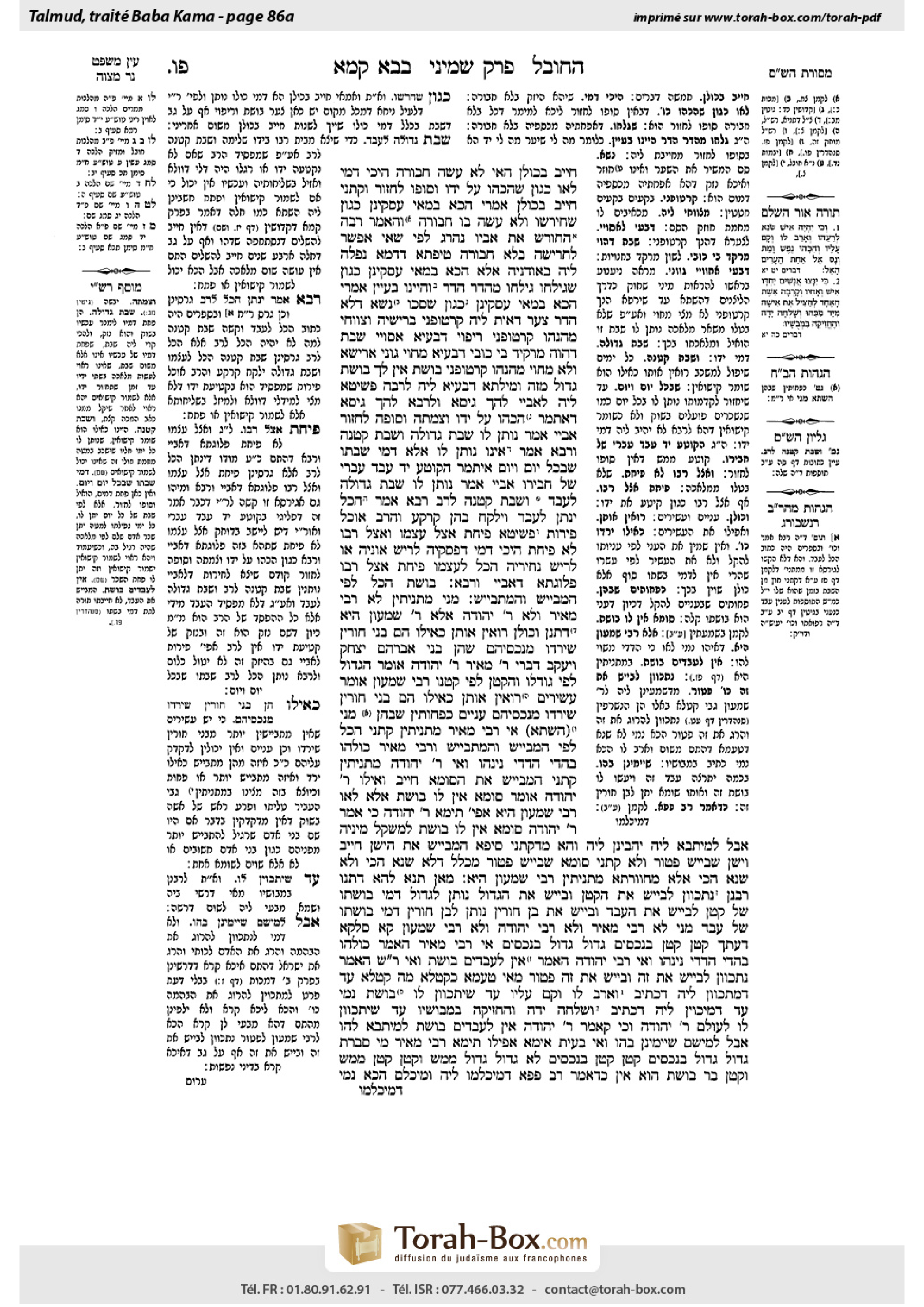
Bava Kamma 86a: Talmud study for Daf Yomi
Study the Talmud for Daf Yomi with scanned pages, Hebrew text, English translations from Sefaria and AI-generated French translations.
Passage selection and English or AI-generated French translation are available where the scan has annotations. Daf Study is independent of Torah-Box and Sefaria.
Browse Bava Kamma · בבא קמא · All tractatesBava Kamma 86a text and translations
This page of Bava Kamma includes the Aramaic text, an English translation and an AI-generated French translation, alongside the scan above.
בבא קמא פ״ו א · Aramaic and Hebrew text
חַיָּיב בְּכוּלָּן.
הַאי ״לֹא עָשָׂה בּוֹ חַבּוּרָה״, הֵיכִי דָּמֵי? לָאו כְּגוֹן שֶׁהִכָּהוּ עַל יָדוֹ וְסוֹפוֹ לַחְזוֹר? וְקָתָנֵי: חַיָּיב בְּכוּלָּן!
אָמְרִי: הָכָא בְּמַאי עָסְקִינַן – כְּגוֹן שֶׁחֵירְשׁוֹ, וְלֹא עָשָׂה בּוֹ חַבּוּרָה. וְהָאָמַר רַבָּה: (הַחוֹרֵשׁ) [חֵרֵשׁ] אֶת אָבִיו – נֶהֱרָג, לְפִי שֶׁאִי אֶפְשָׁר לַחֲרִישָׁה בְּלֹא חַבּוּרָה; טִיפְּתָא דִּדְמָא נְפַלָה לֵיהּ בְּאוּדְנֵיהּ!
אֶלָּא הָכָא בְּמַאי עָסְקִינַן – כְּגוֹן שֶׁגִּילְּחוֹ. גִּילְּחוֹ – מִהְדָּר הָדַר, וְהַיְינוּ בַּעְיָין!
אָמְרִי: הָכָא בְּמַאי עָסְקִינַן – כְּגוֹן שֶׁסָּכוֹ נָשָׁא, דְּלָא הָדַר.
צַעַר – דְּאִית לֵיהּ קַרְטוּפָנֵי בְּרֵישֵׁיהּ, וְצָוַוחי [לֵיהּ] מֵהָנְהוּ קַרְטוּפָנֵי. רִיפּוּי – דְּבָעֵי אַסּוֹיֵי. שֶׁבֶת – דַּהֲוָה מְרַקֵּיד בֵּי כוּבֵּי, דְּבָעֵיא מַחְוֵי גַּוְנֵי אַרֵישֵׁיהּ; וְלָא מַחְוֵי – מֵהָנְהוּ קַרְטוּפָנֵי. בּוֹשֶׁת – אֵין לְךָ בּוֹשֶׁת גָּדוֹל מִזֶּה.
וּמִילְּתָא דְּבַעְיָא לֵיהּ לְרַבָּה – פְּשִׁיטָא לֵיהּ לְאַבָּיֵי לְהָךְ גִּיסָא, וּלְרָבָא לְהָךְ גִּיסָא. דְּאִתְּמַר: הִכָּהוּ עַל יָדוֹ וְצָמְתָה, וְסוֹפָהּ לַחֲזוֹר – אַבָּיֵי אָמַר: נוֹתֵן לוֹ שֶׁבֶת גְּדוֹלָה וְשֶׁבֶת קְטַנָּה. וְרָבָא אָמַר: אֵינוֹ נוֹתֵן לוֹ אֶלָּא דְּמֵי שִׁבְתּוֹ שֶׁבְּכׇל יוֹם וָיוֹם.
אִיתְּמַר: הַקּוֹטֵעַ יַד עֶבֶד עִבְרִי שֶׁל חֲבֵירוֹ – אַבָּיֵי אָמַר: נוֹתֵן לוֹ שֶׁבֶת גְּדוֹלָה לָעֶבֶד, וְשֶׁבֶת קְטַנָּה לָרַב. רָבָא אָמַר: הַכֹּל יִנָּתֵן לָעֶבֶד, וְיִלָּקַח בָּהֶן קַרְקַע וְהָרַב אוֹכֵל פֵּירוֹת.
פְּשִׁיטָא – פִּיחֵת אֵצֶל עַצְמוֹ, וְאֵצֶל רַבּוֹ לֹא פִּיחֵת – הֵיכִי דָּמֵי? דְּפַסְקֵיהּ לְרֵישׁ אוּנֵּיה אוֹ לְרֵישׁ נְחִירֵיהּ – הַכֹּל לְעַצְמוֹ. פִּיחֵת אֵצֶל רַבּוֹ – פְּלוּגְתָּא דְּאַבָּיֵי וְרָבָא.
בּוֹשֶׁת – הַכֹּל לְפִי הַמְבַיֵּישׁ וְהַמִּתְבַּיֵּישׁ. מַנִּי מַתְנִיתִין? לָא רַבִּי מֵאִיר וְלָא רַבִּי יְהוּדָה, אֶלָּא רַבִּי שִׁמְעוֹן הִיא.
דִּתְנַן: וְכוּלָּן – רוֹאִין אוֹתָן כְּאִילּוּ הֵם בְּנֵי חוֹרִין שֶׁיָּרְדוּ מִנִּכְסֵיהֶם, שֶׁהֵן בְּנֵי אַבְרָהָם יִצְחָק וְיַעֲקֹב; דִּבְרֵי רַבִּי מֵאִיר. רַבִּי יְהוּדָה אוֹמֵר: הַגָּדוֹל לְפִי גּוֹדְלוֹ, וְהַקָּטָן לְפִי קׇטְנוֹ. רַבִּי שִׁמְעוֹן אוֹמֵר: עֲשִׁירִים – רוֹאִין אוֹתָן כְּאִילּוּ הֵם בְּנֵי חוֹרִין שֶׁיָּרְדוּ מִנִּכְסֵיהֶם, עֲנִיִּים – כִּפְחוּתִין שֶׁבָּהֶן.
מַנִּי? הַשְׁתָּא אִי רַבִּי מֵאִיר – מַתְנִיתִין קָתָנֵי: הַכֹּל לְפִי הַמְבַיֵּישׁ וְהַמִּתְבַּיֵּישׁ; וְרַבִּי מֵאִיר – כּוּלְּהוּ בַּהֲדֵי הֲדָדֵי נִינְהוּ! וְאִי רַבִּי יְהוּדָה – מַתְנִיתִין קָתָנֵי: הַמְבַיֵּישׁ אֶת הַסּוֹמֵא – חַיָּיב; וְאִילּוּ רַבִּי יְהוּדָה אוֹמֵר: סוֹמֵא אֵין לוֹ בּוֹשֶׁת! אֶלָּא לָאו רַבִּי שִׁמְעוֹן הִיא?
אֲפִילּוּ תֵּימָא רַבִּי יְהוּדָה, כִּי אָמַר רַבִּי יְהוּדָה סוֹמֵא אֵין לוֹ בּוֹשֶׁת – לְמִשְׁקַל מִינֵּיהּ, אֲבָל לְמִיתְּבָא לֵיהּ – יָהֲבִינַן לֵיהּ.
וְהָא מִדְּקָתָנֵי סֵיפָא: הַמְבַיֵּישׁ אֶת הַיָּשֵׁן – חַיָּיב, וְיָשֵׁן שֶׁבִּיֵּישׁ – פָּטוּר; וְלָא קָתָנֵי: סוֹמֵא שֶׁבִּיֵּישׁ – פָּטוּר; מִכְּלָל דְּלָא שְׁנָא הָכִי וְלָא שְׁנָא הָכִי! אֶלָּא מְחַוַּורְתָּא מַתְנִיתִין רַבִּי שִׁמְעוֹן הִיא.
מַאן תְּנָא לְהָא דְּתָנוּ רַבָּנַן: נִתְכַּוֵּון לְבַיֵּישׁ אֶת הַקָּטָן, וּבִיֵּישׁ אֶת הַגָּדוֹל – נוֹתֵן לַגָּדוֹל דְּמֵי בוֹשְׁתּוֹ שֶׁל קָטָן. לְבַיֵּישׁ אֶת הָעֶבֶד, וּבִיֵּישׁ אֶת בֶּן חוֹרִין – נוֹתֵן לְבֶן חוֹרִין דְּמֵי בוֹשְׁתּוֹ שֶׁל עֶבֶד. מַנִּי? לָא רַבִּי מֵאִיר, וְלָא רַבִּי יְהוּדָה, וְלָא רַבִּי שִׁמְעוֹן!
קָא סָלְקָא דַּעְתָּךְ: קָטָן – קָטָן בִּנְכָסִים, גָּדוֹל – גָּדוֹל בִּנְכָסִים. אִי רַבִּי מֵאִיר, הָאָמַר: כּוּלְּהוּ בַּהֲדֵי הֲדָדֵי נִינְהוּ! וְאִי רַבִּי יְהוּדָה, הָאָמַר: אֵין לַעֲבָדִים בּוֹשֶׁת! וְאִי רַבִּי שִׁמְעוֹן, הָאָמַר: נִתְכַּוֵּון לְבַיֵּישׁ אֶת זֶה, וּבִיֵּישׁ אֶת זֶה – פָּטוּר!
מַאי טַעְמָא? כִּקְטָלָא; מָה קְטָלָא – עַד דְּמִתְכַּוֵּון לֵיהּ, דִּכְתִיב: ״וְאָרַב לוֹ וְקָם עָלָיו״ – עַד שֶׁיִּתְכַּוֵּון לוֹ; בּוֹשֶׁת נָמֵי – עַד דְּמִיכַּוֵּין לֵיהּ, דִּכְתִיב: ״וְשָׁלְחָה יָדָהּ וְהֶחֱזִיקָה בִּמְבֻשָׁיו״ – עַד שֶׁיִּתְכַּוֵּון לוֹ!
לְעוֹלָם רַבִּי יְהוּדָה, וְכִי קָאָמַר רַבִּי יְהוּדָה: אֵין לַעֲבָדִים בּוֹשֶׁת – לְמִיתְּבָא לְהוּ; אֲבָל לְמֵישַׁם – שָׁיְימִינַן בְּהוּ.
וְאִי בָּעֵית אֵימָא: אֲפִילּוּ תֵּימָא רַבִּי מֵאִיר, מִי סָבְרַתְּ: גָּדוֹל – גָּדוֹל בִּנְכָסִים, קָטָן – קָטָן בִּנְכָסִים? לֹא; גָּדוֹל – גָּדוֹל מַמָּשׁ, וְקָטָן – קָטָן מַמָּשׁ.
וְקָטָן בַּר בּוֹשֶׁת הוּא?! אִין; כִּדְאָמַר רַב פָּפָּא: דְּמַיכְלְמוּ לֵיהּ וּמִיכְּלַם; הָכָא נָמֵי –
Bava Kamma 86a · English translation
is liable to pay all of the five types of indemnity.
The Gemara explains: In this case of one who injured his parent but did not bruise him, what are the circumstances? Is it not a case where he struck him on his hand, and it will eventually return to its original health? And with regard to this case that mishna teaches: He is liable to pay all of the five types of indemnity. If so, this resolves Rabba’s dilemma.
The Sages object and say: Here we are dealing with a case where he deafened his parent by striking him, but did not bruise him. Since his father’s hearing loss is permanent, he is liable to pay all five types of indemnity, and this is not relevant to Rabba’s dilemma. The Gemara objects: But doesn’t Rabba himself say: One who deafens his father is executed, even though no bruise is visible, because it is impossible for deafening to occur without a bruise? It is certain that a drop of blood fell into his ear from the blow, even if it is not visible from the outside.
Rather, it must be that here we are dealing with a case where he shaved his father’s hair without causing a bruise. In a case where he shaved him, his hair will return, and this is an example of our dilemma, i.e., of an injury to a limb that will return to its original health. If so, this resolves Rabba’s dilemma.
The Sages object and say: It is possible that here we are dealing with a case where he smeared his father with a depilatory agent [nasha] that caused his hair to fall out, so that his hair will not return.
The Gemara explains how one could be liable for each of the five types of indemnity by smearing a depilatory agent: The father experiences pain in a case where he has fissures on his head and has pain from those fissures. He incurs medical costs because he requires healing for the fissures. He incurs loss of livelihood in a case where he would dance in taverns to earn money, which requires him to make various gestures with his head and his hair while dancing; and now he cannot gesture because of those fissures on his head. He experiences humiliation, because there is no humiliation greater than losing one’s hair.
The Gemara comments: And the matter that is a dilemma for Rabba is obvious to Abaye on this side of the dilemma, and to Rava on that side of the dilemma; they each resolved the dilemma but with opposing conclusions. As it was stated: If one struck another on his hand and the hand was weakened, but it will ultimately return to its original health, Abaye says: He gives him compensation for his major loss of livelihood, i.e., the decrease in his value, due to his temporary paralysis, as measured by his price on the slave market; and his minor loss of livelihood, i.e., the money he would have earned while idle during his recovery. And Rava says: He gives him only the value of his loss of livelihood for each and every day, and he does not give him the full value of his hand.
§ The Gemara presents another dispute between Abaye and Rava. It was stated: With regard to one who severs the hand of a Hebrew slave who belongs to another, Abaye says: He gives compensation for the major loss of livelihood to the slave, and compensation for the minor loss of livelihood to the master. Rava says: All the compensation shall be given to the slave, and land shall be purchased with the money; and the master garners the profits from the land for the duration of the slave’s term of slavery.
The Gemara comments: It is obvious that if one injured a slave and thereby reduced the slave’s value for the slave himself, but he did not reduce the slave’s value for his master; the Gemara interjects: What are the circumstances where this is possible? This is possible in a case where he split the tip of his ear or the tip of his nostril, which does not impact the slave’s ability to perform labor. The Gemara returns to continue the statement: In such a case, all of the compensation goes to the slave himself. If the injury reduced the slave’s value for his master, then this is the case of the dispute of Abaye and Rava.
§ The mishna teaches: How is payment for humiliation assessed? It all depends on the stature of the one who humiliates the other and the one who is humiliated. The Gemara asks: Whose opinion is expressed in the mishna? It is not the opinion of Rabbi Meir, and it is not the opinion of Rabbi Yehuda. Rather, it is the opinion of Rabbi Shimon.
These opinions are as we learned in a baraita: And in all of those cases of Jews who were humiliated, regardless of their individual stature, they are viewed as though they were freemen who lost their property and were impoverished, and their humiliation is calculated according to this status, as they are the sons of Abraham, Isaac, and Jacob, and are all of prominent lineage. Humiliation is assessed according to a standard formula, regardless of who was humiliated. This is the statement of Rabbi Meir. Rabbi Yehuda says: The court views each person according to his stature, the great person according to his greatness, and the small person according to his smallness. Rabbi Shimon says: In a case of wealthy people, the court views them as though they were freemen who lost their property; in a case of poor people, the court views them as the least among the poor. This lessens the payment of compensation for the one who caused humiliation.
The Gemara explains: Whose opinion is expressed in the mishna? Now, if it is the opinion of Rabbi Meir, the mishna teaches: It all depends on the stature of the one who humiliates the other and the one who is humiliated, and Rabbi Meir holds in the baraita that all of those who were humiliated are considered alike to one another. And if it is the opinion of Rabbi Yehuda, a mishna teaches (86b): One who humiliates a blind person is liable, whereas Rabbi Yehuda says in a baraita: A blind person does not have humiliation. Rather, is the opinion expressed in the mishna not that of Rabbi Shimon?
The Gemara rejects this conclusion: You can even say that the mishna expresses the opinion of Rabbi Yehuda. When Rabbi Yehuda said that a blind person does not have humiliation, he meant with regard to another taking compensation for humiliation from him. A blind person is not fully aware of what he does, and one can be rendered liable for causing humiliation only if he intended to humiliate the other. But with regard to giving him compensation for humiliation, he is given compensation.
The Gemara challenges this explanation of the opinion of Rabbi Yehuda: But from the fact that the latter clause of that mishna teaches that one who humiliates a sleeping person is liable but a sleeping person who humiliates another is exempt, and does not teach that a blind person who humiliates another is exempt, by inference, the mishna teaches that there is no difference this way, and no difference that way; whether a blind person humiliates another or is humiliated, the one who causes humiliation is liable to pay compensation. Rather, it is clear that the mishna is in accordance with the opinion of Rabbi Shimon.
§ The Gemara analyzes a related baraita in light of the three opinions cited earlier. Who is the tanna who taught this baraita, as the Sages taught: If one intended to humiliate a small man [katan] and instead humiliated a great man [gadol], he gives the money he would have owed for the small man’s humiliation to the great man. If one intended to humiliate a slave and instead humiliated a freeman, he gives the money he would have owed for the slave’s humiliation to the freeman. Whose opinion is this? It is not the opinion of Rabbi Meir, and not the opinion of Rabbi Yehuda, and not the opinion of Rabbi Shimon.
The Gemara explains why this is not in accordance with the opinion of any of these tanna’im: It enters your mind to say that when the baraita is referring to a katan, it means that he is small in terms of his property, i.e., he is poor; and when the baraita is referring to a gadol, it means that he is great in terms of his property, i.e., he is wealthy. If this baraita is stating the opinion of Rabbi Meir, doesn’t he say in the baraita that all of those who were humiliated are considered similar to one another? And if it is stating the opinion of Rabbi Yehuda, doesn’t he say: Slaves have no humiliation; whereas the baraita discusses the compensation owed to a slave. And if it is stating the opinion of Rabbi Shimon, doesn’t he say: If one intended to humiliate this one, and instead humiliated that one, he is exempt?
The Gemara explains Rabbi Shimon’s statement: What is the reason for exempting one who humiliated a person whom he did not intend to humiliate? The halakha of humiliation is like the halakha of killing. Just as in a case of killing, the murderer is not executed unless he intended to kill the victim specifically, as it is written: “And he lies in wait for him, and rises up against him” (Deuteronomy 19:11), which means he is not liable unless he intended to kill him specifically, so too, in a case of humiliation, the one who humiliated is not liable unless he intended to humiliate him specifically, as it is written: “And she put forth her hand, and took him by his genitals” (Deuteronomy 25:11); this teaches that one is not liable for humiliation unless he intended to humiliate him specifically.
The Gemara returns to analyzing the baraita: Actually, the baraita is in accordance with the opinion of Rabbi Yehuda, and when Rabbi Yehuda said: Slaves have no humiliation, he meant that one would not be liable to give them compensation for humiliation; but if the court needs to appraise compensation for the humiliation of others according to their humiliation, and thereby determine the compensation one owes to a freeman when he intended to humiliate a slave, then we do appraise according to their humiliation.
The Gemara presents an alternative explanation of the baraita: And if you wish, say instead: You can even say that the baraita is in accordance with the opinion of Rabbi Meir. Do you maintain that when the baraita is referring to a gadol, it means he is great in terms of his property, and when the baraita is referring to a katan, it means he is small in terms of his property? No, rather, when the baraita is referring to a gadol, it means an actual adult [gadol]; and when the baraita is referring to a katan, it means an actual minor [katan].
The Gemara asks: But is a minor subject to humiliation? The Gemara answers: Yes, as Rav Pappa said with regard to another halakha: The case involves a minor who has reached a stage in which when others humiliate him he feels humiliation; here, too,
Bava Kamma 86a · Traduction française (IA)
il est tenu responsable de payer les cinq types d'indemnité.
La Guemara explique : Dans le cas d'une personne qui a blessé son père mais ne l'a pas contusionné, quelles sont les circonstances ? N'est-ce pas un cas où il l'a frappé à la main, et cela reviendra à son état initial ? Et concernant ce cas que la Michna enseigne : il est tenu responsable de payer les cinq types d'indemnité. Si c'est ainsi, cela résout le dilemme de Rabba.
Les Sages s'opposent et disent : ici, nous sommes en présence d'un cas où il a rendu son père sourd en le frappant, sans le contusionner. Puisque la perte d'audition de son père est permanente, il est tenu responsable de payer les cinq types d'indemnité, et cela n'est pas pertinent pour le dilemme de Rabba. La Guemara s'oppose : mais n'a-t-il pas lui-même dit : celui qui rend sourd son père est exécuté, même s'il n'y a pas de contusion visible, car il est impossible que la surdité se produise sans une contusion ? Il est certain qu'une goutte de sang est tombée dans son oreille à cause du coup, même si elle n'est pas visible de l'extérieur.
Plutôt, il faut comprendre que nous sommes en présence d’un cas où il a rasé les cheveux de son père sans lui avoir causé de contusion. Dans le cas où il l’a rasé, ses cheveux repousseront, et c’est un exemple de notre dilemme, c’est-à-dire d’une blessure à un membre qui revient à son état initial. Si c’est ainsi, cela résout le dilemme de Rabba.
Les Sages s’opposent et disent : il est possible que nous soyons en présence d’un cas où il a appliqué un agent de dépilation [nasha] sur son père, ce qui a fait tomber ses cheveux, de sorte qu’ils ne repousseront pas.
La Guemara explique comment on peut être tenu responsable des cinq types de réparation en appliquant un agent de dépilation : le père ressent de la douleur dans le cas où il a des fissures sur la tête et souffre de ces fissures. Il subit des coûts médicaux car il a besoin de guérison pour ces fissures. Il subit une perte de revenus dans le cas où il dansait dans les tavernes pour gagner de l’argent, ce qui exige qu’il fasse des gestes avec sa tête et ses cheveux pendant la danse ; et maintenant, il ne peut pas faire ces gestes à cause de ces fissures sur sa tête. Il ressent de la humiliation, car il n’y a pas de humiliation plus grande que de perdre ses cheveux.
La Guemara commente : et la question qui constitue un dilemme pour Rabba est évidente pour Abaye d'un côté du dilemme, et pour Rava de l'autre côté du dilemme ; ils ont chacun résolu le dilemme mais avec des conclusions opposées. Comme il a été dit : si l'on frappe un autre à la main et que la main est affaiblie, mais qu'elle reviendra à son état initial, Abaye dit : on lui donne une compensation pour sa perte majeure de revenus, c'est-à-dire la baisse de sa valeur en raison de sa paralysie temporaire, mesurée par sa valeur sur le marché des esclaves ; et sa perte mineure de revenus, c'est-à-dire l'argent qu'il aurait gagné pendant son repos de guérison. Et Rava dit : on lui donne seulement la valeur de sa perte de revenus pour chaque jour, et on ne lui donne pas la valeur totale de sa main.
§ La Guemara présente un autre débat entre Abaye et Rava. Il a été dit : concernant celui qui coupe la main d'un esclave juif appartenant à un autre, Abaye dit : on lui donne une compensation pour la perte majeure de revenus à l'esclave, et une compensation pour la perte mineure de revenus à l'homme. Rava dit : toute la compensation doit être donnée à l'esclave, et un terrain doit être acheté avec l'argent ; et l'homme récupère les profits du terrain pendant la durée du terme d'esclavage de l'esclave.
La Guemara commente : il est évident que si l'on a blessé un esclave et que cela a réduit la valeur de l'esclave pour l'esclave lui-même, mais qu'il n'a pas réduit la valeur de l'esclave pour son maître ; la Guemara interrompt : quels sont les circonstances où cela est possible ? Cela est possible dans le cas où il a coupé le bout de son oreille ou le bout de son nez, ce qui n'affecte pas la capacité de l'esclave à travailler. La Guemara reprend pour continuer l'explication : dans ce cas, toute la compensation va à l'esclave lui-même. Si la blessure a réduit la valeur de l'esclave pour son maître, alors c'est le cas du débat d'Abaye et de Rava.
§ La Michna enseigne : comment est-il évalué le dommage de l'humiliation ? Cela dépend du statut de celui qui humilie l'autre et de celui qui est humilié. La Guemara demande : quel est l'avis exprimé dans la Michna ? Ce n'est pas l'avis de Rabbi Meir, ni celui de Rabbi Yéhouda. Plutôt, c'est l'avis de Rabbi Shimon.
Ces avis sont comme nous avons appris dans une baraïta : et dans tous les cas de Juifs humiliés, indépendamment de leur statut individuel, ils sont considérés comme s'ils étaient des hommes libres ayant perdu leurs biens et étaient ruinés, et leur humiliation est calculée selon ce statut, car ils sont les fils d'Abraham, d'Isaac et de Jacob, et sont tous de lignée illustre. La humiliation est évaluée selon une formule standard, indépendamment de celui qui a été humilié. C'est l'avis de Rabbi Meir. Rabbi Yéhouda dit : le tribunal considère chaque personne selon son statut, le grand homme selon sa grandeur, et le petit homme selon sa petitesse. Rabbi Shimon dit : dans le cas des gens riches, le tribunal les considère comme s'ils étaient des hommes libres ayant perdu leurs biens ; dans le cas des pauvres, le tribunal les considère comme les moins des pauvres. Cela diminue le paiement de compensation pour celui qui a causé l'humiliation.
La Guemara explique : quel est l'avis exprimé dans la Michna ? Maintenant, si c'est l'avis de Rabbi Meir, la Michna enseigne : cela dépend du statut de celui qui humilie l'autre et de celui qui est humilié, et Rabbi Meir dit dans la baraïta que tous ceux qui ont été humiliés sont considérés comme égaux les uns aux autres. Et si c'est l'avis de Rabbi Yéhouda, une Michna enseigne (86b) : celui qui humilie un aveugle est tenu responsable, alors que Rabbi Yéhouda dit dans une baraïta : un aveugle n'a pas de humiliation. Plutôt, l'avis exprimé dans la Michna n'est-ce pas celui de Rabbi Shimon ?
La Guemara rejette cette conclusion : on peut même dire que la michna exprime l'opinion de Rabbi Yéhuda. Lorsque Rabbi Yéhuda affirmait qu'un aveugle n'éprouve pas de humiliation, il entendait par rapport à un autre qui demande une compensation pour la humiliation. Un aveugle n'est pas pleinement conscient de ce qu'il fait, et l'on peut être tenu responsable de causer une humiliation uniquement si l'on a l'intention d'humilier l'autre. Mais en ce qui concerne la compensation pour la humiliation, il est indemnisé.
La Guemara conteste cette explication de l'opinion de Rabbi Yéhuda : mais du fait que la clause finale de cette michna enseigne que celui qui humilie une personne endormie est responsable, tandis que la personne endormie qui humilie un autre est exempté, et ne parle pas du fait qu'un aveugle qui humilie un autre soit exempté, par conséquent, la michna enseigne que cette manière n'a pas de différence, et cette autre non plus ; que l'aveugle humilie un autre ou qu'il soit lui-même humilié, celui qui cause la humiliation est tenu de payer la compensation. En réalité, il est clair que la michna suit l'opinion de Rabbi Shim'on.
§ La Guemara analyse une baraïta connexe à la lumière des trois opinions citées plus haut. Qui est le tanna qui a enseigné cette baraïta, comme les Sages ont dit : si l'on avait l'intention d'humilier un petit homme [katan] et qu'on a finalement humilié un grand homme [gadol], on donne à ce dernier l'argent qu'on aurait dû payer pour l'humiliation du petit homme. Si l'on avait l'intention d'humilier un esclave et qu'on a finalement humilié un homme libre, on donne à ce dernier l'argent qu'on aurait dû payer pour l'humiliation de l'esclave. À qui cette opinion appartient-elle ? Ce n'est pas l'opinion de Rabbi Méir, ni celle de Rabbi Yéhuda, ni celle de Rabbi Shim'on.
La Guemara explique pourquoi cette baraïta ne correspond pas à l'opinion de l'un de ces tannaïm : Il vous vient à l'esprit de dire que lorsque la baraïta mentionne un katan, cela signifie qu'il est petit en termes de ses biens, c'est-à-dire qu'il est pauvre ; et lorsque la baraïta mentionne un gadol, cela signifie qu'il est grand en termes de ses biens, c'est-à-dire qu'il est riche. Si cette baraïta exprime l'opinion de Rabbi Méir, n'a-t-il pas dit dans la baraïta que tous ceux qui ont été humiliés sont considérés comme semblables les uns aux autres ? Et si elle exprime l'opinion de Rabbi Yéhuda, n'a-t-il pas dit : les esclaves n'ont pas de humiliation ; alors que la baraïta discute de la compensation due à un esclave. Et si elle exprime l'opinion de Rabbi Shim'on, n'a-t-il pas dit : si l'on avait l'intention d'humilier celui-ci, et qu'on a finalement humilié celui-là, on est exempté ?
La Guemara explique l'affirmation de Rabbi Shim'on : Quelle est la raison d'exonérer celui qui a humilié une personne qu'il n'avait pas l'intention d'humilier ? La halakha de l'humiliation est comme la halakha de l'assassinat. Tout comme dans le cas d'un meurtre, le meurtrier n'est pas exécuté à moins qu'il n'ait eu l'intention de tuer la victime spécifiquement, comme il est écrit : « Et il attend en embuscade, et se lève contre lui » (Deutéronome 19:11), ce qui signifie qu'il n'est pas responsable à moins qu'il n'ait eu l'intention de le tuer spécifiquement, de même, dans le cas d'une humiliation, celui qui a humilié n'est pas responsable à moins qu'il n'ait eu l'intention d'humilier spécifiquement, comme il est écrit : « Et elle tendit sa main, et saisit son sexe » (Deutéronome 25:11) ; cela enseigne que l'on n'est pas responsable d'humiliation à moins qu'on n'ait eu l'intention d'humilier spécifiquement.
La Guemara reprend l'analyse de la baraïta : En réalité, la baraïta suit l'opinion de Rabbi Yéhuda, et lorsque Rabbi Yéhuda disait : les esclaves n'ont pas de humiliation, il voulait dire qu'on ne serait pas tenu de leur payer une compensation pour l'humiliation ; mais si le tribunal doit évaluer la compensation pour l'humiliation d'autrui selon leur humiliation, et ainsi déterminer la compensation qu'on doit à un homme libre lorsqu'on avait l'intention d'humilier un esclave, alors on évalue selon leur humiliation.
La Guemara présente une autre explication de la baraïta : et si vous le souhaitez, dites plutôt : on peut même dire que la baraïta suit l'opinion de Rabbi Méir. Maintenez-vous que lorsque la baraïta mentionne un gadol, cela signifie qu'il est grand en termes de ses biens, et lorsque la baraïta mentionne un katan, cela signifie qu'il est petit en termes de ses biens ? Non, plutôt, lorsque la baraïta mentionne un gadol, cela signifie un adulte réel [gadol] ; et lorsque la baraïta mentionne un katan, cela signifie un mineur réel [katan].
La Guemara pose une question : mais un mineur est-il sujet à l'humiliation ? La Guemara répond : oui, comme Rav Pappa a dit concernant une autre halakha : le cas concerne un mineur qui a atteint un stade où, lorsqu'on l'humilie, il ressent de l'humiliation ; ici aussi,
Traduction française générée par IA à partir de l’édition anglaise de Sefaria. Vérifie toujours un passage avec le texte source.
Text from Sefaria: William Davidson Edition - Vocalized Aramaic (CC BY NC); William Davidson Edition - English (CC BY NC).