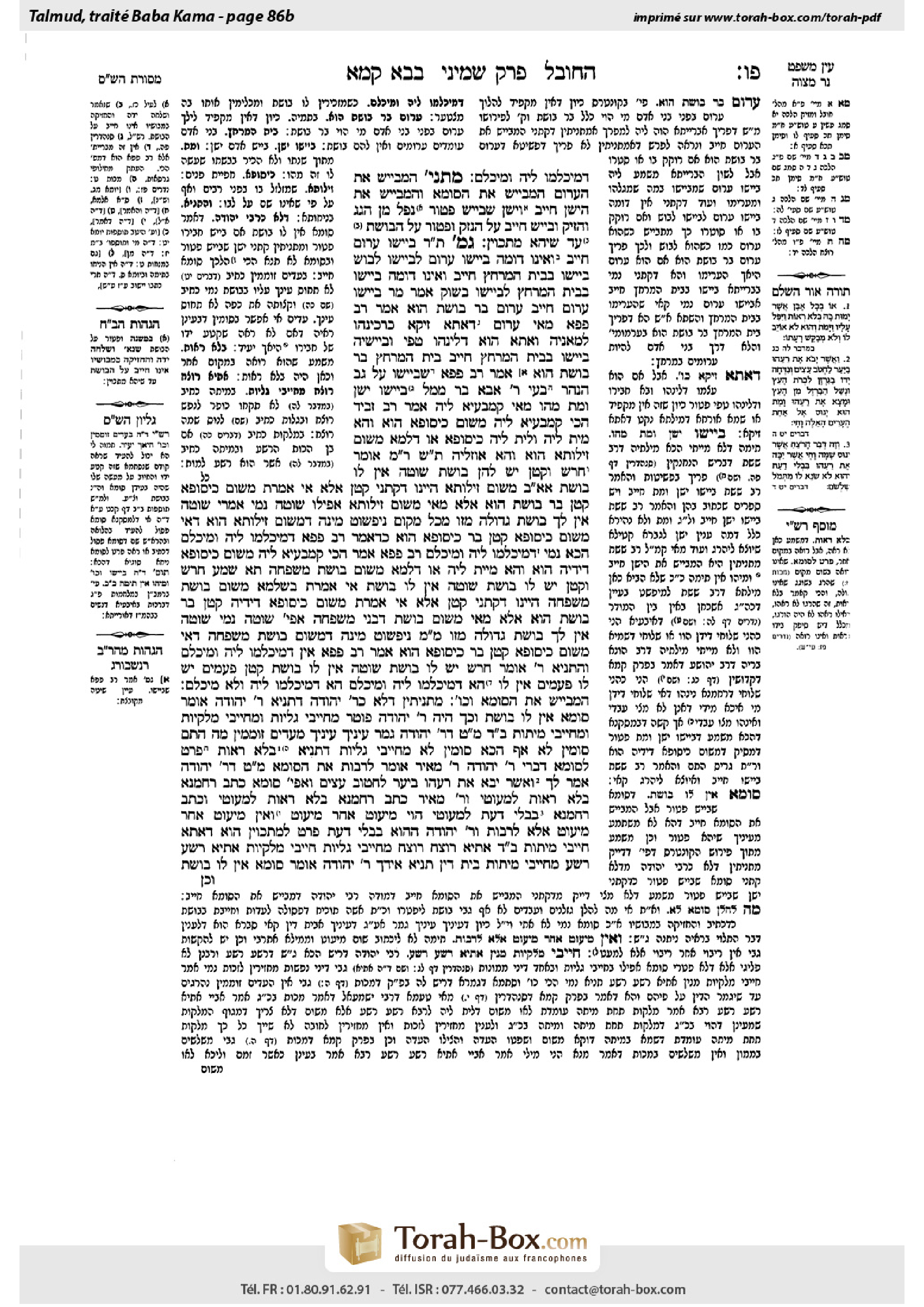
Bava Kamma 86b: Talmud study for Daf Yomi
Study the Talmud for Daf Yomi with scanned pages, Hebrew text, English translations from Sefaria and AI-generated French translations.
Passage selection and English or AI-generated French translation are available where the scan has annotations. Daf Study is independent of Torah-Box and Sefaria.
Browse Bava Kamma · בבא קמא · All tractatesBava Kamma 86b text and translations
This page of Bava Kamma includes the Aramaic text, an English translation and an AI-generated French translation, alongside the scan above.
בבא קמא פ״ו ב · Aramaic and Hebrew text
דְּמַיכְלְמוּ לֵיהּ וּמִיכְּלַם.
מַתְנִי׳ הַמְבַיֵּישׁ אֶת הֶעָרוֹם, הַמְבַיֵּישׁ אֶת הַסּוֹמֵא, וְהַמְבַיֵּישׁ אֶת הַיָּשֵׁן – חַיָּיב. וְיָשֵׁן שֶׁבִּיֵּישׁ – פָּטוּר. נָפַל מִן הַגָּג, וְהִזִּיק וּבִיֵּישׁ – חַיָּיב עַל הַנֶּזֶק, וּפָטוּר עַל הַבּוֹשֶׁת עַד שֶׁיְּהֵא מִתְכַּוֵּין.
גְּמָ׳ תָּנוּ רַבָּנַן: בִּיְּישׁוֹ עָרוֹם – חַיָּיב, וְאֵינוֹ דּוֹמֶה בִּיְּישׁוֹ עָרוֹם לְבִיְּישׁוֹ לָבוּשׁ. בִּיְּישׁוֹ בְּבֵית הַמֶּרְחָץ – חַיָּיב, וְאֵינוֹ דּוֹמֶה בִּיְּישׁוֹ בְּבֵית הַמֶּרְחָץ לְבִיְּישׁוֹ בַּשּׁוּק.
אָמַר מָר: בִּיְּישׁוֹ עָרוֹם – חַיָּיב. עָרוֹם בַּר בּוֹשֶׁת הוּא?! אָמַר רַב פָּפָּא: מַאי ״עָרוֹם״ – דַּאֲתָא זִיקָא כַּרְכִינְהוּ לְמָאנֵיהּ, וַאֲתָא הוּא דַּלִּינְהוּ טְפֵי וּבַיְּישֵׁיהּ.
בִּיְּישׁוֹ בְּבֵית הַמֶּרְחָץ – חַיָּיב. בֵּית הַמֶּרְחָץ בַּר בּוֹשֶׁת הוּא?! אָמַר רַב פָּפָּא: שֶׁבִּיְּישׁוֹ עַל גַּב הַנָּהָר.
בָּעֵי רַבִּי אַבָּא בַּר מֶמֶל: בִּיְּישׁוֹ יָשֵׁן – וָמֵת, מַהוּ? מַאי קָמִבַּעְיָא לֵיהּ? אָמַר רַב זְבִיד, הָכִי קָמִבַּעְיָא לֵיהּ: מִשּׁוּם כִּיסּוּפָא הוּא – וְהָא מִית לֵיהּ וְלֵית לֵיהּ כִּיסּוּפָא, אוֹ דִלְמָא מִשּׁוּם זִילוּתָא הוּא – וְהָא אוֹזְלֵיהּ?
תָּא שְׁמַע, רַבִּי מֵאִיר אוֹמֵר: חֵרֵשׁ וְקָטָן – יֵשׁ לָהֶן בּוֹשֶׁת, שׁוֹטֶה – אֵין לוֹ בּוֹשֶׁת. אִי אָמְרַתְּ בִּשְׁלָמָא מִשּׁוּם זִילוּתָא, הַיְינוּ דְּקָתָנֵי קָטָן; אֶלָּא אִי אָמְרַתְּ מִשּׁוּם כִּיסּוּפָא, קָטָן בַּר בּוֹשֶׁת הוּא?!
אֶלָּא מַאי, מִשּׁוּם זִילוּתָא? אֲפִילּוּ שׁוֹטֶה נָמֵי! אָמְרִי: שׁוֹטֶה – אֵין לְךָ בּוֹשֶׁת גְּדוֹלָה מִזּוֹ.
מִכׇּל מָקוֹם נִיפְשׁוֹט מִינַּהּ דְּמִשּׁוּם זִילוּתָא הוּא, דְּאִי מִשּׁוּם כִּיסּוּפָא – קָטָן בַּר כִּיסּוּפָא הוּא? כִּדְאָמַר רַב פָּפָּא: דְּמַיכְלְמוּ לֵיהּ וּמִיכְּלַם, הָכָא נָמֵי – דְּמַיכְלְמוּ לֵיהּ וּמִיכְּלַם.
רַב פָּפָּא אָמַר, הָכִי קָמִבַּעְיָא לֵיהּ: מִשּׁוּם כִּיסּוּפָא דִידֵיהּ הוּא – וְהוּא מִיית לֵיהּ, אוֹ דִלְמָא מִשּׁוּם בּוֹשֶׁת מִשְׁפָּחָה?
תָּא שְׁמַע: חֵרֵשׁ וְקָטָן יֵשׁ לוֹ בּוֹשֶׁת, שׁוֹטֶה אֵין לוֹ בּוֹשֶׁת. אִי אָמְרַתְּ בִּשְׁלָמָא מִשּׁוּם בּוֹשֶׁת מִשְׁפָּחָה – הַיְינוּ דְּקָתָנֵי קָטָן. אֶלָּא אִי אָמְרַתְּ מִשּׁוּם כִּיסּוּפָא דִידֵיהּ – קָטָן בַּר בּוֹשֶׁת הוּא?
אֶלָּא מַאי? מִשּׁוּם בּוֹשֶׁת דִּבְנֵי מִשְׁפָּחָה? אֲפִילּוּ שׁוֹטֶה נָמֵי! שׁוֹטֶה – אֵין לְךָ בּוֹשֶׁת גְּדוֹלָה מִזּוֹ.
מִכׇּל מָקוֹם נִיפְשׁוֹט מִינַּהּ דְּמִשּׁוּם בּוֹשֶׁת מִשְׁפָּחָה, דְּאִי מִשּׁוּם כִּיסּוּפָא – קָטָן בַּר כִּיסּוּפָא הוּא? אָמַר רַב פָּפָּא: אִין, דְּמַיכְלְמוּ לֵיהּ וּמִיכְּלַם.
וְהָתַנְיָא, רַבִּי אוֹמֵר: חֵרֵשׁ – יֵשׁ לוֹ בּוֹשֶׁת. שׁוֹטֶה – אֵין לוֹ בּוֹשֶׁת. קָטָן – פְּעָמִים יֵשׁ לוֹ, פְּעָמִים אֵין לוֹ – הָא דְּמַיכְלְמוּ לֵיהּ וּמִיכְּלַם, הָא דְּמַיכְלְמוּ לֵיהּ וְלָא מִיכְּלַם.
הַמְבַיֵּישׁ אֶת הַסּוֹמֵא וְכוּ׳. מַתְנִיתִין דְּלָא כְּרַבִּי יְהוּדָה; דְּתַנְיָא, רַבִּי יְהוּדָה אוֹמֵר: סוֹמֵא – אֵין לוֹ בּוֹשֶׁת, וְכָךְ הָיָה רַבִּי יְהוּדָה פּוֹטֵר מֵחַיָּיבֵי גָלִיּוֹת, וּמֵחַיָּיבֵי מַלְקִיּוֹת, וּמֵחַיָּיבֵי מִיתוֹת בֵּית דִּין.
מַאי טַעְמָא דְּרַבִּי יְהוּדָה? גָּמַר ״עֵינֶךָ״–״עֵינֶךָ״ מֵעֵדִים זוֹמְמִין; מָה הָתָם סוֹמִין לָא, אַף הָכָא סוֹמִין לָא.
מֵחַיָּיבֵי גָלִיּוֹת – דְּתַנְיָא: ״בְּלֹא רְאוֹת״ – פְּרָט לַסּוֹמֵא, דִּבְרֵי רַבִּי יְהוּדָה. רַבִּי מֵאִיר אוֹמֵר: לְרַבּוֹת אֶת הַסּוֹמֵא.
מַאי טַעְמָא דְּרַבִּי יְהוּדָה? אָמַר לָךְ: ״וַאֲשֶׁר יָבֹא אֶת רֵעֵהוּ בַיַּעַר לַחְטֹב עֵצִים״ – וַאֲפִילּוּ סוֹמֵא; כְּתַב רַחֲמָנָא ״בְּלֹא רְאוֹת״ – לְמַעוֹטֵי.
וְרַבִּי מֵאִיר – כְּתַב רַחֲמָנָא ״בְּלֹא רְאוֹת״ לְמַעוֹטֵי, וּכְתַב רַחֲמָנָא ״בִּבְלִי דַעַת״ לְמַעוֹטֵי; הָוֵי מִיעוּט אַחַר מִיעוּט, וְאֵין מִיעוּט אַחַר מִיעוּט אֶלָּא לְרַבּוֹת.
וְרַבִּי יְהוּדָה – הָהוּא ״בִּבְלִי דַעַת״, פְּרָט לְמִתְכַּוֵּין הוּא דַּאֲתָא.
חַיָּיבֵי מִיתוֹת בֵּית דִּין – אָתְיָא ״רֹצֵחַ״–״רֹצֵחַ״ מֵחַיָּיבֵי גָלִיּוֹת.
חַיָּיבֵי מַלְקִיּוֹת – אָתְיָא ״רָשָׁע״–״רָשָׁע״ מֵחַיָּיבֵי מִיתוֹת בֵּית דִּין.
תַּנְיָא אִידַּךְ, רַבִּי יְהוּדָה אוֹמֵר: סוֹמֵא אֵין לוֹ בּוֹשֶׁת.
Bava Kamma 86b · English translation
say that the baraita discusses a case involving a minor who has reached a stage in which when others humiliate him he feels humiliation.
MISHNA: One who humiliates a naked person, or one who humiliates a blind person, or one who humiliates a sleeping person is liable, but a sleeping person who humiliates another is exempt. If one fell from the roof onto another person, and thereby caused him damage and humiliated him, then the one who fell is liable for the indemnity of damage, since a person is always considered forewarned, and exempt from the indemnity of humiliation, since a person is not liable for humiliation unless he intends to humiliate the other person.
GEMARA: The Sages taught in a baraita (Tosefta 9:12): If one humiliated another who was naked, he is liable, but the magnitude of humiliation felt when he humiliated him while naked is not comparable to the magnitude of humiliation felt had he humiliated him while clothed, since one who chooses to be naked is less sensitive to humiliation. Similarly, if one humiliated another in a bathhouse, he is liable, but the magnitude of humiliation felt when he humiliated him in a bathhouse is not comparable to the magnitude of humiliation felt had he humiliated him in the marketplace.
The Gemara clarifies the baraita: The Master says: If one humiliated another who was naked, the one who humiliated him is liable. The Gemara asks: Is a naked person subject to humiliation? Is it possible to humiliate him in this state? Rav Pappa said: What does the baraita mean when it says: Naked? It means a case where a gust of wind came and lifted his clothes, and then this one came and raised them higher and humiliated him.
The baraita also teaches: If one humiliated another in a bathhouse, he is liable. The Gemara asks: Is one in a bathhouse subject to humiliation? In a place where people stand naked, can a person be humiliated by having his clothes removed? Rav Pappa said: This is a case where he humiliated him not in an actual bathhouse, but on the bank of the river, which is a place where people behave more discreetly when they undress.
§ Rabbi Abba bar Memel raises a dilemma: If one humiliated another who was asleep, and he died before he awoke, so he never knew of his humiliation, what is the halakha? The Gemara asks: What is his dilemma? Rav Zevid said that this is his dilemma: Is the compensation for humiliation due to embarrassment, i.e., that his feelings suffer because of what he experienced, and this one died and does not have that feeling of embarrassment? Or perhaps the compensation for humiliation is due to disgrace, i.e., lessening of his honor in front of other people, and he disgraced him.
The Gemara suggests: Come and hear a resolution to the dilemma from a baraita: Rabbi Meir says: A deaf-mute and a minor have the right to receive compensation for humiliation; an imbecile does not have the right to receive compensation for humiliation. The Gemara explains: Granted, if you say that the compensation is due to disgrace, this explanation is consistent with that which the baraita teaches concerning a minor, who can be disgraced; but if you say that the compensation is due to embarrassment, is a minor subject to humiliation?
The Gemara rejects this suggestion: Rather, what do you mean by stating that the compensation is due to disgrace? If compensation is granted due to disgrace, then an imbecile should receive compensation as well. The Sages say in response: With regard to an imbecile, you can have no greater humiliation than this. It is impossible to degrade him further.
The Gemara returns to the original suggestion: In any case, resolve from this baraita that the compensation is due to disgrace, as, if it is due to embarrassment, is a minor subject to embarrassment? The Gemara rejects this proof: This is as Rav Pappa said with regard to a different halakha, cited later by the Gemara: The case involves a minor who has reached an age in which when others humiliate him he feels humiliation; here, too, say that this baraita discusses a case involving a minor who has reached an age in which when others humiliate him he feels humiliation. This is how Rav Zevid understands the dilemma of Rabbi Abba bar Memel.
Rav Pappa explains Rabbi Abba bar Memel’s dilemma differently: Rav Pappa said that this is his dilemma: Is the compensation for humiliation due to his own embarrassment, and this one died and was not embarrassed? Or perhaps the compensation for humiliation is due to his family’s humiliation, and therefore the one who humiliated him must pay compensation to his family?
The Gemara suggests: Come and hear a resolution from the same baraita: A deaf-mute and a minor have the right to receive compensation for humiliation; an imbecile does not have the right to receive compensation for humiliation. The Gemara explains: Granted, if you say that the compensation is due to his family’s humiliation, this explanation is consistent with that which the baraita teaches concerning a minor, whose family can experience humiliation based on what was done to their relative; but if you say that the compensation is due to his own embarrassment, is a minor subject to humiliation?
The Gemara rejects this suggestion: Rather, what do you mean by stating that the compensation is due to the humiliation of members of his family? If this is the case, an imbecile should receive compensation as well. The Sages say in response: If one is an imbecile, you can have no greater humiliation than this.
The Gemara returns to the original suggestion: In any case, resolve from this that the compensation is due to his family’s humiliation, as, if it is due to embarrassment, is a minor subject to embarrassment? Rav Pappa said: Yes, he is subject to embarrassment, as the baraita discusses a case involving a minor who has reached an age in which when others humiliate him he feels humiliation.
The Gemara adds: And this distinction is taught in a baraita, as Rabbi Yehuda HaNasi says: A deaf-mute has the right to receive compensation for humiliation; an imbecile does not have the right to receive compensation for humiliation. With regard to a minor, sometimes he has the right to receive compensation for humiliation, and sometimes he does not have the right. Why is this so? This case where he has the right to receive compensation for humiliation is one involving a minor who has reached the stage in which when others humiliate him he feels humiliation; that case where he does not have the right to receive compensation for humiliation is one involving a minor who has not reached the stage in which when others humiliate him he feels humiliation.
§ The mishna teaches: One who humiliates a blind person is liable to pay compensation. The Gemara comments: The mishna is not in accordance with the opinion of Rabbi Yehuda, as it is taught in a baraita that Rabbi Yehuda says: A blind person who humiliated another does not have liability for humiliation. And in this way Rabbi Yehuda deemed a blind person exempt from being among those liable to be exiled for killing unintentionally, and from being among those liable to receive lashes, and from being among those liable to receive court-imposed capital punishment, if he transgresses a prohibition for which the Torah mandates one of these punishments.
The Gemara asks: What is the reasoning of Rabbi Yehuda? He derives a verbal analogy to: “Your eye shall not pity” (Deuteronomy 25:12), stated with regard to humiliation, from: “Your eye shall not pity” (Deuteronomy 19:21), stated with regard to conspiring witnesses. The analogy teaches that just as there, with regard to the halakha of conspiring witnesses, blind people are not included, as blind people cannot see events occur in order to testify, so too here, with regard to the halakha of compensation for humiliation, blind people are not included.
The Gemara continues its explanation: Why did Rabbi Yehuda deem a blind person exempt from being among those liable to be exiled for killing unintentionally? As it is taught in a baraita that the verse states with regard to an unintentional killing: “Or with any stone, whereby one may die, seeing him not” (Numbers 35:23), this formulation serves to exclude a blind person; this is the statement of Rabbi Yehuda. Rabbi Meir says: The verse serves to include a blind person.
The Gemara explains the dispute: What is the reasoning of Rabbi Yehuda? He would say to you: The verse states with regard to an unintentional killing, without any further limiting clause: “As when one goes into the forest with his neighbor to hew wood” (Deuteronomy 19:5), and this includes even a blind person; therefore, the Merciful One wrote in the Torah: “Seeing him not” (Numbers 35:23), to exclude a blind person.
And what is the reasoning of Rabbi Meir? The Merciful One wrote in the Torah: “Seeing him not” (Numbers 35:23), apparently to exclude one who happened to not see the one he killed; and the Merciful One wrote in the Torah: “Who kills his neighbor unawares” (Deuteronomy 19:4), apparently to exclude a blind person, who is not aware of where others are standing. This is a restriction following a restriction, and there is a hermeneutical principle that a restriction following a restriction serves only to amplify the halakha and include additional cases. Therefore, a blind person is included in the halakha of those liable to be exiled for unintentional killing.
The Gemara asks: And what would Rabbi Yehuda respond to this reasoning? The Gemara explains: That verse: “Who kills his neighbor unawares,” does not exclude one who could not see, but rather, it comes to exclude one who was intending to kill a particular person and unintentionally killed someone else. That killer is not exiled.
The Gemara continues to explain the opinion of Rabbi Yehuda. Why did he deem a blind person exempt from being among those liable to receive court-imposed capital punishment? That halakha is derived by means of a verbal analogy to: “But if he smote him with an instrument of iron so that he died, he is a killer; the killer shall be put to death” (Numbers 35:16), written with regard to capital punishment, from: “You shall appoint for yourselves cities, to be cities of refuge for you, that a killer who killed any person unintentionally may flee there” (Numbers 35:11), written with regard to those liable to be exiled.
Why did Rabbi Yehuda deem a blind person exempt from being among those liable to receive lashes? That halakha is derived by means of a verbal analogy to: “Then it shall be, if the guilty one deserves to be beaten” (Deuteronomy 25:2), written with regard to lashes, from: “Moreover you shall take no ransom for the life of a murderer, that is guilty of death” (Numbers 35:31), written with regard to those liable to receive court-imposed capital punishment.
The Gemara presents another statement of Rabbi Yehuda: It is taught in another baraita that Rabbi Yehuda says: A blind person does not have humiliation,
Bava Kamma 86b · Traduction française (IA)
dire que la baraïta discute d'un cas impliquant un mineur qui a atteint un stade où, lorsqu'on l'humilie, il ressent de l'humiliation.
MICHNA : Celui qui humilie une personne nue, ou celui qui humilie une personne aveugle, ou celui qui humilie une personne endormie est responsable, mais celui qui est endormi et humilie un autre est exempt. Si l'on tombe du toit sur une autre personne et qu'il en cause des dommages et qu'il l'humilie ainsi, alors celui qui est tombé est responsable des dommages, car une personne est toujours considérée comme avertie, et exempt de l'indemnité pour l'humiliation, car une personne n'est pas responsable d'humiliation à moins qu'elle ne veuille humilier l'autre.
GUEMARA : Les Sages ont enseigné dans une baraïta (Tosefta 9:12) : Si l'on humilie une autre personne qui est nue, il est responsable, mais la mesure de l'humiliation ressentie lorsqu'on l'a humilié nu n'est pas comparable à celle ressentie s'il l'avait humilié vêtu, car celui qui choisit d'être nu est moins sensible à l'humiliation. De même, si l'on humilie une autre personne dans une salle de bain, il est responsable, mais la mesure de l'humiliation ressentie lorsqu'on l'a humilié dans une salle de bain n'est pas comparable à celle ressentie s'il l'avait humilié dans la rue.
La Guemara clarifie la baraïta : Le Maître dit : Si l'on humilie une autre personne qui est nue, celui qui l'humilie est responsable. La Guemara pose la question : Une personne nue est-elle soumise à l'humiliation ? Est-il possible d'humilier une personne dans cet état ? Rav Pappa dit : Que signifie la baraïta lorsqu'elle dit : nu ? Elle signifie un cas où un coup de vent a soulevé ses vêtements, et ensuite cette personne a levé ses vêtements davantage et l'a humilié.
La baraïta enseigne également : Si l'on humilie une autre personne dans une salle de bain, il est responsable. La Guemara pose la question : Une personne dans une salle de bain est-elle soumise à l'humiliation ? Dans un lieu où les gens sont nus, peut-on être humilié en ayant ses vêtements retirés ? Rav Pappa dit : C'est un cas où l'on a humilié cette personne non dans une véritable salle de bain, mais sur la rive du fleuve, un lieu où les gens se déshabillent plus discrètement.
§ Rabbi Abba bar Memel soulève un dilemme : Si l'on humilie une autre personne qui est endormie, et qu'il meurt avant de se réveiller, de sorte qu'il ne connaît pas son humiliation, quelle est la halakha ? La Guemara pose la question : Quel est son dilemme ? Rav Zevid dit que c'est son dilemme : La compensation pour l'humiliation est-elle due à l'embarras, c'est-à-dire que ses sentiments souffrent de ce qu'il a vécu, et cette personne est morte et n'a plus ce sentiment d'embarras ? Ou peut-être la compensation pour l'humiliation est-elle due à la disgrâce, c'est-à-dire la diminution de son honneur devant les autres, et il l'a disgracié.
La Guemara suggère : Viens écouter une résolution à ce dilemme tirée d'une baraïta : Rabbi Meir dit : Un sourd-muet et un mineur ont le droit de recevoir une compensation pour l'humiliation ; un imbécile n'a pas le droit de recevoir une compensation pour l'humiliation. La Guemara explique : Admettons que tu dis que la compensation est due à la disgrâce, cette explication est cohérente avec ce que la baraïta enseigne concernant un mineur, qui peut être humilié ; mais si tu dis que la compensation est due à l'embarras, un mineur est-il sujet à l'humiliation ?
La Guemara rejette cette suggestion : Plutôt, que veux-tu dire en disant que la compensation est due à la disgrâce ? Si la compensation est accordée en raison de la disgrâce, alors un imbécile devrait recevoir une compensation également. Les Sages répondent : Concernant un imbécile, tu ne peux pas avoir une humiliation plus grande que celle-ci. Il est impossible de le dégrader davantage.
La Guemara revient à la suggestion originale : En tout cas, résous cela à partir de cette baraïta que la compensation est due à la disgrâce, car, si elle est due à l'embarras, un mineur est-il sujet à l'embarras ? La Guemara rejette cette preuve : C'est comme Rav Pappa a dit concernant une autre halakha, citée plus tard par la Guemara : Le cas concerne un mineur qui a atteint un âge où, lorsqu'on l'humilie, il ressent de l'humiliation ; ici aussi, dis que cette baraïta discute d'un cas impliquant un mineur qui a atteint un âge où, lorsqu'on l'humilie, il ressent de l'humiliation. C'est ainsi que Rav Zevid comprend le dilemme de Rabbi Abba bar Memel.
Rav Pappa explique différemment le dilemme de Rabbi Abba bar Memel : Rav Pappa dit que c'est son dilemme : La compensation pour l'humiliation est-elle due à son propre embarras, et cette personne est morte et n'a pas été embarrassée ? Ou peut-être la compensation pour l'humiliation est-elle due à l'humiliation de sa famille, et donc celui qui l'a humilié doit payer une compensation à sa famille ?
La Guemara suggère : Viens écouter une résolution à partir de la même baraïta : Un sourd-muet et un mineur ont le droit de recevoir une compensation pour l'humiliation ; un imbécile n'a pas le droit de recevoir une compensation pour l'humiliation. La Guemara explique : Admettons que tu dis que la compensation est due à l'humiliation de ses membres de famille, cette explication est cohérente avec ce que la baraïta enseigne concernant un mineur, dont la famille peut subir une humiliation en raison de ce qui a été fait à leur proche ; mais si tu dis que la compensation est due à son propre embarras, un mineur est-il sujet à l'embarras ?
La Guemara rejette cette suggestion : Plutôt, que veux-tu dire en disant que la compensation est due à l'humiliation des membres de sa famille ? Si c'est le cas, un imbécile devrait recevoir une compensation également. Les Sages répondent : Si l'on est un imbécile, tu ne peux pas avoir une humiliation plus grande que celle-ci.
La Guemara reprend la suggestion originale : En tout cas, concluez que la compensation est due à l'humiliation de sa famille, car, si elle est due à l'embarras, un mineur est-il sensible à l'embarras ? Rav Pappa dit : Oui, il est sensible à l'embarras, car la baraïta discute d'un cas impliquant un mineur qui a atteint un âge où, lorsqu'on l'humilie, il ressent de l'humiliation.
La Guemara ajoute : Cette distinction est enseignée dans une baraïta, comme le dit Rabbi Yéhuda HaNasi : un muet a le droit de recevoir une compensation pour l’humiliation ; un imbécile n’a pas le droit de recevoir une compensation pour l’humiliation. En ce qui concerne un mineur, parfois il a le droit de recevoir une compensation pour l’humiliation, et parfois il n’a pas le droit. Pourquoi est-ce ainsi ? Ce cas où il a le droit de recevoir une compensation pour l’humiliation est celui d’un mineur qui a atteint le stade où, lorsqu’on l’humilie, il ressent de l’humiliation ; ce cas où il n’a pas le droit de recevoir une compensation pour l’humiliation est celui d’un mineur qui n’a pas atteint le stade où, lorsqu’on l’humilie, il ressent de l’humiliation.
§ La mitsna enseigne : celui qui humilie un aveugle est tenu responsable de compensation. La Guemara commente : la mitsna ne suit pas l’opinion de Rabbi Yéhuda, car il est enseigné dans une baraïta que Rabbi Yéhuda dit : un aveugle qui a humilié un autre n’est pas tenu responsable d’humiliation. Ainsi, Rabbi Yéhuda considérait un aveugle comme exempt de figurer parmi ceux qui sont exilés pour avoir tué accidentellement, et de figurer parmi ceux qui sont punis de flagellation, et de figurer parmi ceux qui sont condamnés à la peine de mort par la cour, s’il transgresse une interdiction pour laquelle la Torah prescrit l’une de ces punitions.
La Guemara pose la question : quelle est la raison de Rabbi Yéhuda ? Il dérive une analogie verbale à : « Ton œil ne doit pas avoir de pitié » (Deutéronome 25:12), concernant l’humiliation, à partir de : « Ton œil ne doit pas avoir de pitié » (Deutéronome 19:21), concernant les témoins conjurés. L’analogie enseigne que, tout comme là, concernant la halakha des témoins conjurés, les aveugles ne sont pas inclus, car les aveugles ne peuvent pas voir les événements pour témoigner, de même ici, concernant la halakha de la compensation pour l’humiliation, les aveugles ne sont pas inclus.
La Guemara continue son explication : pourquoi Rabbi Yéhuda considère-t-il un aveugle comme exempt de figurer parmi ceux qui sont exilés pour avoir tué accidentellement ? Comme il est enseigné dans une baraïta que le verset dit en ce qui concerne un meurtre accidentel : « Ou avec toute pierre, par laquelle l’un peut mourir, en ne le voyant pas » (Nombres 35:23), cette formulation sert à exclure un aveugle ; c’est la déclaration de Rabbi Yéhuda. Rabbi Méir dit : ce verset sert à inclure un aveugle.
La Guemara explique le débat : quelle est la raison de Rabbi Yéhuda ? Il dirait à vous : le verset dit en ce qui concerne un meurtre accidentel, sans clause limitante supplémentaire : « Comme lorsqu’un homme entre dans la forêt avec son voisin pour couper du bois » (Deutéronome 19:5), et cela inclut même un aveugle ; donc, le Très Miséricordieux a écrit dans la Torah : « En ne le voyant pas » (Nombres 35:23), pour exclure un aveugle.
Et quelle est la raison de Rabbi Méir ? Le Très Miséricordieux a écrit dans la Torah : « En ne le voyant pas » (Nombres 35:23), visiblement pour exclure celui qui n’a pas vu la personne qu’il a tuée ; et le Très Miséricordieux a écrit dans la Torah : « Qui tue son voisin accidentellement » (Deutéronome 19:4), visiblement pour exclure un aveugle, qui n’est pas conscient de la position des autres. C’est une restriction suivie d’une restriction, et il existe un principe herméneutique selon lequel une restriction suivie d’une restriction sert uniquement à amplifier la halakha et à inclure des cas supplémentaires. Donc, un aveugle est inclus dans la halakha de ceux qui sont exilés pour avoir tué accidentellement.
La Guemara pose la question : et que répondrait Rabbi Yéhuda à cette raisonnement ? La Guemara explique : ce verset : « Qui tue son voisin accidentellement », ne exclut pas celui qui ne peut pas voir, mais plutôt, il s’agit d’exclure celui qui avait l’intention de tuer une personne particulière et a accidentellement tué quelqu’un d’autre. Ce meurtrier n’est pas exilé.
La Guemara continue d’expliquer l’opinion de Rabbi Yéhuda. Pourquoi a-t-il considéré un aveugle comme exempt de figurer parmi ceux qui sont condamnés à la peine de mort par la cour ? Cette halakha est dérivée par analogie verbale à : « Et s’il le frappe avec un instrument de fer de sorte qu’il meurt, il est un meurtrier ; le meurtrier sera mis à mort » (Nombres 35:16), écrit en ce qui concerne la peine de mort, à partir de : « Vous choisirez pour vous des villes, des villes de refuge, afin que le meurtrier qui a tué une personne accidentellement puisse s’y réfugier » (Nombres 35:11), écrit en ce qui concerne ceux qui sont exilés.
Pourquoi Rabbi Yéhuda considère-t-il un aveugle comme exempt de figurer parmi ceux qui sont soumis à la flagellation ? Cette halakha est tirée par analogie verbale à : « Et il sera, si le coupable mérite d’être battu » (Deutéronome 25:2), concernant la flagellation, à partir de : « Et vous ne prendrez pas de rançon pour la vie d’un meurtrier, celui qui est coupable de mort » (Nombres 35:31), concernant ceux qui sont condamnés à la peine de mort par la cour.
La Guemara présente une autre déclaration de Rabbi Yéhuda : il est enseigné dans une autre baraïta que Rabbi Yéhuda dit : un aveugle n’a pas d’humiliation,
Traduction française générée par IA à partir de l’édition anglaise de Sefaria. Vérifie toujours un passage avec le texte source.
Text from Sefaria: William Davidson Edition - Vocalized Aramaic (CC BY NC); William Davidson Edition - English (CC BY NC).