Bava Kamma 87b: Talmud study for Daf Yomi
Study the Talmud for Daf Yomi with scanned pages, Hebrew text, English translations from Sefaria and AI-generated French translations.
Passage selection and English or AI-generated French translation are available where the scan has annotations. Daf Study is independent of Torah-Box and Sefaria.
Browse Bava Kamma · בבא קמא · All tractatesBava Kamma 87b text and translations
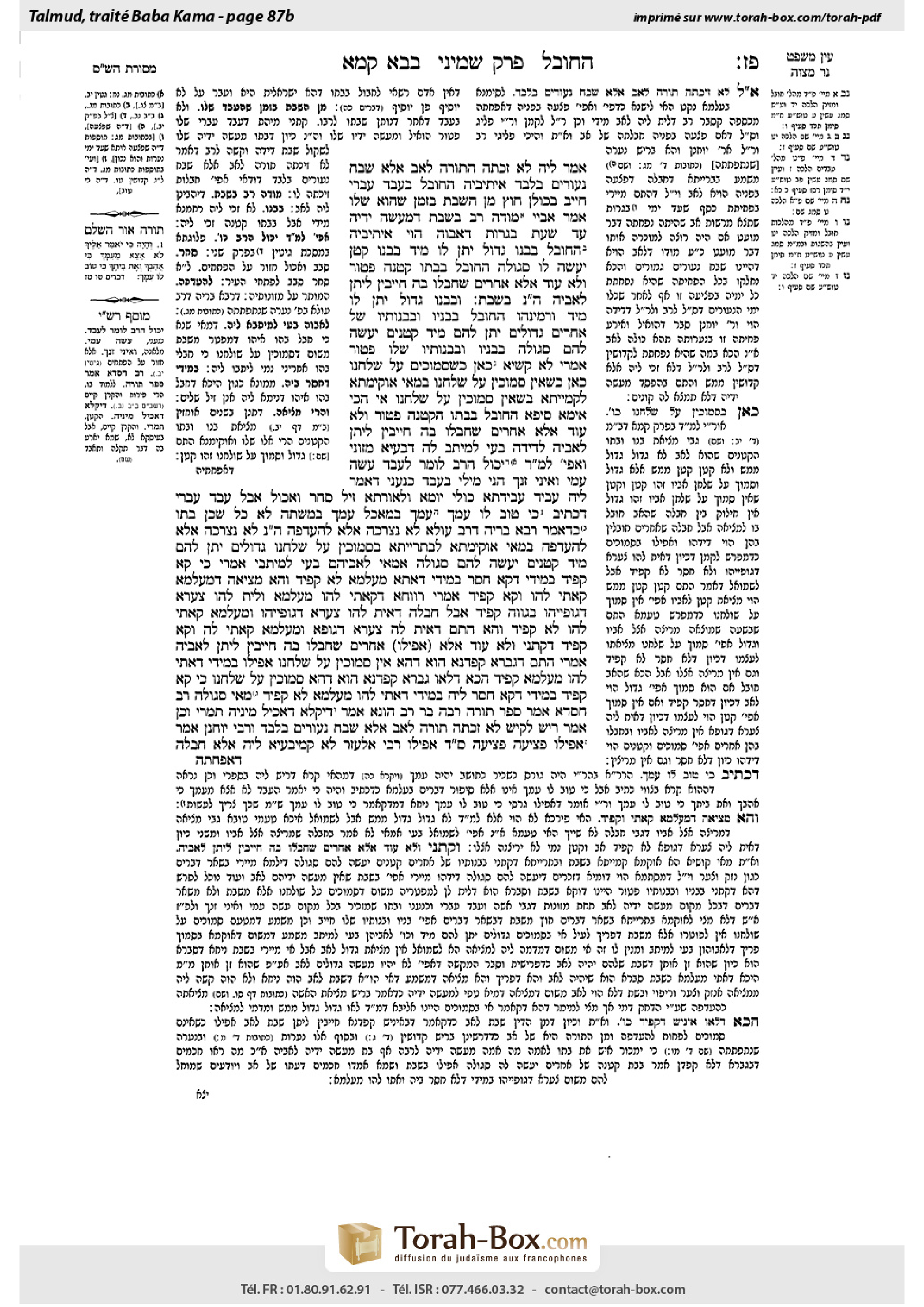
This page of Bava Kamma includes the Aramaic text, an English translation and an AI-generated French translation, alongside the scan above.
בבא קמא פ״ז ב · Aramaic and Hebrew text
אֲמַר לֵיהּ: לֹא זִכְּתָה תּוֹרָה לָאָב, אֶלָּא שֶׁבַח נְעוּרִים בִּלְבָד. אֵיתִיבֵיהּ: הַחוֹבֵל בְּעֶבֶד עִבְרִי – חַיָּיב בְּכוּלָּן, חוּץ מִן הַשֶּׁבֶת בִּזְמַן שֶׁהוּא שֶׁלּוֹ! אָמַר אַבָּיֵי: מוֹדֶה רַב בְּשֶׁבֶת, דְּמַעֲשֵׂה יָדֶיהָ עַד שְׁעַת בַּגְרוּת – דַּאֲבוּהּ הָוֵי.
אֵיתִיבֵיהּ: הַחוֹבֵל בִּבְנוֹ גָּדוֹל – יִתֵּן לוֹ מִיָּד, בִּבְנוֹ קָטָן – יַעֲשֶׂה לוֹ סְגוּלָּה. הַחוֹבֵל בְּבִתּוֹ קְטַנָּה – פָּטוּר, וְלֹא עוֹד, אֶלָּא אֲחֵרִים שֶׁחָבְלוּ בָּהּ – חַיָּיבִין לִיתֵּן לְאָבִיהָ! הָכִי נָמֵי בְּשֶׁבֶת.
וּבִבְנוֹ גָּדוֹל יִתֵּן לוֹ מִיָּד? וּרְמִינְהוּ: הַחוֹבֵל בְּבָנָיו וּבִבְנוֹתָיו שֶׁל אֲחֵרִים, גְּדוֹלִים – יִתֵּן לָהֶם מִיָּד, קְטַנִּים – יַעֲשֶׂה לָהֶם סְגוּלָּה. בְּבָנָיו וּבִבְנוֹתָיו שֶׁלּוֹ – פָּטוּר!
אָמְרִי: לָא קַשְׁיָא; כָּאן כְּשֶׁסְּמוּכִים עַל שֻׁלְחָנוֹ, כָּאן כְּשֶׁאֵין סְמוּכִין עַל שֻׁלְחָנוֹ.
בְּמַאי אוֹקֵימְתַּהּ לְקַמַּיְיתָא – בְּשֶׁאֵין סְמוּכִין עַל שֻׁלְחָנוֹ? אִי הָכִי, אֵימָא סֵיפָא: הַחוֹבֵל בְּבִתּוֹ הַקְּטַנָּה – פָּטוּר; וְלֹא עוֹד, אֶלָּא אֲחֵרִים שֶׁחָבְלוּ בָּהּ – חַיָּיבִין לִיתֵּן לְאָבִיהָ. לְדִידַהּ בָּעֵי לְמִיתַּב לַהּ – דְּבַעְיָא מְזוֹנֵי!
וַאֲפִילּוּ לְמַאן דְּאָמַר: יָכוֹל הָרַב לוֹמַר לָעֶבֶד ״עֲשֵׂה עִמִּי וְאֵינִי זָנָךְ״; הָנֵי מִילֵּי בְּעֶבֶד כְּנַעֲנִי – דְּאָמַר לֵיהּ: עֲבֵיד עֲבִידְתָּא כּוּלֵּי יוֹמָא, וּלְאוּרְתָּא זִיל סְחַר וֶאֱכוֹל; אֲבָל עֶבֶד עִבְרִי, דִּכְתִיב: ״כִּי טוֹב לוֹ עִמָּךְ״ – עִמְּךָ בְּמַאֲכָל, עִמְּךָ בְּמִשְׁתֶּה – לֹא כׇּל שֶׁכֵּן בִּתּוֹ?!
כִּדְאָמַר רָבָא בְּרֵיהּ דְּרַב עוּלָּא: לֹא נִצְרְכָה אֶלָּא לְהַעְדָּפָה; הָכָא נָמֵי, לָא נִצְרְכָה אֶלָּא לְהַעְדָּפָה.
בְּמַאי אוֹקֵימְתַּהּ לְבָתְרָיְיתָא – בִּסְמוּכִין עַל שֻׁלְחָנוֹ? ״גְּדוֹלִים – יִתֵּן לָהֶם מִיָּד, קְטַנִּים – יַעֲשֶׂה לָהֶם סְגוּלָּה״, אַמַּאי? לַאֲבִיהֶם בָּעֵי לְמִיתַּב!
אָמְרִי: כִּי קָא קָפֵיד – בְּמִידֵּי דְּקָא חָסַר, בְּמִידֵּי דַּאֲתָא מֵעָלְמָא – לָא קָפֵיד.
וְהָא מְצִיאָה, דְּמֵעָלְמָא קָאָתֵי לְהוּ, וְקָא קָפֵיד! אָמְרִי: רַוְוחָא דְּקָאָתֵי לְהוּ מֵעָלְמָא, וְלֵית לְהוּ צַעֲרָא דְּגוּפַיְיהוּ בְּגַוַּוהּ – קָפֵיד; אֲבָל חֲבָלָה, דְּאִית לְהוּ צַעֲרָא דְּגוּפַיְיהוּ, וּמֵעָלְמָא קָאָתֵי לְהוּ – לָא קָפֵיד.
וְהָא הָתָם, דְּאִית לַהּ צַעֲרָא דְּגוּפָא, וּמֵעָלְמָא קָאָתֵי לַהּ, וְקָא קָפֵיד! דְּקָתָנֵי: וְלֹא עוֹד, אֶלָּא (אֲפִילּוּ) אֲחֵרִים שֶׁחָבְלוּ בָּהּ – חַיָּיבִין לִיתֵּן לְאָבִיהָ!
אָמְרִי: הָתָם, דְּגַבְרָא קַפְדָנָא הוּא, דְּהָא אֵין סְמוּכִין עַל שֻׁלְחָנוֹ – אֲפִילּוּ בְּמִידֵּי דְּאָתֵי לְהוּ מֵעָלְמָא קָפֵיד. הָכָא, דְּלָאו גַּבְרָא קַפְדָנָא הוּא, דְּהָא סְמוּכִין עַל שֻׁלְחָנוֹ; כִּי קָא קָפֵיד – בְּמִידֵּי דְּקָא חָסַר לֵיהּ, בְּמִידֵּי דְּאָתֵי לְהוּ מֵעָלְמָא – לָא קָפֵיד.
מַאי ״סְגוּלָּה״? רַב חִסְדָּא אָמַר: סֵפֶר תּוֹרָה. רַבָּה בַּר רַב הוּנָא אָמַר: דִּיקְלָא דְּאָכֵיל מִינֵּיהּ תַּמְרֵי.
וְכֵן אָמַר רֵישׁ לָקִישׁ: לֹא זִכְּתָה תּוֹרָה לָאָב – אֶלָּא שֶׁבַח נְעוּרִים בִּלְבָד. וְרַבִּי יוֹחָנָן אָמַר: אֲפִילּוּ פְּצִיעָה.
פְּצִיעָה סָלְקָא דַּעְתָּךְ?! אֲפִילּוּ רַבִּי אֶלְעָזָר לָא קָמִיבַּעְיָא לֵיהּ אֶלָּא חֲבָלָה –
Bava Kamma 87b · English translation
Rav said to Rabbi Elazar in response: The Torah granted the father only the profits of her youth and nothing else. Therefore, compensation for the injury goes to the daughter. Rabbi Elazar raised an objection to Rav’s statement based on the mishna: One who injures a Hebrew slave is liable for all of the five types of indemnity. This is except for compensation for loss of livelihood occurring during the time that the injured slave belongs to the one that injured him. This should be the halakha with regard to a minor daughter as well, that since the father has the right to the earnings of his minor daughter, he should receive the compensation for her loss of livelihood. Abaye said in response: Rav concedes with regard to compensation for her loss of livelihood that it is paid to the father, since her earnings belong to her father until the time of her adulthood, and therefore her inability to work is her father’s loss.
Rabbi Elazar raised an objection to Rav’s statement based on a baraita: One who injures his adult son must give him his compensation immediately. If one injured his minor son he must make a safe investment [segulla] for him with the compensation money. One who injures his minor daughter is exempt, and moreover, if there were others who injured her, they are liable to give compensation to her father. The Gemara answers: So too here, the baraita is speaking with regard to the daughter’s loss of livelihood alone, which is paid to the father. The other types of indemnity are paid to the daughter.
The Gemara questions the first ruling of the baraita: And is it so that if a father injured his adult son he must give him his compensation immediately? And the Gemara raises a contradiction from that which is taught in another baraita: In a case of one who injures the sons or daughters of others, if they are adults he must give them their compensation immediately; if they are minors he must make a safe investment for them. If one injures his own sons or daughters, he is exempt from paying them compensation.
The Sages say in response: This is not difficult. Here, where the baraita states that the father is exempt, it is dealing with a case where the children are dependent on their father’s table for support. There, where the baraita states that the father is liable, it is dealing with a case where the children are not dependent on his table.
The Gemara challenges this resolution of the two baraitot: In what manner did you interpret the first baraita? You interpreted it as dealing with a case where the children are not dependent on his table? If so, say the latter clause of that baraita: One who injures his minor daughter is exempt, and moreover, if there were others who injured her, they are liable to give compensation to her father. If this is a case where the daughter is not dependent upon her father for support, then the one who injured her would be required to give the compensation to her, because she needs to provide her own sustenance.
The Gemara continues its challenge. And even according to the one who says that a master can say to his slave: Work for me but I will not feed you, i.e., a master is not legally obligated to provide sustenance for his slave, this matter applies only to a Canaanite slave, as the master can say to him: Work for me the entire day, and at night go around, beg, and eat. But in the case of a Hebrew slave, as it is written with regard to him: “Because he fares well with you” (Deuteronomy 15:16), indicating that the Hebrew slave must be “with you” in food and “with you” in drink, i.e., the Hebrew slave is entitled to live with his master as an equal, the master may not compel the slave to serve him unless he feeds him. All the more so is it not the case with regard to his daughter, that she is not required to beg for her sustenance and should receive the compensation herself?
The Gemara answers: This is as Rava, son of Rav Ulla, said concerning a similar matter (Ketubot 43a): This halakha is necessary only for the surplus, i.e., money that a woman earns beyond what she needs for her essential sustenance. Here too, this halakha is necessary only for the surplus. If the compensation for injury is more than the daughter requires for her sustenance, the additional sum is paid to her father.
The Gemara again challenges the resolution of the two baraitot: In what manner did you interpret the latter baraita discussing one who injures the children of another? You interpreted it as dealing with a case where the sons are dependent on their father’s table. But the baraita also stated: If they are adults, he must give them their compensation immediately; if they are minors, he must make a safe investment for them. Why does he make a safe investment for them? Shouldn’t he be required to give the compensation to their father?
The Sages say in response: Where the father is particular about receiving money that would go to his child is specifically in a matter that causes him a loss, as in a case where the father himself injured his child and would need to pay compensation. But in a matter that comes from elsewhere, as in a case where someone else injured his child, he is not particular about receiving the money, and it is paid to the child.
The Gemara challenges that response: But isn’t a found item a matter that comes to the children from elsewhere, and the father is particular about receiving it? The Sages say in response: With regard to profit that comes to the children from elsewhere, and they do not suffer physical pain in obtaining it, the father is particular about receiving the money, as he does not feel that the children deserve it. But in the case of an injury, where they suffer physical pain and it comes to them from elsewhere, the father is not particular about receiving the compensation paid to his child.
The Gemara challenges: But there, in the first baraita, isn’t it discussing a case where the daughter suffers physical pain, and it is a matter that comes to her from elsewhere, and the father is particular about receiving the money, as it teaches: And moreover, if there were others who injured her, they are liable to give compensation to her father?
The Sages say in response: There, the baraita discusses a case where the father is a captious man, which is evident from the case of the baraita itself, as his children are not dependent on his table. A man like this is particular even about matters that come to them from elsewhere. By contrast, here, in the latter baraita, it discusses a case where the father is not a captious man, which is evident from the case of the baraita itself, as his children are dependent on his table. When he is particular about receiving the money, it is in a matter that causes him a loss, but in a matter that comes to them from elsewhere, he is not particular.
The two baraitot stated that the father makes a safe investment for his minor children with the compensation paid to them. The Gemara asks: What is meant by a safe investment? Rav Ḥisda says: The father should purchase a Torah scroll for his child. Rabba bar Rav Huna, says: The father should purchase a date palm, from which the child will consume dates.
The Gemara comments that the amora’im of Eretz Yisrael discussed the same issue as did those in Babylonia. And so says Reish Lakish: The Torah granted the father only the profits of her youth, and nothing else. And Rabbi Yoḥanan says: The father receives even the compensation for his daughter’s wound.
The Gemara objects: Does it enter your mind that the father receives compensation for his daughter’s wound, which, unlike an injury, does not diminish his daughter’s value? Even Rabbi Elazar raised his dilemma only with regard to an injury,
Bava Kamma 87b · Traduction française (IA)
Rav dit à Rabbi Elazar en réponse : La Torah a donné au père seulement les profits de la jeunesse de sa fille et rien d'autre. Par conséquent, la compensation pour l'injury va à la fille. Rabbi Elazar opposa une objection à la déclaration de Rav, basée sur la mitsna : Celui qui blesse un serviteur juif est tenu responsable de toutes les cinq formes de réparation. Cela est excepté pour la compensation de la perte de revenu qui survient pendant la période où le serviteur blessé appartient à celui qui l'a blessé. Cela devrait être la halakha concernant une fille mineure également, car le père a le droit aux revenus de sa fille mineure, il devrait donc recevoir la compensation pour sa perte de revenu. Abaye dit en réponse : Rav reconnaît que la compensation pour la perte de revenu est payée au père, car les revenus de sa fille appartiennent à son père jusqu'au moment de sa majorité, et par conséquent, son incapacité à travailler est la perte du père.
Rabbi Elazar opposa une objection à la déclaration de Rav, basée sur une baraïta : Celui qui blesse son fils adulte doit lui payer sa compensation immédiatement. Si l'on blesse son fils mineur, il doit faire un investissement sûr [segulla] pour lui avec l'argent de la compensation. Celui qui blesse sa fille mineure est exempt, et de plus, si d'autres l'ont blessée, ils sont tenus de payer la compensation à son père. La Guemara répond : De même ici, la baraïta parle uniquement de la perte de revenu de la fille, qui est payée au père. Les autres types de réparation sont payés à la fille.
La Guemara questionne la première décision de la baraïta : Et est-ce que c'est ainsi que si un père blesse son fils adulte, il doit lui payer sa compensation immédiatement ? Et la Guemara soulève une contradiction avec ce qui est enseigné dans une autre baraïta : Dans un cas où l'on blesse les fils ou les filles d'autrui, si ils sont adultes, il doit leur payer leur compensation immédiatement ; si ils sont mineurs, il doit faire un investissement sûr pour eux. Si l'on blesse ses propres fils ou filles, il est exempt de payer leur compensation.
Les Sages disent en réponse : Ce n'est pas difficile. Ici, où la baraïta dit que le père est exempt, elle parle d'un cas où les enfants dépendent de la table du père pour leur soutien. Là, où la baraïta dit que le père est responsable, elle parle d'un cas où les enfants ne dépendent pas de sa table.
La Guemara conteste cette résolution des deux baraitot : De quelle manière avez-vous interprété la première baraïta ? Vous l'avez interprétée comme un cas où les enfants ne dépendent pas de sa table ? Si c'est le cas, dites la dernière partie de cette baraïta : Celui qui blesse sa fille mineure est exempt, et de plus, si d'autres l'ont blessée, ils sont tenus de payer la compensation à son père. Si c'est un cas où la fille ne dépend pas de son père pour son soutien, alors celui qui l'a blessée devrait être tenu de payer la compensation à elle, car elle doit se procurer sa propre subsistance.
La Guemara poursuit sa contestation. Et même selon celui qui dit qu'un maître peut dire à son serviteur : Travaille pour moi mais je ne te nourrirai pas, c'est-à-dire qu'un maître n'est pas légalement tenu de fournir un soutien alimentaire à son serviteur, cette affaire s'applique uniquement à un serviteur cananéen, car le maître peut dire à lui : Travaille pour moi toute la journée, et la nuit, va t'enquérir et mange. Mais dans le cas d'un serviteur juif, comme il est écrit concernant lui : « Parce qu'il prospère avec toi » (Deutéronome 15:16), indiquant que le serviteur juif doit être « avec toi » en nourriture et « avec toi » en boisson, c'est-à-dire que le serviteur juif a le droit de vivre avec son maître comme un égal, le maître ne peut pas obliger le serviteur à le servir sans le nourrir. De plus, encore, ce n'est pas le cas concernant sa fille, qu'elle ne doit pas mendier sa subsistance et devrait recevoir la compensation elle-même ?
La Guemara répond : C'est comme Rava, fils de Rav Ulla, a dit concernant une affaire similaire (Ketubot 43a) : Cette halakha est nécessaire uniquement pour le surplus, c'est-à-dire l'argent que la femme gagne au-delà de ce qu'elle a besoin pour sa subsistance essentielle. Ici aussi, cette halakha est nécessaire uniquement pour le surplus. Si la compensation pour l'injury est supérieure à ce que la fille a besoin pour sa subsistance, la somme supplémentaire est payée à son père.
La Guemara conteste à nouveau la résolution des deux baraitot : De quelle manière avez-vous interprété la baraïta ultérieure discutant celui qui blesse les enfants d'autrui ? Vous l'avez interprétée comme un cas où les enfants dépendent de la table de leur père. Mais la baraïta a aussi dit : Si ils sont adultes, il doit leur payer leur compensation immédiatement ; si ils sont mineurs, il doit faire un investissement sûr pour eux. Pourquoi fait-il un investissement sûr pour eux ? Ne devrait-il pas être tenu de leur payer la compensation à leur père ?
Les Sages disent en réponse : Lorsque le père est particulier à recevoir de l'argent qui va à son enfant, c'est spécifiquement dans un cas où cela lui cause une perte, comme dans un cas où le père lui-même a blessé son enfant et devrait payer la compensation. Mais dans un cas qui vient d'ailleurs, comme dans un cas où quelqu'un d'autre a blessé son enfant, il n'est pas particulier à recevoir l'argent, et il est payé à l'enfant.
La Guemara conteste cette réponse : Mais n'est-ce pas un objet trouvé un cas qui vient d'ailleurs, et le père est particulier à le recevoir ? Les Sages disent en réponse : Concernant un profit qui vient d'ailleurs aux enfants et qu'ils n'ont pas de douleur physique à obtenir, le père est particulier à recevoir l'argent, car il ne se sent pas que les enfants méritent cela. Mais dans le cas d'une blessure, où ils souffrent de douleur physique et que cela vient d'ailleurs, le père n'est pas particulier à recevoir la compensation payée à son enfant.
La Guemara conteste : Mais là, dans la première baraïta, n’est-ce pas qu’il s’agit d’un cas où la fille subit une douleur physique, et il s’agit d’une affaire qui vient d’ailleurs, et le père est exigeant quant à recevoir l’argent, comme il enseigne : Et de plus, si d’autres avaient blessé elle, ils sont tenus de réparer à son père ?
Les Sages répondent : Là, la baraïta discute d’un cas où le père est exigeant, ce qui est évident du cas même de la baraïta, car ses enfants ne dépendent pas de sa table. Un homme comme cela est exigeant même sur des affaires qui viennent d’ailleurs. En revanche, ici, dans la seconde baraïta, il s’agit d’un cas où le père n’est pas exigeant, ce qui est évident du cas même de la baraïta, car ses enfants dépendent de sa table. Quand il est exigeant quant à recevoir l’argent, c’est dans une affaire qui lui cause une perte, mais dans une affaire qui vient d’ailleurs, il n’est pas exigeant.
Les deux baraitot ont dit que le père investit en sécurité pour ses enfants mineurs avec l’indemnité payée à ses enfants. La Guemara demande : De quoi s’agit-il par un investissement en sécurité ? Rav Ḥisda dit : Le père devrait acheter un livre de Torah pour son enfant. Rabba bar Rav Huna dit : Le père devrait acheter un palmier, duquel l’enfant consommera des dattes.
La Guemara commente que les amoraïm d’Eretz Yisraël ont discuté de la même question que ceux de Babylone. Et ainsi dit Reish Lakish : La Torah a accordé au père seulement les profits de sa jeunesse, et rien d’autre. Et Rabbi Yoḥanan dit : Le père reçoit même l’indemnité pour la plaie de sa fille.
La Guemara s’oppose : Est-ce que cela entre dans votre pensée que le père reçoit l’indemnité pour la plaie de sa fille, qui, contrairement à une blessure, ne diminue pas la valeur de sa fille ? Même Rabbi Elazar a soulevé son doute uniquement concernant une blessure,
Traduction française générée par IA à partir de l’édition anglaise de Sefaria. Vérifie toujours un passage avec le texte source.
Text from Sefaria: William Davidson Edition - Vocalized Aramaic (CC BY NC); William Davidson Edition - English (CC BY NC).