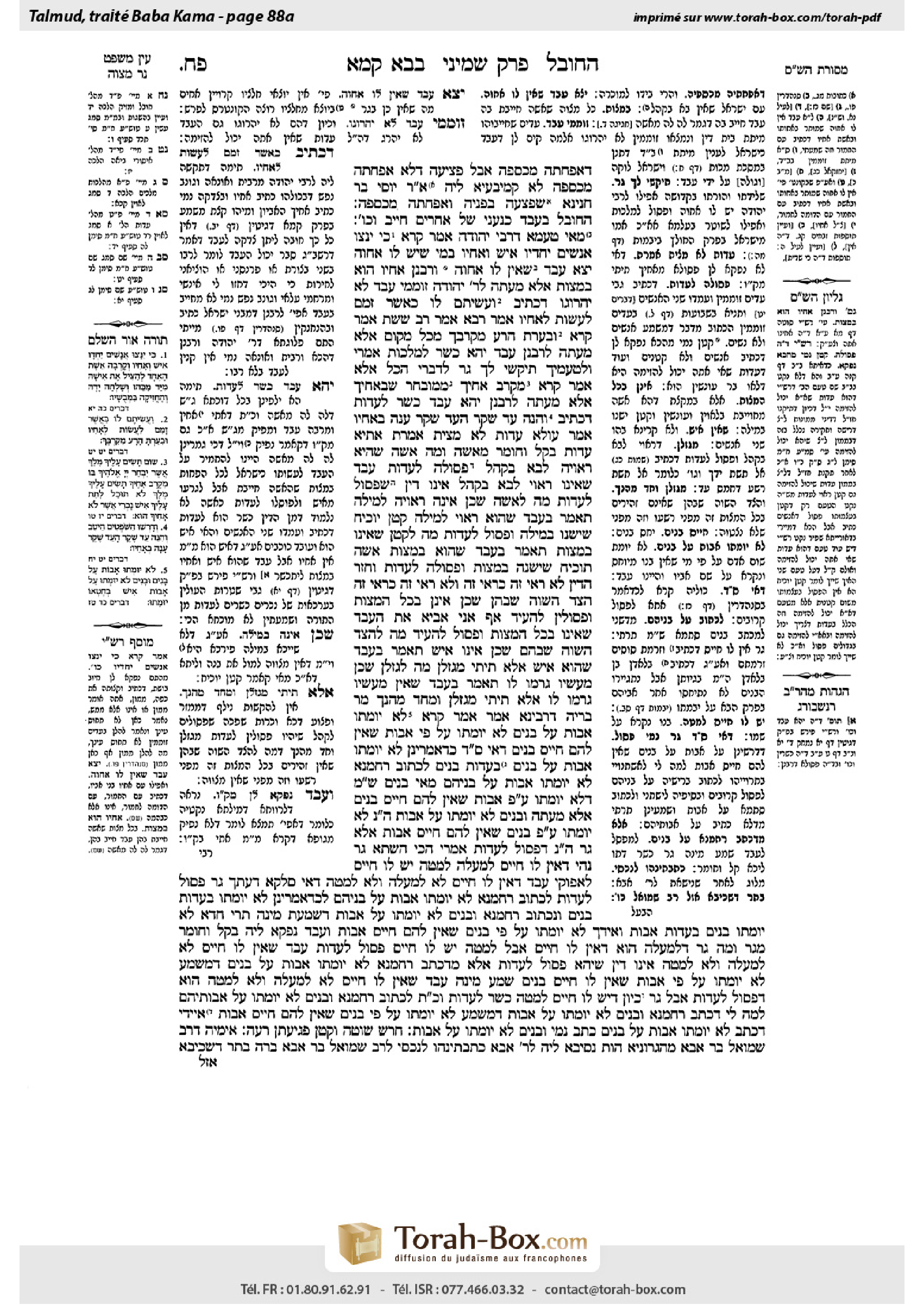
Bava Kamma 88a: Talmud study for Daf Yomi
Study the Talmud for Daf Yomi with scanned pages, Hebrew text, English translations from Sefaria and AI-generated French translations.
Passage selection and English or AI-generated French translation are available where the scan has annotations. Daf Study is independent of Torah-Box and Sefaria.
Browse Bava Kamma · בבא קמא · All tractatesBava Kamma 88a text and translations
This page of Bava Kamma includes the Aramaic text, an English translation and an AI-generated French translation, alongside the scan above.
בבא קמא פ״ח א · Aramaic and Hebrew text
דְּאַפְחֲתַהּ מִכַּסְפַּהּ; אֲבָל פְּצִיעָה – דְּלָא אַפְחֲתַהּ מִכַּסְפַּהּ, לָא קָמִיבַּעְיָא לֵיהּ!
אָמַר רַבִּי יוֹסֵי בַּר חֲנִינָא: שֶׁפְּצָעָהּ בְּפָנֶיהָ, וְאַפְחֲתַהּ מִכַּסְפַּהּ.
הַחוֹבֵל בְּעֶבֶד כְּנַעֲנִי שֶׁל אֲחֵרִים – חַיָּיב וְכוּ׳. מַאי טַעְמָא דְּרַבִּי יְהוּדָה? אָמַר קְרָא: ״כִּי יִנָּצוּ אֲנָשִׁים יַחְדָּו אִישׁ וְאָחִיו״ – בְּמִי שֶׁיֵּשׁ לוֹ אַחְוָה, יָצָא עֶבֶד שֶׁאֵין לוֹ אַחְוָה. וְרַבָּנַן – אָחִיו הוּא בְּמִצְוֹת.
אֶלָּא מֵעַתָּה, לְרַבִּי יְהוּדָה – זוֹמְמֵי עֶבֶד לֹא יֵהָרְגוּ, דִּכְתִיב: ״וַעֲשִׂיתֶם לוֹ כַּאֲשֶׁר זָמַם לַעֲשׂוֹת לְאָחִיו״! אָמַר רָבָא אָמַר רַב שֵׁשֶׁת, אָמַר קְרָא: ״וּבִעַרְתָּ הָרָע מִקִּרְבֶּךָ״ – מִכׇּל מָקוֹם.
אֶלָּא מֵעַתָּה, לְרַבָּנַן – עֶבֶד יְהֵא כָּשֵׁר לַמַּלְכוּת! אָמְרִי: וּלְטַעְמָיךְ, תִּיקְשֵׁי לָךְ גֵּר – לְדִבְרֵי הַכֹּל! אֶלָּא אָמַר קְרָא: ״מִקֶּרֶב אַחֶיךָ״ – מִמּוּבְחָר שֶׁבְּאַחֶיךָ.
אֶלָּא מֵעַתָּה, לְרַבָּנַן – יְהֵא עֶבֶד כָּשֵׁר לְעֵדוּת, דִּכְתִיב: ״וְהִנֵּה עֵד שֶׁקֶר הָעֵד, שֶׁקֶר עָנָה בְאָחִיו״!
אָמַר עוּלָּא: עֵדוּת לָא מָצֵית אָמְרַתְּ; אָתְיָא עֵדוּת בְּקַל וָחוֹמֶר מֵאִשָּׁה: וּמָה אִשָּׁה, שֶׁהִיא רְאוּיָה לָבֹא בַּקָּהָל – פְּסוּלָה לְעֵדוּת; עֶבֶד, שֶׁאֵינוֹ רָאוּי לָבֹא בַּקָּהָל – אֵינוֹ דִּין שֶׁפָּסוּל לְעֵדוּת?
מָה לְאִשָּׁה – שֶׁכֵּן אֵינָהּ רְאוּיָה לְמִילָה; תֹּאמַר בְּעֶבֶד שֶׁהוּא רָאוּי לְמִילָה?! קָטָן יוֹכִיחַ – שֶׁיֶּשְׁנוֹ בְּמִילָה, וּפָסוּל לְעֵדוּת.
מָה לְקָטָן – שֶׁאֵינוֹ בְּמִצְוֹת; תֹּאמַר בְּעֶבֶד, שֶׁהוּא בְּמִצְוֹת?! אִשָּׁה תּוֹכִיחַ – שֶׁיֶּשְׁנָהּ בְּמִצְוֹת, וּפְסוּלָה לְעֵדוּת.
וְחָזַר הַדִּין: לֹא רְאִי זֶה כִרְאִי זֶה, וְלֹא רְאִי זֶה כִרְאִי זֶה; הַצַּד הַשָּׁוֶה שֶׁבָּהֶן – שֶׁכֵּן אֵינָן בְּכׇל הַמִּצְוֹת, וּפְסוּלִין לְהָעִיד; אַף אֲנִי אָבִיא אֶת הָעֶבֶד – שֶׁאֵינוֹ בְּכׇל הַמִּצְוֹת, וּפָסוּל לְהָעִיד.
מָה לְהַצַּד הַשָּׁוֶה שֶׁבָּהֶם – שֶׁכֵּן אֵינוֹ אִישׁ; תֹּאמַר בְּעֶבֶד, שֶׁהוּא אִישׁ?!
אֶלָּא תֵּיתֵי מִגַּזְלָן. מָה לְגַזְלָן – שֶׁכֵּן מַעֲשָׂיו גָּרְמוּ לוֹ; תֹּאמַר בְּעֶבֶד – שֶׁאֵין מַעֲשָׂיו גָּרְמוּ לוֹ?!
אֶלָּא תֵּיתֵי מִגַּזְלָן וּמֵחַד מֵהָנָךְ.
מָר בְּרֵיהּ דְּרָבִינָא אָמַר, אָמַר קְרָא: ״לֹא יוּמְתוּ אָבוֹת עַל בָּנִים״ – לֹא יוּמְתוּ עַל פִּי אָבוֹת שֶׁאֵין לָהֶם חַיִיס בָּנִים. דְּאִי סָלְקָא דַּעְתָּךְ כִּדְאָמְרִינַן: ״לֹא יוּמְתוּ אָבוֹת עַל בָּנִים״ – בְּעֵדוּת בָּנִים; לִכְתּוֹב רַחֲמָנָא: ״לֹא יוּמְתוּ אָבוֹת עַל בְּנֵיהֶם״! מַאי ״בָּנִים״? שְׁמַע מִינַּהּ דְּלֹא יוּמְתוּ עַל פִּי אָבוֹת שֶׁאֵין לָהֶם חַיִיס בָּנִים.
אֶלָּא מֵעַתָּה, ״וּבָנִים לֹא יוּמְתוּ עַל אָבוֹת״ – הָכִי נָמֵי, לֹא יוּמְתוּ עַל פִּי בָּנִים שֶׁאֵין לָהֶם חַיִיס אָבוֹת? אֶלָּא גֵּר הָכִי נָמֵי דְּפָסוּל לְעֵדוּת?!
אָמְרִי: הָכִי הַשְׁתָּא?! גֵּר, נְהִי דְּאֵין לוֹ חַיִיס לְמַעְלָה, לְמַטָּה יֵשׁ לוֹ חַיִיס; לְאַפּוֹקֵי עֶבֶד, דְּאֵין לוֹ חַיִיס לֹא לְמַעְלָה וְלֹא לְמַטָּה.
דְּאִי סָלְקָא דַעְתָּךְ גֵּר פָּסוּל לְעֵדוּת, לִכְתּוֹב רַחֲמָנָא: ״לֹא יוּמְתוּ אָבוֹת עַל בְּנֵיהֶם״ לְכִדְאָמְרִינַן – לֹא יוּמְתוּ בְּעֵדוּת בָּנִים; וְנִכְתּוֹב רַחֲמָנָא: ״וּבָנִים לֹא יוּמְתוּ עַל אָבוֹת״ – דְּשָׁמְעַתְּ מִינַּהּ תְּרֵי: חֲדָא – לֹא יוּמְתוּ בָּנִים בְּעֵדוּת אָבוֹת, וְאִידַּךְ – לֹא יוּמְתוּ עַל פִּי בָּנִים שֶׁאֵין לָהֶם חַיִיס אָבוֹת!
וְעֶבֶד – נָפְקָא לֵיהּ בְּקַל וָחוֹמֶר מִגֵּר; וּמָה גֵּר, דִּלְמַעְלָה הוּא דְּאֵין לוֹ חַיִיס, אֲבָל לְמַטָּה יֵשׁ לוֹ חַיִיס – פָּסוּל לְעֵדוּת; עֶבֶד, שֶׁאֵין לוֹ חַיִיס לֹא לְמַעְלָה וְלֹא לְמַטָּה – אֵינוֹ דִּין שֶׁיְּהֵא פָּסוּל לְעֵדוּת?
אֶלָּא מִדִּכְתַב רַחֲמָנָא: ״לֹא יוּמְתוּ אָבוֹת עַל בָּנִים״ – דְּמַשְׁמַע: לֹא יוּמְתוּ עַל פִּי אָבוֹת שֶׁאֵין לוֹ חַיִיס בָּנִים; שְׁמַע מִינַּהּ, עֶבֶד, שֶׁאֵין לוֹ חַיִיס לֹא לְמַעְלָה וְלֹא לְמַטָּה – הוּא דְּפָסוּל לְעֵדוּת; אֲבָל גֵּר, כֵּיוָן דְּיֵשׁ לוֹ חַיִיס לְמַטָּה – כָּשֵׁר לְעֵדוּת.
וְכִי תֵּימָא, לִכְתּוֹב רַחֲמָנָא: ״וּבָנִים לֹא יוּמְתוּ עַל אֲבוֹתֵיהֶם״, לְמָה לִי דִּכְתַב רַחֲמָנָא: ״וּבָנִים לֹא יוּמְתוּ עַל אָבוֹת״ – דְּמַשְׁמַע: לֹא יוּמְתוּ עַל פִּי בָּנִים שֶׁאֵין לָהֶם חַיִיס אָבוֹת? אַיְּידֵי דִּכְתַב: ״לָא יוּמְתוּ אָבוֹת עַל בָּנִים״, כְּתַב נָמֵי: ״וּבָנִים לֹא יוּמְתוּ עַל אָבוֹת״.
חֵרֵשׁ, שׁוֹטֶה וְקָטָן פְּגִיעָתָן רָעָה. אִימֵּיהּ דְּרַב שְׁמוּאֵל בַּר אַבָּא מֵהַגְרוֹנְיָא הֲוָת נְסִיבָא לֵיהּ לְרַבִּי אַבָּא, כְּתַבְתִּינְהוּ (לְנִכְסֵי) [לְנִכְסַהּ] לְרַב שְׁמוּאֵל בַּר אַבָּא בְּרַהּ. בָּתַר דִּשְׁכִיבָא,
Bava Kamma 88a · English translation
by which he lowered her monetary value, diminishing the amount of money that her father will receive for her betrothal. But with regard to a wound, by which he did not lower her monetary value, Rabbi Elazar did not even raise a dilemma.
Rabbi Yosei bar Ḥanina said: Rabbi Yoḥanan is discussing a case where someone wounded her on her face, and he thereby lowered her monetary value, as this affects the amount of money that her father will receive for her betrothal.
§ The mishna teaches: One who injures a Canaanite slave belonging to others is liable for all of the five types of indemnity. Rabbi Yehuda says: Canaanite slaves do not have humiliation, so one who injures a slave pays only the other four types of indemnity. What is the reasoning of Rabbi Yehuda? The Gemara explains: The verse states with regard to the indemnity of humiliation: “When men strive together, a man and his brother” (Deuteronomy 25:11). The formulation “and his brother” teaches that the payment of compensation for humiliation is applicable with regard to someone who has a relationship of brotherhood with a Jew. This is excluding a Canaanite slave, who does not have a relationship of brotherhood with Jews. And the Sages, who hold that a Canaanite slave is included in the halakhot of compensation for humiliation, maintain that he is the Jews’ brother with regard to the observance of mitzvot, as a Canaanite slave is obligated to observe most mitzvot.
The Gemara challenges: If that is so, then according to Rabbi Yehuda, who holds that slaves are not in the category of brothers, conspiring witnesses who testify that a Canaanite slave committed a sin punishable by capital punishment should not be put to death by the court, as it is written: “You shall do unto him as he conspired to do unto his brother” (Deuteronomy 19:19), and the slave is not considered a brother. Rava said that Rav Sheshet said: The same verse states with regard to conspiring witnesses: “And you shall put away the evil from your midst,” indicating that the punishment for conspiring witnesses should be applied in any case, including when they testified about a slave.
The Gemara raises another challenge: If that is so, then according to the Sages, who hold that slaves are in the category of brothers, a Canaanite slave should be fit for kingship, as it is written: “One from among your brothers shall you set a king over you” (Deuteronomy 17:15). The Sages say in response: But according to your reasoning, the halakha disqualifying a convert from being king should pose a difficulty for you according to all opinions, both according to the opinion of the Sages and of Rabbi Yehuda: Why is a convert not fit to be a king, as he is certainly in the category of brother? The Gemara answers: Rather, the verse states: “One from among your brothers shall you set a king over you,” which indicates that the king must be from the choicest among your brothers, which disqualifies both converts and slaves.
The Gemara challenges further: If that is so, then according to the Sages, who hold that slaves are in the category of brothers, a Canaanite slave should be fit to bear witness, as it is written: “And behold, the witness is a false witness, and has testified falsely against his brother” (Deuteronomy 19:18). If a slave is considered a brother, why is he not eligible to testify in court?
Ulla said: You cannot say that a slave is fit to bear witness, because the halakha concerning the testimony of a slave is derived by an a fortiori inference from the halakha concerning the testimony of a woman: And just as a woman, who is fit to enter into the congregation, i.e., to marry a Jew of fit lineage, is nevertheless disqualified from bearing witness, so too, with regard to a slave, who is not fit to enter the congregation, is it not logical that he is disqualified from bearing witness?
The Gemara counters this derivation: What is notable about a woman? She is notable in that she is not fit to undergo the mitzva of circumcision. Would you say that from the fact that a woman is disqualified from bearing witness one can derive that the same is true for a slave, who is fit to undergo circumcision? The Gemara responds: The halakha of a minor shall prove that one’s fitness to undergo circumcision is not germane to one’s qualification to bear witness, as a minor is included in the mitzva to undergo circumcision, and yet he is disqualified from bearing witness.
This is countered: What is notable about a minor? He is notable in that he is not obligated in the performance of mitzvot. Would you say that from the fact that a minor is disqualified from bearing witness one can derive that the same is true for a slave, who is obligated in the performance of mitzvot? The Gemara responds: The halakha of a woman shall prove the matter, as she is obligated in the performance of mitzvot and is disqualified from bearing witness.
And the derivation has reverted to its starting point. The aspect of this case is not like the aspect of that case, and the aspect of that case is not like the aspect of this case, as each case has its own unique halakha. Their common denominator is that both a woman and a minor are not obligated in the performance of all the mitzvot and are disqualified from bearing witness. I will also bring the case of the slave for inclusion in this halakha, as he is also not obligated in the performance of all the mitzvot and is disqualified from bearing witness.
This derivation is rejected: What is notable about their common denominator? It is notable in that a woman or a minor is not a man, and this is why they are disqualified from bearing witness. Would you say that from the fact that they are disqualified from bearing witness one can derive that the same is true for a slave, who is a man?
The Gemara offers a different derivation: Rather, derive the halakha that a slave is disqualified from bearing witness from that of a robber, who is disqualified from bearing witness. The Gemara objects: What is notable about a robber? He is notable in that his actions caused him to be disqualified. Would you say that from the fact that a robber is disqualified from bearing witness one can derive that the same is true for a slave, whose actions did not cause him to be unfit?
The Gemara answers: Rather, derive the halakha from a robber and from one of these other two, either a woman or a minor. Their common denominator is that they do not observe all the mitzvot and are disqualified from bearing witness. So too, a slave does not observe all the mitzvot and is disqualified from bearing witness.
Mar, son of Ravina, said another derivation. The verse states: “Fathers shall not be put to death for children” (Deuteronomy 24:16), meaning that people shall not be put to death based on the testimony of fathers who do not have common lineage [ḥayis] with their children. This is referring to Canaanite slaves, whose children are not considered to be related to them. For if it enters your mind to interpret the verse according to its straightforward meaning, as we say: “Fathers shall not be put to death for children,” meaning by the testimony of their children, then let the Merciful One write: Fathers shall not be put to death for their children. What does the verse teach by stating only: “Children,” without the word their? Learn from this formulation that people shall not be put to death based on the testimony of fathers who do not have common lineage with their children.
The Gemara challenges this: If that is so, when the end of the verse states: “Nor shall children be put to death for fathers” (Deuteronomy 24:16), does this also mean that people shall not be put to death based on the testimony of children who do not have common lineage with their fathers? But if that were the case, it would also be the case that a convert would be disqualified from bearing witness, as one who converts no longer shares common lineage with his parents.
The Sages say in response: How can these cases be compared? With regard to a convert, although he has no common lineage with those above him, i.e., his parents, he does have common lineage with those below him, i.e., his children. This serves to exclude a slave, who has no common lineage either with those above him or with those below him.
The Sages prove that a convert is fit to bear witness: As, if it enters your mind that a convert is disqualified from bearing witness, then let the Merciful One write: Fathers shall not be put to death for their children, according to the interpretation that we say: Fathers shall not be put to death based on the testimony of their children; and let the Merciful One also write: “Nor shall children be put to death for fathers,” from which you learn two halakhot: One, that children shall not be put to death by the testimony of their fathers, and another, that people shall not be put to death based on the testimony of children who do not have common lineage with their fathers, i.e., converts.
The Gemara continues the statement: And the halakha with regard to a slave being disqualified from bearing witness is derived by an a fortiori inference from the halakha of a convert: And just as with regard to a convert, that it is the case concerning those above him that he has no common lineage, but with those below him he does have common lineage, and he is disqualified from bearing witness, then with regard to a slave, who has no common lineage with those above him or those below him, all the more so is it not logical that he is disqualified from bearing witness?
The Gemara continues the statement: Rather, due to the fact that the Merciful One did not write the verse that way, but instead wrote: “Fathers shall not be put to death for children,” which indicates that people shall not be put to death based on the testimony of fathers who do not have common lineage with their children, learn from this formulation that with regard to a slave, who has no common lineage with those above him or those below him, he is the one who is disqualified from bearing witness. But with regard to a convert, since he has common lineage with those below him, he is fit to bear witness.
And if you would say: Let the Merciful One write: Nor shall children be put to death for their fathers, why do I need that which the Merciful One wrote: “Nor shall children be put to death for fathers,” which indicates that people shall not be put to death based on the testimony of children who do not have common lineage with their fathers? The Gemara answers: Since the Merciful One wrote: “Fathers shall not be put to death for children,” He also wrote in the same manner: “Nor shall children be put to death for fathers.”
§ The mishna (87a) teaches: With regard to a deaf-mute, an imbecile, or a minor, an encounter with them is disadvantageous, since one who injures them is liable. But if they were the ones who injured, they are exempt. The Gemara relates an incident: The mother of Rav Shmuel bar Abba from the city of Hagroneya was married to Rabbi Abba. She wrote, i.e., signed over, her property to Rav Shmuel bar Abba, her son. After she died,
Bava Kamma 88a · Traduction française (IA)
par lequel il a abaissé sa valeur monétaire, diminuant ainsi le montant d'argent que son père recevra pour son engagement matrimonial. Mais concernant une blessure, par laquelle il n'a pas abaissé sa valeur monétaire, le maître Elazar n'a même pas soulevé de question.
Le maître Yosei bar Ḥanina a dit : Le maître Yoḥanan discute d'un cas où quelqu'un a blessé une femme sur son visage, et par là a abaissé sa valeur monétaire, car cela affecte le montant d'argent que son père recevra pour son engagement matrimonial.
§ La mitsna enseigne : Celui qui blesse un esclave cananéen appartenant à autrui est tenu responsable de toutes les cinq formes de réparation. Le maître Yehuda dit : Les esclaves cananéens n'ont pas de humiliation, donc celui qui blesse un esclave paie seulement les quatre autres formes de réparation. Quelle est la raison du maître Yehuda ? La Guemara explique : La Parashah dit concernant la réparation de la humiliation : « Quand des hommes s'entre-tuent, un homme et son frère » (Lévitique 25:11). La formulation « et son frère » enseigne que la réparation pour la humiliation s'applique à quelqu'un ayant une relation de fraternité avec un Juif. Cela exclut un esclave cananéen, qui n'a pas de relation de fraternité avec les Juifs. Et les Sages, qui pensent que l'esclave cananéen est inclus dans les halakhot de la réparation pour la humiliation, maintiennent qu'il est le frère des Juifs concernant l'observance des mitsvot, car l'esclave cananéen est tenu de pratiquer la plupart des mitsvot.
La Guemara soulève un défi : Si c'est ainsi, alors selon Rabbi Yehuda, qui considère que les esclaves ne sont pas dans la catégorie des frères, les témoins conspirateurs qui témoignent que l'esclave cananéen a commis un péché punissable par la peine de mort ne devraient pas être punis par la cour, car il est écrit : « Tu feras à lui ce qu'il a conspiré de faire à son frère » (Deutéronome 19:19), et l'esclave n'est pas considéré comme un frère. Rava a dit que Rav Sheshet a dit : Le même verset dit concernant les témoins conspirateurs : « Et tu enlèveras le mal de milieu de toi », indiquant que la punition des témoins conspirateurs doit s'appliquer dans tous les cas, y compris lorsqu'ils ont témoigné contre un esclave.
La Guemara soulève un autre défi : Si c'est ainsi, alors selon les Sages, qui pensent que les esclaves sont dans la catégorie des frères, l'esclave cananéen devrait être digne d'être roi, car il est écrit : « Tu établiras parmi tes frères un roi sur toi » (Deutéronome 17:15). Les Sages répondent : Mais selon votre raisonnement, la halakha qui disqualifie un converti d'être roi devrait poser un problème pour vous selon toutes les opinions, à la fois selon l'opinion des Sages et de Rabbi Yehuda : Pourquoi un converti n'est-il pas digne d'être roi, puisqu'il est certainement dans la catégorie des frères ? La Guemara répond : Plutôt, le verset dit : « Tu établiras parmi tes frères un roi sur toi », ce qui indique que le roi doit être parmi les plus choisis de vos frères, ce qui disqualifie à la fois les convertis et les esclaves.
La Guemara soulève un autre défi : Si c'est ainsi, alors selon les Sages, qui pensent que les esclaves sont dans la catégorie des frères, l'esclave cananéen devrait être digne de témoigner, car il est écrit : « Et voici, le témoin est un témoin menteur, et a témoigné faussement contre son frère » (Deutéronome 19:18). Si l'esclave est considéré comme un frère, pourquoi n'est-il pas éligible à témoigner devant la cour ?
Ulla a dit : On ne peut pas affirmer qu'un esclave est digne de témoigner, car la halakha concernant le témoignage de l'esclave est dérivée par une inférence a fortiori à partir de la halakha concernant le témoignage d'une femme : Et tout comme une femme, qui est digne d'entrer dans la congrégation, c'est-à-dire de se marier avec un Juif de lignage digne, est néanmoins disqualifiée pour témoigner, de même, concernant un esclave, qui n'est pas digne d'entrer dans la congrégation, n'est-il pas logique qu'il soit disqualifié pour témoigner ?
La Guemara contredit cette dérivation : Qu'est-ce qui est notable à propos de la femme ? Elle est notable dans le fait qu'elle n'est pas digne d'accomplir la mitsva de la circoncision. Diriez-vous que, du fait qu'une femme est disqualifiée pour témoigner, on peut déduire que c'est aussi le cas pour un esclave, qui est digne d'accomplir la circoncision ? La Guemara répond : La halakha concernant l'enfant mineur prouvera que la dignité d'accomplir la circoncision n'est pas pertinente pour la qualification à témoigner, car l'enfant mineur est inclus dans la mitsva d'accomplir la circoncision, et pourtant il est disqualifié pour témoigner.
Cela est contredit : Qu'est-ce qui est notable à propos de l'enfant mineur ? Il est notable dans le fait qu'il n'est pas tenu de pratiquer les mitsvot. Diriez-vous que, du fait qu'il est disqualifié pour témoigner, on peut déduire que c'est aussi le cas pour l'esclave, qui est tenu de pratiquer les mitsvot ? La Guemara répond : La halakha concernant la femme prouvera la question, car elle est tenu de pratiquer les mitsvot et est disqualifiée pour témoigner.
Et cette dérivation est revenue à son point de départ. L'aspect de ce cas n'est pas comme l'aspect de celui-là, et l'aspect de celui-là n'est pas comme l'aspect de ce cas, car chaque cas a sa propre halakha. Le point commun est que les femmes et les enfants mineurs ne sont pas tenus de pratiquer toutes les mitsvot et sont disqualifiés pour témoigner. Je m'inscrirai également le cas de l'esclave dans cette halakha, car il est aussi non tenu de pratiquer toutes les mitsvot et est disqualifié pour témoigner.
Cette dérivation est rejetée : Qu'est-ce qui est notable à propos de leur point commun ? C'est notable dans le fait qu'une femme ou un enfant mineur n'est pas un homme, et c'est pour cette raison qu'ils sont disqualifiés pour témoigner. Diriez-vous que, du fait qu'ils sont disqualifiés pour témoigner, on peut déduire que c'est aussi le cas pour un esclave, qui est un homme ?
La Guemara propose une autre dérivation : Plutôt, dérivez la halakha selon laquelle un esclave est disqualifié de témoigner à partir de celle d'un voleur, lui-même disqualifié de témoigner. La Guemara s'oppose à cela : Qu'est-ce qui est notable dans le cas du voleur ? C'est qu'il est notable dans le sens où ses actions l'ont rendu disqualifié. Voulez-vous dire que parce qu'un voleur est disqualifié de témoigner, on peut déduire que c'est aussi le cas pour un esclave, dont les actions n'ont pas causé son inaptitude ?
La Guemara répond : Plutôt, dérivez la halakha à partir d'un voleur et d'un de ces deux autres, soit une femme ou un mineur. Le point commun est qu'ils ne respectent pas tous les mitsvot et sont disqualifiés de témoigner. De même, un esclave ne respecte pas tous les mitsvot et est disqualifié de témoigner.
Mar, fils de Ravina, a dit une autre dérivation. La Sainte Écriture dit : « Les pères ne doivent pas être mis à mort pour leurs enfants » (Deutéronome 24:16), ce qui signifie que les gens ne doivent pas être mis à mort en vertu du témoignage des pères qui n'ont pas de lignage commun avec leurs enfants. Cela s'applique aux esclaves cananéens, dont les enfants ne sont pas considérés comme étant de leur lignage. Si vous interprétez la Sainte Écriture selon sa signification littérale, comme nous disons : « Les pères ne doivent pas être mis à mort pour leurs enfants », c'est-à-dire par le témoignage de leurs enfants, alors que l'Éternel écrive : « Les pères ne doivent pas être mis à mort pour leurs enfants ». Qu'enseigne cette formulation ? Que les gens ne doivent pas être mis à mort en vertu du témoignage des pères qui n'ont pas de lignage commun avec leurs enfants.
La Guemara conteste cela : Si c'est ainsi, lorsque la fin de la Sainte Écriture dit : « Ni les enfants ne doivent être mis à mort pour leurs pères » (Deutéronome 24:16), cela signifie-t-il aussi que les gens ne doivent pas être mis à mort en vertu du témoignage des enfants qui n'ont pas de lignage commun avec leurs pères ? Mais si c'était le cas, cela impliquerait aussi que le converti serait disqualifié de témoigner, puisqu'il ne partage plus de lignage avec ses parents.
Les Sages répondent : Comment peuvent-on comparer ces cas ? En ce qui concerne le converti, bien qu'il n'ait pas de lignage commun avec ceux qui sont au-dessus de lui, c'est-à-dire ses parents, il a un lignage commun avec ceux qui sont en dessous de lui, c'est-à-dire ses enfants. Cela sert à exclure l'esclave, qui n'a pas de lignage commun ni avec ceux qui sont au-dessus de lui ni avec ceux qui sont en dessous de lui.
Les Sages prouvent que le converti est apte à témoigner : Comme, si vous pensez que le converti est disqualifié de témoigner, alors que l'Éternel écrive : « Les pères ne doivent pas être mis à mort pour leurs enfants », selon l'interprétation que nous disons : « Les pères ne doivent pas être mis à mort en vertu du témoignage de leurs enfants » ; et que l'Éternel écrive aussi : « Ni les enfants ne doivent être mis à mort pour leurs pères », d'où vous apprendrez deux halakhot : l'une, que les enfants ne doivent pas être mis à mort par le témoignage de leurs pères, et l'autre, que les gens ne doivent pas être mis à mort en vertu du témoignage des enfants qui n'ont pas de lignage commun avec leurs pères, c'est-à-dire les convertis.
La Guemara poursuit : Et la halakha concernant un esclave qui est disqualifié de témoigner est déduite par une inférence a fortiori à partir de la halakha du converti : Et c'est le cas du converti, que concernant ceux qui sont au-dessus de lui, il n'a pas de lignage commun, mais avec ceux qui sont en dessous de lui, il en a un, et pourtant il est disqualifié de témoigner, alors concernant l'esclave, qui n'a pas de lignage commun ni avec ceux qui sont au-dessus de lui ni avec ceux qui sont en dessous de lui, cela est encore plus vrai qu'il soit disqualifié de témoigner.
La Guemara poursuit : Plutôt, en raison du fait que l'Éternel n'a pas écrit la Sainte Écriture ainsi, mais plutôt : « Les pères ne doivent pas être mis à mort pour leurs enfants », ce qui indique que les gens ne doivent pas être mis à mort en vertu du témoignage des pères qui n'ont pas de lignage commun avec leurs enfants, apprenez de cette formulation que concernant l'esclave, qui n'a pas de lignage commun ni avec ceux qui sont au-dessus de lui ni avec ceux qui sont en dessous de lui, il est celui qui est disqualifié de témoigner. Mais concernant le converti, puisqu'il a un lignage commun avec ceux qui sont en dessous de lui, il est apte à témoigner.
Et si vous dites : Que l'Éternel écrive : « Ni les enfants ne doivent être mis à mort pour leurs pères », pourquoi ai-je besoin de ce que l'Éternel a écrit : « Ni les enfants ne doivent être mis à mort pour leurs pères », qui indique que les gens ne doivent pas être mis à mort en vertu du témoignage des enfants qui n'ont pas de lignage commun avec leurs pères ? La Guemara répond : Puisque l'Éternel a écrit : « Les pères ne doivent pas être mis à mort pour leurs enfants », il a aussi écrit de la même manière : « Ni les enfants ne doivent être mis à mort pour leurs pères ».
§ La Michna (87a) enseigne : Concernant un sourd-muet, un imbécile ou un mineur, une rencontre avec eux est désavantageuse, puisqu'un homme qui les blesse est responsable. Mais si c'est eux qui ont blessé, ils sont exempt. La Guemara rapporte un incident : La mère de Rav Shmuel bar Abba, de la ville de Hagroneya, était mariée à Rabbi Abba. Elle a écrit, c'est-à-dire signé, ses biens à Rav Shmuel bar Abba, son fils. Après sa mort,
Traduction française générée par IA à partir de l’édition anglaise de Sefaria. Vérifie toujours un passage avec le texte source.
Text from Sefaria: William Davidson Edition - Vocalized Aramaic (CC BY NC); William Davidson Edition - English (CC BY NC).