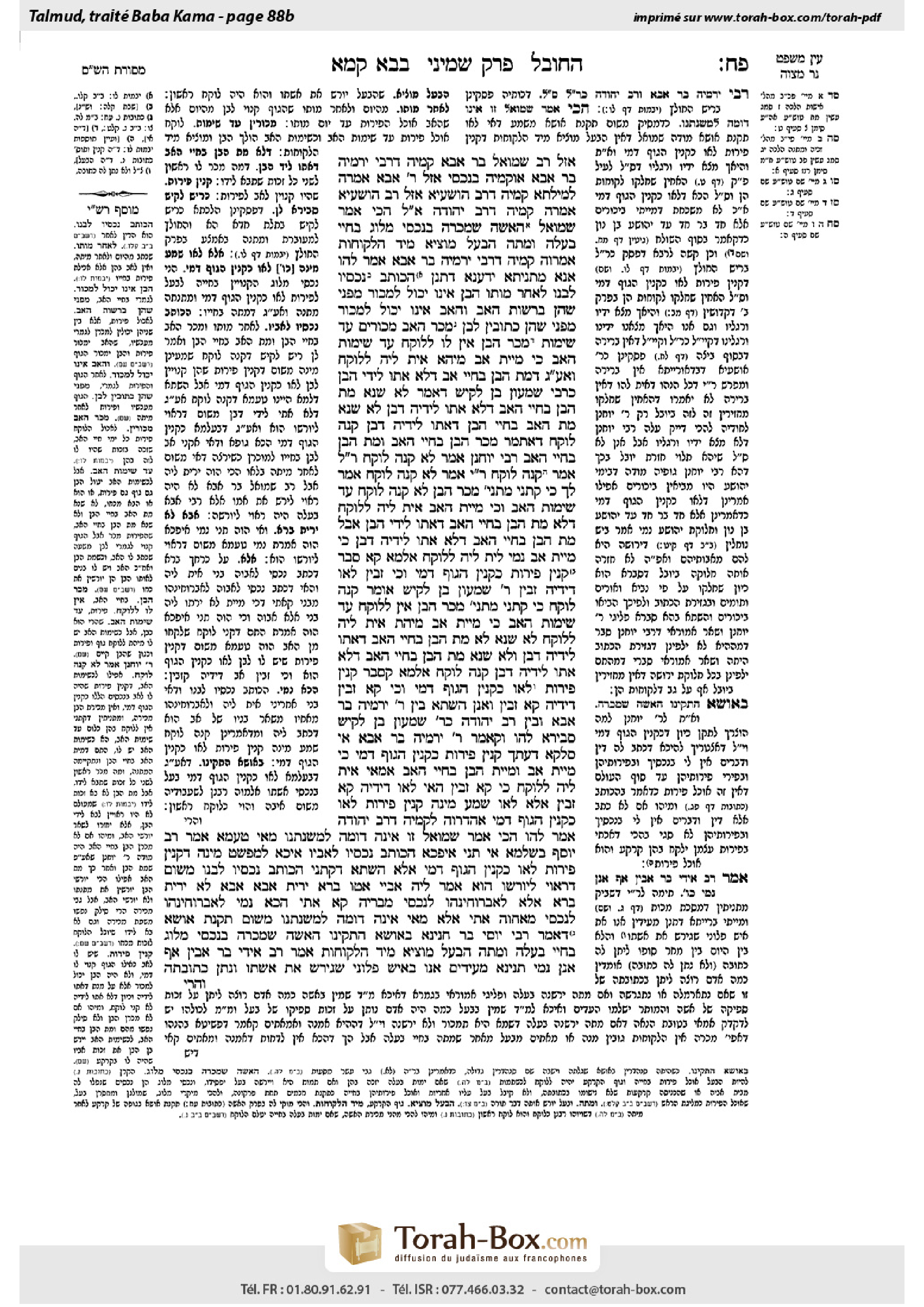
Bava Kamma 88b: Talmud study for Daf Yomi
Study the Talmud for Daf Yomi with scanned pages, Hebrew text, English translations from Sefaria and AI-generated French translations.
Passage selection and English or AI-generated French translation are available where the scan has annotations. Daf Study is independent of Torah-Box and Sefaria.
Browse Bava Kamma · בבא קמא · All tractatesBava Kamma 88b text and translations
This page of Bava Kamma includes the Aramaic text, an English translation and an AI-generated French translation, alongside the scan above.
בבא קמא פ״ח ב · Aramaic and Hebrew text
אֲזַל רַב שְׁמוּאֵל בַּר אַבָּא קַמֵּיהּ דְּרַבִּי יִרְמְיָה בַּר אַבָּא, אוֹקְמֵיהּ בְּנִכְסֵי. אֲזַל רַבִּי אַבָּא אַמְרַהּ לְמִילְּתָא קַמֵּיהּ דְּרַב הוֹשַׁעְיָא, אֲזַל רַב הוֹשַׁעְיָא אַמְרַהּ קַמֵּיהּ דְּרַב יְהוּדָה. אֲמַר לֵיהּ, הָכִי אָמַר שְׁמוּאֵל: הָאִשָּׁה שֶׁמָּכְרָה בְּנִכְסֵי מְלוֹג בְּחַיֵּי בַּעְלָהּ, וָמֵתָה – הַבַּעַל מוֹצִיא מִיַּד הַלָּקוֹחוֹת.
אַמְרוּהָ קַמֵּיהּ דְּרַבִּי יִרְמְיָה בַּר אַבָּא, אֲמַר לְהוּ: אֲנָא מַתְנִיתָא יָדַעְנָא, דִּתְנַן: הַכּוֹתֵב נְכָסָיו לִבְנוֹ לְאַחַר מוֹתוֹ – הַבֵּן אֵינוֹ יָכוֹל לִמְכּוֹר, מִפְּנֵי שֶׁהֵן בִּרְשׁוּת הָאָב; וְהָאָב אֵינוֹ יָכוֹל לִמְכּוֹר, מִפְּנֵי שֶׁהֵן כְּתוּבִין לַבֵּן. מָכַר הָאָב – מְכוּרִים עַד שֶׁיָּמוּת. מָכַר הַבֵּן – אֵין לוֹ לַלּוֹקֵחַ עַד שֶׁיָּמוּת הָאָב.
כִּי מָיֵית אָב מִיהָא אִית לֵיהּ לְלוֹקֵחַ, וְאַף עַל גַּב דְּמֵת הַבֵּן בְּחַיֵּי אָב – דְּלָא אֲתוֹ לִידֵי הַבֵּן.
כְּרַבִּי שִׁמְעוֹן בֶּן לָקִישׁ, דְּאָמַר: לָא שְׁנָא מֵת הַבֵּן בְּחַיֵּי הָאָב – דְּלָא אֲתוֹ לִידֵיהּ דְּבֵן, לָא שְׁנָא מֵת הָאָב בְּחַיֵּי הַבֵּן – דַּאֲתוֹ לִידֵיהּ דְּבֵן; קָנָה לוֹקֵחַ.
דְּאִתְּמַר: מָכַר הַבֵּן בְּחַיֵּי הָאָב, וּמֵת הַבֵּן בְּחַיֵּי הָאָב – רַבִּי יוֹחָנָן אָמַר: לֹא קָנָה לוֹקֵחַ, רֵישׁ לָקִישׁ אָמַר: קָנָה לוֹקֵחַ.
רַבִּי יוֹחָנָן אָמַר לֹא קָנָה לוֹקֵחַ – אָמַר לָךְ: כִּי קָתָנֵי מַתְנִיתִין ״מָכַר הַבֵּן – לֹא קָנָה לוֹקֵחַ עַד שֶׁיָּמוּת הָאָב״, וְכִי מָיֵית הָאָב אִית לֵיהּ לְלוֹקֵחַ – דְּלֹא מֵת הַבֵּן בְּחַיֵּי הָאָב, דַּאֲתוֹ לִידֵי הַבֵּן. אֲבָל מֵת הַבֵּן בְּחַיֵּי הָאָב, דְּלָא אֲתוֹ לִידֵיהּ דְּבֵן – כִּי מָיֵית אָב נָמֵי לֵית לֵיהּ לְלוֹקֵחַ.
אַלְמָא קָא סָבַר: קִנְיַן פֵּירוֹת – כְּקִנְיַן הַגּוּף דָּמֵי, וְכִי זַבֵּין – לָאו דִּידֵיהּ זַבֵּין.
רַבִּי שִׁמְעוֹן בֶּן לָקִישׁ אוֹמֵר קָנָה לוֹקֵחַ – כִּי קָתָנֵי מַתְנִיתִין: ״מָכַר הַבֵּן אֵין לַלּוֹקֵחַ עַד שֶׁיָּמוּת הָאָב״ – כִּי מָיֵית אָב מִיהַת אִית לֵיהּ לְלוֹקֵחַ; לָא שְׁנָא לָא מֵת הַבֵּן בְּחַיֵּי הָאָב – דַּאֲתוֹ לִידֵיהּ דְּבֵן, וְלָא שְׁנָא מֵת הַבֵּן בְּחַיֵּי הָאָב – דְּלָא אֲתוֹ לִידֵיהּ דְּבֵן; קָנָה לוֹקֵחַ.
אַלְמָא קָסָבַר: קִנְיַן פֵּירוֹת לָאו כְּקִנְיַן הַגּוּף דָּמֵי, וְכִי (קָא) זַבֵּין – דִּידֵיהּ (קָא) זַבֵּין.
וַאֲנַן הַשְׁתָּא, בֵּין רַבִּי יִרְמְיָה בַּר אַבָּא וּבֵין רַב יְהוּדָה – כְּרַבִּי שִׁמְעוֹן בֶּן לָקִישׁ סְבִירָא לְהוּ. וְקָאָמַר רַבִּי יִרְמְיָה בַּר אַבָּא: אִי סָלְקָא דַעְתָּךְ קִנְיַן פֵּירוֹת כְּקִנְיַן הַגּוּף דָּמֵי, כִּי מָיֵית אָב וּמָיֵית הַבֵּן בְּחַיֵּי הָאָב, אַמַּאי אִית לֵיהּ לְלוֹקֵחַ? כִּי (קָא) זַבֵּין הַאי – לָאו דִּידֵיהּ (קָא) זַבֵּין!
אֶלָּא לָאו שְׁמַע מִינַּהּ קִנְיַן פֵּירוֹת לָאו כְּקִנְיַן הַגּוּף דָּמֵי?
אַהְדְּרוּהָ לְקַמֵּיהּ דְּרַב יְהוּדָה, אֲמַר לְהוּ, הָכִי אָמַר שְׁמוּאֵל: זוֹ אֵינָהּ דּוֹמָה לְמִשְׁנָתֵנוּ.
מַאי טַעְמָא? אָמַר רַב יוֹסֵף, בִּשְׁלָמָא אִי תָּנֵי אִיפְּכָא: ״הַכּוֹתֵב נְכָסָיו לְאָבִיו״ – אִיכָּא לְמִפְשַׁט מִינַּהּ דְּקִנְיַן פֵּירוֹת לָאו כְּקִנְיַן הַגּוּף דָּמֵי.
אֶלָּא הַשְׁתָּא דְּקָתָנֵי: ״הַכּוֹתֵב נְכָסָיו לִבְנוֹ״, מִשּׁוּם דְּרָאוּי לְיוֹרְשׁוֹ הוּא.
אֲמַר לֵיהּ אַבָּיֵי: אַטּוּ בְּרָא יָרֵית אַבָּא, אַבָּא לָא יָרֵית בְּרָא?! אֶלָּא לְאַבְרוֹחִינְהוּ לְנִכְסֵי מִבְּרֵיהּ קָא אָתֵי; הָכָא נָמֵי, לְאַבְרוֹחִינְהוּ לְנִכְסֵי מֵאֲחוּהּ אָתֵי.
אֶלָּא מַאי ״אֵינָהּ דּוֹמָה לְמִשְׁנָתֵנוּ״? מִשּׁוּם תַּקָּנַת אוּשָׁא. דְּאָמַר רַבִּי יוֹסֵי בַּר חֲנִינָא: בְּאוּשָׁא הִתְקִינוּ, הָאִשָּׁה שֶׁמָּכְרָה בְּנִכְסֵי מְלוֹג בְּחַיֵּי בַּעְלָהּ, וּמֵתָה – הַבַּעַל מוֹצִיא מִיַּד הַלָּקוֹחוֹת.
אָמַר רַב אִידִי בַּר אָבִין, אַף אֲנַן נָמֵי תְּנֵינָא: ״מְעִידִים אָנוּ בְּאִישׁ פְּלוֹנִי שֶׁגֵּירַשׁ אֶת אִשְׁתּוֹ, וְנָתַן כְּתוּבָּתָהּ״,
Bava Kamma 88b · English translation
Rav Shmuel bar Abba went before Rabbi Yirmeya bar Abba to claim his mother’s property. Rabbi Yirmeya established him as the owner of the property, in accordance with what was written in the document. Rabbi Abba, the mother’s husband, went and said a report of the matter before Rav Hoshaya. Rav Hoshaya went and said a report of the matter before Rav Yehuda. Rav Yehuda said to Rav Hoshaya: This is what Shmuel says: In a case of a woman who sold her usufruct property, which belongs to her but whose profits her husband garners, in her husband’s lifetime, and then she died, the husband repossesses the property from the purchasers. The granting of her property by means of the document is analogous to a sale, and Rabbi Abba can repossess the property from Rav Shmuel bar Abba.
The Sages said that halakha before Rabbi Yirmeya bar Abba, who had ruled that the property belongs to Rav Shmuel bar Abba. He said to them: I know the mishna that supports my opinion, as we learned in a mishna (Bava Batra 136a): In the case of one who writes a document transferring ownership of his property to his son, stating that the transfer should take effect immediately but the son will have use of it only after the father’s death, the son cannot sell the property due to the fact that it is still in the father’s possession. And the father, even though he retained the right to use the property, cannot sell the property due to the fact that it is written as belonging to the son. If the father sold the property, then it is sold to the extent that the purchaser may use it until the father dies. If the son sold the property during his father’s lifetime, the purchaser does not have the right to use the property until the father dies.
Rabbi Yirmeya bar Abba infers: In any event, if the son sold the property during his father’s lifetime, when the father dies the purchaser has rights to the property. And this would be so even though it is a case where the son died in the father’s lifetime, where the property never came into the son’s possession.
Rabbi Yirmeya bar Abba’s analysis is in accordance with the opinion of Rabbi Shimon ben Lakish, who says: There is no difference if the son died in the father’s lifetime, where the property never came into the son’s possession, and there is no difference if the father died in the son’s lifetime, where the property came into the son’s possession. In any event, the purchaser acquired the property.
The Gemara records a dispute between the amora’im with regard to this point. As was stated: In a case where the son sold the property in the father’s lifetime, and the son died in the father’s lifetime, Rabbi Yoḥanan says: The purchaser did not acquire the property. Reish Lakish says: The purchaser acquired the property.
The Gemara explains the opinion of Rabbi Yoḥanan. Rabbi Yoḥanan says: The purchaser did not acquire the property, because he could have said to you: When the mishna teaches that if the son sold the property during his father’s lifetime the purchaser does not acquire any rights to use the property until the father dies, and one could infer that when the father dies the purchaser has rights to the property, the mishna is discussing a case where the son did not die during the father’s lifetime, so that the property came into the son’s possession upon the father’s death, before the purchaser acquired it. But if the son died in the father’s lifetime, so that the property did not come into the son’s possession, then even when the father dies the purchaser does not have rights to the property.
The Gemara comments: Apparently, Rabbi Yoḥanan holds that ownership of the rights to use an item and to its produce is considered to be like ownership of the item itself. Even though the property itself did not belong to the father, it is as though the father owned the property, because all of the produce belonged to him in practice. Therefore, when the son sold the property, he sold property that did not belong to him.
The Gemara explains the opinion of Rabbi Shimon ben Lakish: Rabbi Shimon ben Lakish says that the purchaser acquired the property based on this claim: When the mishna teaches that if the son sold the property during his father’s lifetime the purchaser does not have any right to use the property until the father dies, and one could infer that in any event, when the father dies the purchaser has rights to the property, the mishna means that there is no difference if the son did not die in the father’s lifetime, where the property came into the son’s possession, and there is no difference if the son died in the father’s lifetime, where the property did not come into the son’s possession. In either case, the purchaser acquired the property.
The Gemara comments: Apparently, Rabbi Shimon ben Lakish holds that ownership of the rights to use an item and to its produce is not considered to be like ownership of the item itself. And therefore when the son sold the property, he sold property that belonged to him.
The Gemara returns to the discussion of the opinion of Rabbi Yirmeya bar Abba. And now for us, whether if one discusses the opinion of Rabbi Yirmeya bar Abba and whether one discusses the opinion of Rav Yehuda, they both hold in accordance with the opinion of Rabbi Shimon ben Lakish, that ownership of the rights to use an item and to its produce is not considered to be like ownership of the item itself. And Rabbi Yirmeya bar Abba says: If it enters your mind that ownership of the rights to use an item and to its produce is considered to be like ownership of the item itself, then when the father dies and the son had died in the father’s lifetime, why does the purchaser have rights to the property? When the son sold it, didn’t he sell property that did not belong to him?
Rather, isn’t it correct to conclude from the mishna that ownership of the rights to use an item and to its produce is not considered to be like ownership of the item itself? Therefore, Rav Shmuel bar Abba should receive the property transferred to him by his mother, as the fact that the husband owned the rights to its produce does not limit her ability to transfer her property to her son.
The Sages brought back Rabbi Yirmeya bar Abba’s reply before Rav Yehuda. Rav Yehuda said to them: This is what Shmuel said: This halakha, that a husband can repossess the property that his wife sold before she died, is not similar to the halakha of our mishna concerning a father who transfers his property to his son while retaining the right to garner the profits.
The Gemara asks: What is the reasoning for distinguishing between the two cases? Rav Yosef said: Granted, if the mishna had taught the opposite and stated that in the case of one who writes a document transferring ownership of his property to his father after his death, with the son retaining the right to garner the profits until then, and the father sold the property during his son’s lifetime, the purchaser has rights to the property after the son dies, then it is possible to resolve from the mishna that ownership of the rights to use an item and to its produce is not considered to be like ownership of the item itself.
Rav Yosef continues: But now that the mishna teaches specifically: One who writes a document transferring ownership of his property to his son, the ability of the son to sell the property is due to the fact that the son is fit to inherit from him and already has a right to the property, and not just due to the existence of the document. In the case of Rav Shmuel bar Abba as well, the woman’s property is inherited by her husband, not her son, so she cannot transfer it to Rav Shmuel bar Abba.
Abaye said to Rav Yosef: Is this to say that a son inherits from a father, but a father does not inherit from a son? There is no difference between their rights to inherit from one another. Rather, even if the mishna taught a halakha concerning a son transferring his property to his father, the son’s reason for doing so could have been that he comes to hide his property from his own son and wants his father to inherit from him instead. Here too, when a father transfers his property to his son, he comes to hide his property from the son’s brothers, as the father has other sons but does not want them to inherit from him. Therefore, the mishna’s choice of case cannot serve as a basis for inference.
Abaye continues: Rather, what was Shmuel’s reason for saying that the right of a husband to the property that his wife sold before she died is not similar to our mishna that states that a father does not have rights to property sold by his son? The difference is due to the rabbinic ordinance of Usha, an ordinance instituted with regard to a husband’s rights to his wife’s property. As Rabbi Yosei bar Ḥanina says: In the town of Usha the Sages instituted that in the case of a woman who sold her usufruct property in her husband’s lifetime and then died, the husband repossesses it from the purchasers. This ordinance was instituted only for the benefit of a husband, but not for the benefit of a father or son.
Rav Idi bar Avin said: We too learn of the ordinance of Usha in the baraita: If witnesses said: We testify about so-and-so that he divorced his wife and gave her the full value of the obligations recorded in her marriage contract,
Bava Kamma 88b · Traduction française (IA)
Rav Shmuel bar Abba est allé devant Rabbi Yirmeya bar Abba pour revendiquer la propriété de sa mère. Rabbi Yirmeya l'a établi comme propriétaire de la propriété, conformément à ce qui était écrit dans le document. Rabbi Abba, le mari de la mère, est allé rapporter l'affaire devant Rav Hoshaya. Rav Hoshaya est allé rapporter l'affaire devant Rav Yehuda. Rav Yehuda a dit à Rav Hoshaya : C'est ce que Shmuel dit : Dans le cas d'une femme qui a vendu sa propriété de usufruit, qui lui appartient mais dont les profits sont réclamés par son mari pendant la vie de ce dernier, et ensuite elle est décédée, le mari récupère la propriété auprès des acheteurs. Le transfert de sa propriété par le document est analogue à une vente, et Rabbi Abba peut récupérer la propriété auprès de Rav Shmuel bar Abba.
Les Sages ont dit que la halakha est avant Rabbi Yirmeya bar Abba, qui avait décidé que la propriété appartient à Rav Shmuel bar Abba. Il a dit à eux : Je connais la mishna qui soutient mon opinion, comme nous l'avons appris dans une mishna (Bava Batra 136a) : Dans le cas d'une personne qui écrit un document transférant la propriété de sa propriété à son fils, en indiquant que le transfert doit prendre effet immédiatement mais que le fils n'aura le droit d'en jouir qu'après la mort du père, le fils ne peut pas vendre la propriété en raison du fait qu'elle est encore en possession du père. Et le père, même s'il conservait le droit d'en jouir, ne peut pas vendre la propriété en raison du fait qu'elle est écrite comme appartenant au fils. Si le père vend la propriété, alors elle est vendue à l'égard que l'acheteur peut en jouir jusqu'à la mort du père. Si le fils vend la propriété pendant la vie de son père, l'acheteur n'a pas le droit d'en jouir jusqu'à la mort du père.
Rabbi Yirmeya bar Abba déduit : En tout cas, si le fils a vendu la propriété pendant la vie de son père, lorsque le père meurt, l'acheteur a des droits sur la propriété. Et cela serait ainsi même dans le cas où le fils est mort pendant la vie du père, et la propriété n'a jamais été en possession du fils.
L'analyse de Rabbi Yirmeya bar Abba s'inscrit dans l'opinion de Rabbi Shimon ben Lakish, qui dit : Il n'y a pas de différence si le fils est mort pendant la vie du père, et la propriété n'a jamais été en possession du fils, et il n'y a pas de différence si le père est mort pendant la vie du fils, et la propriété est entrée en possession du fils. En tout cas, l'acheteur a acquis la propriété.
La Guemara enregistre un débat entre les amoraïm concernant ce point. Comme il a été dit : Dans le cas où le fils a vendu la propriété pendant la vie du père, et que le fils est mort pendant la vie du père, Rabbi Yoḥanan dit : L'acheteur n'a pas acquis la propriété. Reish Lakish dit : L'acheteur a acquis la propriété.
La Guemara explique l'opinion de Rabbi Yoḥanan. Rabbi Yoḥanan dit : L'acheteur n'a pas acquis la propriété, car il pourrait dire à l'acheteur : Lorsque la Michna enseigne que si le fils a vendu la propriété pendant la vie de son père, l'acheteur n'a pas le droit d'en jouir jusqu'à la mort du père, et qu'on pourrait en déduire que lorsque le père meurt, l'acheteur a des droits sur la propriété, la Michna parle d'un cas où le fils n'est pas mort pendant la vie du père, de sorte que la propriété est entrée en possession du fils après la mort du père, avant que l'acheteur ne l'acquière. Mais si le fils est mort pendant la vie du père, de sorte que la propriété n'a pas été en possession du fils, alors même après la mort du père, l'acheteur n'a pas le droit d'en jouir.
La Guemara commente : Apparemment, Rabbi Yoḥanan considère que la propriété des droits d'utilisation d'un objet et de ses produits est considérée comme la propriété de l'objet lui-même. Même si l'objet lui-même n'appartenait pas au père, il est comme si le père en était propriétaire, car tous les produits appartenaient en pratique à lui. Ainsi, lorsque le fils a vendu la propriété, il a vendu une propriété qui n'appartenait pas à lui.
La Guemara explique l'opinion de Rabbi Shimon ben Lakish : Rabbi Shimon ben Lakish dit que l'acheteur a acquis la propriété en vertu de cette affirmation : Lorsque la Michna enseigne que si le fils a vendu la propriété pendant la vie de son père, l'acheteur n'a pas le droit d'en jouir jusqu'à la mort du père, et qu'on pourrait en déduire que dans tous les cas, lorsque le père meurt, l'acheteur a des droits sur la propriété, la Michna signifie qu'il n'y a pas de différence si le fils n'est pas mort pendant la vie du père, où la propriété est entrée en possession du fils, et il n'y a pas de différence si le fils est mort pendant la vie du père, où la propriété n'a pas été en possession du fils. Dans les deux cas, l'acheteur a acquis la propriété.
La Guemara commente : Apparemment, Rabbi Shimon ben Lakish considère que la propriété des droits d'utilisation d'un objet et de ses produits n'est pas considérée comme la propriété de l'objet lui-même. Et par conséquent, lorsque le fils a vendu la propriété, il a vendu une propriété qui appartenait à lui.
La Guemara retourne à la discussion de l'opinion de Rabbi Yirmeya bar Abba. Et maintenant, pour nous, que l'on discute de l'opinion de Rabbi Yirmeya bar Abba et que l'on discute de l'opinion de Rav Yehuda, ils tiennent tous les deux dans l'opinion de Rabbi Shimon ben Lakish, que la propriété des droits d'utilisation d'un objet et de ses produits n'est pas considérée comme la propriété de l'objet lui-même. Et Rabbi Yirmeya bar Abba dit : Si cela entre dans votre esprit que la propriété des droits d'utilisation d'un objet et de ses produits est considérée comme la propriété de l'objet lui-même, alors lorsque le père meurt et que le fils est mort pendant la vie du père, pourquoi l'acheteur a-t-il des droits sur la propriété ? Lorsque le fils l'a vendu, n'a-t-il pas vendu une propriété qui n'appartenait pas à lui ?
Plutôt, n'est-ce pas conclure correctement de la mitsna que la possession des droits d'utilisation d'un objet et de ses produits n'est pas considérée comme la possession de l'objet lui-même ? Ainsi, Rav Shmuel bar Abba devrait recevoir la propriété transférée par sa mère, car le fait que le mari possède les droits sur ses produits ne limite pas sa capacité à transférer sa propriété à son fils.
Les Sages ont rapporté la réponse de Rabbi Yirmeya bar Abba à Rav Yehuda. Rav Yehuda leur a dit : C'est ce que Shmuel a dit : Cette halakha, selon laquelle un mari peut récupérer la propriété que sa femme a vendue avant sa mort, n'est pas comparable à la halakha de notre mitsna concernant un père qui transfère sa propriété à son fils tout en conservant le droit de récolter les profits.
Le Guemara pose la question : Quel est le raisonnement qui distingue ces deux cas ? Rav Yosef a dit : Bien sûr, si la mitsna avait enseigné l'opposé et affirmé que dans le cas d'une personne qui écrit un document transférant la propriété à son père après sa mort, avec le fils conservant le droit de récolter les profits jusqu'à ce moment, et que le père vend la propriété pendant la vie du fils, l'acheteur a des droits sur la propriété après la mort du fils, alors il serait possible de résoudre de la mitsna que la possession des droits d'utilisation d'un objet et de ses produits n'est pas considérée comme la possession de l'objet lui-même.
Rav Yosef continue : Mais maintenant que la mitsva enseigne spécifiquement : Une personne qui écrit un document transférant la propriété à son fils, la capacité du fils à vendre la propriété est due au fait que le fils est digne d'héritage et possède déjà un droit sur la propriété, et non pas seulement à l'existence du document. Dans le cas de Rav Shmuel bar Abba également, la propriété de la femme est héritée par son mari, pas par son fils, donc elle ne peut pas la transférer à Rav Shmuel bar Abba.
Abaye a dit à Rav Yosef : Est-ce que cela signifie que le fils hérite du père, mais que le père ne hérite pas du fils ? Il n'y a pas de différence entre leurs droits d'héritage les uns envers les autres. Plutôt, même si la mitsva avait enseigné une halakha concernant un fils transférant sa propriété à son père, la raison du fils pour le faire pourrait avoir été de cacher sa propriété à son propre fils et de vouloir que son père hérite de lui au lieu de cela. Ici aussi, lorsque le père transfère sa propriété à son fils, il le fait pour cacher sa propriété aux frères du fils, car le père a d'autres fils et ne veut pas qu'ils héritent de lui. Ainsi, le choix de cas par la mitsva ne peut pas servir de base pour l'inférence.
Abaye continue : Plutôt, quelle était la raison de Shmuel pour dire que le droit du mari sur la propriété que sa femme a vendue avant sa mort n'est pas comparable à notre mitsva qui affirme que le père n'a pas de droits sur la propriété vendue par son fils ? La différence provient de l'ordonnance rabbinique d'Usha, une ordonnance instituée concernant les droits du mari sur la propriété de sa femme. Comme Rabbi Yosei bar Ḥanina dit : Dans la ville d'Usha, les Sages ont institué que dans le cas d'une femme qui a vendu sa propriété de jouissance pendant la vie de son mari et est ensuite morte, le mari récupère la propriété auprès des acheteurs. Cette ordonnance a été instituée uniquement au bénéfice du mari, pas au bénéfice du père ou du fils.
Rav Idi bar Avin a dit : Nous apprenons également de l'ordonnance d'Usha dans la baraïta : Si des témoins disent : Nous témoignons sur tel et tel qui a divorcé de sa femme et lui a donné la valeur totale des obligations inscrites dans son contrat de mariage,
Traduction française générée par IA à partir de l’édition anglaise de Sefaria. Vérifie toujours un passage avec le texte source.
Text from Sefaria: William Davidson Edition - Vocalized Aramaic (CC BY NC); William Davidson Edition - English (CC BY NC).