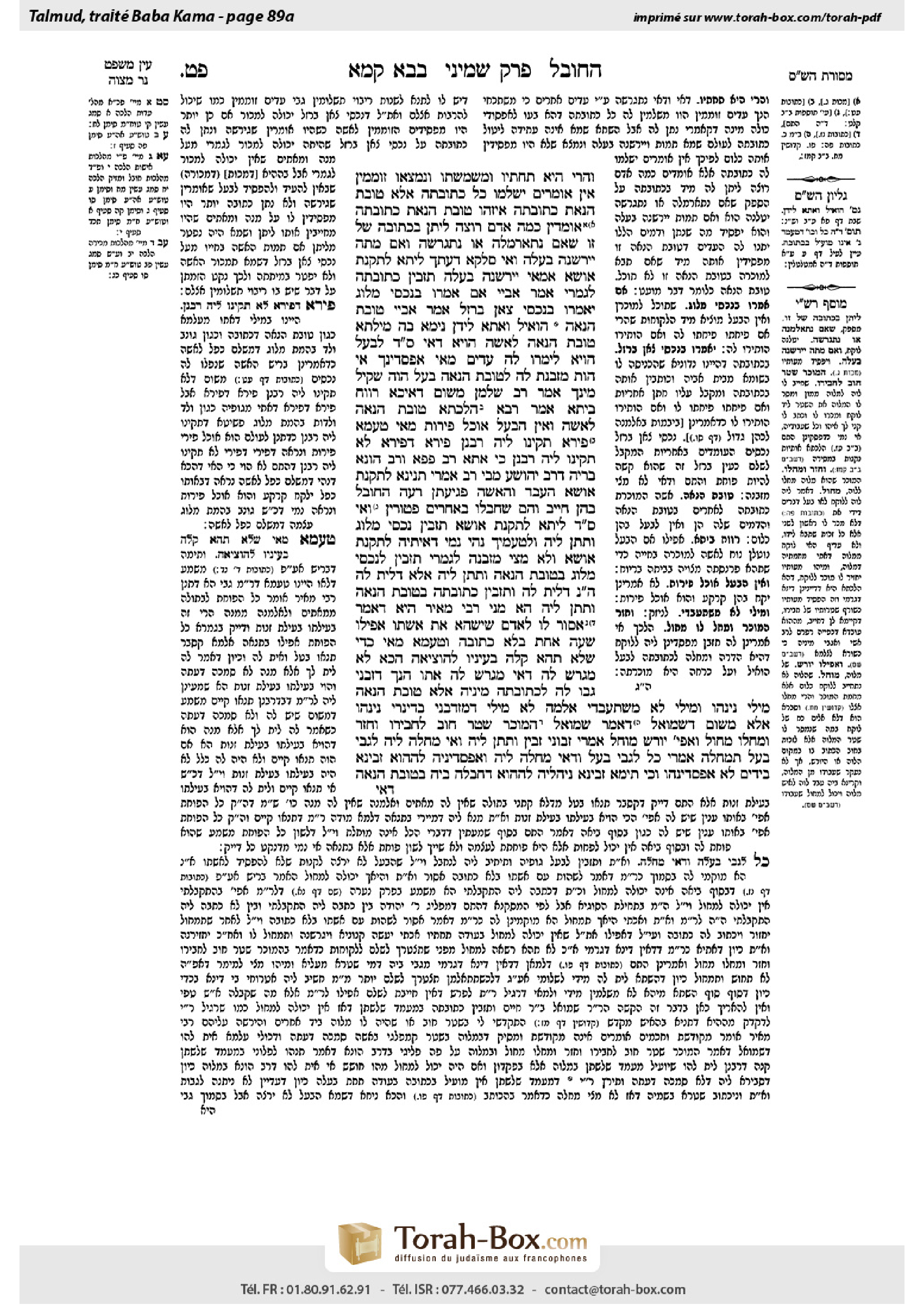
Bava Kamma 89a: Talmud study for Daf Yomi
Study the Talmud for Daf Yomi with scanned pages, Hebrew text, English translations from Sefaria and AI-generated French translations.
Passage selection and English or AI-generated French translation are available where the scan has annotations. Daf Study is independent of Torah-Box and Sefaria.
Browse Bava Kamma · בבא קמא · All tractatesBava Kamma 89a text and translations
This page of Bava Kamma includes the Aramaic text, an English translation and an AI-generated French translation, alongside the scan above.
בבא קמא פ״ט א · Aramaic and Hebrew text
וַהֲרֵי הִיא תַּחְתָּיו וּמְשַׁמַּשְׁתּוֹ; וְנִמְצְאוּ זוֹמְמִין; אֵין אוֹמְרִים יְשַׁלְּמוּ כׇּל כְּתוּבָּתָהּ, אֶלָּא טוֹבַת הֲנָאַת כְּתוּבָּתָהּ. אֵיזֶהוּ טוֹבַת הֲנָאַת כְּתוּבָּתָהּ? אוֹמְדִין כַּמָּה אָדָם רוֹצֶה לִיתֵּן בִּכְתוּבָּה שֶׁל זוֹ – שֶׁאִם נִתְאַרְמְלָה אוֹ נִתְגָּרְשָׁה, וְאִם מֵתָה – יִירָשֶׁנָּה בַּעֲלָהּ.
וְאִי סָלְקָא דַעְתָּךְ לֵיתַהּ לְתַקָּנַת אוּשָׁא, אַמַּאי יִירָשֶׁנָּה בַּעֲלָהּ? תְּזַבֵּין כְּתוּבְּתַהּ לִגְמָרֵי!
אָמַר אַבָּיֵי: אִם אָמְרוּ בְּנִכְסֵי מְלוֹג, יֹאמְרוּ בְּנִכְסֵי צֹאן בַּרְזֶל?!
אָמַר אַבָּיֵי: טוֹבַת הֲנָאָה, הוֹאִיל וַאֲתָא לְיָדַן, נֵימָא בַּהּ מִילְּתָא: טוֹבַת הֲנָאָה – לְאִשָּׁה הָוְיָא. דְּאִי סָלְקָא דַעְתָּךְ לְבַעַל הָוְיָא, לֵימְרוּ לַהּ עֵדִים: מַאי אַפְסֵדְינִּךְ? אִי הֲוָה מְזַבְּנַתְּ לַהּ לְטוֹבַת הֲנָאָה, בַּעַל הֲוָה שָׁקֵיל מִינִּךְ! אָמַר רַב שַׁלְמַן: מִשּׁוּם דְּאִיכָּא רְוַוח בֵּיתָא.
אָמַר רָבָא, הִלְכְתָא: טוֹבַת הֲנָאָה לָאִשָּׁה, וְאֵין הַבַּעַל אוֹכֵל פֵּירוֹת. מַאי טַעְמָא? פֵּירָא תַּקִּינוּ לֵיהּ רַבָּנַן, פֵּירָא דְפֵירָא לָא תַּקִּינוּ לֵיהּ רַבָּנַן.
כִּי אֲתָא רַב פָּפָּא וְרַב הוּנָא בְּרֵיהּ דְּרַב יְהוֹשֻׁעַ מִבֵּי רַב, אָמְרִי, תְּנֵינָא לְתַקָּנַת אוּשָׁא: הָעֶבֶד וְהָאִשָּׁה פְּגִיעָתָן רָעָה; הַחוֹבֵל בָּהֶן חַיָּיב, וְהֵם שֶׁחָבְלוּ בַּאֲחֵרִים – פְּטוּרִין. וְאִי סָלְקָא דַעְתָּךְ לֵיתַהּ לְתַקָּנַת אוּשָׁא, תְּזַבֵּין נִכְסֵי מְלוֹג וְתִתֵּן לֵיהּ!
וּלְטַעְמָיךְ, נְהִי נָמֵי דְּאִיתַיהּ לְתַקָּנַת אוּשָׁא – וְלָא מָצֵי מְזַבְּנָה לִגְמָרֵי; תְּזַבֵּין לְנִכְסֵי מְלוֹג בְּטוֹבַת הֲנָאָה, וְתִתֵּן לֵיהּ! אֶלָּא דְּלֵית לַהּ; הָכִי נָמֵי דְּלֵית לַהּ.
וּתְזַבֵּין כְּתוּבְּתַהּ בְּטוֹבַת הֲנָאָה, וְתִתֵּן לֵיהּ! הָא מַנִּי – רַבִּי מֵאִיר הִיא, דְּאָמַר: אָסוּר לוֹ לְאָדָם שֶׁיְּשַׁהֶא אֶת אִשְׁתּוֹ אֲפִילּוּ שָׁעָה אַחַת בְּלֹא כְּתוּבָּה.
וְטַעְמָא מַאי – כְּדֵי שֶׁלֹּא תְּהֵא קַלָּה בְּעֵינָיו לְהוֹצִיאָהּ; הָכָא לָא מְגָרֵשׁ לַהּ – דְּאִי מְגָרֵשׁ לַהּ, אָתוּ הָנָךְ דְּזָבְנִי, גָּבוּ לַהּ לִכְתוּבְּתַהּ מִינֵּיהּ!
אֶלָּא טוֹבַת הֲנָאָה מִילֵּי נִינְהוּ, וּמִילֵּי לָא מִשְׁתַּעְבְּדִי.
אַלְּמָה לָא? מִילֵּי דְּמִזְדַּבְּנִי בְּדִינָרֵי נִינְהוּ! אֶלָּא מִשּׁוּם דִּשְׁמוּאֵל, דְּאָמַר שְׁמוּאֵל: הַמּוֹכֵר שְׁטַר חוֹב לַחֲבֵירוֹ, וְחָזַר וּמְחָלוֹ – מָחוּל. וַאֲפִילּוּ יוֹרֵשׁ מוֹחֵל.
אָמְרִי: זַבּוֹנֵי [תְּ]זַבֵּין וְתִתֵּן לֵיהּ, וְאִי מָחֲלָה לֵיהּ לְגַבֵּי בַעַל – תִּמְחֲלַהּ.
אָמְרִי: כֹּל לְגַבֵּי בַעַל, וַדַּאי מָחֲלָה לֵיהּ. (וְאַפְסְדִינֵּיהּ לְהָהוּא זְבִינָא בְּיָדַיִם לָא אַפְסְדִינְהוּ.)
וְכִי תֵּימָא: (זְבִינָא) [תְּזַבְּנַיהּ] נִיהֲלֵיהּ לְהָהוּא דַּחֲבַלָה בֵּיהּ בְּטוֹבַת הֲנָאָה,
Bava Kamma 89a · English translation
and she is under him and serves him, i.e., she was in fact still married to him, and then these witnesses were found to be conspiring witnesses who were attempting to deny this woman the ability to ever collect payment of her marriage contract, then the court does not say that the witnesses shall pay the entire value of her marriage contract. Rather, the court says that they shall pay the financial advantage of her marriage contract. The Gemara explains: What is the financial advantage of her marriage contract? The court evaluates how much a person would want to give to purchase the rights of this woman’s marriage contract, taking into account the halakha that if she becomes widowed or divorced the purchaser will receive its full value, but if she dies during her husband’s lifetime, her husband will inherit her property and the purchaser will receive nothing.
Rav Idi bar Avin continues: And if it enters your mind that there is no ordinance of Usha, why would her husband inherit from her? Let the woman sell her marriage contract entirely.
Abaye said: This is not a proof for the existence of the ordinance of Usha, because even if there is no ordinance, and the Sages said that the woman retains the right to sell with regard to the usufruct property, would they also say that the woman retains the right to sell with regard to guaranteed property, which is listed among the possessions she brought into the marriage but is entirely under her husband’s authority? In any event, there is property that she does not have the right to sell and that the husband would inherit if she dies, regardless of whether or not there is an ordinance of Usha, so the marriage contract could not be sold for its full value.
§ Abaye said: With regard to financial advantage, since discussion of this matter came to us, let us say something about it. The money received for selling the financial advantage is given only to the wife. For if it enters your mind to say that it is given to the husband, then let the conspiring witnesses, who have been rendered liable to pay a penalty to the wife, say to her: What loss have we caused you by testifying that you had received payment of your marriage contract? Even if you were to sell it for the financial advantage, your husband would have taken it from you. Rav Shalman said in response: She still would incur a loss, because there is a gain to the household. Even if the husband were to be the one to receive the payment from the sale, the financial situation of the household would be improved, leading to a concrete benefit for the wife as well. This offsets the wife’s potential loss.
Rava said: The halakha is that the money received for selling the financial advantage of the marriage contract is given only to the wife, and the husband does not even garner the profits from that money or from property the wife would purchase with that money. What is the reason? The Sages instituted that the profits of her property are for the husband, but the Sages did not institute that the profits of the profits are for him.
§ When Rav Pappa and Rav Huna, son of Rav Yehoshua, came from the study hall of Rav they said: We learned a source for the ordinance of Usha in the mishna (87a): With regard to a slave or a married woman, an encounter with them is disadvantageous, since one who injures them is liable. But if they were the ones who injured others they are exempt, because they do not have money with which to pay. And if it enters your mind to say that there is no ordinance of Usha, there would be a method by which a married woman can obtain money with which to pay, as the court can have her sell her usufruct property and give the money received to the one she injured. It can therefore be inferred from the mishna that a woman cannot sell her usufruct property, in accordance with the ordinance of Usha.
The Gemara responds: And according to your reasoning, though indeed there is an ordinance of Usha, and she cannot fully sell her usufruct property, she should nevertheless be able to sell her usufruct property for the financial advantage, i.e., the purchaser will pay her for the future rights to the property in the event that she gets divorced or is widowed, and she will give that money to the one she injured. Rather, it must be that the mishna is discussing a case where she does not have usufruct property of which she can sell the future rights. So too, there is no source from the mishna for the ordinance of Usha, as the mishna is discussing a case where she does not have usufruct property to sell.
The Gemara questions the ruling of the mishna: Why does the mishna assert that a married woman will not have money with which to pay, but she should sell the financial advantage of her marriage contract and give the money received to the one she injured? The Gemara answers: In accordance with whose opinion is this ruling of the mishna? It is in accordance with the opinion of Rabbi Meir, who says that it is prohibited for a man to remain living together with his wife for even one hour without her having a marriage contract. Therefore, the woman cannot sell the financial advantage of her marriage contract.
The Gemara asks: And what is the reason for the ruling of Rabbi Meir? It is so that she will not be demeaned in his eyes such that he will easily divorce her, as he would not suffer any adverse financial consequences by divorcing her. The Gemara asks: If that is the reason, then here, when she sold her marriage contract to others, the husband will not easily divorce her, as, if he would divorce her, those who purchased her marriage contract will come and collect payment of her marriage contract from the husband. It makes no difference to the husband whether he will have to pay the marriage contract to her or to the purchasers. Therefore, the reason for the ruling of the mishna cannot be based upon the statement of Rabbi Meir.
Rather, the reason she is not required to sell the financial advantage of her marriage contract to pay the one she injured is that the financial advantage of her marriage contract is mere words, i.e., not a specific possession, but a legal entity that simply creates the possibility to collect its value at a later date. And mere words are not mortgaged for the payment of debts, in this case her debt to the injured party.
The Gemara questions this assertion: Why not? Why is financial advantage not mortgaged? They are words that are sold for dinars. Since the financial advantage of her marriage contract has a market value, it is mortgaged to pay the debt to the injured party. Rather, she is not required to sell the financial advantage of her marriage contract because of the statement of Shmuel, as Shmuel says: With regard to one who sells a promissory note to another, and the seller went back and forgave the debtor his debt, it is forgiven, and the promissory note is left valueless, since the debtor essentially had a non-transferable obligation to the creditor alone, and even the seller’s heir can forgive the debt. Since there is a concern that the woman will forgive the debt of her marriage contract after having sold it, causing a loss to the purchaser, she is not required to sell it.
The Sages say: Let her sell the financial advantage of the marriage contract and give the money to the one she injured, and if she happens to forgive the debt of her marriage contract to her husband, she will forgive it. Just as it is generally permitted for one to sell a promissory note despite the fact that he could then forgive the debt, the same should hold true in this case as well.
The Sages say: In any matter that will engender a benefit to her husband, she will certainly forgive the debt to him so that he will not have to pay the marriage contract. And with regard to causing a definite loss to that purchaser through direct action by having the woman sell the financial advantage of her marriage contract in a case where she will certainly forgive the debt, the Sages will not be willing to cause a definite loss to the purchaser.
The Gemara offers another suggestion: And if you would say that she should sell her marriage contract to that one whom she injured in order to receive the money for the financial advantage,
Bava Kamma 89a · Traduction française (IA)
et elle est sous lui et le sert, c'est-à-dire qu'elle était en fait encore mariée à lui, et ensuite ces témoins ont été trouvés être des témoins complotant qui tentaient de lui ôter la possibilité de jamais récupérer le paiement de son contrat de mariage, alors la cour ne dit pas que les témoins doivent payer la valeur totale de son contrat de mariage. Plutôt, la cour dit qu'ils doivent payer l'avantage financier de son contrat de mariage. La Guemara explique : Quel est l'avantage financier de son contrat de mariage ? La cour évalue combien une personne voudrait donner pour acheter les droits de ce contrat de mariage de cette femme, en tenant compte de la halakha selon laquelle si elle devient veuve ou divorcée, l'acheteur recevra sa valeur totale, mais si elle meurt pendant la vie de son mari, ce dernier héritera de ses biens et l'acheteur recevra rien.
Rav Idi bar Avin continue : Et si cela entre dans votre pensée qu'il n'y a pas d'ordonnance d'Usha, pourquoi son mari hériterait-il d'elle ? Laissez la femme vendre entièrement son contrat de mariage.
Abaye dit : Ce n'est pas une preuve de l'existence de l'ordonnance d'Usha, car même si elle n'existe pas, et que les Sages disent que la femme conserve le droit de vendre concernant la propriété usufruitière, diraient-ils aussi que la femme conserve le droit de vendre concernant la propriété garantie, qui est mentionnée parmi les biens qu'elle a apportés dans le mariage mais qui est entièrement sous l'autorité de son mari ? En tout cas, il y a des biens qu'elle ne peut pas vendre et que le mari hériterait s'il mourait, indépendamment de l'existence de l'ordonnance d'Usha, donc le contrat de mariage ne pourrait pas être vendu à sa valeur totale.
§ Abaye dit : Concernant l'avantage financier, puisque la discussion sur ce sujet nous est venue, disons quelque chose à ce sujet. L'argent reçu pour la vente de l'avantage financier est donné uniquement à la femme. Car si cela entre dans votre pensée de dire qu'il est donné au mari, alors laissez les témoins complotants, qui sont rendus responsables de payer une amende à la femme, lui dire : Quel préjudice avons-nous causé à votre femme en témoignant que vous aviez reçu le paiement de votre contrat de mariage ? Même si vous vendiez cela pour l'avantage financier, votre mari l'aurait pris de vous. Rav Shalman répond en disant : Elle subirait quand même un préjudice, car il y a un gain pour la maison. Même si le mari était celui qui recevait le paiement de la vente, la situation financière de la maison s'améliorerait, ce qui entraînerait un bénéfice concret pour la femme également. Cela compenserait le préjudice potentiel de la femme.
Rava dit : La halakha est que l'argent reçu pour la vente de l'avantage financier du contrat de mariage est donné uniquement à la femme, et le mari ne gagne même pas les profits de cet argent ou des biens que la femme achèterait avec cet argent. Quelle est la raison ? Les Sages ont institué que les profits de ses biens sont pour le mari, mais les Sages n'ont pas institué que les profits des profits sont pour lui.
§ Quand Rav Pappa et Rav Huna, fils de Rav Yehoshua, sont revenus de la salle de étude de Rav, ils dirent : Nous avons appris une source pour l'ordonnance d'Usha dans la michna (87a) : Concernant un esclave ou une femme mariée, une rencontre avec eux est défavorable, car celui qui les blesse est responsable. Mais si c'étaient eux qui avaient blessé d'autres, ils sont exemptés, car ils n'ont pas d'argent pour payer. Et si cela entre dans votre pensée de dire qu'il n'y a pas d'ordonnance d'Usha, il y aurait une méthode par laquelle une femme mariée pourrait obtenir de l'argent pour payer, car la cour pourrait lui faire vendre sa propriété usufruitière et donner l'argent reçu à celui qu'elle a blessé. On peut donc en déduire de la michna que la femme ne peut pas vendre sa propriété usufruitière, conformément à l'ordonnance d'Usha.
La Guemara répond : Et selon votre raisonnement, bien qu'il y ait effectivement une ordonnance d'Usha, et qu'elle ne puisse pas vendre entièrement sa propriété usufruitière, elle devrait néanmoins pouvoir vendre sa propriété usufruitière pour l'avantage financier, c'est-à-dire que l'acheteur paiera pour les droits futurs à la propriété en cas de divorce ou de veuvage, et elle donnera cet argent à celui qu'elle a blessé. Plutôt, il faut que la michna parle d'un cas où elle n'a pas de propriété usufruitière à vendre. De même, il n'y a pas de source de la michna pour l'ordonnance d'Usha, car la michna parle d'un cas où elle n'a pas de propriété usufruitière à vendre.
La Guemara questionne la décision de la Michna : Pourquoi la Michna affirme-t-elle qu'une femme mariée n'aura pas d'argent pour payer, mais qu'elle devrait vendre l'avantage financier de son contrat de mariage et donner l'argent reçu à celui qu'elle a blessé ? La Guemara répond : Selon quel avis est cette décision de la Michna ? C'est selon l'avis de Rabbi Meir, qui dit qu'il est interdit à un homme de rester avec sa femme même une heure sans qu'elle ait un contrat de mariage. Par conséquent, la femme ne peut pas vendre l'avantage financier de son contrat de mariage.
La Guemara demande : Et quelle est la raison de la décision de Rabbi Meir ? C'est pour qu'elle ne soit pas humiliée à ses yeux de sorte qu'il divorce facilement d'elle, car il ne subirait pas de préjudice financier en divorçant d'elle. La Guemara demande : Si c'est la raison, alors ici, quand elle a vendu son contrat de mariage à d'autres, le mari ne divorcerait pas facilement d'elle, car, si il divorçait, ceux qui ont acheté son contrat de mariage viendraient et récupéreraient le paiement de son contrat de mariage auprès du mari. Il n'y a pas de différence pour le mari qu'il doive payer le contrat de mariage à elle ou aux acheteurs. Par conséquent, la raison de la décision de la Michna ne peut pas être basée sur l'affirmation de Rabbi Meir.
En effet, la raison pour laquelle elle n'est pas tenue de vendre le bénéfice financier de son contrat de mariage afin de payer celle qu'elle a blessée est que le bénéfice financier de son contrat de mariage est simplement des mots, c'est-à-dire qu'il ne s'agit pas d'un bien spécifique, mais d'une entité juridique qui permet simplement de récupérer sa valeur à une date ultérieure. Et des mots ne sont pas hypothéqués pour payer des dettes, dans ce cas sa dette envers la partie blessée.
La Guemara remet en question cette affirmation : Pourquoi pas ? Pourquoi le bénéfice financier ne serait-il pas hypothéqué ? Ils sont des mots qui sont vendus en dinars. Puisque le bénéfice financier de son contrat de mariage a une valeur marchande, il est hypothéqué pour payer la dette envers la partie blessée. En effet, elle n'est pas tenue de vendre le bénéfice financier de son contrat de mariage en raison de la déclaration de Shmuel, car Shmuel dit : En ce qui concerne celui qui vend une note de remboursement à un autre, et que le vendeur revient ensuite et remet au débiteur sa dette, elle est remise, et la note de remboursement devient sans valeur, puisque le débiteur avait une obligation non transférable envers le créancier seul, et même l'héritier du vendeur peut remettre la dette. Puisque l'on craint que la femme remette la dette de son contrat de mariage après avoir vendu ce bénéfice, causant une perte au acheteur, elle n'est pas tenue de le vendre.
Les Sages disent : Qu'elle vende le bénéfice financier de son contrat de mariage et qu'elle donne l'argent à celle qu'elle a blessée, et si par hasard elle remet la dette de son contrat de mariage à son mari, elle le fera. Tout comme il est généralement permis à une personne de vendre une note de remboursement malgré le fait qu'elle puisse alors remettre la dette, cela devrait également être vrai dans ce cas.
Les Sages disent : Dans toute affaire qui engendrera un bénéfice pour son mari, elle remettra certainement la dette envers lui afin qu'il n'ait pas à payer le contrat de mariage. Et concernant causer une perte certaine à cet acheteur en agissant directement en faisant vendre le bénéfice financier de son contrat de mariage dans un cas où elle remettra certainement la dette, les Sages ne souhaiteront pas causer une perte certaine à l'acheteur.
La Guemara propose une autre suggestion : Et si vous dites qu'elle devrait vendre son contrat de mariage à celui qu'elle a blessé afin d'obtenir l'argent pour le bénéfice financier,
Traduction française générée par IA à partir de l’édition anglaise de Sefaria. Vérifie toujours un passage avec le texte source.
Text from Sefaria: William Davidson Edition - Vocalized Aramaic (CC BY NC); William Davidson Edition - English (CC BY NC).