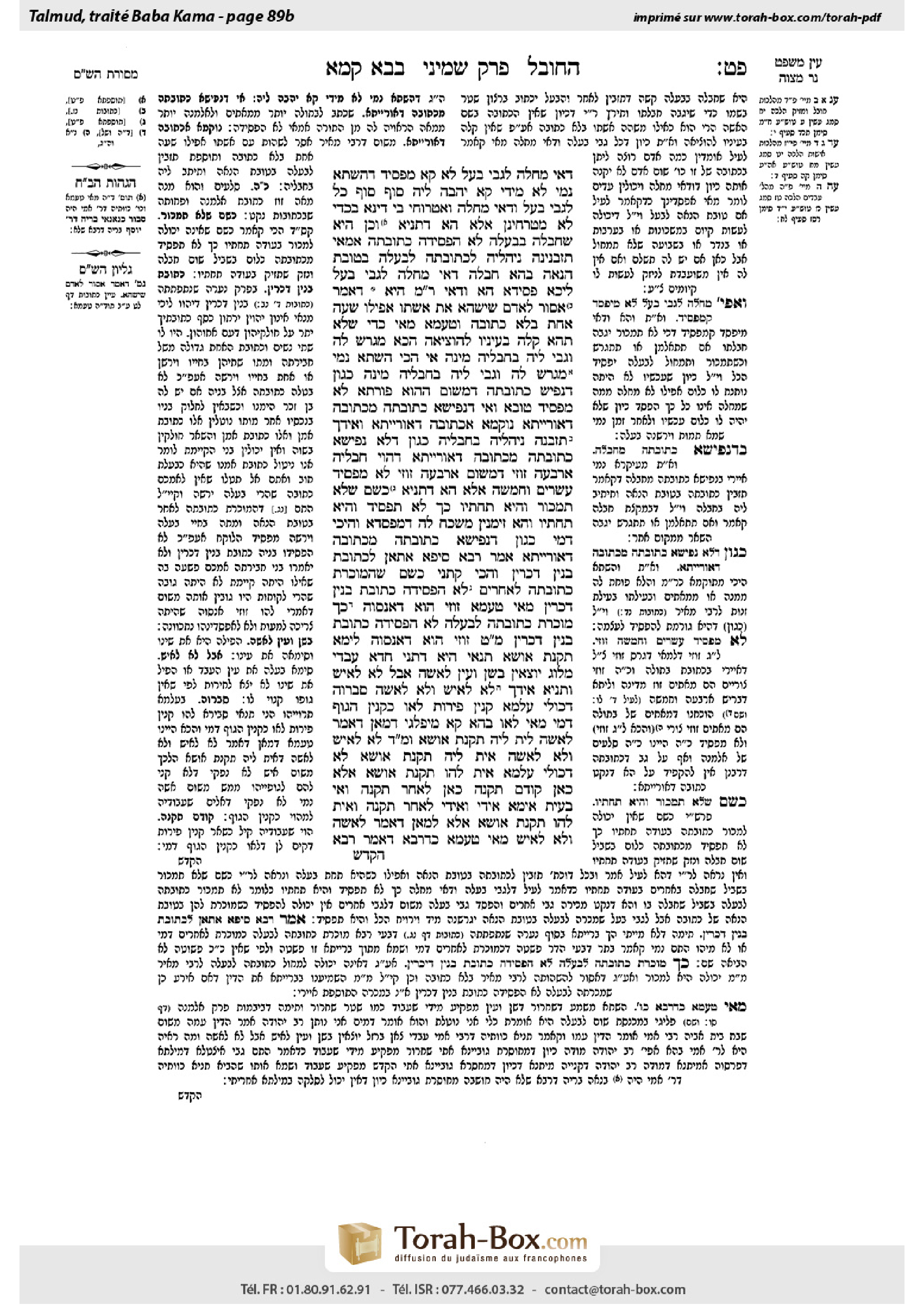
Bava Kamma 89b: Talmud study for Daf Yomi
Study the Talmud for Daf Yomi with scanned pages, Hebrew text, English translations from Sefaria and AI-generated French translations.
Passage selection and English or AI-generated French translation are available where the scan has annotations. Daf Study is independent of Torah-Box and Sefaria.
Browse Bava Kamma · בבא קמא · All tractatesBava Kamma 89b text and translations
This page of Bava Kamma includes the Aramaic text, an English translation and an AI-generated French translation, alongside the scan above.
בבא קמא פ״ט ב · Aramaic and Hebrew text
דְּאִי מָחֲלָה לְגַבֵּי בַעַל – לָא קָא מַפְסֵיד, דְּהַשְׁתָּא נָמֵי לָא מִידֵּי קָא יָהֲבָה לֵיהּ! סוֹף סוֹף, כֹּל לְגַבֵּי בַעַל – וַדַּאי מָחֲלָה, וְאַטְרוֹחֵי בֵּי דִינָא בִּכְדִי לָא מַטְרְחִינַן.
אֶלָּא הָא דְּתַנְיָא: וְכֵן הִיא שֶׁחָבְלָה בְּבַעְלָהּ – לֹא הִפְסִידָה כְּתוּבָּתָהּ, אַמַּאי? תְּזַבְּנִינַּהּ נִיהֲלֵיהּ לִכְתוּבְּתַהּ לְבַעְלַהּ בְּטוֹבַת הֲנָאָה – בְּהָא חֲבָלָה, דְּאִי מָחֲלָה לְגַבֵּי בַעַל, לֵיכָּא פְּסֵידָא!
הָא וַדַּאי רַבִּי מֵאִיר הִיא, דְּאָמַר: אָסוּר לְאָדָם שֶׁיְּשַׁהֶא אֶת אִשְׁתּוֹ אֲפִילּוּ שָׁעָה אַחַת בְּלֹא כְּתוּבָּה.
וְטַעְמָא מַאי – כְּדֵי שֶׁלֹּא תְּהֵא קַלָּה בְּעֵינָיו לְהוֹצִיאָהּ; הָכָא מְגָרֵשׁ לַהּ, וְגָבֵי לֵיהּ בַּחֲבָלֵיהּ מִינַּהּ. אִי הָכִי, הַשְׁתָּא נָמֵי – מְגָרֵשׁ לַהּ, וְגָבֵי לֵיהּ בַּחֲבָלֵיהּ מִינַּהּ!
כְּגוֹן דִּנְפִישָׁ[א] כְּתוּבְּתַהּ, דְּמִשּׁוּם הָהוּא פּוּרְתָּא לָא מַפְסֵיד טוּבָא.
וְאִי דִּנְפִישָׁא כְּתוּבְּתַהּ מִכְּתוּבָּה דְּאוֹרָיְיתָא, נוֹקְמַהּ אַכְּתוּבָּה דְּאוֹרָיְיתָא – וְאִידַּךְ תְּזַבְּנַהּ נִיהֲלֵיהּ בַּחֲבָלֵיהּ!
כְּגוֹן דְּלָא נְפִישָׁא כְּתוּבְּתַהּ מִכְּתוּבָּה דְּאוֹרָיְיתָא; דְּהָוֵי חֲבָלֵיהּ אַרְבְּעָה זוּזֵי, דְּמִשּׁוּם אַרְבְּעָה זוּזֵי לָא מַפְסֵיד עֶשְׂרִים וְחַמְשָׁה.
אֶלָּא הָא דְּתַנְיָא: כְּשֵׁם שֶׁלֹּא תִּמְכּוֹר וְהִיא תַּחְתָּיו, כָּךְ לֹא תַּפְסִיד וְהִיא תַּחְתָּיו; וְהָא זִימְנִין מַשְׁכַּח לַהּ דְּמַפְסְדָא, וְהֵיכִי דָּמֵי – כְּגוֹן דִּנְפִישָׁא כְּתוּבְּתַהּ מִכְּתוּבָּה דְּאוֹרָיְיתָא!
אָמַר רָבָא: סֵיפָא אֲתָאן לִכְתוּבַּת בְּנִין דִּכְרִין.
וְהָכִי קָתָנֵי: כְּשֵׁם שֶׁהַמּוֹכֶרֶת כְּתוּבָּתָהּ לַאֲחֵרִים – לֹא הִפְסִידָה כְּתוּבַּת בְּנִין דִּכְרִין, מַאי טַעְמָא – זוּזֵי הוּא דְּאַנְסוּהָ; כָּךְ מוֹכֶרֶת כְּתוּבָּתָהּ לְבַעְלָהּ – לֹא הִפְסִידָה כְּתוּבַּת בְּנִין דִּכְרִין, מַאי טַעְמָא? זוּזֵי הוּא דְּאַנְסוּהָ.
לֵימָא תַּקָּנַת אוּשָׁא תַּנָּאֵי הִיא? דְּתָנֵי חֲדָא: עַבְדֵי מְלוֹג יוֹצְאִין בְּשֵׁן וָעַיִן לָאִשָּׁה, אֲבָל לֹא לָאִישׁ. וְתַנְיָא אִידַּךְ: לֹא לָאִישׁ וְלֹא לָאִשָּׁה.
סַבְרוּהָ, דְּכוּלֵּי עָלְמָא – קִנְיַן פֵּירוֹת לָאו כְּקִנְיַן הַגּוּף דָּמֵי; מַאי, לָאו בְּהָא קָא מִיפַּלְגִי: דְּמַאן דְּאָמַר לָאִשָּׁה – לֵית לֵיהּ תַּקָּנַת אוּשָׁא, וּמַאן דְּאָמַר לֹא לָאִישׁ וְלֹא לָאִשָּׁה – אִית לֵיהּ תַּקָּנַת אוּשָׁא?
לָא; דְּכוּלֵּי עָלְמָא אִית לְהוּ תַּקָּנַת אוּשָׁא; אֶלָּא כָּאן קוֹדֶם תַּקָּנָה, כָּאן לְאַחַר תַּקָּנָה.
וְאִי בָּעֵית אֵימָא: אִידֵּי וְאִידֵּי לְאַחַר תַּקָּנָה, וְאִית לְהוּ תַּקָּנַת אוּשָׁא; אֶלָּא לְמַאן דְּאָמַר לָאִשָּׁה וְלֹא לָאִישׁ – מַאי טַעְמָא? כִּדְרָבָא, דְּאָמַר רָבָא:
Bava Kamma 89b · English translation
so that even if she were to forgive the debt of her marriage contract with regard to her husband, the one she injured would not lose anything, as now as well she is not giving him any payment, one could respond that ultimately, in any matter that will engender a benefit to her husband, she will certainly forgive the debt with regard to him. And we do not trouble the courts to supervise the sale of the financial advantage without cause.
The Gemara asks: But if the reason she does not sell the financial advantage of her marriage contract to obtain money with which to pay the injured party is that she would then forgive the debt of the marriage contract, then with regard to that which is taught in a baraita (Tosefta 9:22): And similarly, in a case where she was the one who injured her husband she has not lost her marriage contract as a result, as he does not collect compensation from the properties she brought into the marriage that are enumerated in the marriage contract, why does she not lose it? Let her sell the financial advantage of her marriage contract to her husband in order to obtain the money to compensate him for that injury that she caused him, as, if she will forgive the debt of her marriage contract with regard to her husband there will be no loss for the purchaser, i.e., her husband.
The Gemara answers: This baraita is certainly in accordance with the opinion of Rabbi Meir, who says that it is prohibited for a man to remain living together with his wife for even one hour without her having a marriage contract. Therefore, the woman cannot sell the financial advantage of her marriage contract to her husband.
The Gemara asks: And what is the reason for the ruling of Rabbi Meir? It is so that she will not be demeaned in his eyes such that he will easily divorce her, and here, if she were to sell the marriage contract to him, he would then divorce her and collect the properties listed in the marriage contract as payment for his injuries from her. If that is so, even now, where she does not sell her marriage contract to him, he will divorce her, and once she is divorced, he will collect the properties listed in the marriage contract as payment for his injuries from her. Preventing her from selling the marriage contract to him will not serve as an impediment to his divorcing her.
The Gemara answers: The baraita is discussing a case where there is a large sum recorded in her marriage contract, so that because of that slight sum due him as compensation for his injuries, he would not be willing to lose the large sum that he would have to pay were he to divorce her. Therefore, the marriage contract does serve as an impediment to his divorcing her.
The Gemara suggests: But if in fact the baraita is discussing a case where the sum recorded in her marriage contract is larger than the sum recorded in a marriage contract required by Torah law, let them establish her marriage contract at the sum of a marriage contract required by Torah law, and with regard to the other, additional, sum, let her sell it to her husband as payment for his injuries. Since she will be left with a marriage contract of standard value, they would be allowed to remain living together.
The Gemara answers: The baraita is discussing a case where the sum recorded in her marriage contract is not larger than the sum recorded in a marriage contract required by Torah law, that payment for his injury was assessed to be four dinars, and because of a gain of four dinars, the husband would not be willing to lose twenty-five dinars, which is the value of a marriage contract required by Torah law.
The Gemara asks: But with regard to that which is taught in the latter case of the baraita: Just as she does not sell her marriage contract to obtain money to pay damages while she is under him, i.e., married to her husband, so too, she does not lose the value of her marriage contract to pay damages while she is under him. But there are times when she will be found to have lost the value of her marriage contract, and what are the circumstances? It would be a case where the sum recorded in her marriage contract is larger than the sum recorded in a marriage contract required by Torah law. In that case she would be obligated to sell the portion of the marriage contract representing the additional amount in order to obtain money with which to compensate the one she injured.
Rava said in response: In the latter clause of that baraita, we arrive at the stipulation in the marriage contract that the male offspring inherit payment of their mother’s marriage contract, and it is not discussing the sale of a marriage contract in general.
And this is what the baraita is teaching: Just as the halakha stipulates that a woman who sells her marriage contract to others does not lose the future implementation of the stipulation in the marriage contract that the male offspring inherit payment of their mother’s marriage contract, and Rava clarifies: What is the reason for this? The need for money is what caused her to sell it under duress, and she did not intend to abrogate her sons’ rights to inherit the property in the future. Rava continues his explanation of the baraita: So too, a woman who sells her marriage contract to her husband does not lose the future implementation of the stipulation in the marriage contract that the male offspring inherit payment of their mother’s marriage contract, and Rava clarifies: What is the reason for this? The need for money is what caused her to sell it under duress.
§ The Gemara returns to the earlier discussion and suggests: Shall we say that the issue whether or not there was an ordinance of Usha instituting that the wife cannot sell her usufruct property is a dispute between tanna’im? As it is taught in one baraita: Canaanite slaves that the woman brought into the marriage as usufruct property are emancipated by having a tooth knocked out or an eye blinded by the woman, i.e., the wife, as is the halakha when the owner of a slave knocks out the slave’s tooth or blinds his eye, but they are not emancipated by having a tooth knocked out or an eye blinded by the man, i.e., the husband, as he is not their owner. And it is taught in another baraita: The slave is not emancipated if his tooth was knocked out or his eye was blinded, nor by the man nor by the woman.
The Gemara continues its analysis: They assumed that everyone holds that ownership of the rights to use an item and to its produce, which the husband has with regard to usufruct property, is not like ownership of the item itself, which is why the husband is not considered the owner of the slaves. What, is it not so that the two baraitot disagree with regard to this: That the one who says that the slave is emancipated if he was struck by the woman holds that there is no ordinance of Usha? Since she retains the right to sell her usufruct property, she is considered the full owner of the slaves with regard to the halakha of their being emancipated. And the one who says that the slave is not emancipated if he was struck by the man and not if he was struck by the woman holds that there is an ordinance of Usha. Since she cannot sell her usufruct property, she is not considered to be the full owner of the slaves with regard to the halakha of their being emancipated.
The Gemara offers an alternative explanation: No; perhaps it is the case that everyone holds that there is an ordinance of Usha. But here, in the first baraita, it is referring to the time before the ordinance was instituted, and since the wife had the right to sell her usufruct property, she is considered the full owner of the slaves with regard to the halakha of their being emancipated, while there, in the second baraita, it is referring to the time after the ordinance was instituted, and since she could no longer sell her usufruct property, she is not considered to be the full owner of the slaves with regard to the halakha of their being emancipated.
The Gemara offers an alternative explanation: And if you wish, say instead that both this baraita and that baraita are referring to the time after the ordinance was instituted, and the tanna in each baraita holds that there is an ordinance of Usha. Rather, according to the one who says that the slave is emancipated if he is struck by the woman but not if he is struck by the man, what is the reason? It is in accordance with the statement of Rava, as Rava said:
Bava Kamma 89b · Traduction française (IA)
de sorte que même si elle pardonnait la dette du contrat de mariage concernant son mari, la personne qu'elle a blessée ne perdrait rien, car elle ne lui paie pas non plus maintenant, on pourrait répondre que finalement, dans toute affaire qui génère un bénéfice pour son mari, elle pardonnera certainement la dette concernant lui. Et nous ne nous soucions pas des tribunaux de surveiller la vente de ce bénéfice financier sans cause.
La Guemara demande : Mais si la raison pour laquelle elle ne vend pas le bénéfice financier du contrat de mariage afin d'obtenir de l'argent pour payer la personne blessée est qu'elle pardonnerait alors la dette du contrat de mariage, alors concernant ce qui est enseigné dans une baraïta (Tosefta 9:22) : Et de même, dans le cas où elle a blessé son mari, elle ne perd pas son contrat de mariage en conséquence, car il ne réclame pas de dommages-intérêts sur les biens qu'elle a apportés dans le mariage et qui sont énumérés dans le contrat de mariage, pourquoi ne perd-elle pas ce contrat ? Laissons-la vendre le bénéfice financier du contrat de mariage à son mari afin d'obtenir de l'argent pour compenser la blessure qu'elle lui a causée, car si elle pardonne la dette du contrat de mariage concernant son mari, il n'y aura pas de perte pour l'acheteur, c'est-à-dire son mari.
La Guemara répond : Cette baraïta est certainement en accord avec l'opinion de Rabbi Meïr, qui dit qu'il est interdit à un homme de rester avec sa femme même une heure sans qu'elle ait un contrat de mariage. Par conséquent, la femme ne peut pas vendre le bénéfice financier du contrat de mariage à son mari.
La Guemara demande : Et quelle est la raison de la décision de Rabbi Meïr ? C'est afin qu'elle ne soit pas humiliée à ses yeux de sorte qu'il divorce facilement d'elle, et ici, si elle vendait le contrat de mariage à lui, il divorcerait alors d'elle et réclamerait les biens énumérés dans le contrat de mariage comme compensation pour ses blessures. Si c'est ainsi, même maintenant, où elle ne vend pas le contrat de mariage à lui, il divorcerait d'elle, et une fois divorcée, il réclamerait les biens énumérés dans le contrat de mariage comme compensation pour ses blessures. Empêcher la vente du contrat de mariage à lui ne servira pas d'obstacle à son divorce.
La Guemara répond : La baraïta discute d'un cas où la somme inscrite dans le contrat de mariage est importante, de sorte que, à cause de cette petite somme due en compensation pour ses blessures, il ne serait pas disposé à perdre la grande somme qu'il devrait payer s'il divorçait d'elle. Par conséquent, le contrat de mariage sert d'obstacle à son divorce.
La Guemara suggère : Mais si, en réalité, la baraïta discute d'un cas où la somme inscrite dans le contrat de mariage est plus grande que celle d'un contrat de mariage requis par la Torah, on pourrait établir son contrat de mariage à la somme d'un contrat de mariage requis par la Torah, et concernant la somme supplémentaire, on laisserait la femme le vendre à son mari comme compensation pour ses blessures. Ainsi, elle resterait avec un contrat de mariage de valeur standard, et ils pourraient rester ensemble.
La Guemara répond : La baraïta discute d'un cas où la somme inscrite dans le contrat de mariage n'est pas plus grande que celle d'un contrat de mariage requis par la Torah, c'est-à-dire que le paiement pour sa blessure a été estimé à quatre dinars, et à cause d'un gain de quatre dinars, le mari ne serait pas disposé à perdre vingt-cinq dinars, qui est la valeur d'un contrat de mariage requis par la Torah.
La Guemara demande : Mais concernant ce qui est enseigné dans le cas ultérieur de la baraïta : Tout comme elle ne vend pas son contrat de mariage pour obtenir de l'argent pour payer les dommages tout en étant sous son autorité, c'est-à-dire mariée à son mari, tout comme elle ne perd pas la valeur de son contrat de mariage pour payer les dommages tout en étant sous son autorité, mais il y a des moments où elle est trouvée avoir perdu la valeur de son contrat de mariage, et quels sont les circonstances ? Cela serait le cas où la somme inscrite dans son contrat de mariage est plus grande que celle d'un contrat de mariage requis par la Torah. Dans ce cas, elle serait obligée de vendre la partie du contrat de mariage représentant la somme supplémentaire afin d'obtenir de l'argent pour compenser la personne qu'elle a blessée.
Rava répondit en réponse : Dans la clause ultérieure de cette baraïta, nous arrivons à la stipulation du contrat de mariage selon laquelle les fils masculins héritent du paiement du contrat de mariage de leur mère, et il ne s'agit pas de la vente d'un contrat de mariage en général.
Et c'est ce que la baraïta enseigne : Tout comme la halakha stipule que la femme qui vend son contrat de mariage à d'autres ne perd pas l'application future de la stipulation du contrat de mariage selon laquelle les fils masculins héritent du paiement du contrat de mariage de leur mère, et Rava clarifie : Quelle est la raison de cela ? La nécessité d'argent a causé sa vente sous la contrainte, et elle n'avait pas l'intention d'abroger les droits de ses fils à hériter des biens à l'avenir. Rava continue son explication de la baraïta : Tout comme cela, une femme qui vend son contrat de mariage à son mari ne perd pas l'application future de la stipulation du contrat de mariage selon laquelle les fils masculins héritent du paiement du contrat de mariage de leur mère, et Rava clarifie : Quelle est la raison de cela ? La nécessité d'argent a causé sa vente sous la contrainte.
§ La Guemara reprend la discussion précédente et suggère : Doit-on dire que la question de savoir s'il y avait une ordonnance de Usha instituant que la femme ne peut pas vendre sa propriété de jouissance est un débat entre les tannaïm ? Comme il est enseigné dans une baraïta : Les esclaves cananéens que la femme a apportés dans le mariage en tant que propriété de jouissance sont emancipés par le fait qu'on leur arrache un dents ou qu'on leur arrache un œil par la femme, c'est-à-dire la femme, comme c'est la halakha lorsque l'propriétaire d'un esclave arrache un dents ou arrache un œil à l'esclave, mais ils ne sont pas emancipés par le fait qu'on leur arrache un dents ou qu'on leur arrache un œil par l'homme, c'est-à-dire le mari, car il n'est pas leur propriétaire. Et il est enseigné dans une autre baraïta : L'esclave n'est pas emancipé si son dents a été arraché ou son œil a été arraché, ni par l'homme ni par la femme.
La Guemara continue son analyse : Ils supposaient que tout le monde considère que l'ownership des droits d'utilisation d'un objet et de ses produits, que le mari a envers la propriété de jouissance, n'est pas comme l'ownership de l'objet lui-même, ce qui est pourquoi le mari n'est pas considéré comme propriétaire des esclaves. Qu'est-ce que cela ne serait pas, que les deux baraitot s'opposent à ce sujet : Que celui qui dit que l'esclave est emancipé s'il a été frappé par la femme considère qu'il n'y a pas d'ordonnance de Usha ? Puisque elle conserve le droit de vendre sa propriété de jouissance, elle est considérée comme la propriétaire complète des esclaves en ce qui concerne la halakha de leur émancipation. Et celui qui dit que l'esclave n'est pas emancipé s'il a été frappé par l'homme et pas s'il a été frappé par la femme considère qu'il y a une ordonnance de Usha. Puisque elle ne peut plus vendre sa propriété de jouissance, elle n'est pas considérée comme la propriétaire complète des esclaves en ce qui concerne la halakha de leur émancipation.
La Guemara propose une autre explication : Non, peut-être que tout le monde considère qu'il y a une ordonnance de Usha. Mais ici, dans la première baraïta, il s'agit du temps avant que l'ordonnance ne soit instituée, et puisque la femme avait le droit de vendre sa propriété de jouissance, elle est considérée comme la propriétaire complète des esclaves en ce qui concerne la halakha de leur émancipation, tandis que là, dans la seconde baraïta, il s'agit du temps après que l'ordonnance ait été instituée, et puisque elle ne pouvait plus vendre sa propriété de jouissance, elle n'est pas considérée comme la propriétaire complète des esclaves en ce qui concerne la halakha de leur émancipation.
La Guemara propose une autre explication : Et si vous le souhaitez, dites plutôt que ces deux baraitot se réfèrent toutes deux au temps après que l'ordonnance ait été instituée, et que le tanna de chaque baraïta considère qu'il y a une ordonnance de Usha. Plutôt, selon celui qui dit que l'esclave est emancipé s'il est frappé par la femme mais pas s'il est frappé par l'homme, quelle est la raison ? C'est selon la déclaration de Rava, comme Rava a dit :
Traduction française générée par IA à partir de l’édition anglaise de Sefaria. Vérifie toujours un passage avec le texte source.
Text from Sefaria: William Davidson Edition - Vocalized Aramaic (CC BY NC); William Davidson Edition - English (CC BY NC).