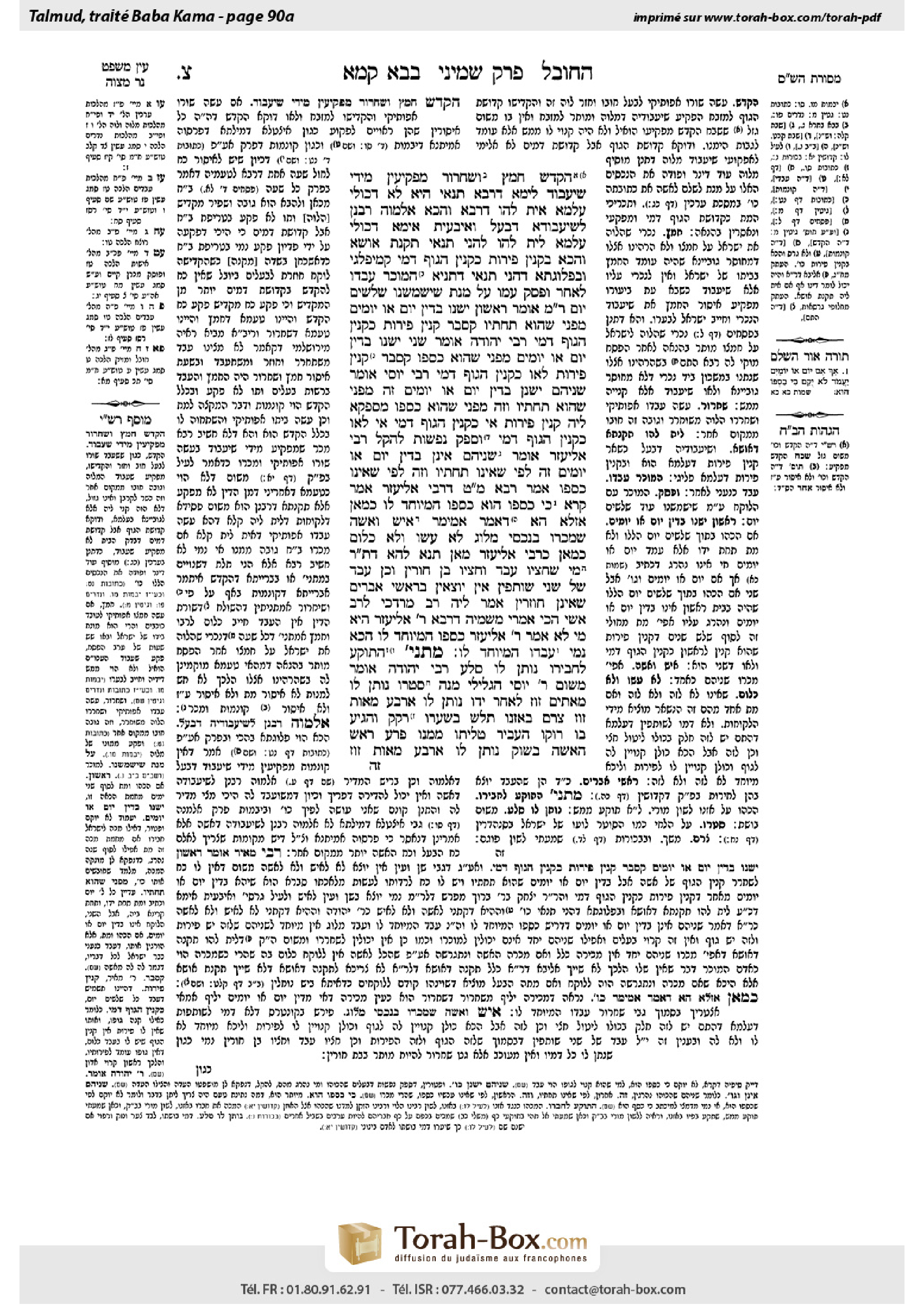
Bava Kamma 90a: Talmud study for Daf Yomi
Study the Talmud for Daf Yomi with scanned pages, Hebrew text, English translations from Sefaria and AI-generated French translations.
Passage selection and English or AI-generated French translation are available where the scan has annotations. Daf Study is independent of Torah-Box and Sefaria.
Browse Bava Kamma · בבא קמא · All tractatesBava Kamma 90a text and translations
This page of Bava Kamma includes the Aramaic text, an English translation and an AI-generated French translation, alongside the scan above.
בבא קמא צ׳ א · Aramaic and Hebrew text
הֶקְדֵּשׁ, חָמֵץ וְשִׁחְרוּר – מַפְקִיעִים מִידֵי שִׁיעְבּוּד.
לֵימָא דְּרָבָא תַּנָּאֵי הִיא? לָא; דְּכוּלֵּי עָלְמָא אִית לְהוּ דְּרָבָא, וְהָכָא אַלְמוּהּ רַבָּנַן לְשִׁיעְבּוּדָא דְבַעַל.
וְאִיבָּעֵית אֵימָא: דְּכוּלֵּי עָלְמָא – לֵית לְהוּ לְהָנֵי תַּנָּאֵי תַּקָּנַת אוּשָׁא, וְהָכָא – בְּקִנְיַן פֵּירוֹת כְּקִנְיַן הַגּוּף דָּמֵי קָמִיפַּלְגִי –
וּבִפְלוּגְתָּא דְּהָנֵי תַּנָּאֵי, דְּתַנְיָא: הַמּוֹכֵר עַבְדּוֹ לְאַחֵר, וּפָסַק עִמּוֹ עַל מְנָת שֶׁיְּשַׁמְּשֶׁנּוּ שְׁלֹשִׁים יוֹם;
רַבִּי מֵאִיר אוֹמֵר: רִאשׁוֹן יֶשְׁנוֹ בְּדִין יוֹם אוֹ יוֹמַיִם, מִפְּנֵי שֶׁהוּא תַּחְתָּיו. קָסָבַר: קִנְיַן פֵּירוֹת – כְּקִנְיַן הַגּוּף דָּמֵי.
רַבִּי יְהוּדָה אוֹמֵר: שֵׁנִי יֶשְׁנוֹ בְּדִין יוֹם אוֹ יוֹמַיִם, מִפְּנֵי שֶׁהוּא כַּסְפּוֹ. קָסָבַר: קִנְיַן פֵּירוֹת – לָאו כְּקִנְיַן הַגּוּף דָּמֵי.
רַבִּי יוֹסֵי אוֹמֵר: שְׁנֵיהֶם יֶשְׁנָן בְּדִין יוֹם אוֹ יוֹמַיִם; זֶה מִפְּנֵי שֶׁהוּא תַּחְתָּיו, וְזֶה מִפְּנֵי שֶׁהוּא כַּסְפּוֹ. מְסַפְּקָא לֵיהּ קִנְיַן פֵּירוֹת אִי כְּקִנְיַן הַגּוּף דָּמֵי אִי לָאו כְּקִנְיַן הַגּוּף דָּמֵי, וְסָפֵק נְפָשׁוֹת לְהָקֵל.
רַבִּי אֱלִיעֶזֶר אוֹמֵר: שְׁנֵיהֶם אֵינָן בְּדִין יוֹם אוֹ יוֹמַיִם; זֶה לְפִי שֶׁאֵינוֹ תַּחְתָּיו, וְזֶה לְפִי שֶׁאֵינוֹ כַּסְפּוֹ.
אָמַר רָבָא: מַאי טַעְמָא דְּרַבִּי אֱלִיעֶזֶר? אָמַר קְרָא: ״כִּי כַסְפּוֹ הוּא״ – כַּסְפּוֹ הַמְיוּחָד לוֹ.
כְּמַאן אָזְלָא הָא דְּאָמַר אַמֵּימָר: אִישׁ וְאִשָּׁה שֶׁמָּכְרוּ בְּנִכְסֵי מְלוֹג – לֹא עָשׂוּ וְלֹא כְּלוּם? כְּמַאן – כְּרַבִּי אֱלִיעֶזֶר.
מַאן תְּנָא לְהָא דְּתָנוּ רַבָּנַן: מִי שֶׁחֶצְיוֹ עֶבֶד וְחֶצְיוֹ בֶּן חוֹרִין, וְכֵן עֶבֶד שֶׁל שְׁנֵי שׁוּתָּפִין – אֵין יוֹצְאִין בְּרָאשֵׁי אֵבָרִים שֶׁאֵינָן חוֹזְרִין? אֲמַר לֵיהּ רַב מָרְדֳּכַי לְרַב אָשֵׁי, הָכִי אָמְרִי מִשְּׁמֵיהּ דְּרָבָא: רַבִּי אֱלִיעֶזֶר הִיא –
מִי לָא אָמַר רַבִּי אֱלִיעֶזֶר: ״כַּסְפּוֹ״ – הַמְיוּחָד לוֹ? הָכָא נָמֵי, ״עַבְדּוֹ״ – הַמְיוּחָד לוֹ.
מַתְנִי׳ הַתּוֹקֵעַ לַחֲבֵירוֹ – נוֹתֵן לוֹ סֶלַע. רַבִּי יְהוּדָה אוֹמֵר מִשּׁוּם רַבִּי יוֹסֵי הַגְּלִילִי: מָנֶה. סְטָרוֹ – נוֹתֵן לוֹ מָאתַיִם זוּז. לְאַחַר יָדוֹ – נוֹתֵן לוֹ אַרְבַּע מֵאוֹת זוּז.
צָרַם בְּאׇזְנוֹ; תָּלַשׁ בִּשְׂעָרוֹ; רָקַק – וְהִגִּיעַ בּוֹ רוּקּוֹ; הֶעֱבִיר טַלִּיתוֹ מִמֶּנּוּ; פָּרַע רֹאשׁ הָאִשָּׁה בַּשּׁוּק – נוֹתֵן לוֹ אַרְבַּע מֵאוֹת זוּז.
Bava Kamma 90a · English translation
Consecration of an item to the Temple, the advent of the prohibition of leavened bread taking effect upon a leavened food, and the emancipation of a slave abrogate any lien that exists upon them. Therefore, the emancipation of a slave resulting from the knocking out of his tooth or the blinding of his eye abrogates the lien that the husband has on the slave as usufruct property, leaving the woman as the solitary owner.
The Gemara questions this explanation: Shall we say that this statement of Rava is a dispute between tanna’im? According to this explanation, the baraita that states that the slave is not emancipated when he is struck by the woman holds that the lien of the husband is not abrogated, which would run counter to the statement of Rava. The Gemara responds: No; it is the case that everyone agrees with the statement of Rava that a lien is abrogated, and here the reason why the baraita holds that the husband’s lien on the slave is not abrogated is that the Sages strengthened the lien of a husband on his wife’s property, and it is only this type of lien that is not abrogated by emancipation.
And if you wish, say instead that everyone agrees that these tanna’im of the two baraitot hold that there is no ordinance of Usha, and here, they disagree with regard to the question whether ownership of the rights to use an item and to its produce is like ownership of the item itself. In this case, the husband enjoys the usage of the slave while the wife owns the slave himself. The baraita that rules that the slave is not emancipated when struck by the woman holds that the husband is also considered to be an owner, and the baraita that rules that the slave is emancipated when struck by the woman holds that the husband is not considered to be an owner.
And the dispute with regard to the question whether ownership of the rights to use an item and to its produce is like ownership of the item itself is with regard to the issue that is the subject of the dispute between these tanna’im, as it is taught in a baraita: In the case of one who sells his Canaanite slave to another, and he contracted with him that the sale is effected on the condition that the slave will serve the seller for thirty days before he is transferred to the purchaser, the outcome of this sale is that during those thirty days, the original master enjoys the usage of the slave and the purchaser is the owner of the slave.
As detailed in the Torah (Exodus 21:18–21), if one strikes another and the injury leads directly to the victim’s death, the one who struck him is liable to receive court-imposed capital punishment. This ruling does not apply in the case where a master strikes his Canaanite slave and the slave lingers with his injuries for more than a day or two and then dies, in which case the master is exempt from court-imposed capital punishment. The baraita addresses who is considered the owner of the slave with regard to this latter halakha. Rabbi Meir says that during those thirty days, only the first owner is included in the halakha of: A day or two days. Rabbi Meir holds that in this case, the first owner is included in this exemption, because the slave is under his authority, as he enjoys the usage of the slave, and he holds that ownership of the rights to use an item and to its produce is like ownership of the item itself. The status of the first owner as the owner also negates the possibility that the second owner would be regarded as the owner with regard to this halakha, and he would not be included in the exemption.
The baraita continues. Rabbi Yehuda says that only the second owner is included in the halakha of: A day or two days, because the slave is his money, i.e., property, but the first owner is not included in the halakha of: A day or two days, as he holds that ownership of the rights to use an item and to its produce is not like ownership of the item itself. Therefore, the first owner does not have the status of an owner with regard to this halakha.
The baraita continues. Rabbi Yosei says that both of them are included in the halakha of: A day or two days. This one, the first owner, is included because the slave is under his authority, and that one, the second owner, is included because the slave is his money. The Gemara explains the reasoning of Rabbi Yosei: He is uncertain, with regard to ownership of the rights to use an item and to its produce, if it is like ownership of the item itself, in which case only the first owner would be exempt, or if it is not like ownership of the item itself, in which case only the second owner would be exempt. And where there is an uncertainty in a case of capital law, the ruling is to be lenient. Therefore, neither of them would receive court-imposed capital punishment in this case.
The baraita continues. Rabbi Eliezer says that both of them are not included in the halakha of: A day or two days, and both would receive court-imposed capital punishment. This one, the second owner, would be liable to receive it because the slave is not under his authority, and that one, the first owner, would receive it because the slave is not his money. Rabbi Eliezer holds that one is required both to own the slave himself and enjoy the usage of the slave to be included in the exemption.
The Gemara notes that Rava said: What is the reason for the opinion of Rabbi Eliezer? The verse states: “Notwithstanding if he continue a day or two, he shall not be punished; for he is his money” (Exodus 21:21), and Rabbi Eliezer understands this to be referring to a slave that is his money alone, a slave that is unique to him, and therefore this exemption does not apply to one who does not have total ownership of the slave.
The Gemara asks: In accordance with whose opinion is that which Ameimar says: If there was a man or a woman, i.e., a husband or a wife, who sold the wife’s usufruct property, which is owned by the wife but used by the husband, they did not accomplish anything, as the sale does not take effect? In accordance with whose opinion is his statement? It is in accordance with the opinion of Rabbi Eliezer, who holds that one is considered to be an owner only if he both owns the item itself and enjoys the usage of that item.
The Gemara asks: Who is the tanna who taught that which the Sages taught: One who is a half-slave half-freeman, and similarly, a slave belonging to two partners, are not emancipated when injured by one of their owners in one of their extremities that do not regenerate, i.e., the twenty-four extremities whose injury by an owner emancipates a slave? Rav Mordekhai said to Rav Ashi: This is what the Sages say in the name of Rava: It is in accordance with the opinion of Rabbi Eliezer.
He explains: Didn’t Rabbi Eliezer say that the term “his money” indicates a slave that is unique to him? Here too, since the verse states with regard to the emancipation of a slave resulting from his master striking him: “And if a man smite the eye of his slave” (Exodus 21:26), this is referring to his slave that is unique to him. Therefore, this halakha of emancipation would not apply to a slave not fully owned by one master.
MISHNA: One who strikes another must give him a sela. Rabbi Yehuda says in the name of Rabbi Yosei HaGelili that he must give him one hundred dinars. If he slapped another on the cheek, he must give him two hundred dinars. If he slapped him on the cheek with the back of his hand, which is more degrading than a slap with the palm, he must give him four hundred dinars.
If he pulled his ear, or pulled out his hair, or spat at him and his spittle reached him, or if he removed the other’s cloak from him, or if he uncovered the head of a woman in the marketplace, in all of these cases, he must give the injured party four hundred dinars.
Bava Kamma 90a · Traduction française (IA)
La consécration d'un objet au Temple, l'entrée en vigueur de l'interdiction du pain levé sur un aliment levé, et l'émancipation d'un esclave annulent toute garantie existante sur eux. Ainsi, l'émancipation d'un esclave due à la cassure de son dents ou à la perte de son œil annule la garantie que le mari a sur l'esclave en tant que propriété de jouissance, laissant la femme comme propriétaire unique.
La Guemara questionne cette explication : devons-nous dire que cette déclaration de Rava est un débat entre les tannaïm ? Selon cette explication, la baraïta qui affirme que l'esclave n'est pas émancipé lorsqu'il est frappé par la femme considère que la garantie du mari n'est pas annulée, ce qui contredirait la déclaration de Rava. La Guemara répond : Non ; c'est le cas que tout le monde convient de la déclaration de Rava selon laquelle une garantie est annulée, et ici la raison pour laquelle la baraïta considère que la garantie du mari sur l'esclave n'est pas annulée est que les Sages ont renforcé la garantie du mari sur la propriété de sa femme, et c'est uniquement ce type de garantie qui n'est pas annulée par l'émancipation.
Et si vous le souhaitez, dites plutôt que tout le monde convient que ces tannaïm des deux baraitot considèrent qu'il n'y a pas d'ordonnance d'Usha, et ici, ils divergent concernant la question de savoir si la propriété des droits d'utilisation d'un objet et de ses produits est comme la propriété de l'objet lui-même. Dans ce cas, le mari jouit de l'utilisation de l'esclave tandis que la femme possède l'esclave lui-même. La baraïta qui déclare que l'esclave n'est pas émancipé lorsqu'il est frappé par la femme considère que le mari est également considéré comme propriétaire, et la baraïta qui déclare que l'esclave est émancipé lorsqu'il est frappé par la femme considère que le mari n'est pas considéré comme propriétaire.
Et le débat concernant la question de savoir si la propriété des droits d'utilisation d'un objet et de ses produits est comme la propriété de l'objet lui-même concerne l'objet de débat entre ces tannaïm, comme il est enseigné dans une baraïta : Dans le cas d'une personne qui vend son esclave cananéen à un autre, et qu'il a conclu un contrat selon lequel la vente est effectuée sous la condition que l'esclave servira le vendeur pendant trente jours avant d'être transféré à l'acheteur, le résultat de cette vente est que pendant ces trente jours, le maître original jouit de l'utilisation de l'esclave et l'acheteur est le propriétaire de l'esclave.
Comme détaillé dans la Torah (Exode 21:18–21), si l'on frappe un autre et que l'injury mène directement à la mort de la victime, celui qui l'a frappé est tenu responsable de la peine de mort imposée par le tribunal. Cette décision ne s'applique pas dans le cas où un maître frappe son esclave cananéen et que l'esclave meurt après avoir subi des blessures pendant plus d'un ou deux jours, dans ce cas le maître est exempt de la peine de mort imposée par le tribunal. La baraïta aborde qui est considéré comme le propriétaire de l'esclave concernant cette dernière halakha. Rabbi Meir dit que pendant ces trente jours, seul le premier propriétaire est inclus dans la halakha de : un ou deux jours. Rabbi Meir considère que dans ce cas, le premier propriétaire est inclus dans cette exemption, car l'esclave est sous son autorité, comme il jouit de l'utilisation de l'esclave, et il considère que la propriété des droits d'utilisation d'un objet et de ses produits est comme la propriété de l'objet lui-même. Le statut du premier propriétaire comme propriétaire annule la possibilité que le second propriétaire soit considéré comme propriétaire concernant cette halakha, et il ne serait pas inclus dans l'exemption.
La baraïta continue. Rabbi Yehuda dit que seul le second propriétaire est inclus dans la halakha de : un ou deux jours, car l'esclave est son argent, c'est-à-dire sa propriété, mais le premier propriétaire n'est pas inclus dans la halakha de : un ou deux jours, car il considère que la propriété des droits d'utilisation d'un objet et de ses produits n'est pas comme la propriété de l'objet lui-même. Ainsi, le premier propriétaire n'a pas le statut de propriétaire concernant cette halakha.
La baraïta continue. Rabbi Yosei dit que les deux sont inclus dans la halakha de : un ou deux jours. Celui-ci, le premier propriétaire, est inclus car l'esclave est sous son autorité, et celui-là, le second propriétaire, est inclus car l'esclave est son argent. La Guemara explique la raison du Rabbi Yosei : Il est incertain, concernant la propriété des droits d'utilisation d'un objet et de ses produits, si c'est comme la propriété de l'objet lui-même, dans ce cas seul le premier propriétaire serait exempt, ou si ce n'est pas comme la propriété de l'objet lui-même, dans ce cas seul le second propriétaire serait exempt. Et dans un cas de loi de peine de mort, où il y a une incertitude, la décision est de lenir. Ainsi, ni l'un ni l'autre ne recevraient la peine de mort imposée par le tribunal dans ce cas.
La baraïta continue. Rabbi Eliezer dit que les deux ne sont pas inclus dans la halakha de : un ou deux jours, et les deux recevraient la peine de mort imposée par le tribunal. Celui-ci, le second propriétaire, serait tenu responsable car l'esclave n'est pas sous son autorité, et celui-là, le premier propriétaire, serait tenu responsable car l'esclave n'est pas son argent. Rabbi Eliezer considère que l'on doit posséder l'esclave lui-même et jouir de l'utilisation de l'esclave pour être inclus dans l'exemption.
La Guemara souligne que Rava a dit : Quelle est la raison de l'opinion de Rabbi Eliezer ? La versette dit : « Quel que soit le cas, s'il continue un ou deux jours, il ne sera pas puni ; car il est son argent » (Exode 21:21), et Rabbi Eliezer comprend cela comme se référant à un esclave qui est son argent seul, un esclave unique à lui, et donc cette exemption ne s'applique pas à celui qui ne possède pas la propriété totale de l'esclave.
La Guemara pose la question : Selon l'opinion de quel maître est-ce que ce que Ameimar dit : Si un homme ou une femme, c'est-à-dire un mari ou une femme, a vendu la propriété de jouissance de la femme, qui appartient à la femme mais est utilisée par le mari, ils n'ont pas accompli rien, car la vente ne prend pas effet ? Selon l'opinion de quel maître est-ce que son propos ? C'est selon l'opinion de Rabbi Eliezer, qui considère qu'une personne est propriétaire uniquement s'il possède l'objet lui-même et en jouit.
La Guemara pose la question : Qui est le tanna qui a enseigné ce que les Sages ont enseigné : Celui qui est demi-esclave et demi-libre, ainsi que l'esclave appartenant à deux partenaires, ne sont pas emancipés lorsqu'ils sont blessés par l'un de leurs maîtres dans l'une de leurs extrémités qui ne se régénère pas, c'est-à-dire les vingt-quatre extrémités dont la blessure par un maître emancipait un esclave ? Rav Mordekhai dit à Rav Ashi : C'est ce que les Sages disent en nom de Rava : C'est selon l'opinion de Rabbi Eliezer.
Il explique : N'a-t-il pas dit Rabbi Eliezer que le terme « son argent » indique un esclave unique à lui ? Ici aussi, puisque la Parashah parle de l'émancipation d'un esclave en raison de la frappe de son maître : « Et si un homme frappe l'œil de son esclave » (Exode 21:26), cela fait référence à son esclave unique à lui. Par conséquent, cette halakha d'émancipation ne s'appliquerait pas à un esclave non entièrement possédé par un seul maître.
MICHNA : Celui qui frappe un autre doit lui donner un sela. Rabbi Yehuda dit en nom de Rabbi Yosei HaGelili qu'il doit lui donner cent dinars. Si on frappe un autre sur la joue, on doit lui donner deux cents dinars. Si on frappe un autre sur la joue avec le dos de la main, qui est plus humiliant qu'un coup de poing, on doit lui donner quatre cents dinars.
Si on tire l'oreille de l'autre, ou on tire les cheveux de l'autre, ou on crache sur lui et son crachat atteint l'autre, ou si on ôte la cape de l'autre, ou si on découvre la tête d'une femme dans le marché, dans tous ces cas, on doit donner à la personne blessée quatre cents dinars.
Traduction française générée par IA à partir de l’édition anglaise de Sefaria. Vérifie toujours un passage avec le texte source.
Text from Sefaria: William Davidson Edition - Vocalized Aramaic (CC BY NC); William Davidson Edition - English (CC BY NC).