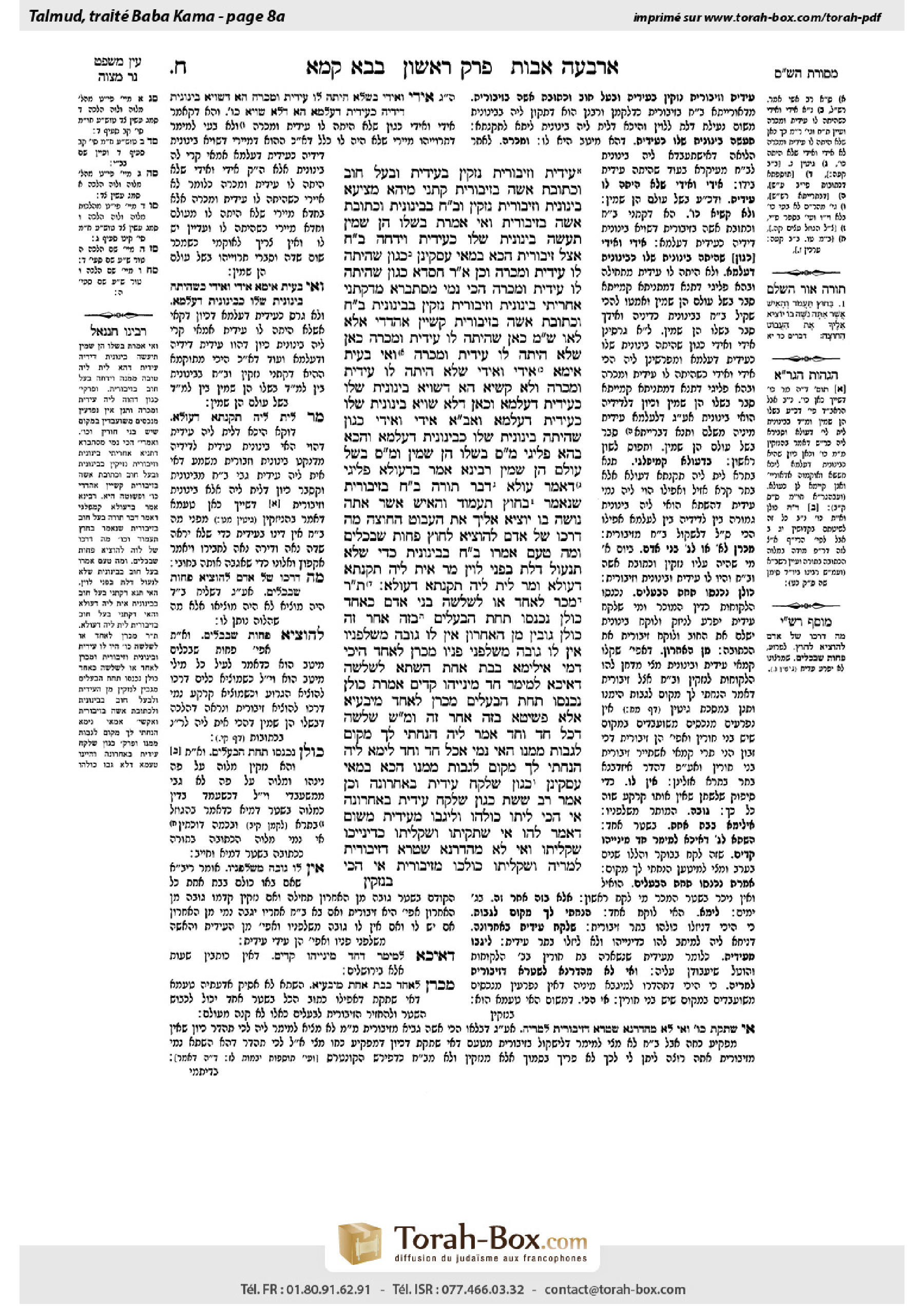
Bava Kamma 8a: Talmud study for Daf Yomi
Study the Talmud for Daf Yomi with scanned pages, Hebrew text, English translations from Sefaria and AI-generated French translations.
Passage selection and English or AI-generated French translation are available where the scan has annotations. Daf Study is independent of Torah-Box and Sefaria.
Browse Bava Kamma · בבא קמא · All tractatesBava Kamma 8a text and translations
This page of Bava Kamma includes the Aramaic text, an English translation and an AI-generated French translation, alongside the scan above.
בבא קמא ח׳ א · Aramaic and Hebrew text
עִידִּית וְזִיבּוּרִית – נִזָּקִין בְּעִידִּית, וּבַעַל חוֹב וּכְתוּבַּת אִשָּׁה בְּזִיבּוּרִית.
קָתָנֵי מִיהָא מְצִיעָא: בֵּינוֹנִית וְזִיבּוּרִית – נִזָּקִין וּבַעַל חוֹב בְּבֵינוֹנִית, וּכְתוּבַּת אִשָּׁה בְּזִיבּוּרִית. וְאִי אָמְרַתְּ בְּשֶׁלּוֹ הֵן שָׁמִין; תֵּעָשֶׂה בֵּינוֹנִית שֶׁלּוֹ – כְּעִידִּית, וְיִדְחֶה בַּעַל חוֹב אֵצֶל זִיבּוּרִית!
הָכָא בְּמַאי עָסְקִינַן – כְּגוֹן שֶׁהָיְתָה לוֹ עִידִּית, וּמְכָרָהּ.
וְכֵן אָמַר רַב חִסְדָּא: כְּגוֹן שֶׁהָיְתָה לוֹ עִידִּית, וּמְכָרָהּ.
הָכִי נָמֵי מִסְתַּבְּרָא – מִדְּקָתָנֵי אַחֲרִיתִי: בֵּינוֹנִית וְזִיבּוּרִית – נִזָּקִין בְּבֵינוֹנִית, בַּעַל חוֹב וּכְתוּבַּת אִשָּׁה בְּזִיבּוּרִית. קַשְׁיָין אַהֲדָדֵי!
אֶלָּא לָאו שְׁמַע מִינַּהּ: כָּאן שֶׁהָיְתָה לוֹ עִידִּית וּמְכָרָהּ, כָּאן – שֶׁלֹּא הָיְתָה לוֹ עִידִּית וּמְכָרָהּ?
וְאִי בָּעֵית אֵימָא: אִידֵּי וְאִידֵּי שֶׁלֹּא הָיְתָה לוֹ עִידִּית וּמְכָרָהּ; וְלָא קַשְׁיָא, הָא דְּשָׁוְיָא בֵּינוֹנִית שֶׁלּוֹ כְּעִידִּית דְּעָלְמָא, וְכָאן דְּלָא שָׁוְיָא בֵּינוֹנִית שֶׁלּוֹ כְּעִידִּית דְּעָלְמָא.
וְאִיבָּעֵית אֵימָא: אִידֵּי וְאִידֵּי כְּגוֹן שֶׁהָיְתָה בֵּינוֹנִית שֶׁלּוֹ כְּבֵינוֹנִית דְּעָלְמָא, וְהָכָא בְּהָא פְּלִיגִי – מָר סָבַר: בְּשֶׁלּוֹ הֵן שָׁמִין. וּמָר סָבַר: בְּשֶׁל עוֹלָם הֵן שָׁמִין.
רָבִינָא אָמַר: בִּדְעוּלָּא פְּלִיגִי – דְּאָמַר עוּלָּא: דְּבַר תּוֹרָה – בַּעַל חוֹב בְּזִיבּוּרִית, שֶׁנֶּאֱמַר: ״בַּחוּץ תַּעֲמוֹד, וְהָאִישׁ אֲשֶׁר אַתָּה נֹשֶׁה בוֹ יוֹצִיא אֵלֶיךָ אֶת הַעֲבוֹט הַחוּצָה״ – מָה דַּרְכּוֹ שֶׁל אָדָם לְהוֹצִיא לַחוּץ – פָּחוּת שֶׁבַּכֵּלִים. וּמָה טַעַם אָמְרוּ בַּעַל חוֹב בְּבֵינוֹנִית – כְּדֵי שֶׁלֹּא תִּנְעוֹל דֶּלֶת בִּפְנֵי לֹוִין.
מָר אִית לֵיהּ תַּקַּנְתָּא דְּעוּלָּא, וּמָר לֵית לֵיהּ תַּקַּנְתָּא דְּעוּלָּא.
תָּנוּ רַבָּנַן: מָכַר לְאֶחָד אוֹ לִשְׁלֹשָׁה בְּנֵי אָדָם כְּאֶחָד – כּוּלָּן נִכְנְסוּ תַּחַת הַבְּעָלִים.
בְּזֶה אַחַר זֶה – כּוּלָּן גּוֹבִין מִן הָאַחֲרוֹן. אֵין לוֹ – גּוֹבֶה מִשֶּׁלְּפָנָיו, אֵין לוֹ – גּוֹבֶה מִשֶּׁלִּפְנֵי פָנָיו.
״מְכָרָן לְאֶחָד״ הֵיכִי דָּמֵי?
אִילֵימָא בְּבַת אַחַת – הַשְׁתָּא לִשְׁלֹשָׁה, דְּאִיכָּא לְמֵימַר חַד מִינַּיְיהוּ קָדֵים, אָמְרַתְּ כּוּלָּן נִכְנְסוּ תַּחַת הַבְּעָלִים; מְכָרָן לְאֶחָד מִיבַּעְיָא?
אֶלָּא פְּשִׁיטָא – בְּזֶה אַחַר זֶה.
וּמַאי שְׁנָא שְׁלֹשָׁה – דְּכֹל חַד וְחַד אָמַר לֵיהּ: הִנַּחְתִּי לְךָ מָקוֹם לִגְבּוֹת מִמֶּנּוּ;
הַאי נָמֵי – אַכֹּל חַד וְחַד לֵימָא לֵיהּ: הִנַּחְתִּי לְךָ מָקוֹם לִגְבּוֹת מִמֶּנּוּ!
הָכָא בְּמַאי עָסְקִינַן – כְּגוֹן שֶׁלָּקַח עִידִּית בָּאַחֲרוֹנָה. וְכֵן אָמַר רַב שֵׁשֶׁת: כְּגוֹן שֶׁלָּקַח עִידִּית בָּאַחֲרוֹנָה.
אִי הָכִי, לֵיתוֹ כּוּלְּהוּ וְלִיגְבּוֹ מֵעִידִּית!
מִשּׁוּם דְּאָמַר לְהוּ: אִי שָׁתְקִיתוּ וְשָׁקְלִיתוּ כְּדִינַיְיכוּ – שָׁקְלִיתוּ, וְאִי לָא – מַהְדַּרְנָא שְׁטָרָא דְּזִיבּוּרִית לְמָרֵיהּ, וְשָׁקְלִיתוּ כּוּלְּכוּ מִזִּיבּוּרִית.
אִי הָכִי,
Bava Kamma 8a · English translation
If he has only superior-quality and inferior-quality land, damages are paid from the superior-quality land, and payments owed to a creditor and payments of a woman’s marriage contract are made from the inferior-quality land.
The Gemara explains how this baraita poses a challenge: In any event, the baraita teaches in the middle clause: If he owns only intermediate-quality and inferior-quality land, payments for damages and payments owed to a creditor are made from the intermediate-quality land, and payments of a woman’s marriage contract are made from the inferior-quality land. This clause demonstrates that the quality of land is appraised objectively based on the standard of the world at large. The reason for this is that if you say that the court appraises land based on the quality of the land of the one liable for the damage, let his intermediate-quality land be classified as superior-quality land, as that is the best land he owns, and consequently, the creditor should be directed to collect the debt from the inferior-quality land.
The Gemara rejects this: With what are we dealing here? This is a case where at the time the borrower took the loan he also had superior-quality land and he subsequently sold it. Accordingly, no matter how land is appraised, at the time that the loan was given his intermediate-quality land would be classified as being of intermediate quality. Consequently, the creditor’s lien on the borrower’s land, which took effect from the moment the loan was given, takes effect with regard to the intermediate-quality land. Therefore, the creditor retains his right to collect from that land, regardless of the fact that by the time of collection it was the borrower’s best land and at that point could be reclassified as land of superior quality.
And so says Rav Ḥisda: The baraita deals with a case where at the time he took the loan he also had superior-quality land and he subsequently sold it.
The Gemara notes: This too stands to reason, from the fact that another baraita teaches: If a debtor has only intermediate-quality and inferior-quality land, damages are collected from the intermediate-quality land, while payments to a creditor and payments of a woman’s marriage contract are made from the inferior-quality land. These two baraitot are difficult, as they contradict each other. The baraita above teaches that in this case the creditor collects the debt from the intermediate-quality land, whereas this baraita teaches that he collects the debt from the inferior-quality land.
Rather, must one not conclude from it that here, in the baraita above, it is a case where he also had superior-quality land at the time that he took the loan and he subsequently sold it, while there, in the baraita subsequently cited, it is a case where he did not have superior-quality land and he did not sell it. In such a case, since his intermediate-quality land was his best land, it is classified as superior-quality land and accordingly, no lien took effect with regard to it.
And if you wish, say instead that the contradiction between the baraitot can be resolved differently: Both this baraita and that baraita concern cases where the borrower did not have superior-quality land and sell it. And it is not difficult because this second baraita concerns a case where his intermediate-quality land is equivalent in quality to the superior-quality land of the world at large; therefore, it is classified as superior-quality land and the creditor has no right to collect from it. And here, the first baraita concerns a case in which his intermediate-quality land is not equivalent in quality to the superior-quality land of the world at large but is similar to the intermediate-quality land of the world at large; consequently, the creditor has a claim to it.
And if you wish, say instead: Both this baraita and that baraita concern a case where the borrower’s intermediate-quality land, which is the best land he owns, is equivalent in quality to the intermediate-quality land of the world at large, and here, the baraitot disagree about this: One Sage, the tanna of the second baraita, holds that the court appraises the debtor’s land based on the quality of his other land, so that his best land is classified as superior-quality land and the creditor has no claim on it. And the other Sage, the tanna of the first baraita, holds that the court appraises the debtor’s land based on the quality of land in the world at large, so that his land is classified as intermediate-quality land and the creditor is entitled to claim it.
Ravina said: Another resolution to the contradiction between the baraitot is that the baraitot disagree with regard to the opinion of Ulla, as Ulla says: By Torah law, a creditor collects from inferior-quality land, as it is stated: “You shall stand outside, and the man you have a claim against will bring his collateral out to you” (Deuteronomy 24:11). One can infer: What item would a person typically choose to bring out for use as collateral and potential payment? Certainly it is the most inferior of his utensils. The verse thereby indicates that a creditor collects from inferior-quality land. But if so, for what reason did the Sages say that a creditor collects from intermediate-quality land? They instituted this ordinance so as not to lock the door in the face of potential borrowers, as, if creditors were limited to collecting from inferior-quality land they would be hesitant to offer loans in the first place.
Ravina explains: One Sage, the tanna of the first baraita, is of the opinion that the ruling is in accordance with the ordinance cited by Ulla that a creditor collects from intermediate-quality land. And the other Sage, the tanna of the second baraita, is not of the opinion that the ruling is in accordance with the ordinance cited by Ulla, so the creditor has a right to collect from only inferior-quality land, in accordance with Torah law.
§ The Sages taught in the Tosefta (Ketubot 12:3): If one owes money to pay damages, repay a loan, and pay a woman’s marriage contract, and he owns inferior-quality, intermediate-quality, and superior-quality land, and he sells all of his land, then if he sold all of the land to one person or to three people simultaneously, all the buyers replace the land’s prior owner with regard to repayment of his debts. At the time when each debt was created, each creditor gained a lien on the plots of the debtor’s land, from which they have a right to collect. As a lien remains in effect even if the land is sold, then even after the sale, each creditor can collect from the plots of land upon which they have a lien. Accordingly, damages are collected from the superior-quality land, the loan is repaid from the intermediate-quality land, and the marriage contract is paid from the inferior-quality land.
If he sold his plots of land one after the other, all the creditors collect from the last buyer, regardless of the quality of the land he purchased. If that buyer does not have sufficient land purchased from the debtor to pay all the debts, the creditors take the land he has and collect the remaining sums from the one who purchased land before him, and if he also does not have sufficient land, they collect the rest from the one before the one before him, i.e., the first buyer. The Sages instituted that creditors may not collect from land that a debtor sold, even though it is technically still liened to them, as long as the debtor still has sufficient means with which to repay the debt (see Gittin 48b). Accordingly, after the sale of the first plot of land, the creditors’ rights to collect are restricted to the land that remains in the possession of the debtor, and consequently they gain a lien on it, irrespective of its quality. Therefore, even if that land is subsequently sold, their rights to collect are restricted to that land, and only if the value of that land is insufficient to cover the cost of the debt may they utilize the original liens they had on the plots of land that were sold first.
The Gemara clarifies: With regard to the first case in the baraita, where he sold all the land to one person, what are the circumstances?
If we say that he simultaneously sold all of the land to one person, that is difficult. Now that the baraita teaches that if he sold the land to three different people simultaneously, where it is possible to say that the sale to one of them preceded the other sales, yet you say the halakha is that all the buyers replace the land’s prior owner equally, and the possibility that one might have proceeded the other is disregarded, is it necessary to teach that the halakha is the same in a case where all the plots of land were simultaneously sold to one person?
Rather, it is obvious that the baraita is referring to a case where the plots of land were sold one after the other.
The Gemara asks: But what is different about the latter clause of the baraita, where the plots of land were sold to three buyers, one after the other, and the creditors collect only from the last buyer? It is different in that each one of the first two buyers can say to any creditor who tries to seize the land they purchased: Do not collect my land, as I left a place for you, a plot of land in the debtor’s possession, from which to collect. In other words, when the first two buyers purchased their land a plot of land remained with the debtor, and therefore the creditor’s rights of collection are restricted to that land.
The Gemara continues its question: In this case as well, where all the plots of land were sold to a single buyer, with regard to each one of the first two plots of land that were sold, let the buyer say to any creditor who tries to collect: With my purchase of the first two plots of land, I left a place for you, a plot of land in the debtor’s possession, from which to collect. Therefore, even though the debtor subsequently sold the buyer all of the land, the creditor’s rights of collection are restricted to the last plot of land the debtor sold the buyer, irrespective of its quality. Why then does the baraita rule that in this case each creditor collects from the land that was originally liened to him?
The Gemara explains: With what are we dealing here? This is a case where the individual buyer purchased the superior-quality land last. Accordingly, the buyer is satisfied with allowing each creditor to collect from the land that was previously liened to him, rather than having them each collect from the superior-quality land. And so says Rav Sheshet: It is a case where the individual buyer purchased the superior-quality land last.
The Gemara asks: If that is so, let them all come and collect from the superior-quality land, as their rights to collect should be restricted to it, since it was purchased last.
The Gemara answers: Because he can say the following threat to them: If you are silent and do not insist on collecting from the superior-quality land, and take the land of a quality that is due to you according to your standard legal rights, as in a case where you collect directly from the debtor, i.e., the injured party will collect from the superior-quality land, the creditor from the intermediate-quality land, and the woman will collect her marriage contract from the inferior-quality land, then take that land and I will allow you to do so. But if not, and you insist on taking the superior-quality land that I purchased last, then I will return the bill of sale of the inferior-quality land to its prior owner, i.e., the debtor, and you will all be forced to collect from the inferior-quality land, because whenever the debtor has land in his possession you are able to collect the debts only from him.
The Gemara asks: If so, that this is the reason for the ruling in the baraita,
Bava Kamma 8a · Traduction française (IA)
Si l'homme possède uniquement des terres de qualité supérieure et des terres de qualité inférieure, les dommages sont payés à partir des terres de qualité supérieure, et les paiements dus à un créancier ainsi que les paiements relatifs au contrat de mariage d'une femme sont effectués à partir des terres de qualité inférieure.
La Guemara explique comment ce baraïta pose un défi : En tout cas, le baraïta enseigne dans la clause intermédiaire : Si l'homme possède uniquement des terres de qualité intermédiaire et des terres de qualité inférieure, les paiements pour les dommages et les paiements dus à un créancier sont effectués à partir des terres de qualité intermédiaire, et les paiements relatifs au contrat de mariage d'une femme sont effectués à partir des terres de qualité inférieure. Cette clause montre que la qualité des terres est évaluée objectivement en fonction de la norme du monde entier. La raison en est que si l'on dit que le tribunal évalue les terres en fonction de la qualité des terres de l'homme responsable du dommage, alors ses terres de qualité intermédiaire pourraient être classées comme des terres de qualité supérieure, étant donné qu'il s'agit de ses meilleures terres, et par conséquent, le créancier devrait être dirigé vers la collecte de la dette à partir des terres de qualité inférieure.
La Guemara rejette cette interprétation : Avec quels cas sommes-nous confrontés ici ? C'est un cas où, au moment où le prêteur a pris le prêt, il possédait également des terres de qualité supérieure et il les a ensuite vendues. Ainsi, indépendamment de la manière dont les terres sont évaluées, au moment où le prêt a été octroyé, ses terres de qualité intermédiaire étaient classées comme des terres de qualité intermédiaire. Par conséquent, le droit du créancier sur les terres du prêteur, qui s'est instauré au moment où le prêt a été octroyé, s'applique aux terres de qualité intermédiaire. Ainsi, le créancier conserve son droit de collecte à partir de ces terres, indépendamment du fait que, lors de la collecte, ces terres étaient les meilleures du prêteur et pouvaient être reclassées comme des terres de qualité supérieure.
Et ainsi dit Rav Ḥisda : le baraïta traite d'un cas où, au moment où il a pris le prêt, il possédait également des terres de qualité supérieure et il les a ensuite vendues.
La Guemara note : Cela aussi est logique, du fait que l'autre baraïta enseigne : Si un débiteur possède uniquement des terres de qualité intermédiaire et des terres de qualité inférieure, les dommages sont collectés à partir des terres de qualité intermédiaire, tandis que les paiements au créancier et les paiements relatifs au contrat de mariage d'une femme sont effectués à partir des terres de qualité inférieure. Ces deux baraitot sont difficiles, car ils s'opposent l'un à l'autre. Le baraïta ci-dessus enseigne que dans ce cas, le créancier collecte la dette à partir des terres de qualité intermédiaire, tandis que ce baraïta enseigne que le créancier collecte la dette à partir des terres de qualité inférieure.
Plutôt, ne devrait-on pas conclure de cela que, dans le baraïta ci-dessus, il s'agit d'un cas où il possédait également des terres de qualité supérieure au moment où il a pris le prêt et il les a ensuite vendues, tandis que, dans le baraïta cité ensuite, il ne possédait pas de terres de qualité supérieure et il ne les a pas vendues. Dans ce cas, puisque ses terres de qualité intermédiaire étaient ses meilleures terres, elles sont classées comme des terres de qualité supérieure et par conséquent, aucun droit de créance ne s'applique à elles.
Et si l'on veut, on peut dire plutôt que le débat entre les baraitot peut être résolu différemment : Ces deux baraitot concernent des cas où le prêteur n'avait pas de terres de qualité supérieure et les a vendues. Et cela n'est pas difficile, car ce deuxième baraïta concerne un cas où ses terres de qualité intermédiaire sont équivalentes en qualité aux terres de qualité supérieure du monde entier ; par conséquent, elles sont classées comme des terres de qualité supérieure et le créancier n'a aucun droit de collecte à leur égard. Et ici, le premier baraïta concerne un cas où ses terres de qualité intermédiaire ne sont pas équivalentes en qualité aux terres de qualité supérieure du monde entier mais sont similaires aux terres de qualité intermédiaire du monde entier ; par conséquent, le créancier a un droit de collecte à leur égard.
Et si l'on veut, on peut dire plutôt : Ces deux baraitot concernent un cas où les terres de qualité intermédiaire du prêteur, qui sont ses meilleures terres, sont équivalentes en qualité aux terres de qualité intermédiaire du monde entier. Et ici, les baraitot s'opposent : Un Sage, le tanna du deuxième baraïta, affirme que le tribunal évalue les terres du débiteur en fonction de la qualité de ses autres terres, de sorte que ses meilleures terres sont classées comme des terres de qualité supérieure et le créancier n'a aucun droit de collecte à leur égard. Et l'autre Sage, le tanna du premier baraïta, affirme que le tribunal évalue les terres du débiteur en fonction de la qualité des terres du monde entier, de sorte que ses terres sont classées comme des terres de qualité intermédiaire et le créancier a un droit de collecte à leur égard.
Ravina dit : Une autre résolution au débat entre les baraitot est que les baraitot s'opposent par rapport à l'opinion d'Ulla, car Ulla dit : Selon la loi divine, un créancier collecte à partir des terres de qualité inférieure, car il est dit : « Vous resterez à l'extérieur, et l'homme contre lequel vous avez un droit vous apportera son garantie à vous » (Deutéronome 24:11). On peut en déduire : Quel objet un homme choisirait-t-il habituellement pour le présenter comme garantie et paiement ? Certainement, c'est le plus inférieur de ses ustensiles. Le verset indique ainsi que le créancier collecte à partir des terres de qualité inférieure. Mais si c'est ainsi, pourquoi les Sages ont-ils dit que le créancier collecte à partir des terres de qualité intermédiaire ? Ils ont institué cette ordonnance afin de ne pas fermer la porte aux emprunteurs potentiels, car, si les créanciers étaient limités à la collecte à partir des terres de qualité inférieure, ils hésiteraient à offrir des prêts dès le départ.
Ravina explique : Un Sage, le tanna du premier baraïta, est d'avis que la décision est en conformité avec l'ordonnance citée par Ulla selon laquelle un créancier collecte à partir des terres de qualité intermédiaire. Et l'autre Sage, le tanna du deuxième baraïta, n'est pas d'avis que la décision soit en conformité avec l'ordonnance citée par Ulla, de sorte que le créancier a le droit de collecter uniquement à partir des terres de qualité inférieure, conformément à la loi divine.
§ Les Sages ont enseigné dans la Tosefta (Ketubot 12:3) : Si une personne doit payer des dommages, rembourser un prêt et payer le contrat de mariage d'une femme, et qu'il possède des terres de qualité inférieure, intermédiaire et supérieure, et qu'il vend toutes ses terres, alors si il vend toutes ses terres à une seule personne ou à trois personnes en même temps, tous les acheteurs remplacent l'ancien propriétaire des terres en ce qui concerne le remboursement de ses dettes. Au moment où chaque dette a été créée, chaque créancier a acquis un droit de gage sur les parcelles des terres du débiteur, d'où il a le droit de récupérer. Comme un droit de gage reste en vigueur même si les terres sont vendues, alors même après la vente, chaque créancier peut récupérer sur les parcelles sur lesquelles il a un droit de gage. Ainsi, les dommages sont récupérés sur les terres de qualité supérieure, le prêt est remboursé sur les terres de qualité intermédiaire, et le contrat de mariage est payé sur les terres de qualité inférieure.
Si un homme vend ses parcelles de terre les unes après les autres, tous les créanciers récupèrent auprès du dernier acheteur, indépendamment de la qualité des terres qu'il a achetées. Si cet acheteur n'a pas suffisamment de terres achetées au débiteur pour payer toutes les dettes, les créanciers prennent les terres qu'il a et récupèrent les sommes restantes auprès de celui qui a acheté la terre avant lui, et si celui-ci n'a pas non plus suffisamment de terres, ils récupèrent le reste auprès de celui avant lui, c'est-à-dire le premier acheteur. Les Sages ont institué que les créanciers ne peuvent pas récupérer des terres que le débiteur a vendues, même si elles sont techniquement encore gagnées par eux, tant que le débiteur dispose encore de moyens suffisants pour rembourser la dette (voir Gittin 48b). Ainsi, après la vente de la première parcelle de terre, les droits des créanciers à récupérer sont limités aux terres restant en possession du débiteur, et par conséquent ils acquièrent un droit de gage sur celles-ci, indépendamment de leur qualité. Par conséquent, même si ces terres sont ultérieurement vendues, leurs droits à récupérer sont limités à ces terres, et seulement si la valeur de ces terres est insuffisante pour couvrir le coût de la dette peuvent-ils utiliser les gages qu'ils avaient initialement sur les parcelles de terre vendues en premier.
Le Guemara clarifie : En ce qui concerne le premier cas du baraïta, où il a vendu toutes les terres à une seule personne, quels sont les circonstances ?
Si nous disons qu'il a vendu toutes ses terres à une seule personne en même temps, cela est difficile. Maintenant que le baraïta enseigne que si il a vendu les terres à trois personnes différentes en même temps, où il est possible de dire que la vente à l'une d'entre elles a précédé les autres ventes, et pourtant vous dites que la halakha est que tous les acheteurs remplacent l'ancien propriétaire des terres de manière égale, et la possibilité que l'un ait précédé l'autre est négligée, est-il nécessaire d'enseigner que la halakha est la même dans un cas où toutes les parcelles de terre ont été vendues simultanément à une seule personne ?
Plutôt, il est évident que le baraïta fait référence à un cas où les parcelles de terre ont été vendues les unes après les autres.
Le Guemara pose la question : Mais qu'y a-t-il de différent dans la dernière partie du baraïta, où les parcelles de terre ont été vendues à trois acheteurs, les unes après les autres, et les créanciers récupèrent uniquement auprès du dernier acheteur ? Il y a une différence dans le fait que chacun des deux premiers acheteurs peut dire à tout créancier qui tente de saisir la terre qu'il a achetée : Ne récupère pas ma terre, car j'ai laissé une place pour vous, une parcelle de terre en possession du débiteur, d'où récupérer. En d'autres termes, lorsque les deux premiers acheteurs ont acheté leurs terres, une parcelle de terre restait en possession du débiteur, et par conséquent les droits de récupération des créanciers sont limités à cette terre.
Le Guemara continue sa question : Dans ce cas également, où toutes les parcelles de terre ont été vendues à un seul acheteur, concernant chacune des deux premières parcelles de terre vendues, laissez l'acheteur dire à tout créancier qui tente de récupérer : Avec mon achat des deux premières parcelles de terre, j'ai laissé une place pour vous, une parcelle de terre en possession du débiteur, d'où récupérer. Par conséquent, même si le débiteur a ensuite vendu à l'acheteur toutes ses terres, les droits de récupération des créanciers sont limités à la dernière parcelle de terre que le débiteur a vendue à l'acheteur, indépendamment de sa qualité. Pourquoi alors le baraïta règle-t-il que dans ce cas chaque créancier récupère sur la terre qui était initialement liée à lui ?
Le Guemara explique : Avec quels éléments sommes-nous en train de travailler ? C'est un cas où l'acheteur a acheté la terre de qualité supérieure en dernier. Ainsi, l'acheteur est satisfait de permettre à chaque créancier de récupérer sur la terre qui était initialement liée à lui, plutôt que de les faire récupérer sur la terre de qualité supérieure. Et ainsi dit Rav Sheshet : C'est un cas où l'acheteur a acheté la terre de qualité supérieure en dernier.
Le Guemara pose la question : Si c'est ainsi, laissez-les tous récupérer sur la terre de qualité supérieure, car leurs droits à récupérer devraient être limités à celle-ci, puisqu'elle a été achetée en dernier.
Le Guemara répond : Parce qu'il peut faire la menace suivante à ceux-ci : Si vous restez silencieux et ne vous insistez pas pour récupérer sur la terre de qualité supérieure, et que vous prenez la terre qui vous est due selon vos droits légaux, comme dans un cas où vous récupérez directement auprès du débiteur, c'est-à-dire que l'individu blessé récupère la terre de qualité supérieure, le créancier la terre de qualité intermédiaire, et la femme récupère son contrat de mariage sur la terre de qualité inférieure, alors prenez cette terre et je vous permettrai de le faire. Mais si vous ne le faites pas et que vous insistez pour prendre la terre de qualité supérieure que j'ai achetée en dernier, je rendrai le contrat de vente de la terre de qualité inférieure à son propriétaire initial, c'est-à-dire au débiteur, et vous serez tous contraints de récupérer sur la terre de qualité inférieure, car chaque fois que le débiteur a des terres en sa possession, vous pouvez récupérer les dettes uniquement auprès de lui.
Le Guemara pose la question : Si c'est ainsi, que cela est la raison du baraïta.
Traduction française générée par IA à partir de l’édition anglaise de Sefaria. Vérifie toujours un passage avec le texte source.
Text from Sefaria: William Davidson Edition - Vocalized Aramaic (CC BY NC); William Davidson Edition - English (CC BY NC).