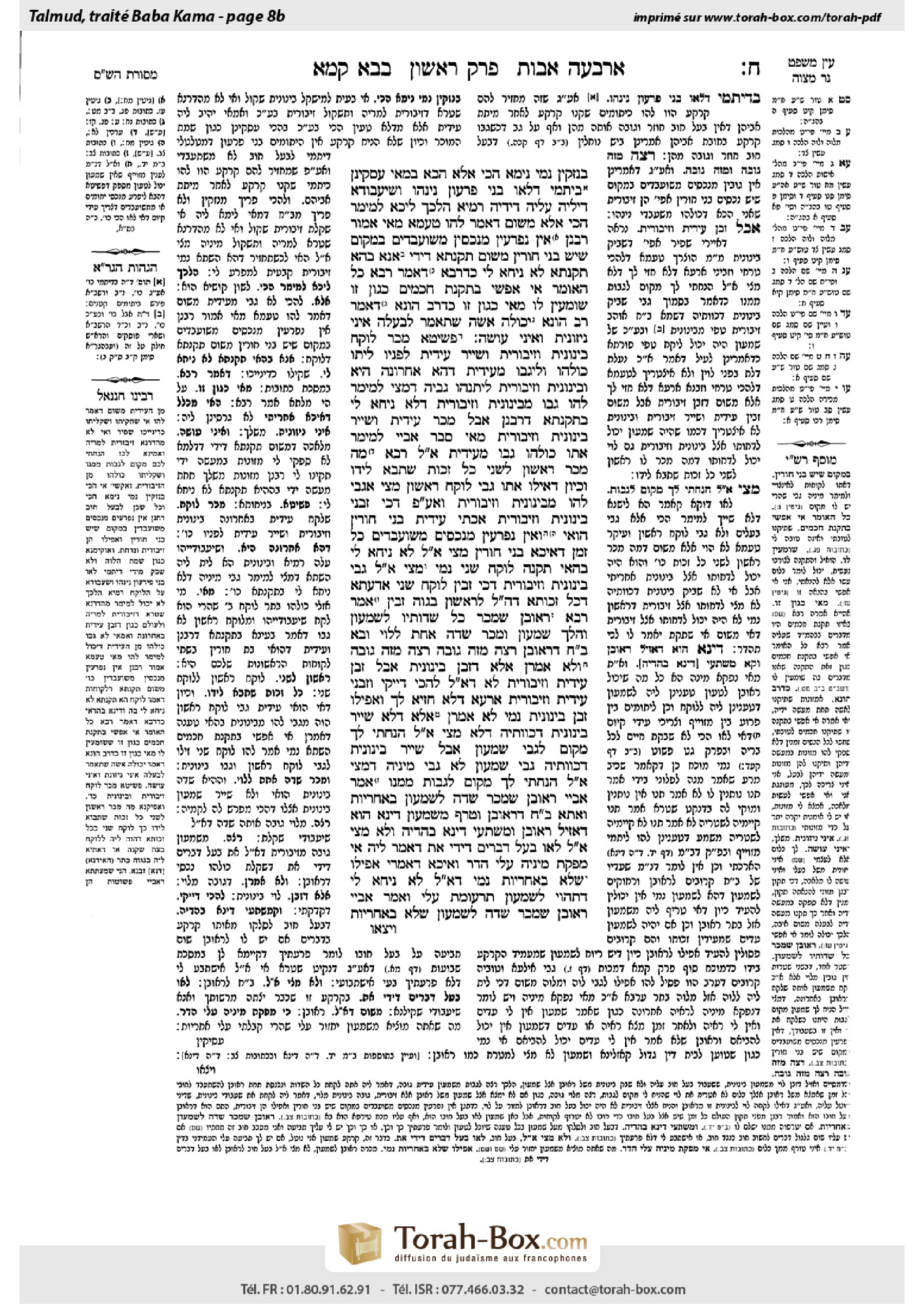
Bava Kamma 8b: Talmud study for Daf Yomi
Study the Talmud for Daf Yomi with scanned pages, Hebrew text, English translations from Sefaria and AI-generated French translations.
Passage selection and English or AI-generated French translation are available where the scan has annotations. Daf Study is independent of Torah-Box and Sefaria.
Browse Bava Kamma · בבא קמא · All tractatesBava Kamma 8b text and translations
This page of Bava Kamma includes the Aramaic text, an English translation and an AI-generated French translation, alongside the scan above.
בבא קמא ח׳ ב · Aramaic and Hebrew text
בְּנִזָּקִין נָמֵי נֵימָא הָכִי!
אֶלָּא הָכָא בְּמַאי עָסְקִינַן – בְּיַתְמֵי, דְּלָאו בְּנֵי פֵרָעוֹן נִינְהוּ, וְשִׁיעְבּוּדָא דִּילֵיהּ עֲלֵיהּ דִּידֵיהּ רַמְיָא;
הִלְכָּךְ לֵיכָּא לְמֵימַר הָכִי.
אֶלָּא מִשּׁוּם דְּאָמַר לְהוּ: טַעְמָא מַאי אֲמוּר רַבָּנַן אֵין נִפְרָעִין מִנְּכָסִין מְשׁוּעְבָּדִים בְּמָקוֹם שֶׁיֵּשׁ בְּנֵי חוֹרִין – מִשּׁוּם תַּקַּנְתָּא דִּידִי; אֲנָא בְּהָא תַּקַּנְתָּא לָא נִיחָא לִי.
כִּדְרָבָא – דְּאָמַר רָבָא: כׇּל הָאוֹמֵר אִי אֶפְשִׁי בְּתַקָּנַת חֲכָמִים כְּגוֹן זוֹ – שׁוֹמְעִין לוֹ.
מַאי ״כְּגוֹן זוֹ״?
כִּדְרַב הוּנָא – דְּאָמַר רַב הוּנָא, יְכוֹלָה אִשָּׁה שֶׁתֹּאמַר לְבַעְלָהּ: אֵינִי נִיזּוֹנֶית, וְאֵינִי עוֹשָׂה.
פְּשִׁיטָא, מָכַר לוֹקֵחַ בֵּינוֹנִית וְזִיבּוּרִית, וְשִׁיֵּיר עִידִּית לְפָנָיו – לֵיתוֹ כּוּלְּהוּ וְלִיגְבּוֹ מֵעִידִּית;
דְּהָא אַחֲרוֹנָה הִיא, וּבֵינוֹנִית וְזִיבּוּרִית לֵיתַנְהוּ גַּבֵּיהּ דְּמָצֵי לְמֵימַר לְהוּ: גְּבוֹ מִבֵּינוֹנִית וְזִיבּוּרִית, דְּלָא נִיחָא לִי בְּתַקַּנְתָּא דְּרַבָּנַן.
אֲבָל מָכַר עִידִּית, וְשִׁיֵּיר בֵּינוֹנִית וְזִיבּוּרִית, מַאי?
סְבַר אַבָּיֵי לְמֵימַר: אָתוּ כּוּלְּהוּ גָּבוּ מֵעִידִּית.
אֲמַר לֵיהּ רָבָא: מָה מָכַר רִאשׁוֹן לַשֵּׁנִי – כׇּל זְכוּת שֶׁתָּבֹא לְיָדוֹ; וְכֵיוָן דְּאִילּוּ אָתוּ גַּבֵּי לוֹקֵחַ רִאשׁוֹן – מָצֵי (אַגְבֵּי לְהוּ) [לְאַגְבּוֹיִינְהוּ] מִבֵּינוֹנִית וְזִיבּוּרִית, וְאַף עַל פִּי דְּכִי זַבְנִי[נְהוּ לְ]בֵינוֹנִית וְזִיבּוּרִית אַכַּתִּי עִידִּית (בְּנֵי) [בַּת] חוֹרִין הֲוַאי – וְאֵין נִפְרָעִין מִנְּכָסִים מְשׁוּעְבָּדִים כׇּל זְמַן דְּאִיכָּא בְּנֵי חוֹרִין; מָצֵי אָמַר לְהוּ: לָא נִיחָא לִי בְּהַאי תַּקָּנָה;
לוֹקֵחַ שֵׁנִי נָמֵי, מָצֵי אָמַר לְהוּ: גְּבֵי בֵּינוֹנִית וְזִיבּוּרִית. דְּכִי זָבֵין לוֹקֵחַ שֵׁנִי, אַדַּעְתָּא דְּכֹל זְכוּתָא דַּהֲוָה לֵיהּ לְרִאשׁוֹן בְּגַוַּהּ זָבֵין.
אָמַר רָבָא: רְאוּבֵן שֶׁמָּכַר כׇּל שְׂדוֹתָיו לְשִׁמְעוֹן, וְהָלַךְ שִׁמְעוֹן וּמָכַר שָׂדֶה אַחַת לְלֵוִי, וּבָא בַּעַל חוֹב דִּרְאוּבֵן; רָצָה – מִזֶּה גּוֹבֶה, רָצָה – מִזֶּה גּוֹבֶה. וְלָא אֲמַרַן אֶלָּא דִּזְבַן בֵּינוֹנִית,
אֲבָל זְבַן עִידִּית וְזִיבּוּרִית – לָא, דַּאֲמַר לֵיהּ: לְהָכִי דְּיַיקִי וּזְבַנִי עִידִּית וְזִיבּוּרִית, אַרְעָא דְּלָא חַזְיָא לָךְ.
וַאֲפִילּוּ זְבַן בֵּינוֹנִית נָמֵי, לָא אֲמַרַן אֶלָּא דְּלָא שַׁיַּיר בֵּינוֹנִית דִּכְווֹתַיהּ, דְּלָא מָצֵי אָמַר לֵיהּ: הִנַּחְתִּי לְךָ מָקוֹם לְגַבֵּי שִׁמְעוֹן. אֲבָל שַׁיַּיר בֵּינוֹנִית דִּכְווֹתַיהּ גַּבֵּי שִׁמְעוֹן – לָא גָּבֵי מִינֵּיהּ, דְּמָצֵי אָמַר לֵיהּ: הִנַּחְתִּי לְךָ מָקוֹם לִגְבּוֹת מִמֶּנּוּ.
אָמַר אַבָּיֵי: רְאוּבֵן שֶׁמָּכַר שָׂדֶה לְשִׁמְעוֹן בְּאַחְרָיוּת, וַאֲתָא בַּעַל חוֹב דִּרְאוּבֵן וּטְרַף מִשִּׁמְעוֹן, דִּינָא הוּא דְּאָזֵיל רְאוּבֵן וּמִשְׁתַּעֵי דִּינָא בַּהֲדֵיהּ; וְלָא מָצֵי אָמַר לֵיהּ: לָאו בַּעַל דְּבָרִים דִּידִי אַתְּ, דְּאָמַר לֵיהּ: אִי מַפְּקַתְּ מִינֵּיהּ – עֲלַי הָדַר.
וְאִיכָּא דְּאָמְרִי: אֲפִילּוּ שֶׁלֹּא בְּאַחְרָיוּת נָמֵי, דְּאָמַר לֵיהּ: לָא נִיחָא לִי דְּתֶהְוֵי לְשִׁמְעוֹן תַּרְעוֹמֶת עֲלַי.
וְאָמַר אַבָּיֵי: רְאוּבֵן שֶׁמָּכַר שָׂדֶה לְשִׁמְעוֹן שֶׁלֹּא בְּאַחְרָיוּת,
Bava Kamma 8b · English translation
then also with regard to damages, let the buyer say this to the injured party. He could threaten to return the bill of sale of the inferior-quality land to the debtor, which would force the injured party to collect directly from the debtor’s inferior-quality land. Since the buyer can do so, he can effectively force the injured party to collect from the purchased intermediate-quality land instead of fulfilling his right to collect from superior-quality land. Yet, the baraita teaches that in this case each party collects from the land that was originally liened to him, which means that damages are collected from the superior-quality land, indicating that this threat would not be effective.
Rather, with what are we dealing here? We are dealing with a case in which the debtor died and his inheritors are his orphans, who are not subject to an obligation to repay the debts of their father. When one dies, his monetary debts are not inherited by his children. And therefore, the lien of the creditor rests solely upon the buyer of the land. Any lien that was in effect with regard to the land he owned at the time he incurred the obligation remains, and his creditors can therefore collect what they are owed from that land, even if it is in the possession of a buyer.
Therefore, one cannot say that the ruling in the baraita is based on the fact that the buyer can threaten to return the bill of sale to the debtor, or in this case, to his orphans. In this case, even if he were to return the bill of sale, the creditors would not be able to collect from the land now in the orphans’ possession, as they received it anew, not as an inheritance from their father. Therefore, the creditors can still collect from the plots of land that remain with the buyer.
The Gemara suggests another explanation of the Tosefta: Rather, not all the creditors collect from the superior-quality land, which was the last plot of land purchased from the debtor, because the buyer can say to them: What is the reason that the Sages said one is not paid from liened property, i.e., property liened to a creditor that has been sold by the debtor, whenever there is unsold property still in the debtor’s possession? It is due to an ordinance created solely for my benefit, as I should not be expected to pay from the land I purchased when the debtor is still able to pay. If that ordinance were to be in effect in this case, all of their liens would be in effect with regard to the superior-quality land, as that was purchased last. In this case I do not find this ordinance satisfactory to me, and I would prefer for the lien of each creditor to remain in effect with regard to the land it had been on initially, and I will give each of you that land.
The Gemara notes: This fact that one is not required to avail himself of the financial benefit provided by a rabbinic ordinance is in accordance with the opinion of Rava. As Rava says: Anyone who says: I do not want to avail myself of the financial benefit provided by an ordinance of the Sages, such as this one, one listens to him.
The Gemara asks: What does Rava mean by saying: An ordinance of the Sages, such as this one?
The Gemara answers: His statement is in accordance with the opinion of Rav Huna. As Rav Huna says: The Sages enacted that a husband must sustain his wife. They also enacted that he receives her earnings in exchange. Yet, a wife is legally entitled to say to her husband: I will not be sustained by you, and in turn I will not work i.e., you will not keep my earnings. Since his obligation to sustain her is only for her benefit, she may forgo her sustenance and retain her earnings for herself.
The Gemara discusses a limitation on the buyer’s ability to refuse the benefit of the rabbinic ordinance: It is obvious that if the buyer sold, of the land he purchased from the debtor, the intermediate- and inferior-quality land to another buyer and retained in his possession only the superior-quality land, which he had purchased last, then all the creditors may come and collect from the superior-quality land.
For if the intermediate-quality and inferior quality land were in his possession, he would be able to say to the creditors: Collect from the intermediate-quality land and from the inferior-quality land, as it is not satisfactory to me to avail myself of the ordinance of the Sages. Now that he has sold the land of intermediate and inferior quality, however, he cannot unilaterally waive the ordinance without the consent of the second buyer. The second buyer benefits from the ordinance, since it compels the creditors to collect from the first buyer, and he will therefore certainly not agree to waive it.
But if the first buyer sold only the superior-quality land that he had purchased last, and he retained in his possession the intermediate-quality and inferior-quality land, what is the halakha?
Abaye thought to say: All the creditors should come and collect from the superior-quality land. Since that land was the last plot of land in the debtor’s possession, the creditors’ right of collection was restricted to that land, irrespective of the fact that it was then subsequently sold twice.
Rava said to him: What has the first person sold to the second in any sale? Any rights that will come into his possession. And since, if the creditors were to come to the first buyer while he was still in possession of all three plots of land, he could have had them collect from the intermediate-quality and inferior-quality land; and this is the halakha even though when he initially purchased the intermediate-quality and inferior-quality land the superior-quality land was still unsold property in the debtor’s possession. As although there is the rabbinic ordinance that one does not exact payment from liened property when there is unsold property still in the debtor’s possession, the buyer could have said to them: I do not find this ordinance satisfactory to me.
Rava continues: Therefore, since the first buyer had the right to say this, the second buyer can also say to them: Collect from the intermediate-quality and inferior-quality land in the first buyer’s possession. As, when the second buyer purchased the superior-quality land, he purchased it with the understanding that he also acquired all the rights that the first buyer had with regard to that land. Accordingly, he also acquires the right to insist that the creditors collect from the intermediate-quality and inferior-quality land.
In a related ruling, Rava says: In the case of Reuven, who sold all of his fields to Shimon simultaneously and Shimon proceeded to sell one field of those purchased to Levi, and Reuven’s creditor came to collect the debt, if the creditor so desires, he collects from this one, i.e., Shimon, and if he so desires, he collects from that one, i.e., Levi. And we said this only in a case where Levi purchased intermediate-quality land from Shimon. A creditor’s right is to collect the debt from intermediate-quality land. Accordingly, in this case, Reuven’s creditor can collect his loan from the intermediate-quality land even after it has been transferred into Levi’s possession. Nevertheless, if he so desires, he may insist on collecting his loan from any inferior-quality land left in Shimon’s possession. This is because a creditor also has the right to demand payment from a borrower’s inferior-quality land instead of his intermediate-quality land, and therefore that land is also liened to the loan.
But if Levi purchased superior-quality and inferior-quality land from Shimon, no, the creditor can collect only from Shimon’s intermediate-quality land, as Levi could say to him: For this reason I was particular to purchase superior-quality and inferior-quality land, which is land that is not fit for you to collect from as a creditor.
And if Levi purchased the intermediate-quality land from Shimon as well, we said that Reuven’s creditor can collect from him only in a case where he did not leave some similar intermediate-quality land in Shimon’s possession, as in that case, Levi is unable to say to the creditor: I left a place for you, i.e., a plot of land, in Shimon’s possession, from which to collect. But where Levi did leave some similar intermediate-quality land in Shimon’s possession, the creditor does not collect from Levi, as Levi is able to say to him: I left a place for you from which to collect.
In another related ruling, Abaye says: In the case of Reuven, who sold a field liened to his creditor to Shimon with a guarantee, meaning that Reuven agreed to reimburse Shimon should Reuven’s creditor collect the debt from that field, and Reuven’s creditor came and seized the field from Shimon, the halakha is that Reuven can go and litigate with his creditor and claim that he had already repaid the debt, and insist that the field be returned to Shimon. And the creditor is unable to say to Reuven: I am not legally answerable to you, as I am not taking away your land, since you sold it to Shimon. This is because Reuven could say to him: If you extract the field from him, Shimon will return to me and demand that I reimburse him for his loss. Consequently, I am involved in this matter.
And there are those who say: Even in a case where he sold the field without a guarantee, as well, in which case even if the creditor seizes Shimon’s land there are no legal consequences for Reuven, Reuven can litigate with the creditor, as he could say to him: It is not satisfactory for me for Shimon to have a grievance against me because he lost the field I sold him on account of the fact that I was unable to pay my debt. Consequently, I am involved in this matter.
And in another related ruling, Abaye says: In the case of Reuven, who sold a field to Shimon without a guarantee,
Bava Kamma 8b · Traduction française (IA)
En ce qui concerne les dommages, le vendeur peut dire cela à la partie blessée. Il pourrait menacer de rendre le contrat de vente du terrain de qualité inférieure au débiteur, ce qui obligerait la partie blessée à récupérer directement sur le terrain de qualité inférieure du débiteur. Puisque le vendeur peut le faire, il peut ainsi forcer la partie blessée à récupérer sur le terrain de qualité intermédiaire acheté plutôt que d'exercer son droit de récupérer sur le terrain de qualité supérieure. Cependant, la baraïta enseigne que dans ce cas, chaque partie récupère sur le terrain qui lui était initialement lié, ce qui signifie que les dommages sont récupérés sur le terrain de qualité supérieure, indiquant que cette menace ne serait pas efficace.
En réalité, de quoi sommes-nous en train de parler ? Nous parlons d'un cas où le débiteur est décédé et ses héritiers sont ses orphelins, qui ne sont pas soumis à l'obligation de rembourser les dettes de leur père. Lorsqu'une personne meurt, ses dettes monétaires ne sont pas héritées par ses enfants. Par conséquent, le droit de gage du créancier repose uniquement sur l'acheteur du terrain. Tout gage qui était en vigueur concernant le terrain qu'il possédait lorsqu'il a contracté l'obligation reste en place, et ses créanciers peuvent donc récupérer ce qu'ils doivent de ce terrain, même s'il est en possession d'un acheteur.
Par conséquent, on ne peut pas dire que la décision de la baraïta s'appuie sur le fait que le vendeur puisse menacer de rendre le contrat de vente au débiteur, ou, dans ce cas, à ses orphelins. Dans ce cas, même s'il le faisait, les créanciers ne pourraient pas récupérer sur le terrain désormais en possession des orphelins, car ils l'ont reçu de nouveau, et non en héritage de leur père. Par conséquent, les créanciers peuvent toujours récupérer sur les parcelles de terrain restant avec l'acheteur.
La Guemara suggère une autre explication de la Tosefta : En réalité, ce n'est pas tous les créanciers qui récupèrent sur le terrain de qualité supérieure, qui était la dernière parcelle achetée auprès du débiteur, car le vendeur peut dire aux créanciers : Quel est le motif pour lequel les Sages ont dit qu'on ne récupère pas sur la propriété gageée, c'est-à-dire sur une propriété gageée par un créancier qui a été vendue par le débiteur, lorsqu'il reste encore des biens non vendus dans la possession du débiteur ? C'est en raison d'un ordonnance créé uniquement à mon bénéfice, car je ne devrais pas être attendu à payer sur le terrain que j'ai acheté lorsque le débiteur est encore en mesure de payer. Si cet ordonnance était en vigueur dans ce cas, tous leurs gages seraient en vigueur concernant le terrain de qualité supérieure, car c'était le dernier acheté. Dans ce cas, je ne trouve pas cet ordonnance satisfaisant à moi, et je préfère que le gage de chaque créancier reste en vigueur concernant le terrain sur lequel il était initialement, et je donnerai à chacun de vous ce terrain.
La Guemara note : Ce fait que l'on n'est pas tenu de profiter du bénéfice financier offert par un ordonnance rabbinique est conforme à l'opinion de Rava. Comme Rava dit : Quiconque dit : Je ne veux pas profiter du bénéfice financier offert par un ordonnance des Sages, tel que celui-ci, on écoute ce qu'il dit.
La Guemara pose la question : De quoi Rava veut-il parler lorsqu'il dit : Un ordonnance des Sages, tel que celui-ci ?
La Guemara répond : Son déclaration correspond à l'opinion de Rav Huna. Comme Rav Huna dit : Les Sages ont institué que le mari doit subvenir aux besoins de sa femme. Ils ont aussi institué qu'il reçoit ses revenus en échange. Cependant, la femme a le droit légal de dire à son mari : Je ne veux pas être subventionnée par vous, et en retour je ne travaillerai pas, c'est-à-dire que vous ne conserverez pas mes revenus. Puisque son obligation de subventionner est uniquement pour son bénéfice, elle peut renoncer à son subsistance et conserver ses revenus pour elle-même.
La Guemara discute d'une limitation sur la capacité du vendeur à refuser le bénéfice de l'ordonnance rabbinique : Il est évident que si le vendeur a vendu, du terrain qu'il a acheté auprès du débiteur, les terrains de qualité intermédiaire et inférieure à un autre acheteur et a conservé en sa possession uniquement le terrain de qualité supérieure, qui était le dernier acheté, alors tous les créanciers pourront venir et récupérer sur le terrain de qualité supérieure.
Car si les terrains de qualité intermédiaire et inférieure étaient en sa possession, il pourrait dire aux créanciers : Récupérez sur les terrains de qualité intermédiaire et inférieure, car cela ne me convient pas de profiter de l'ordonnance des Sages. Maintenant qu'il a vendu les terrains de qualité intermédiaire et inférieure, cependant, il ne peut pas unilatéralement renoncer à l'ordonnance sans le consentement du second acheteur. L'acheteur second bénéficie de l'ordonnance, car elle oblige les créanciers à récupérer auprès du premier acheteur, et il ne consentira donc certainement pas à la renoncer.
Mais si le premier acheteur a vendu uniquement le terrain de qualité supérieure qu'il avait acheté en dernier, et qu'il a conservé en sa possession les terrains de qualité intermédiaire et inférieure, quelle est la halakha ?
Abaye pensait dire : Tous les créanciers devraient venir et récupérer sur le terrain de qualité supérieure. Puisque ce terrain était la dernière parcelle dans la possession du débiteur, le droit de récupération des créanciers était limité à ce terrain, indépendamment du fait qu'il ait été ensuite vendu deux fois.
Rava a dit à lui : Quel est le sens de la vente que le premier a fait au second ? Toute propriété qui entrera en sa possession. Et puisque, si les créanciers venaient au premier acheteur alors qu'il était encore en possession de toutes les trois parcelles, il aurait pu les faire récupérer sur les terrains de qualité intermédiaire et inférieure ; et c'est la halakha même si, lorsqu'il a initialement acheté les terrains de qualité intermédiaire et inférieure, le terrain de qualité supérieure était encore une propriété non vendue dans la possession du débiteur. Bien que l'ordonnance rabbinique stipule que l'on ne peut pas exiger un paiement sur une propriété gageée lorsqu'il reste encore des biens non vendus dans la possession du débiteur, le vendeur aurait pu dire aux créanciers : Je ne trouve pas cet ordonnance satisfaisant à moi.
Rava continue : Par conséquent, puisque le premier acheteur avait le droit de dire cela, le second acheteur peut aussi dire à ceux-ci : Recueillez auprès des terres de qualité intermédiaire et inférieure qui sont dans la possession du premier acheteur. Car, lorsque le second acheteur a acheté la terre de qualité supérieure, il l'a achetée en sachant qu'il acquérait aussi tous les droits que le premier acheteur avait concernant cette terre. Ainsi, il acquiert aussi le droit de demander aux créanciers de recueillir auprès des terres de qualité intermédiaire et inférieure.
Dans une décision liée, Rava dit : Dans le cas de Réouven, qui a vendu tous ses champs à Simôn en même temps, et Simôn a ensuite vendu un de ces champs à Lévi, et le créancier de Réouven est venu réclamer son créance, si le créancier le désire, il peut réclamer auprès de celui-ci, c'est-à-dire Simôn, et si le créancier le désire, il peut réclamer auprès de celui-là, c'est-à-dire Lévi. Et nous avons dit cela uniquement dans le cas où Lévi a acheté une terre de qualité intermédiaire à Simôn. Le droit du créancier est de réclamer la créance auprès d'une terre de qualité intermédiaire. Ainsi, dans ce cas, le créancier de Réouven peut réclamer son prêt auprès de la terre de qualité intermédiaire même après qu'elle ait été transférée en possession de Lévi. Cependant, si le créancier le désire, il peut exiger que le prêt soit réclamé auprès de toute terre de qualité inférieure restant en possession de Simôn. Cela est dû au fait que le créancier a aussi le droit de demander le paiement auprès de la terre de qualité inférieure du prêteur plutôt que de la terre de qualité intermédiaire, et par conséquent cette terre est aussi liée au prêt.
Mais si Lévi a acheté à Simôn à la fois des terres de qualité supérieure et inférieure, non, le créancier ne peut réclamer que auprès de la terre de qualité intermédiaire de Simôn, car Lévi pourrait lui dire : Pour cette raison j'ai été particulièrement précis à acheter des terres de qualité supérieure et inférieure, qui sont des terres qui ne sont pas adaptées à votre réclamation en tant que créancier.
Et si Lévi a acheté la terre de qualité intermédiaire à Simôn également, nous avons dit que le créancier de Réouven peut réclamer auprès de lui uniquement dans le cas où il n'a pas laissé une terre similaire de qualité intermédiaire en possession de Simôn, car dans ce cas, Lévi ne peut pas dire au créancier : J'ai laissé une place pour vous, c'est-à-dire un terrain, en possession de Simôn, auprès duquel réclamer. Mais où Lévi a laissé une terre similaire de qualité intermédiaire en possession de Simôn, le créancier ne réclame pas auprès de Lévi, car Lévi peut lui dire : J'ai laissé une place pour vous auprès de laquelle réclamer.
Dans une autre décision liée, Abaye dit : Dans le cas de Réouven, qui a vendu un champ lié à son créancier à Simôn avec une garantie, c'est-à-dire que Réouven a convenu de réimputer à Simôn si le créancier de Réouven réclamait la dette à partir de ce champ, et le créancier de Réouven est venu et a saisi le champ à Simôn, la halakha est que Réouven peut aller en justice contre son créancier et affirmer qu'il a déjà remboursé la dette, et exiger que le champ soit rendu à Simôn. Et le créancier ne peut pas dire à Réouven : Je ne suis pas légalement responsable envers vous, car je ne prends pas votre terre, puisque vous l'avez vendue à Simôn. Cela est dû au fait que Réouven pouvait dire à lui : Si vous extrayez le champ de lui, Simôn reviendra vers moi et exige que je lui réimpute sa perte. Par conséquent, je suis impliqué dans cette affaire.
Et certains disent : Même dans le cas où il a vendu le champ sans garantie, car dans ce cas, même si le créancier saisit la terre de Simôn, il n'y a pas de conséquences juridiques pour Réouven, Réouven peut en justice avec le créancier, car il pourrait lui dire : Ce n'est pas satisfaisant pour moi que Simôn ait une réclamation contre moi à cause du fait qu'il a perdu le champ que j'ai vendu à cause de mon incapacité à payer ma dette. Par conséquent, je suis impliqué dans cette affaire.
Et dans une autre décision liée, Abaye dit : Dans le cas de Réouven, qui a vendu un champ à Simôn sans garantie,
Traduction française générée par IA à partir de l’édition anglaise de Sefaria. Vérifie toujours un passage avec le texte source.
Text from Sefaria: William Davidson Edition - Vocalized Aramaic (CC BY NC); William Davidson Edition - English (CC BY NC).