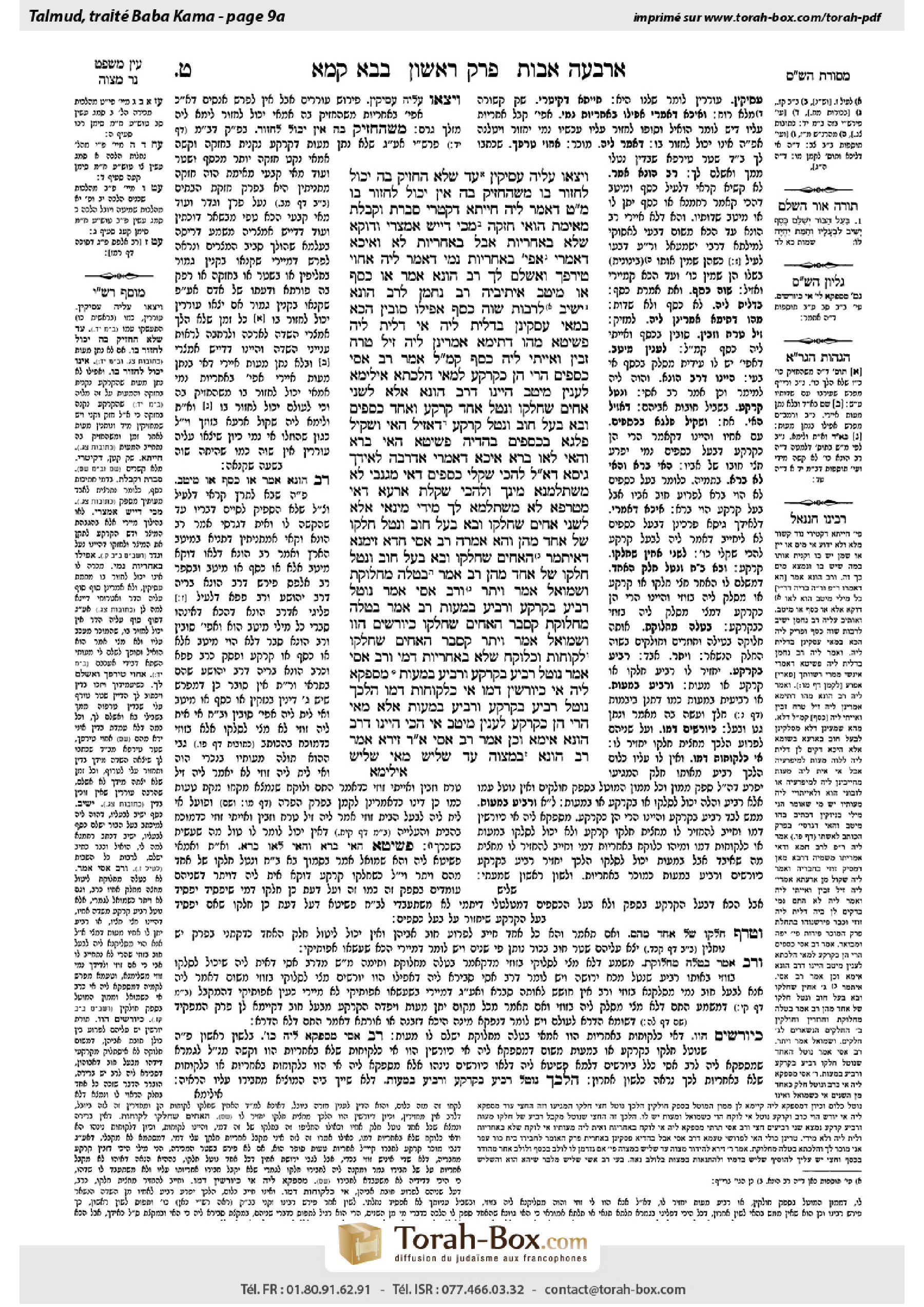
Bava Kamma 9a: Talmud study for Daf Yomi
Study the Talmud for Daf Yomi with scanned pages, Hebrew text, English translations from Sefaria and AI-generated French translations.
Passage selection and English or AI-generated French translation are available where the scan has annotations. Daf Study is independent of Torah-Box and Sefaria.
Browse Bava Kamma · בבא קמא · All tractatesBava Kamma 9a text and translations
This page of Bava Kamma includes the Aramaic text, an English translation and an AI-generated French translation, alongside the scan above.
בבא קמא ט׳ א · Aramaic and Hebrew text
וְיָצְאוּ עָלֶיהָ עֲסִיקִין; עַד שֶׁלֹּא הֶחְזִיק בָּהּ – יָכוֹל לַחֲזוֹר בּוֹ, מִשֶּׁהֶחְזִיק בָּהּ – אֵין יָכוֹל לַחֲזוֹר בּוֹ.
מַאי טַעְמָא? דְּאָמַר לֵיהּ: חַיְיתָא דְּקִטְרֵי סְבַרְתְּ וְקַבֵּלְתְּ.
מֵאֵימַת הֲוַאי חֲזָקָה? מִכִּי דָיֵישׁ אַמִּצְרֵי.
וְדַוְקָא שֶׁלֹּא בְּאַחְרָיוּת, אֲבָל בְּאַחְרָיוּת – לָא.
וְאִיכָּא דְּאָמְרִי: אֲפִילּוּ בְּאַחְרָיוּת נָמֵי, דַּאֲמַר לֵיהּ: אַחְוִי טִירְפָךְ וַאֲשַׁלֵּם לָךְ.
רַב הוּנָא אָמַר: אוֹ כֶּסֶף אוֹ מֵיטַב.
אֵיתִיבֵיהּ רַב נַחְמָן לְרַב הוּנָא: ״יָשִׁיב״ – לְרַבּוֹת שָׁוֶה כֶּסֶף, אֲפִילּוּ סוּבִּין!
הָכָא בְּמַאי עָסְקִינַן – בִּדְלֵית לֵיהּ. אִי דְּלֵית לֵיהּ, פְּשִׁיטָא! מַהוּ דְּתֵימָא, אָמְרִינַן לֵיהּ: זִיל טְרַח זַבֵּין, וְאַיְיתִי לֵיהּ כְּסַף; קָא מַשְׁמַע לַן.
אָמַר רַב אַסִּי: כְּסָפִים הֲרֵי הֵן כְּקַרְקַע. לְמַאי הִלְכְתָא? אִילֵּימָא לְעִנְיַן מֵיטַב – הַיְינוּ דְּרַב הוּנָא!
אֶלָּא לִשְׁנֵי אַחִים שֶׁחָלְקוּ, וְנָטַל אֶחָד קַרְקַע וְאֶחָד כְּסָפִים, וּבָא בַּעַל חוֹב וְנָטַל קַרְקַע; דְּאָזֵיל הַאי, וְשָׁקֵיל פַּלְגָא בִּכְסָפִים בַּהֲדֵיהּ.
פְּשִׁיטָא! הַאי בְּרָא וְהַאי לָאו בְּרָא?!
אִיכָּא דְּאָמְרִי אַדְּרַבָּה, לְאִידַּךְ גִּיסָא – דַּאֲמַר לֵיהּ: לְהָכִי שְׁקַלִי כְּסָפִים, דְּאִי מִגַּנְבִי – לָא מִשְׁתַּלַּמְנָא מִינָּךְ; וּלְהָכִי שָׁקְלַתְּ אַרְעָא – דְּאִי מִטַּרְפָא, לָא מִשְׁתַּלְּמָא לָךְ מִידֵּי מִינַּאי!
אֶלָּא לִשְׁנֵי אַחִים שֶׁחָלְקוּ, וּבָא בַּעַל חוֹב וְנָטַל חֶלְקוֹ שֶׁל אֶחָד מֵהֶן.
וְהָא אַמְרַהּ רַב אַסִּי חֲדָא זִימְנָא – דְּאִיתְּמַר: הָאַחִים שֶׁחָלְקוּ, וּבָא בַּעַל חוֹב וְנָטַל חֶלְקוֹ שֶׁל אֶחָד מֵהֶן, רַב אָמַר: בָּטְלָה מַחְלוֹקֶת. וּשְׁמוּאֵל אָמַר: וִיתֵּר. וְרַב אַסִּי אָמַר: נוֹטֵל רְבִיעַ בְּקַרְקַע, וּרְבִיעַ בְּמָעוֹת.
רַב אָמַר: בָּטְלָה מַחְלוֹקֶת – קָסָבַר: הָאַחִים שֶׁחָלְקוּ, כְּיוֹרְשִׁים הָווּ.
וּשְׁמוּאֵל אָמַר: וִיתֵּר – קָסָבַר: הָאַחִים שֶׁחָלְקוּ לָקוֹחוֹת, וּכְלוֹקֵחַ שֶׁלֹּא בְּאַחְרָיוּת דָּמֵי.
וְרַב אַסִּי אָמַר: נוֹטֵל רְבִיעַ בְּקַרְקַע וּרְבִיעַ בְּמָעוֹת – מְסַפְּקָא לֵיהּ אִי כְּיוֹרְשִׁין דָּמוּ אִי כְּלָקוֹחוֹת דָּמוּ, הִלְכָּךְ נוֹטֵל רְבִיעַ בְּקַרְקַע, וּרְבִיעַ בְּמָעוֹת!
אֶלָּא: מַאי ״הֲרֵי הֵן כְּקַרְקַע״ – לְעִנְיַן מֵיטַב.
אִי הָכִי, הַיְינוּ דְּרַב הוּנָא! אֵימָא: וְכֵן אָמַר רַב אַסִּי.
אָמַר רַבִּי זֵירָא אָמַר רַב הוּנָא: בְּמִצְוָה – עַד שְׁלִישׁ.
מַאי שְׁלִישׁ?
Bava Kamma 9a · English translation
and claimants [asikin] come forth about the ownership of the land, disputing Reuven’s prior ownership, as long as Shimon has not yet taken possession of the land, he can retract his agreement to the transaction and is not required to pay for the land. Once he has taken possession of the land, he cannot retract his agreement to the transaction.
What is the reason that he cannot retract his agreement to the transaction once he has taken possession? As Reuven says to him: The purchase of the land was like purchasing a tied bag [ḥayta] whose contents are unknown and might not have any value. Since you were aware of and accepted that possibility, as you purchased it without a guarantee, you cannot retract your agreement.
The Gemara asks: From when is it considered that he has taken possession of the property? He takes possession from the time that he walks upon the boundaries of the land to inspect it.
The Gemara notes: And this is referring specifically to a case where the field was sold without a guarantee. But where it was sold with a guarantee this is not so, and Shimon can retract his agreement and refuse to pay for the land even after taking possession of it. The reason is that if the claimants succeed with their claims and seize the land, Reuven will then have to return the sum Shimon paid for it. In order to minimize judicial proceedings, the court allows Shimon to claim that there is no point in paying Reuven now only to have his money returned to him later. Therefore, he can retract his agreement to the transaction.
And there are those who say that even where the field was sold with a guarantee, Shimon is unable to retract his agreement to the transaction, as Reuven has the legal right to say to him: First show me the claim authorization document, which a court provides to a buyer when the land he purchased is seized from him by a third party who proved that he had a lien on the land, and only then I will pay you. Consequently, Shimon cannot claim that there is no point in paying Reuven now, after he agreed to the sale but before a third party seized the land, as even if the land will be seized it does not automatically follow that Reuven will have to reimburse Shimon.
§ The Gemara returns to its earlier discussion concerning the form of the payment of damages: Rav Huna says: Damages are paid either with money or with one’s best-quality land.
Rav Naḥman raised an objection to Rav Huna from a baraita: The verse states: “He shall recompense money to its owner” (Exodus 21:34), which serves to include items worth money, even bran, a relatively inferior commodity, as valid forms of payment.
Rav Huna replied: With what are we dealing here in the baraita? We are dealing with a case where he does not have any money or land. The Gemara asks: If he does not have any other means with which to pay, isn’t it obvious that he can pay using what he has? The Gemara explains: Lest you say that we would say to him: Go to the trouble of selling whatever commodity you own, and thereby bring him money as payment for the damage, the baraita teaches us that it is unnecessary to sell one’s possessions and pay with money.
Rav Asi says: Money is equivalent to land. The Gemara asks: With regard to what halakha are they equivalent? If we say that it is with regard to fulfilling the requirement of paying with one’s best-quality land, meaning that he can choose to pay with money instead, this is precisely the ruling of Rav Huna; and yet the ruling of Rav Asi is presented as an independent ruling.
Rather, Rav Asi is referring to a case of two brothers who divided their inheritance, and one took land and the other one took money, and subsequently their father’s creditor came and took the land, as it was liened to his loan. Rav Asi’s ruling teaches that this brother whose land was taken can go and take a half share of the money together with his brother.
The Gemara rejects this explanation: Isn’t that obvious? Is this one a son and that one not a son? Since they are both sons and equally inherited the estate of their father, they share responsibility for their father’s debts. If the creditor takes repayment of the debt from one brother, the other one must reimburse him.
There are those who say that the Gemara rejects this explanation not because it is obvious, but on the contrary, because it is incorrect. As, one could look at it from the opposite direction, saying that one brother could say to the other: It was with this understanding that I took the money, that if it would be stolen from me I would not be reimbursed from your land, and it was with this understanding that you took the land, that if it would be seized from you by a creditor you would not be reimbursed from my money.
Rather, Rav Asi is referring to a case of two brothers who divided the land they inherited from their father, and their father’s creditor came and took the portion of one of them. Since the brothers carry joint responsibility for their father’s debt, the one whose portion was seized has a right to be reimbursed by his brother. Rav Asi’s ruling teaches that this may be done either by redistributing the remaining portion of land or by reimbursing him with money.
The Gemara asks: But didn’t Rav Asi already explicitly say that ruling once before? Therefore, this cannot be the explanation of this ruling. As it was stated: In a case of brothers who divided the land they inherited from their father, and their father’s creditor came and took the portion of one of them, Rav says that the initial division of the land is voided and any remaining land is divided equally between the brothers. Shmuel says that each brother, upon taking his portion, relinquished [viter] any rights to be reimbursed if his portion were lost. And Rav Asi says that the brother whose portion was seized has a right to receive half of the remaining inheritance: He takes a quarter in land, and he takes the other quarter in money.
The Gemara explains the rationale behind each opinion: Rav says that the initial division of the land is voided. This is because he holds that brothers who divided their inheritance are considered to still be similar to heirs with respect to the inheritance, and therefore they continue to share joint responsibility for their father’s debts. Consequently, any remaining land is divided equally between the brothers.
And Shmuel says that each brother, upon taking his portion, relinquished any rights to be reimbursed if his portion were lost, as he holds that brothers who divided their inheritance are considered to be like buyers of their respective portions, and each one is considered to be similar to a buyer who bought his portion without a guarantee that would have provided him with a right to be reimbursed if his portion were seized by a creditor.
And Rav Asi says that the brother whose portion was seized has the right to receive half the remaining inheritance. He takes a quarter in land and he takes the other quarter in money. This is because he is uncertain as to whether they are similar to heirs, in which case the remaining land should be redistributed between them, or whether they are similar to buyers who bought their portions with a guarantee, in which case the brother whose portion was taken should be reimbursed by his brother with a sum of money equal to the value of the land that was seized from him. Therefore, he takes a quarter in land and he takes the other quarter in money.
As Rav Asi had already stated the halakha of brothers who divided their inheritance, the Gemara suggests another explanation of his statement. Rather, with regard to what did Rav Asi state that money is equivalent to land? He stated it with regard to the requirement of paying with one’s best-quality land, and is teaching that one may choose to pay with money instead of land.
The Gemara repeats its original rejection of this suggestion: If so, then this is precisely the ruling of Rav Huna, and yet Rav Asi is presented as an independent ruling. The Gemara resolves the problem: Emend the statement and say: And similarly, Rav Asi said.
§ Rabbi Zeira says that Rav Huna says: For the purchase of an object with which to fulfill a mitzva, one should spend up to one-third.
The Gemara asks: To what does this one-third refer?
Bava Kamma 9a · Traduction française (IA)
et les demandeurs [asikin] s'élèvent concernant la propriété du terrain, contestant la propriété antérieure de Réouven, tant que Shim'on n'a pas encore pris possession du terrain, il peut rétracter son accord à la transaction et n'est pas tenu de payer pour le terrain. Une fois qu'il a pris possession du terrain, il ne peut plus rétracter son accord à la transaction.
Pourquoi ne peut-il plus rétracter son accord à la transaction une fois qu'il a pris possession ? Réouven dit à lui : L'achat du terrain était comme l'achat d'une sac de marchandises [ḥayta] dont le contenu est inconnu et pourrait ne pas avoir de valeur. Puisque vous étiez conscient de cette possibilité et l'avez acceptée, en achetant sans garantie, vous ne pouvez plus rétracter votre accord.
La Guemara pose la question : À partir de quand est-il considéré qu'il a pris possession de la propriété ? Il prend possession à partir du moment où il marche sur les limites du terrain pour l'inspecter.
La Guemara note : Et cela fait référence spécifiquement à un cas où le champ a été vendu sans garantie. Mais dans le cas où il a été vendu avec une garantie, cela n'est pas ainsi, et Shim'on peut rétracter son accord à la transaction et refuser de payer pour le terrain même après avoir pris possession de celui-ci. La raison est que si les demandeurs réussissent à faire valoir leurs revendications et s'emparent du terrain, Réouven devra alors rembourser la somme que Shim'on a payée. Afin de minimiser les procédures judiciaires, la cour permet à Shim'on de dire qu'il n'y a plus de raison de payer à Réouven maintenant, seulement pour avoir son argent rendu plus tard. Ainsi, il peut rétracter son accord à la transaction.
Et certains disent que même dans le cas où le champ a été vendu avec une garantie, Shim'on ne peut pas rétracter son accord à la transaction, car Réouven a le droit légal de lui dire : D'abord montre-moi le document de réclamation, que la cour fournit à un acheteur lorsque le terrain qu'il a acheté est s'emparé par un tiers qui a prouvé qu'il avait un droit sur le terrain, et seulement alors je te paierai. Ainsi, Shim'on ne peut pas dire qu'il n'y a plus de raison de payer à Réouven maintenant, après qu'il ait accepté la vente mais avant qu'un tiers ne s'empare du terrain, car même si le terrain sera s'emparé, cela ne signifie pas automatiquement que Réouven devra rembourser Shim'on.
§ La Guemara reprend sa discussion précédente concernant la forme du paiement des dommages : Rav Huna dit : Les dommages sont payés soit avec de l'argent, soit avec la meilleure terre de l'acheteur.
Rav Naḥman a soulevé une objection contre Rav Huna à partir d'une baraïta : La parole dit : « Il devra réparer l'argent à son propriétaire » (Exode 21:34), ce qui sert à inclure des objets ayant de la valeur, même la farine, un produit relativement inférieur, comme des formes de paiement valides.
Rav Huna a répondu : Avec quoi sommes-nous ici dans la baraïta ? Nous sommes ici dans un cas où il n'a pas d'argent ni de terre. La Guemara pose la question : Si il n'a pas d'autres moyens pour payer, n'est-ce pas évident qu'il puisse payer avec ce qu'il a ? La Guemara explique : Pour éviter que vous ne disiez qu'on devrait lui dire de se donner la peine de vendre tout ce qu'il possède, et ainsi d'apporter de l'argent comme paiement pour le dommage, la baraïta nous apprend que cela n'est pas nécessaire de vendre ses possessions et de payer avec de l'argent.
Rav Asi dit : L'argent est équivalent à la terre. La Guemara pose la question : Concernant quelle halakha sont-ils équivalents ? Si nous disons qu'il s'agit de la halakha concernant le paiement avec la meilleure terre de l'acheteur, c'est-à-dire qu'il peut choisir de payer avec de l'argent au lieu de la terre, c'est précisément la décision de Rav Huna ; et pourtant, la décision de Rav Asi est présentée comme une décision indépendante.
Plutôt, Rav Asi fait référence à un cas de deux frères qui ont divisé leur héritage, et l'un a pris la terre et l'autre l'argent, et ensuite le créancé de leur père est venu et a pris la terre, car elle était liée à son prêt. La décision de Rav Asi enseigne que ce frère dont la terre a été prise peut aller prendre une part égale de l'argent avec son frère.
La Guemara rejette cette explication : N'est-ce pas évident ? Est-ce que l'un est un fils et que l'autre ne l'est pas ? Puisque ce sont tous les deux des fils et héritent équitablement de l'héritage de leur père, ils partagent la responsabilité de leurs dettes de leur père. Si le créancé récupère le paiement de la dette auprès d'un frère, l'autre doit le compenser.
Certains disent que la Guemara rejette cette explication non parce qu'elle est évidente, mais au contraire, parce qu'elle est incorrecte. En effet, on pourrait y regarder d'un autre côté, en disant que l'un des frères pourrait dire à l'autre : C'était avec cette compréhension que j'ai pris l'argent, que si cela serait volé de moi, je ne serais pas récompensé par ta terre, et c'était avec cette compréhension que tu as pris la terre, que si elle serait s'emparée par un créancé, tu ne serais pas récompensé par mon argent.
Plutôt, Rav Asi fait référence à un cas de deux frères qui ont divisé la terre qu'ils avaient héritée de leur père, et le créancier de leur père est venu et a pris la part d'un d'eux. Puisque les frères portent une responsabilité commune pour la dette de leur père, celui dont la part a été s'emparée a le droit de se faire rembourser par son frère. La décision de Rav Asi enseigne que cela peut être fait soit en redistribuant la part restante de la terre, soit en lui remboursant avec de l'argent.
La Guemara pose la question : Mais n’avait-il pas déjà dit Rav Asi explicitement que la décision avait déjà été rendue ? Ainsi, cela ne peut pas être l’explication de cette décision. Comme il a été dit : Dans un cas de frères qui ont divisé la terre qu’ils avaient héritée de leur père, et que le créancé de leur père est venu et a pris la part d’un d’eux, Rav dit que la première division de la terre est annulée et que toute terre restante est divisée également entre les frères. Shmuel dit que chaque frère, en prenant sa part, a renoncé à tout droit de réclamation en cas de perte de sa part. Et Rav Asi dit que le frère dont la part a été saisie a le droit de recevoir la moitié de l’héritage restant : il prend un quart de terre et l’autre quart en argent.
La Guemara explique la raison de chaque opinion : Rav dit que la première division de la terre est annulée. Cela est dû au fait qu’il considère que les frères qui ont divisé leur héritage sont encore considérés comme des héritiers envers l’héritage, et qu’ils continuent donc à partager la responsabilité commune envers les dettes de leur père. Ainsi, toute terre restante est divisée également entre les frères.
Et Shmuel dit que chaque frère, en prenant sa part, a renoncé à tout droit de réclamation en cas de perte de sa part, car il considère que les frères qui ont divisé leur héritage sont comme des acheteurs de leurs portions respectives, et chaque frère est considéré comme un acheteur qui a acheté sa portion sans garantie qui lui aurait donné le droit de réclamation en cas de saisie de sa part par un créancier.
Et Rav Asi dit que le frère dont la part a été saisie a le droit de recevoir la moitié de l’héritage restant. Il prend un quart de terre et l’autre quart en argent. Cela est dû au fait qu’il est incertain quant à ce qu’ils sont considérés comme des héritiers, dans ce cas la terre restante devrait être redistribuée entre eux, ou comme des acheteurs qui ont acheté leurs portions avec une garantie, dans ce cas le frère dont la part a été saisie devrait être indemnisé par son frère avec une somme d’argent égale à la valeur de la terre saisie. Ainsi, il prend un quart de terre et l’autre quart en argent.
Comme Rav Asi avait déjà établi la halakha concernant les frères qui ont divisé leur héritage, la Guemara suggère une autre explication de son affirmation. Plutôt, à propos de quoi Rav Asi a-t-il dit que l’argent est équivalent à la terre ? Il l’a dit concernant la nécessité de payer avec sa meilleure terre, et il enseigne que l’on peut choisir de payer avec de l’argent plutôt que de la terre.
La Guemara répète son rejet initial de cette suggestion : Si c’est ainsi, alors c’est précisément la décision de Rav Huna, et pourtant Rav Asi est présenté comme une décision indépendante. La Guemara résout le problème : Corrigez l’affirmation et dites : Et de même, Rav Asi a dit.
§ Rabbi Zeira dit que Rav Huna dit : Pour l’achat d’un objet avec lequel on peut accomplir une mitsva, on doit dépenser jusqu’à un tiers.
La Guemara demande : À quoi ce tiers fait-il référence ?
Traduction française générée par IA à partir de l’édition anglaise de Sefaria. Vérifie toujours un passage avec le texte source.
Text from Sefaria: William Davidson Edition - Vocalized Aramaic (CC BY NC); William Davidson Edition - English (CC BY NC).