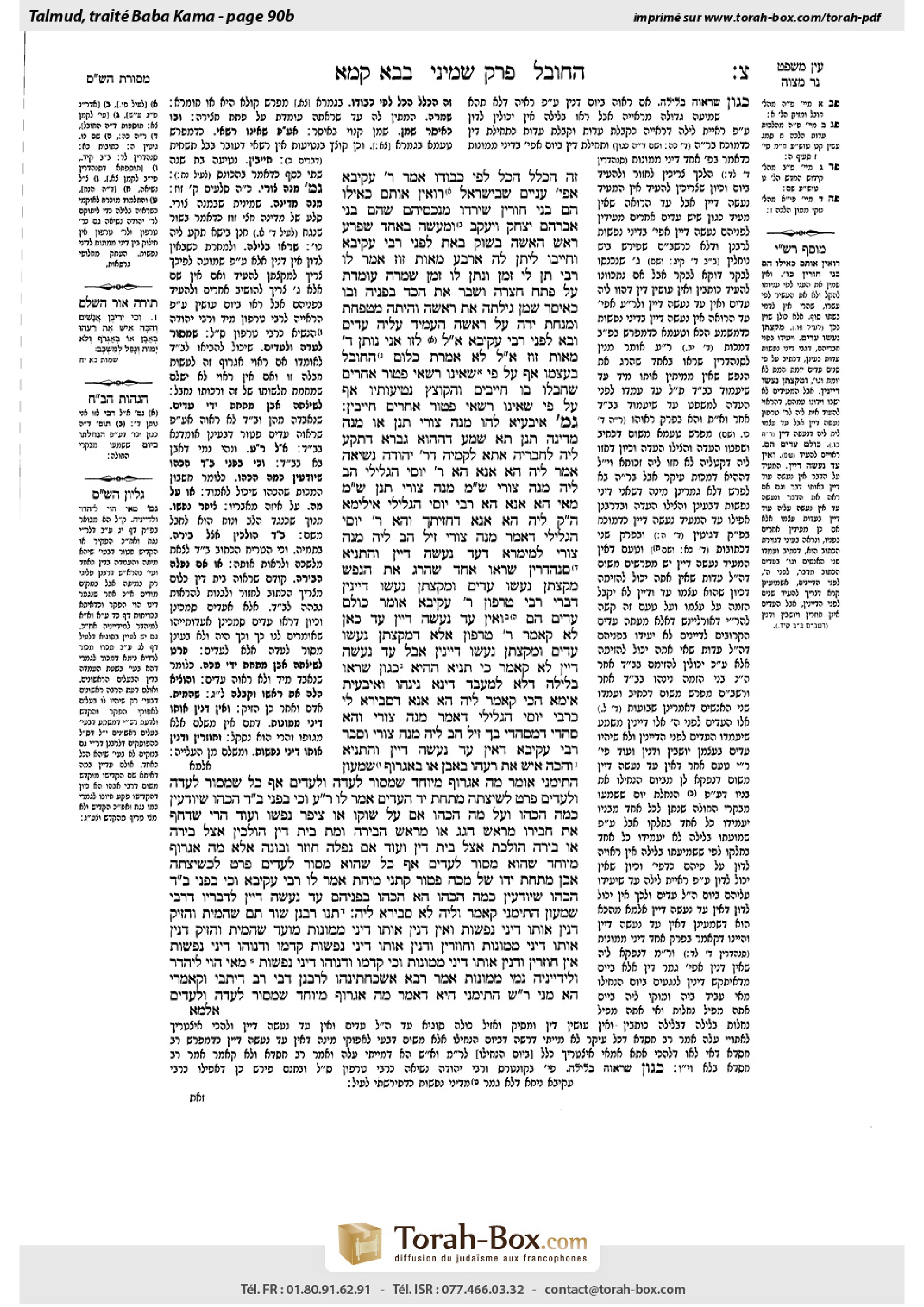
Bava Kamma 90b: Talmud study for Daf Yomi
Study the Talmud for Daf Yomi with scanned pages, Hebrew text, English translations from Sefaria and AI-generated French translations.
Passage selection and English or AI-generated French translation are available where the scan has annotations. Daf Study is independent of Torah-Box and Sefaria.
Browse Bava Kamma · בבא קמא · All tractatesBava Kamma 90b text and translations
This page of Bava Kamma includes the Aramaic text, an English translation and an AI-generated French translation, alongside the scan above.
בבא קמא צ׳ ב · Aramaic and Hebrew text
זֶה הַכְּלָל – הַכֹּל לְפִי כְּבוֹדוֹ. אָמַר רַבִּי עֲקִיבָא: אֲפִילּוּ עֲנִיִּים שֶׁבְּיִשְׂרָאֵל, רוֹאִין אוֹתָם כְּאִילּוּ הֵם בְּנֵי חוֹרִין שֶׁיָּרְדוּ מִנִּכְסֵיהֶם; שֶׁהֵם בְּנֵי אַבְרָהָם יִצְחָק וְיַעֲקֹב.
וּמַעֲשֶׂה בְּאֶחָד שֶׁפָּרַע רֹאשׁ הָאִשָּׁה בַּשּׁוּק, בָּאת לִפְנֵי רַבִּי עֲקִיבָא, וְחִיְּיבוֹ לִיתֵּן לָהּ אַרְבַּע מֵאוֹת זוּז. אָמַר לוֹ: רַבִּי, תֵּן לִי זְמַן. וְנָתַן לוֹ זְמַן.
שְׁמָרָהּ עוֹמֶדֶת עַל פֶּתַח חֲצֵרָהּ, וְשָׁבַר אֶת הַכַּד בְּפָנֶיהָ, וּבוֹ כְּאִיסָּר שֶׁמֶן. גִּילְּתָה אֶת רֹאשָׁהּ, וְהָיְתָה מְטַפַּחַת וּמַנַּחַת יָדָהּ עַל רֹאשָׁהּ.
הֶעֱמִיד עָלֶיהָ עֵדִים, וּבָא לִפְנֵי רַבִּי עֲקִיבָא; אָמַר לוֹ: לָזוֹ אֲנִי נוֹתֵן אַרְבַּע מֵאוֹת זוּז?!
אָמַר לוֹ: לֹא אָמַרְתָּ כְּלוּם. הַחוֹבֵל בְּעַצְמוֹ, אַף עַל פִּי שֶׁאֵינוֹ רַשַּׁאי – פָּטוּר; אֲחֵרִים שֶׁחָבְלוּ בּוֹ – חַיָּיבִים. וְהַקּוֹצֵץ נְטִיעוֹתָיו, אַף עַל פִּי שֶׁאֵינוֹ רַשַּׁאי – פָּטוּר; אֲחֵרִים – חַיָּיבִין.
גְּמָ׳ אִיבַּעְיָא לְהוּ: מָנֶה צוֹרִי תְּנַן, אוֹ מָנֶה מְדִינָה תְּנַן?
תָּא שְׁמַע: דְּהָהוּא גַּבְרָא דִּתְקַע לֵיהּ לְחַבְרֵיהּ. אֲתָא לְקַמֵּיהּ דְּרַבִּי יְהוּדָה נְשִׂיאָה, אֲמַר לֵיהּ: הָא אֲנָא, הָא רַבִּי יוֹסֵי הַגְּלִילִי, הַב לֵיהּ מָנֶה צוֹרִי. שְׁמַע מִינַּהּ: מָנֶה צוֹרִי תְּנַן! שְׁמַע מִינַּהּ.
מַאי ״הָא אֲנָא, הָא רַבִּי יוֹסֵי הַגְּלִילִי״? אִילֵּימָא הָכִי קָאָמַר לֵיהּ: הָא אֲנָא – דַּחֲזֵיתָךְ, וְהָא רַבִּי יוֹסֵי הַגְּלִילִי – דְּאָמַר מָנֶה צוֹרִי, זִיל הַב לֵיהּ מָנֶה צוֹרִי. לְמֵימְרָא דְּעֵד נַעֲשֶׂה דַּיָּין?!
וְהָתַנְיָא: סַנְהֶדְרִין שֶׁרָאוּ אֶחָד שֶׁהָרַג אֶת הַנֶּפֶשׁ – מִקְצָתָן נַעֲשׂוּ עֵדִים, וּמִקְצָתָן נַעֲשׂוּ דַּיָּינִין; דִּבְרֵי רַבִּי טַרְפוֹן. רַבִּי עֲקִיבָא אוֹמֵר: כּוּלָּם עֵדִים הֵם, וְאֵין עֵד נַעֲשֶׂה דַּיָּין.
עַד כָּאן לָא קָאָמַר רַבִּי טַרְפוֹן – אֶלָּא דְּמִקְצָתָן נַעֲשׂוּ עֵדִים וּמִקְצָתָן נַעֲשׂוּ דַּיָּינִין; אֲבָל עֵד נַעֲשֶׂה דַּיָּין – לָא קָאָמַר!
כִּי תַּנְיָא הָהִיא – כְּגוֹן שֶׁרָאוּ בַּלַּיְלָה, דְּלָא (לְמֶעְבַּד) [בְּנֵי מֶעְבַּד] דִּינָא נִינְהוּ.
וְאִיבָּעֵית אֵימָא, הָכִי קָאָמַר לֵיהּ: הָא אֲנָא – דִּסְבִירָא לִי כְּרַבִּי יוֹסֵי הַגְּלִילִי, דְּאָמַר מָנֶה צוֹרִי; וְהָא סָהֲדִי דְּמַסְהֲדִי בָּךְ; זִיל הַב לֵיהּ מָנֶה צוֹרִי.
וְסָבַר רַבִּי עֲקִיבָא דְּאֵין עֵד נַעֲשֶׂה דַּיָּין?
וְהָתַנְיָא: ״וְהִכָּה אִישׁ אֶת רֵעֵהוּ בְּאֶבֶן אוֹ בְאֶגְרֹף״ – שִׁמְעוֹן הַתִּימְנִי אוֹמֵר: מָה אֶגְרוֹף מְיוּחָד – שֶׁמָּסוּר לָעֵדָה וְלָעֵדִים, אַף כֹּל שֶׁמָּסוּר לָעֵדָה וְלָעֵדִים; פְּרָט לְשֶׁיָּצְתָה מִתַּחַת יַד הָעֵדִים.
אָמַר לוֹ רַבִּי עֲקִיבָא: וְכִי בִּפְנֵי בֵּית דִּין הִכָּהוּ – שֶׁיּוֹדְעִין כַּמָּה הִכָּהוּ, וְעַל מָה הִכָּהוּ – אִם עַל שׁוֹקוֹ אוֹ צִיפַּר נַפְשׁוֹ?
וְעוֹד, הֲרֵי שֶׁדָּחַף אֶת חֲבֵירוֹ מֵרֹאשׁ הַגָּג אוֹ מֵרֹאשׁ הַבִּירָה וָמֵת – בֵּית דִּין הוֹלְכִין אֵצֶל בִּירָה, אוֹ בִירָה הוֹלֶכֶת אֵצֶל בֵּית דִּין? וְעוֹד, אִם נָפְלָה, חוֹזֵר וּבוֹנֶה?!
אֶלָּא מָה אֶגְרוֹף מְיוּחָד – שֶׁהוּא מָסוּר לָעֵדִים, אַף כֹּל שֶׁהוּא מָסוּר לָעֵדִים;
פְּרָט לִכְשֶׁיָּצְתָה אֶבֶן מִתַּחַת יָדוֹ שֶׁל מַכֶּה – פָּטוּר.
קָתָנֵי מִיהַת, אָמַר לוֹ רַבִּי עֲקִיבָא: וְכִי בִּפְנֵי בֵּית דִּין הִכָּהוּ, שֶׁיּוֹדְעִין כַּמָּה הִכָּהוּ? הָא הִכָּהוּ בִּפְנֵיהֶם – עֵד נַעֲשֶׂה דַּיָּין!
לִדְבָרָיו דְּרַבִּי שִׁמְעוֹן הַתִּימְנִי קָאָמַר, וְלֵיהּ לָא סְבִירָא לֵיהּ.
תָּנוּ רַבָּנַן: שׁוֹר תָּם שֶׁהֵמִית וְהִזִּיק – דָּנִין אוֹתוֹ דִּינֵי נְפָשׁוֹת, וְאֵין דָּנִין אוֹתוֹ דִּינֵי מָמוֹנוֹת.
מוּעָד שֶׁהֵמִית וְהִזִּיק – דָּנִין אוֹתוֹ דִּינֵי מָמוֹנוֹת, וְחוֹזְרִין וְדָנִין אוֹתוֹ דִּינֵי נְפָשׁוֹת. קָדְמוּ וְדָנוּהוּ דִּינֵי נְפָשׁוֹת – אֵין חוֹזְרִין וְדָנִין אוֹתוֹ דִּינֵי מָמוֹנוֹת.
וְכִי קָדְמוּ וְדָנוּהוּ דִּינֵי נְפָשׁוֹת מַאי הָוֵי? לִיהְדַּר וְלִידַיְינֵיהּ (נָמֵי) [דִּינֵי] מָמוֹנוֹת!
אֲמַר רָבָא: אַשְׁכַּחְתִּינְהוּ לְרַבָּנַן דְּבֵי רַב, דְּיָתְבִי וְקָאָמְרִי: הָא מַנִּי – רַבִּי שִׁמְעוֹן הַתִּימְנִי הִיא, דְּאָמַר: ״מָה אֶגְרוֹף מְיוּחָד – שֶׁמָּסוּר לָעֵדָה וְלָעֵדִים״,
Bava Kamma 90b · English translation
This is the principle of assessing payment for humiliation caused to another: It is all evaluated in accordance with the honor of the one who was humiliated, as the Gemara will explain. Rabbi Akiva said: Even with regard to the poor among the Jewish people, they are viewed as though they were freemen who lost their property and were impoverished. And their humiliation is calculated according to this status, as they are the children of Abraham, Isaac, and Jacob, and are all of prominent lineage.
The mishna relates: And an incident occurred involving one who uncovered the head of a woman in the marketplace, and the woman came before Rabbi Akiva to request that he render the assailant liable to pay for the humiliation that she suffered, and Rabbi Akiva rendered the assailant liable to give her four hundred dinars. The man said to Rabbi Akiva: My teacher, give me time to pay the penalty, and Rabbi Akiva gave him time.
The man then waited for her until she was standing by the opening of her courtyard, and he broke a jug in front of her, and there was the value of about an issar of oil inside the jug. The woman then exposed her own head and she was wetting [metapaḥat] her hand in the oil, and placing her hand on her head to make use of the oil.
The man set up witnesses to observe her actions, and he came before Rabbi Akiva, and he said to him: Will I give four hundred dinars to this woman for having uncovered her head? By uncovering her head for a minimal benefit, she has demonstrated that this does not cause her humiliation.
Rabbi Akiva said to him: You did not say anything, i.e., this claim will not exempt you. One who injures himself, although it is not permitted for him to do so, is nevertheless exempt from any sort of penalty, but others who injured him are liable to pay him. In this case as well, the man was liable to compensate the woman for shaming her, despite the fact that she did the same to herself. Similarly, one who cuts down his own saplings, although it is not permitted for him to do so, as this violates the prohibition of: “You shall not destroy” (see Deuteronomy 20:19), is exempt from any penalty, but others who cut down his saplings are liable to pay him.
GEMARA: The mishna teaches that according to the opinion of Rabbi Yosei HaGelili, one who strikes another must pay him one hundred dinars. The Gemara clarifies this opinion. A dilemma was raised before the Sages: Did we learn in the mishna that he must pay one hundred dinars of Tyrian coinage, or did we learn in the mishna that he must pay one hundred dinars of state coinage, which is worth one-eighth of Tyrian coinage, i.e., twelve and a half dinars of Tyrian coinage?
The Gemara answers: Come and hear a proof: It happened that there was a certain man who struck another man, and the latter came before Rabbi Yehuda Nesia to request an assessment for the humiliation he suffered. Rabbi Yehuda Nesia said to the assailant: This is I, and this is Rabbi Yosei HaGelili. Give him one hundred dinars of Tyrian coinage. The Gemara suggests: Conclude from the incident that we learned in the mishna he must pay one hundred dinars of Tyrian coinage. The Gemara affirms: Conclude from it that it is so.
The Gemara clarifies: What did Rabbi Yehuda Nesia mean when he stated: This is I, and this is Rabbi Yosei HaGelili? If we say that this is what Rabbi Yehuda Nesia said to the assailant: This is I, who saw you strike the man, and this is the opinion of Rabbi Yosei HaGelili, who says that the penalty for this act is one hundred dinars of Tyrian coinage; therefore, go and give him one hundred dinars of Tyrian coinage, is this to say that a witness can become a judge, i.e., that one who witnessed an event can himself serve as a judge concerning the matter, and consequently Rabbi Yehuda Nesia was able to act as both witness and judge in the same case?
But isn’t it taught in a baraita that if there was a Sanhedrin that saw one kill another person, some of them have become witnesses and testify before the others, and some of them have become judges to issue a verdict; this is the statement of Rabbi Tarfon. Rabbi Akiva says: They are all witnesses to the act, and a witness cannot become a judge.
The Gemara infers from this baraita that even Rabbi Tarfon says his opinion only in a case where some of the members of the Sanhedrin have become witnesses and some of them have become judges, but he did not say that a witness becomes a judge without anyone else testifying. All the more so according to the opinion of Rabbi Akiva would it not be permitted for Rabbi Yehuda Nesia to act as a judge as well as serving as a witness.
The Gemara rejects this: One could say that when that baraita is taught, it is taught in a case where the Sanhedrin saw the murder at night, at which time it is not permitted for them to practice judgment, since cases of capital law may be judged only during the daytime. They were therefore not functioning as judges at that time. On the following day, testimony must be heard from some, now acting as witnesses, in front of the others, now acting as judges. By contrast, in the case of Rabbi Yehuda Nesia, he was able to serve as both the witness and the judge, as he witnessed the event while functioning as a judge.
The Gemara offers an alternative explanation: And if you wish, say instead that Rabbi Yehuda Nesia did not witness the incident, and this is what he said to the assailant: This is I, that I hold in accordance with the opinion of Rabbi Yosei HaGelili, who says that one hundred dinars of Tyrian coinage must be paid; and these are witnesses who testify concerning you that you struck the other. Therefore, go and give him one hundred dinars of Tyrian coinage.
§ The Gemara discusses the previously mentioned opinion of Rabbi Akiva: But does Rabbi Akiva hold that a witness cannot become a judge?
But isn’t it taught in a baraita (Tosefta, Sanhedrin 12:3) with regard to what is stated in the Torah concerning injuries: “And if men contend, and one smite the other with a stone, or with his fist” (Exodus 21:18), that Shimon HaTimni says: Just as a fist is unique in that it is submitted to the assembly of judges to assess its ability to injure and to the witnesses who attest that it was the fist used to strike, as a fist remains attached to the assailant, so too, a ruling can be issued in the case of any item that is submitted to the assembly of judges to assess its ability to injure and to the witnesses who attest that this was the item used to strike? This serves to exclude a case where the stone that injured left the possession of the witnesses and is not available to be inspected by the court to assess if it is capable of causing the purported injury.
Rabbi Akiva said to him: But is it the case that in all incidents of injury the assailant struck him in the presence of the court, so that they know exactly how hard he struck him and on what part of the body he struck him, e.g., if he struck him on his thigh or if he struck him on the lobe of his heart? Rather, the court relies on witnesses to testify about the injury. Therefore, the witnesses should be able to testify about the item used as well.
And furthermore, if there was one who pushed another from the top of the roof or from the top of a building, and the one who was pushed died as a result of the fall, do the members of the court go to the building to inspect how high it is, or does the building go to the court? Obviously neither, and the court relies upon the testimony of witnesses who state how tall the building is. And furthermore, if the building collapsed, must the court rebuild it in order to assess its height? The witnesses should then be able to testify about the item used as well.
Rather, Rabbi Akiva interprets the verse differently: Just as a fist is unique in that it is submitted to the witnesses for them to testify about it, so too, a ruling can be issued in the case of any item that is submitted to the witnesses to testify about, despite the item’s not being available for the court to assess.
This serves to exclude a case where the stone that injured left the possession of the assailant and cannot be found, and even the witnesses were unable to see it. In such a case the assailant is exempt from payment, since even the witnesses cannot testify about whether the stone was capable of inflicting the purported injuries.
The Gemara states its question: In any event, it teaches that Rabbi Akiva said to Shimon HaTimni: Are all cases of injury such that the assailant struck him in the presence of the court so that they know exactly how hard he struck him? It can be inferred from this that if he did in fact strike him in front of them, Rabbi Akiva would agree that a witness can become a judge. This contradicts the opinion of Rabbi Akiva in the baraita, that a witness cannot become a judge.
The Gemara answers that there is no proof as to the opinion of Rabbi Akiva, since it may be that he stated his refutation in accordance with the statement of Shimon HaTimni, but he himself does not hold accordingly. Perhaps Rabbi Akiva himself holds that if the court had witnessed the act, they would not be able to render judgment concerning it.
The Gemara quotes a related halakha. The Sages taught: In the case of an innocuous ox that killed a person and subsequently went and caused damage, the court judges it as a case of capital law and the ox is killed, and the court does not judge it as a case of monetary law, despite the damage that it caused.
By contrast, in the case of a forewarned ox that killed a person and subsequently went and caused damage, the court judges it as a case of monetary law, and the owner is liable to pay for the damage it caused, and then the court goes back and judges it again as a case of capital law, and the ox is killed. But if the court proceeded and judged it first as a case of capital law, the court does not go back and judge it again as a case of monetary law, since it has already been sentenced to be killed.
The Gemara asks: And if they proceeded and judged it first as a case of capital law, what of it? Let them go back and judge it again also as a case of monetary law.
Rava said: I found the Sages of the school of Rav who were sitting and saying to explain this: In accordance with whose opinion is this? It is in accordance with the opinion of Rabbi Shimon HaTimni, who says that just as a fist is unique in that it is submitted to the assembly of judges to assess its ability to injure and to the witnesses to attest that this was the fist used to strike, so too, a ruling can be issued in the case of any item that is submitted to the assembly of judges to assess its ability to injure and to the witnesses to attest that this was the item used to strike.
Bava Kamma 90b · Traduction française (IA)
C'est le principe de l'évaluation du paiement pour l'humiliation causée à un autre : tout est évalué selon l'honneur de celui qui a été humilié, comme l'explique la Guemara. Rabbi Akiva a dit : même envers les pauvres du peuple juif, ils sont considérés comme des hommes libres ayant perdu leurs biens et se trouvant dans la misère. L'humiliation est calculée selon ce statut, car ils sont les enfants d'Abraham, d'Isaac et de Jacob, et sont tous de noble lignage.
La mitsna rapporte : un incident s'est produit concernant une femme dont la tête a été dévoilée dans le marché, et la femme est venue devant Rabbi Akiva demander qu'il rende l'agresseur responsable de payer la somme correspondant à l'humiliation qu'elle avait subie, et Rabbi Akiva a rendu l'agresseur responsable de lui donner quatre cents dinars. L'homme a dit à Rabbi Akiva : mon maître, donne-moi du temps pour payer la sanction, et Rabbi Akiva lui a donné du temps.
L'homme a ensuite attendu qu'elle soit debout à l'entrée de son courtil, et il a brisé une jarre devant elle, et il y avait à l'intérieur environ une issar d'huile. La femme a ensuite dévoilé sa propre tête et elle a trempé sa main dans l'huile, et l'a posée sur sa tête pour en faire usage.
L'homme a fait appel à des témoins pour observer ses actions, et il est venu devant Rabbi Akiva, et il lui a dit : Je vais donner quatre cents dinars à cette femme pour avoir dévoilé sa tête ? En dévoilant sa tête pour un bénéfice minimal, elle a montré que cela ne l'humilieait pas.
Rabbi Akiva a dit à lui : Tu n'as pas dit quelque chose, c'est-à-dire cette revendication ne t'exonère pas. Celui qui se fait du mal, même s'il n'est pas autorisé à le faire, est néanmoins exempt de toute sanction, mais ceux qui l'ont blessé sont responsables de le compenser. Dans ce cas également, l'homme était responsable de compenser la femme pour l'avoir humiliée, malgré le fait qu'elle avait fait la même chose à elle-même. De même, celui qui coupe ses jeunes arbres, même s'il n'est pas autorisé à le faire, en violant l'interdiction : « Vous ne détruirez pas » (voir Lévitique 20:19), est exempt de toute sanction, mais ceux qui coupent ses jeunes arbres sont responsables de le compenser.
GUEMARA : La mitsna enseigne que selon l'opinion de Rabbi Yosei HaGelili, celui qui frappe un autre doit lui payer cent dinars. La Guemara clarifie cette opinion. Un dilemme a été soulevé devant les Sages : avons-nous appris dans la mitsna que l'on doit payer cent dinars de monnaie tyrienne, ou avons-nous appris dans la mitsna que l'on doit payer cent dinars de monnaie d'État, qui vaut un huitième de monnaie tyrienne, c'est-à-dire douze et demi dinars de monnaie tyrienne ?
La Guemara répond : viens écouter une preuve : il s'est produit qu'un certain homme avait frappé un autre homme, et l'autre était venu devant Rabbi Yehuda Nesia demander une évaluation pour l'humiliation qu'il avait subie. Rabbi Yehuda Nesia a dit à l'agresseur : c'est moi, et c'est Rabbi Yosei HaGelili. Donne-lui cent dinars de monnaie tyrienne. La Guemara suggère : conclure de l'incident que nous avons appris dans la mitsna qu'il doit payer cent dinars de monnaie tyrienne. La Guemara affirme : conclure de cela qu'il en est ainsi.
La Guemara clarifie : que voulait dire Rabbi Yehuda Nesia lorsqu'il a dit : c'est moi, et c'est Rabbi Yosei HaGelili ? Si nous disons que c'est ce que Rabbi Yehuda Nesia a dit à l'agresseur : c'est moi, qui ai vu que tu as frappé l'homme, et c'est l'opinion de Rabbi Yosei HaGelili, qui dit que la sanction pour cet acte est cent dinars de monnaie tyrienne ; donc, va et donne-lui cent dinars de monnaie tyrienne, est-ce dire que le témoin peut devenir juge, c'est-à-dire que celui qui a témoin d'un événement peut lui-même servir de juge concernant l'affaire, et par conséquent Rabbi Yehuda Nesia a pu agir à la fois comme témoin et comme juge dans le même cas ?
Mais n'est-il pas enseigné dans une baraïta que si un Sanhédrin a vu un meurtre, certains d'entre eux sont devenus témoins et ont témoigné devant les autres, et certains d'entre eux sont devenus juges pour rendre un verdict ; c'est la déclaration de Rabbi Tarfon. Rabbi Akiva dit : ils sont tous témoins de l'acte, et un témoin ne peut pas devenir juge.
La Guemara déduit de cette baraïta que même Rabbi Tarfon affirme son opinion uniquement dans un cas où certains membres du Sanhédrin sont devenus témoins et d'autres juges, mais il n'a pas dit qu'un témoin puisse devenir juge sans que quelqu'un d'autre témoigne. Tout autant encore, selon l'opinion de Rabbi Akiva, ne serait-il pas permis à Rabbi Yehuda Nesia d'agir à la fois comme juge et comme témoin ?
La Guemara rejette cette interprétation : on pourrait dire que lorsque cette baraïta est enseignée, elle est enseignée dans un cas où le Sanhédrin a vu le meurtre la nuit, à ce moment-là il n'était pas permis qu'ils pratiquent le jugement, car les affaires de lois capitales peuvent être jugées uniquement pendant la journée. Ils n'étaient donc pas en exercice de leur fonction de juges à ce moment-là. Le lendemain, des témoignages doivent être entendus de certains, maintenant agissant comme témoins, devant les autres, maintenant agissant comme juges. À l'inverse, dans le cas de Rabbi Yehuda Nesia, il a pu servir à la fois de témoin et de juge, car il avait témoin de l'événement tout en exerçant la fonction de juge.
La Guemara propose une autre explication : et si tu veux, dis plutôt que Rabbi Yehuda Nesia n'avait pas témoin de l'incident, et c'est ce qu'il a dit à l'agresseur : c'est moi, c'est-à-dire que je suis d'accord avec l'opinion de Rabbi Yosei HaGelili, qui dit que cent dinars de monnaie tyrienne doivent être payés ; et ces témoins témoignent à votre sujet que vous avez frappé l'autre. Donc, va et donne-lui cent dinars de monnaie tyrienne.
§ La Guemara examine l'opinion précédemment mentionnée de Rabbi Akiva : mais Rabbi Akiva considère-t-il que le témoin ne peut pas devenir juge ?
Mais n’est-ce pas enseigné dans une baraïta (Tosefta, Sanhedrin 12:3) concernant ce qui est dit dans la Torah concernant les blessures : « Et si des hommes s’affrontent, et qu’un frappe l’autre avec une pierre ou avec son poing » (Exode 21:18), que Shimon HaTimni dit : Tout comme le poing est unique dans le sens où il est soumis à l’assemblée des juges pour évaluer sa capacité à causer des blessures et aux témoins qui attestent qu’il s’agit du poing utilisé pour frapper, tout comme le poing reste attaché à l’agresseur, de même, une décision peut être rendue dans le cas de tout objet soumis à l’assemblée des juges pour évaluer sa capacité à causer des blessures et aux témoins qui attestent que cet objet a été utilisé pour frapper ? Cela sert à exclure un cas où la pierre qui a causé la blessure a quitté la possession des témoins et n’est plus disponible pour être examinée par le tribunal afin d’évaluer si elle est capable de causer la blessure prétendue.
Rabbi Akiva dit à lui : Mais est-ce que dans tous les cas de blessures, l’agresseur a frappé la victime en présence du tribunal, de sorte qu’ils connaissent exactement la force de la frappe et la partie du corps touchée, par exemple, si l’agresseur a frappé le cuisse ou si l’agresseur a frappé la fossette du cœur ? Plutôt, le tribunal repose sur les témoins pour témoigner de la blessure. Ainsi, les témoins devraient être en mesure de témoigner sur l’objet utilisé.
Et de plus, si quelqu’un a poussé un autre de la terrasse d’un toit ou d’un bâtiment, et que celui qui a été poussé est mort à cause de la chute, les membres du tribunal vont-ils au bâtiment pour inspecter sa hauteur, ou le bâtiment va-t-il au tribunal ? Évidemment, ni l’un ni l’autre, et le tribunal repose sur le témoignage des témoins qui indiquent la hauteur du bâtiment. Et de plus, si le bâtiment s’est effondré, le tribunal doit-il le reconstruire afin d’évaluer sa hauteur ? Les témoins devraient alors être en mesure de témoigner sur l’objet utilisé.
Plutôt, Rabbi Akiva interprète la parole différemment : Tout comme le poing est unique dans le sens où il est soumis aux témoins pour qu’ils témoignent à son sujet, de même, une décision peut être rendue dans le cas de tout objet soumis aux témoins pour qu’ils témoignent à son sujet, même si l’objet n’est pas disponible pour que le tribunal l’examène.
Cela sert à exclure un cas où la pierre qui a causé la blessure a quitté la possession de l’agresseur et n’a pu être trouvée, et même les témoins n’ont pas pu la voir. Dans ce cas, l’agresseur est exempt de paiement, car même les témoins ne peuvent témoigner sur le fait que la pierre était capable de causer la blessure prétendue.
Le Guemara pose sa question : En tout cas, cela enseigne que Rabbi Akiva a dit à Shimon HaTimni : Tous les cas de blessures sont-ils tels que l’agresseur a frappé la victime en présence du tribunal, de sorte qu’ils connaissent exactement la force de la frappe ? On peut en déduire que si l’agresseur a effectivement frappé devant eux, Rabbi Akiva serait d’accord pour que le témoin devienne juge. Cela contredit l’opinion de Rabbi Akiva dans la baraïta, selon laquelle un témoin ne peut pas devenir juge.
Le Guemara répond que l’on ne peut établir l’opinion de Rabbi Akiva, car cela pourrait être qu’il a formulé sa réfutation en conformité avec la déclaration de Shimon HaTimni, mais qu’il ne l’entend pas ainsi. Peut-être que Rabbi Akiva lui-même considère que si le tribunal avait assisté à l’acte, ils ne pourraient pas rendre un jugement concernant cet acte.
Le Guemara cite une halakha liée. Les Sages enseignèrent : Dans le cas d’un taureau inoffensif qui a tué une personne et qui a ensuite causé des dommages, le tribunal le juge comme un cas de loi punitive et le taureau est tué, et le tribunal ne le juge pas comme un cas de droit civil, malgré les dommages qu’il a causés.
Par contraste, dans le cas d’un taureau averti qui a tué une personne et qui a ensuite causé des dommages, le tribunal le juge comme un cas de droit civil, et l’propriétaire est tenu responsable des dommages causés, et ensuite le tribunal reprend l’affaire et la juge à nouveau comme un cas de loi punitive, et le taureau est tué. Mais si le tribunal a déjà jugé l’affaire comme un cas de loi punitive, le tribunal ne reprend pas l’affaire comme un cas de droit civil, car il a déjà été condamné à être tué.
Le Guemara demande : Et s'ils ont jugé d'abord cette affaire comme un cas de loi punitive, qu'en est-il ? Faisons-leur retourner et juger à nouveau cette affaire comme un cas de droit civil.
Rava dit : J'ai trouvé les Sages de l'école de Rav qui étaient assis et disaient pour expliquer cela : Selon l'opinion de qui est-ce ? C'est selon l'opinion de Rabbi Shimon HaTimni, qui dit que tout comme le poing est unique dans le sens où il est soumis à l'assemblée des juges pour évaluer sa capacité à causer des blessures et aux témoins pour qu'ils attestent qu'il s'agit du poing utilisé pour frapper, de même, une décision peut être rendue dans le cas de tout objet soumis à l'assemblée des juges pour évaluer sa capacité à causer des blessures et aux témoins pour qu'ils attestent que cet objet a été utilisé pour frapper.
Traduction française générée par IA à partir de l’édition anglaise de Sefaria. Vérifie toujours un passage avec le texte source.
Text from Sefaria: William Davidson Edition - Vocalized Aramaic (CC BY NC); William Davidson Edition - English (CC BY NC).