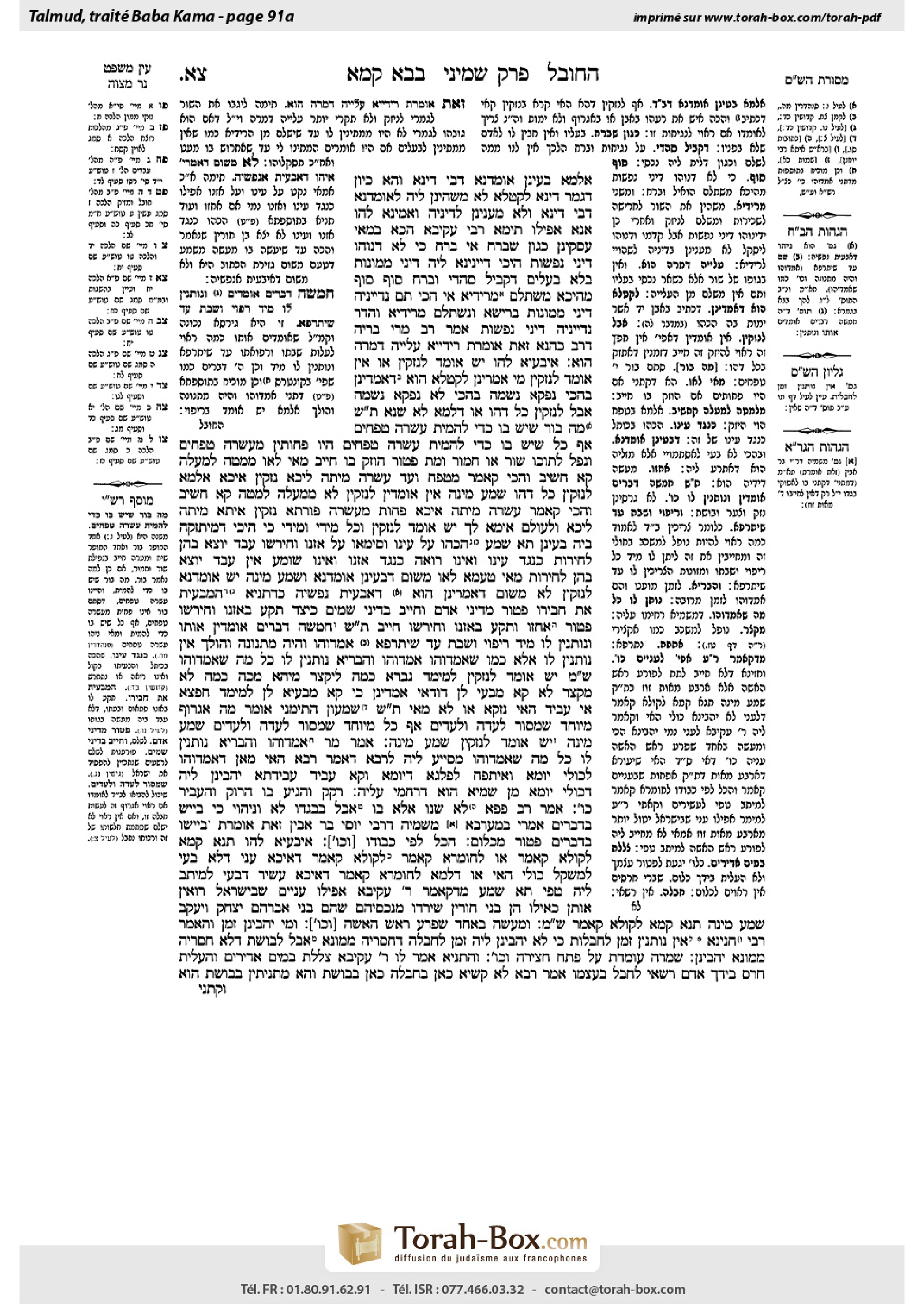
Bava Kamma 91a: Talmud study for Daf Yomi
Study the Talmud for Daf Yomi with scanned pages, Hebrew text, English translations from Sefaria and AI-generated French translations.
Passage selection and English or AI-generated French translation are available where the scan has annotations. Daf Study is independent of Torah-Box and Sefaria.
Browse Bava Kamma · בבא קמא · All tractatesBava Kamma 91a text and translations
This page of Bava Kamma includes the Aramaic text, an English translation and an AI-generated French translation, alongside the scan above.
בבא קמא צ״א א · Aramaic and Hebrew text
אַלְמָא בָּעֵינַן אוּמְדָּנָא דְּבֵי דִינָא; וְהָא, כֵּיוָן דִּגְמַר דִּינֵיהּ לִקְטָלָא – לָא מְשַׁהֵינַן לֵיהּ לְאוּמְדָּנָא דְּבֵי דִינָא, וְלָא מְעַנֵּינַן לְדִינֵיהּ.
וְאָמֵינָא לְהוּ אֲנָא: אֲפִילּוּ תֵּימָא רַבִּי עֲקִיבָא, הָכָא בְּמַאי עָסְקִינַן – כְּגוֹן שֶׁבָּרַח.
אִי בָּרַח, כִּי לֹא דָּנוּהוּ דִּינֵי נְפָשׁוֹת – הֵיכִי דָּיְינִינַן לֵיהּ דִּינֵי מָמוֹנוֹת בְּלֹא בְּעָלִים? דְּקַבֵּיל סָהֲדִי וּבָרַח.
סוֹף סוֹף, מֵהֵיכָא מִשְׁתַּלַּם – מֵרִידְיָא; אִי הָכִי, תָּם – נְדַיְינֵיהּ דִּינֵי מָמוֹנוֹת בְּרֵישָׁא וְנִשְׁתַּלַּם מֵרִידְיָא, וַהֲדַר נְדַיְינֵיהּ דִּינֵי נְפָשׁוֹת!
אָמַר רַב מָרִי בְּרֵיהּ דְּרַב כָּהֲנָא, זֹאת אוֹמֶרֶת: רִידְיָיא – עֲלִיָּיה דְּמָרֵהּ הוּא.
אִיבַּעְיָא לְהוּ: יֵשׁ אוֹמֶד לִנְזָקִין, אוֹ אֵין אוֹמֶד לִנְזָקִין?
מִי אָמְרִינַן: לִקְטָלָא הוּא דְּאָמְדִינַן – בְּהָכִי נָפְקָא נְשָׁמָה, בְּהָכִי לָא נָפְקָא נְשָׁמָה; אֲבָל לִנְזָקִין – כֹּל דְּהוּ; אוֹ דִלְמָא לָא שְׁנָא?
תָּא שְׁמַע: מָה בּוֹר – שֶׁיֵּשׁ בּוֹ כְּדֵי לְהָמִית, עֲשָׂרָה טְפָחִים; אַף כֹּל שֶׁיֵּשׁ בּוֹ כְּדֵי לְהָמִית, עֲשָׂרָה טְפָחִים. הָיוּ פְּחוּתִין מֵעֲשָׂרָה טְפָחִים, וְנָפַל לְתוֹכוֹ שׁוֹר אוֹ חֲמוֹר וָמֵת – פָּטוּר. הוּזַּק בּוֹ – חַיָּיב.
מַאי, לָאו מִמַּטָּה לְמַעְלָה קָא חָשֵׁיב – וְהָכִי קָאָמַר: מִטֶּפַח וְעַד עֲשָׂרָה – מִיתָה לֵיכָּא, נְזָקִין אִיכָּא? אַלְמָא לִנְזָקִין – כֹּל דְּהוּ, שְׁמַע מִינַּהּ אֵין אוֹמְדִין לִנְזָקִין!
לֹא, מִמַּעְלָה לְמַטָּה קָא חָשֵׁיב; וְהָכִי קָאָמַר: עֲשָׂרָה – מִיתָה אִיכָּא; פָּחוֹת מֵעֲשָׂרָה פּוּרְתָּא – נְזָקִין אִיתָא, מִיתָה לֵיכָּא. וּלְעוֹלָם אֵימָא לָךְ יֵשׁ אוֹמֶד לִנְזָקִין, וְכֹל מִידֵּי וּמִידֵּי – כִּי הֵיכִי דְּמִיתַּזְקָה בֵּיהּ בָּעֵינַן.
תָּא שְׁמַע: הִכָּהוּ עַל עֵינוֹ וְסִימְּאוֹ, עַל אׇזְנוֹ וְחֵירְשׁוֹ – עֶבֶד יוֹצֵא בָּהֶן לְחֵירוּת. כְּנֶגֶד עֵינוֹ – וְאֵינוֹ רוֹאֶה, כְּנֶגֶד אׇזְנוֹ – וְאֵינוֹ שׁוֹמֵעַ, אֵין עֶבֶד יוֹצֵא בָּהֶן לְחֵירוּת. מַאי טַעְמָא? לָאו מִשּׁוּם דְּבָעֵינַן אוּמְדָּנָא – וּשְׁמַע מִינַּה:ּ יֵשׁ אוּמְדָּנָא לִנְזָקִין?
לָא; מִשּׁוּם דְּאָמְרִינַן: הוּא דְּאַבְעֵית נַפְשֵׁיהּ. כִּדְתַנְיָא: הַמַּבְעִית אֶת חֲבֵירוֹ – פָּטוּר מִדִּינֵי אָדָם, וְחַיָּיב בְּדִינֵי שָׁמַיִם. כֵּיצַד? תָּקַע בְּאׇזְנוֹ וְחֵירְשׁוֹ – פָּטוּר, אֲחָזוֹ וְתָקַע בְּאׇזְנוֹ וְחֵירְשׁוֹ – חַיָּיב.
תָּא שְׁמַע: חֲמִשָּׁה דְּבָרִים אוֹמְדִין אוֹתוֹ, וְנוֹתְנִין לוֹ מִיָּד. רִיפּוּי וָשֶׁבֶת – עַד שֶׁיִּתְרַפֵּא. אֲמָדוּהוּ, וְהָיָה מִתְנַוְנֶה וְהוֹלֵךְ – אֵין נוֹתְנִין לוֹ אֶלָּא כְּמוֹ שֶׁאֲמָדוּהוּ.
אֲמָדוּהוּ וְהִבְרִיא – נוֹתְנִין לוֹ כׇּל מַה שֶּׁאֲמָדוּהוּ. שְׁמַע מִינַּהּ: יֵשׁ אוֹמֶד לִנְזָקִין! לְמֵימַד גַּבְרָא, כַּמָּה לִיקְּצַר מֵיהָא מַכָּה כַּמָּה לָא מִקְּצַר – לָא קָא מִבְּעֵי לַן, דְּוַדַּאי אָמְדִינַן. כִּי קָא מִבַּעְיָא לַן – לְמֵימַד חֶפְצָא, אִי עָבֵיד הַאי נִזְקָא אוֹ לָא. מַאי?
תָּא שְׁמַע, שִׁמְעוֹן הַתִּימְנִי אוֹמֵר: מָה אֶגְרוֹף מְיוּחָד – שֶׁמָּסוּר לָעֵדָה וְלָעֵדִים, אַף כֹּל מְיוּחָד שֶׁמָּסוּר לָעֵדָה וְלָעֵדִים. שְׁמַע מִינַּהּ: יֵשׁ אוֹמֶד לִנְזָקִין! שְׁמַע מִינַּהּ.
אָמַר מָר: אֲמָדוּהוּ וְהִבְרִיא, נוֹתְנִין לוֹ כׇּל מַה שֶּׁאֲמָדוּהוּ. מְסַיַּיע לֵיהּ לְרָבָא – דְּאָמַר רָבָא: הַאי מַאן דַּאֲמָדוּהוּ לְכוּלֵּי יוֹמָא, וְאִיתְּפַח לְפַלְגָא דְיוֹמָא וְקָא עָבֵיד עֲבִידְתָּא – יָהֲבִינַן לֵיהּ. דְּכוּלֵּי יוֹמָא מִן שְׁמַיָּא הוּא (דְּרַחֲמֵי) [דְּרַחִימוּ] עֲלֵיהּ.
רָקַק – וְהִגִּיעַ בּוֹ הָרוֹק, וְהֶעֱבִיר כּוּ׳. אָמַר רַב פָּפָּא: לֹא שָׁנוּ אֶלָּא בּוֹ, אֲבָל בְּבִגְדוֹ – לָא. וְנִיהְוֵי כִּי בִיֵּישׁ בִּדְבָרִים!
אָמְרִי בְּמַעְרְבָא מִשְּׁמֵיהּ דְּרַבִּי יוֹסֵי בַּר אָבִין, זֹאת אוֹמֶרֶת: בִּיְּישׁוֹ בִּדְבָרִים – פָּטוּר מִכְּלוּם.
הַכֹּל לְפִי כְבוֹדוֹ [וְכוּ׳]. אִיבַּעְיָא לְהוּ: תַּנָּא קַמָּא לְקוּלָּא קָאָמַר, אוֹ לְחוּמְרָא קָאָמַר? לְקוּלָּא קָאָמַר – דְּאִיכָּא עָנִי דְּלָא בָּעֵי לְמִשְׁקַל כּוּלֵּי הַאי, אוֹ דִלְמָא לְחוּמְרָא קָאָמַר – דְּאִיכָּא עָשִׁיר דְּבָעֵי לְמִיתַּב לֵיהּ טְפֵי?
תָּא שְׁמַע, מִדְּקָאָמַר רַבִּי עֲקִיבָא: אֲפִילּוּ עֲנִיִּים שֶׁבְּיִשְׂרָאֵל – רוֹאִין אוֹתָן כְּאִילּוּ הֵן בְּנֵי חוֹרִין שֶׁיָּרְדוּ מִנִּכְסֵיהֶם, שֶׁהֵם בְּנֵי אַבְרָהָם יִצְחָק וְיַעֲקֹב; שְׁמַע מִינַּהּ, תַּנָּא קַמָּא לְקוּלָּא קָאָמַר! שְׁמַע מִינַּהּ.
וּמַעֲשֶׂה בְּאֶחָד שֶׁפָּרַע רֹאשׁ הָאִשָּׁה [וְכוּ׳]. וּמִי יָהֲבִינַן זְמַן? וְהָאָמַר רַבִּי חֲנִינָא: אֵין נוֹתְנִין זְמַן לַחֲבָלוֹת!
כִּי לָא יָהֲבִינַן לֵיהּ זְמַן – לַחֲבָלָה, דְּחַסְּרֵיהּ מָמוֹנָא; אֲבָל לְבוֹשֶׁת, דְּלָא חַסְּרֵיהּ מָמוֹנָא – יָהֲבִינַן.
שְׁמָרָהּ עוֹמֶדֶת עַל פֶּתַח חֲצֵירָהּ וְכוּ׳. וְהָתַנְיָא, אָמַר לוֹ רַבִּי עֲקִיבָא: צָלַלְתָּ בְּמַיִם אַדִּירִים וְהֶעֱלִיתָ חֶרֶס בְּיָדְךָ, אָדָם רַשַּׁאי לַחְבֹּל בְּעַצְמוֹ!
אָמַר רָבָא: לָא קַשְׁיָא; כָּאן בַּחֲבָלָה, כָּאן בְּבוֹשֶׁת. וְהָא מַתְנִיתִין בְּבוֹשֶׁת הוּא,
Bava Kamma 91a · English translation
Rava continues the report in their name: Apparently, we require the evaluation of the court in order to render him liable to pay for the damage. And with regard to this ox that killed, once the verdict was given that it to be put to death, we do not delay the implementation of the verdict in order to wait for the evaluation of the court, and we do not delay its judgment. Therefore, the monetary case is not judged.
And I, Rava, said to the Sages of the school of Rav: Even if you say that this halakha is in accordance with the opinion of Rabbi Akiva, who does not require assessment by the court, one could explain that here we are dealing with a case where the owner of the ox fled, and the court cannot judge his case in his absence and cannot render him liable to pay for the damage caused by his ox.
The Gemara asks: If the baraita is discussing a case where the owner fled, then in the case where they did not yet judge it as a case of capital law, how does the court judge it as a case of monetary law without the owner of the ox being present? The Gemara answers: The baraita is discussing a case where the court accepted the testimony of the witnesses in the presence of the owner, and he subsequently fled.
The Gemara asks: Ultimately, from where are the damages paid in a situation where the owner fled, as he is not here to pay the damages? The Gemara answers: They are paid from plowing. The ox is rented out to plow fields, and the fees generated are used to pay the damages. Afterward, the ox is judged for the killing as a case of capital law. The Gemara asks: If so, with regard to an innocuous ox, why did the baraita rule that the court does not judge it as a case of monetary law? The court should judge it as a case of monetary law first, and the damages will be paid from fees generated from renting out the animal for plowing, and then the court should judge it as a case of capital law.
Rav Mari, son of Rav Kahana, said in answer to this last question: That is to say that the money gained from plowing is considered like the superior-quality property of its owner. In other words, that money is like the rest of the owner’s estate, and is not considered to be part of the value of the ox itself. Since payment for damage caused by an innocuous ox is taken only from the value of the ox itself, it follows that money received from renting out the ox to plow cannot be used to pay damages.
§ In connection with the ruling of the baraita that the court must assess whether the death can be attributed directly to the action of the assailant, the Gemara notes: A dilemma was raised before the Sages: Is there an evaluation performed with regard to damage as well, to determine whether the act was sufficient to inflict that damage, or is there no evaluation performed with regard to damage?
Do we say that specifically in a case of killing is where we perform an evaluation? The assessment is to determine whether a soul departs with this assault and the assailant will be held liable or whether a soul doesn’t depart with this assault and the death is attributed to other factors. But in a case of damage, perhaps we say that he is liable for whatever caused the damage. Or perhaps there is no difference between the two, and with regard to damage as well, the court evaluates whether the act was sufficient to inflict that damage, and if it was not, he will be exempt.
The Gemara says: Come and hear a proof from what was taught in a mishna (50b) concerning the halakhot of a pit: Just as a pit that has sufficient depth to cause death when falling into it is at least ten handbreadths deep, so too, any other excavations that have sufficient depth to cause death may be no less than ten handbreadths. If any of the types of excavations were less than ten handbreadths deep, and an ox or a donkey fell into one of them and died, the digger of the excavation is exempt. But if it was injured in it but did not die he is liable to pay damages.
What, is it not the case that the mishna is counting the handbreadths from below to above, and this is what it is saying: From one handbreadth deep until ten handbreadths deep, there is no liability for death but there is liability for damage? Apparently, with regard to damage he is liable for whatever caused the damage, even a fall into an excavation having the depth of one handbreadth. Learn from the mishna that the court does not perform an evaluation with regard to damage.
The Gemara rejects this: No, the mishna is counting from above to below, and this is what it is saying: If the excavation is ten handbreadths deep then there is liability for death. If the excavation is slightly less than ten, there is liability for damage but there is no liability for death. And actually, I will say to you that there is an evaluation performed for damage, and for each and every circumstance, we require that there be conditions whereby the injured party could reasonably be damaged by whatever caused the damage.
The Gemara suggests another proof: Come and hear a proof from what was taught in a baraita (Tosefta 9:26): If a slave owner struck his Canaanite slave on his eye and blinded him, or on his ear and deafened him, the slave is emancipated by means of these wounds. If he struck near his eye and as a result he does not see, or near his ear and he does not hear, the slave is not emancipated by means of these wounds. What is the reason that the slave is not emancipated? Isn’t it due to the fact that we require an evaluation of the damage, and in such a case the assumption is that the owner’s action did not suffice to cause the injury? And learn from the baraita that there is an evaluation performed with regard to damage.
The Gemara rejects this: No; the slave is not emancipated, because we say that it is possible that it was the slave who frightened himself, resulting in his blindness or deafness, but it was not the actual strike that caused it. An injury can result from being frightened, as it is taught in a baraita (Tosefta 6:16): One who frightens another and thereby causes him injury is exempt according to human laws but liable according to the laws of Heaven. How so? If one shouted into another’s ear and deafened him, he is exempt according to human laws but liable according to the laws of Heaven. But if he held him and shouted into his ear and deafened him, he is liable according to human laws as well, as he physically took hold of him.
The Gemara suggests another proof: Come and hear a proof from what was taught in a baraita (Tosefta 9:3): With regard to the five types of indemnity that one who injures another must pay, the court evaluates the victim as to the value of the damage that he suffered, and the assailant gives this payment to him immediately. Payment for medical costs and loss of livelihood is evaluated from the moment of injury until he is healed. If the court evaluated that a certain sum would be needed to pay for his medical costs and loss of livelihood, and subsequently the victim’s condition began progressively deteriorating and the sum proved to be inadequate, they give him payment only as they had evaluated him.
The baraita continues: If they evaluated him as requiring a certain sum for medical costs and loss of livelihood and he healed sooner than expected, they nevertheless give him the entire sum as they had evaluated him. Learn from the baraita that there is an evaluation performed with regard to damage. The Gemara clarifies: With regard to evaluating an injured man to determine how long he will suffer from this injury and how long he will not suffer, we do not raise a dilemma, since it is obvious that we certainly evaluate this element. When we raise the dilemma of whether the court performs an evaluation or not, it is with regard to evaluating an item, i.e., determining if it is capable of causing this damage or if it is not capable of causing this damage. With regard to this issue, what is the halakha?
The Gemara suggests: Come and hear a proof from what was taught in a baraita (Tosefta, Sanhedrin 12:3): Shimon HaTimni says: Just as a fist is unique in that it is submitted to the assembly of judges to assess its ability to injure and to the witnesses who attest that this was the fist used to strike, so too, a ruling can be issued in the case of any item that is submitted to the assembly of judges to identify its ability to injure and to the witnesses who attest that this was the item used to strike. Learn from the baraita that there is an evaluation performed with regard to damage. The Gemara affirms: Learn from the baraita that this is so.
The Master said above: If they evaluated him as requiring a certain sum for medical costs and loss of livelihood and he healed sooner than expected, they nevertheless give him the entire sum as they had evaluated him. This supports the opinion of Rava, as Rava said: With regard to this man whom they evaluated, concluding that he would not be able to perform labor for the entire day, and his wounds healed [ve’itpaḥ] at midday and he was performing labor, we give him compensation for the entire day. The injury was one that would generally cause a man to not be able to perform labor for an entire day, and it was from Heaven that they had compassion on him and healed him sooner. This does not affect the liability of the one who caused the damage.
§ The mishna teaches (90a): If he spat at him and his spittle reached him, or if he removed another’s cloak, he must give the injured party four hundred dinars. Rav Pappa says: They taught this halakha only in a case where the spittle reached him. But if the spittle landed on his clothing without touching him, he is not required to pay him. The Gemara asks: Why not? Let it be like one who humiliated another with words.
The Gemara answers: In the West, Eretz Yisrael, they say in the name of Rabbi Yosei bar Avin: That is to say that if he humiliated another with words alone, he is exempt from paying anything, although he will be held accountable by Heaven for his sin.
The mishna teaches with regard to the assessment of payment for humiliation: It is all assessed in accordance with the honor of the one who was humiliated. A dilemma was raised before the Sages: Does the first tanna in the mishna say his opinion as a leniency, or does he say his opinion as a stringency? The Gemara explains the two possibilities: He says his opinion as a leniency, teaching that there is a poor person, who doesn’t need to take so much payment for humiliation, as detailed in the fixed sums of the mishna. Or perhaps he says his opinion as a stringency, teaching that there is a rich person whom the assailant needs to give him more than those fixed sums.
The Gemara suggests: Come and hear a proof from that which Rabbi Akiva says in the mishna: Even with regard to the poor of the Jewish people, they are viewed as though they were freemen who lost their property and were impoverished, and their humiliation is calculated according to this status, as they are the sons of Abraham, Isaac, and Jacob, and are all of prominent lineage. Conclude from Rabbi Akiva’s statement that the first tanna says his opinion as a leniency, meaning that while the first tanna states the principle that payment for humiliation is in accordance with the honor of the one who was humiliated, and therefore a poor person will receive less than the fixed sums listed in the mishna, Rabbi Akiva responds that even a poor man is deserving of those fixed sums by virtue of his esteemed lineage. The Gemara affirms: Conclude from the mishna that this is so.
§ The mishna relates: And an incident occurred involving one who uncovered the head of a woman in the marketplace. The woman came before Rabbi Akiva to request that he assess payment for the humiliation that she suffered, and Rabbi Akiva obligated the assailant to give her four hundred dinars. The man said to Rabbi Akiva: My teacher, give me time to pay the penalty, and Rabbi Akiva gave him time. The Gemara asks: But do we give time for an assailant to pay compensation? But doesn’t Rabbi Ḥanina say: The court does not give one time to provide payment for injuries, and he must pay compensation immediately.
The Gemara answers: When we do not give him time to pay compensation it is specifically with regard to injury, as he caused a monetary loss by inflicting physical damage on the victim. But with regard to humiliation, where he did not cause him a monetary loss, we do give him time to pay compensation.
The mishna relates that the man then waited for her until she was standing by the opening of her courtyard, and caused her to uncover her own head. Rabbi Akiva said that although she caused injury to herself, which is not permitted, this does not negate the man’s requirement to pay her compensation. The Gemara asks: But isn’t it taught in a baraita that Rabbi Akiva said to him: You plunged into mighty waters and you raised nothing more than worthless earthenware in your hand, since it is permitted for a person to injure himself. This contradicts the mishna’s account of Rabbi Akiva’s opinion.
The Gemara answers: Rava said: It is not difficult. Here, in the mishna, where it states that one may not injure himself, it is stated with regard to inflicting actual physical injury, while there, in the baraita, where it states that it is permitted for one to injure himself, it is stated with regard to causing humiliation to oneself. The Gemara asks: But the ruling of Rabbi Akiva in the mishna is stated with regard to causing humiliation,
Bava Kamma 91a · Traduction française (IA)
Rava continue la rédaction en leur nom : Apparemment, nous exigeons l'évaluation du tribunal afin de rendre l'homme responsable de la réparation des dommages. Et concernant ce taureau qui a tué, une fois que le verdict a été rendu qu'il doive être mis à mort, nous n'attendons pas l'évaluation du tribunal pour mettre en œuvre le verdict, et nous n'attendons pas son jugement. Par conséquent, le cas monétaire n'est pas jugé.
Et moi, Rava, j'ai dit aux Sages de l'école de Rav : Même si vous dites que cette halakha suit l'opinion de Rabbi Akiva, qui ne nécessite pas l'évaluation par le tribunal, on pourrait expliquer que nous sommes ici dans un cas où l'propriétaire du taureau a fui, et le tribunal ne peut pas juger son cas en son absence et ne peut pas le rendre responsable de la réparation des dommages causés par son taureau.
La Guemara pose la question : Si la baraïta discute d'un cas où l'propriétaire a fui, alors dans le cas où ils n'ont pas encore jugé en matière de loi de mort, comment le tribunal peut-il juger en matière de droit monétaire sans que l'propriétaire du taureau soit présent ? La Guemara répond : La baraïta discute d'un cas où le tribunal a accepté le témoignage des témoins en présence de l'propriétaire, et il a ensuite fui.
La Guemara pose la question : Finalement, d'où proviennent les dommages dans un cas où l'propriétaire a fui, puisqu'il n'est pas là pour payer les dommages ? La Guemara répond : Ils sont payés à partir des revenus de la location. Le taureau est loué pour labourer les champs, et les frais générés sont utilisés pour payer les dommages. Ensuite, le taureau est jugé en matière de loi de mort. La Guemara pose la question : Si tel est le cas, concernant un taureau inoffensif, pourquoi la baraïta a-t-elle décidé que le tribunal ne le juge pas en matière de droit monétaire ? Le tribunal devrait d'abord le juger en matière de droit monétaire, et les dommages seraient payés à partir des frais générés par la location du bétail pour labourer, puis le tribunal devrait le juger en matière de loi de mort.
Rav Mari, fils de Rav Kahana, répond à cette dernière question ainsi : Cela signifie que l'argent gagné par la location est considéré comme la propriété supérieure de son propriétaire. En d'autres termes, cet argent est comme le reste des biens du propriétaire, et n'est pas considéré comme faisant partie de la valeur du taureau lui-même. Puisque le paiement des dommages causés par un taureau inoffensif est uniquement pris à partir de la valeur du taureau lui-même, il en découle que l'argent reçu à partir de la location du taureau pour labourer ne peut pas être utilisé pour payer les dommages.
§ En lien avec la décision de la baraïta que le tribunal doit évaluer si la mort peut être attribuée directement à l'action de l'agresseur, la Guemara note : Un dilemme a été soulevé devant les Sages : Y a-t-il une évaluation concernant les dommages également, afin de déterminer si l'action était suffisante pour causer ce dommage, ou n'y a-t-il pas d'évaluation concernant les dommages ?
Disons-nous que c'est spécifiquement dans le cas de la mort que nous effectuons une évaluation ? L'évaluation est pour déterminer si une âme quitte avec cet assaut et l'agresseur sera tenu responsable, ou si une âme ne quitte pas avec cet assaut et la mort est attribuée à d'autres facteurs. Mais dans le cas de dommages, peut-être disons-nous qu'il est responsable de tout ce qui a causé les dommages. Ou peut-être n'y a-t-il pas de différence entre les deux, et concernant les dommages également, le tribunal évalue si l'action était suffisante pour causer ce dommage, et si ce n'était pas le cas, il sera exempt.
La Guemara dit : Venez et entendez une preuve à partir de ce qui a été enseigné dans une mitsva (50b) concernant les halakhot d'un trou : Tout comme un trou qui a une profondeur suffisante pour causer la mort en y tombant est au moins dix coudées de profondeur, de même, toute autre excavation qui a une profondeur suffisante pour causer la mort peut être au moins dix coudées. Si l'une de ces excavations était moins de dix coudées de profondeur, et qu'un taureau ou un âne y est tombé et est mort, le creuseur de l'excavation est exempt. Mais si l'animal s'est blessé mais n'est pas mort, il est tenu responsable de payer les dommages.
Qu'est-ce que cela signifie, n'est-ce pas que la mitsva compte les coudées depuis le bas vers le haut, et c'est ce qu'elle dit : De une coudée de profondeur jusqu'à dix coudées de profondeur, il n'y a pas de responsabilité pour la mort mais il y a de la responsabilité pour les dommages ? Apparemment, concernant les dommages, il est responsable de tout ce qui a causé les dommages, même une chute dans une excavation ayant une profondeur d'une coudée. Apprenez de la mitsva que le tribunal ne fait pas d'évaluation concernant les dommages.
La Guemara rejette cela : Non, la Michna compte depuis le haut vers le bas, et c'est ce qu'elle dit : Si l'excavation est dix coudées de profondeur, alors il y a responsabilité pour la mort. Si l'excavation est légèrement moins de dix, il y a responsabilité pour les dommages mais pas pour la mort. Et en réalité, je vous dirai que l'évaluation est effectuée pour les dommages, et pour chaque circonstance, nous exigeons que des conditions soient présentes où la partie blessée pourrait raisonnablement être blessée par ce qui a causé les dommages.
La Guemara suggère une autre preuve : Venez et entendez une preuve à partir de ce qui a été enseigné dans une baraïta (Tosefta 9:26) : Si un propriétaire d'esclave frappe son esclave cananéen à l'œil et le rend aveugle, ou à l'oreille et le rend sourd, l'esclave est libéré grâce à ces blessures. Si l'on frappe près de l'œil et en conséquence il ne voit pas, ou près de l'oreille et il ne perçoit pas, l'esclave n'est pas libéré grâce à ces blessures. Quelle est la raison pour laquelle l'esclave n'est pas libéré ? N'est-ce pas à cause du fait que nous exigeons une évaluation des dommages, et dans ce cas, l'hypothèse est que l'action du propriétaire n'a pas suffi à causer la blessure ? Et apprenez de la baraïta que l'évaluation est effectuée concernant les dommages.
La Guemara rejette cette opinion : Non ; l’esclave n’est pas emancipé, car nous disons qu’il est possible que ce soit l’esclave lui-même qui s’est effrayé, entraînant ainsi sa cécité ou sa surdité, mais ce n’est pas le coup réel qui l’a causé. Une blessure peut résulter de la peur, comme il est enseigné dans une baraïta (Tosefta 6:16) : Celui qui effraie un autre et lui cause ainsi un préjudice est exempt selon les lois humaines mais responsable selon les lois du Ciel. Comment cela ? Si l’on criait dans l’oreille d’un autre et le rendait sourd, il est exempt selon les lois humaines mais responsable selon les lois du Ciel. Mais si l’on tenait l’autre et criait dans son oreille et le rendait sourd, il est responsable selon les lois humaines également, car on l’a physiquement saisi.
La Guemara suggère une autre preuve : Viens écouter une preuve à partir de ce qui a été enseigné dans une baraïta (Tosefta 9:3) : En ce qui concerne les cinq types de réparation que doit payer celui qui a blessé un autre, la cour évalue la victime selon la valeur des dommages qu’il a subis, et l’agresseur lui verse cette somme immédiatement. La réparation des frais médicaux et de la perte de revenu est évaluée à partir du moment de la blessure jusqu’à ce qu’il se remette. Si la cour avait estimé qu’une certaine somme serait nécessaire pour couvrir ses frais médicaux et sa perte de revenu, et que par la suite l’état du victime s’était progressivement détérioré et que cette somme s’est révélée insuffisante, on lui verse la somme uniquement selon l’évaluation initiale.
La baraïta continue : Si la cour avait évalué qu’une certaine somme était nécessaire pour couvrir ses frais médicaux et sa perte de revenu et qu’il s’était rétabli plus tôt que prévu, on lui verse néanmoins la totalité de la somme selon l’évaluation. Apprends de la baraïta qu’il y a une évaluation concernant les dommages. La Guemara clarifie : En ce qui concerne l’évaluation d’un homme blessé afin de déterminer pendant combien de temps il souffrira de cette blessure et pendant combien de temps il ne souffrira pas, nous ne posons pas de dilemme, car il est évident que nous évaluons cet élément. Lorsque nous posons le dilemme sur le fait que la cour effectue une évaluation ou non, c’est concernant l’évaluation d’un objet, c’est-à-dire déterminer s’il est capable de causer ce préjudice ou non. En ce qui concerne cette question, quelle est la halakha ?
La Guemara suggère : Viens écouter une preuve à partir de ce qui a été enseigné dans une baraïta (Tosefta, Sanhédrin 12:3) : Simon HaTimni dit : Comme un poing est unique dans le sens où il est soumis à l’assemblée des juges pour évaluer sa capacité à causer des dommages et aux témoins qui attestent que c’est ce poing qui a frappé, de même, un arrêt peut être rendu dans le cas de tout objet soumis à l’assemblée des juges pour identifier sa capacité à causer des dommages et aux témoins qui attestent que c’est cet objet qui a frappé. Apprends de la baraïta qu’il y a une évaluation concernant les dommages. La Guemara affirme : Apprends de la baraïta que c’est ainsi.
Le Maître a dit plus haut : Si la cour avait estimé qu'une certaine somme était nécessaire pour couvrir ses frais médicaux et sa perte de revenu et qu'il s'était rétabli plus tôt que prévu, on lui verse néanmoins la totalité de la somme selon l'évaluation. Cela soutient l'opinion de Rava, car Rava a dit : En ce qui concerne cet homme qu'ils avaient évalué, concluant qu'il ne serait pas capable de travailler toute la journée, et que ses plaies se sont guéries à midi et qu'il travaillait, on lui verse la réparation pour toute la journée. La blessure était celle qui, en général, rend un homme incapable de travailler toute la journée, et c'est grâce à la miséricorde du Ciel qu'il s'est rétabli plus tôt. Cela n'affecte pas la responsabilité de celui qui a causé le préjudice.
§ La mésorah enseigne (90a) : Si l'on a craché sur lui et que son crachat l'a atteint, ou si l'on a ôté la cape d'un autre, il doit verser à la victime quatre cents dinars. Rav Pappa dit : Ils ont enseigné cette halakha uniquement dans le cas où le crachat l'a atteint. Mais si le crachat est tombé sur ses vêtements sans l'atteindre, il n'est pas tenu de le payer. La Guemara pose la question : Pourquoi pas ? Faisons-le comme celui qui a humilié un autre avec des paroles.
La Guemara répond : En Occident, en Terre d'Israël, on dit en nom de Rabbi Yosei bar Avin : Cela signifie que si l'on a humilié un autre uniquement avec des paroles, il est exempt de payer quoi que ce soit, bien qu'il sera tenu responsable par le Ciel pour son péché.
La Michna enseigne concernant l’évaluation de la réparation pour l’humiliation : Tout est évalué selon l’honneur de celui qui a été humilié. Un dilemme a été posé devant les Sages : Le premier tanna de la Michna dit-il son opinion comme une facilité ou comme une difficulté ? La Guemara explique les deux possibilités : Il dit son opinion comme une facilité, enseignant qu’il y a un pauvre, qui n’a pas besoin de recevoir autant de réparation pour l’humiliation, comme détaillé dans les montants fixes de la Michna. Ou peut-être dit-il son opinion comme une difficulté, enseignant qu’il y a un riche dont l’agresseur doit lui verser plus que les montants fixes de la Michna.
La Guemara suggère : Viens écouter une preuve à partir de ce que Rabbi Akiva dit dans la Michna : Même concernant les pauvres du peuple d’Israël, ils sont vus comme s’ils étaient libres et avaient perdu leurs biens et étaient ruinés, et leur humiliation est calculée selon ce statut, car ils sont les fils d’Abraham, d’Isaac et de Jacob, et sont tous de noble lignage. Conclure de la déclaration de Rabbi Akiva que le premier tanna dit son opinion comme une facilité, c’est-à-dire que bien que le premier tanna énonce le principe selon lequel la réparation pour l’humiliation est en fonction de l’honneur de celui qui a été humilié, et donc un pauvre recevrait moins que les montants fixes de la Michna, Rabbi Akiva répond que même un pauvre est digne de ces montants fixes en raison de sa lignée estimée. La Guemara affirme : Conclure de la Michna que c’est ainsi.
§ La Michna relate : Un incident s'est produit concernant une femme dont la tête a été dévoilée dans le marché. La femme est venue devant Rabbi Akiva pour demander qu'il évalue le prix de l'humiliation qu'elle avait subie, et Rabbi Akiva a imposé à l'agresseur de lui verser quatre cents dinars. L'homme a dit à Rabbi Akiva : Mon maître, donne-moi du temps pour payer la peine, et Rabbi Akiva lui a donné du temps. La Guemara demande : Mais donnons-nous du temps à l'agresseur pour payer la compensation ? Mais ne dit pas Rabbi Ḥanina : Le tribunal ne donne pas de délai pour payer les dommages, et il doit payer immédiatement la compensation ?
La Guemara répond : Lorsque nous ne donnons pas de délai pour payer la compensation, c'est spécifiquement concernant les blessures, car il a causé une perte monétaire en infligeant des dommages physiques à la victime. Mais concernant l'humiliation, où il n'a pas causé de perte monétaire, nous donnons du temps pour payer la compensation.
La Michna relate que l'homme a attendu jusqu'à ce qu'elle soit debout à l'entrée de son courtil, et qu'il a fait dévoiler sa propre tête. Rabbi Akiva a dit que bien que la femme ait causé des dommages à elle-même, ce qui n'est pas permis, cela ne nulifie pas la responsabilité de l'homme de payer la compensation. La Guemara demande : Mais n'est-il pas enseigné dans une baraïta que Rabbi Akiva a dit à lui : Tu as plongé dans des eaux puissantes et tu as levé rien de plus qu'un vase de terre, car il est permis à une personne de se blesser elle-même. Cela contredit le récit de la Michna concernant l'opinion de Rabbi Akiva.
La Guemara répond : Rava a dit : Ce n'est pas difficile. Ici, dans la Michna, où il est dit qu'on ne peut pas se blesser soi-même, il est question d'infliger un dommage physique réel, tandis que là, dans la baraïta, où il est dit qu'il est permis à une personne de se blesser elle-même, il est question de causer une humiliation à soi-même. La Guemara demande : Mais la décision de Rabbi Akiva dans la Michna est formulée concernant l'humiliation,
Traduction française générée par IA à partir de l’édition anglaise de Sefaria. Vérifie toujours un passage avec le texte source.
Text from Sefaria: William Davidson Edition - Vocalized Aramaic (CC BY NC); William Davidson Edition - English (CC BY NC).