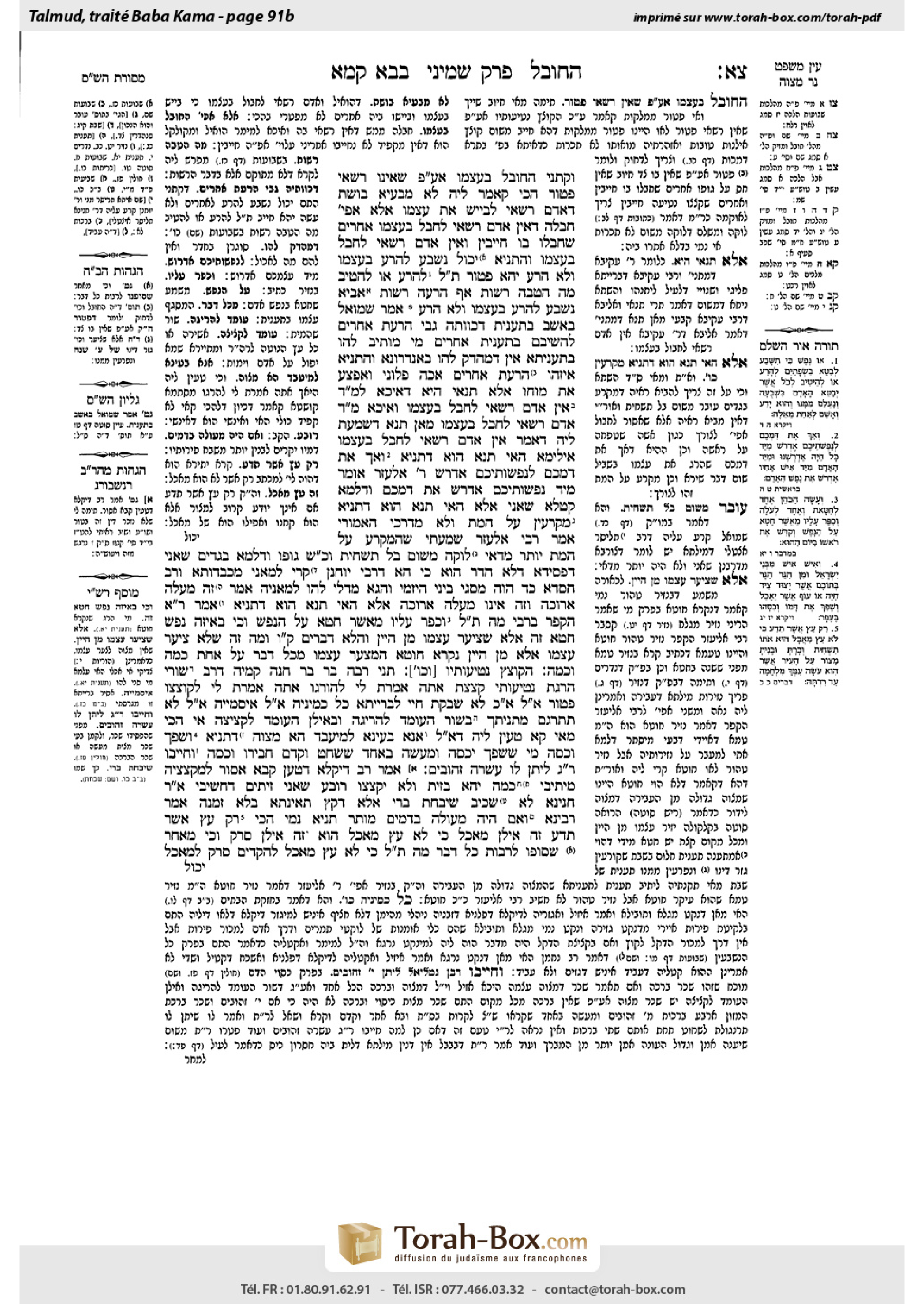
Bava Kamma 91b: Talmud study for Daf Yomi
Study the Talmud for Daf Yomi with scanned pages, Hebrew text, English translations from Sefaria and AI-generated French translations.
Passage selection and English or AI-generated French translation are available where the scan has annotations. Daf Study is independent of Torah-Box and Sefaria.
Browse Bava Kamma · בבא קמא · All tractatesBava Kamma 91b text and translations
This page of Bava Kamma includes the Aramaic text, an English translation and an AI-generated French translation, alongside the scan above.
בבא קמא צ״א ב · Aramaic and Hebrew text
וְקָתָנֵי: הַחוֹבֵל בְּעַצְמוֹ, אַף עַל פִּי שֶׁאֵינוֹ רַשַּׁאי – פָּטוּר! הָכִי קָאָמַר לֵיהּ: לָא מִבַּעְיָא בּוֹשֶׁת, דְּאָדָם רַשַּׁאי לְבַיֵּישׁ אֶת עַצְמוֹ; אֶלָּא אֲפִילּוּ חֲבָלָה, דְּאֵין אָדָם רַשַּׁאי לְחַבֵּל בְּעַצְמוֹ – אֲחֵרִים שֶׁחָבְלוּ בּוֹ, חַיָּיבִין.
וְאֵין אָדָם רַשַּׁאי לְחַבֵּל בְּעַצְמוֹ? וְהָתַנְיָא: יָכוֹל נִשְׁבַּע לְהָרַע בְּעַצְמוֹ – וְלֹא הֵרַע, יְהֵא פָּטוּר? תַּלְמוּד לוֹמַר: ״לְהָרַע אוֹ לְהֵטִיב״ – מָה הֲטָבָה רְשׁוּת, אַף הֲרָעָה רְשׁוּת; אָבִיא נִשְׁבָּע לְהָרַע בְּעַצְמוֹ וְלֹא הֵרַע!
אָמַר שְׁמוּאֵל: בְּ״אֵשֵׁב בְּתַעֲנִית״.
דִּכְווֹתַהּ גַּבֵּי הֲרָעַת אֲחֵרִים – לְהֹשִׁיבָם בְּתַעֲנִית; אֲחֵרִים מִי מוֹתֵיב לְהוּ בְּתַעֲנִיתָא?!
אִין; דִּמְהַדַּק לְהוּ בְּאִנְדְּרוֹנָא.
וְהָתַנְיָא: אֵיזֶהוּ הֲרָעַת אֲחֵרִים? ״אַכֶּה פְּלוֹנִי וְאֶפְצַע אֶת מוֹחוֹ״!
אֶלָּא תַּנָּאֵי הִיא; דְּאִיכָּא לְמַאן דְּאָמַר: אֵין אָדָם רַשַּׁאי לְחַבֵּל בְּעַצְמוֹ, וְאִיכָּא מַאן דְּאָמַר: אָדָם רַשַּׁאי לְחַבֵּל בְּעַצְמוֹ.
מַאן תַּנָּא דְּשָׁמְעַתְּ לֵיהּ דְּאָמַר: אֵין אָדָם רַשַּׁאי לְחַבֵּל בְּעַצְמוֹ? אִילֵּימָא הַאי תַּנָּא הוּא – דְּתַנְיָא: ״וְאַךְ אֶת דִּמְכֶם לְנַפְשֹׁתֵיכֶם אֶדְרֹשׁ״ – רַבִּי אֶלְעָזָר אוֹמֵר: מִיַּד נַפְשׁוֹתֵיכֶם אֶדְרֹשׁ אֶת דִּמְכֶם;
וְדִלְמָא קְטָלָא שָׁאנֵי!
אֶלָּא הַאי תַּנָּא הוּא – דְּתַנְיָא: מְקָרְעִין עַל הַמֵּת, וְלֹא מִדַּרְכֵי הָאֱמוֹרִי. אָמַר רַבִּי אֶלְעָזָר: שָׁמַעְתִּי שֶׁהַמְקָרֵעַ עַל הַמֵּת יוֹתֵר מִדַּאי – לוֹקֶה מִשּׁוּם ״בַּל תַּשְׁחִית״. וְכׇל שֶׁכֵּן גּוּפוֹ.
וְדִלְמָא בְּגָדִים שָׁאנֵי, דִּפְסֵידָא דְּלָא הָדַר הוּא! כִּי הָא דְּרַבִּי יוֹחָנָן קָרֵי [לְהוּ] לְמָאנֵי[הּ] ״מְכַבְּדוֹתַי״, וְרַב חִסְדָּא כַּד הֲוָה מְסַגֵּי בֵּינֵי הִיזְמֵי (וְהִגֵּא) [וְהִגֵּי] – מְדַלֵּי לְהוּ לְמָאנֵיהּ, אָמַר: זֶה מַעֲלֶה אֲרוּכָה, וְזֶה אֵינוֹ מַעֲלֶה אֲרוּכָה.
אֶלָּא הַאי תַּנָּא הוּא – דְּתַנְיָא: אָמַר רַבִּי אֶלְעָזָר הַקַּפָּר בְּרַבִּי, מָה תַּלְמוּד לוֹמַר: ״וְכִפֶּר עָלָיו מֵאֲשֶׁר חָטָא עַל הַנָּפֶשׁ״? וְכִי בְּאֵיזֶה נֶפֶשׁ חָטָא זֶה? אֶלָּא שֶׁצִּיעֵר עַצְמוֹ מִן הַיַּיִן. וַהֲלֹא דְּבָרִים קַל וְחוֹמֶר – וּמָה זֶה, שֶׁלֹּא צִיעֵר עַצְמוֹ אֶלָּא מִן הַיַּיִן, נִקְרָא חוֹטֵא; הַמְצַעֵר עַצְמוֹ מִכׇּל דָּבָר, עַל אַחַת כַּמָּה וְכַמָּה!
הַקּוֹצֵץ נְטִיעוֹתָיו [וְכוּ׳]. תָּנֵי רַבָּה בַּר בַּר חַנָּה קַמֵּיהּ דְּרַב: ״שׁוֹרִי הָרַגְתָּ״, ״נְטִיעוֹתַי קָצַצְתָּ״; ״אַתָּה אָמַרְתָּ לִי לְהוֹרְגוֹ״, ״אַתָּה אָמְרַתְּ לִי לְקוֹצְצוֹ״ – פָּטוּר. אֲמַר לֵיהּ: אִם כֵּן, לָא שְׁבַקְתְּ חַיֵּי לְבִרְיָיתָא! כֹּל כְּמִינֵּיהּ?!
אֲמַר לֵיהּ: אֶיסְמְיַיהּ? אֲמַר לֵיהּ: לָא; תִּתַּרְגַּם מַתְנִיתָךְ בְּשׁוֹר הָעוֹמֵד לַהֲרִיגָה, וּבְאִילָן הָעוֹמֵד לִקְצִיצָה.
אִי הָכִי, מַאי קָא טָעֵין לֵיהּ? דְּאָמַר לֵיהּ: אֲנָא בָּעֵינָא לְמִיעְבַּד הָא מִצְוָה.
דְּתַנְיָא: ״וְשָׁפַךְ וְכִסָּה״ – מִי שֶׁשָּׁפַךְ, יְכַסֶּה. וּמַעֲשֶׂה בְּאֶחָד שֶׁשָּׁחַט, וְקָדַם חֲבֵירוֹ וְכִסָּה, וְחִיְּיבוֹ רַבָּן גַּמְלִיאֵל לִיתֵּן לוֹ עֲשָׂרָה זְהוּבִים.
אָמַר רַב: דִּיקְלָא דִּטְעַן קַבָּא – אָסוּר לְמִקְצְצֵיהּ.
מֵיתִיבִי: כַּמָּה יְהֵא בַּזַּיִת וְלֹא יִקְצְצֶ[נּ]וּ? רוֹבַע! שָׁאנֵי זֵיתִים, דַּחֲשִׁיבִי.
אָמַר רַבִּי חֲנִינָא: לָא שְׁכֵיב שִׁיבְחַת בְּרִי, אֶלָּא דְּקַץ תְּאֵינְתָּא בְּלָא זִמְנַהּ. אָמַר רָבִינָא: וְאִם הָיָה מְעוּלֶּה בְּדָמִים, מוּתָּר.
תַּנְיָא נָמֵי הָכִי: ״רַק עֵץ אֲשֶׁר תֵּדַע״ – זֶה אִילַן מַאֲכָל, ״כִּי לֹא עֵץ מַאֲכָל הוּא״ – זֶה אִילַן סְרָק.
וְכִי מֵאַחַר שֶׁסּוֹפֵ[נ]וּ לְרַבּוֹת כׇּל דָּבָר, מָה תַּלְמוּד לוֹמַר ״כִּי לֹא עֵץ מַאֲכָל״? לְהַקְדִּים סְרָק לְמַאֲכָל.
Bava Kamma 91b · English translation
and it teaches: With regard to one who injures himself, although it is not permitted for him to do so, he is nevertheless exempt from any sort of penalty, indicating that the prohibition is in effect even with regard to humiliation. The Gemara answers: This is what Rabbi Akiva said to the man: It is not necessary to say with regard to humiliation, where it is permitted for a person to humiliate himself, that someone else who humiliated him is liable. But even with regard to injury, where it is not permitted for a person to injure himself, others who injured him are liable.
§ The Gemara discusses whether it is permitted to injure oneself. And is a person not permitted to injure himself? But isn’t it taught in a baraita: One might have thought that if one takes an oath to do evil to himself and did not do evil he will be exempt from bringing an offering for having transgressed this oath. Therefore, the verse states: “Or if anyone swear clearly with his lips to do evil or to do good” (Leviticus 5:4), which teaches that just as taking an oath to do good for which one is liable is referring to an optional activity, as opposed to taking an oath to perform a mitzva, so too, taking an oath to do evil is referring to an optional activity, as opposed to taking an oath to transgress. I can therefore include within the category of one who is liable if he transgressed his oath the person who takes an oath to do evil to himself and did not do evil. It is clear from this baraita that doing evil to oneself is permitted.
The Gemara answers: Shmuel says: The ruling of the baraita is not referring to one who takes an oath to injure himself but is stated with regard to one who takes an oath stating: I will sit in observance of a fast, which it is permitted to do.
Earlier in this same baraita, it states that one who takes an oath to do evil to others is not liable for violating his oath if he does not do evil, as it is prohibited to do evil to others. If the baraita is referring to one who takes an oath to fast, then in the corresponding situation in the context of doing evil to others, the baraita must also then be referring to one who takes an oath to have others sit in observance of a fast. The Gemara asks: Can one compel others to sit in observance of a fast?
The Gemara answers: Yes; it is possible, as by preventing others from accessing food he can impose a fast on them, e.g., in a situation where he confined them in a room.
The Gemara questions the assertion that this is the case of the baraita: But isn’t it taught in a baraita: What is considered taking an oath to do evil to others? It is considered such if one takes an oath stating: I will strike so-and-so and I will injure his brain. Accordingly, in the corresponding situation of doing evil to oneself it is necessary to explain that the baraita is referring to causing injury as well, and the inference that this is permitted remains.
Rather, it must be that this is a dispute between tanna’im, as there is a tanna who says that it is not permitted for a person to injure himself, and there is a tanna who says that it is permitted for a person to injure himself.
The Gemara asks: Who is the tanna that you heard that says: It is not permitted for a person to injure himself? If we say that it is this tanna, as it is taught in a baraita: The verse states: “And surely your blood of your souls will I require” (Genesis 9:5), and Rabbi Elazar says: From the hand of your souls, i.e., from yourself, will I require your blood, meaning one is liable even for taking his own life, that is not a correct inference.
But perhaps killing is different. While Rabbi Elazar holds that it is prohibited to take one’s own life, it cannot be inferred from here that he holds that one is liable for injuring himself.
The Gemara suggests: Rather, it is the opinion of this tanna, as it is taught in a baraita: One may rend garments in anguish over one who died, and it is not considered of the ways of the Amorites, but a Jewish custom. Rabbi Elazar says: I heard that one who rends his garments excessively over one who died is flogged for having transgressed the prohibition of: Do not destroy (see Deuteronomy 20:19). The Gemara suggests: And all the more so it is the case that according to Rabbi Elazar one who injures his body in anguish transgresses this prohibition.
The Gemara rejects this suggestion: But perhaps garments are different, in that tearing them is a loss that is irreversible, like that practice of Rabbi Yoḥanan, who would refer to his garments as: My honor, and like that practice of Rav Ḥisda, who, when he would walk among thorns and shrubs, would raise his clothing despite the fact that his skin would get scratched by the thorns. He said in explanation of his actions: This flesh will heal if scratched, but that garment will not heal if torn. Similarly, perhaps it is prohibited to rend one’s garments, but it is permitted to injure oneself.
Rather, it is this tanna, as it is taught in a baraita: Rabbi Elazar HaKappar the Distinguished said: What is the meaning when the verse states with regard to a nazirite: “And he shall atone for him for sinning by the soul” (Numbers 6:11)? And with which soul did this person sin by becoming a nazirite? Rather, in that he afflicted himself by abstaining from wine he is considered to have sinned with his own soul, and he must bring a sin-offering for the naziriteship itself, for causing his body to suffer. And are these matters not inferred a fortiori: And just as this person who afflicted himself by abstaining only from wine is nevertheless called a sinner, one who afflicts himself by abstaining from everything, through fasting or other acts of mortification, all the more so is he described as a sinner? Consequently, Rabbi Elazar HaKappar holds that one may not harm himself in any manner.
§ The mishna teaches: One who cuts down his own saplings, although it is not permitted for him to do so, is exempt from payment. Nevertheless, others who cut down his saplings are liable. Rabba bar bar Ḥana taught the following baraita before Rav: If one charged another: You killed my ox, or: You cut down my saplings, and you are liable to pay for them, and the other responds: You told me to kill the ox, or: You told me to cut down the saplings, he is exempt from paying. Rav said to him: If that is so, you let no creature exist. Is it in his power to assert that because the other instructed him to cause damage he is exempt? With this claim, anyone who causes damage can exempt himself.
Rabba bar bar Ḥana said to Rav: Shall I erase this baraita from the baraitot that I teach? Rav said to him: No, just interpret that your baraita is stated with regard to an ox that is ready to be killed, e.g., it had gored, and the owner decided to have it killed, and it is stated with regard to a tree that is ready to be cut down for whatever reason, e.g., it was worshipped as part of an idolatrous rite or it is situated in a manner that poses a danger to the public. In such a case there is reason to believe that he was in fact instructed to cut it down.
The Gemara asks: If that is so, that the owner of the ox or tree acknowledges that it would be killed or cut down in any event, what claim is he stating to him, as there was no loss resulting from the action of the other? The Gemara answers: The case is where he said to him: I desire to perform this mitzva of removing a danger or destroying idolatry by myself, and therefore I am demanding payment from you for having prevented me from doing so.
This is as it is taught in a baraita: The verse states with regard to one who slaughters an undomesticated animal or a bird: “He shall pour out the blood thereof, and he shall cover it with dust” (Leviticus 17:13). This teaches that the one who poured the blood, i.e., the one who slaughtered, shall cover the blood. An incident occurred involving one who slaughtered an undomesticated animal or bird, and another preempted him and covered the blood, and Rabban Gamliel deemed him liable to give ten golden coins to the one who slaughtered the animal, as he prevented him from performing the mitzva.
§ In connection with the prohibition against cutting down trees the Gemara notes: Rav said with regard to a palm tree that still produces fruit in the amount of a kav, that it is prohibited to cut it down due to the prohibition of: “When you shall besiege a city…you shall not destroy the trees” (Deuteronomy 20:19).
The Gemara raises an objection to the statement of Rav from what was taught in a mishna (Shevi’it 4:10): How much fruit must be on an olive tree so that one may not cut it down? A quarter-kav. Why did Rav say that it must produce a full kav? The Gemara answers: Olive trees are different, since they are significant. Therefore, even a quarter-kav is valuable.
Rabbi Ḥanina said: My son Shivḥat did not die for any reason other than that he cut down a fig tree before its time. Ravina says: But if the lumber was greater in monetary value than its fruits, it is permitted to chop it down, and this does not violate the prohibition against destroying a tree.
This halakha is also taught in a baraita. The verse states: “Only the trees of which you know that they are not trees for food, them you may destroy and cut down” (Deuteronomy 20:20). “Only the trees of which you know”; this is referring to a tree that bears fruit used for food, and it is permitted to cut down this type of tree under certain circumstances. “That they are not trees for food”; this is referring to a barren tree.
The Gemara asks: And since the baraita will ultimately include all types of trees, so that even a tree that produces fruit may be cut down, what, then, is the meaning when the verse states: “That they are not trees for food,” which indicates that it is permitted to cut down only a barren tree? The Gemara answers: It is to give precedence to cutting down a barren tree over a tree whose fruit is used for food.
Bava Kamma 91b · Traduction française (IA)
et il enseigne : concernant celui qui se fait du mal, bien qu'il ne soit pas permis de le faire, il est toutefois exempt de toute sorte de punition, indiquant que l'interdiction s'applique même à l'humiliation. La Guemara répond : c'est ce que Rabbi Akiva a dit à l'homme : il n'est pas nécessaire de dire concernant l'humiliation, là où il est permis à une personne d'elle-même s'humilier, que celui qui l'a humilié est responsable. Mais même concernant la blessure, là où il n'est pas permis à une personne de se blesser elle-même, ceux qui l'ont blessé sont responsables.
§ La Guemara discute si on peut se blesser soi-même. Et une personne n'est-elle pas interdite de se blesser elle-même ? Mais n'est-il pas enseigné dans une baraïta : on pourrait penser que si l'on prend un serment de faire du mal à soi-même et qu'on n'a pas fait de mal, on sera exempt de présenter un holocauste pour avoir transgressé ce serment. Par conséquent, la Sainte Écriture dit : « Ou si quelqu'un jure clairement avec ses lèvres de faire du mal ou de faire du bien » (Lévitique 5:4), ce qui enseigne que tout comme prendre un serment de faire du bien pour lequel on est responsable est relatif à une activité optionnelle, contrairement à prendre un serment de faire une mitsva, de même, prendre un serment de faire du mal est relatif à une activité optionnelle, contrairement à prendre un serment de transgresser. Je peux donc inclure dans la catégorie de celui qui est responsable s'il a transgressé son serment la personne qui prend un serment de faire du mal à soi-même et n'a pas fait de mal. Il est clair à partir de cette baraïta que faire du mal à soi-même est permis.
La Guemara répond : Shmuel dit : la décision de la baraïta ne concerne pas celui qui prend un serment de se blesser lui-même, mais est énoncée concernant celui qui prend un serment disant : je jeûnerai, ce qui est permis de le faire.
Plus tôt dans cette même baraïta, il est dit que celui qui prend un serment de faire du mal aux autres n'est pas responsable de violer son serment s'il ne fait pas de mal, car il est interdit de faire du mal aux autres. Si la baraïta concerne celui qui prend un serment de jeûner, alors dans la situation correspondante concernant faire du mal aux autres, la baraïta doit aussi concerner celui qui prend un serment de faire jeûner les autres. La Guemara pose la question : peut-on obliger d'autres à jeûner ?
La Guemara répond : oui ; c'est possible, car en empêchant d'autres d'accéder aux aliments, il peut imposer un jeûne à eux, par exemple dans une situation où il les a confinés dans une pièce.
La Guemara questionne l'affirmation que c'est le cas de la baraïta : mais n'est-il pas enseigné dans une baraïta : qu'est-ce qui constitue un serment de faire du mal aux autres ? C'est le cas si l'on prend un serment disant : je frapperai tel et tel et je blesserai son cerveau. Ainsi, dans la situation correspondante de faire du mal à soi-même, il faut expliquer que la baraïta concerne aussi la cause de la blessure, et l'inférence que cela est permis reste valable.
Plutôt, il s'agit d'un débat entre les tannaïm, car il y a un tanna qui dit qu'il n'est pas permis à une personne de se blesser elle-même, et il y a un tanna qui dit qu'il est permis à une personne de se blesser elle-même.
La Guemara pose la question : qui est le tanna que vous avez entendu qui dit : il n'est pas permis à une personne de se blesser elle-même ? Si nous disons que c'est ce tanna, comme il est enseigné dans une baraïta : la Sainte Écriture dit : « Et certainement ton sang de tes âmes je le demanderai » (Genèse 9:5), et Rabbi Elazar dit : « De la main de tes âmes, c'est-à-dire de toi-même, je demanderai ton sang, c'est-à-dire qu'on est responsable même de prendre sa propre vie, ce n'est pas une inférence correcte.
Mais peut-être que tuer est différent. Bien que Rabbi Elazar dise qu'il est interdit de prendre sa propre vie, on ne peut pas en déduire qu'il considère que se blesser soi-même est punissable.
La Guemara suggère : plutôt, c'est l'opinion de ce tanna, comme il est enseigné dans une baraïta : on peut déchirer ses vêtements en raison de la douleur d'une personne décédée, et cela n'est pas considéré comme l'usage des Amorites, mais une coutume juive. Rabbi Elazar dit : j'ai entendu que celui qui déchire excessivement ses vêtements sur une personne décédée est battu pour avoir transgressé l'interdiction de : ne détruis pas (cf. Deutéronome 20:19). La Guemara suggère : et encore plus, selon Rabbi Elazar, celui qui se blesse son corps en raison de la douleur transgresse cette interdiction.
La Guemara rejette cette suggestion : mais peut-être les vêtements sont différents, car déchirer est une perte irréversible, comme la pratique de Rabbi Yoḥanan qui appelait ses vêtements : mon honneur, et comme la pratique de Rav Ḥisda, qui, lorsqu'il marchait parmi les buissons et les épines, levait ses vêtements malgré les égratignures qu'il recevait. Il expliquait ses actions en disant : cette chair guérira si elle est égratignée, mais ce vêtement ne guérira pas si on le déchire. De même, peut-être il est interdit de déchirer ses vêtements, mais il est permis de se blesser soi-même.
Plutôt, c'est ce tanna, comme il est enseigné dans une baraïta : Rabbi Elazar HaKappar le Distingué dit : quelle est la signification lorsque la Sainte Écriture dit concernant un nazirite : « Et il s'at-ontera pour lui pour avoir péché par l'âme » (Nombres 6:11) ? Et avec quelle âme ce personnage a-t-il péché en devenant un nazirite ? Plutôt, en s'affligeant en se privant du vin, il est considéré comme ayant péché avec son propre âme, et il doit présenter un sacrifice expiatoire pour la nazirité elle-même, pour avoir causé souffrance à son corps. Et ces choses ne ne sont-elles pas inférées a fortiori : et tout comme cette personne qui s'affligeait seulement en se privant du vin est toutefois appelée un pécheur, celui qui s'afflige en se privant de tout, par le jeûne ou d'autres actes de mortification, tout autant qu'elle est décrit comme un pécheur ? Ainsi, Rabbi Elazar HaKappar considère que l'on ne doit pas se blesser de quelque manière que ce soit.
§ La Michna enseigne : Celui qui coupe ses propres jeunes arbres, bien qu'il ne soit pas autorisé à le faire, est exempt de réparation. Cependant, ceux qui coupent ses jeunes arbres sont tenus responsables. Rabba bar bar Ḥana a enseigné la suivante baraïta devant Rav : Si l'un accuse l'autre en disant : Tu as tué mon bœuf, ou : Tu as coupé mes jeunes arbres, et tu es tenu de réparer, et l'autre répond : Tu m'as dit de tuer le bœuf, ou : Tu m'as dit de couper les jeunes arbres, il est exempt de réparation. Rav a dit à lui : Si c'est ainsi, tu laisses mourir toute créature. Est-ce qu'il est en mesure d'affirmer que parce que l'autre l'a chargé de causer un préjudice, il est exempt ? Avec cette revendication, toute personne qui cause un préjudice peut s'écarter de la responsabilité.
Rabba bar bar Ḥana a dit à Rav : Dois-je effacer cette baraïta des baraitot que je t'enseigne ? Rav a dit à lui : Non, interprète simplement que ta baraïta est formulée concernant un bœuf prêt à être tué, c'est-à-dire qu'il avait blessé, et que l'owner avait décidé de le tuer, et elle est formulée concernant un arbre prêt à être coupé pour toute raison, c'est-à-dire qu'il était vénéré dans un rituel idolâtre ou qu'il est situé de manière à constituer un danger pour le public. Dans ce cas-là, il y a lieu de penser qu'il avait effectivement été chargé de le couper.
Le Guemara pose la question : Si c'est ainsi, que l'owner du bœuf ou de l'arbre reconnaît qu'il serait tué ou coupé de toute façon, quelle revendication énonce-t-il, puisque l'action de l'autre n'a pas causé de préjudice ? Le Guemara répond : Le cas est celui où il a dit à lui : Je désire accomplir cette mitsva de supprimer un danger ou de détruire l'idolâtrie par moi-même, et donc je demande une réparation de ta part pour avoir empêché cela.
C'est ce qui est enseigné dans une baraïta : La Parashah stipule concernant celui qui sacrifie un animal sauvage ou un oiseau : « Il versera le sang de celui-ci, et il recouvrera le sang avec de la poussière » (Lévitique 17:13). Cela enseigne que celui qui a versé le sang, c'est-à-dire celui qui a sacrifié, doit recouvrir le sang. Un incident s'est produit concernant celui qui sacrifiait un animal sauvage ou un oiseau, et un autre l'a anticipé et a recouvert le sang, et Rabban Gamliel a estimé qu'il devait donner dix pièces d'or à celui qui avait sacrifié l'animal, car il l'avait empêché d'accomplir la mitsva.
§ En lien avec l'interdiction de couper les arbres, le Guemara note : Rav a dit concernant un palmier qui produit encore des fruits en quantité d'un kav, qu'il est interdit de le couper en raison de l'interdiction de : « Quand tu assiégeras une ville… tu ne détruiras pas les arbres » (Dn 20:19).
Le Guemara soulève un objet contre l'affirmation de Rav à partir de ce qui est enseigné dans une Michna (Shevi’it 4:10) : Quelle quantité de fruits doit être sur un arbre d'olivier pour que l'on ne puisse pas le couper ? Un quart de kav. Pourquoi Rav a-t-il dit qu'il devait produire un kav complet ? Le Guemara répond : Les arbres d'olivier sont différents, car ils sont importants. Ainsi, même un quart de kav est précieux.
Rabbi Ḥanina a dit : Mon fils Shivḥat n'est mort pour aucune autre raison que d'avoir coupé un arbre à figues avant l'heure. Ravina a dit : Mais si la valeur du bois était supérieure à celle de ses fruits, il est permis de le couper, et cela ne viole pas l'interdiction de détruire un arbre.
Cette halakha est aussi enseignée dans une baraïta. La parole stipule : « Seulement les arbres dont vous savez qu'ils ne sont pas des arbres de nourriture, vous pouvez détruire et couper » (Dn 20:20). « Seulement les arbres dont vous savez » : cela fait référence à un arbre qui produit des fruits utilisés pour la nourriture, et il est permis de couper ce type d'arbre sous certaines conditions. « Qui ne sont pas des arbres de nourriture » : cela fait référence à un arbre sans fruits.
Le Guemara pose la question : Et puisque la baraïta inclura finalement tous types d'arbres, de sorte que même un arbre qui produit des fruits peut être coupé, que signifie alors la parole stipulant : « Qui ne sont pas des arbres de nourriture », qui indique que seul un arbre sans fruits peut être coupé ? Le Guemara répond : C'est pour accorder la priorité à couper un arbre sans fruits par rapport à un arbre dont les fruits sont utilisés pour la nourriture.
Traduction française générée par IA à partir de l’édition anglaise de Sefaria. Vérifie toujours un passage avec le texte source.
Text from Sefaria: William Davidson Edition - Vocalized Aramaic (CC BY NC); William Davidson Edition - English (CC BY NC).