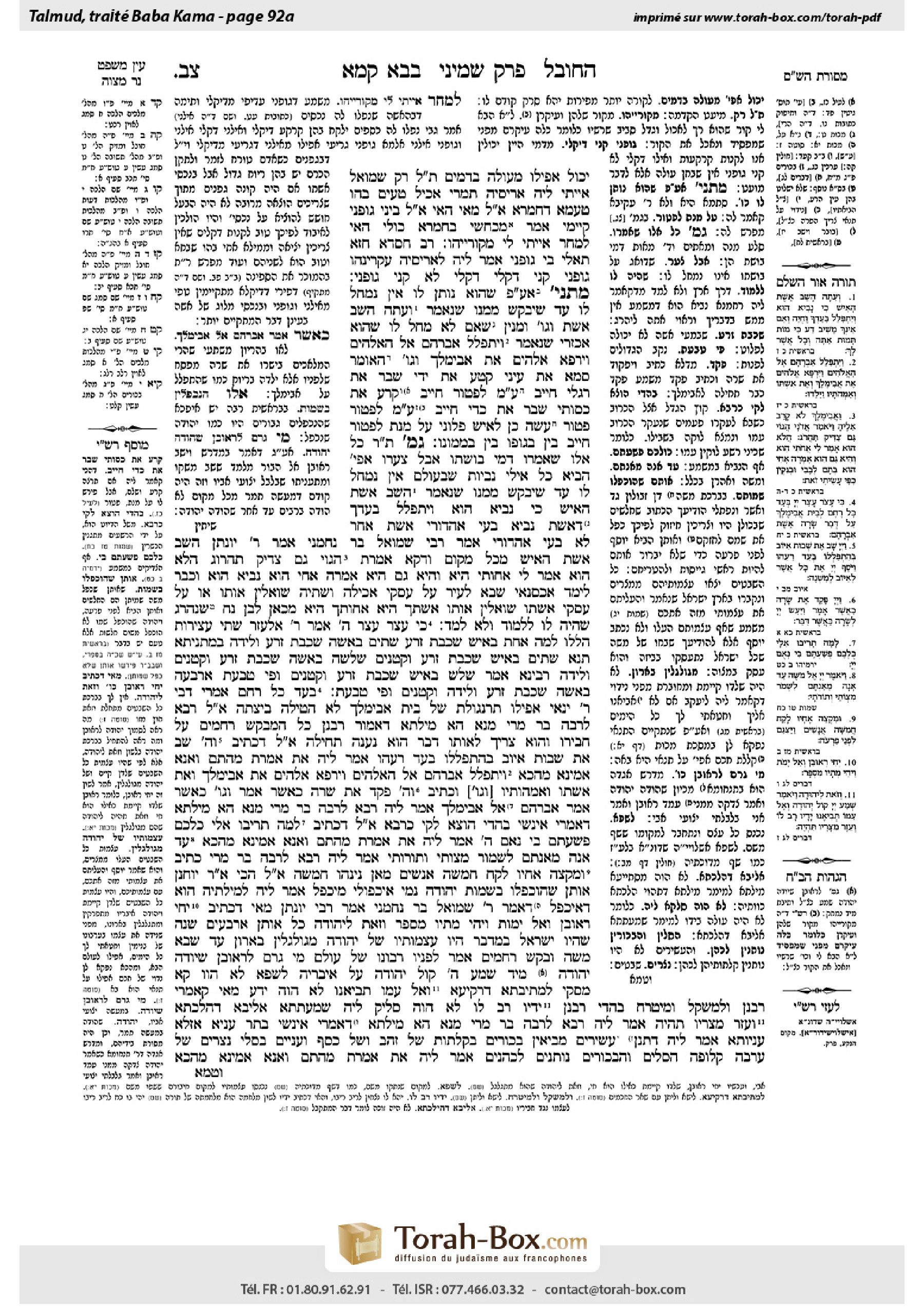
Bava Kamma 92a: Talmud study for Daf Yomi
Study the Talmud for Daf Yomi with scanned pages, Hebrew text, English translations from Sefaria and AI-generated French translations.
Passage selection and English or AI-generated French translation are available where the scan has annotations. Daf Study is independent of Torah-Box and Sefaria.
Browse Bava Kamma · בבא קמא · All tractatesBava Kamma 92a text and translations
This page of Bava Kamma includes the Aramaic text, an English translation and an AI-generated French translation, alongside the scan above.
בבא קמא צ״ב א · Aramaic and Hebrew text
יָכוֹל אֲפִילּוּ מְעוּלֶּה בְּדָמִים? תַּלְמוּד לוֹמַר: ״רַק״.
שְׁמוּאֵל אַיְיתִי לֵיהּ אֲרִיסֵיהּ תַּמְרֵי. אָכֵיל, טָעֵים בְּהוּ טַעְמָא דְחַמְרָא. אֲמַר לֵיהּ: מַאי הַאי? אֲמַר לֵיהּ: בֵּינֵי גוּפְנֵי קָיְימִי. אָמַר: מַכְחֲשִׁי בְּחַמְרָא כּוּלֵּי הַאי? לִמְחַר אַיְיתִי לִי מִקּוֹרַיְיהוּ.
רַב חִסְדָּא חֲזָא תָּאלֵי בֵּי גוּפְנֵי. אֲמַר לֵיהּ לַאֲרִיסֵיהּ: עַקְרִינְהוּ; גּוּפְנֵי קָנֵי דִּקְלֵי, דִּקְלֵי לָא קָנֵי גּוּפְנֵי.
מַתְנִי׳ אַף עַל פִּי שֶׁהוּא נוֹתֵן לוֹ, אֵין נִמְחָל לוֹ עַד שֶׁיְּבַקֵּשׁ מִמֶּנּוּ. שֶׁנֶּאֱמַר: ״וְעַתָּה הָשֵׁב אֵשֶׁת וְגוֹ׳״. וּמִנַּיִן שֶׁאִם לֹא מָחַל לוֹ, שֶׁהוּא אַכְזָרִי? שֶׁנֶּאֱמַר: ״וַיִּתְפַּלֵּל אַבְרָהָם אֶל הָאֱלֹהִים, וַיִּרְפָּא אֱלֹהִים אֶת אֲבִימֶלֶךְ וְגוֹ׳״.
הָאוֹמֵר ״סַמֵּא אֶת עֵינִי״; ״קַטַּע אֶת יָדִי״; ״שַׁבֵּר אֶת רַגְלִי״ – חַיָּיב. ״עַל מְנָת לִפְטוֹר״ – חַיָּיב.
״קְרַע אֶת כְּסוּתִי״; ״שַׁבֵּר אֶת כַּדִּי״ – חַיָּיב. ״עַל מְנָת לִפְטוֹר״ – פָּטוּר. ״עֲשֵׂה כֵּן לְאִישׁ פְּלוֹנִי עַל מְנָת לִפְטוֹר״ – חַיָּיב, בֵּין בְּגוּפוֹ בֵּין בְּמָמוֹנוֹ.
גְּמָ׳ תָּנוּ רַבָּנַן: כׇּל אֵלּוּ שֶׁאָמְרוּ – דְּמֵי בוֹשְׁתּוֹ; אֲבָל צַעֲרוֹ – אֲפִילּוּ הֵבִיא כׇּל אֵילֵי נְבָיוֹת שֶׁבָּעוֹלָם, אֵין נִמְחָל לוֹ עַד שֶׁיְּבַקֵּשׁ מִמֶּנּוּ. שֶׁנֶּאֱמַר: ״הָשֵׁב אֵשֶׁת הָאִישׁ כִּי נָבִיא הוּא, וְיִתְפַּלֵּל בַּעַדְךָ״.
דְּאֵשֶׁת נָבִיא בָּעֵי אַהְדּוֹרֵי, אֵשֶׁת אַחֵר לָא בָּעֵי אַהְדּוֹרֵי?
אָמַר רַבִּי שְׁמוּאֵל בַּר נַחְמָנִי אָמַר רַבִּי יוֹנָתָן: ״הָשֵׁב אֵשֶׁת הָאִישׁ״ – מִכׇּל מָקוֹם. וּדְקָא אָמְרַתְּ: ״הֲגוֹי גַּם צַדִּיק תַּהֲרֹג?! הֲלֹא הוּא אָמַר לִי אֲחֹתִי הִיא, וְהִיא גַּם הִיא אָמְרָה אָחִי הוּא!״ נָבִיא הוּא, וּכְבָר לִימֵּד: אַכְסְנַאי שֶׁבָּא לָעִיר – עַל עִסְקֵי אֲכִילָה וּשְׁתִיָּה שׁוֹאֲלִין אוֹתוֹ, אוֹ עַל עִסְקֵי אִשְׁתּוֹ שׁוֹאֲלִין אוֹתוֹ – ״אִשְׁתְּךָ הִיא?״ ״אֲחוֹתְךָ הִיא?״
מִכָּאן לְבֶן נֹחַ שֶׁנֶּהֱרָג, שֶׁהָיָה לוֹ לִלְמוֹד וְלֹא לָמַד.
״כִּי עָצֹר עָצַר ה׳״ – אָמַר רַבִּי אֶלְעָזָר: שְׁתֵּי עֲצִירוֹת הַלָּלוּ לָמָּה? אַחַת בְּאִישׁ – שִׁכְבַת זֶרַע, שְׁתַּיִם בְּאִשָּׁה – שִׁכְבַת זֶרַע וְלֵידָה.
בְּמַתְנִיתָא תְּנָא: שְׁתַּיִם בְּאִישׁ – שִׁכְבַת זֶרַע וּקְטַנִּים, שְׁלֹשָׁה בָּאִשָּׁה – שִׁכְבַת זֶרַע וּקְטַנִּים וְלֵידָה.
רָבִינָא אָמַר: שָׁלֹשׁ בְּאִישׁ – שִׁכְבַת זֶרַע וּקְטַנִּים וּפִי טַבַּעַת, אַרְבָּעָה בְּאִשָּׁה – שִׁכְבַת זֶרַע וְלֵידָה וּקְטַנִּים וּפִי טַבַּעַת.
״בְּעַד כׇּל רֶחֶם״ – אָמְרִי דְּבֵי רַבִּי יַנַּאי: אֲפִילּוּ תַּרְנְגוֹלֶת שֶׁל בֵּית אֲבִימֶלֶךְ לֹא הֵטִילָה בֵּיצָתָהּ.
אֲמַר לֵיהּ רָבָא לְרַבָּה בַּר מָרִי: מְנַָא הָא מִילְּתָא דַאֲמוּר רַבָּנַן: כׇּל הַמְבַקֵּשׁ רַחֲמִים עַל חֲבֵירוֹ וְהוּא צָרִיךְ לְאוֹתוֹ דָּבָר, הוּא נַעֲנֶה תְּחִילָּה? אֲמַר לֵיהּ: דִּכְתִיב: ״וַה׳ שָׁב אֶת שְׁבוּת אִיּוֹב בְּהִתְפַּלְלוֹ בְּעַד רֵעֵהוּ״.
אֲמַר לֵיהּ: אַתְּ אָמְרַתְּ מֵהָתָם, וַאֲנָא אָמֵינָא מֵהָכָא: ״וַיִּתְפַּלֵּל אַבְרָהָם אֶל הָאֱלֹהִים, וַיִּרְפָּא אֱלֹהִים אֶת אֲבִימֶלֶךְ וְאֶת אִשְׁתּוֹ וְאַמְהוֹתָיו [וְגוֹ׳]״, וּכְתִיב: ״וַה׳ פָּקַד אֶת שָׂרָה כַּאֲשֶׁר אָמָר וְגוֹ׳״ – כַּאֲשֶׁר אָמַר אַבְרָהָם אֶל אֲבִימֶלֶךְ.
אֲמַר לֵיהּ רָבָא לְרַבָּה בַּר מָרִי: מְנָא הָא מִילְּתָא דְאָמְרִי אִינָשֵׁי: בַּהֲדֵי הוּצָא לָקֵי כְּרָבָא? אֲמַר לֵיהּ, דִּכְתִיב: ״לָמָּה תָרִיבוּ אֵלָי? כֻּלְּכֶם פְּשַׁעְתֶּם בִּי נְאֻם ה׳״.
אֲמַר לֵיהּ: אַתְּ אָמְרַתְּ מֵהָתָם, וַאֲנָא אָמֵינָא מֵהָכָא: ״עַד אָנָה מֵאַנְתֶּם לִשְׁמֹר מִצְוֹתַי וְתוֹרֹתָי״.
אֲמַר לֵיהּ רָבָא לְרַבָּה בַּר מָרִי: כְּתִיב: ״וּמִקְצֵה אֶחָיו לָקַח חֲמִשָּׁה אֲנָשִׁים״ – מַאן נִינְהוּ חֲמִשָּׁה? אֲמַר לֵיהּ: הָכִי אָמַר רַבִּי יוֹחָנָן: אוֹתָן שֶׁהוּכְפְּלוּ בְּשֵׁמוֹת.
יְהוּדָה נָמֵי אִיכְּפוֹלֵי מִיכְּפַל!
אֲמַר לֵיהּ: לְמִילְּתֵיהּ הוּא דְּאִיכְּפַל. דְּאָמַר רַבִּי שְׁמוּאֵל בַּר נַחְמָנִי אָמַר רַבִּי יוֹנָתָן, מַאי דִּכְתִיב: ״יְחִי רְאוּבֵן וְאַל יָמֹת, וִיהִי מְתָיו מִסְפָּר – וְזֹאת לִיהוּדָה״?
כׇּל אוֹתָן אַרְבָּעִים שָׁנָה שֶׁהָיוּ יִשְׂרָאֵל בַּמִּדְבָּר, הָיוּ עַצְמוֹתָיו שֶׁל יְהוּדָה מְגוּלְגָּלִין בָּאָרוֹן; עַד שֶׁבָּא מֹשֶׁה וּבִקֵּשׁ רַחֲמִים – אָמַר לְפָנָיו: רִבּוֹנוֹ שֶׁל עוֹלָם, מִי גָּרַם לִרְאוּבֵן שֶׁיּוֹדֶה – יְהוּדָה!
מִיָּד: ״שְׁמַע ה׳ קוֹל יְהוּדָה״ – עָל אֵיבְרֵיהּ לְשָׁפָא. לָא הֲווֹ קָא מַסְּקִי [לֵיהּ] לִמְתִיבְתָּא דִּרְקִיעָא, ״וְאֶל עַמּוֹ תְּבִיאֶנּוּ״. לָא הֲוָה יָדַע מַאי קָאָמְרִי רַבָּנַן, וּלְמִשְׁקַל וּמִיטְרַח בַּהֲדֵי רַבָּנַן, ״יָדָיו רָב לוֹ״. לָא הֲוָה סָלֵיק לֵיהּ שְׁמַעְתְּתָא אַלִּיבָּא דְהִלְכְתָא, ״וְעֵזֶר מִצָּרָיו תִּהְיֶה״.
אֲמַר לֵיהּ רָבָא לְרַבָּה בַּר מָרִי, מְנָא הָא מִילְּתָא דְּאָמְרִי אִינָשֵׁי: בָּתַר עַנְיָא אָזְלָא עַנְיוּתָא? אֲמַר לֵיהּ, דִּתְנַן: עֲשִׁירִים מְבִיאִין בִּכּוּרִים בִּקְלָתוֹת שֶׁל זָהָב וְשֶׁל כֶּסֶף, וַעֲנִיִּים בְּסַלֵּי נְצָרִים שֶׁל עֲרָבָה קְלוּפָה. הַסַּלִּים וְהַבִּכּוּרִים נְתוּנִים לַכֹּהֲנִים. אֲמַר לֵיהּ: אַתְּ אָמְרַתְּ מֵהָתָם, וַאֲנָא אָמֵינָא מֵהָכָא:
Bava Kamma 92a · English translation
One might have thought that he must give precedence to the cutting down of a barren tree even if the barren tree is greater in monetary value than the fruit-bearing tree. The verse states: “Only,” which teaches that there is an exception to the rule. Similarly, if the fruit-bearing tree itself would be worth more as lumber than for its fruits, it would be permitted for one to cut it down.
The Gemara relates: The sharecropper of Shmuel brought him dates. Shmuel ate them, and tasted the taste of wine in them. He said to his sharecropper: What is this? The sharecropper said to him: The date palms stand among the grapevines and therefore contain a taste of wine from the grapes. Shmuel said: Do they weaken the wine, i.e., the grapevines, so much that it is possible to taste the wine in the dates? Tomorrow, cut down the date palms and bring me from their marrow to eat.
The Gemara relates a similar incident: Rav Ḥisda saw date palms growing among grapevines on his estate. He said to his sharecropper: Uproot the date palms, since one can purchase date palms with grapevines, as grapevines are more valuable, while one cannot purchase grapevines with date palms.
MISHNA: Despite the fact that the assailant who caused damage gives to the victim all of the required payments for the injury, his transgression is not forgiven for him in the heavenly court until he requests forgiveness from the victim, as it is stated that God told Abimelech after he had taken Sarah from Abraham: “Now therefore restore the wife of the man; for he is a prophet, and he shall pray for you, and you shall live” (Genesis 20:7). And from where is it derived that if the victim does not forgive him that he is cruel? As it is stated: “And Abraham prayed to God; and God healed Abimelech, and his wife, and his maidservants; and they bore children” (Genesis 20:17).
The mishna continues: With regard to one who says to another: Blind my eye, or: cut off my hand, or: break my leg, and he does so, the one who performed these actions is liable to pay for the damage, despite having been instructed to do so. Even if he explicitly instructed him: Do so on the condition that you will be exempt from payment, he is nevertheless liable.
With regard to one who says to another: Tear my garment, or: break my jug, and he does so, he is liable to pay for the damage. But if he instructed him explicitly: Do so on the condition that you will be exempt from payment, he is exempt from payment. If one says to another: Do so, i.e., cause damage, to so-and-so on the condition that you will be exempt from payment, and he did so, he is liable, whether the instructions were with regard to the victim himself, or whether the instructions were with regard to his property.
GEMARA: The Sages taught: All these sums that in the previous mishna they said one is liable to pay for humiliating another are the compensation for his humiliation, for which there is a set amount. But for the victim’s pain caused by the assailant, even if the assailant brings as offerings all the rams of Nebaioth (see Isaiah 60:7) that are in the world, which are of the best quality, his transgression is not forgiven for him in the heavenly court until he requests forgiveness from the victim, as it is stated: “Restore the wife of the man; for he is a prophet, and he shall pray for you” (Genesis 20:7).
Having quoted the verse, the Gemara asks: Shall one infer from here that the wife of a prophet needs to be returned, but the wife of another individual need not be returned?
The Gemara answers. Rabbi Shmuel bar Naḥmani says that Rabbi Yonatan says: This is how the verse should be understood: “Restore the wife of the man” in any case, since she is his wife. And with regard to that which you, Abimelech, said: “Will you slay even a righteous nation? Did he not say himself to me: She is my sister, and she, even she herself, said: He is my brother?” (Genesis 20:4–5), the answer is that you, Abimelech, are not so righteous, since the reason Abraham said that Sarah was his sister is that he is a prophet, and he already learned how to conduct himself based on your behavior. As with regard to a guest [akhsenai] who comes to town, does one ask him about matters concerning eating and drinking, or does one ask him about matters concerning his wife? Does one ask a guest: Is she your wife? Is she your sister? Abimelech was to be blamed, since Abraham thought that he intended to steal his wife.
The Gemara remarks: From here it can be derived that a gentile is executed for having transgressed a prohibition without awareness that the act was prohibited, since he should have learned and he did not learn.
Having mentioned the verses concerning the incident of Abraham and Abimelech, the Gemara explains other related verses. “For the Lord had obstructed [atzor atzar] all the wombs of the house of Abimelech” (Genesis 20:18). Rabbi Elazar says: Why are these two obstructions [atzor atzar] both stated? One is stated with regard to a man, that semen will not be discharged, and two are stated with regard to a woman, that semen will not be discharged from her, and that she will not give birth.
It was taught in a baraita: Two are stated with regard to a man: Semen and urine, i.e., that the men were unable to both urinate and discharge semen; three are stated with regard to a woman: Semen, and urine, and birth.
Ravina says: Three are stated with regard to a man: Semen, and urine, and the anal sphincter, i.e., that they were unable to discharge stool as well. Consequently, they would be unable to relieve themselves at all. Four are stated with regard to a woman: Semen, and birth, and urine, and the anal sphincter.
The verse states: “For the Lord had obstructed all the wombs of the house of Abimelech.” The Sages of the school of Rabbi Yannai say: Even a hen of the house of Abimelech did not lay her egg during that time.
§ The Gemara cites a series of questions that Rava asked Rabba bar Mari, the first one being related to the previous topic of discussion. Rava said to Rabba bar Mari: From where is this matter derived whereby the Sages stated: Anyone who asks for compassion from Heaven on behalf of another, and he requires compassion from Heaven concerning that same matter, he is answered first? Rabba bar Mari said to him that the source for this is as it is written: “And the Lord changed the fortune of Job, when he prayed for his friends” (Job 42:10).
Rava said to him: You said the proof from there, from a verse in the Writings, and I say the proof from here, from a verse in the Torah. As it is written: “And Abraham prayed to God; and God healed Abimelech, and his wife, and his maidservants, and they bore children” (Genesis 20:17), and it is written immediately following that: “And the Lord remembered Sarah, as He had said” (Genesis 21:1), with the pronoun interpreted homiletically: As Abraham said with regard to Abimelech. Because Abraham prayed for Abimelech that the women of his household should give birth, Abraham himself was answered concerning that matter.
Rava said to Rabba bar Mari: From where is this matter derived whereby people say: The cabbage is damaged together with the thorn, since the cabbage is sometimes harmed when the thorn is removed? Rabba bar Mari said to him that the source is as it is written: “Why will you contend with Me? You all have transgressed against Me, says the Lord” (Jeremiah 2:29). The term “you all” includes even those who have not sinned.
Rava said to him: You said the proof from there, from a verse in the Prophets, and I say the proof from here, from a verse in the Torah. The Lord said to Moses after some of the people collected the manna on Shabbat: “How long do you refuse [me’antem] to keep My commandments and My laws?” (Exodus 16:28). The term “you refuse [me’antem]” is written in the plural, indicating that even Moses was included, although he did not sin.
Rava said to Rabba bar Mari: It is written with regard to Joseph: “And from among his brothers he took five men, and presented them to Pharaoh” (Genesis 47:2). Who are these five men? Rabba bar Mari said to him: This is what Rabbi Yoḥanan says: Those whose names were repeated in the blessings with which Moses later blessed the twelve tribes. They are Dan, Zebulun, Gad, Asher, and Naftali (see Deuteronomy 35). Since they were weak, Joseph brought them before Pharaoh.
Rava said: Judah also had his name repeated in the blessings, and he was strong.
Rabba bar Mari said to him: His name was repeated for his own matter, as Rabbi Shmuel bar Naḥmani says that Rabbi Yonatan said: What is the meaning of that which is written concerning Reuben and Judah in Moses’ blessing of the tribes at the end of his life: “Let Reuben live and not die in that his men become few” (Deuteronomy 33:6), and immediately afterward in the following verse it states: “And this for Judah, and he said: Hear Lord, the voice of Judah, and bring him in unto his people; may his hands fight on his behalf, and You shall be a help against his adversaries” (Deuteronomy 33:7)? What is the connection between the blessing of Reuben and that of Judah, juxtaposed with the conjunction “and”?
Rabbi Yoḥanan said: All those forty years that the Jewish people were in the desert, the bones of Judah, which the Jewish people took with them from Egypt along with the bones of his brothers, were rolling around in the coffin, until Moses came and asked for mercy on Judah’s behalf. Moses said before God: Master of the Universe, who served as the impetus for Reuben that he should confess his sin, through which he merited a blessing and was not excluded from the count of the twelve sons of Jacob (see Genesis 35:22)? It was Judah, as Reuben saw him confess his sin, and thereby did the same.
Immediately after Moses prayed, the verse states: “Hear, Lord, the voice of Judah” (Deuteronomy 33:7). His bones then entered their sockets [leshafa], and his skeleton became attached. The angels still did not elevate him into the heavenly study hall. Moses then prayed: “And bring him in unto his people” (Deuteronomy 33:7), i.e., bring him to those in the heavenly study hall. This prayer was accepted, but he still did not know what the sages were saying, and he was unable to deliberate in Torah matters with the sages. Moses then prayed: “May his hands fight on his behalf” (Deuteronomy 33:7), meaning that he should have the ability to contend with them in study. But still he was unable to draw conclusions from his discussion in accordance with the halakha. Moses then prayed: “And You shall be a help against his adversaries” (Deuteronomy 33:7).
Rava said to Rabba bar Mari: From where is this matter derived whereby people say: Poverty follows the poor? Rabba bar Mari said to him: As we learned in a mishna (Bikkurim 3:8): Rich people would bring first fruits in baskets of gold and of silver, and poor people would bring first fruits in wicker baskets made of peeled willow, and they would give the baskets and the first fruits to the priests. The rich would have their baskets returned to them, while the poor would not. Rava said to him: You said the proof from there, from a mishna, and I say the proof from here, from a verse in the Torah:
Bava Kamma 92a · Traduction française (IA)
On aurait pu penser qu'il fallait accorder la priorité à l'abattage d'un arbre sans fruit même si l'arbre sans fruit est plus précieux que l'arbre fruitier. La Sainte Écriture dit : « Seulement », ce qui enseigne qu'il y a une exception à la règle. De même, si l'arbre fruitier lui-même est plus précieux en bois que pour ses fruits, il serait permis à l'individu d'en couper les branches.
Le Guemara rapporte : Le partageur de terres de Shmuel lui apporta des dattes. Shmuel les mangea et perçut le goût du vin dans celles-ci. Il dit à son partageur : Qu'est-ce que c'est ? Le partageur lui répondit : Les palmiers à dattes sont plantés parmi les vignes et donc contiennent le goût du vin des raisins. Shmuel dit : Est-ce que cela affaiblit autant le vin, c'est-à-dire les vignes, qu'on puisse percevoir le goût du vin dans les dattes ? Demain, abattez les palmiers à dattes et apportez-moi de leur moelle pour manger.
Le Guemara rapporte un incident similaire : Rav Ḥisda vit des palmiers à dattes pousser parmi les vignes sur sa propriété. Il dit à son partageur : Démontez les palmiers à dattes, car on peut échanger des palmiers à dattes contre des vignes, car les vignes sont plus précieuses, tandis qu'on ne peut pas échanger des vignes contre des palmiers à dattes.
MICHNA : Malgré le fait que l'agresseur qui a causé un préjudice doive verser à la victime toutes les sommes nécessaires pour la blessure, sa transgression n'est pas pardonnée devant la Cour céleste jusqu'à ce qu'il demande pardon à la victime, comme il est dit que Dieu dit à Abimelech après qu'il eut pris Sarah d'Abraham : « Maintenant donc, restaure la femme de l'homme ; car il est prophète, et il prie pour toi, et tu vivras » (Genèse 20:7). Et d'où tire-t-on que si la victime ne pardonne pas, il est cruel ? Comme il est dit : « Et Abraham pria Dieu ; et Dieu guérit Abimelech, et sa femme, et ses servantes ; et elles donnèrent des enfants » (Genèse 20:17).
La mishna continue : Concernant celui qui dit à un autre : Aveugle mon œil, ou : coupe ma main, ou : brise ma jambe, et il le fait, celui qui a accompli ces actions est tenu de payer pour le préjudice, même s'il a été instruit à le faire. Même s'il a explicitement ordonné : Fais-le sous la condition que tu seras exempt de paiement, il est tout de même tenu responsable.
Concernant celui qui dit à un autre : Déchire mon vêtement, ou : brise mon pot, et il le fait, il est tenu de payer pour le préjudice. Mais si il a explicitement ordonné : Fais-le sous la condition que tu seras exempt de paiement, il est exempt de paiement. Si l'un dit à un autre : Fais-le, c'est-à-dire cause un préjudice, à tel et tel sous la condition que tu seras exempt de paiement, et il le fait, il est tenu responsable, que les instructions soient concernant la victime elle-même ou concernant sa propriété.
GUEMARA : Les Sages enseignèrent : Tous ces montants que dans la mishna précédente ils dirent qu'on est tenu de payer pour l'humiliation d'un autre sont la réparation pour son humiliation, pour laquelle il y a un montant fixe. Mais pour la douleur de la victime causée par l'agresseur, même si l'agresseur apporte comme offrandes tous les holocaustes de Nebaioth (cf. Isaïe 60:7) qui sont dans le monde, qui sont de la meilleure qualité, sa transgression n'est pas pardonnée devant la Cour céleste jusqu'à ce qu'il demande pardon à la victime, comme il est dit : « Restaure la femme de l'homme ; car il est prophète, et il prie pour toi » (Genèse 20:7).
Ayant cité la versette, le Guemara pose la question : Faut-il en déduire que la femme d'un prophète doit être rendue, mais que la femme d'un autre individu n'a pas besoin d'être rendue ?
Le Guemara répond. Rabbi Shmuel bar Naḥmani dit que Rabbi Yonatan dit : C'est ainsi que la versette doit être compris : « Restaure la femme de l'homme » dans tous les cas, car elle est sa femme. Et concernant ce que tu as dit, Abimelech : « Vas-tu tuer même une nation juste ? N'a-t-il pas dit lui-même à moi : Elle est ma sœur, et elle, même elle-même, a dit : Il est mon frère ? » (Genèse 20:4–5), la réponse est que tu, Abimelech, n'es pas si juste, car la raison pour laquelle Abraham a dit que Sarah était sa sœur est que c'est un prophète, et il a déjà appris à se comporter en fonction de ton comportement. Comme concernant un hôte [akhsenai] qui vient en ville, demande-t-on à lui des choses concernant la nourriture et la boisson, ou demande-t-on à lui des choses concernant sa femme ? Demande-t-on à un hôte : Est-elle ta femme ? Est-elle ta sœur ? Abimelech était blâmable, car Abraham pensait qu'il avait l'intention de voler sa femme.
La Guemara observe : On peut en déduire ici que l'on exécute un non-Juif pour avoir transgressé une interdiction sans être conscient que l'acte était interdit, car il aurait dû apprendre et n'a pas appris.
Ayant mentionné les versets relatifs à l'incident d'Abraham et d'Abimelech, la Guemara explique d'autres versets connexes. « Car l'Éternel avait bloqué [atzor atzar] toutes les femmes de la maison d'Abimelech » (Genèse 20:18). Rabbi Elazar dit : Pourquoi ces deux blocages [atzor atzar] sont-ils mentionnés ? Un concerne un homme, que le sperme ne sera pas émis, et deux concernent une femme, que le sperme ne sera pas émis d'elle et qu'elle ne donnera pas naissance.
Il a été enseigné dans une baraïta : Deux sont mentionnés concernant un homme : le sperme et l'urine, c'est-à-dire que les hommes ne pouvaient pas à la fois uriner et émettre du sperme ; trois sont mentionnés concernant une femme : le sperme, l'urine et la naissance.
Ravina dit : Trois sont mentionnés concernant un homme : le sperme, l'urine et le sphincter anal, c'est-à-dire qu'ils ne pouvaient pas non plus émettre les déjections. Ainsi, ils ne pouvaient pas se soulager du tout. Quatre sont mentionnés concernant une femme : le sperme, la naissance, l'urine et le sphincter anal.
La parabole dit : « Car l'Éternel avait bouché toutes les femmes de la maison d'Abimelech. » Les Sages de l'école de Rabbi Yannai disent : Même une poule de la maison d'Abimelech ne pondit pas son œuf durant cette période.
§ Le Guemara cite une série de questions que Rava posa à Rabba bar Mari, la première étant liée au sujet précédent. Rava dit à Rabba bar Mari : D'où vient cette matière selon laquelle les Sages dirent : Quiconque demande la compassion du Ciel en faveur d'autrui, et qui exige la compassion du Ciel concernant cette même affaire, est d'abord répondu ? Rabba bar Mari dit à lui que la source est telle qu'il est écrit : « Et l'Éternel changea la fortune de Job, lorsqu'il pria pour ses amis » (Job 42:10).
Rava dit à lui : Vous avez dit la preuve d'après là, d'un verset des Ecritures, et je dis la preuve d'après ici, d'un verset de la Torah. Car il est écrit : « Et Abraham pria Dieu ; et Dieu guérit Abimelech, et sa femme, et ses servantes, et elles donnèrent des enfants » (Genèse 20:17), et il est écrit immédiatement après cela : « Et l'Éternel souvint de Sarah, comme Il avait dit » (Genèse 21:1), avec l'interprétation homélique du pronom : Comme Abraham dit concernant Abimelech. Car Abraham pria pour Abimelech afin que les femmes de sa maison donnent des enfants, Abraham lui-même fut répondu concernant cette affaire.
Rava dit à Rabba bar Mari : D'où vient cette question selon laquelle les gens disent : La chou-fleur est endommagée avec l'épine, car la chou-fleur est parfois blessée lorsque l'épine est retirée ? Rabba bar Mari dit à lui que la source est telle qu'il est écrit : « Pourquoi donc me contester-vous ? Vous avez tous transgressé contre moi, dit l'Éternel » (Jérémie 2:29). Le terme « vous tous » inclut même ceux qui n'ont pas péché.
Rava dit à lui : Vous avez dit la preuve d'après là, d'un verset des Prophètes, et je dis la preuve d'après ici, d'un verset de la Torah. L'Éternel dit à Moïse après que certains des gens avaient collecté la manne le sabbat : « Combien de temps refusez-vous [me'antem] de garder mes commandements et mes lois ? » (Exode 16:28). Le terme « vous refusez [me'antem] » est écrit au pluriel, indiquant que même Moïse était inclus, bien qu'il n'ait pas péché.
Rava dit à Rabba bar Mari : Il est écrit concernant Joseph : « Et de parmi ses frères il prit cinq hommes, et les présenta à Pharaon » (Genèse 47:2). Qui sont ces cinq hommes ? Rabba bar Mari dit à lui : C'est ce que dit Rabbi Yoḥanan : Ceux dont les noms furent répétés dans les bénédictions avec lesquelles Moïse bénit plus tard les douze tribus. Ils sont Dan, Zébulon, Gad, Achér, et Naftalî (voir Deutéronome 33). Puisqu'ils étaient faibles, Joseph les présenta devant Pharaon.
Rava dit : Juda avait aussi son nom répété dans les bénédictions, et il était fort.
Rabba bar Mari dit à lui : Son nom fut répété à cause de son propre affaire, comme dit Rabbi Shmuel bar Naḥmani que Rabbi Yonatan dit : Quelle est la signification de ce qui est écrit concernant Réuben et Juda dans la bénédiction de Moïse des tribus à la fin de sa vie : « Que Réuben vive et ne meure pas, car ses hommes deviennent rares » (Deutéronome 33:6), et immédiatement après, dans la verset suivant, il est dit : « Et ceci pour Juda, et il dit : Écoute, Seigneur, la voix de Juda, et ramène-le à son peuple ; que ses mains combattent en son nom, et Tu seras un secours contre ses adversaires » (Deutéronome 33:7) ? Quel est le lien entre la bénédiction de Réuben et celle de Juda, juxtaposées avec la conjonction « et » ?
Rabbi Yoḥanan dit : Tous ces quarante ans que le peuple juif était dans le désert, les os de Juda, que le peuple juif emporta avec lui d'Égypte avec les os de ses frères, roulaient autour du cercueil, jusqu'à ce que Moïse vint et pria pour la miséricorde de Juda. Moïse dit devant Dieu : Maître du Monde, qui fut le moteur pour Réuben afin qu'il confesse son péché, par lequel il mérita une bénédiction et ne fut pas exclu du compte des douze fils de Jacob (voir Genèse 35:22) ? C'était Juda, car Réuben vit lui confesser son péché, et fit de même.
Immédiatement après que Moïse ait prié, la parole dit : « Écoute, Seigneur, la voix de Juda » (Deutéronome 33:7). Ses os entrèrent alors dans leurs articulations [leshafa], et son squelette devint fixé. Les anges n'avaient pas encore levé son corps dans la salle de study céleste. Moïse pria alors : « Et ramène-le à son peuple » (Deutéronome 33:7), c'est-à-dire ramène-le à ceux de la salle de study céleste. Cette prière fut acceptée, mais il ne savait pas encore ce que disaient les sages, et il ne pouvait pas débattre des questions de Torah avec les sages. Moïse pria alors : « Que ses mains combattent en son nom » (Deutéronome 33:7), c'est-à-dire qu'il devrait avoir la capacité de s'opposer à eux dans l'étude. Mais il ne pouvait pas encore tirer des conclusions de ses discussions conformément à la halakha. Moïse pria alors : « Et Tu seras un secours contre ses adversaires » (Deutéronome 33:7).
Rava dit à Rabba bar Mari : D'où vient cette matière selon laquelle les gens disent : La pauvreté suit le pauvre ? Rabba bar Mari dit à lui : Comme nous avons appris dans une mitsna (Bikkurim 3:8) : Les riches apportaient les premiers fruits dans des paniers d'or et d'argent, et les pauvres apportaient les premiers fruits dans des paniers en osier fait de saule dépouillé, et ils donnaient les paniers et les premiers fruits aux prêtres. Les riches récupéraient leurs paniers, tandis que les pauvres ne le faisaient pas. Rava dit à lui : Vous avez dit la preuve d'après là, d'une mitsna, et je dis la preuve d'après ici, d'un verset de la Torah :
Traduction française générée par IA à partir de l’édition anglaise de Sefaria. Vérifie toujours un passage avec le texte source.
Text from Sefaria: William Davidson Edition - Vocalized Aramaic (CC BY NC); William Davidson Edition - English (CC BY NC).