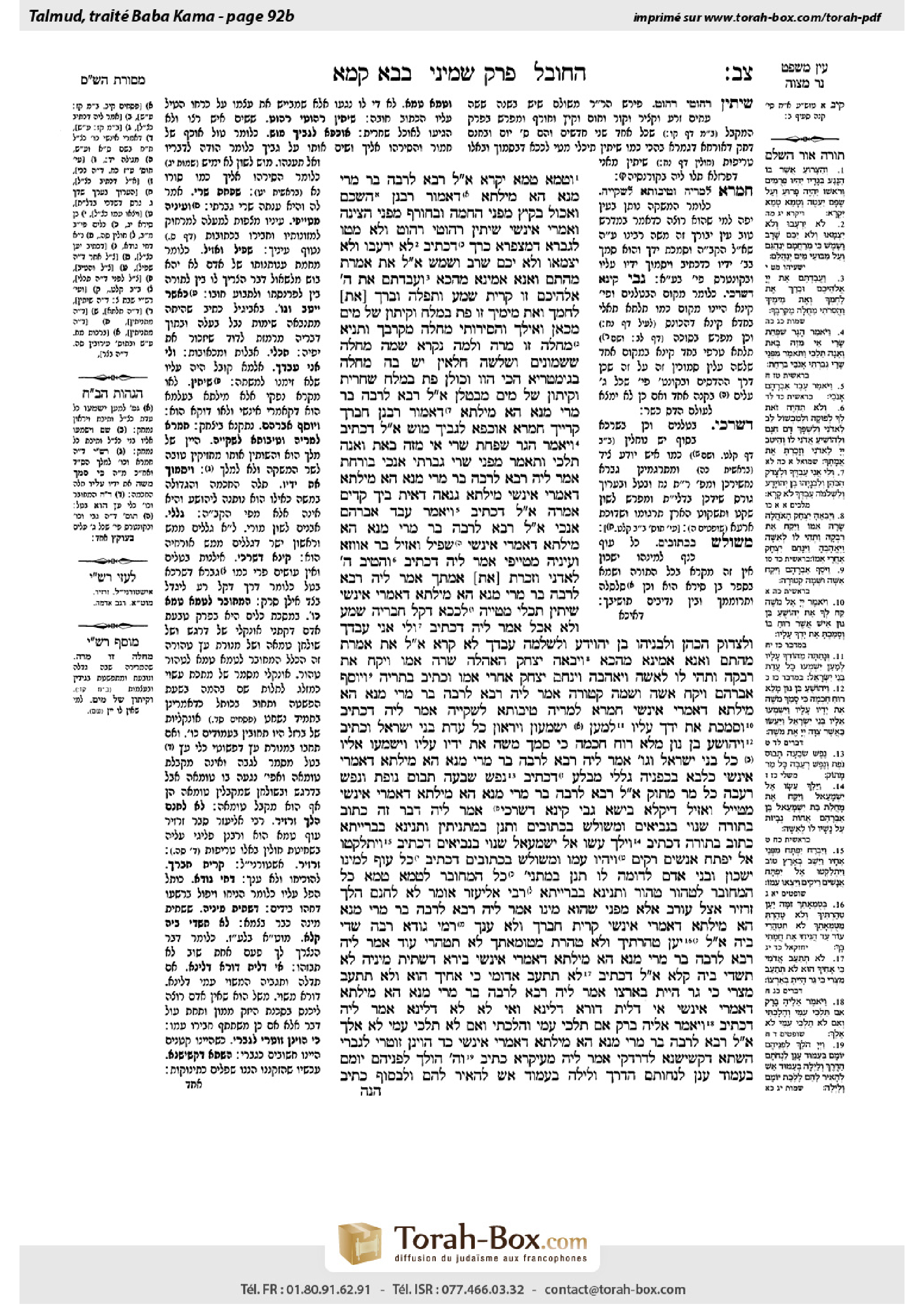
Bava Kamma 92b: Talmud study for Daf Yomi
Study the Talmud for Daf Yomi with scanned pages, Hebrew text, English translations from Sefaria and AI-generated French translations.
Passage selection and English or AI-generated French translation are available where the scan has annotations. Daf Study is independent of Torah-Box and Sefaria.
Browse Bava Kamma · בבא קמא · All tractatesBava Kamma 92b text and translations
This page of Bava Kamma includes the Aramaic text, an English translation and an AI-generated French translation, alongside the scan above.
בבא קמא צ״ב ב · Aramaic and Hebrew text
״וְטָמֵא טָמֵא יִקְרָא״.
אֲמַר לֵיהּ רָבָא לְרַבָּה בַּר מָרִי, מְנַָא הָא מִילְּתָא דַאֲמוּר רַבָּנַן: הַשְׁכֵּם וֶאֱכוֹל בַּקַּיִץ מִפְּנֵי הַחַמָּה, וּבַחוֹרֶף מִפְּנֵי הַצִּינָּה; וְאָמְרִי אִינָשֵׁי: שִׁיתִּין רָהוֹטֵי רְהוּט, וְלָא מְטוֹ לְגַבְרָא דְּמִצַּפְרָא כְּרַךְ? דִּכְתִיב: ״לֹא יִרְעָבוּ וְלֹא יִצְמָאוּ, וְלֹא יַכֵּם שָׁרָב וָשָׁמֶשׁ״.
אֲמַר לֵיהּ: אַתְּ אָמְרַתְּ מֵהָתָם, וַאֲנָא אָמֵינָא מֵהָכָא: ״וַעֲבַדְתֶּם אֵת ה׳ אֱלֹהֵיכֶם״ – זוֹ קְרִיַּת שְׁמַע וּתְפִלָּה. ״וּבֵרַךְ [אֶת] לַחְמְךָ וְאֶת מֵימֶיךָ״ – זוֹ פַּת בְּמֶלַח וְקִיתוֹן שֶׁל מַיִם. מִכָּאן וְאֵילָךְ: ״וַהֲסִירֹתִי מַחֲלָה מִקִּרְבֶּךָ״.
וְתַנְיָא: מַחֲלָה – זוֹ מָרָה. וְלָמָּה נִקְרָא שְׁמָהּ מַחֲלָה? שֶׁשְּׁמוֹנִים וּשְׁלֹשָׁה חֳלָאִין יֵשׁ בָּהּ – ״מַחֲלָה״ בְּגִימַטְרִיָּא הָכִי הָווּ. וְכוּלָּן, פַּת בַּמֶּלַח שַׁחֲרִית וְקִיתוֹן שֶׁל מַיִם – מְבַטְּלָן.
אֲמַר לֵיהּ רָבָא לְרַבָּה בַּר מָרִי, מְנַָא הָא מִילְּתָא דַאֲמוּר רַבָּנַן: חַבְרָךְ קַרְיָיךְ ״חֲמָרָא״ – אוּכָּפָא לְגַבָּיךְ מוּשׁ? אֲמַר לֵיהּ, דִּכְתִיב: ״וַיֹּאמַר: הָגָר שִׁפְחַת שָׂרַי, אֵי מִזֶּה בָאת וְאָנָה תֵלֵכִי? וַתֹּאמֶר: מִפְּנֵי שָׂרַי גְּבִרְתִּי אָנֹכִי בּוֹרַחַת״.
אֲמַר לֵיהּ רָבָא לְרַבָּה בַּר מָרִי, מְנָא הָא מִילְּתָא דְאָמְרִי אִינָשֵׁי: מִילְּתָא גְּנָאָה דְּאִית בָּיךְ – קְדֵים אַמְרַהּ? אֲמַר לֵיהּ, דִּכְתִיב: ״וַיֹּאמַר: עֶבֶד אַבְרָהָם אָנֹכִי״.
אֲמַר לֵיהּ רָבָא לְרַבָּה בַּר מָרִי, מְנָא הָא מִילְּתָא דְאָמְרִי אִינָשֵׁי: שָׁפֵיל וְאָזֵיל בַּר אֲווֹזָא, וְעֵינֵיהּ מְטַיְּיפִי? אֲמַר לֵיהּ, דִּכְתִיב: ״וְהֵטִיב ה׳ לַאדֹנִי, וְזָכַרְתָּ [אֶת] אֲמָתֶךָ״.
אֲמַר לֵיהּ רָבָא לְרַבָּה בַּר מָרִי, מְנָא הָא מִילְּתָא דְאָמְרִי אִינָשֵׁי: שִׁיתִּין תִּכְלֵי מַטְיוּהּ לְכַכָּא דְּקָל חַבְרֵיהּ שְׁמַע, וְלָא אֲכַל? אֲמַר לֵיהּ, דִּכְתִיב: ״וְלִי אֲנִי עַבְדֶּךָ וּלְצָדֹק הַכֹּהֵן וְלִבְנָיָהוּ בֶן יְהוֹיָדָע וְלִשְׁלֹמֹה עַבְדְּךָ לֹא קָרָא״.
אֲמַר לֵיהּ: אַתְּ אָמְרַתְּ מֵהָתָם, וַאֲנָא אָמֵינָא מֵהָכָא: ״וַיְבִאֶהָ יִצְחָק הָאֹהֱלָה שָׂרָה אִמּוֹ, וַיִּקַּח אֶת רִבְקָה וַתְּהִי לוֹ לְאִשָּׁה וַיֶּאֱהָבֶהָ, וַיִּנָּחֵם יִצְחָק אַחֲרֵי אִמּוֹ״, וּכְתִיב בָּתְרֵיהּ: ״וַיֹּסֶף אַבְרָהָם וַיִּקַּח אִשָּׁה וּשְׁמָהּ קְטוּרָה״.
אֲמַר לֵיהּ רָבָא לְרַבָּה בַּר מָרִי, מְנָא הָא מִילְּתָא דְּאָמְרִי אִינָשֵׁי: חַמְרָא לְמָרֵיהּ, טֵיבוּתָא לְשָׁקְיֵיהּ? אֲמַר לֵיהּ, דִּכְתִיב: ״וְסָמַכְתָּ אֶת יָדְךָ עָלָיו״ – ״לְמַעַן יִשְׁמְעוּן וְיִרְאוּן כׇּל עֲדַת בְּנֵי יִשְׂרָאֵל״. וּכְתִיב: ״וִיהוֹשֻׁעַ בִּן נוּן מָלֵא רוּחַ חׇכְמָה, כִּי סָמַךְ מֹשֶׁה אֶת יָדָיו עָלָיו, וַיִּשְׁמְעוּ אֵלָיו כׇּל בְּנֵי יִשְׂרָאֵל וְגוֹ׳״.
אֲמַר לֵיהּ רָבָא לְרַבָּה בַּר מָרִי, מְנָא הָא מִילְּתָא דְאָמְרִי אִינָשֵׁי: כַּלְבָּא בְּכַפְנֵיהּ – גְּלָלֵי (מ)בָּלַע? דִּכְתִיב: ״נֶפֶשׁ שְׂבֵעָה – תָּבוּס נֹפֶת, וְנֶפֶשׁ רְעֵבָה – כׇּל מַר, מָתוֹק״.
אֲמַר לֵיהּ רָבָא לְרַבָּה בַּר מָרִי, מְנָא הָא מִילְּתָא דְאָמְרִי אִינָשֵׁי: מְטַיֵּיל וְאָזֵיל דִּיקְלָא בִּישָׁא גַּבֵּי קִינָּא דִשְׁרָכֵי? אֲמַר לֵיהּ: דָּבָר זֶה כָּתוּב בַּתּוֹרָה, שָׁנוּי בַּנְּבִיאִים, וּמְשׁוּלָּשׁ בַּכְּתוּבִים; וּתְנַן בְּמַתְנִיתִין, וּתְנֵינָא בְּבָרַיְיתָא.
כָּתוּב בַּתּוֹרָה – דִּכְתִיב: ״וַיֵּלֶךְ עֵשָׂו אֶל יִשְׁמָעֵאל״. שָׁנוּי בַּנְּבִיאִים – דִּכְתִיב: ״וַיִּתְלַקְּטוּ אֶל יִפְתָּח אֲנָשִׁים רֵקִים, וַיִּהְיוּ עִמּוֹ״. וּמְשׁוּלָּשׁ בַּכְּתוּבִים – דִּכְתִיב: ״כׇּל עוֹף לְמִינוֹ יִשְׁכּוֹן, (וּבְנֵי) [וּבֶן] אָדָם לַדּוֹמֶה לוֹ״. תְּנַן בְּמַתְנִיתִין – כׇּל הַמְחוּבָּר לַטָּמֵא, טָמֵא; כׇּל הַמְחוּבָּר לַטָּהוֹר, טָהוֹר. וּתְנֵינָא בְּבָרַיְיתָא – רַבִּי אֱלִיעֶזֶר אוֹמֵר: לֹא לְחִנָּם הָלַךְ זַרְזִיר אֵצֶל עוֹרֵב, אֶלָּא מִפְּנֵי שֶׁהוּא מִינוֹ.
אֲמַר לֵיהּ רָבָא לְרַבָּה בַּר מָרִי, מְנָא הָא מִילְּתָא דְאָמְרִי אִינָשֵׁי: קָרֵית חַבְרָךְ וְלָא עֲנָךְ, רְמִי גּוּדָּא רַבָּה – שְׁדִי בֵּיהּ? אֲמַר לֵיהּ: ״יַעַן טִהַרְתִּיךְ וְלֹא טָהַרְתְּ מִטֻּמְאָתֵךְ – לֹא תִטְהֲרִי עוֹד״.
אֲמַר לֵיהּ רָבָא לְרַבָּה בַּר מָרִי, מְנָא הָא מִילְּתָא דְאָמְרִי אִינָשֵׁי: בֵּירָא דִּשְׁתֵית מִינֵּיהּ – לָא תִּשְׁדֵּי בֵּיהּ קָלָא? אֲמַר לֵיהּ, דִּכְתִיב: ״לֹא תְתַעֵב אֲדֹמִי – כִּי אָחִיךָ הוּא, וְלֹא תְתַעֵב מִצְרִי – כִּי גֵר הָיִיתָ בְאַרְצוֹ״.
אֲמַר לֵיהּ רָבָא לְרַבָּה בַּר מָרִי, מְנָא הָא מִילְּתָא דְּאָמְרִי אִינָשֵׁי: אִי דְּלֵית דּוּרָא – דָּלֵינָא, וְאִי לָא – לָא דָּלֵינָא? אֲמַר לֵיהּ, דִּכְתִיב: ״וַיֹּאמֶר אֵלֶיהָ בָּרָק: אִם תֵּלְכִי עִמִּי – וְהָלָכְתִּי, וְאִם לֹא תֵלְכִי עִמִּי – לֹא אֵלֵךְ״.
אֲמַר לֵיהּ רָבָא לְרַבָּה בַּר מָרִי, מְנָא הָא מִילְּתָא דְּאָמְרִי אִינָשֵׁי: כַּד הֲוֵינַן זוּטְרֵי – לְגַבְרֵי, הַשְׁתָּא דְּקַשִּׁישְׁנָא – לְדַרְדְּקֵי? אֲמַר לֵיהּ, מֵעִיקָּרָא כְּתִיב: ״וַה׳ הוֹלֵךְ לִפְנֵיהֶם יוֹמָם בְּעַמּוּד עָנָן לַנְחֹתָם הַדֶּרֶךְ, וְלַיְלָה בְּעַמּוּד אֵשׁ לְהָאִיר לָהֶם״, וּלְבַסּוֹף כְּתִיב:
Bava Kamma 92b · English translation
The verse states with regard to one diagnosed with leprosy: “And the leper in whom the plague is, his clothes shall be rent, and the hair of his head shall go loose, and he shall cover his upper lip, and he shall cry: Unclean, unclean” (Leviticus 13:45). Not only must the leper suffer from the leprosy itself; he must undergo further embarrassment by publicizing his condition. This is akin to the aphorism that poverty follows the poor.
Rava said to Rabba bar Mari: From where is this matter derived whereby the Sages stated: Awaken early and eat, in the summer due to the heat and in the winter due to the cold. And similarly, people say: Sixty runners run and do not reach the man who ate in the morning. Rabba bar Mari said to him that the source is as it is written: “They shall not hunger nor thirst, neither shall the heat nor the sun smite them” (Isaiah 49:10), indicating that one who is not hungry or thirsty will not be affected by the weather.
Rava said to him: You said the proof from there, from a verse in the Prophets, and I say the proof from here, from a verse in the Torah. The verse states: “And you shall serve the Lord your God, and He will bless your bread and your water; and I will take sickness away from the midst of you” (Exodus 23:25). Rava explicates: “And you shall serve the Lord your God”; this is referring to the recitation of Shema and prayer. “And He will bless your bread and your water”; this is referring to bread dipped in salt, and a flask of water drunk after the bread, in the mornings. From this point forward the remainder of the verse applies: “And I will take sickness away from the midst of you.”
And it is taught in a baraita: “Sickness”; this is referring to bile. And why is its name called sickness [maḥala]? It is called this since there are eighty-three sicknesses in bile. The letters spelling the word maḥala, i.e., mem, ḥet, lamed, heh, have that numerical value of eighty-three. And with regard to all of those sicknesses, eating bread dipped in salt in the morning and drinking a flask of water afterward negates them.
Rava said to Rabba bar Mari: From where is this matter derived whereby the Sages stated: If your friend calls you a donkey, prepare a saddle for your back, i.e., do not contest his statement? Rabba bar Mari said to him that the source is as it is written in the conversation between the angel and Hagar: “And he said: Hagar, maidservant of Sarai, from where did you come and to where are you going? And she said: I am fleeing from the face of my mistress Sarai” (Genesis 16:8). Though Hagar was no longer the maidservant of Sarai, since the angel referred to her as such, she responded in kind.
Rava said to Rabba bar Mari: From where is this matter derived whereby people say: If you are aware of a derogatory matter that is found in you, say it first before others say it about you? Rabba bar Mari said to him that the source is as it is written with regard to Eliezer: “And he said: I am Abraham’s servant” (Genesis 24:34), immediately proclaiming that he is a servant.
Rava said to Rabba bar Mari: From where is this matter derived whereby people say: The goose stoops its head as it goes along, but its eyes look afar to find food for itself? Rabba bar Mari said to him that the source is as it is written with regard to Abigail’s statement to David: “And when the Lord shall have dealt well with my lord, then remember your maidservant” (I Samuel 25:31). Although Abigail spoke with humility in her request that David spare her husband’s life, she made reference to deriving future benefit from David.
Rava said to Rabba bar Mari: From where is this matter derived whereby people say: Sixty discomforts come to the teeth [lekhakha] of one who hears the sound of another eating and does not eat? Rabba bar Mari said to him that the source is as it is written with regard to what Nathan the prophet said concerning the coronation banquet of Adonijah, to which he was not invited: “For he is gone down this day, and has slain oxen and fatlings and sheep in abundance, and has called all the king’s sons…But me, even me your servant, and Zadok the priest, and Benaiah the son of Jehoiada, and your servant Solomon he has not called” (I Kings 1:25–26).
Rava said to him: You said the proof from there, from a verse in the Prophets, and I say the proof from here, from a verse in the Torah. As it is written: “And Isaac brought her into his mother Sarah’s tent, and took Rebekah, and she became his wife; and he loved her, and Isaac was comforted for his mother” (Genesis 24:67). And it is written immediately afterward: “And Abraham took another wife, and her name was Keturah” (Genesis 25:1). After seeing his son marry, Abraham was disquieted by the fact he was not married. This is akin to one who sees another eating and does not eat.
Rava said to Rabba bar Mari: From where is this matter derived whereby people say: While the wine belongs to its owner, the gratitude is given to the one who pours it? Rabba bar Mari said to him that the source is as it is written with regard to God commanding Moses to transfer his authority to Joshua: “And the Lord said unto Moses: Take you Joshua the son of Nun, a man in whom is spirit, and lay your hand upon him…that all the congregation of the children of Israel may hearken” (Numbers 27:18–20). And it is written: “And Joshua the son of Nun was full of the spirit of wisdom; for Moses had laid his hands upon him; and the children of Israel hearkened unto him, and did as the Lord commanded Moses” (Deuteronomy 34:9). Although the spirit of God was not given to Joshua by Moses, as Moses was only a conduit, he was given credit for it.
Rava said to Rabba bar Mari: From where is this matter derived whereby people say: A dog, in its hunger, swallows even dung? Rabba bar Mari said to him that the source is as it is written: “The full soul loathes a honeycomb; but to the hungry soul every bitter thing is sweet” (Proverbs 27:7).
Rava said to Rabba bar Mari: From where is this matter derived whereby people say: A bad palm tree strolls and goes to be among a grove of barren trees, i.e., bad people seek out other bad people? Rabba bar Mari said to him: This matter is written in the Torah, repeated in the Prophets, and triplicated in the Writings, and we learned it in a mishna, and we learned it in a baraita.
Rabba bar Mari explains each of the sources. It is written in the Torah, as it is written: “And so Esau went to Ishmael” (Genesis 28:9). It is repeated in the Prophets, as it is written: “And there were gathered vain fellows to Yiftah, and they went out with him” (Judges 11:3). And it is triplicated in the Writings, as it is written: All fowl will live with its kind, and men with those like him (Book of Ben Sira 13:17). We learned it in a mishna (Kelim 12:2): All that is attached to that which is ritually impure is ritually impure; all that is attached to that which is ritually pure is ritually pure. And we learned it in a baraita: Rabbi Eliezer says: Not for naught did the starling go to the raven but because it is its kind, as it too is a non-kosher bird.
Rava said to Rabba bar Mari: From where is this matter derived whereby people say: If you called to your friend and he did not answer you, throw a large wall and cast it at him, i.e., do not attempt to help him anymore? Rabba bar Mari said to him that the source is as it is written: “Because I have purged you and you were not purged, you shall not be purged from your impurity anymore, until I have satisfied My fury upon you” (Ezekiel 24:13).
Rava said to Rabba bar Mari: From where is this matter derived whereby people say: If there is a well that you drank from, do not throw a stone into it? Rabba bar Mari said to him that the source is as it is written: “You shall not abhor an Edomite, for he is your brother; you shall not abhor an Egyptian, because you were a stranger in his land” (Deuteronomy 23:8). Since you dwelled in their lands, you may not cause them harm.
Rava said to Rabba bar Mari: From where is this matter derived whereby people say: If you lift the load with me I will lift it, and if you will not lift it with me I won’t lift it? Rabba bar Mari said to him that the source is as it is written with regard to Barak and Deborah concerning the war of Sisera: “And Barak said to her: If you will go with me, then I will go; but if you will not go with me, I will not go” (Judges 4:8).
Rava said to Rabba bar Mari: From where is this matter derived whereby people say: When we were small, we were considered to be men; now that we are old, we are considered to be children [ledardekei]? Rabba bar Mari said to him that the source is that initially, it is written with regard to the Jewish people traveling in the wilderness: “And the Lord went before them by day in a pillar of cloud, to lead them the way; and by night in a pillar of fire, to give them light” (Exodus 13:21). God Himself guarded over the Jewish people. But at the end, after some time passed and it would be expected that the Jewish people were considered more important, it is written:
Bava Kamma 92b · Traduction française (IA)
La parabole mentionne celui qui souffre de la maladie de la pourriture : « Et le lépreux dont la maladie est, il déchirera ses vêtements, et ses cheveux seront en désordre, et il couvrira sa bouche, et il criera : Impur, impur » (Lévitique 13:45). Non seulement le lépreux souffre de la maladie elle-même, mais il doit subir une humiliation supplémentaire en publiant son état. Cela ressemble à l'aphorisme selon lequel la pauvreté suit le pauvre.
Rava dit à Rabba bar Mari : D'où vient cette loi selon laquelle les Sages ont dit : Réveille-toi tôt et mange, en été à cause de la chaleur et en hiver à cause du froid. De même, on dit : Soixante coureurs courent et n'atteignent pas celui qui a mangé le matin. Rabba bar Mari répondit à Rava que la source est telle que cela est écrit : « Ils ne mourront ni de faim ni de soif, ni la chaleur ni le soleil ne les toucheront » (Is 49:10), indiquant que celui qui n'a pas faim ou soif ne sera pas affecté par le temps.
Rava dit à Rabba bar Mari : Tu as tiré la preuve d'une parabole, et je tire la preuve d'une parabole. La parabole dit : « Et tu serviras le Seigneur ton Dieu, et Il bénira ton pain et ton eau ; et Il enlèvera la maladie du milieu de toi » (Ex 23:25). Rava explique : « Et tu serviras le Seigneur ton Dieu » : cela fait référence à la prière et à la récitation du Chéma. « Et Il bénira ton pain et ton eau » : cela fait référence au pain trempé dans le sel et à la gourde d'eau buve après le pain, le matin. À partir de ce point, la suite de la parabole s'applique : « Et Il enlèvera la maladie du milieu de toi. »
Et il est enseigné dans une baraïta : « La maladie » : cela fait référence à la bile. Et pourquoi est-elle appelée « maladie » [maḥala] ? C'est ainsi parce qu'il y a quatre-vingt-trois maladies dans la bile. Les lettres qui composent le mot maḥala, c'est-à-dire mem, ḥet, lamed, heh, ont une valeur numérique de quatre-vingt-trois. Et concernant toutes ces maladies, manger du pain trempé dans le sel le matin et boire une gourde d'eau après cela les annule.
Rava dit à Rabba bar Mari : D'où vient cette loi selon laquelle les Sages ont dit : Si ton ami t'appelle âne, prépare un siège pour ton dos, c'est-à-dire ne conteste pas son affirmation ? Rabba bar Mari répondit à Rava que la source est telle que cela est écrit dans la conversation entre l'ange et Hagar : « Et il dit : Hagar, servante de Sarai, d'où viens-tu et où vas-tu ? Et elle dit : Je fuis le visage de ma maîtresse Sarai » (Gn 16:8). Bien que Hagar ne fût plus la servante de Sarai, puisque l'ange l'appelait ainsi, elle a répondu de la même manière.
Rava dit à Rabba bar Mari : D'où vient cette loi selon laquelle les gens disent : Si tu sais d'une chose dégradante qui est en toi, dis-la avant que les autres ne te la disent ? Rabba bar Mari répondit à Rava que la source est telle que cela est écrit concernant Eliezer : « Et il dit : Je suis le serviteur d'Abraham » (Gn 24:34), immédiatement proclamant qu'il est un serviteur.
Rava dit à Rabba bar Mari : D'où vient cette loi selon laquelle les gens disent : L'oie baisse la tête en marchant, mais ses yeux regardent loin pour trouver de la nourriture ? Rabba bar Mari répondit à Rava que la source est telle que cela est écrit concernant la déclaration d'Abigail à David : « Et quand le Seigneur aura bien traité mon seigneur, alors souviens-toi de ta servante » (1 Sm 25:31). Bien que Abigail ait parlé humblement dans sa demande que David épargne la vie de son mari, elle a fait référence à un bénéfice futur auprès de David.
Rava dit à Rabba bar Mari : D'où vient cette loi selon laquelle les gens disent : Soixante désagréments viennent aux dents [lekhakha] de celui qui entend le bruit d'un autre mangeant et ne mange pas ? Rabba bar Mari répondit à Rava que la source est telle que cela est écrit concernant ce que Nathan le prophète a dit concernant le banquet de couronnement d'Adonijah, à qui il n'était pas invité : « Car il est descendu aujourd'hui, et a tué des bœufs et des veaux et des moutons en abondance, et a appelé tous les fils du roi… Mais moi, même moi, ton serviteur, et Zadok le prêtre, et Benaïah fils de Jéhoyada, et ton serviteur Salomon, il ne les a pas appelés » (1 R 1:25–26).
Rava dit à Rabba bar Mari : Tu as tiré la preuve d'une parabole, et je tire la preuve d'une parabole. Comme il est écrit : « Et Isaac l'amena dans le tentérieur de sa mère Sarah, et il prit Rebekah, et elle devint sa femme ; et il l'aima, et Isaac fut consolé pour sa mère » (Gn 24:67). Et il est écrit immédiatement après : « Et Abraham prit une autre femme, et son nom était Keturah » (Gn 25:1). Après avoir vu son fils se marier, Abraham était troublé par le fait qu'il n'était pas marié. Cela ressemble à celui qui voit un autre manger et ne mange pas.
Rava dit à Rabba bar Mari : D'où vient cette matière selon laquelle les gens disent : Bien que le vin appartienne à son propriétaire, la gratitude est donnée à celui qui le verse ? Rabba bar Mari répondit à Rava que la source est telle que cela est écrit concernant Dieu commandant à Moïse de transférer son autorité à Josué : « Et le Seigneur dit à Moïse : Prends Joshua, fils de Nun, un homme plein d'esprit, et pose ta main sur lui… afin que toute la congrégation des enfants d'Israël l'entende » (Nb 27:18–20). Et il est écrit : « Et Joshua, fils de Nun, était plein de l'esprit de sagesse ; car Moïse avait posé ses mains sur lui ; et les enfants d'Israël l'entendirent, et firent ce que le Seigneur avait commandé à Moïse » (Dt 34:9). Bien que l'esprit de Dieu ne soit pas donné à Josué par Moïse, puisque Moïse était seulement un canal, il a été crédité pour cela.
Rava dit à Rabba bar Mari : D'où vient cette matière selon laquelle les gens disent : Un chien, en manque, avale même les déjections ? Rabba bar Mari répondit à Rava que la source est telle que cela est écrit : « L'âme pleine dédaigne la miel ; mais à l'âme affamée, tout ce qui est amer est doux » (Pr 27:7).
Rava dit à Rabba bar Mari : D'où vient cette matière selon laquelle on dit : Un palmier mauvais marche et va se mêler à un groupe d'arbres stériles, c'est-à-dire que les mauvais gens cherchent les mauvais gens ? Rabba bar Mari répondit à lui : Cette matière est écrite dans la Torah, répétée dans les Prophètes, tripliquée dans les Ecritures, et nous l'avons apprise dans une mitsva, et nous l'avons apprise dans une baraïta.
Rabba bar Mari explique chaque source. Il est écrit dans la Torah, comme il est écrit : « Et Esau alla vers Ishmaël » (Genèse 28:9). Il est répété dans les Prophètes, comme il est écrit : « Et des gens vains se rassemblèrent autour de Jephthah, et ils sortirent avec lui » (Juges 11:3). Et il est tripliqué dans les Ecritures, comme il est écrit : « Tous les oiseaux vivent avec leur espèce, et les hommes avec ceux qui sont semblables à eux » (Livre de Ben Sira 13:17). Nous l'avons apprise dans une mitsva (Kelim 12:2) : Tout ce qui est attaché à ce qui est impur rituellement est impur rituellement ; tout ce qui est attaché à ce qui est pur rituellement est pur rituellement. Et nous l'avons apprise dans une baraïta : Rabbi Eliezer dit : Le corbeau n'est pas allé au cormoran à tort, mais parce qu'il est de sa espèce, car il est aussi un oiseau non permis.
Rava dit à Rabba bar Mari : D'où vient cette matière selon laquelle on dit : Si tu appelles ton ami et qu'il ne t'a pas répondu, construis une grande muraille et lance-la contre lui, c'est-à-dire que tu ne t'efforces plus de l'aider ? Rabba bar Mari répondit à lui que la source est telle que cela est écrit : « Parce que j'ai purifié toi et que tu n'as pas été purifié, tu ne seras plus purifié de ta impureté, jusqu'à ce que j'aie satisfait ma colère contre toi » (Ezéchiel 24:13).
Rava dit à Rabba bar Mari : D'où vient cette matière selon laquelle on dit : Si un puits existe que tu as bu, ne jette pas une pierre dedans ? Rabba bar Mari répondit à lui que la source est telle que cela est écrit : « Tu ne devras pas haïr un Edomite, car il est ton frère ; tu ne devras pas haïr un Égyptien, car tu as été étranger dans son pays » (Deutéronome 23:8). Puisque tu as habité dans leurs pays, tu ne dois pas leur causer de mal.
Rava dit à Rabba bar Mari : D'où vient cette matière selon laquelle on dit : Si tu portes le fardeau avec moi, je le porterai, et si tu ne le portes pas avec moi, je ne le porterai pas ? Rabba bar Mari répondit à lui que la source est telle que cela est écrit concernant Barak et Déborah concernant la guerre de Sisera : « Et Barak dit à elle : Si tu vas avec moi, alors je vais ; mais si tu ne vas pas avec moi, je ne vais pas » (Juges 4:8).
Rava dit à Rabba bar Mari : D'où vient cette matière selon laquelle on dit : Quand nous étions petits, nous étions considérés comme des hommes ; maintenant que nous sommes vieux, nous sommes considérés comme des enfants [ledardekei] ? Rabba bar Mari répondit à lui que la source est que d'abord, il est écrit concernant le peuple juif voyageant dans le désert : « Et l'Éternel marcha devant eux de jour dans un pilier de nuage, pour les guider ; et de nuit dans un pilier de feu, pour leur donner de la lumière » (Exode 13:21). Dieu lui-même protégeait le peuple juif. Mais à la fin, après un certain temps s'était écoulé et il était attendu que le peuple juif fût considéré comme plus important, il est écrit :
Traduction française générée par IA à partir de l’édition anglaise de Sefaria. Vérifie toujours un passage avec le texte source.
Text from Sefaria: William Davidson Edition - Vocalized Aramaic (CC BY NC); William Davidson Edition - English (CC BY NC).