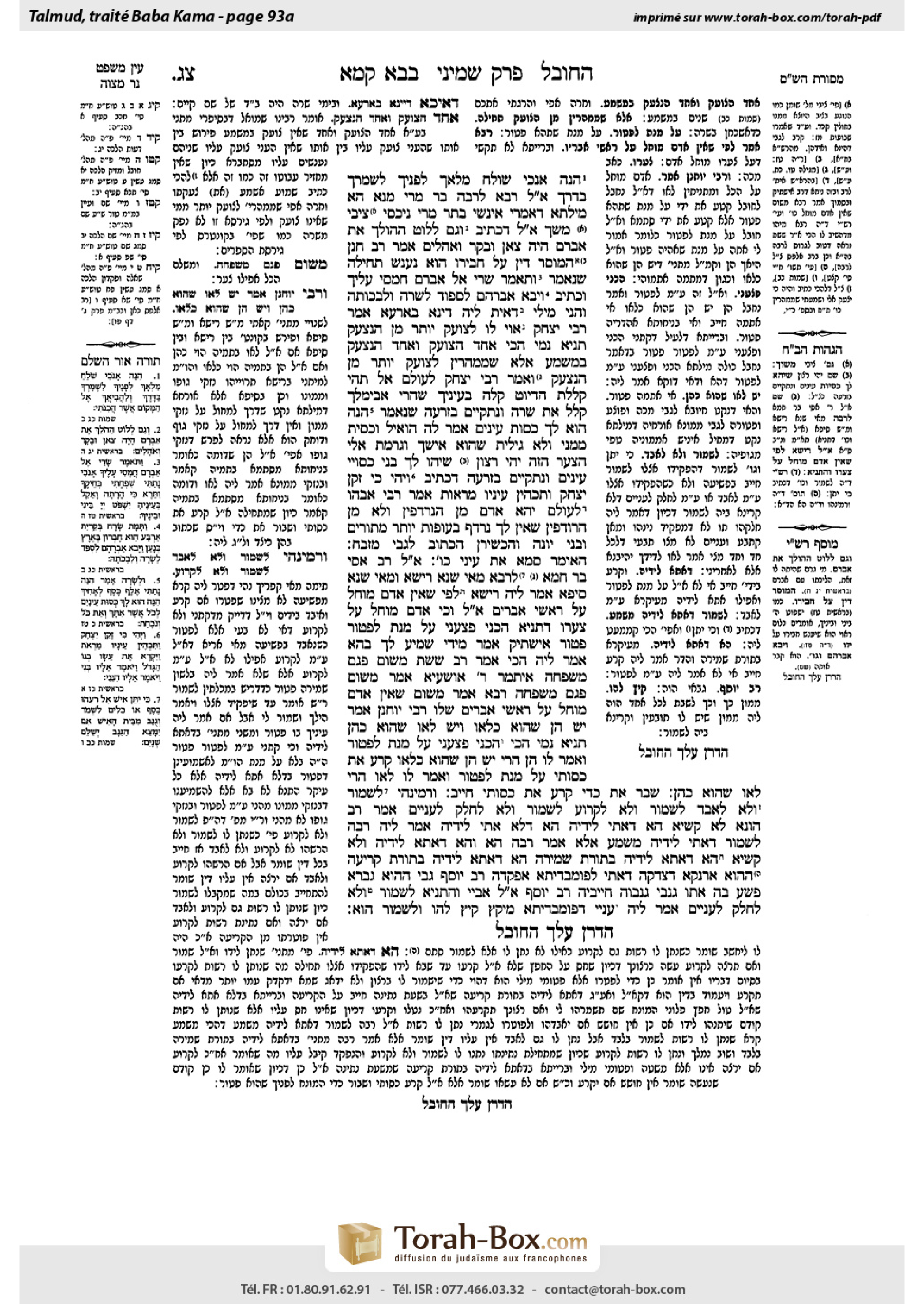
Bava Kamma 93a: Talmud study for Daf Yomi
Study the Talmud for Daf Yomi with scanned pages, Hebrew text, English translations from Sefaria and AI-generated French translations.
Passage selection and English or AI-generated French translation are available where the scan has annotations. Daf Study is independent of Torah-Box and Sefaria.
Browse Bava Kamma · בבא קמא · All tractatesBava Kamma 93a text and translations
This page of Bava Kamma includes the Aramaic text, an English translation and an AI-generated French translation, alongside the scan above.
בבא קמא צ״ג א · Aramaic and Hebrew text
״הִנֵּה אָנֹכִי שֹׁלֵחַ מַלְאָךְ לְפָנֶיךָ, לִשְׁמָרְךָ בַּדָּרֶךְ״.
אֲמַר לֵיהּ רָבָא לְרַבָּה בַּר מָרִי, מְנָא הָא מִילְּתָא דְּאָמְרִי אִינָשֵׁי: בָּתַר מָרֵי נִיכְסֵי – צִיבֵי מְשֹׁךְ? אֲמַר לֵיהּ, דִּכְתִיב: ״וְגַם לְלוֹט הַהֹלֵךְ אֶת אַבְרָם הָיָה צֹאן וּבָקָר וְאֹהָלִים״.
אָמַר רַב חָנָן: הַמּוֹסֵר דִּין עַל חֲבֵירוֹ – הוּא נֶעֱנָשׁ תְּחִילָּה. שֶׁנֶּאֱמַר: ״וַתֹּאמֶר שָׂרַי אֶל אַבְרָם: חֲמָסִי עָלֶיךָ״, וּכְתִיב: ״וַיָּבֹא אַבְרָהָם לִסְפֹּד לְשָׂרָה וְלִבְכֹּתָהּ״. וְהָנֵי מִילֵּי דְּאִית לֵיהּ דִּינָא בְּאַרְעָא.
אָמַר רַבִּי יִצְחָק: אוֹי לוֹ לַצּוֹעֵק יוֹתֵר מִן הַנִּצְעָק. תַּנְיָא נָמֵי הָכִי: אֶחָד הַצּוֹעֵק וְאֶחָד הַנִּצְעָק בַּמַּשְׁמָע, אֶלָּא שֶׁמְּמַהֲרִין לַצּוֹעֵק יוֹתֵר מִן הַנִּצְעָק.
וְאָמַר רַבִּי יִצְחָק: לְעוֹלָם אַל תְּהִי קִלְלַת הֶדְיוֹט קַלָּה בְּעֵינֶיךָ. שֶׁהֲרֵי אֲבִימֶלֶךְ קִלֵּל אֶת שָׂרָה, וְנִתְקַיֵּים בְּזַרְעָהּ. שֶׁנֶּאֱמַר: ״הִנֵּה הוּא לָךְ כְּסוּת עֵינַיִם״ – אָמַר לָהּ: הוֹאִיל וְכִסִּית מִמֶּנִּי וְלֹא גִּילִּית שֶׁהוּא אִישֵׁךְ, וְגָרַמְתְּ לִי הַצַּעַר הַזֶּה, יְהִי רָצוֹן שֶׁיְּהוּ לָךְ בָּנִים כְּסוּיֵי עֵינַיִם. וְנִתְקַיֵּים בְּזַרְעָהּ – דִּכְתִיב: ״וַיְהִי כִּי זָקֵן יִצְחָק, וַתִּכְהֶיןָ עֵינָיו מֵרְאֹת״.
אָמַר רַבִּי אֲבָהוּ: לְעוֹלָם יְהֵא אָדָם מִן הַנִּרְדָּפִין, וְלֹא מִן הָרוֹדְפִין. שֶׁאֵין לְךָ נִרְדׇּף בָּעוֹפוֹת יוֹתֵר מִתּוֹרִים וּבְנֵי יוֹנָה, וְהִכְשִׁירָן הַכָּתוּב לְגַבֵּי מִזְבֵּחַ.
הָאוֹמֵר ״סַמֵּא אֶת עֵינִי״ כּוּ׳. אֲמַר לֵיהּ רַב אַסִּי בַּר חָמָא לְרָבָא: מַאי שְׁנָא רֵישָׁא, וּמַאי שְׁנָא סֵיפָא?
אֲמַר לֵיהּ: רֵישָׁא – לְפִי שֶׁאֵין אָדָם מוֹחֵל עַל רָאשֵׁי אֵבָרִים.
אֲמַר לֵיהּ: וְכִי אָדָם מוֹחֵל עַל צַעֲרוֹ?! דְּתַנְיָא: ״הַכֵּנִי, פְּצָעֵנִי, עַל מְנָת לִפְטוֹר״ – פָּטוּר! אִישְׁתִּיק.
אָמַר: מִידֵּי שְׁמִיעַ לָךְ בְּהָא? אֲמַר לֵיהּ, הָכִי אָמַר רַב שֵׁשֶׁת: מִשּׁוּם פְּגַם מִשְׁפָּחָה.
אִיתְּמַר, רַבִּי אוֹשַׁעְיָא אָמַר: מִשּׁוּם פְּגַם מִשְׁפָּחָה. רָבָא אָמַר: מִשּׁוּם שֶׁאֵין אָדָם מוֹחֵל עַל רָאשֵׁי אֵבָרִים שֶׁלּוֹ.
רַבִּי יוֹחָנָן אָמַר: יֵשׁ ״הֵן״ שֶׁהוּא כְּ״לָאו״, וְיֵשׁ ״לָאו״ שֶׁהוּא כְּ״הֵן״.
תַּנְיָא נָמֵי הָכִי: ״הַכֵּנִי, פְּצָעֵנִי״, ״עַל מְנָת לִפְטוֹר?״ וְאָמַר לוֹ ״הֵן״ – הֲרֵי יֵשׁ ״הֵן״ שֶׁהוּא כְּ״לָאו״. ״קְרַע אֶת כְּסוּתִי״, ״עַל מְנָת לִפְטוֹר?״ וְאָמַר לוֹ: ״לָאו״ – הֲרֵי ״לָאו״ שֶׁהוּא כְּ״הֵן״.
״שַׁבֵּר אֶת כַּדִּי״, ״קְרַע אֶת כְּסוּתִי״ – חַיָּיב. וּרְמִינְהִי: ״לִשְׁמוֹר״ – וְלֹא לְאַבֵּד, ״לִשְׁמוֹר״ – וְלֹא לִקְרוֹעַ, ״לִשְׁמוֹר״ – וְלֹא לְחַלֵּק לַעֲנִיִּים!
אָמַר רַב הוּנָא: לָא קַשְׁיָא; הָא דַּאֲתַי לִידֵיהּ, הָא דְּלָא אֲתַי לִידֵיהּ.
אֲמַר לֵיהּ רַבָּה: ״לִשְׁמוֹר״ – דַּאֲתַי לִידֵיהּ מַשְׁמַע!
אֶלָּא אָמַר רַבָּה: הָא וְהָא דַּאֲתָא לִידֵיהּ, וְלָא קַשְׁיָא; הָא דַּאֲתָא לִידֵיהּ בְּתוֹרַת שְׁמִירָה, הָא דַּאֲתָא לִידֵיהּ בְּתוֹרַת קְרִיעָה.
הָהוּא אַרְנְקָא דִצְדָקָה דַּאֲתַי לְפוּמְבְּדִיתָא, אַפְקְדַהּ רַב יוֹסֵף גַּבֵּי הָהוּא גַּבְרָא. פְּשַׁע בַּהּ, אֲתוֹ גַּנָּבֵי גַּנְבוּהָ. חַיְּיבֵיהּ רַב יוֹסֵף. אֲמַר לֵיהּ אַבָּיֵי, וְהָתַנְיָא: ״לִשְׁמוֹר״ – וְלֹא לְחַלֵּק לַעֲנִיִּים!
אֲמַר לֵיהּ: עַנְיֵי דְפוּמְבְּדִיתָא מִיקָּץ קִיץ לְהוּ, וְ״לִשְׁמוֹר״ הוּא.
הֲדַרַן עֲלָךְ הַחוֹבֵל
Bava Kamma 93a · English translation
“Behold, I send an angel before you, to keep you by the way” (Exodus 23:20), indicating that an angel was sent in place of God to guard the Jewish people.
Rava said to Rabba bar Mari: From where is this matter derived whereby people say: Drag wood after a property owner. In other words, help out a wealthy man even in a small way, as this may lead to your benefiting from him. Rabba bar Mari said to him that the source is as it is written: “And Lot also, who went with Abram, had flocks, and herds, and tents” (Genesis 13:5).
§ In connection with the incident of Abraham and Abimelech mentioned in the mishna, the Gemara quotes a related statement. Rabbi Ḥanan says: One who passes the judgment of another to Heaven is punished first, as it is stated: “And Sarai said to Abram: My wrong be upon you, I gave my handmaid into your bosom; and when she saw that she had conceived, I was despised in her eyes: The Lord judge between me and you” (Genesis 16:5). Sarai stated that God should judge Abram for his actions. And it is written: “And Abraham came to mourn for Sarah, and to weep for her” (Genesis 23:2), as Sarah died first. The Gemara comments: And this matter applies only in a situation where he has someone to do judgment for him on earth and has no need to appeal to the heavenly court.
Concerning this, Rabbi Yitzḥak says: Woe to he who cries out to Heaven more than the one about whom he is crying out. The Gemara comments: This concept is also taught in a baraita: Both the one who cries out and the one about whom he is crying out are included in the verse discussing the cries of an orphan who is mistreated: “If you afflict them, for if they cry at all to Me, I will surely hear their cry. My wrath shall wax hot, and I will kill you with the sword” (Exodus 22:22–23). But they are quicker to punish the one who cries out than the one about whom he is crying out, as in the incident with Sarai.
The Gemara provides another lesson from the story of Abraham and Abimelech. And Rabbi Yitzḥak says: The curse of an ordinary person should never be regarded as light in your eyes, for Abimelech cursed Sarah and it was fulfilled in her descendant. The curse on Sarah is as it is stated: “Behold, it is to you a covering of the eyes” (Genesis 20:16), meaning that he said to her: Since you concealed your status from me and you did not reveal that Abraham is your husband, and you caused me this suffering, may it be God’s will that you should have children with covered eyes. And this curse was fulfilled in her descendant, as it is written: “And it came to pass, that when Isaac was old, and his eyes were dim, so that he could not see” (Genesis 27:1).
Rabbi Abbahu says: A person should always be among those who are pursued and not among the pursuers. One can prove that this is so, as none among birds are pursued more than doves and pigeons, as all predators hunt them, and from all birds the verse deemed them fit to be sacrificed on the altar.
§ The mishna teaches: With regard to one who says to another: Blind my eye, or: Cut off my hand, or: Break my leg, and he does so, the latter is liable to pay for the damage, even if the injured party explicitly instructed him to do so on the condition that he will be exempt from payment. But if one instructs another to damage his property on the condition that he will be exempt from payment, he is exempt. Rav Asi bar Ḥama said to Rava: What is different in the first clause and what is different in the latter clause?
Rava said to him: In the case of the first clause he is liable, despite the fact that he was instructed to carry out the injury on the condition that he would be exempt, because a person does not forgo compensation for damage to his extremities such as his eyes, hands, and feet, mentioned in the mishna (92a). Consequently, when he told the assailant that he would be exempt, the presumption is that he was not sincere.
Rav Asi bar Ḥama said to him: But does a person forgo compensation for his pain when he doesn’t lose a limb? As it is taught in a baraita: With regard to one who said to another: Strike me, or wound me, on the condition that you will be exempt from payment, he is exempt. According to Rava’s reasoning, he should be liable in this case as well, as the presumption should be that he was not sincere. Rava was silent, as he did not have a response.
Rava said to him: Have you heard anything with regard to this matter? Rav Asi bar Ḥama said to him that this is what Rav Sheshet said: It is because loss of a limb may result in a family flaw, i.e., it may cause harm to the family name. One who loses a limb not only suffers pain; his family suffers as well. He is not in a position to forgive the assailant for the harm caused to his family, but he may forgo compensation for his own pain. Consequently, if he instructed another merely to injure him, without causing loss of limb, on condition that the assailant will be exempt from payment, the assailant will be exempt.
It was stated that the amora’im disagreed concerning the explanation for the ruling of the first clause of the mishna. Rabbi Oshaya says: It is because loss of a limb may result in a family flaw. Rava says: It is because a person does not forgo compensation for damage to his extremities.
Rabbi Yoḥanan says: There is a yes that, based on other factors, is like a no and is not viewed as giving consent. And conversely, there is a no that, based on other factors, is like a yes, and although one said no it is as though he gave consent. In this case as well, where he said: On condition to be exempt, he was not sincere.
The Gemara comments that this is also taught in a baraita. With regard to one who said to another: Strike me, or wound me; and the other asks: Is this on the condition that I will be exempt from payment? And the first one said to him, in the tone of a question: Yes, this is an example of the principle: There is a yes that is like a no. It is as if the victim asked: Even if I give you permission to do it, do you think that I would forgo the compensation? By contrast, if one said: Tear my garment, and the other asks: Is this on the condition that I will be exempt from payment? And he said to him, in the tone of a question: No, this is an example of a no that is like a yes, since he meant to say that if he did not want to exempt him from payment he would not ask him to do it.
§ The mishna teaches that if one instructed another: Break my jug, or: Tear my garment, and the other did so, he is liable to pay for the damage. And the Gemara raises a contradiction from a baraita: The verses state with regard to bailees: “If a man delivers to his neighbor money or vessels to safeguard” (Exodus 22:6), and: “If a man delivers to his neighbor an ass, or an ox, or a sheep, or any beast, to safeguard” (Exodus 22:9). The Sages derived from these verses that the bailee is liable if the item was given to him to safeguard, but not where it was given to him to destroy; if it was given to him to safeguard, but not where it was given to him to tear; if it was given to him to safeguard, but not where it was given to him to distribute to the poor. This indicates that a bailee is not liable for damage to an item if he was told to tear it, even if the owner did not state that it is on condition to be exempt.
Rav Huna said: This is not difficult, as this mishna that obligates him to pay for the damage is dealing with a case where it came into his possession, and he was responsible for it before the owner instructed him to tear it. Therefore, even if he was instructed to tear it, he is liable. And that baraita, which exempts him from paying, is discussing a case where it did not come into his possession, but he simply tore it.
Rabba said to Rav Huna: But the phrase in the verse “to safeguard,” which obligates a bailee, indicates that it came into his possession already, and this is the case of the baraita that rules he is exempt.
Rather, Rabba said: This and that are discussing a case where it came into his possession, and it is not difficult. This mishna is discussing a case where it came into his possession as an item given for safeguarding, and he is exempt if the owner stated explicitly that this will be the case, and that baraita is discussing a case where it came into his possession as an item given for tearing.
The Gemara relates: There was a certain purse full of charity money that came to the city of Pumbedita. Rav Yosef deposited it with a certain man. That man was negligent in safeguarding it and thieves came and stole it. Rav Yosef deemed the bailee liable to pay compensation. Abaye said to Rav Yosef: But isn’t it taught in a baraita: To safeguard, but not where it was given to him to distribute to the poor? This seems to teach that with regard to money that is distributed to the poor, there is no halakha of safeguarding.
Rav Yosef said to him: The poor of Pumbedita have an amount that is set for them to receive. Each poor person already had a specific sum designated for him, and accordingly is in the category of: To safeguard. Therefore, he is liable.
Bava Kamma 93a · Traduction française (IA)
« Voici, je m'envoie un ange devant toi, pour te garder sur la route » (Exode 23:20), indiquant qu'un ange a été envoyé à la place de Dieu pour garder le peuple juif.
Rava dit à Rabba bar Mari : D'où vient cette matière selon laquelle on dit : « Porte du bois après le propriétaire » ? En d'autres termes, aide un homme riche même de manière mineure, car cela peut entraîner que tu profits de lui. Rabba bar Mari répondit à lui que la source est telle qu'il est écrit : « Et Lot, qui était avec Abram, avait des troupeaux, des bêtes et des tentes » (Genèse 13:5).
§ En lien avec l'incident d'Abraham et d'Abimelech mentionné dans la Michna, le Guemara cite une déclaration connexe. Rabbi Ḥanan dit : Celui qui passe le jugement d'un autre devant Dieu est puni en premier, comme il est dit : « Et Sarai dit à Abram : Mon malheur soit sur toi, j'ai donné ma servante dans ton sein ; et quand elle vit qu'elle avait conçu, je fus méprisée à ses yeux : L'Éternel jugera entre moi et toi » (Genèse 16:5). Sarai déclara que Dieu devrait juger Abram pour ses actions. Et il est écrit : « Et Abraham vint pleurer pour Sarah, et pleurer pour elle » (Genèse 23:2), car Sarah mourut en premier. Le Guemara commente : Et cette matière s'applique uniquement dans un cas où il a quelqu'un pour lui rendre justice sur terre et n'a pas besoin d'aller devant la cour céleste.
Concernant cela, Rabbi Yitzḥak dit : Malheur à celui qui crie devant le Trône du Royaume des Cieux plus que celui à propos duquel il crie. Le Guemara commente : Ce concept est également enseigné dans une baraïta : Les deux, celui qui crie et celui à propos duquel il crie, sont inclus dans la parole concernant les cris d'un orphelin maltraité : « Si vous les opprimez, car si ils crient même à Moi, Je m'entendrai certainement à leur cri. Ma colère s'embrasera, et Je tuerai vous avec le glaive » (Exode 22:22–23). Mais ils punissent plus rapidement celui qui crie que celui à propos duquel il crie, comme dans l'incident de Sarai.
Le Guemara donne une autre leçon tirée de l'histoire d'Abraham et d'Abimelech. Et Rabbi Yitzḥak dit : La malédiction d'une personne ordinaire ne doit jamais être considérée comme légère à vos yeux, car Abimelech a maudit Sarah et cela s'est réalisé dans son descendant. La malédiction sur Sarah est telle qu'il est dit : « Voici, c'est pour toi un voile des yeux » (Genèse 20:16), signifiant qu'il a dit à elle : Puisque tu as caché ton statut devant moi et que tu n'as pas révélé que Abraham est ton mari, et que tu as causé ce malheur, que ce soit selon la volonté de Dieu que tu aies des enfants avec des yeux voilés. Et cette malédiction s'est réalisée dans son descendant, comme il est écrit : « Et il arriva que, quand Isaac était vieux, et ses yeux étaient devenus aveugles, de sorte qu'il ne pouvait pas voir » (Genèse 27:1).
Rabbi Abbahu dit : Une personne devrait toujours être parmi ceux qui sont persécutés et non parmi les persécuteurs. On peut prouver cela, car aucun oiseau n'est plus persécuté que les moineaux et les pigeons, car tous les prédateurs les chassent, et parmi tous les oiseaux, la Parole a considéré qu'ils étaient dignes d'être sacrifiés sur l'autel.
§ La mitsna enseigne : Concernant celui qui dit à un autre : « Aveugle mon œil », ou : « Détache ma main », ou : « Casser ma jambe », et il le fait, le dernier est tenu responsable du dommage, même si la partie blessée l'a explicitement instruit à faire cela sous la condition qu'il sera exempt de paiement. Mais si l'on instruit un autre à endommager sa propriété sous la condition qu'il sera exempt de paiement, il est exempt. Rav Asi bar Ḥama dit à Rava : Qu'est-ce qui est différent dans la première clause et qu'est-ce qui est différent dans la seconde clause ?
Rava dit à lui : Dans le cas de la première clause, il est responsable, malgré le fait qu'il ait été instruit à accomplir la blessure sous la condition qu'il serait exempt, car une personne ne renonce pas à la compensation pour un dommage à ses extrémités tel que ses yeux, ses mains et ses pieds, mentionnés dans la mitsna (92a). Ainsi, quand il a dit à l'agresseur qu'il serait exempt, la présomption est qu'il n'était pas sincère.
Rav Asi bar Ḥama dit à lui : Mais est-ce qu'une personne renonce à la compensation pour sa douleur quand il ne perd pas un membre ? Comme il est enseigné dans une baraïta : Concernant celui qui dit à un autre : « Frappe-moi », ou « Blesse-moi », sous la condition qu'il sera exempt de paiement, il est exempt. Selon la raisonnement de Rava, il devrait être responsable dans ce cas également, car la présomption devrait être qu'il n'était pas sincère. Rava resta silencieux, car il n'avait pas de réponse.
Rava dit à lui : As-tu entendu quelque chose à ce sujet ? Rav Asi bar Ḥama dit à lui que c'est ce que Rav Sheshet a dit : C'est parce que la perte d'un membre peut entraîner une dégradation familiale, c'est-à-dire qu'elle peut nuire au nom de la famille. Celui qui perd un membre souffre non seulement de douleur, mais sa famille souffre aussi. Il n'est pas en position de pardonner à l'agresseur pour le préjudice causé à sa famille, mais il peut renoncer à la compensation pour sa propre douleur. Ainsi, si quelqu'un a instruit un autre simplement à le blesser, sans causer la perte d'un membre, sous la condition que l'agresseur sera exempt de paiement, l'agresseur sera exempt.
Il a été dit que les amora’im étaient en désaccord concernant l'explication de la décision de la première clause de la mitsna. Rabbi Oshaya dit : C'est parce que la perte d'un membre peut entraîner une dégradation familiale. Rava dit : C'est parce qu'une personne ne renonce pas à la compensation pour un dommage à ses extrémités.
Rabbi Yoḥanan dit : Il y a un oui qui, basé sur d'autres facteurs, est comme un non et n'est pas considéré comme un consentement. Et inversement, il y a un non qui, basé sur d'autres facteurs, est comme un oui, et bien qu'on ait dit non, cela est comme si on avait donné le consentement. Dans ce cas également, où il a dit : sous la condition d'être exempt, il n'était pas sincère.
Le Guemara commente que cela est également enseigné dans une baraïta. En ce qui concerne celui qui dit à un autre : Frappe-moi, ou blesse-moi ; et l'autre demande : C'est sous la condition que je serai exempt de réparation ? Et le premier lui répond, dans le ton d'une question : Oui, c'est un exemple du principe : Il y a un oui qui ressemble à un non. C'est comme si la victime demandait : Même si je te donne mon accord, penses-tu que je renoncerais à la réparation ? À l'inverse, si l'un dit : Déchire mon vêtement, et l'autre demande : C'est sous la condition que je serai exempt de réparation ? Et il lui répond, dans le ton d'une question : Non, c'est un exemple d'un non qui ressemble à un oui, car il voulait dire que s'il ne voulait pas être exempt de réparation, il ne lui aurait pas demandé de le faire.
§ La mitsna enseigne que si l'un a ordonné à un autre : Casses mon pot, ou : Déchire mon vêtement, et l'autre l'a fait, il est tenu de réparer le préjudice. Et le Guemara soulève une contradiction à partir d'une baraïta : Les versets disent concernant les dépositaires : « Si un homme donne à son voisin de l'argent ou des objets pour les garder » (Exode 22:6), et : « Si un homme donne à son voisin un âne, ou un bœuf, ou une brebis, ou tout animal, pour les garder » (Exode 22:9). Les Sages ont tiré de ces versets que le dépositaire est tenu de réparer si l'objet lui a été confié pour être gardé, mais pas s'il avait été confié pour être détruit ; si l'objet lui avait été confié pour être gardé, mais pas s'il avait été confié pour être déchiré ; si l'objet lui avait été confié pour être gardé, mais pas s'il avait été confié pour être distribué aux pauvres. Cela indique que le dépositaire n'est pas tenu de réparer un objet s'il avait été ordonné de le détruire, même si l'owner n'avait pas précisé que cela était sous condition d'exemption.
Rav Huna a dit : Ce n'est pas difficile, car cette mitsna qui oblige à réparer le préjudice traite d'un cas où l'objet est entré en possession de l'autre, et il était responsable de lui avant que l'owner ne l'ait ordonné de le détruire. Par conséquent, même s'il avait été ordonné de le détruire, il est tenu. Et cette baraïta, qui exempt, traite d'un cas où l'objet n'avait pas encore entré en possession, mais il l'avait simplement détruit.
Rabba a dit à Rav Huna : Mais la phrase du verset « pour les garder », qui oblige le dépositaire, indique qu'il avait déjà l'objet en possession, et c'est le cas de la baraïta qui déclare qu'il est exempt.
Plutôt, Rabba a dit : Ce et cela discutent d'un cas où l'objet est entré en possession, et ce n'est pas difficile. Cette mitsna traite d'un cas où l'objet est entré en possession comme un objet à garder, et il est exempt si l'owner a précisé explicitement que c'était le cas, et cette baraïta traite d'un cas où l'objet est entré en possession comme un objet à détruire.
Le Guemara rapporte : Il y avait un sac rempli d'argent de charité qui est arrivé à la ville de Pumbedita. Rav Yosef l'a déposé chez un certain homme. Cet homme a négligé de le garder et des voleurs sont venus et l'ont volé. Rav Yosef a considéré que le dépositaire était tenu de réparer le préjudice. Abaye a dit à Rav Yosef : Mais n'est-ce pas enseigné dans une baraïta : Pour les garder, mais pas s'il avait été donné pour être distribué aux pauvres ? Cela semble enseigner que concernant l'argent distribué aux pauvres, il n'y a pas de halakha de garder.
Rav Yosef a dit à lui : Les pauvres de Pumbedita ont un montant fixe qu'ils reçoivent. Chaque pauvre avait déjà un montant spécifique désigné pour lui, et ainsi il est dans la catégorie de : Pour les garder. Par conséquent, il est tenu.
Traduction française générée par IA à partir de l’édition anglaise de Sefaria. Vérifie toujours un passage avec le texte source.
Text from Sefaria: William Davidson Edition - Vocalized Aramaic (CC BY NC); William Davidson Edition - English (CC BY NC).